




Abstract
Working-from-home arrangements have become increasingly important for firms’ work organization. In this context, the COVID-19 pandemic has led to teams that previously did not work virtually being forced to interact and communicate virtually. In this study, we analyze changes in intra-team communication of four teams in a German medium-sized enterprise. Quantitative network analyses of email communication and qualitative analyses of interviews before and during the COVID-19 lockdown in spring 2020 show that flat hierarchies and self-managing processes helped team members to mitigate negative effects due to spatial and temporal dispersion in forced working-from-home arrangements. Moreover, analysis of the teams’ communication networks shows that forced remote work can trigger faultlines to become salient but that team cohesion, identification with the team, and individuals taking on broker roles prevent negative effects of faultlines on team performance. In discussing these findings, our study contributes to the research on coordination and communication in virtual teams by analyzing contextual, organizational, team-related as well as individual factors that explain how and why teams differ in successfully implementing working-from-home arrangements.
Keywords
Introduction
Working from home already had become popular in the years prior to COVID-19 (Allen et al., 2015; Vilhelmson and Thulin, 2016), and regulations (e.g. ETUC et al., 2002) providing institutional support for such work forms had been issued before the pandemic. Remote work gained further momentum due to the COVID-19 pandemic. The shelter-in-place orders issued by governments forced firms to try remote work even for tasks that had been considered unsuitable before. Despite a significant number of studies on working-from home arrangements and the effects of such arrangements on individuals’ social lives (Gajendran and Harrison, 2007; Kreikebaum and Herbert, 1988), work-life balance (Avery and Zabel, 2001; Kelliher and De Menezes, 2019), or performance (Bailey and Kurland, 2002; Choudhury et al., 2021; De Menezes and Kelliher, 2017; Gajendran and Harrison, 2007; Martínez-Sánchez et al., 2007), the considerations of how such arrangements affect teams and team communication have received comparatively scant attention yet (Van der Lippe and Lippényi, 2020). However, the focus on communication in teams is highly relevant because it influences teams’ coordination behavior and ultimately their performance (Kollmann et al., 2020; Lehmann-Willenbrock and Chiu, 2018; Samra et al., 2019; Uitdewilligen and Waller, 2018).
The scant consideration of research on teams in working-from-home arrangements is surprising as there is an established stream of research on virtual teams (Bell and Kozlowski, 2002; Kirkman and Mathieu, 2005; Martins et al., 2004)—that is, on teams that coordinate predominantly using virtual tools. Research on virtual teams focuses, for example, on success factors (Ahuja, 2017; Gibson and Gibbs, 2006), trust (Alsharo et al., 2017; Breuer et al., 2020; Jarvenpaa and Leidner, 1999), and leadership (Hoch and Kozlowski, 2014; Liao, 2017; Purvanova and Bono, 2009; Zigurs, 2003). However, this research does not address the impact of working-from-home arrangements on teams that historically had been used to coordinating their tasks working on-site (Van der Lippe and Lippényi, 2020).
Our study questions how communications in teams change when they are forced to work from home. Thus, our study provides two contributions: First, by analyzing the email communications among team members before and after the COVID-19 lockdown in spring 2020, we add to prior studies on the communication patterns of virtual teams (Van der Lippe and Lippényi, 2020). In shifting the focus away from comparisons between virtual and co-located teams (Hinds and Mortensen, 2005) to teams that were used to working and interacting face-to-face but were forced to work virtually (Whillans et al., 2021), we offer a more comprehensive understanding of how decoupling working time and working spaces affects team communications. Second, questioning how and why communication within teams changed when forced to work virtually, we contribute to research on faultlines in teams (Lau and Murnighan, 1998, 2005; Meyer et al., 2014; Zhang and Liu, 2019) by showing why they become salient and how they affect team performance in such situations (Bezrukova et al., 2009; Jehn and Bezrukova, 2010). While prior research in this context frequently addressed factors such as team demographics or diversity (Meyer and Schermuly, 2012; Molleman, 2005; Thatcher and Patel, 2011) as central determinants, we add to this research by showing that task structure, job role design, and individuals’ brokering can attenuate frequently observed negative performance effects of faultlines (Gratton et al., 2007). In line with our findings that forced remote work influences team communication which in turn influences team performance, our study bridges the consequences of faultlines and the consequences of working virtually on team-functioning and team performance (Raghuram et al., 2019).
Findings of our study are based on quantitative network analysis of email communication in teams as well as on semi-structured interviews with senior management, middle managers, and employees. Questioning how and why communication within teams changed when forced to work virtually, we observe that teams’ reactions differed, including faultlines becoming salient in some teams, not in others. Analyzing the causes of these differences we identified contextual, organizational, team, and individual level determinants. In general, the firm’s efforts to implement team-based organizational units and self-managing processes in the years preceding the COVID-19 pandemic helped enormously to successfully switch to remote-work. This experience during the COVID-19 crisis led to changes in organizational culture toward trust, taking charge, and self-responsibility. In combination with high team cohesion this helped to mitigate negative effects at the team level due to faultlines becoming salient. At the individual level, virtual competence in combination with felt responsibility led to individual team members taking on brokering roles in the communication network.
The empirical setting of our study is a medium-sized enterprise in Germany, which we observed in its development from bureaucracy and hierarchy to more self-managing structures from 2016 to 2020. At the end of our observation period, the COVID-19 pandemic occurred and allowed us—in a kind of natural experiment—to compare team communication before working from home to during the lockdown situation. The main data of our study are based on 6,684 emails among team members in four teams collected during two 30-day observation windows before (2019) and during the COVID-19 lockdown in spring 2020 as well as 109 interviews with top managers, (former) middle managers, and team members collected in 2016, 2017, 2019, and during the COVID-19 lockdown in spring 2020.
Theory and research questions
Teams in forced remote work due to the COVID-19 lockdown differ from the globally dispersed born-virtual teams known in the literature in several regards, such as leadership, coordination, interaction, and communication (Charlier et al., 2016; Gibson et al., 2014; Gilson et al., 2015; Hanna et al., 2021; Martins et al., 2004). These differences result from teams in forced remote work having no or very limited experience with a spatially and temporally decoupled work context. In contrast, such teams are in general characterized by a common work history on site which facilitates leadership, coordination, interaction, and communication. Compared to born-virtual teams, however, forced virtual teams are also subject to inherently different contextual factors that challenge their management (Charlier et al., 2016; Eseryel et al., 2021).
Virtual teams are a phenomenon well known in management research (Gilson et al., 2015). A common notion is that in order to avoid employee isolation such teams require a balance between face-to-face and virtual communication (Cooper and Kurland, 2002; Golden et al., 2008). Employees also respond differently to working-from-home arrangements, depending on their integration and segmentation preferences (Kreiner, 2006). Correspondingly, team composition and team members’ individual preferences are important determinants for coordination, social interaction, and communication in virtual teams. Studies show, for example, that individual team members’ virtual competence is highly relevant (Wang and Haggerty, 2011) because working-from-home arrangements often require extensive use of modern communication and information technologies (Allen et al., 2015; Schmoll and Süß, 2019). In addition, contextual factors such as the availability of a separate workplace at home also affect the successful implementation of work-from-home arrangements (Felstead and Jewson, 2000; Phizacklea and Wolkowitz, 1995). Above all, leadership plays a pivotal role for virtual teams (Bell and Kozlowski, 2002; Morgeson et al., 2010; Zigurs, 2003). Working-from-home arrangements are more successful if supervisor support is available and if the corporate culture supports such work organization (Allen et al., 2015; Hoch and Kozlowski, 2014; Lautsch et al., 2009).
Summarizing these findings on working-from-home arrangements and virtual teams, it becomes obvious that communication in virtual teams is a key aspect of team performance. This is in line with meta studies on team communication that show moderating effects for both team familiarity and virtuality on team performance (Marlow et al., 2018). While in newly formed teams (unfamiliar with each other) communication frequency is higher, familiar teams were characterized by a higher communication quality. Furthermore, face-to-face teams exhibited a stronger relationship between communication and performance than teams whose communication highly depended on the use of virtual tools. Differences in communication behavior are also known to result from team members’ identification with the team, which was found to moderate negative effects of faultlines in teams (Bezrukova et al., 2009), preventing subgroups to form and to interrupt team communication (Lau and Murnighan, 1998, 2005). Furthermore, Ren et al. (2015) found informal networks to serve as both triggers and dampeners of negative faultline effects. While friendship ties between individuals may bridge subgroups in teams, the negative effects of faultlines were often triggered and became even stronger when animosity ties between subgroups existed (Ren et al., 2015). Finally, studying faultlines in top management teams and how these affected strategic change in firms, Richard et al. (2019) found that the effect of faultlines was moderated by environmental dynamism, depending on faultline strengths and faultline type.
Given that recent studies indicate that for many employees, remote work is likely to continue after the pandemic (Barrero et al., 2020; Brynjolfsson et al., 2020; Ozimek, 2020), studying communication behavior within teams that have moved from face-to-face on-site coordination to a working-from-home arrangement is highly important for work organization and human resource management. First, it reveals factors that enable the successful implementation of working-from-home arrangements for teams. Second, taking into account that faultlines may take effect when switching to virtual collaboration, changing team composition accordingly and assigning broker roles may prevent the team from splitting in subgroups. Third, insights into communication behavior in teams’ working-from-home arrangements can help to defuse work-life conflicts early on by enabling the flexible integration of work and private spheres.
Considering the high relevance and the relatively scant attention that has been paid to the shift from co-located to virtual teams, our study will be guided by the following two research questions:
(1) How do hitherto co-located teams change their communication when forced to adopt working-from-home arrangements?
(2) How and why do teams differ in handling forced adoption of working-from-home arrangements?
Data and methods
Research context
Our research setting is a family business in East Germany founded at the end of the 19th century. When the fourth-generation owner took over as CEO in 2012, he managed to grow the firm (HHR in the following, as an abbreviation for Haul and Handling Rental) to more than 300 employees in the subsequent 4 years. This was achieved by both internal growth in the original sales regions and external growth by adding additional sales regions for its main supplier of material-handling machinery. Despite financial success, in 2016, the owner decided to implement a self-managing organizational model to replace managerial authority through more consensus-oriented team decision processes based on holacracy (Robertson, 2015) and consocratic theory (Wells, 2019).
At the beginning of our observation period in 2016 (first interview wave), the formal organization still consisted of functional departments headed by managers responsible for results and with full authority to give orders to and control their subordinates. When we conducted the second interview wave (2017), as a result of pilot projects in some departments, middle managers’ formal authority gradually had been replaced by team decisions. At the end of the change process in 2019 (third interview wave), cross-functional teams without formal managers had been installed, and most of the former managerial authority, order, and control had been replaced by team decision processes. After the introduction of the new organizational model, COVID-19 hit HHR in spring 2020, bringing about the transition to reduced work hours and forced virtual teams.
Case selection
For our study, we chose a synchronic and diachronic (Seawright and Gerring, 2008) embedded single-case study design (Yin, 2018). Accordingly, we study one single organization as the main unit and different teams as embedded subunits over time (diachronic), each of which with different characteristics and context at the same observation time points (synchronic). We chose this design for several reasons: First, the shelter-in-place orders issued by governments due to the COVID-19 pandemic have been a real-life experiment that forced employees and employers to try new forms of work organization. Since the selected organization had already introduced a self-managing organizational model prior to the COVID-19 pandemic, selecting HHR is based on a revelatory and longitudinal case rationale (Yin, 2018).
Furthermore, our research focus is on four teams in HHR and how their communication behavior changed in forced working-from-home arrangements due to the COVID-19 pandemic. We deliberately chose teams that differed in the dimensions relevant to our research questions (individual work history, team familiarity, availability of technical and organizational arrangements allowing the use of virtual tools for task coordination, and how the respective teams perceived the implementation of this infrastructure), as described below (for an overview, see Table 1 for the teams’ demographic characteristics and Table 4 in the results):
Teams’ demographic characteristics.
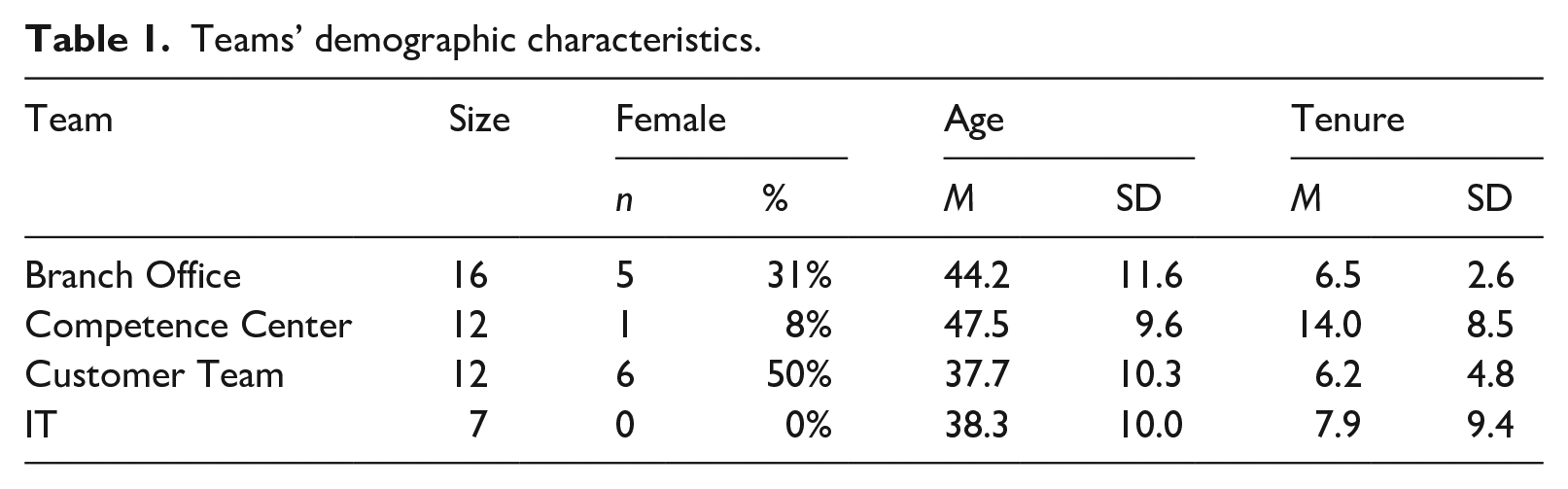
Branch Office
The Branch Office Team was chosen for our study because it resembles the historical division of labor at HHR and a corresponding leadership style based on full authority and residual decision rights for the branch manager. The Branch Office was established in 2009, when HHR signed on a new sales region for its main supplier. Job roles in the new Branch Office were designed according to the division of labor based on products and functions at the headquarters, which proved to be feasible. Over time, the team grew to 16 members, without changes to its division of labor and mainly adding new staff without turnover.
Competence Center
The Competence Center Team was chosen for our study because it was the first pilot team to try a new team-based work organization without a formal manager. The Competence Center had been established in 2011, when one of most senior employees was appointed to develop a team of experts as a knowledge base for technical problems. Accordingly, the team members are all experts in certain product technologies, which means they differ in their individual work histories and they are not able to fully substitute for each other. Team members work on their own in special tasks, but also collaborate in customer projects to complement each other in their expertise.
Customer Team
The Customer Team was chosen for our study because it was the second team designed to work without a formal manager, in 2018, and was still regarded as a pilot project at the time. While the Competence Center was installed in a new functional role for the organization, the Customer Team was the result of reorganizing former functional departments within the product divisions. Most of the team members had a work history in one of the former functional departments per product division, while other team members were recruited especially for the new team.
IT
The IT Team was chosen for our study because its work organization differs from those of the other teams. IT work at HHR is predominantly project based and organized through a ticketing system. Although its seven team members were hired to perform specific functions within IT, they can substitute for each other and handle day-to-day requests individually. However, two team members hold responsibility for HHR’s ERP-system, the others primarily work on software applications for various functional tasks (e.g. HR software, dispatching software, etc.).
Data collection
The present data were collected as part of a larger research project investigating the implementation of self-managing organizational models. Beginning with the owner announcing (in 2016) that he would implement a self-managing model of organization, we conducted 109 interviews (33, 29, 33, and 14 interviews per wave, respectively) with the owner, the department managers (some former), and selected team members (some previously department staff). Furthermore, the IT Team logged the firm’s email traffic and provided us with a 30- to 60-day log for each of the following observation times: before (2016), during (2017), and after the change (2019) and during the COVID-19 lockdown in spring 2020.
Emails are frequently used to study inter- and intra-organizational communication patterns (Grippa et al., 2006; Johnson et al., 2012; Kleinbaum and Stuart, 2014; Quintane and Kleinbaum, 2011). However, using emails for our analysis brings some strengths and weaknesses. First, analyzing email data allows the analysis of network structures and relationships between network members, such as work relationships (Ahuja and Carley, 1999; Borgatti et al., 2018). Moreover, other studies suggest that centrality analyses are particularly well suited for inferring relationships involving coordination (Dogan et al., 2015), interaction, advice seeking, or communication (Johnson et al., 2012). Nevertheless, communication can vary greatly depending on the medium used and also depends on other factors such as co-location or the type of task. According to Grippa et al. (2006), for example, working on the same project or in the same office tends to lead to the use of synchronous rather than asynchronous media. However, in the pandemic situation, asynchronous and spatially distributed work was the rule, making emails suitable for analyzing team communication. In conclusion, emails are suited for gaining insights into internal communication but are, of course, only one of many possible forms of communication media in an organization.
For the present study, we chose to compare the third and fourth email logs—that is, communications after the reorganization in 2019 and one year later during the COVID-19 lockdown in spring 2020. Moreover, and in line with our research questions, we focused on the email communications within the selected teams. The email logs contained data on the sender, recipient, date, and subject. It should be emphasized that we received information about whether the message was sent successfully but no data about the content of an email. This information was supplemented by information from human resources, such as employee sociodemographic data, similar log files for internal telephone connections, and general statistics on the use of internal video and chat platforms.
In terms of qualitative data, the contextual findings presented in this study are based primarily on the last 14 semi-structured interviews conducted in July 2020. First, we were able to interview at least one team member from all four teams. In two teams (the Customer and IT Team), we were able to interview two team members. Second, the perspective of top management on team communication was very important to us because we did not want to focus exclusively on self-reporting in our analyses. Therefore, we interviewed two top managers of the firm as well. Third, while former middle managers had lost their formal position, many of their former subordinates (now team members) described them as still being central in the third interview wave. Therefore, we also interviewed six (former) middle managers because they often have specific knowledge about the teams’ tasks and compositions that exceeds the knowledge of top management. Importantly, in July 2020, the (former) middle managers no longer had disciplinary authority over their former subordinates. All of the interviewees (especially team members) mentioned that daily business in the headquarters-based teams was self-organized and without orders from former middle managers. However, they still contacted their former managers because they wanted to use the knowledge of middle managers, who were experienced experts on extraordinary issues. On the contrary, the Branch Office Team consistently was reported to operate as managed by the branch manager.
The interviews lasted an average of 35 minutes, and the interview guide included blocks of questions about (a) business challenges in the context of the COVID-19 pandemic, (b) the importance of self-managing structures in the context of the crisis and crisis management, (c) changes in work organization involving reduced work hours and working remotely, and (d) the post-crisis outlook and the extent to which structures/processes that proved effective during the crisis should be continued after the crisis. The interviews were all recorded, and the recordings were transcribed.
While the focus was on email and interview data from the fourth wave, data collected prior to the COVID-19 pandemic allowed us to position the main organizational measures and subsequent findings on a timeline and in a broader context and enabled us to make conclusions as well as comparisons with interviewees’ statements unaffected by the crisis.
Methods
Without filtering the emails for duplicates, out-of-office notifications, loop emails (i.e. messages where one has CC’d themselves), or errors in the log file, our total sample was based on 14,989 emails. These emails were sent between members of the four teams during our observation windows (30 days each). We removed 773 emails that were not successfully received. After excluding emails to oneself (2,860), automatically sent emails (731), and emails about meetings and tasks (315), we checked for duplicates (3,626 cases filtered out by email address, subject line, and timestamp). The final sample comprised 6,684 emails as the basis of our network analysis (see Table 2 for our data cleansing). Finally, we merged this data set with the personnel data and then anonymized the resulting overall data set to protect employees’ privacy.
Data filtering for analysis.
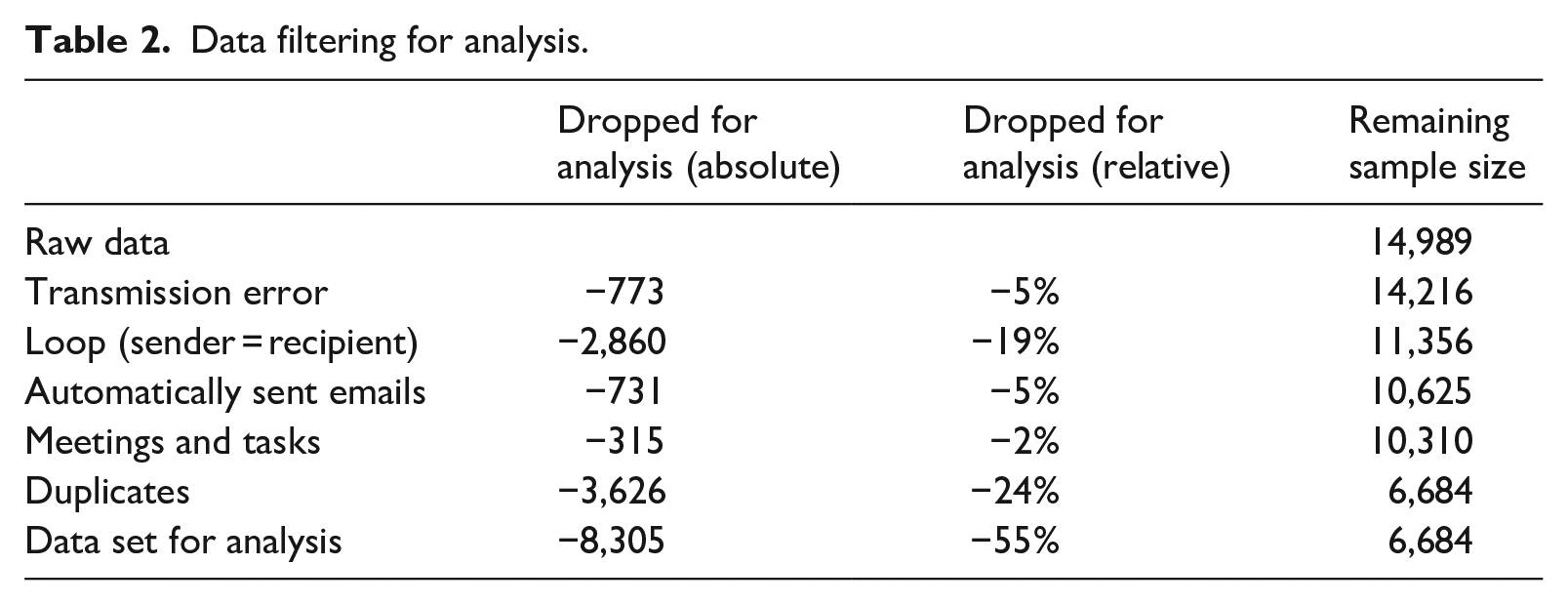
Then, we counted the numbers of messages between each sender and receiver and derived an edge list. We extracted four sub-networks and visualized each sub-network with different thresholds to qualitatively find patterns in communication. Furthermore, we calculated the following basic network measures for each team. First, density refers to the ratio between the realized and all theoretically possible ties between a network’s nodes. Second, reciprocity is calculated by the share of symmetrical ties in the maximum possible number of dyads at the network level (Wasserman and Faust, 1994). Third, degree in directed graphs, according to Freeman (1978), denotes the number of incoming (indegree) and outgoing (outdegree) ties of an actor. Fourth, betweenness centrality is another degree measure, which, in contrast to degree centrality, does not determine the communication activity but the potential communication role. For this purpose, the proportion of shortest paths between all actors that pass through actor i is determined. The value is zero if actor i does not lie on any of the shortest paths between two actors. Degree measures are also defined at the graph level to compare different networks (i.e. teams). In graph-level centralization, the difference of the measure (here: indegree, outdegree and betweenness) between each actor and the most central actor is summed and then divided by the theoretically largest inequality distribution (star structure, i.e. one actor has all ties to unrelated actors). We documented each step of how the data were prepared and analyzed using the statistical software program R (R Core Team, 2020).
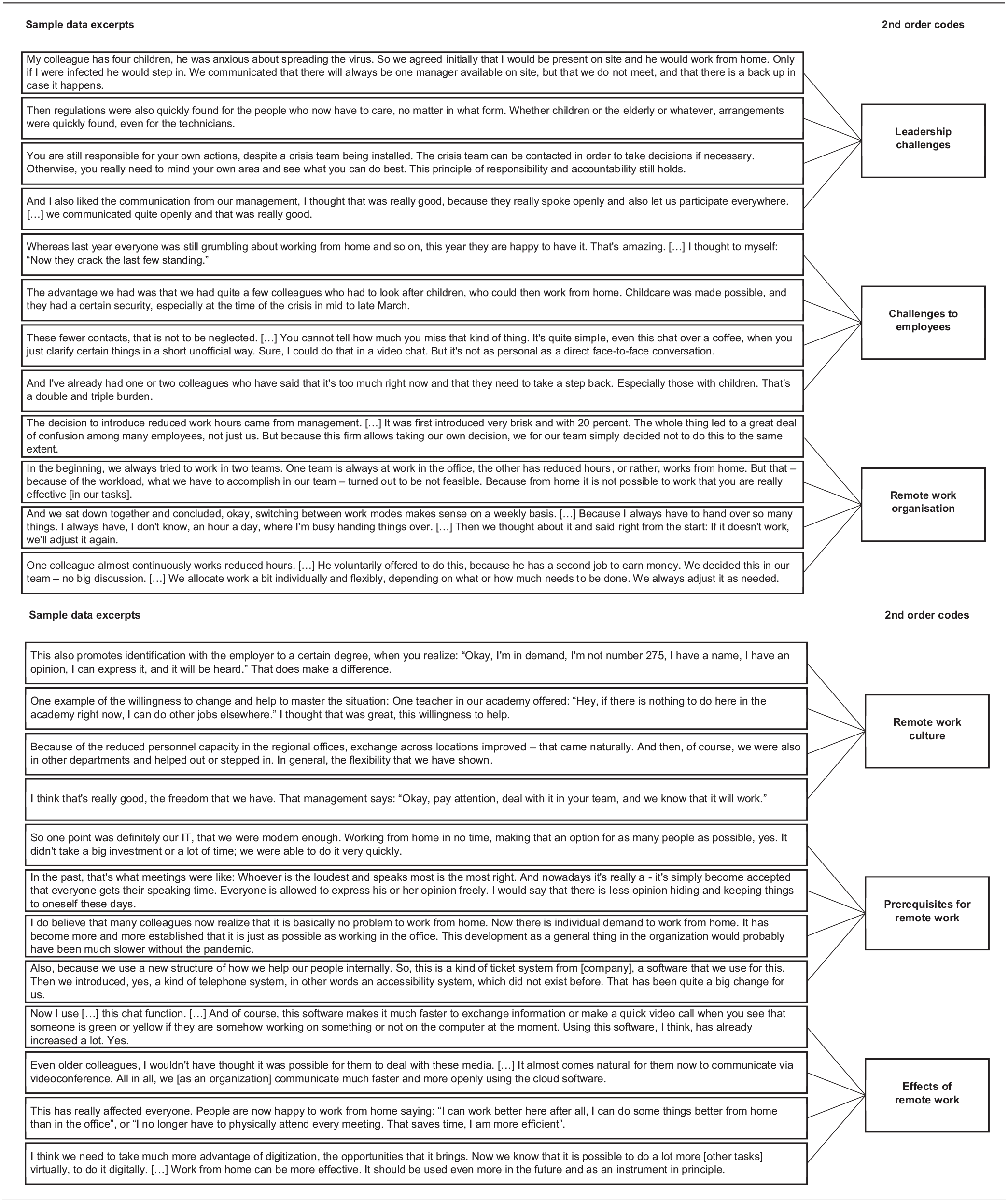
To analyze the interview data, we followed prior studies (Corley and Gioia, 2004; Pratt et al., 2006) and adapted the approach by Gioia et al. (2013). Consequently, we followed an inductive approach characterized by three steps. (1) First, all of the authors read the interviews to develop a shared understanding of the content. Then, the second author of this study inductively coded the 14 interviews collected during the COVID-19 lockdown (the second author was also involved in coding all of the other interviews collected prior to the COVID-19 lockdown). Thereafter, all of the authors discussed the coding scheme. In these discussions, we reduced and refined the first-order codes (see Kok et al., 2019, for a similar procedure). (2) The first coding scheme was explained in detail to a student research assistant, who independently coded all of the interviews according to the emergent coding scheme (see Figure 1). (3) The study authors and the student research assistant discussed the coding differences. Such differences occurred, for example, from the fact that while the author coded “challenges to work-life balance” more in terms of individual overload or extraordinary stress caused by the crisis, the student assistant assigned many text passages to this category much more generously. They often coded everyday burdens that characterize work in the firm into this category, even without the crisis. When discussing such differences, we always agreed on a narrower interpretation of the passage, largely resulting in consistent coding (about 90%). For presentation and interpretation, most first-order codes were summarized in six second-order codes and aggregated to challenges of crisis situation, remote work and contingencies for remote work as third-order codes. The coding scheme resulting from this process can be found in Figure 1, and coding examples for second-order codes are provided in Figure 2.
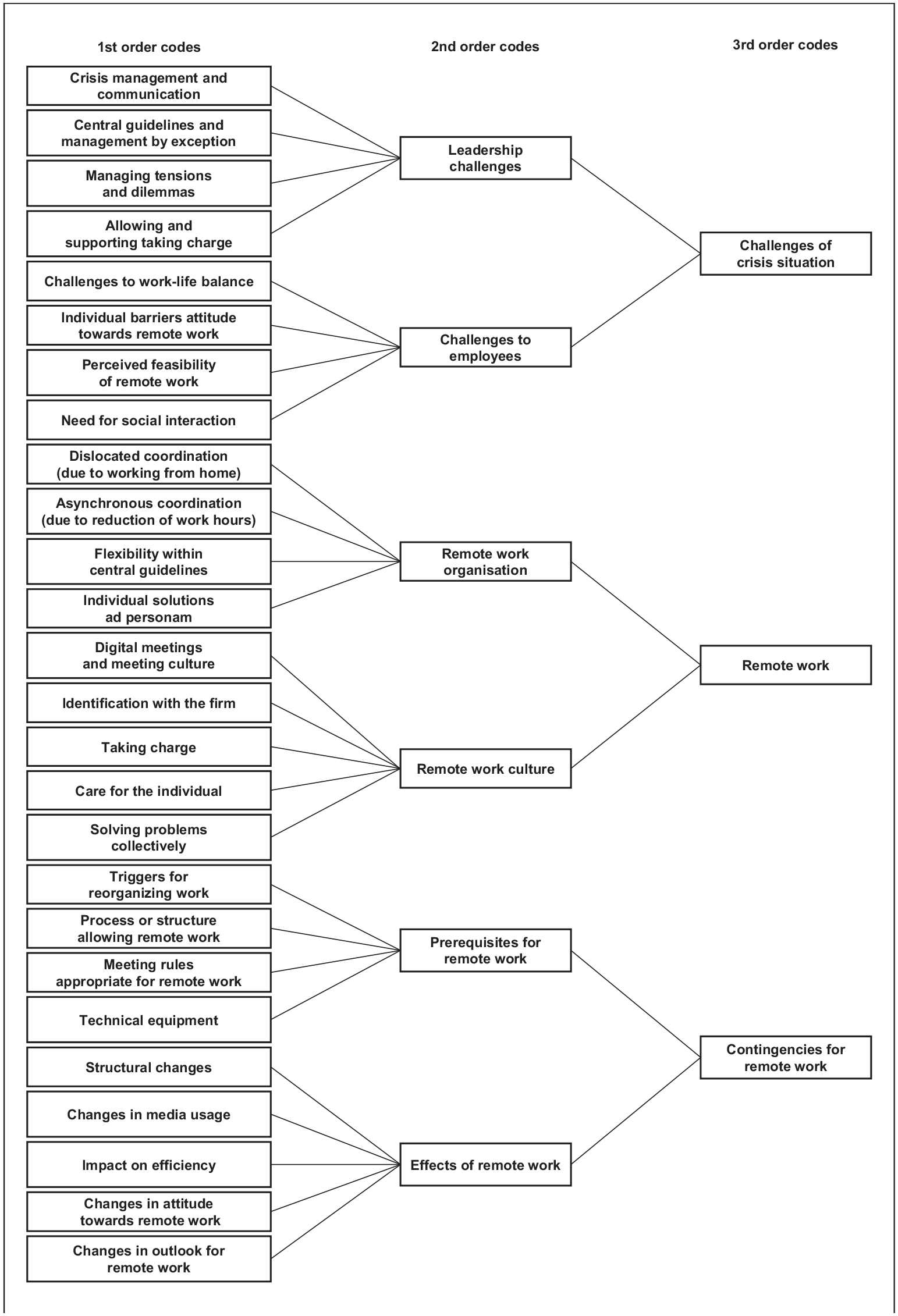
Coding scheme.
Coding examples.
Results
Our results section is divided into two parts. First, we focus on the consequences of the COVID-19 pandemic for the organization of work—that is, “the way tasks are organized and coordinated within the context of an overarching work system” (Cordery and Parker, 2007: 189). Even though our study focuses on teams’ communication behavior, this consideration seems highly important to us because the observed changes have an effect on communication. We then focus on how work-from-home arrangements affected teams’ communication, present changes in communication overall and for each team individually, and then analyze differences between teams based on contextual factors.
How COVID-19 changed the organization of work at HHR
The lockdown situation in Germany in spring 2020 affected HHR’s business development, work organization, and use of media and tools, and brought about both professional and personal challenges to employees. While the firm’s economic situation did not require immediate turnaround measures, the legal restrictions to fight the pandemic nevertheless brought about severe consequences for HHR.
First, as a reaction to the legal changes triggered by COVID-19, a crisis-management team was set up, which defined several rules and procedures for changes in work organization and remote work arrangements. (1) The operational teams were granted the discretion to take decisions how to meet challenges in their area at their own responsibility. (2) Differences in work organization between teams within the firm were explicitly allowed in order to meet different contextual requirements. (3) All areas of the firm were asked to work reduced hours unless full capacity was functionally necessary (e.g. the IT Team worked at full capacity). Other areas with mandatory customer interaction, such as for providing safety instructions for rental machinery, were adjusted in accordance with infection control regulations. The framework even allowed individual areas to decide independently which team members would work reduced work hours and to what extent, as long as daily business demands could be met. This flexible solution also made it possible, as soon as unequal workloads of individual employees became clear, to quickly balance them out by adjusting working hours and staffing.
We were given a lot of freedom and discretion; this is what we are used to. While the pandemic plan said to reduce work hours by 80%, we were still allowed to work longer as we saw fit. (Interview 12)
Second, COVID-19 also changed which communication media and tools teams used and how. The lack of co-location required most team members to work from home using IT-based communication tools. In addition to traditional remote-communication media, such as phone or email, media use shifted to an internal platform that unified chat, video calling, and file organization. The reduced-work-hour scheme was organized within each team using a software tool centrally provided by HR, and an intelligent telephone system was set up to route incoming calls based on availability. Unexpectedly, even older team members embraced the technological options provided and their benefits. Digital meetings and remote work have been part of daily operations since the first lockdown.
The software really makes a difference. It changes communication; people use it as an ad hoc messenger, similar to “App.” Yes, that is the way it is used. [. . .] You can start a video chat with a mouse click, with no need to pick up the phone. Both emails and phone calls went down in numbers. It just happened—people used it to their advantage. (Interview 12) The firm really helped with the change to working from home. In the old days, we mainly worked based on lists and forms. Everything was printed and filed away. And years later, you had to clean out the filing cabinet. Those processes are gone. Believe it or not, people are used to it now. I can take my laptop anywhere, connect, and be ready to work. All I need for my job is internet access—not a single sheet of paper required. Good stuff, isn’t it? (Interview 2)
Changes in team communication due to remote work arrangements
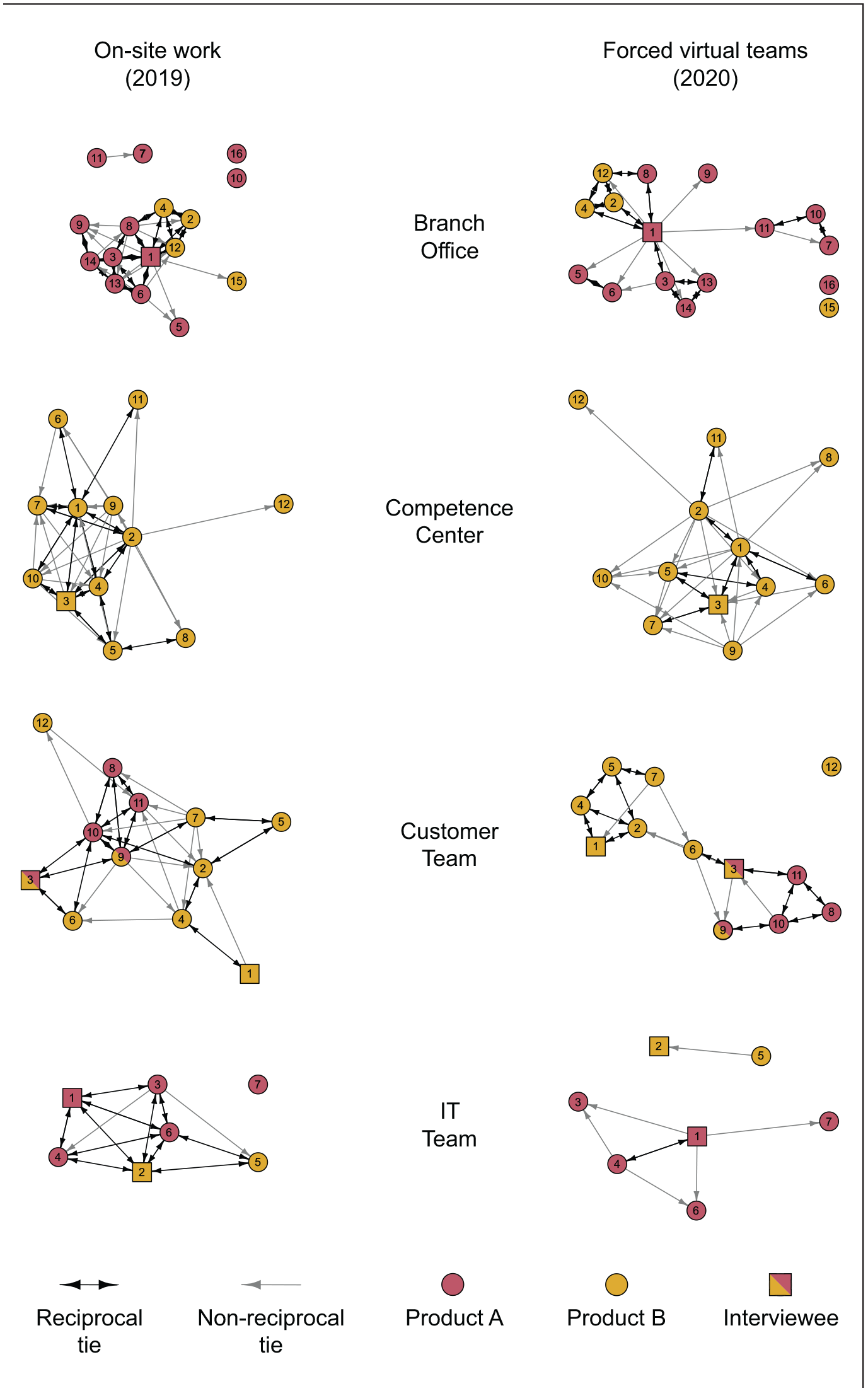
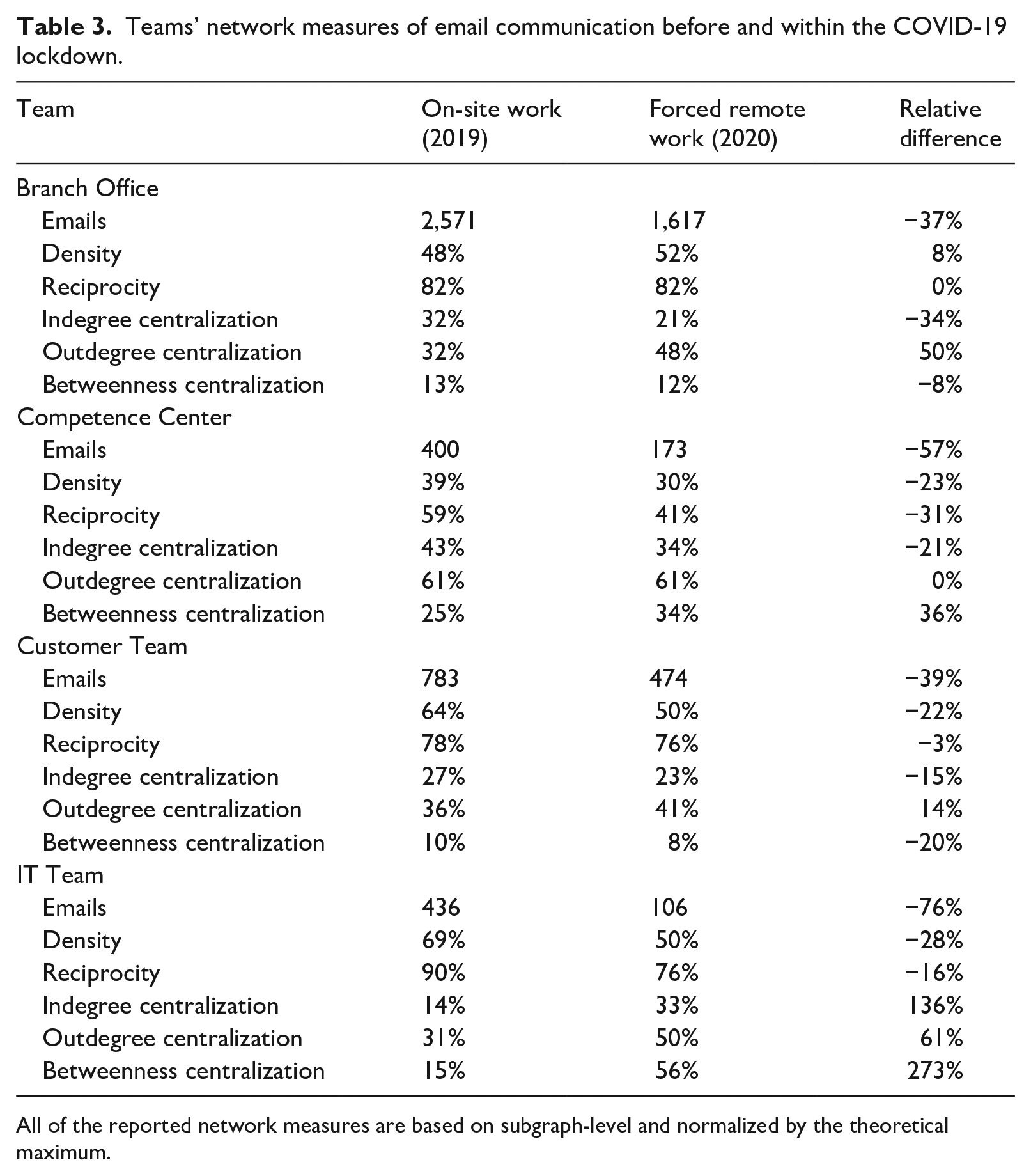
To better understand how communication in teams changed when switching from face-to-face to virtual interaction, we first checked for changes in email communication behavior. The quantitative findings of the social network analysis are presented in Table 3, where we calculated the network measures presented in the methods section for the four different teams. We distinguish between the measures of email communication networks within teams before and during the COVID-19 lockdown and show their relative differences. In addition, Figure 3 shows a visual representation of the network for each team and illustrates what the measures in Table 3 mean for each network. For clarity of the effects, we have filtered the networks in Figure 3 by using thresholds. However, the measures in Table 3 refer to networks without thresholds.
Teams’ network measures of email communication before and within the COVID-19 lockdown.
All of the reported network measures are based on subgraph-level and normalized by the theoretical maximum.
Email communication networks within teams before and during the COVID-19 lockdown (filtered for clarity reasons).
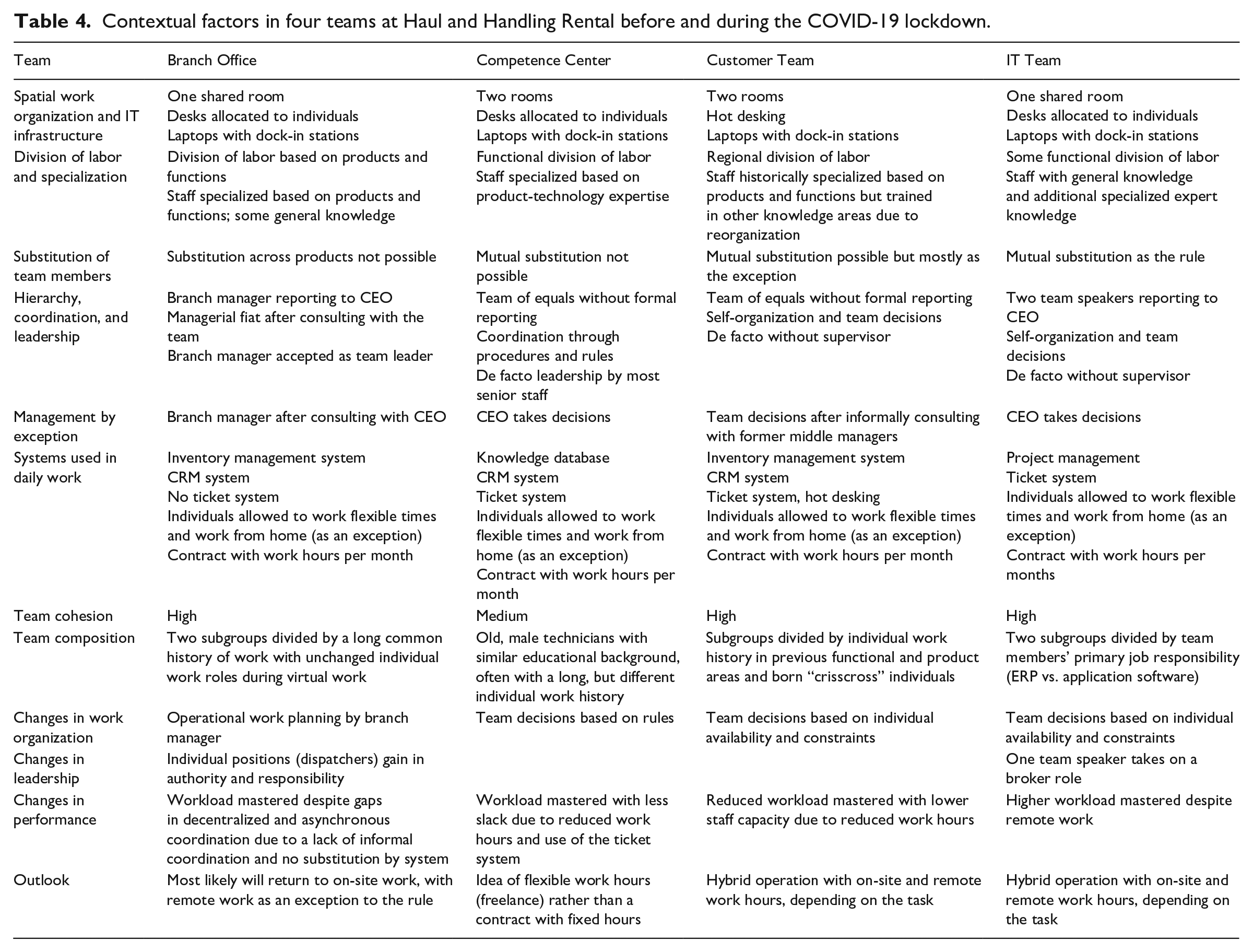
Findings show that the communication network in some teams changed more and in different ways than in other teams. First, the amount of communication via email decreased within all teams, albeit to varying degrees. Second, the team-communication structure changed noticeably in three teams, whereas in the fourth team, the Competence Center Team, email communication did not change in network structure albeit in volume (which may be the result of reduced work hours). The Competence Center Team was the only team without a faultline in its team composition. As shown in Figure 3, in the other three teams, faultlines not visible in on-site work mode became salient when the teams were forced to remote work mode. However, each of the three teams reacted differently to faultlines becoming salient. In order to find explanations for these differences between teams, we contextualize the above findings with interview data. Table 4 provides the core findings of our analysis and a comparison of the teams. In this overview we present contextual factors for example team composition, spatial work organization and IT infrastructure or the division of labor, summarize the changes in the work organization, leadership and performance and give an outlook whether remote work will prevail after the COVID-19 pandemic. Next, we explain our findings for each team in more detail.
Contextual factors in four teams at Haul and Handling Rental before and during the COVID-19 lockdown.
Team 1: Branch Office
For the Branch Office, the branch manager—contrary to the other teams—planned and scheduled the operational work time during the lockdown and reduced-work-hour scheme. Before the pandemic, team members were used to ad hoc “across the desk” coordination, which is possible in a shared room. As a result, team members in the Branch Office relied much more on this form of coordination and made less use of the technical tools available to them (as compared to the teams at headquarters). Some tools, such as the ticketing system, were even not used at all or were used sparingly. Working on-site (left visualization in Figure 3) some team members did not communicate with the other team members via email. These team members all have a sales service role in one product line that requires use of a specialized application software. When the team was forced to work from home during the lockdown, they had to coordinate across locations and working hours—a situation that team members in the Branch Office were not used to. This led to information losses and coordination problems new to team members, most of which could be solved by consulting the branch manager or using the technology provided. Furthermore, interview partners explained that the dispatchers in the team took on a role with higher responsibility in managing drivers and service personnel. Culturally, the team at the branch was characterized by a high level of group cohesion. This was further strengthened by the lockdown. Even the lorry drivers, who previously had been aware of being a bottleneck and capitalized on this, now followed the work schedule as planned by the branch manager not claiming special rights.
In one branch office, it was obvious they are back to “listen to the boss.” Up to last week, every Friday, he sends out his plan of who has to work when and where. For each function. [. . .] If I had to do this—oh my God. [. . .] I guess five years ago, I would have done exactly the same. Work to exhaustion. Managing, directing, giving orders—thinking I need to have everything in control. [. . .] The branch manager is like that. (Interview 7) A real challenge is information loss. [. . .] It is different sitting with three people in the same office talking across the table, passing on information the other person may need. Now, two of the three work from home, and the third one is on his own in the office. Sitting together makes life easier. On the other hand, I reckon 80% of the problems could be solved working from home. Thanks to the equipment that the firm provides, this is really good. (Interview 13)
In contrast to the other teams, the number of communication links in the team—and thus the network density, increased, while reciprocity did not change. The opposing trends in network centralities show that the number of incoming emails was more evenly distributed among team members than before the pandemic, while individual actors sent emails to many others in the network. The most obvious driver was the branch manager with his detailed operational planning, which also is reflected visually in the network (see member 1 in Figure 3). Clustering based on product areas is also evident here, but only when the network is relatively filtered. Moreover, the communication network shows that the branch manager acted as a broker, which he also confirmed in his interview. In forced remote work this brokering—most likely performed face-to-face in on-site work—became visible in the email communication structure in the non-reciprocal tie with team member 11.
Team 2: Competence Center
While the Competence Center Team formally operated without a supervisor, the interviews and network analyses showed that one person took informal leadership, both before and during the lockdown. In day-to-day business, the expert team members took decisions independently. Nevertheless, during the lockdown, interdependencies and social interaction resulted from a detailed joint work schedule (reduced work-hour scheme), which resulted from a team decision. As the other teams did, the Competence Center had good technical prerequisites for remote work due to its ticket system, connection to the telephone system, and mobile terminals. Due to disagreements and even power struggles regarding the department’s management in the past, the team’s group cohesion could be described as medium. Due to the initial technical and cultural conditions, this team—for which remote work previously had been a little-used alternative and exception to the rule—was able to maintain and even improve its performance. This is because slack—which inevitably occurs in groups of specialists working regular operating hours—was offset by the more flexible work organization during lockdown which allowed to avoid paid availability time.
Overall, members of the Competence Center wrote fewer emails to each other than members of the other teams did, regardless of the pandemic. During the lockdown, the density decreased like it did in the other teams. Contrary to the other teams, communication is also more one-sided, for example, emails among the team members are answered less during the pandemic (decline in reciprocity). Of the four teams analyzed, the Competence Center’s network had the highest centralization scores, both before and during the pandemic. Visually, team member 3—who was hired and promised to replace the former middle manager (team member 9) far before the organizational change—seemed to occupy a central position in the communication network. In line with this, team member 3 confirmed in an interview that he perceived himself as being more central than others are.
What was clearly more at the beginning were all these questions around covid. “What about reduced work hours? Can I stay at home if I have a child?” and so on. So a lot of people from my team came up to me and asked me. [. . .] So, during this whole crisis management [in the team] at the beginning of the covid crisis, [my] phone was ringing off the hook. (Interview 14)
Different from the other teams, the Competence Center Team of only male and comparatively old technical experts did not show a faultline. As team members had been used to work individually on specialized tasks prior to the lockdown there had been no need to change individual work organization when switching to remote work. Moreover, at the team level a ticket system allowed coordination across team members and their decoupled work time and work space. Besides, team members had joined the team at different time points and for different areas of expertise. New members were added to the Competence Center whenever management saw the need for a particular technological or product expertise to be centrally available. Hence, most of the team members complemented each other in their knowledge and responsibilities.
Team 3: Customer Team
The Customer Team is used to self-management and decision making without a supervisor or manager. This approach was retained after the lockdown and transferred to the digital level. This was possible because of the numerous communication tools—such as a ticket system, laptop computers, and an intelligent telephone system—that already had been available to each team member before the lockdown or were set up on short notice. Overall, the initial conditions regarding technical and organizational prerequisites had been well suited for remote work. Accordingly, the shift to remote work did not cause any problems in work routines.
The Customer Team was characterized by a high level of group cohesion. Team members worked together for many years in the previous functional departments and numerous team building measures as part of the reorganization process has taken place over the last years. This facilitated remote work because the team’s working methods and expectations were known to each other. However, while remote work was considered and used only as an exception to the rule before the crisis, this changed when the Customer Team was forced to work remotely. The team’s performance was inhibited only weakly during the lockdown, with one reason being the more flexible work organization allowing to balance uneven workloads between team members.
The Customer Team had been really, really well organized before the crisis. When it became clear that there would be a shutdown and some colleagues had family members to care for, it was not a problem to work from home and still find a solution to serve the customers. Access to data and telephone from a new place—business as usual. (Interview 6) In our team, we always plan the coming week. But if the plan is wrong and demand is too high, we simply ask around in our chat group: Who is available? People jump in for a day, sometimes just for a few hours. It always works out. (Interview 3)
During remote work, Customer Team members overall wrote fewer emails and had fewer contact partners via email. The density of the email network was lower during the lockdown as compared to when working in the office. Accordingly, fewer of the theoretically possible connections were realized. Other network metrics also dropped during the lockdown but less sharply. For example, network centralization values for outgoing emails showed a clear tendency toward more centralization because only a few team members had many contact partners during lockdown. Notably, team members during the lockdown preferred email contact with those who had the same functional background (homophily—former colleagues in the previous functional department), rather than across former organizational unit boundaries or with team members hired after the reorganization. It seems that team members’ work history represents a faultline that remained after the reorganization. In this situation, remote work conditions acted as a trigger for this historical faultline to become salient affecting team communication.
They split it up a bit. But we have now realized that it doesn’t make sense to make the [specialist for area A] the [specialist for area B]. That makes no sense. That has now remained separate. [. . .] The [specialists for area A] will not become [specialists for area B], and vice versa. (Interview 2)
In this context, the email-communication network shows that team member 6 in a remote work context took on a broker role by bridging a structural hole that had not existed before the lockdown. Furthermore, team member 3 has an individual work history with longer intervals in both product lines and team member 9 is a newly hired person that does not have an individual work history in one of the product lines. These two can be regarded “crisscrossing actors” (Mäs et al., 2013) linking the two subgroups divided by a work history faultline.
Team 4: IT Team
The technical conditions for the IT Team before the lockdown were very good, new tools were tested as the team saw fit. For example, the intelligent telephone system, which technically enabled fast call forwarding and mobile working with the landline number from headquarters, had already been tested with and implemented for one employee on a temporary work assignment abroad. The successful pilot project allowed existing experience with remote work to be leveraged and for the tool to be scaled up for enterprise-wide use starting with the lockdown.
The small IT Team (seven members) has a high level of group cohesion. The two team speakers (with no formal authority over other team members), in particular, are highly regarded as problem solvers throughout the firm. Remote work is a known work form for all of the team’s members but had been used in the past only as an exception to the rule. Working remotely as a routine practice was not considered a realistic alternative before the lockdown. Looking ahead, the IT Team will maintain hybrid operations with simultaneous on-site and remote work. Particularly at the beginning of the pandemic, the IT Team had seen a heavy workload but was able to manage it well, without any major loss of efficiency. Overall, this team faced only minor changes in work organization and in technical and cultural requirements.
If a request cannot be handled [. . .], I call my expert colleague on his mobile phone—we help each other. We are able to log on remotely any time. [. . .] We are no nerds, with each of us only able to work on one theme, one for clients, one for network, one for security. That is not how we work. We are generalists with some special expertise. We are able to substitute for each other or to complement the teammate with special expertise when needed. (Interview 12) We are used to working autonomously without a manager. We take initiative and deliver. That turned out to be an advantage—we did not have to wait for orders or permission. [. . .] In our team, most things just happen; problems are solved. There is no need to coordinate or to adjust. (Interview 4)
For the IT Team, the network analysis showed that before the pandemic, almost every team member had email contact with almost all of the other team members (69%). During the lockdown, the density in the network dropped by a quarter. Furthermore, it is particularly striking that both indegree and outdegree centralization increased sharply. Accordingly, individual actors became massively more important in communication: they received emails from and/or wrote emails to many different team members much more than others in the team did. Filtering the network (Figure 3) revealed that the choice of communication partners aligned with individual team members’ primary job responsibility for the ERP-system or application software. As in the Customer Team and the Branch Office Team, a faultline in the IT Team became salient in the email communication network in remote working conditions.
We are two teams in IT. One is the [A] team with [team leader A], and then, we have the [B] team with me [team leader B] [. . .] And these teams stick together. (Interview 4)
Nevertheless, as one of the IT Team members explained in the interview, it is quite likely that the email communication network does not represent the full communication structure in the team. In addition to the faultline opening up, we observed that one of the team speakers (team member 1) came to occupy an important broker position in the network. The increased values of betweenness centrality also indicate that several actors in the network brokered between other actors. Like the Customer Team, an individual team member changed their email communication behavior in order to close structural holes that otherwise may have deteriorated team processes and team performance. While we cannot say with absolute certainty whether he exhibited this broker role on purpose, we experienced team member 1 as a very well-respected employee, both on and off the team. It seems plausible that requests outside the team were more likely to come to him and that he distributed them within the team. Furthermore, both team speakers told in the interviews that they frequently called each other on their private mobile phones and they highly identify with the IT team.
Discussion
Virtual team coordination and collaboration gained increasing importance in recent years (Raghuram et al., 2019) and experienced a real boom due to the COVID-19 pandemic. The pandemic was particularly challenging for communication in teams that had previously interacted extensively or even exclusively face-to-face. In our study, we examined four such teams. In line with prior research, our findings confirm the importance of the availability of technology both at home and in the organization, a separate workplace at home (Felstead and Jewson, 2000; Phizacklea and Wolkowitz, 1995), individuals’ virtual competence (Wang and Haggerty, 2011), supervisor support and corporate culture for virtual team performance (Allen et al., 2015; Hoch and Kozlowski, 2014; Lautsch et al., 2009). Moreover, our findings support studies on faultlines with respect to effects on team communication (Marlow et al., 2018), team composition, team cohesion, and identification with the team (Bezrukova et al., 2009). Finally, our study adds to prior research on virtual teams (Bell and Kozlowski, 2002; Kirkman and Mathieu, 2005; Martins et al., 2004) and teams that become virtual by offering a comprehensive overview of factors at the organizational level, team level, and individual level that affect team communication and performance. We will focus the subsequent discussion on these new insights summarized in the research model provided by Figure 4.
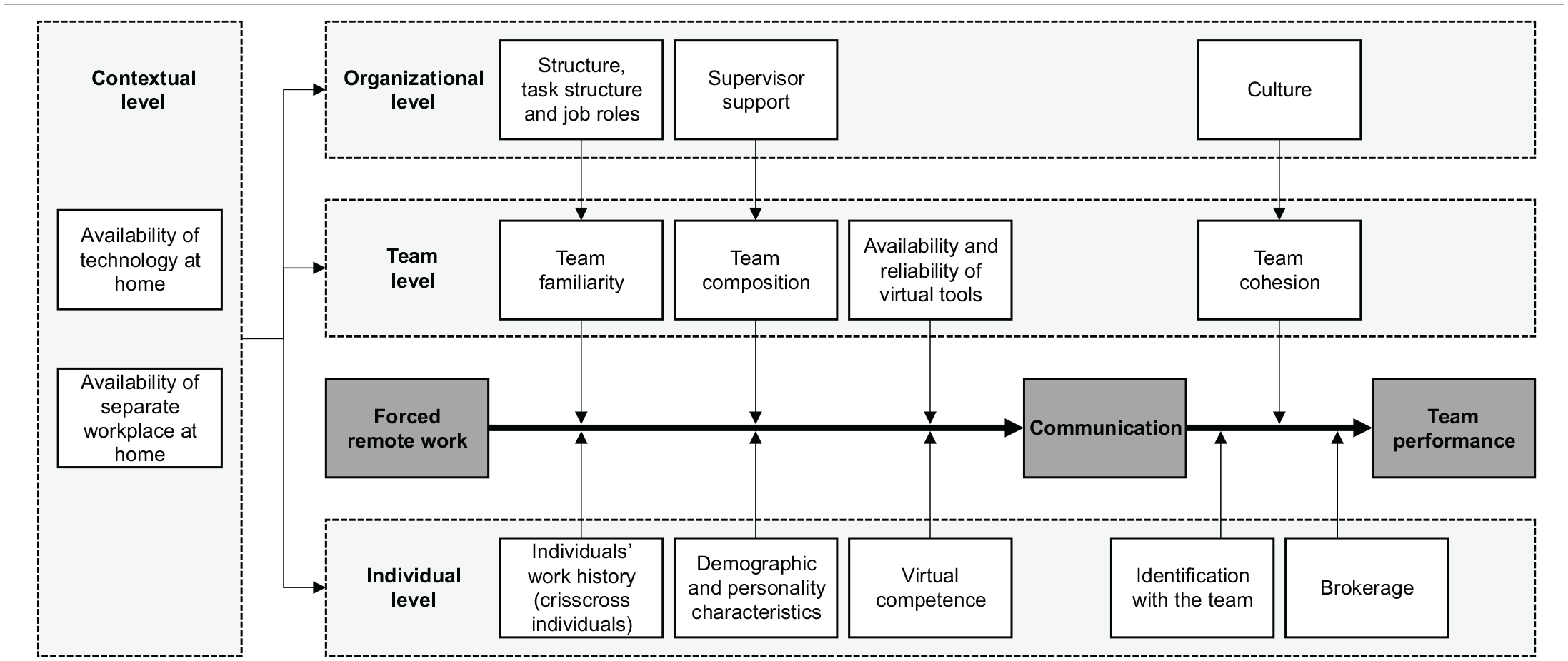
Research model for forced remote work and its effect on team communication.
Structure, task structure, and job roles
Before the pandemic our case study firm HHR had completed a reorganization toward more loosely coupled self-managing units with more or less closed tasks, and decentralized decision making, shifting authority from management to the operational units. Our results across the four teams suggest that this form of organizational structure with corresponding task structures and job roles helped tremendously to switch successfully from on-site to remote work mode. Comparing the Customer Team and the Branch Office Team, the organizational design in the Branch Office Team resulted in challenges when switching to virtual work mode that the Customer Team did not face.
The decentralized decision making that HHR had implemented was continued during the lockdown period and the discretion given to the operational units in the pandemic plan. Each team had discretion to decide among themselves who should be working and how long, when, and where. HHR also benefited from having its employees trained in so-called sociocratic principles (Endenburg, 1998), which apply to meetings and decision-making in teams. This allowed team members to balance work demands individually and collectively (team level) against competing commitments, such as care for children or family members (Kegan and Lahey, 2001), that became more prominent during the lockdown. The cultural change toward more self-responsibility initiated by the owner in 2016 had taken effect and added to the favorable initial conditions when the teams were forced to go virtual. According to our observations and the interviewees, the flat hierarchy and self-managing processes along with a culture supporting self-responsibility enabled the firm to practice flexible and decentralized crisis management.
When asked about competition and other distributors of the same equipment, our interview partners suggested that HHR did much better during the COVID-19 lockdown because of its structure in combination with its self-responsible culture and supporting technical tools and equipment such as laptop computers, ticket system, call routing system, collaborative software, etc. All this infrastructure had been in place before it became a fundamental requirement for remote work. While not all teams had used this infrastructure to the full extend when working on-site, employees used it to their advantage when forced to work from home. When benefiting personally from the combination of structure, job role, and tools, most employees changed their attitude regarding the owner driven change toward more self-responsibility and were now more positive about the change than in in their respective interviews before the change. This further enhanced the cultural change.
Another insight regarding the effect of structure and task structure results from studying the Competence Center Team and the IT Team members with main responsibility application software. Job roles for these team members are expert roles complementing each other in projects, but outside project work they share only limited task interdependencies with other team members of their organizational unit. Furthermore, availability time is a key issue for capacity planning and staffing in teams of experts. While one could argue that this deviates from a constitutive characteristic of a team (Mathieu et al., 2008), this form of “team” is a well known structure for expert job roles, especially in consulting firms. Comparing the four teams, our results suggest that these structures and complementing job roles are better suited for remote work than team designs with a division of labor based on functions and capacity as observed in the Branch Office Team.
Team composition, individual work histories and brokerage to bridge faultlines
Within the research on team communication and performance (Martins et al., 2004), our study takes a first step to show the consequential combination of team composition and individual work history. From the four teams in our study, the Customer Team showed that remote work is more easily achievable when team members are able to fully substitute for each other. While it also requires a certain type of structure, task structure, and job roles, a team composition favorable for team communication and performance can be achieved either because of individual work histories (two team members having worked in both divisions before the reorganization) or special training (newly hired team members). Furthermore, our study demonstrated faultlines not visible in the email communication network when working on-site may take effect when working from home. While it may be inevitable that faultlines become salient, crisscrossing individuals can act as linking pins if team composition accounts for it. In this context, our model (Figure 4) shows how both team composition and individual work histories moderate the effects of forced remote work on team communication and performance (Figure 4).
In three of the four teams in our study faultlines became salient, as can be seen in the communication network visualizations (see Figure 3). We argue that one measure against faultlines is a homogeneous team composition as seen in the Competence Center Team. Almost all team members show the same demographic attributes. Such homophily (McPherson et al., 2001) helps to sustain communication in remote work mode. High homophily among team members may bring about other effects (Ertug et al., 2022), but in our study it helped the team to successfully switch to remote work without negative performance effects due to faultlines.
As known from team faultline research (Bezrukova et al., 2009) team familiarity helps to mitigate negative effects of faultlines. This can be taken into account when composing a team. Furthermore, long tenure in a team typically leads to higher identification with the team. We argue that high team identification in combination with felt responsibility (Morrison and Phelps, 1999) led to some team members taking on brokering roles (Halevy et al., 2019). Brokerage then helped to sustain communication across faultlines which otherwise could have negatively affected team performance. When forcing teams to go virtual it is advantageous to know about team members identification with the team and their felt responsibility. Even if one cannot take measures against communication gaps in the short run, knowing these factors helps to assess the likelihood of team members taking on brokering roles.
Limitations and future research
Our study has some limitations, which at the same time can be seen as opportunities for future research. First, despite our contextual data and the number of interviews, we cannot eliminate remaining unobserved aspects. Email communication represents only a subset of all communication, and our data only covers 30-day intervals as snapshots in time. Possibly, our network representations and the subsequent qualitative analysis do not display each team’s full communication network. To reduce this limitation, we tried to collect additional employee telephone and chat data at the beginning of our study. However, for technical reasons, such a collection was not systematically possible. However, to address this limitation to some extent, we compared the telephone data for each employee with the email data prior to the pandemic and found support for our findings—even if the communication intensity differs between the two communication media in absolute terms. Therefore, we assume that the use of email data did not lead to a major bias in our study results. Second, the email data and the interviews for the remote work mode stem from the first lockdown in Germany during spring 2020. The findings may suffer from a “first time” bias; it was the first lockdown experienced by team members. Hence, as time passes and employees become accustomed to remote work, employees may change their attitudes and behave differently. Third, team members may only bear social distancing and infrequent social interaction for a limited period, and in the end, the observed positive effects of remote work organization may not last.
Despite these limitations, our study delivered interesting insights on forced virtual teams that future research may explore. Especially, quantitative analyses are required to test how far the new effects of remote work on team communication found in this study may be generalizable. Besides technical, organizational, and cultural prerequisites, factors at the contextual, organizational, team, and individual level were identified. Besides structure and job roles especially team composition and team member attributes turned out to be highly important for changes in team members’ communication behavior in our study. Our results indicate that remote work may be a trigger for faultlines to open up that remained unobserved or did not impact team performance in an on-site work mode. Only when individual team members realize changes in communication behavior and take on a broker role does this not affect team performance. However, this finding needs a more refined analysis and different research settings are required in order to proof robustness and generalizability of findings. Furthermore, to shed more light on our notion of remote work as a trigger for faultlines opening up, future research should take into account both team composition and team members individual attributes in more comprehensive ways, for example, by analyzing the complete job history and individuals’ private life. Moreover, since all team members analyzed developed their team relationships face-to-face before the lockdown, we encourage further research to analyze teams with different preconditions, where it might be more difficult to build personal relationships based on online communication only.
Conclusion
The COVID-19 pandemic context is central to our study, as this situation created the observed pressures for the firm and the teams to make communication and interaction virtual. Research on the immediate effects of the pandemic and the attempts to predict the long-term consequences currently dominate research. Our study certainly connects to this stream of research. At the same time, our research setting of the decoupling of work force, work time, and work space is a phenomenon that has been increasing for years and is central to many studies in management and sociology. The COVID-19 pandemic has functioned as an accelerator, although the findings of our study can represent a variety of teams and their (future) form of work organization.
