




Abstract
In-depth interviews with IT employees (N = 84) working under two types of work design—a post-bureaucratic work design labeled “agile,” and a bureaucratic work design labeled “waterfall”—are used to examine gendered patterns in the adoption of remote work. Interviews reveal an unintended consequence of the agile model: It promotes a physical orientation that induces on-site work. Agile is gender-inegalitarian, with more women than men working remotely despite its perceived unacceptability, and low numbers of employees working remotely overall. By contrast, workers within a waterfall work design express a digital orientation to work and feel empowered to work remotely. The waterfall model is associated with gender egalitarianism; most employees opt to work remotely, and men and women do so in even numbers. Findings suggest that when compared to the post-bureaucratic work design, the bureaucratic work design provides more flexibility. This article refines our understanding of barriers to remote work and provides a lens on the gender dynamics underlying work design.
With more employees living in dual income households and facing the need to negotiate care responsibilities, flexible work policies such as remote work have become a priority in the workplace. Access to remote work is also an important lever for improving gender equality in organizations; research finds that job advertisements highlighting workplace flexibility bring in 20% more women applicants (Hacohen et al. 2020). Offering remote work options in STEM fields (i.e., science, technology, engineering, and mathematics), in which women are underrepresented, may be even more important for organizations concerned with increasing women’s recruitment and retention. Despite workers’ desire for remote work, it is perceived by many as a stigmatized practice. Because most societies continue to associate mothering with unpaid work, flexible work policies that help workers accommodate household labor are deemed more acceptable for women than for men (Padavic, Ely, and Reid 2020). Bias toward remote work is steeped in gendered workplace cultures, and the social context of work groups matters for the extent to which employees are buffered from negative consequences (Blair-Loy and Wharton 2002; Berg, Bosch, and Charest 2014; Golden and Eddleston 2020).
More recently, scholars have turned their attention to examining the wider social context in which these biases are generated, and which may in turn encourage or prevent the use of remote work arrangements. Work design plays an important role in mediating biases and facilitating the use of flexible work policies (Briscoe 2006, 2007; Perlow and Kelly 2014; Gonsalves 2020; Kelly and Moen 2020). This small but burgeoning group of studies is confined to traditionally bureaucratic work environments; through such mechanisms as hand-off procedures, employees in traditional work settings are empowered to use the flexible arrangements offered by employers. But what of post-bureaucratic work contexts? Post-bureaucratic work design is characterized by flattened hierarchies, consensus building, fluid decision-making processes, and an expectation of change (Hodgson 2004). Given that work design matters for whether unequal outcomes are alleviated or exacerbated (Grant and Parker 2009; Kalev 2009; Parker, Van den Broeck, and Holman 2017), we can expect it to matter for the adoption and use of remote work, which itself is a lever designed to improve work–life balance.
Post-bureaucratic forms of organizing promote worker autonomy (Appelbaum et al. 2000), which may empower employees to decide for themselves where and how they work. Post-bureaucratic organizing also promotes worker interdependency (Heckscher and Donnellon 1994; Vallas 2003), however, which may make remote work more difficult compared to on-site work. In addition, post-bureaucratic forms of organizing hold implications for gender equality. The simultaneous emphasis on teamwork and consensus building, coupled with the increasingly individualized imperative to manage one’s career progression, disadvantages women (Williams, Muller, and Kilanski 2012). These disparate lines of inquiry concerning the role of post-bureaucratic work design—its role in facilitating or hindering the use of remote work arrangements as well as its role in mediating gender inequality—motivate the present study. Drawing on interviews with 84 employees in the information technology (IT) division of a financial services firm, I compare how two types of work design—a traditionally bureaucratic work design designated “waterfall,” and a post-bureaucratic work design designated “agile”—relate to employees’ remote work uptake.
While agile facilitates the kind of worker agency we might expect to see in post-bureaucratic forms of work design, my findings shed light on an unintended consequence of agile: It promotes a physical orientation to work that induces members to work on-site. Agile work is also gender-inegalitarian, with more women than men working remotely despite the practice’s perceived unacceptability and low numbers of employees overall choosing to work remotely. By contrast, those within the more traditionally bureaucratic waterfall work design express a digital orientation to work and feel empowered to work remotely. Waterfall design is associated with gender egalitarianism; most waterfall workers opt to work remotely, and men and women do so in relatively even numbers. These findings suggest that, ironically, organizational systems with traditional bureaucratic work practices can be more empowering and flexible for the people within them compared to organizational systems that are traditionally less bureaucratic (Briscoe 2007). This outcome, and attention to work design configurations more broadly, offers a refinement to our understanding of barriers to remote work arrangements, as well as a lens on gender dynamics that underlie work design.
Remote Work, Work Design, and Gendered Organizations
Although evidence regarding the benefits of remote work is mixed (Schieman and Young 2010; Noonan and Glass 2012; Chung 2020), employees continue to seek these perceived benefits (Cain-Miller and Yar 2019). In addition to examining the role of stigma and managerial bias (Blair-Loy and Wharton 2002; Kelly, Ammons, Chermack, and Moen 2010; Cech and Blair-Loy 2014; Munsch, Ridgeway, and Williams 2014; Wynn and Rao 2020), recent scholarship has converged on how work design affects flexibility. This line of inquiry is increasingly important during the COVID-19 pandemic, during which privileged white-collar workers are compelled to work remotely regardless of individual preference or managerial bias. In this context, work design is a main determinant of whether remote workers will be readily equipped to work off-site.
Core characteristics of work shape the temporal dimensions of workers’ lives (Kunda and Barley 2001; Briscoe 2006, 2007; Grant and Parker 2009; Parker et al. 2017). Beyond the role of managerial bias, policies, practices, and procedures—the suite of activities composing work design—may also challenge expectations about how and where work needs to occur (Briscoe 2006, 2007; Kelly et al. 2010; Kelly, Moen, and Tranby 2011; Moen, Kelly, and Hill 2011; Moen, Fan, and Kelly 2013; Perlow and Kelly 2014).
Kelly, Moen, and colleagues examined a work design intervention labeled ROWE (Results Only Work Environment) that decrees employees should be “free to do whatever they want, whenever they want, as long as the work gets done” (Perlow and Kelly 2014: 117). ROWE consists of participatory sessions in which employees and management are taught that they will be more focused and efficient if they feel in control of their schedule. It is framed as a practice to encourage productivity rather than a practice whose primary aim is to encourage remote work or diminish gender inequality per se (Perlow and Kelly 2014; Kelly and Moen 2020). Participants in the ROWE work design experienced an increase in schedule flexibility and a decrease in work–family conflict (Kelly et al. 2011), decreases in turnover (Moen et al. 2011), and improvements in health (Moen et al. 2011; Moen et al. 2013). 1
A study of primary care physicians found that doctors were able to achieve flexibility in their work schedules through the work design practice of well-governed patient hand-offs (Briscoe 2006, 2007). Hand-offs were most effective when patient expectations about care were managed, clinical protocols were standardized, and record-keeping systems were codified to help with knowledge transfer. The work design of physical space also influences the use of remote work (Gonsalves 2020); notably, the transition from assigned cubicles to unassigned common workspaces makes it easier for employees to work remotely because it disrupts taken-for-granted greeting and noticing practices. In sum, work design can play a critical role in facilitating the use of remote work arrangements, often despite perceived stigma and biases.
The aforementioned studies focused on bureaucratic work design interventions within traditional work contexts: The design interventions introduced uphold hierarchical reporting structures, siloed work roles, and decision-making based on authority. Indeed, Briscoe (2007) argued that it is the very presence of bureaucratic organizational processes that facilitates temporal flexibility. In recent decades, however, many traditional organizations have introduced changes to work design that upend such practices, including post-bureaucratic work designs (Appelbaum et al. 2000; Osterman 2000). The post-bureaucratic organization is an “ideal type,” conceptualized in the literature as a compendium of practices that may collectively constitute a type of work design. Post-bureaucratic ways of working differ from widely institutionalized bureaucratic ways of organizing (i.e., a clear hierarchy, sequential work processes governed by explicit rules, and a decision-making process inscribed in official record). Post-bureaucracy may include flattened hierarchies, decentralized control, project-based work accomplished by temporary teams of employees and/or consultants, lateral career growth, more varied forms of communication, fluid decision-making, and an expectation of change (Heckscher and Donnellon 1994; Hodgson 2004).
Contemporary workplaces are increasingly characterized by some degree of post-bureaucratic, team-based, and networked production activities (Castells 2000). The spatial and temporal boundaries of work and non-work are increasingly blurred for a large segment of white-collar workers within ever-demanding and “greedy” institutions (Sullivan 2014: 1; see also Correll, Kelly, O’Connor, and Williams 2014; Kelly and Moen 2020). In this context, the social organization of teamwork and the introduction of flattened decision-making hierarchies help workers renegotiate the boundaries of managerial authority (Heckscher and Donnellon 1994; Vallas 2003) and reduce job segregation along lines of race and gender (Kalev 2009). Although post-bureaucratic forms of work design may be empowering under certain conditions, research has not attended to how they align with remote work arrangements. On the one hand, we might expect employee empowerment to include decision-making control over schedules, enabling employees to choose where they work. On the other hand, post-bureaucratic organizations promote team interdependency and solidarity (Vallas 2003), and the more reliant one is on co-workers, the more likely one may be to work on-site to better facilitate trust.
Another important consideration regarding the interface of post-bureaucracy and remote work is gender; as ways of organizing the workplace change, so too does gender become inscribed in new and potentially damaging ways. For example, research finds that women are less likely to assert their contributions in post-bureaucratic team settings and may be disadvantaged by having less-connected professional networks (Williams, Muller, and Kilanski 2012; Mickey 2019). This is especially the case in technology sectors, which tend to be highly masculinized (Cooper 2000). Indeed, despite a growing awareness of gender inequities in STEM fields more broadly, traditional understandings of gender roles in IT sectors persist (Alegria 2019), and gendered barriers are perceived as anecdotal events undeserving of structural change (Wynn 2020).
The work designs analyzed in the present study, agile and waterfall, are processes through which gendered contexts of IT work unfold. Waterfall work design originated in the aerospace and manufacturing industries in the 1970s and is imprinted with traditionally bureaucratic practices including centralized managerial control, hierarchical decision-making, a rule-based division of roles and duties, and sequential project rollouts (Ruël, Bondarouk, and Smink 2010). By contrast, agile work design originated in the early 2000s as an alternative to waterfall, which was increasingly perceived by technology workers as too rigid and inflexible (Mahadevan, Kettinger, and Meservy 2015). The agile model is an iteration of post-bureaucracy because of its emphasis on rapid change, teamwork, flattened hierarchies, decentralized decision-making, and temporary, project-based work (Hodgson and Briand 2013). Agile was popularized in Silicon Valley, where it is not uncommon for organizational cultures to valorize “ideal worker” status competitions, including putting in long hours at the office (Cooper 2000; Williams 2010). At the same time, the flattened hierarchies that are a common feature of agile methodology increase worker control over output, and we might expect this to extend to working conditions, too (see, e.g., Turco 2016).
More inquiry is needed into how post-bureaucratic work design influences the social characteristics of work and the gendered use of remote work arrangements (Grant and Parker 2009). The present study thus compares the agile post-bureaucratic form of work design with the more traditionally bureaucratic form of waterfall work design. While working long hours is a feature of work life in Silicon Valley, by examining two distinct work designs within the same company and region, I can more closely attend to whether differences in remote work usage rates are mediated by work design.
Setting: Work Design at MetroTech
Bureaucratic Work Design: Waterfall
The data for this study consist of interviews with employees working in IT at “MetroTech,” a large multinational financial services corporation with more than 50,000 employees worldwide. 2 The majority of MetroTech IT employees work in a standard bureaucratic setting maintained through the waterfall method of project management. This style of work design aligns with stereotypical images of office life in a large, white-collar organization. It is a sequential approach to project management consisting of several discrete phases, and a new phase does not begin until the previous phase has ended. Managerial control is hierarchical, and instead of being located with employees from disparate divisions, employees work alongside others with similar roles. Waterfall is most often used when the IT requirements for a given project are well-known, and outcomes are predictable (Mahadevan et al. 2015).
As practiced at MetroTech, waterfall work teams are “siloed,” or segmented by role and function. Decision-making is hierarchical, and managerial authority drives workplace processes and outcomes. Online documentation of practices and procedures is conducted as a matter of routine, and the work that takes place is typically “heads down” and computer-centered. Because of its emphasis on documentation and solitary thinking-work, traditional bureaucratic work design maintains the importance of intellective skills, which are more easily transportable and less reliant on physical proximity to co-workers.
Post-Bureaucratic Work Design: Agile
While the interviews were taking place, MetroTech was transitioning from a “financial services firm that does technology” to a “technology firm that does financial services.” As part of this transition, MetroTech had innovated their technology division by introducing an “agile methodology” work system, the goal of which is to make work more efficient and responsive to the needs of end users. Under the agile method of production, efficiency is sought through the practice of four core values: 1) individuals and interactions over processes and tools; 2) software over documentation; 3) customer collaboration over contract negotiation; and 4) responding to changes over following a plan (Agile Alliance 2001; Nikolic and Gledic 2013). In following these values, agile practitioners believe workers avoid getting bogged down in red tape, increase productivity, and are more responsive to clients. Other benefits include reducing time-to-market, increasing product quality, and increasing worker morale (Laanti, Salo, and Abrahamsson 2011). Agile is most often used when the IT requirements are less clear, or when end-users/clients are uncertain about what the final product of a given project should be. Instead of having one final goal or output in mind, agile teams work in sprints—short increments of time with small, fixed goals—to inform the development of a final product. While the practical implementation of agile values will vary from place to place, prioritizing individuals and interactions over processes and tools, software over documentation, and responding to change were particularly salient at MetroTech.
The person overseeing the agile team is called a scrum master; they fulfill a similar function to line managers or forepersons in that they are responsible for scheduling, keeping teams on track, and facilitating daily stand-up meetings—so named because workers remain standing in order to keep the meeting brief—in which people set goals and celebrate milestones. Leadership from scrum masters is more amenable to employee feedback, and work in general is less structured to prioritize shared decision-making and the execution of working software, however imperfect.
Agile principles dictate that teams are self-organizing. Leadership roles within the team are not fixed, and roles change depending on the needs of the sprint. As such, the scrum master is typically more of a coordination role rather than a leadership role (Cervone 2011). As practiced at MetroTech, the scrum masters hold slightly more authority, at least when it pertains to controlling employees’ schedules. Whereas managers have the power to decide whether employees are granted the right to work remotely under waterfall work design, on agile teams that authority is conferred to scrum masters.
According to the workers I interviewed, they had little control over what project management style was used: Employees could not choose to work in either waterfall or agile, but were instead assigned onto teams. In addition, four participants indicated that their unit was in the process of transitioning to agile, which aligns with other participants’ disclosures that a broad shift to agile is under way at MetroTech. Janet, a senior manager working in an agile work environment, described the difference between the bureaucratic waterfall and post-bureaucratic agile work methods: Agile is the new foundation for MetroTech to implement a project. What we traditionally used to do, which they referred to as waterfall, is you would write a big document with requirements in it. That would be given to a group of developers, they go away for six to eight months, they make all these code changes. It would then move into a testing environment. You’d have anywhere from twelve to sixteen weeks of testing and fixing problem logs, and then after about a year you would deploy it to the customers and it was fraught with errors. The business would say, “That’s not what I wanted.” What agile does is it takes the requirements, and you build them in two-week sprints. In the room, you have a business analyst, the developers, and the testers who do short iterations of very focused work, and you keep building on it until you have a product that’s ready to hit the streets. It’s very expensive because every time you want a project, you have to set a team up. Your staff need to be co-located working in a lab to talk through issues that pop up, since there’s minimal documentation.
Janet ended her description of work designs at MetroTech by highlighting the need for co-location. The tension between work location and work practices was a common thread throughout interviews with MetroTech staff. In subsequent sections, I assess how waterfall and agile work practices interact with remote work.
Data and Methods
In 2018, a MetroTech executive invited me to interview employees in their IT division. The IT division’s main tasks include coding, developing and updating applications, machine learning, robotics, and security software development. The executive had formed a task force on how they could help women advance in IT, and she wanted to learn about the career barriers that women face. In exchange for permission to interview MetroTech employees, I agreed to provide an anonymized report summarizing my main findings, including any information pertinent to barriers confronting women. Neither the executive nor anyone else at MetroTech had influence over my research sample design or interview guide.
I worked with MetroTech human resources (HR) employees to issue a recruitment email to IT workers. I requested to interview employees earning similar salaries, and based on this specification, HR personnel randomly selected 200 employees earning between $70,000 and $110,000 to receive the recruitment email. Participants earning within this salary band are positioned as mid-level management, with the lowest to highest ranking positions ranging from managers to directors. The email sent to employees stated that I was a researcher unaffiliated with MetroTech, and that I was interested in understanding people’s perceptions and uses of flexible work arrangements. This recruitment email generated a response rate of 46% (N = 92 employees). The email requested that employees specify their gender and parental status, and I used this information to ensure I was interviewing an appropriate variety of people in the study (i.e., variation across parental status and gender).
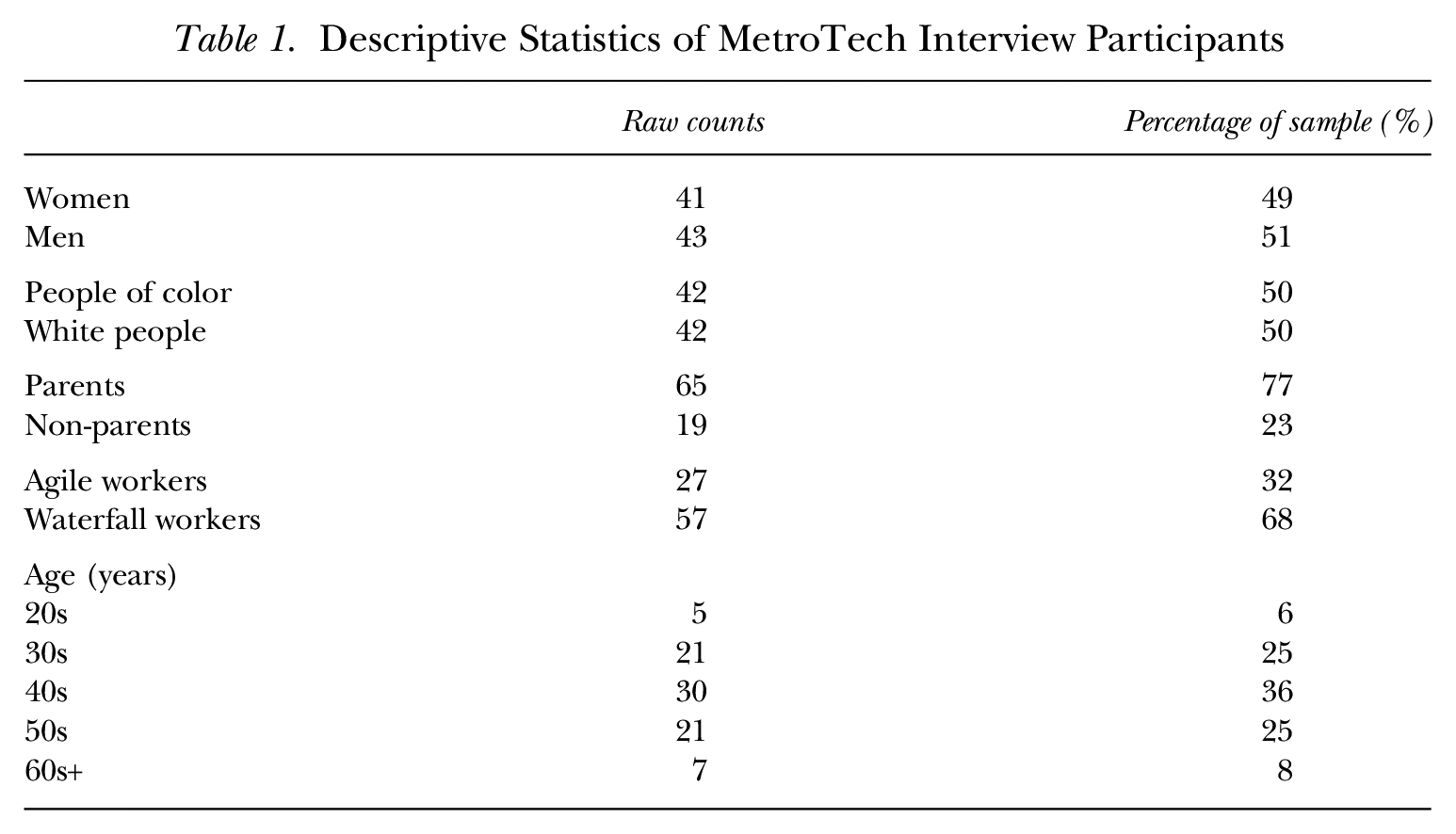
Altogether, I interviewed 41 women and 43 men, for a total of 84 interviews. As outlined in Table 1, 68% (n = 57) of participants worked in waterfall design settings, and 32% (n = 27) worked in agile settings. In my sample, 77% (n = 65) of participants were parents; of these, 52 had preschool- and school-aged children. Table 2 demonstrates that men and women worked in agile and waterfall environments at similar rates; among those working in agile, 52% (n = 14) were men and 48% (n = 13) were women. And among those working in waterfall, 51% (n = 29) were men and 49% (n = 28) were women.
Descriptive Statistics of MetroTech Interview Participants
Perceived Acceptability of Remote Work, by Work Design and Gender
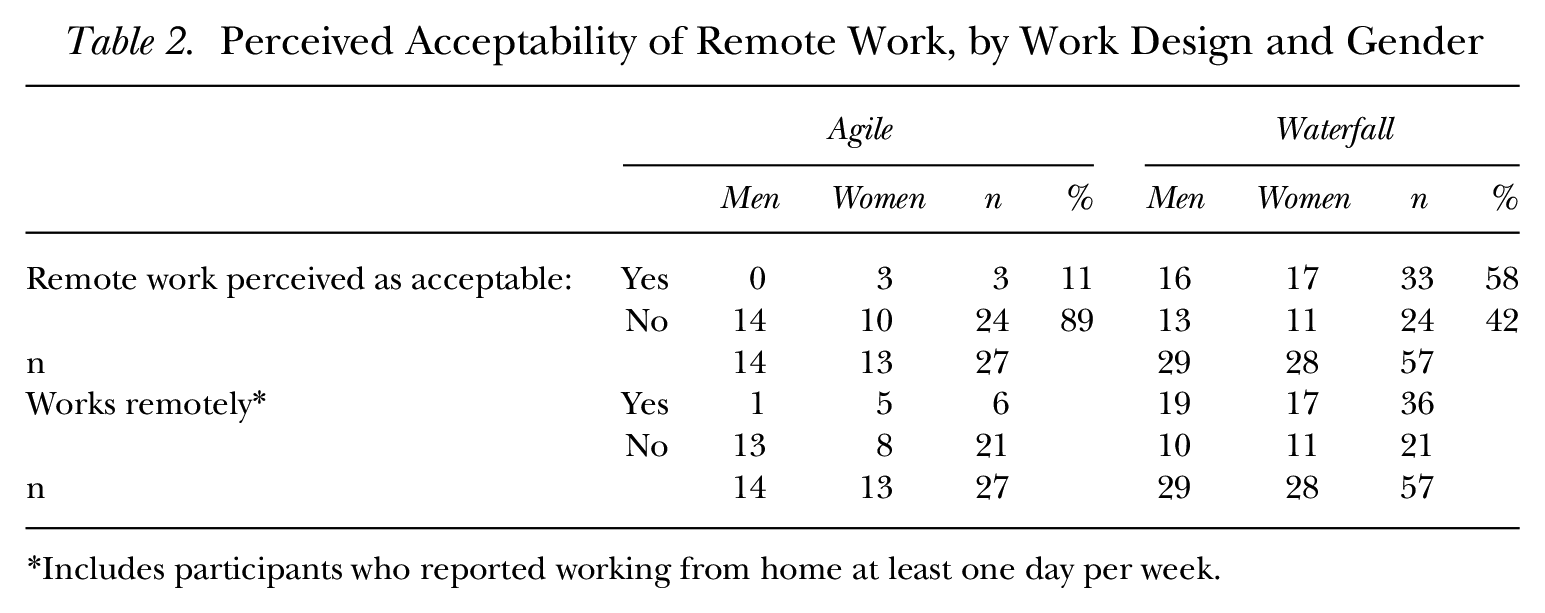
Includes participants who reported working from home at least one day per week.
The interviews took place over a five-month period in 2018. Interviews occurred on-site at MetroTech, at several office locations in a large North American metropolitan area (n = 56), or over the phone when meeting in person could not be accommodated (n = 28). Interviews were semi-structured and lasted on average one hour. Interview participants were asked about their home and work environments, including such topics as relationships with co-workers and management, thoughts on what makes a good worker and good parent, familiarity with, and use of flexible work arrangements offered by MetroTech, household division of labor, work–life balance, and future career plans. All but two of the interviews were recorded and transcribed by a professional transcription service.
Following each interview, I wrote a detailed research note approximately 1,000 words in length, summarizing what was said in the interview. While interviewing was in process, I used the research notes to create a database wherein I coded for attributes relating to participants’ use and perceptions of remote work, division of household labor, and career ambitions, as well as for information such as gender, race/ethnicity, age, parental status, job title, and organizational tenure. The job titles of workers I interviewed included business analyst, business architect, director, manager, scrum master, senior manager, software developer, and technical navigator. Except for scrum masters, all roles were included on both agile and waterfall teams, and men and women occupied these roles at similar rates.
Research note coding was iterative. After I had completed approximately five interviews, the distinction between agile and waterfall work design became prevalent, so I went back through the research notes to add this attribute to the database and formally added a question about whether the participant worked in an agile or waterfall setting to the interview schedule. 3 To be counted as a remote worker, research participants had to work from home at least one day per week. 4
Research note coding informed the first round of “index coding” the interview transcripts (Deterding and Waters 2018). Index coding involved coding large chunks of text, primarily based on questions asked in the interview guide, as well as by attributes and themes that became salient throughout the process of research note writing and coding. For example, while reading, writing, and coding the research notes, I recognized variation in how work design related to the use of remote work. Index coding involved, among other things, coding for demographic information, whether one worked in an agile or waterfall work design, as well as respondents’ use of remote work.
The second round of coding was focused and involved elaborating on analytically interesting index codes by developing subthemes (Emerson, Fretz, and Shaw 2011). Analysis included participants’ motivations for working remotely or on-site, whether they perceived remote work to be an acceptable practice, and their feelings and experiences within their type of work design. As outlined in the findings, this stage of coding uncovered subthemes of digital and physical orientations to work, as well as varying team cultures. The third stage of coding entailed refining and validating the analysis by distinguishing patterns across groups based on attributes such as gender, race, parental status, and work design.
Table 1 provides an overview of the interview sample. 5 Although I explicitly requested to speak with people of all genders, the proportion of racialized interview participants was happenstance: 50% of interviewees identified as people of color, which is in line with the broader demographics of the city where MetroTech is located. People of color were just as likely to work in agile settings as they were in waterfall settings. MetroTech employees were randomly recruited to participate in the study, yet I cannot confirm the absence of a selection effect, whereby only those with strong opinions about flexible work arrangements opted to participate. As with all employee-based recruitment, there is a chance that a middle-ground perspective is less represented. In addition, MetroTech did not provide data on rates of promotion, so I am unable to discern whether remote workers’ perceptions about being able to use flexible work arrangements without penalty align with reality. This limitation is attenuated by the fact that I interviewed individuals within the same salary band, whose job titles hold similar levels of prestige (i.e., all the individuals I interviewed had achieved managerial or commensurate status). In addition, my finding that few individuals in agile settings work remotely (n = 6) proscribes generalizations. As a qualitative study, this is necessarily the case by design and the low number of agile remote workers is itself a finding. Although the influence of agile work design on perceptions and uses of remote work may not scale to other settings, attending to how work orientations are embedded in work designs may be theoretically generative elsewhere (see, e.g., Small 2009).
Findings: Who Works Remotely? Variation by Work Design and Gender
Figure 1 compares rates of remote work policy use among those interview participants in agile settings and those in traditional work settings. Among those in agile work settings, 22%(n = 6) worked at home at least one day per week. By contrast, 63% (n = 36) of the MetroTech employees I interviewed in waterfall work settings reported working at home at least one day per week.
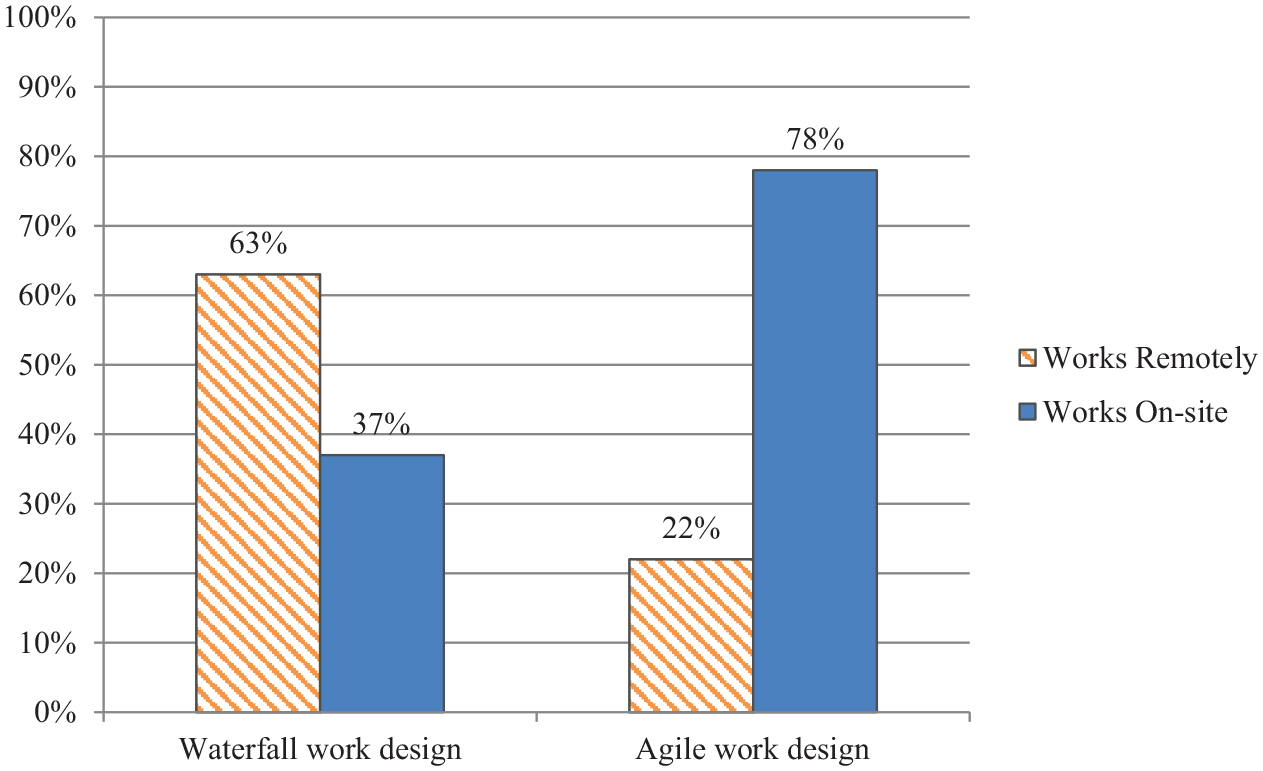
Percentage of MetroTech Participants Who Work Remotely at Least One Day per Week, by Work Design
Figure 2 provides a breakdown of remote work rates by work setting and gender. Under waterfall work design, men and women chose to work on-site or to work remotely in almost even numbers, with slightly more men than women (33% versus 30%) opting to work remotely. Agile work design exhibits a wider gender variation; five of the six people working remotely were women. Most were compelled to work remotely despite the perceived unacceptability of doing so: four were single parents with child care obligations that curtailed the amount of time they could spend in the office (including the sole male agile participant working remotely), and one was immobilized by an injury. Only one of the six remote workers in agile, the woman with an injury, reported having the support of her boss to work remotely. In the following sections, I outline the work practices in agile and waterfall that explain variation in the use of remote work.
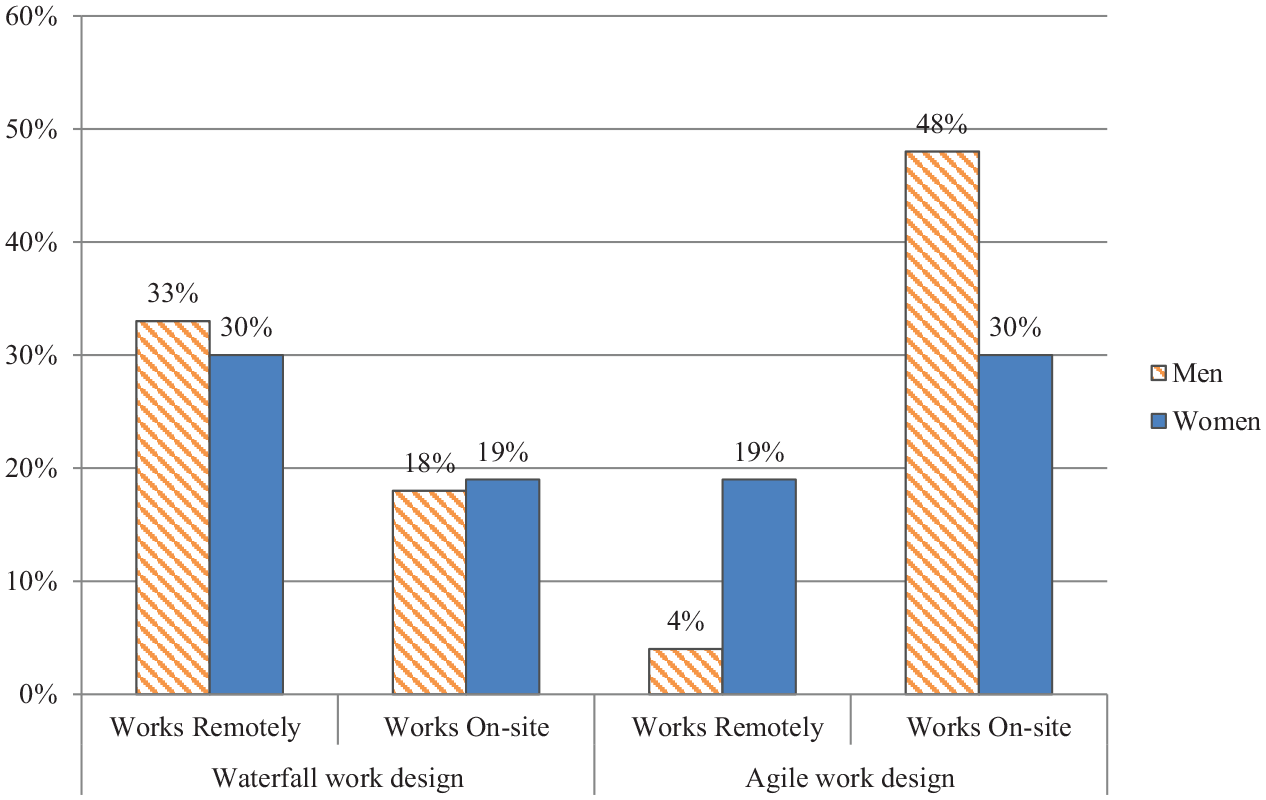
Percentage of MetroTech Participants Who Work Remotely at Least One Day per Week, by Work Design and Gender
Work Orientations and Remote Work Arrangements
Interviews revealed how the structure of work practices—including conventions of co-worker and managerial interaction, and data storage—influence norms regarding the acceptability of remote work. Waterfall workers are part of teams with a digital orientation toward work and information storage. By contrast, agile workers are part of teams espousing a physical orientation to work practices and information storage.
Waterfall/Bureaucratic Work Design: Digital Orientation
As practiced at MetroTech, waterfall work took place in cubicles with most employees, like their agile counterparts, using laptops. Because work is sequential, it lends itself to “heads down” computer work, requiring fewer interruptions. Waterfall work arrangements are traditionally bureaucratic because of the hierarchical nature of managerial authority and the formalized documentation that occurs in online systems (e.g., in shared databases and Excel files). Data can be accessed anywhere if employees are in possession of their company laptop and smartphone. Zuboff (1988) argued that the intellective skills associated with computer work are best learned through the systematic mastery of processing, and learning systems inside and out. While these skills can become tacit over time, they must be made explicit before this can happen. The codification required to render intellective labor explicit (i.e., through learning software applications and documenting work in shared files) democratizes access to information. Because information can be accessed diffusely, those needing to work remotely do not risk missing any communication pertinent to their job performance.
Waterfall work design at MetroTech was characterized by a digital orientation to work and consisted of two main features. First, communication occurs online through digital platforms, including online direct messaging software, video conferencing, and email. Most workers using waterfall practices indicated that little is gained from coming to the office, aside from the occasional in-person meeting and the opportunity to socialize. Comments about the needlessness of going to the office, such as the following from Olga, were common: “Most of my meetings are on the phone anyway, so there’s no reason for me to be in the office.”
Even when they were working on-site, waterfall workers shared that many meetings still happened via conference call, and some staff maintained a preference for direct messaging. According to Ivan, this is because many people working in IT are “introverted, so most of the time you don’t want to be talking. . . . I have my computer lined against one wall, and my co-workers have theirs against another wall, and we will be talking, but instead of talking we actually just message each other in the same room.” In this case, online communication enables workers to communicate in ways that suit their personality.
Digital communication—or more accurately, the absence of in-person communication—was championed as a means of meeting deadlines. Waterfall staff indicated that they were less apt to get caught up in small talk when communication is limited to digital. According to Mohamed: Personally, I think my productivity is better working from home than at the office because you don’t get distracted as much. When my work requires talking I can just use direct messaging to get in touch and via conference call. These days almost all our meetings are on conference calls, so people are coming in from different places anyways.
Waterfall workers reported that communicating in person does not add value to their labor because so much of their actual work takes place online. Although informal conversation and watercooler talk are the kinds of activities that help build rapport, many staff were leery about how they distract from getting work done. They liked working remotely because they avoided inessential disruptions. Because online work practices enable waterfall workers to complete their tasks at home, on the days they are in the office, their colleagues may not be, so meetings nevertheless occur via conference call. When asked how she liked in-person meetings compared to conference calls, Brenda offered: They’re the same to me. To be honest, I do all my meetings online. Even though I’m in the office, I do my meetings online. It’s just sometimes very difficult to gather everyone. At least a couple of our co-workers might be here, but the rest might not be. Even though you meet in person, you still have some other attendee that will join online as well.
A digital orientation to work under the waterfall approach to project management was self-perpetuating: Because remote work was accepted and practiced by a majority, on-site work practices were subsumed by the schedules and needs of remote workers.
The second feature of the digital orientation in waterfall work was that work was managed through digital surveillance. Co-workers and managers checked whether colleagues were accomplishing their tasks by monitoring online activity. MetroTech uses an online communication platform that includes a direct messaging function, videoconferencing, file storage, and application integration. The platform indicates when someone is inactive at their computer. Because calendars are also shared, co-workers can discern when someone is in a meeting or when someone should be available to respond quickly to queries. On the topic of tracking colleagues’ online activity, Anwar shared: “I can see when you are inactive and for how many minutes. You cannot hide your digital footprint from anybody.” When asked what makes it easier or harder for some people to work remotely, Cynthia replied: I think it’s just a maturity. You know, you have to be available. You have to answer emails and instant messages, you have to answer your phone. You’re still accountable to get your job done. Just because you’re not at the office doesn’t mean you’re not being watched.
Similarly, when asked how she felt about working remotely, Carla shared: I like it because you save money and transportation time. I’m actually connected earlier than if I had come to the office. Sometimes you might think that people [co-workers] don’t get any work done, but it doesn’t happen. Our manager can see who’s connected, who’s online, who’s working, who’s not working, who’s sending emails at ten at night. And at the end of the day, if you haven’t been working, everyone will find out.
As did their other remote working counterparts, Cynthia and Carla accepted that surveillance is part of the bargain when they work from home.
Those with managerial responsibilities also acknowledged the surveillance associated with remote work. When asked whether he thinks it is acceptable to work remotely, Peter, who has 20 direct reports, replied: It’s interesting because, just like me, I find that my reports who do work from home, I’ll get an email from them at six thirty in the morning. I’ll get an email from them at midnight. Stuff is getting done, and my thing has always been, regardless of that policy, you can come in late, you can leave early, take as much time off as you want as long as your work is done satisfactorily. There’s a lot of bonuses. While you’re talking on a conference call, if you want to do laundry, put us on mute and do your laundry. I don’t care. Who cares what you’re doing in the background? It doesn’t matter as long as you’re at the meeting and you’re participating.
Peter’s surveillance was passive, in that he informally tracked the times at which he is receiving emails from his reports. But for other managers, such as Ahmed, an effort was made to ensure they were modeling the kind of behavior they wanted to see in return: For me, in terms of how I assess remote work with my team, I look at it as in, you know, do I get quality deliverables when I’m supposed to get them? And if the answer’s “yes” then I don’t even stress it. I don’t even audit it. I mean, presence doesn’t mean efficiency.
When asked as a follow-up how he manages the workflow of his remote workers, Ahmed offered: I try and set an example so that it’s an unwritten thing, but I’m basically telling them: “look, I expect this kind of interaction: not a three-hour turnaround on emails when I know you are working from home.” And when I’m working from home, I’m sitting at my kitchen counter, there’s no way I didn’t see that email.
In line with extant scholarship on surveillance in the workforce, MetroTech workers accepted the trade-off that surveillance offers in favor of flexibility and access (Gilliom and Monahan 2012; Turco 2016). Similarly, managers acknowledged that remote work does require additional surveillance, but the benefits of remote work outweighed the disadvantages for them as well.
Waterfall’s Open Team Culture
The online communication and surveillance features of waterfall’s digital orientation facilitate an emphasis on efficiency. Managers and workers alike expressed the sentiment that what matters is getting the job done, not where the work happens. When asked about his management style, Ivan replied, “I tell people, I don’t care where you work. You can work from Mars for all I care. At the end of the day it’s the results you achieve.” Julie, when asked whether it is acceptable to work remotely, responded, “I don’t find being in the office particularly increases your productivity. I find that for some work, working at home is better. So, I leave it up to the staff to do what they need to, as long as they deliver results.” And Anwar noted, “In our team, we care about the deliverables. If you work at night or in the morning or from a beach, I don’t care.”
Less visibility among waterfall staff enables a ROWE mentality (Kelly et al. 2010; Moen et al. 2011). Unlike the workplaces studied by Kelly, Moen, and colleagues, MetroTech does not formally mandate a ROWE policy. However, diffuse access to data and communication tools as practiced under the traditionally bureaucratic method of waterfall normalizes remote work as an efficient way of achieving goals. 6
As Figure 3 indicates, waterfall work design facilitated a gender-egalitarian use of remote work policies. It was egalitarian both in the sense that most waterfall workers chose to work remotely and that men and women worked remotely in similar numbers. As scholars of gender and work have long acknowledged, the practice of men working remotely at similar rates as women is critical for fostering long-term gender equality at work and at home, because women in heterosexual partnerships cannot dedicate more time to their careers unless their spouses take on their fair share of child care and household labor (Williams 2010; Doucet 2017). Work designs that enable both women and men to work remotely thus have a greater likelihood of ameliorating gender equality more broadly.
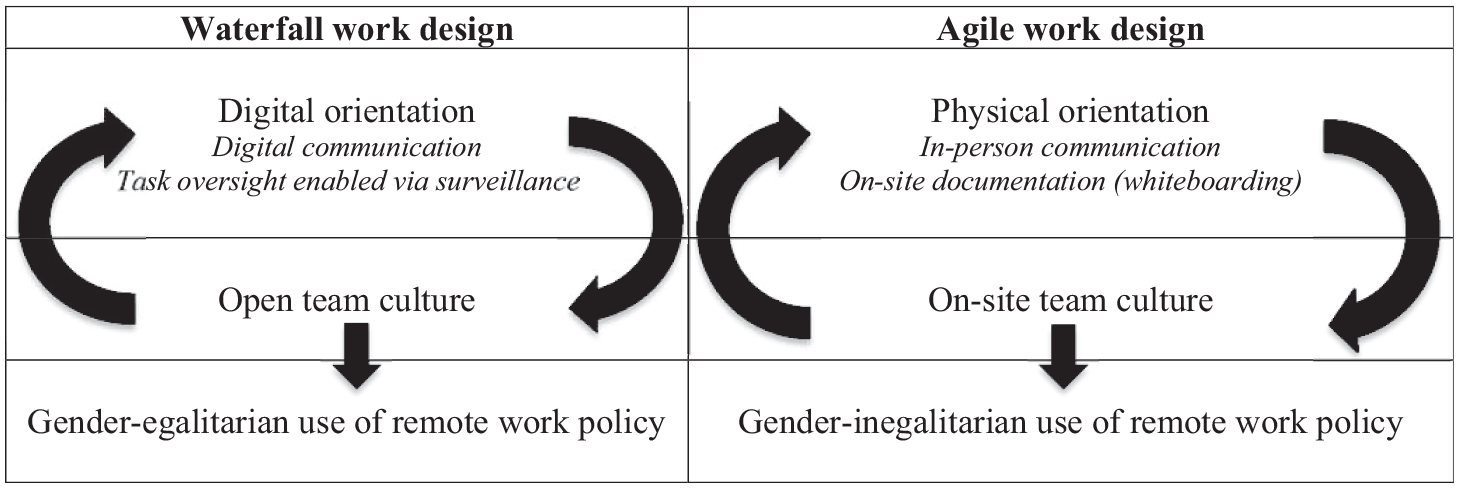
Relationship between Work Design, Work Orientations, and Team Cultures
Agile/Post-Bureaucratic Work Design: Physical Orientation
A typical agile lab at MetroTech was in a conference-style room with a long table and chairs. At one end was a large whiteboard, along with a video screen. Employees sat around the table with laptops and worked side by side. Agile labs facilitated a physical orientation to work in two ways. First, documentation occurred on-site, in the moment. Teams worked in sprints and were expected to produce results in short increments of time. Consequently, employees had less time to document processes and they relied instead on whiteboards to track progress. For some, such as Ellis, this outcome was regrettable: “The thing about agile is that it delivers things fast but there’s no documentation, there’s no legacy or anything. So, five years from now, when the people who did the project are gone, we’ll be asking, ‘How did we do this?’” Because progress was tracked in real time, workers had to access the whiteboard to know what was happening. As Yasmin explained: “Agile is about not having a set process, and having these whiteboards where you can track what everyone is doing with stick-it notes. Things can be shifted around, moved around.” Working with a whiteboard is a tactile process, requiring workers to physically move pieces of paper across the board. Of this orientation to work, Janet shared that, “because of the whiteboard sessions, we make a point of being there in person.” This sentiment was echoed by Tenisha. When asked whether she would consider working remotely, she replied: The role that I am playing, it is like I have to be here because we are meeting with lots of different people. Yes, we do have meetings online. We had a meeting on Friday where we had different consulting companies come in. I could have dialed in, but then people end up whiteboarding stuff. If I had been sitting remotely, it is not that easy to join the conversation.
The reliance on whiteboards instead of written documentation alters the dynamics of meeting conversations, and the ebb and flow of daily work life more generally, such that workers in agile groups risk feeling excluded or missing out on information unless they are on-site.
The physicality of on-site documentation was likewise highlighted by Fiona when she shared what happened when her team transitioned mid-project from waterfall to agile work design: Agile was introduced when we were at the peak of a very large program that started with waterfall. So, we had to shift to agile in the middle of this waterfall project, and the first thing that happened was co-location. There’s a great big room, and everybody had to come and be in the room. It was frowned upon not to be in the room. You needed to be here, just [to] see what’s on the wall. How do you have a stand-up [meeting] if you can’t see the sticky note?
In this way, on-site documentation begets on-site work. As Fiona’s story suggests, workers themselves felt compelled to be on-site to not miss what was happening, but management also conveyed the importance of co-location, frowning upon workers’ absence from the room.
The second way agile facilitated a physical orientation to work was through lack of digital documentation: In-person communication became crucial for keeping a handle on job tasks and responsibilities and for knowing what one was supposed to be doing at any given time. When I asked Philip whether family life affects someone’s ability to be a good worker at MetroTech, he shared: One of the things that I think is an important part of this answer, which I hadn’t thought of until now, is that MetroTech has adopted an agile format. Their view of the agile format is a lab environment with people sitting side by side, and talking to one another across the table, and having an intense work environment where people are constantly communicating with one another or being exposed to everything that’s happening all at once. The idea of working from home to help with family stuff is not really that compatible with that idea.
Philip pointed out that intense, in-person communication was favored as a means of delivering work in agile arrangements. And this approach, he suggested, is incompatible with remote work. Relatedly, when asked whether anyone on the agile teams he oversees worked remotely, Dinesh said this rarely occurred. But he remarked: Even with the right tools like video chatting, and all our laptops have cameras and microphones, and once you plug into a workstation, someone can tell exactly what building you’re in. But still, we’re expected to be there in person. Technology should make it easy to talk to co-workers remotely, but it doesn’t work that way with agile.
Agile business analyst Leanne expressed that the lack of documentation meant she had to spend additional time talking to colleagues to figure out what work had already been completed, and what was expected of her, often through additional meetings. When asked how she likes working on an agile team, she shared: Agile is very hard . . . like if I got a task before [working in agile], I had requirement documentation coming with it. But now you spend lots of time on it to clarify your tasks. It really gives you a lot of troubles. It really requires you to spend more of your time in the office with your colleagues.
Leanne conveyed that the emphasis on in-person communication rather than written documentation obliged her to work on-site to communicate with her team members. Her daily commute was one-and-a-half hours each way; she left her house at 7:30 a.m. and got home by 6:30 p.m. As a result of the time lost to commuting, she reported feeling guilty about the lack of time she could spend with her 10-year-old daughter.
Agile’s On-site Team Culture
The features of agile’s physical orientation toward work facilitated an on-site team culture at MetroTech that is locked into the idea of co-presence as a criterion for doing the job. Progress was measured at the team level and many agile workers valued this emphasis on team membership. When asked how his experience in an agile environment differs from traditional work settings, Chinh shared his preference for in-person communication: “In agile, it’s a little more about the dynamics of the group . . . rather than sending an email to someone, you simply walk over to them and have a quick chat and get it all resolved.” Scrum masters and managers also communicated the importance of team engagement. Some of those with oversight responsibility acknowledged that they judge remote workers, ostensibly for their lack of team dedication. For example, scrum master Tamas shared his thoughts on how he judges those who work from home and how he imagines others pass judgment: The whole purpose of working agile is that you work in smaller increments as a team. Now if the team members are not present, gradually the psychological questions start coming to everybody’s head. People start judging whether they’re working or not, whether they’re being as efficient or not, why someone is coming and the others are not coming.
The oral and physical nature inscribed into agile processes, and the on-site team culture it motivates, thus disadvantages those wanting to work remotely.
Agile work design and its resultant on-site team culture facilitated a gender-inegalitarian use of the remote work policy. It is inegalitarian in that more women than men on agile teams worked remotely despite its perceived unacceptability and because fewer people overall could work remotely. Thus, agile disadvantaged both men and women who may have had responsibilities that necessitated remote work. Because women remain most in need of remote work options owing to the uneven division of household labor, they were doubly disadvantaged. Proponents of agile work design suggest that it transcends hierarchical work structures and offers a more post-bureaucratic, participatory form of collaboration. The team culture stemming from a physical orientation to work, however, reinforces organizational–managerial hegemony by limiting employees’ control over their schedules (Barley and Kunda 1992; Barker 1993, 1999; Vallas 2003, 2006).
Conclusion
This article deepens our understanding of how work design attributes matter for the adoption and use of remote work. In analyzing two types of work design within the same company, I demonstrate how the interface between work design, orientations to work, and the team cultures they facilitate results in varying use of remote work arrangements, with the majority of those in agile working on-site and the majority of those in waterfall working remotely. As manifested at MetroTech, agile work design discourages remote work because of its physical orientation and on-site team culture. And while the more open team cultures in traditionally bureaucratic waterfall work settings do not remove all the negative connotations associated with flexible work arrangements, the digital orientation espoused by waterfall workers fosters more acceptance than it does disapproval of remote work.
This study makes two contributions to scholarship on remote work arrangements and contemporary work practices. First, it documents empirically the agile work methodology and its constraining effect on the use of remote work arrangements. Agile methodology is an iteration of post-bureaucratic organizing, designed to make work more efficient and increase employee decision-making. Scholars of work, labor, and organizational behavior highlight the transformative potential of post-bureaucratic work design to make work processes more efficient and empowering for workers (Osterman 2000; Kalleberg 2003). Employees in post-bureaucratic work designs experience autonomy over their job tasks and have higher levels of communication about work matters with various stakeholders (Appelbaum et al. 2000).
As the interviews I conducted in this study reveal, the autonomy granted to workers in the agile design at MetroTech is a form of freedom through constraint; decision-making hierarchies are flattened but the decision over where to work is highly constrained by an on-site team culture. This barrier has consequences for employees’ abilities to accommodate care obligations. Developing an understanding of agile methods is important to better analyze its effects on employee well-being and because, as a practice, it is increasingly prevalent. McKinsey surveyed 2,500 American companies and found that 74% of firms were prioritizing the transition to agile, and 40% of firms had already begun transitioning divisions to work under the agile system (Ebrahim, Krishnakanthan, and Thaker 2018). In highlighting agile work design, this study provides new insights into the debate on whether post-bureaucratic forms of team organizing are liberating or constraining (Barker 1999; Vallas 2003; Kalev 2009). While agile team members may enjoy latitude in their day-to-day work functions and interactions, control over when and where they work is constrained relative to their peers laboring under the more bureaucratic waterfall design. As such, agile team members internalize some aspects of managerial control, while maintaining agency in other respects (Vallas 2006).
Second, research calls for us to move beyond Acker’s classic theory of gendered organizations (Acker 1990) to better account for the role of gender in the new economy, including post-bureaucratic settings (Williams et al. 2012). This article outlines how the social organization of work design reproduces gendered organizations through physical work orientations. Paradoxically, the action-based skills that are found to be empowering within contexts of manual labor (see, e.g., Zuboff 1988) disadvantage people on agile teams, insofar as they prevent employees from working remotely. Because for the foreseeable future women will remain most in need of flexible work arrangements, they are particularly disadvantaged by this process.
At MetroTech, the failure of agile work design to accommodate structural constraints that trail caregivers—and mothers in particular—into the workplace may hinder their occupational growth and well-being (Pedulla and Thébaud 2015). Notably, the digital orientation in waterfall settings was not accompanied by wide gender variation in the use of remote work arrangements. In contrast to previous findings that women are more apt to make use of flexible work arrangements (Blair-Loy and Wharton 2002; Singley and Hynes 2005; Kelly et al. 2010), slightly more men than women worked remotely under the waterfall work design at MetroTech. Given that men face more pressure than women to live up to standards of the ideal worker, work design premised on a digital orientation may be an intervention for facilitating men’s use of remote work arrangements, and potentially increasing their contribution to unpaid household labor and child care in the process (de Laat 2020). 7
This study likewise corroborates Briscoe’s (2006, 2007) findings that when it comes to flexible work arrangements, the iron cage of bureaucracy works more effectively as an iron shield, protecting control over workers’ schedules. It also expands Briscoe’s findings by outlining the implications of the iron shield for gender equality at work. In such a context, both women and men can work remotely, which may help in dispelling the stereotype of remote work as being for mothers only. Often, initiatives to reduce gender inequality in the workplace prioritize improving outcomes for women. This objective is understandable given the persistent discrimination that women confront at work; however, when it comes to the provision of remote work policies, and flexible work arrangements more broadly, researchers acknowledge the need to design initiatives with men in mind, too (Williams 2010). Most heterosexual couples are dual-earners, and men have obligations that may require them to work remotely. If workplaces are designed to accommodate all of those with care obligations, more people likely will benefit and the gendered stigma associated with remote work policies may diminish.
Overall, this study analyzes the role of post-bureaucratic forms of work design in constraining or enabling worker well-being; the data suggest that team cultures and work orientations accompanying types of work design benefit some workers at the expense of others. Throughout the COVID-19 pandemic, employers have been grappling with how to implement remote work policies, and their choices may have consequences that vary across gender, race, and other lines. For example, one company-led survey found that Black employees were significantly more likely than White employees to report an interest in continuing to work remotely, since doing so buffers them from negative in-person interactions (Williams, Korn, and Boginsky 2021). Efforts to facilitate the use of remote work should include consideration of how work design processes are implicated.
Footnotes
Acknowledgements
I thank Sarah Kaplan, Erin Reid, and Marisa Young for their thoughtful feedback, as well as all of the MetroTech employees who graciously shared their time and insights with me.
This work was supported by the Social Sciences and Humanities Research Council (756-2017-0270).
For information regarding the data and/or computer programs used for this study, please address correspondence to
1
Kelly and Moen (2020) outlined a similar work redesign named STAR (Support. Transform. Achieve. Results.), though it differs in several ways, and significantly, more emphasis is placed on the importance of social support for personal and family lives. (See also  .)
.)
2
Pseudonyms are used to safeguard the identities of MetroTech and its employees.
3
Some participants indicated they did not work directly on an agile team, but they were responsible for overseeing several agile teams. Because they were reflecting on their experiences with agile work design, I code these participants as agile workers, but their oversight role is indicated accordingly if mentioned in the findings.
4
Because MetroTech is such a large organization, no standard set of rules applies to allowances for remote work. In general, participants indicated that they needed to ask their manager for permission to work remotely, at least initially.
5
Sixteen of the research participants worked in the same unit or group as one of the other research participants; seven participants recruited through snowball sampling worked in the same unit as the person who recommended them. And two other people that agreed to participate in the study coincidentally worked in the same unit, though to the best of my knowledge they were unaware of each other’s participation in the study. This overlap acted as a secondary means of validating my findings, in that workers’ perceptions regarding the acceptability or unacceptability of remote work aligned with those of the other person in their unit.
6
As was the case with ROWE at Best Buy (), at MetroTech a high percentage of employees in traditionally bureaucratic waterfall settings perceive remote work to be an unacceptable practice (42%). While an emphasis on goal completion is helpful for those in need of remote work, it is not sufficient for altering persistent stereotypes. It does, however, enable sufficiently large pockets of acceptability such that even in the face of negative perceptions, workers are empowered to work from home.
7
It may also be the case that the propensity for men to feel more autonomous and empowered in the workplace (see, e.g., ) means that the women working on-site in traditionally bureaucratic work settings have an unstated preference for remote work but feel similarly pressured to adhere to the image of an ideal worker.