



Abstract
Hybrid businesses that combine profit and social objectives at their core play an important role in their communities. In this article, we use insights from paradox theory to examine the influence of entrepreneurs’ cultural value orientations and ethnicity on distinct forms of hybrid businesses. We use a unique random sample of international small- and medium-sized privately owned businesses in Canada. After controlling for alternative explanations and using propensity scores to match the samples of Indigenous and non-Indigenous entrepreneurs, we consistently find that entrepreneurs’ self-expression values and Indigenous ethnicity are positively associated with a higher degree of hybridity in the businesses they start. Our findings contribute to the conversations on the micro-foundations of organizational paradox and to the literature on the factors that influence different hybrid organizational forms. Besides, our findings also add to the literature that examines hybridity in the context of internationalized businesses. The rationality and culture of the entrepreneur affect organizational paradox. Entrepreneurs with self-expressive values and identified with an Indigenous ethnicity have higher proclivities to form ideal hybrids and embrace paradoxical organizational forms.
Keywords
Introduction
Hybridity in business 1 has been defined as ‘the mixing of core organizational elements’ such as organizational identities, forms and logics ‘that would not conventionally go together’ (Battilana et al., 2017, p. 138). Hybrid organizations mix several elements that are seemingly contradictory. In the case of symphonies, for instance, musicians view the organization as an artistic entity while the administrators view the organization as an economic entity (Glynn, 2000). In the case of health care, there is a paradox between business-like and medical professional logics (Reay & Hinings, 2009). In our study, we approach organizational hybridity as a paradox between social and economic elements (Smith & Besharov, 2019), where paradox has been defined as ‘contradictory yet interrelated elements that exist simultaneously and persist over time’ (Smith & Lewis 2011, p. 382).
Extant research on hybrid organizing suggests that the joint pursuit of competing elements leads to potential conflicts (Battilana & Lee, 2014; Battilana et al., 2022). Research has shown different ways to manage competing logics in hybrid organizations through structural differentiation or structured flexibility (e.g., Battilana et al., 2015; Smith & Besharov, 2019). However, there is a paucity of research examining the origins and antecedents of hybridity (Arrighetti et al., 2014; Dufays & Huybrechts, 2016). Specifically, what are the factors that lead to the formation of hybrid organizational forms? From a paradox perspective, extant research has focused on firm-level solutions for managing paradoxes (e.g., Ambos et al., 2020); however, limited attention has been paid to the role of the entrepreneur and individuals (Miron-Spektor et al., 2018). Paradoxes in firms require a perspective that accounts for plurality in an entrepreneur’s values and objectives (Dacin et al., 2011) in that multiple identities of entrepreneurs enable the infusion of social and economic logics in the formation of hybrid firms (Battilana et al., 2015). Literature indicates that the development of social logics in a hybrid enterprise rests to a large extent with the individual entrepreneur (Bacq et al., 2016). At the same time, it is difficult to ignore that the creation of social value is closely related to economic goals, the latter then provides the entrepreneur with financial resources to achieve the entrepreneur’s social mission (Dacin et al., 2011). As entrepreneurs are the ones who manage paradoxes in hybrid organizations, it is important to understand the influence of their rationality and value orientations in the formation of such hybrids in the first place (e.g., Bull & Ridley-Duff, 2019). These value orientations stem from the cultural values imbibed from the society (Inglehart, 2006) and the ideology of the ethnic community to which the entrepreneur belongs (Dai et al., 2018).
Inglehart and colleagues suggest that values could be collapsed into traditional (vs. secular–rational) and self-expression (vs. survival) (Inglehart, 2006). We chose Inglehart’s perspective of culture as it explains a significant percentage of culture variance (Swoboda & Batton, 2019). Specifically, we examine the impact of entrepreneurs’ traditional (vs. secular–rational) and self-expression (vs. survival) values on firms’ hybridity. Furthermore, we focus on the influence of entrepreneurs’ ethnicity. Particularly, extant research suggests differences between Indigenous and non-Indigenous cultures in management practices (Dana, 1996). Specifically, research suggests that Indigenous cultures are described to be collectivist, egalitarian and tolerant—characteristics that are reflected in behavioural attitudes (Colbourne, 2017; Redpath & Nielsen, 1997; Pergelova et al., 2022), and this we argue might affect the hybridity of businesses entrepreneurs start.
We, therefore, examine the influence of the culture of individual entrepreneurs (e.g., Dufays & Huybrechts, 2016) and address the following broad research question: how do entrepreneurs’ rationalities affect distinct forms of hybrid businesses? In particular, in this study, we aim to answer: what influence do entrepreneurs’ cultural values and ethnicity have on their firm’s forms of hybridity? In the examination of the phenomenon of hybridity in businesses, scholars have moved from the discrete categorization of firms as either being hybrid or not, to conceptualizing hybridity as a continuum (Shepherd et al., 2019). For instance, in examining social enterprises, scholars have offered three alternative hybrid forms: associative charitable trading activities, cooperative and mutual enterprises, and socially responsible businesses (Bull & Ridley-Duff, 2019; Ridley-Duff & Bull, 2016). In this research, by focusing on private businesses, we analyse three forms along the continuum of their orientation (commercial or social). At one end, we study businesses with a commercial orientation (those driven by an economic logic). At the other end, we analyse businesses with a social orientation (those driven by a social logic). At the centre of the continuum are the ideal hybrid businesses, those that give an equal balance to both social and economic objectives. To treat these different forms empirically and quantitatively, we refer to the notion of degree of hybridity which is the extent of one orientation over the other with hybridity being highest in the middle.
We answer our research question in the context of internationalized businesses. Extant research has shown that firms internationalizing are mainly economic enterprises with profit motives and are less likely to be hybrid firms (Angulo-Ruiz et al., 2020). Such firms present a unique context for understanding the antecedents of hybridity as they must manage seemingly incompatible economic and social elements, in addition to other relevant paradoxical elements international businesses face, such as the strategic tensions between a local and a global focus (e.g., Ambos et al., 2020). Therefore, our context provides fertile ground to examine whether the culture and ethnicity of decision-makers can contribute to the formation of hybrid organizations when internationalizing.
In our random sample of international businesses from the provinces of Alberta and British Columbia (both provinces from Canada) and, after using propensity score matching (PSM) and controlling for alternative explanations, our findings consistently reveal that entrepreneurs’ self-expression values and Indigenous ethnicity generate a higher degree of hybridity in firms. In other words, these entrepreneurs tend to form ideal hybrids, or those that give an equal balance to both social and economic objectives. Robustness checks corroborate our findings. Our research contributes to the conversation on the micro-foundations of organizational paradox. Extant micro-foundational research has advanced the drivers of paradoxical leader behaviour (Zhang et al., 2015) and the relevance of a paradoxical mind-set to enhance innovation and job performance (Miron-Spektor et al., 2018). In our study, however, we suggest that the rationality and culture of the entrepreneur affect organizational paradox. Entrepreneurs with self-expressive values and identified with an Indigenous ethnicity have higher proclivities to form ideal hybrids and embrace paradoxical organizational forms.
The article is organized as follows. First, we briefly review the literature on hybrid firms in international business, entrepreneurs’ traditional values (vs. secular–rational values), self-expression values (vs. survival values), Indigenous ethnicity (vs. non-Indigenous ethnicity), and their effects on the degree of hybridity of the firms they start. Second, we present the objectives and discuss the rationale of the current research. Third, we detail the methodology and present our results. Finally, we present our discussions, conclusions, managerial implications, limitations and suggestions regarding future research.
Review of Literature
Hybrid Firms in International Business
Hybrid firms incorporate core elements that traditionally will not operate together (Battilana et al., 2017, 2022). Such core elements include identities, forms and rationales that form the core organizational process and its relevant goals (Wry & York, 2017). Extant research has studied hybridity in settings such as microfinance institutions (e.g., Battilana & Dorado, 2010), social enterprises (e.g., Smith & Besharov, 2019), symphony orchestras (e.g., Glynn, 2000), health care organizations (e.g., Reay & Hinings, 2009), among many others (for a review of hybridity, see Battilana et al., 2017). This literature on hybrid firms has grown in the last years (Battilana et al., 2017). However, the emergence of these organizational forms in the first place has been under-researched (Lashitew et al., 2020). Specifically, what are the factors that lead to the formation of hybrids? (Wry & York, 2017).
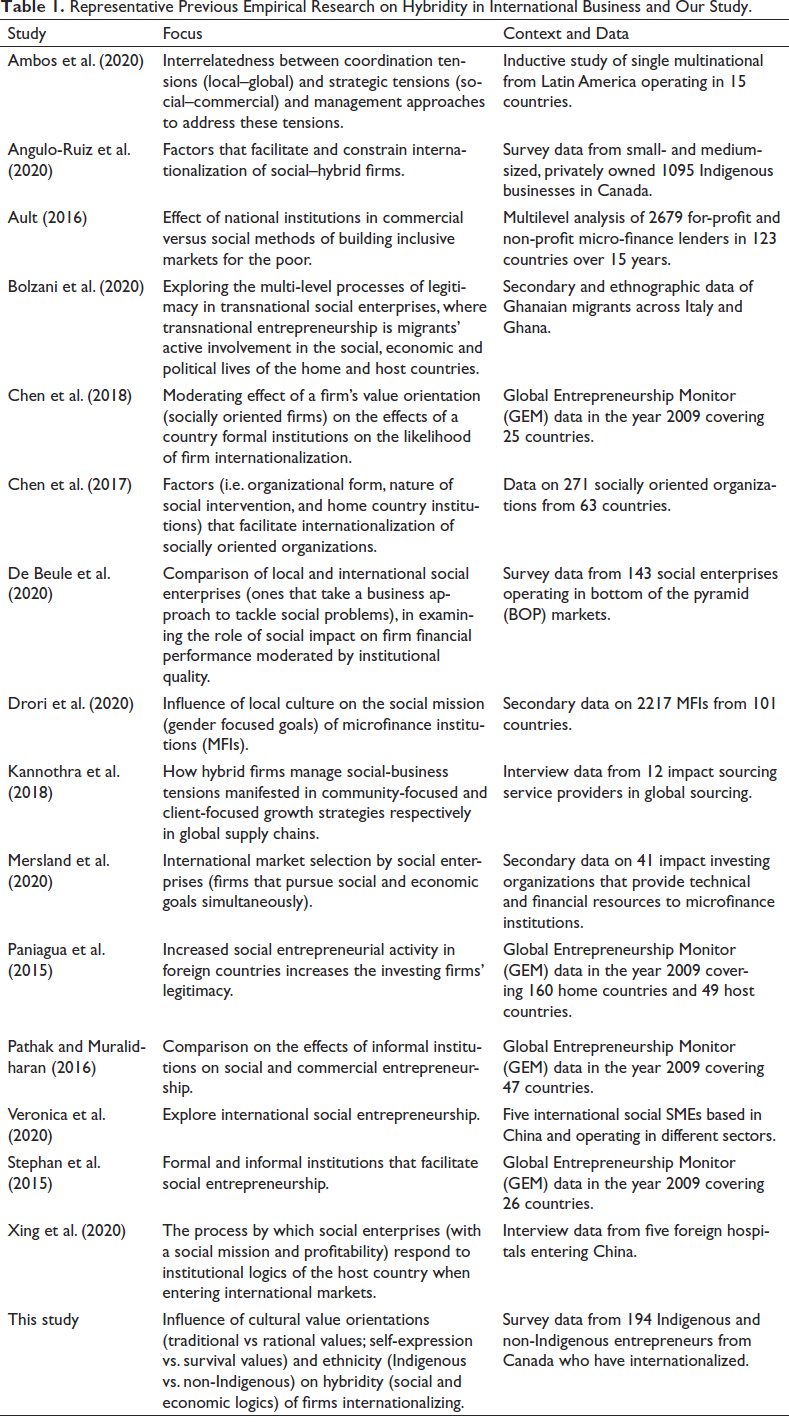
Hybridity in international businesses is in its nascent stage (Alon et al., 2020). A brief review of research on hybrids in an international context is shown in Table 1. Extant research suggests that international hybrid firms face multiple tensions beyond the social and profit ones (Ambos et al., 2020; Kannothra et al., 2018; Xing et al., 2020). Research also shows that cultural differences at the country level are important for the internationalization of hybrids (e.g., Chen et al., 2018; Drori et al., 2020; Mersland et al., 2011; Pathak & Muralidharan, 2016; Stephan et al., 2015). Hybrid firms employ partnerships and specific business models when internationalizing (Xing et al., 2020; De Beule et al., 2023), and they give careful consideration to where to locate (Drori et al., 2020; Mersland et al., 2020; Paniagua et al., 2015).
Representative Previous Empirical Research on Hybridity in International Business and Our Study.
Extant research has focused on firm-level solutions for managing competing logics (Ambos et al., 2020); however, limited attention has been paid to the role of the founder/decision-maker (Pergelova et al., 2022; Wry & York, 2017). Studying the influence of founders’/decision-makers’ values on hybrid organizations is important because ultimately, they are the ones who manage competing logics in the entrepreneurial process (Stephan & Drencheva, 2017).
The current literature has been fundamental in increasing our understanding of hybrid businesses; however, the following requires further attention. While several cultural indicators have been studied as firm-level or country-level factors (e.g., Chen et al., 2018; Drori et al., 2020; Mersland et al., 2011; Pathak & Muralidharan, 2016; Stephan et al., 2015), the influence of cultural indicators at the individual entrepreneur level needs examination. For example, social values at the firm level have been found to weaken the overall supportive impact of strong home-country formal institutions in the internationalization of such firms (Chen et al., 2018). Similarly, local cultures have been found to influence the gender-targeting strategy of microfinance institutions (Drori et al., 2020). Cross-country comparative studies on entrepreneurship have suggested that societal in-group collectivism and societal trust influence social entrepreneurship more than commercial entrepreneurship (Pathak & Muralidharan, 2016). Similarly, societal values of post-materialism and socially supportive cultural norms have been found to strongly influence social entrepreneurship (Stephan et al., 2015). Studies have examined the role of hybrids (firms that pursue social and economic goals simultaneously) in managing the process of internationalization, for example, managing social-business tensions (Kannothra et al., 2018), international market selection (Mersland et al., 2020) and international market entry (Xing et al., 2020). Notwithstanding this evidence, studies that examine the influence of cultural indicators on the extent of hybridity are non-existent.
In view of the above, our study focuses on the influence of cultural indicators at the individual entrepreneur level. Cultural value indicators at the individual level can help avoid country-level generalizations to explain individual behaviours (Muralidharan et al., 2021). In the following sections, we first expand on the role of the entrepreneur in managing hybridity in firms followed by a more detailed characterization of traditional values (vs. secular–rational) and self-expression values (vs. survival). Second, to delve further into the role of culture, we focus on the influence of the ethnic community (entrepreneurs’ ethnicity) on the firm’s degree of hybridity. The focus of our study in the context of empirical studies on the internationalization of hybrids is summarized in Table 1.
The Role of the Entrepreneur
Entrepreneurs, as individuals, shape a new firm’s logic, identity and form based on their motivation (Mueller et al., 2017), identity (Wry & York, 2017) and the attention accorded to social problems (Moroz et al., 2018). Specifically, the ability of the entrepreneur to combine the best of both for-profit and not-profit contexts to address and solve social issues is important (Candi et al., 2019). Businesses strongly depend on their founder(s) and decision-makers to provide managerial resources and ideological spirit (Haveman & Khaire, 2004). The entrepreneur’s a priori experiences, values and imbibed ideologies impact entrepreneurial decision-making and may persist over time (Dufays & Huybrechts, 2016). These values which ‘are beliefs that are linked inextricably to the affect and refer to desired goals that motivate action’ (Schwartz, 2006, p. 143) are likely to affect entrepreneurial behaviour (Hechavarría & Reynolds, 2009). Based on the World Values Survey (WVS) data, Inglehart and Baker (2000) identified two main dimensions of culture—the first reflects the polarization between traditional versus secular–rational values in society and the second is the one between survival versus self-expression values. Both these value dimensions have been found to influence entrepreneurial activity (Hechavarría, 2016). Further, the ideology of the community in the society to which the entrepreneur belongs has also been suggested to influence entrepreneurial behaviour (e.g., Dai et al., 2018). Extending these insights to understand the formation of hybrid organizations, we propose that entrepreneurs’ traditional (vs. secular–rational) values, self-expression (vs. survival) values, and Indigenous ethnicity generate a higher degree of hybridity by incorporating simultaneously commercial and social objectives in the enterprises they start.
Entrepreneurs’ Traditional Values (vs. Secular–Rational Values) and Degree of Hybridity
The WVS data captures cross-cultural variations between traditional and secular/rational values in societies. Traditional societies are observed to prioritize religion, kinship ties, traditional family values and deference to authority. In particular, in traditional societies, religion and making one’s parents proud are priorities, and therefore, in such societies, family and morality or, in other words, in-group collectivism is very important (Hechavarría, 2016). Further, traditional values promote social conformity instead of individualistic achievements (Inglehart, 2006). In traditional societies, individuals believe that ecological problems can be solved without any international interventions (Inglehart & Baker, 2000). Conversely, secular–rational values are the opposing continuum to traditional values (Inglehart, 2006). Societies with secular–rational value orientations place little emphasis on religion, traditional family values and authority. Such societies view divorce, abortion, euthanasia and suicide as acceptable (Inglehart & Baker, 2000). In such societies, logic serves as a core value orientation (Hechavarría, 2016).
Extending the above insights from societal to individual level, we propose that entrepreneurs’ traditional values (vs. rational values) generate a higher degree of hybridity in entrepreneurial ventures, by entrepreneurs incorporating social goals in their enterprises. Traditional values in individuals are characterized by a high emphasis on religion, while secular–rational values are deemed the opposite (Inglehart, 2006). Societies that maintain traditional value orientations place more emphasis on religion and traditional family values than those with secular–rational value orientations (Hechavarría, 2016). These values emphasize the importance of the collective and the environment (Pandey & Gupta, 2008). In traditional societies (with high emphasis on religion) the belief that entrepreneurship is as much a social activity as it is an economic activity (Dana, 2007) is one important reason we argue that entrepreneurs with traditional values would have social goals along with economic ones and hence would imprint a higher degree of hybridity in their firms. Furthermore, for entrepreneurs with traditional values, in-group collectivism is very important and therefore would encourage social conformity in lieu of highly individualistic pursuits (Hechavarría, 2016), and this pro-social behaviour would lead to a higher existence of social goals along with economic ones in the enterprises they start. Such enterprises would therefore exhibit a higher degree of hybridity.
Entrepreneurs with rational or secular–rational values, as mentioned earlier, are at the opposite end of the continuum. Such individuals, with a lower emphasis on religion (Inglehart & Baker, 2000), may not be very prosocial. On the contrary, the existence of logic as key to their value orientations (Hechavarría, 2016), we argue, would drive more the economic logic of the firm such individuals start. In summary, we argue that the simultaneous presence of both economic and social objectives in hybrid organizations is influenced in part by the entrepreneurs’ own values. In particular, the pro-social values of such entrepreneurs with traditional value orientations (as opposed to entrepreneurs with rational value orientations) would enable the presence of social objectives along with economic ones in the businesses they create. Hence, our study proposes that entrepreneurs with traditional (vs. secular–rational) values are more likely to generate a higher degree of hybridity in the firms they start.
Entrepreneurs’ Self-Expression Values (vs. Survival Values) and Degree of Hybridity
The well-being measure of the WVS captures cross-cultural variation between survival values and self-expression values that personify post-industrial societies (Inglehart, 1997). This survival versus self-expression dimension contrasts the emphasis on economic and physical security found in societies shaped by insecurity and low levels of well-being, with emphasis on self-expression, trust, tolerance, quality of life and activism that are seen in rich post-industrial societies (Puumalainen et al., 2015). Self-expressive values are associated with a growing focus on environmental protection, women’s movement, and increasing demands for participation in economic and political life (Inglehart & Baker, 2000). These concepts are in line with the pro-social intentions of entrepreneurs (Nga & Shamuganathan, 2010).
Extending the above insights into the individual entrepreneur level, we propose that entrepreneurs’ self-expression values (vs. survival values) generate a higher degree of hybridity in entrepreneurial ventures, by entrepreneurs incorporating social and economic goals in their enterprises. Self-expression values as observed in the post-industrial or late capitalist societies substitute the values centring on ‘survival’ (Inglehart, 2006). As per Inglehart, values of survival have an emphasis on economic and physical security. Self-expression values, on the other hand, as suggested by Inglehart, favour well-being and quality of life. Survival values are associated with low levels of well-being, where economic and financial insecurity are the key drivers, and therefore, in survival societies, personal survival, food, housing and clothing are paramount (Hechavarría, 2016). Self-expression values, on the other hand, are the opposite of survival values, and individuals high on self-expression values attach high importance to non-material objectives, such as quality of life. These values are typically reflected in the high priority that individuals give to environmental protection, gender equality, sexual orientation and tolerance of foreigners.
Further, self-expressive societies have been shown to facilitate cooperative and collaborative decision-making, value trust and tolerance, and lend support for equal rights of all in society, whereas survival societies focus on income and financial security (Hechavarría, 2016). Individuals high on survival values would not be happy with their financial situation and hence the enterprises they create would be mainly driven by economic objectives (Reynolds, 2011). Self-expressive societies, on the other hand, place higher priorities on post-materialism (Stephan et al., 2015), and this is reflected in the pro-environmental attitudes, volunteering and political activism reflected by individuals of such societies (Franzen & Meyer, 2010). Extant research has also shown that as societies reach higher levels of self-expression values, there is a positive impact on opportunity-based entrepreneurship (Hechavarría & Reynolds, 2009; Muralidharan & Pathak, 2017), which could also be profit driven. We argue that since individuals from such societies also lay importance on non-material objectives, entrepreneurial firms formed by such individuals are likely to have both social and economic goals and hence exhibit a higher degree of hybridity. Additionally, given that self-expression has a positive impact on opportunity-based entrepreneurship (Hechavarría & Reynolds, 2009), we argue that individuals high on self-expression values will not miss any opportunity for both economic gain and social value in the communities they serve. Hence, our study proposes that entrepreneurs with self-expression (vs. survival) values are more likely to generate a higher degree of hybridity in the firms they start.
Entrepreneurs’ Ethnicity and Degree of Hybridity
The ideology of the community to which an entrepreneur belongs influences entrepreneurial behaviour (e.g., Dai et al., 2018; Kish-Gephart & Campbell, 2015). For example, research suggests that the ideology of the community where an entrepreneur belongs affects ways of tackling opportunities (Dai et al., 2018), environmental practices (Han & Zheng, 2016), risk-taking (Kish-Gephart & Campbell, 2015), organizational failure (Oertel et al., 2016), internationalization decisions (Marquis & Qiao, 2020), institutional logics or the agglomeration of hybrid businesses (Russo et al., 2022). Related research shows that Indigenous 2 entrepreneurs are different from non-Indigenous entrepreneurs. The key characteristics that differentiate Indigenous entrepreneurs from non-Indigenous entrepreneurs include their communal orientation and social aims of exchange (Peredo & McLean, 2013). This aligns with the definition of Indigenous entrepreneurship as, ‘the creation, management, and development of new ventures by Indigenous peoples for the benefit of Indigenous peoples’ (Hindle & Lansdowne, 2005, p. 132). We use the above insights to propose that entrepreneurs’ Indigenous (vs. non-Indigenous) ethnicity may influence firms’ degree of hybridity.
Indigenous entrepreneurs are more prone to work and share collectively (Dana, 1996) and thus have a higher propensity for community orientation (Peredo & Chrisman, 2006). Such societies tend to be markedly collectivist in relation to the cultures around them, especially the relatively individualistic cultures of North America (Redpath & Nielsen, 1997). In Indigenous contexts, entrepreneurship is primarily motivated by communal values such as supporting the local community, cultural pride, family and place (Wennecke et al., 2019). For Indigenous entrepreneurs, social aims of exchange are also central (Hindle & Lansdowne, 2005). While the individual profit motive exists in Indigenous businesses (Pergelova et al., 2022), it seems to be ‘subordinate to meeting community needs and objectives’ such as ‘providing local employment, making use of talents and resources locally available, and sharing profits among community members’ (Berkes & Adhikari, 2006, p. 11). Peredo et al. (2004) suggest that, for Indigenous entrepreneurs, the ‘goal is not economic development alone, but economic development as part of the larger agenda of rebuilding their communities and nations and reasserting their control over their traditional territories’ (p. 6).
Further, Indigenous people create new businesses based on ‘Indigenous knowledge’ (Dana, 2007, p. 5). Such Indigenous knowledge refers to ‘the way of living within contexts of flux, paradox, and tension, respecting the pull of dualism and reconciling opposing forces’ (Battiste & Henderson, 2000, p. 42). The desired and achieved benefits by Indigenous businesses ‘can range from the narrow view of economic profit for a single individual to the broad view of multiple, social and economic advantages for entire communities’ (Hindle & Lansdowne, 2002, p. 2). While in the Indigenous business context, there are businesses with a hybrid focus and also with a profit focus (Angulo-Ruiz et al., 2020), we propose that Indigenous businesses overall have a higher degree of hybridity than non-Indigenous businesses for the reasons discussed above, that is, communal orientation and social aims of exchange (Peredo & McLean, 2013). Such businesses, therefore, have a characteristic of dual focus and reconcile opposing forces (Battiste & Henderson, 2000). Hence, our study proposes that Indigenous (vs. non-Indigenous) entrepreneurs are more likely to generate a higher degree of hybridity in the firms they start.
Objectives and Rationale of the Study
Entrepreneurs play an important role in shaping the logic of the organizations they start. Hybrid firms, which combine economic and social logics in their fabric, can therefore be consequences of the entrepreneurs’ value orientations and the ideology of the community they come from. We theorize and empirically test the micro-foundational influence of entrepreneurs’ traditional values, self-expression values, and ethnicity to help unpack the orientations of entrepreneurs that are more likely to generate a higher degree of hybridity in the firms they create.
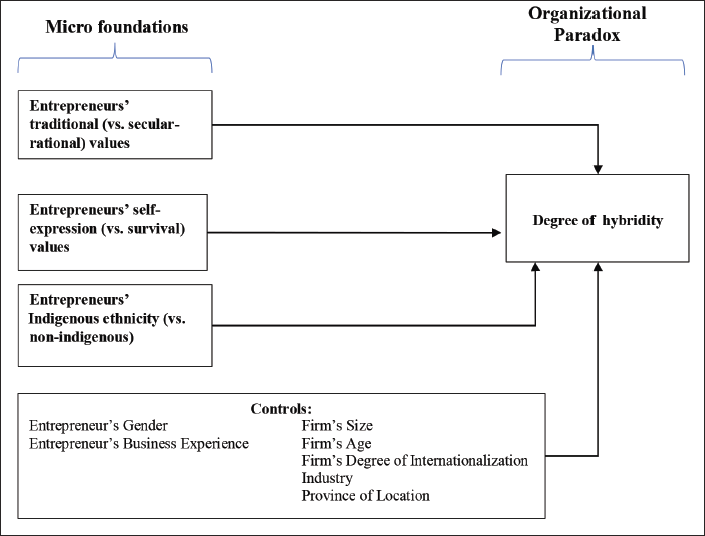
We use insights from paradox theory, as discussed in our earlier sections, to develop our arguments on the influence of entrepreneur’s cultural values on the hybridity of the firms they start. While paradoxes represent contradictions between multiple elements (Shad et al., 2016), paradox theory presents tensions between competing demands as inherent in organizational systems and requires strategies for engaging and accommodating tensions rather than resolving them (Smith & Tracey, 2016). The paradox theory (Smith & Lewis, 2011) provides a strong foundation for examining the influence that entrepreneurs’ cultural values and the ideologies of their communities may have on firms’ degree of hybridity. Current research utilizing paradox theory has advanced knowledge of the assumptions, structure, practices and dynamics of paradox in organizations (Lewis & Smith, 2022). However, our knowledge of the micro-foundations of paradox in organizations is limited. Recently, micro-foundational research has advanced the relevance of holistic thinking, integrative complexity and organic structure for paradoxical leader behaviour (Zhang et al., 2015). The importance of a paradoxical mind-set to improve job performance and innovation (Miron-Spektor et al., 2018) has also been emphasized. In our study (as per the conceptual model shown in Figure 1), we use this understanding to suggest that traditional (vs. secular–rational) values, self-expression (vs. survival) values, and indigeneity (vs. non-indigeneity) of entrepreneurs help to develop the paradoxical mind-set in them to create a higher degree of hybridity (social and economic objectives) in the businesses they start.
The Influence of Entrepreneurs’ Cultural Values and Ethnicity on Firms’ Degree of Hybridity.
This research is important because entrepreneurs face competing demands and hence face tensions. Tensions exist, for example, between profits and purpose (Battilana & Dorado, 2010; Battilana et al., 2022*), present and the future (Andriopoulos & Lewis, 2009), short term and long term (Slawinski & Bansal, 2015), internationalization and innovation (Alves et al., 2021), and globalization and localization (Smets et al., 2015). The findings of this study, therefore, contribute first to the micro-foundations of organizational paradox with a theoretical model that helps unpack which entrepreneurs are more likely to be paradoxical than others (e.g., Miron-Spektor et al., 2018; Poon et al., 2018). Second, our study empirically contributes by adding to the literature that moves the discourse from a binary conceptualization of hybridity to conceptualizing hybridity as a continuum (Shepherd et al., 2019). Third, the findings contribute to the literature on internationalization of hybrid enterprises (with simultaneous economic and social objectives) by highlighting that the culture of the entrepreneur influences the degree of hybridity of firms going international (e.g., Alon et al., 2020; Angulo-Ruiz et al., 2020).
Methodology
Sample and Data
The data for this study are based on a survey with a random sample of international businesses 3 based in Alberta and British Columbia (both provinces in Canada). Hybridity in international businesses is in its nascent stage (Alon et al., 2020) and therefore, our assumption is that hybrids (with economic and social objectives) are less likely to internationalize (Angulo-Ruiz et al., 2020).
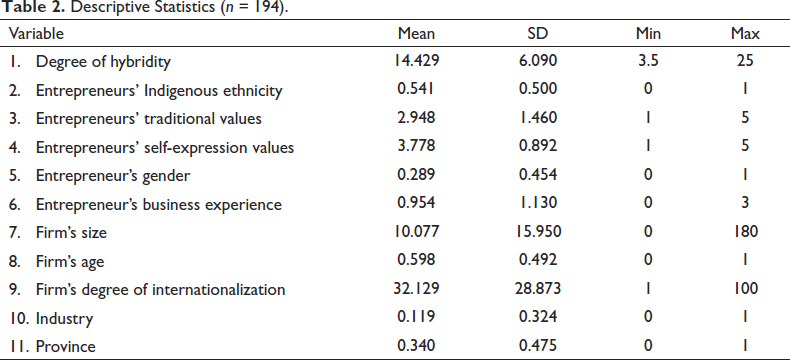
A customized survey was the most appropriate way to collect data because detailed archival information on international businesses, their degree of hybridity, as well as entrepreneurs’ cultural values and ethnicity was not (and still is not) available from secondary sources. Between August and October 2017, we collected a random sample of 299 responses from the majority of owners of businesses. 4 Of these, 150 responses came from self-identified Indigenous business owners (First Nations, Inuit or Métis), 117 came from self-identified Caucasian business owners, 26 came from other ethnicities and 6 did not want to provide information on their ethnicity. For the purposes of this study, we focus only on the Indigenous (First Nation, Inuit or Métis) and Caucasian responses, for a total of 267 responses. The Caucasian sample represents the mainstream focus of extant studies, and we refer to them as the non-Indigenous sample. Since some of the variables had missing responses the final sample set used for our analyses has 194 responses. Other characteristics of entrepreneurs and their enterprises are presented in Table 2.
Descriptive Statistics (n = 194).
We test for non-response bias in two different ways. First, we split the respondents into three groups and compare one-way ANOVA differences between early and late respondents. Second, we split responses into four groups and again compare differences between early and late respondents. The one-way ANOVA for the variables included in this study found no statistical differences between early and late respondents, except for Indigenous ethnicity and province of location variables. This is the case because we started collecting data in the province of Alberta and then we expanded the sampling frame to include businesses in the province of British Columbia to achieve our target quota. Additionally, getting responses from self-identified Indigenous respondents was onerous, and the great majority of self-identified Indigenous respondents were obtained late in the field work. We do not anticipate issues with non-response bias in the analysis after these checks.
We also test for common method bias and follow Podsakoff et al.’s (2003) process to avoid common method bias a-priori and a-posteriori of the survey field work. After all these statistical tests and our careful a-priori approach to build the questionnaire, we believe that common method bias is not a problem in our survey data. For reasons of space, details of common method bias tests are presented in Supplementary Material 1.
Dependent Variable: Degree of Hybridity
Following the current literature, we measure the degree of hybridity as a continuum (Battilana et al., 2017; Shepherd et al., 2019). We take into consideration the firm’s mission of creating social benefits (e.g., community employment) versus the mission of creating economic outcomes (e.g., profits; Smith & Besharov, 2019). In the survey, respondents rate the importance of four objectives for their businesses: (1) profitability, (2) growth, (3) community employment and (4) addressing societal problems along a scale ranging from 1—very unimportant to 5—very important. The order of appearance of these objectives in the survey question was random to avoid order bias.
An exploratory factor analysis yielded two dimensions, one ‘economic objectives’ (which averages responses to profitability and growth) and another ‘social objectives’ (which averages responses to community employment and addressing societal problems). Following previous literature (e.g., Angulo-Ruiz et al., 2020) we multiplied these two dimensions to compute the firm’s degree of hybridity (Shepherd et al., 2019). 5 In the above process, 10 observations were rated lower than 3 for each of the dimensions signifying low importance to economic objectives and social objectives. These observations were eliminated to refine our measure of hybridity. The degree of hybridity ranges from 3.5 to 25 points. Lower values indicate a lower degree of hybridity or businesses rating only economic or social objectives highly, and higher values indicate a higher degree of hybridity or businesses rating both economic and social objectives highly.
Independent Variables
Entrepreneurs’ Indigenous Ethnicity
In the survey, as indicated earlier, respondents who self-identified as First Nations, Métis or Inuit were grouped as Indigenous entrepreneurs and those that self-identified as Caucasian were grouped as non-Indigenous entrepreneurs. Other ethnic groups were not included in view of the low number of responses. Based on previous research, Indigenous ethnicity is considered a binary variable, where Indigenous entrepreneurs are coded as 1 and non-Indigenous entrepreneurs are coded as 0. 6
Entrepreneurs’ Traditional versus Secular-rational Cultural Values
From the items of the scale by Inglehart and Baker (2000) that were used to measure traditional versus secular–rational values, we used the items: God is very important in my life; I have strong sense of national pride; and I favour more respect for authority. 7 Respondents answered each item on a (1) strongly disagree to (5) strongly agree scale, and higher values indicate tendency towards traditional values and lower values indicate a tendency towards secular–rational cultural values. We chose the item ‘god is very important in my life’ as the measure of traditional (vs. secular-rational) values of the individual entrepreneur. The effects of the other two items ‘I have strong sense of national pride’ and ‘I favor more respect for authority’ on degree of hybridity were not significant and therefore were removed from further analysis.
Entrepreneurs’ Self-expression versus Survival Values
From the items of the scale by Inglehart and Baker (2000) that were used to measure self-expression versus survival values, we used the items: I give priority to self-expression and quality of life over economic and physical security; I describe myself as very happy; I have not signed and would not sign a petition; you have to be very careful about trusting people. The item ‘homosexuality is never justifiable’, was dropped for reasons of sensitivity. We chose the item ‘I give priority to self-expression and quality-of-life over economic and physical security’ as the measure of self-expression (vs. survival) values of the individual entrepreneur. The effects of the other three items ‘I describe myself as very happy,’ ‘I have not signed and would not sign a petition’, and ‘you have to be very careful about trusting people’ on the degree of hybridity were not significant, and thus were removed from further analysis.
Control Variables
Gender has been controlled by using a binary variable, that is, 1 and 0 for female and male respondents, respectively (Grimes et al., 2018; Shuvam & Mohanty, 2023). Entrepreneurs’ business experience (Hopp & Sonderegger, 2015) shapes the business’s structure, culture, and routines (Bryant, 2014), and has been controlled by using the number of businesses the entrepreneur has owned or started. Firm’s size approximates access to the ‘reservoir’ of resources which will influence the business (Albert & DeTienne, 2016) and has been controlled by using the total number of employees as a measure of firm size. Firm’s age was calculated by subtracting the year the firm was founded from 2017 (the year the survey data were collected). While previous research has used the threshold that separates new businesses from established ones as 6 years (Zahra et al., 2000), 8 years (Zahra, 1996), or 12 years (Covin et al., 1990), we have considered 10 years in line with the suggestion from recent research (Guenther et al., 2016). We measure a firm’s age as a binary variable where firms which are 10 years and younger are denoted as 0 and those older than 10 years as 1. We also control for firm’s degree of internationalization, which refers to the level of international sales the business makes (Zahra & George, 2002), using responses to the survey question ‘in the last fiscal year, what is the percentage of international sales to total sales?’ Given that the industry structure of the environment affects businesses, we controlled for industry by using a binary variable, where 1 represents manufacturing industry and 0 otherwise. The geographic community in which the entrepreneur is situated influences the networks (Marquis & Battilana, 2009) and the societal expectations of an entrepreneur (Marquis et al., 2007). We use the province where the business is located as the geographical community measured as a binary variable, that is, 1 if business is located in British Columbia and 0 if it is located in Alberta.
Analytical Techniques
We employ both PSM (Barbosa, 2023; Rosenbaum & Rubin, 1983) and ordinary least squares with robust standard errors to test our hypotheses and estimate models associated with Figure 1. Previous studies have used PSM to create comparable (matched) samples (e.g., Barbosa, 2023; Marquis & Qiao, 2020). Since we aim to have comparable samples between Indigenous and non-Indigenous entrepreneurs, we follow these studies. First, we created comparative sub-samples of Indigenous (=1) and non-Indigenous entrepreneurs (=0), and this is our dependent variable in PSM. While this issue may not be severe because the surveys chose respondents randomly, we still employed PSM (Rosenbaum & Rubin, 1983). PSM matches Indigenous entrepreneurs (the treatment group) with non-Indigenous entrepreneurs (control group) based on the propensity score, which we compute by running a probit model on observable variables (Marquis & Qiao, 2020). We specifically run three PSM models using the following sets of observable variables: (a) we use the entrepreneur’s gender, entrepreneur’s business experience, firm’s age, firm’s size, firm’s degree of internationalization and industry; (b) then we added province to the previous set of observable variables; and (c) finally we added entrepreneur’s traditional and self-expression values to the previous set of observable variables.
We estimated the likelihood of being selected into the treatment group (1: Indigenous entrepreneurs, 0: non-Indigenous entrepreneurs) (we use psmatch2 in Stata 17). 8 In the first PSM model, four responses did not match and were dropped for further regression analysis. In the second and third PSM models, 48 responses did not match and were removed from further regression estimations. 9 Tests confirmed that our overall matching quality was good. t-Tests for each variable between the two groups indicate that all differences were insignificant at 5% p-value; the pseudo-R2 of the probit model dropped to 0.029, 0.015 and 0.053 for the matched sample, in the three PSM models, respectively (Rosenbaum & Rubin, 1983).
Second, we estimated four different models using ordinary least squares with robust standard errors. Model 1 is the base model with no associated PSM estimations. Models 2–4 include all variables and weights from the PSM analyses.
Findings
Tables 2 and 3 present the descriptive statistics and correlation coefficients, respectively, of all variables used in our framework. Table 2 indicates that 28.9% of entrepreneurs are female. Entrepreneurs have, on average, started almost one business in the past. On average, the size of a business in our sample is 10 employees. Almost 60% of businesses are older than 10 years. Thirty percent of sales for the businesses in the sample come from international markets. About 12% of businesses are in the manufacturing sector, and 34% of businesses in the sample are located in British Columbia, Canada.
Correlation Matrix (n = 194).
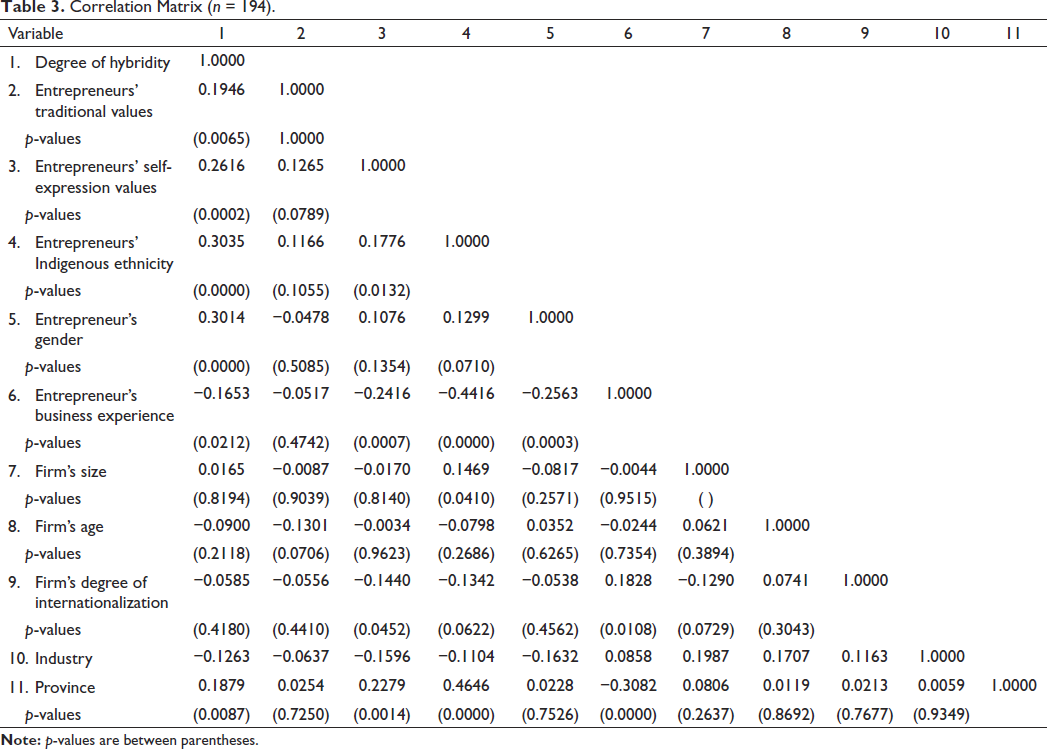
Table 4 presents the estimations of regressions with robust standard errors. Overall, the empirical models have a good fit. The R-squares are all significant. Entrepreneurs’ traditional values are positively related to the degree of hybridity only in model 1 (0.155, p < 0.026). In the three models using PSM-matched samples, entrepreneurs’ traditional values are not significantly related to the degree of hybridity. These results suggest the notion that entrepreneurs with traditional (vs. rational) values are more likely to generate a higher degree of hybridity in the firms they start has limited support.
Entrepreneurs’ Culture, Ethnicity and Firms’ Degree of Hybridity (Standardized Coefficients).
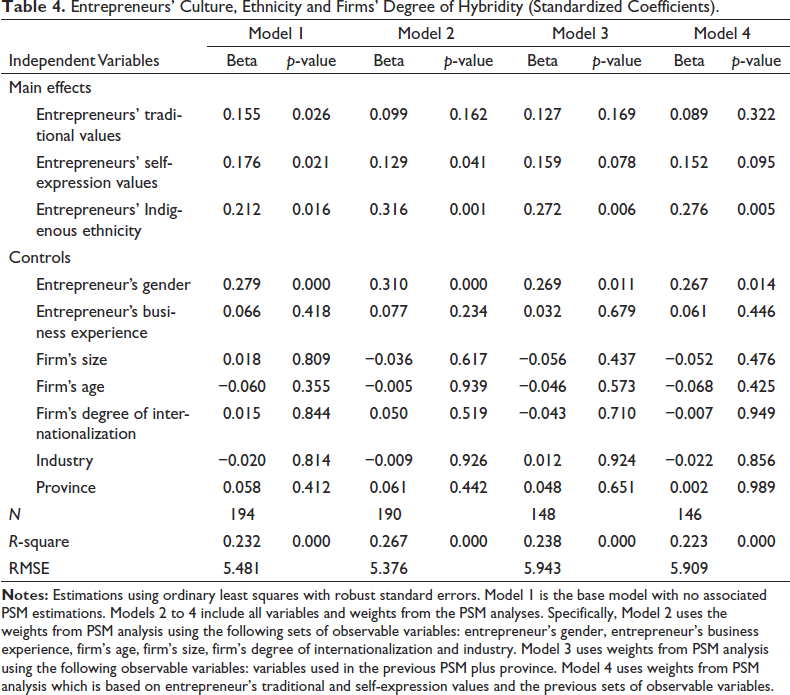
Entrepreneurs’ self-expression values are positively related to the degree of hybridity in all models: model 1 (0.176, p < 0.021), model 2 (0.129, p < 0.041), model 3 (0.159, p < 0.078) and model 4 (0.152, p < 0.095). These results suggest that entrepreneurs with self-expression (vs. survival) values are more likely to generate a higher degree of hybridity in the firms they start. In other words, entrepreneurs’ self-expression values lead to the creation of firms with both economic and social objectives. 10
Entrepreneurs’ Indigenous ethnicity has a strong positive relationship with degree of hybridity in all models: model 1 (0.212, p < 0.016), model 2 (0.316, p < 0.001), model 3 (0.272, p < 0.006) and model 4 (0.276, p < 0.005). These results, therefore, suggest that Indigenous (vs. non-Indigenous) entrepreneurs are more likely to generate a higher degree of hybridity in the firms they start. 11
Robustness Checks 12
We perform several robustness checks. First, we use an alternative measure of degree of hybridity as employed by Janis and Fadner (1943). This approach has been used previously by research on legitimacy to measure media endorsement (e.g., Deephouse, 1996; Zavyalova et al., 2012) and other related research (e.g., Agnihotri & Bhattacharya, 2019). Using this approach, the relative importance of social and economic dimensions of the degree of hybridity can be calculated. The findings from this approach indicate that entrepreneurs’ self-expression values and Indigenous ethnicity remain significant in models 2 and 4. These results corroborate our main findings.
Second, previous research has indicated that international businesses should have at least 25% of international sales to be considered international (e.g., Knight & Cavusgil, 2004). We re-ran regressions using a subset of our sample (sample size is reduced) with 25% or more of international sales. Entrepreneurs’ traditional values are significant in models 2 and 3. Entrepreneurs’ self-expression values and Indigenous ethnicity are no longer significant in models 1–4. However, when focusing on the sample of businesses with less than 25% of international sales, entrepreneurs’ self-expression values and Indigenous ethnicity are highly significant. Interestingly, these results indicate that entrepreneurs’ self-expression values and Indigenous ethnicity generate a higher degree of hybridity when businesses have a lower degree of internationalization. Finally, we use other control variables: entrepreneurs’ managerial experience and international business experience, which were not used in our earlier models as the number of observations is drastically reduced. In re-running models 1–4, we find that entrepreneurs’ self-expression values (in models 1, 3 and 4) and Indigenous ethnicity (in all models) remain significant. Again, these results corroborate our main findings.
Discussion
We discuss the implications of our study for theory and practitioners as follows.
Theoretical Implications
The key gaps in the literature on hybrid businesses, as mentioned in the introduction and literature review sections of our article, are that research examining the micro-foundational antecedents of organizational paradox is limited. Specifically, a lack of insights into the role of the culture of the entrepreneur is an important research endeavour since the entrepreneur is the one who manages paradoxes in hybrid organizations. Our research attempts to fill the above gap using perspectives from paradox theory. Organizational paradoxes arise at the macro-and micro-levels (Zhang et al., 2015). Extant research has predominantly focused on macro-level paradoxes such as tensions between exploitation and exploration (Poon et al., 2020) and conflicts between internal and external stakeholders (Margolis & Walsh, 2003). Paradoxical challenges at the micro-level and, in particular, the role of the leader in managing such challenges have received limited attention from scholars (Zhang et al., 2015). Our study, therefore, contributes in the following manner. First, our study theorizes antecedents of hybrid forms that balance economic and social logics simultaneously. In particular, the study addresses the influences that lead to the formation of such organizations. Second, the role of entrepreneurs and their orientations in the formation of such hybrids has been the primary objective of the study. In understanding the role of the individual entrepreneur’s value orientation and their community identity in the formation of hybrids, the findings of the study have directly demonstrated the role of the leader in the formation of such hybrids. These findings move the conversation on what affects hybrid organizational forms. Drawing parallels between our study and the forms proposed by Bull and Ridley-Duff (2019), ideal hybrids in the context of private businesses might resemble the philosophy of associative charitable trading activities, cooperative and mutual enterprises, and socially responsible businesses in the context of social enterprises. Entrepreneurs with self-expressive values and identified with an Indigenous ethnicity have higher proclivities to form ideal hybrids and embrace paradoxical organizational forms.
Our study indicates that entrepreneurs’ self-expression values as opposed to survival values affect a higher degree of hybridity in the firms they create. Previous literature has shown that in societies high on survival values entrepreneurs create businesses mainly driven by economic objectives (Reynolds, 2011), and in societies high on self-expression values, entrepreneurs not only place higher priorities on post-materialism (Stephan et al., 2015) but also tend to create more profit-driven enterprises (Hechavarría & Reynolds, 2009). Our research thus consolidates these findings and suggests that entrepreneurs with higher self-expression values tend to form firms with a higher degree of hybridity. In other words, entrepreneurs’ self-expression values make these entrepreneurs embrace organizational paradox and opt for ideal hybrids.
Third, our research does not fully support the notion that entrepreneurs’ traditional values affect hybrid organizational forms. In an independent examination of these values on entrepreneurship as a whole, extant research suggests that the greater the emphasis on traditional values, the greater the emphasis on the higher level of business creation (Reynolds, 2011). The existence of traditional values has been closely associated with commercial entrepreneurship and it is suggested that if a society prioritizes traditional value systems, the rate of commercial entrepreneurship should increase (Hechavarría, 2016). Conversely, secular–rational values have been closely associated with social entrepreneurship and it is suggested that if a society prioritizes secular-rational values, the rate of social entrepreneurship should increase (Stephan et al., 2015). In view of the above findings and our own findings from this study, future research may need to further theorize and empirically examine the effect of traditional (vs. secular–rational) values on hybridity.
Fourth, our research shows that entrepreneurs’ Indigenous ethnicity generates a higher degree of hybridity in the firms they start. This finding highlights that Indigenous ethnicity is a driver of the paradox of pursuing economic and social objectives simultaneously. Indigenous communal orientation and social aims of exchange (Peredo & McLean, 2013) would potentially explain such differences. Their communal orientation is a key factor of socio-economic progress within Indigenous communities (Pergelova et al., 2022). Social aims of exchange are also crucial for Indigenous businesses (Hindle & Lansdowne, 2005) where ‘their goal is not economic development alone, but economic development as part of the larger agenda of rebuilding their communities and nations and reasserting their control over their traditional territories’ (Peredo et al., 2004, p. 6). Future research is encouraged to measure communal orientation and social aims of exchange of entrepreneurs and include these measures in empirical models.
Finally, our research also contributes to the extant literature on hybrid firms. Specifically, our study contributes to research on the duality of economic and social objectives in entrepreneurial endeavours. This study addresses the call for research to examine the antecedents of degree of hybridity of firms (Battilana et al., 2017; Shepherd et al., 2019), in the context of international business. This is particularly important in view of the complexities of internationalization (Ambos et al., 2020). Our findings indicate that entrepreneurs’ cultural values and ethnicity are significant antecedents of degree of hybridity in such firms. Finally, the findings from the study enrich the current literature on hybrid firms and move the dialogue from binary hybridity to degree of hybridity (Battilana et al., 2017; Shepherd et al., 2019).
Practical Implications
This study also offers implications for businesses. Based on our findings, entrepreneurs’ self-expression values seem to be central for generating a higher degree of hybridity and thus to forming ideal hybrids. In our empirical analysis, self-expression values comprise the following statement: ‘I give priority to self-expression and quality-of-life over economic and physical security’. 13 Entrepreneurs need to be aware of which values tend to be related to a higher degree of hybridity in the context of this study. Understanding the antecedents of hybrid firms has implications in that such organizational forms that bring together practices from multiple logics are often considered to be potential solutions to address deep-rooted societal problems for which there are no obvious and clear solutions (Holt & Littlewood, 2015). Furthermore, understanding the trajectory of Indigenous businesses is important for the creation of hybrid businesses. Indigenous entrepreneurs tend to value more communal orientation and social aims of exchange (Peredo & McLean, 2013). Future research needs to continue to understand Indigenous entrepreneurs and the businesses they create (Colbourne et al.., 2023; Salmon et al.., 2023). In sum, our study identifies key factors that are central for entrepreneurs to achieve a higher degree of hybridity in the firms they start and generate ideal hybrid organizations.
Limitations and Future Research Opportunities
While we consider this study has advanced current conversations on organizational paradox, culture and hybrid forms, there are other opportunities for future research. First, entrepreneurs’ cultural values have been examined within a single-country study. Future research may extend our findings to examine the phenomena in a cross-cultural/country empirical setting. Second, our study is cross-sectional. Longitudinal case studies could add rich data that could contribute to theory generation both for paradox theory and research on hybrid firms. Future studies should also consider other cultural values such as those of Hofstede, Schwartz or GLOBE at the entrepreneur’s level and include them as antecedents of firms’ degree of hybridity.
Third, hybrid firms could be commercial enterprises with social objectives (firms with corporate social responsibility objectives) (Homer & Gill, 2022; Pradhan & Nibedita, 2021; Russo et al., 2022). Social enterprises are also considered hybrid organizations, which achieve their social goals through business (with economic goals) to sustain their operations (Mair & Marti, 2006). Our research, however, did not distinguish between these kinds of hybrid firms as we only studied private businesses. Future research may theorize and empirically test the effects of entrepreneurs’ culture on these different types of hybrid firms (Bull & Ridley-Duff, 2019).
Fourth, social value in a hybrid firm could be a relative concept that is affected by the context in which it is studied. For example, entrepreneurial activity by Indigenous people of Australia is considered either social or commercial entrepreneurship, where the kinship structures of Indigenous communities play a role in the definition of social (vs. commercial) objectives of the enterprise (Puumalainen et al., 2015). As such it has been established in the literature that individuals from different Indigenous groups may not become entrepreneurs for the same reason (Dana, 1997). Further, in some contexts Indigenous groups may be disadvantaged in terms of access to resources (Mishra & Tripathi, 2017). Future research may, therefore, need to validate our findings across different Indigenous contexts.
Fifth, antecedents that drive the nature of solutions that firms deploy when managing multiple logics, that is, blended hybrids (vs. structural hybrids) may be an area of future research (Perkmann et al., 2019). Sixth, hybrids as an outcome of ethical imprints may also be examined by future research, where hybridity may be reframed as a ‘moral choice of economic system (redistribution, reciprocity and market) and social value orientation (personal, mutual or public benefit)’ (Bull & Ridley-Duff, 2019, p. 619). The effects on hybrid firms with different kinds of social goals (e.g., employee well-being and community development) may also need to be examined in the future (Chowdhury et al., 2019).
Finally, our study in one of its objectives is a comparison between Indigenous and non-Indigenous businesses’ effects on hybridity. Future studies can focus exclusively on non-Indigenous business and Indigenous business samples as independent studies and examine the effects of cultural value orientations on the internationalization of businesses. Doing so can generate fine grained insights on internationalization in these contexts. 14
Footnotes
Acknowledgements
We are very thankful for the guidance and comments received from the editorial board and reviewers of the Global Business Review. We are grateful for the comments and suggestions received from attendees to the 2020 Administrative Sciences Association of Canada Conference as well as from the Academy of International Business conference reviewers. We very much appreciate the participation of Indigenous and non-Indigenous entrepreneurs in Alberta and British Columbia, Canada, who kindly shared their information. Social Sciences and Humanities Research Council of Canada, MacEwan University School of Business and MacEwan University Research Office provided financial support to develop and disseminate this research.
Declaration of Conflicting Interests
The authors declared no potential conflicts of interest with respect to the research, authorship and/or publication of this article. Both authors contributed equally to the development of this study.
Funding
This research was supported by The Social Sciences and Humanities Research Council of Canada, Insight Grant 435-2022-0515..
