




Abstract
Extant developed country-based literature suggests that human resource diversity is a significant predictor of both innovation and internationalization. Equally, this literature consistently finds innovation to be a clear contributor to internationalization and vice versa. This study tests these assumptions in an emerging market context, thus responding to the call for increased business research in under-represented regions and Latin America, specifically. Executives of 343 firms responded to a Likert-scale survey to identify recent HR diversity practices, firm innovation activity and firm internationalization intensity. Principal components, logistic regression and multivariate regression analysis provide insight into how diversity and innovation impact internationalization and how diversity and internationalization impact innovation. As the first study of these relationships in the Latin American setting, our research contributes to the literature on emerging markets by providing evidence of firm behaviour in Colombia and Mexico and demonstrating that Latin American firms do not perform as developed country-based literature would suggest. Diversity, innovation and internationalization do not act as complementary activities in the Colombian and Mexican firms in this study, which contrasts with findings in developed market firms. This study contributes to the literature by exploring the relationships among HR diversity, firm innovation activity and firm internationalization intensity.
Introduction
Latin American firms are increasingly seeking to build competitive advantages based on innovation so as to diversify away from commodities and standardized manufactures (Edler & Fagerberg, 2017; Pino, 2018), and to promote foreign market entry and organizational growth through internationalization (Navarro-García et al., 2013; Rahman et al., 2017). However, with limited firm-level scientific capabilities and budgets and incipient national-level innovation and regulatory institutions, many types of innovation are seemingly out of reach to emerging market firms (Benavente, 2009; Rahman et al., 2017), as the dismal number of innovative firms demonstrates, even despite over-reporting due to a broader concept of innovation than generally applied in OECD countries (Crespi & Zuñiga, 2012; DANE, 2017; INEGI, 2017).
Lesser financial and regulatory demands are an incentive to focus on organizational innovations instead of technological innovations. Defined as the implementation of new methods of business practice, workplace organization or external relationships (OECD/Eurostat, 2019), organizational innovation involves the creation of an internal environment conducive to the enhancement of firm resources and capabilities, including human resources (HR) and organizational learning capabilities. The employment of diverse HR may be considered a form of organizational innovation, which, subsequently, foments the crossing of both mental and geographical barriers required for innovation and internationalization. Previous research demonstrates that organizational innovation is the key predictor of export performance in emerging markets (Bonaglia et al., 2007), including those in South America (Pino et al., 2016), and is the catalyst to other innovations, including technological innovation (Damanpour, 1991; Damanpour et al., 2009; Pino et al., 2016). Internationalization, also, may be a form of organizational innovation, as it is a new method of relating to the external environment (Prashantham, 2005). In turn, internationalization provides opportunities for organizational learning, which may then foment additional innovation, thus creating a virtuous cycle (Alves et al., 2021; Chiva et al., 2014; Filippetti et al., 2011).
Extant literature suggests that HR diversity is a significant predictor of both innovation and internationalization (Schubert, 2021). Equally, the literature consistently finds innovation to be a clear contributor to internationalization and vice versa. Nevertheless, this extant literature is predominantly developed market-derived, and these relationships have thus far been untested in emerging market contexts. To the best of the authors’ knowledge, this is the first study to explore these relationships, in an articulated triad, in Latin America. As Latin American governments and firms seek to improve productivity, enhance competitiveness and shift the economic base to more value-added products, unified and holistic policies and strategies, specific to Latin American realities, are necessary to strengthen the supporting institutions and improve firm performance across and among diversity management, innovation and internationalization.
Latin American-specific literature review and the results of this study indicate, however, that HR diversity, innovation and internationalization do not have the same relationships and importance to firm performance in this context as they do in the developed market context. In particular, while Latin American firms and governments readily identify innovation and internationalization as desirable goals, diversity has not reached the level of political and social desirability in Latin America as it has in many developed countries (Krentz et al., 2019).
This study seeks to explore the relationship between HR diversity, firm innovation activity and firm internationalization intensity in Latin America, hence responding to the call for such an interdisciplinary discussion (Coviello, 2015) while at the same time responding to the call for increased business research in under-represented regions (Andriopoulos & Slater, 2013) and Latin America, specifically (Aguinis et al., 2020). More precisely, this study seeks to respond to the following questions. How do HR diversity and innovation activity impact internationalization intensity? In turn, how do HR diversity and internationalization intensity impact innovation activity?
The setting for the study is Colombia and Mexico, both upper-middle-income economies and the two most populated Spanish-speaking countries in Latin America. Three hundred and forty-three executives in an equal number of firms responded to a Likert-scale survey to identify recent HR diversity practices, innovation activity and internationalization intensity. Principal components analysis (PCA), Logistic Regression and Multivariate Regression analysis provide insight into how the combination of HR diversity and innovation impacts internationalization and how the combination of HR diversity and internationalization impacts innovation.
The article proceeds as such. The subsequent section provides a literature review of the following dyadic relationships: (1) HR diversity–innovation, (2) HR diversity–internationalization, (3) innovation–internationalization and (4) internationalization–innovation. This sets the stage for the presentation of the proposed model for analysis. The subsequent sections describe the empirical research to test this model and the results. The article closes with discussion to guide both firm strategy and national public policy and then provides recommendations for future research.
Literature Review
HR diversity–Innovation
The knowledge-based view (KBV) of the firm emphasizes knowledge as the source of competitive advantage (Schubert, 2021; Grant, 1996; Prashantham, 2005). The configuration of the intangible, non-substitutable and inimitable firm assets provides the basis for competitive advantage (Wiersema & Bantel, 1992) through the HR that constitute the knowledge–resource competencies (Barney, 2001; Sveiby, 2001; Wernerfelt, 1984). Within the KBV is the assumption of many types of knowledge in and for firms’ operations (Prashantham, 2005).
Diversity within HR provides the firm with a variety of types of knowledge as well as better access to non-redundant, task-relevant information (Roberge & van Dick, 2010; Williams & O’Reilly, 1998) through individual attributes, such as skills, abilities, social categories, experience, attitudes, values, beliefs, personalities, organization or community status, and social or network ties (knowledge, skills, abilities and others (KSAOs)) (Chaudhry et al., 2021; Harrison et al., 2002; Mannix & Neale, 2005). Thus, these KSAOs form the intellectual capital, in the form of human capital, at the organizational level (Schultz, 1961 and Becker, 1964 cited in Dar & Mishra, 2019).
Human capital positively impacts innovation capability (Dar & Mishra, 2019). Indeed, the value-in-diversity approach (Cox & Blake, 1991) recognizes that diversity in human capital is a primary source of competitive advantage due to its positive influence on creativity and innovation, among other things (Bantel & Jackson, 1989; Bocquet et al., 2019; Joshi & Roh, 2007; Ostergaard et al., 2011). As such, the promotion of HR diversity is currently one of the most posited non-financial firm goals (Krentz et al., 2019), particularly as firms seek to increase innovation activity and innovation performance (Schubert & Tavassoli, 2020; Sinha & Srivastava, 2015).
This is compatible with the evolutionary perspective of innovation (Nelson & Winter, 1982 cited in Schubert & Tavassoli, 2020) which recognizes HR diversity as providing a greater variety of information. The first stages of idea or concept generation require diverse knowledge sources for opportunity search and brainstorming activities (Chiva et al., 2014). Diverse participants interrelate, integrate and contest their complementary KSAOs, enabling innovation and potentially enhancing the positive impact of innovation on firm performance.
Empirical studies find evidence of positive effects on broadly-defined innovation through general diversity (Chamorro-Premuzic, 2015; Earley & Gardner, 2005; Ranjhan & Mallick, 2018), gender diversity (Maznevski, 1994; Ostergaard et al., 2011), and cultural diversity (Ely & Thomas, 2001; Stahl et al., 2010). Research at the top management team (TMT) and board levels finds that gender, nationality and educational diversity tend to have a positive or null impact on innovation. Nonetheless, the limited HR diversity research at the broader firm level finds mixed results (Bocquet et al., 2019; Goyal & Shrivastava, 2013; Guillaume et al., 2017; Horwitz & Horwitz, 2007; Krome, 2017; Roberson et al., 2017; Shore et al., 2009; Winkler & Bouncken, 2011).
The impact of HR diversity also depends on the type of innovation. The Oslo Manual (OECD/Eurostat, 2019) classifies four principal types of innovation: the technological innovations of product and process innovation and the non-technological innovations of marketing and organizational innovation. For example, general, knowledge-based diversity in Latin American firms in Argentina, Chile, Colombia, Costa Rica, Panama and Uruguay positively impacts technological innovation (Crespi & Zuñiga, 2012), and nationality diversity positively affects product innovation but negatively affects innovation (Bocquet et al., 2019). There is also the question of radical or incremental innovation. Organizations that undergo adaptive learning with limited sources of knowledge and creativity (low diversity) tend to experience incremental innovation and low internationalization intensity. In contrast, organizations that undergo generative learning through broad sources (high diversity) tend to experience radical innovation and high internationalization intensity and extensity (Chiva et al., 2014). As with most emerging market firms, Latin American firms are more likely to participate in the former (Crespi & Zuñiga, 2012).
Latin American firms tend to rely on managerial capabilities rather than HR diversity to overcome constraints. Autocratic and paternalistic management styles predominate throughout Latin America (Behrens & Medeiros, 2020; Castaño et al., 2015; Davila & Elvira, 2012; Lenartowicz & Johnson, 2002). These styles comprise centralized authority and deference to hierarchy. For example, in Mexico, egalitarian decision-making is a sign of leader weakness; in Colombia, the leader is the one expected to provide innovative ideas (Howell et al., 2007 cited in Castaño et al., 2015).
Innovation activity requires openness to ambiguity and receptiveness to mid-course changes at multiple firm levels. Nevertheless, previous cross-national research finds that Latin American employees tend to be inflexible and ambiguity-intolerant and demonstrate a strong preference for clarity, order and structure (Purohit & Simmers, 2006). Paternalistic management style, which extant research identifies as predominant in Latin America, implies that employees acquire a loyal but silent status in return for a ‘psychological contract’ of employment conditions in the void of legal contracts and regulatory labour institutions (Behrens & Medeiros, 2020; Davila & Elvira, 2012). One unfortunate result is subpar productivity and performance. Furthermore, instead of hiring outside talent, many firms train their current employees (Davila & Elvira, 2012), which, while commendable, has the adverse effect of creating knowledge endogamy.
Consistent with paternalism, team-oriented and relationship-oriented leadership tends to prioritize conflict resolution, stability, interpersonal communication and positive social interactions (Castaño et al., 2015; Lenartowicz & Johnson, 2002) with specific findings in Colombia (Ogliastri,1998 and Ogliastri 2007 cited in Castaño et al., 2015) and Mexico (Kras, 1994 and Howell et al., 2007 cited in Castaño et al., 2015). In efforts to maintain social harmony, leaders might limit conflictual engagement—even constructive—with the unintended consequence of limiting innovation.
Increasing HR diversity may enhance their capacity to undertake innovation activities and improve innovation performance, as well as compete in international markets (Schubert, 2021; Bocquet et al., 2019). Research in Argentina, Chile, Colombia, Costa Rica, Panama and Uruguay finds that firms that invest in knowledge are more likely to produce innovative advances (Crespi & Zuñiga, 2012). In fact, the beneficial impacts of innovation in these Latin American firms occur at rates superior to those reported in developed-country firms (Crespi & Zuñiga, 2012).
Based on this literature review relating HR diversity with firm innovation:
HR diversity–Internationalization
Human capital is a significant predictor of internationalization (Gulanowski et al., 2018; Ibarra-Colado et al., 2010), and a lack of qualified human capital is the principal endogenous barrier to internationalization (Pino et al., 2020). Foreign market knowledge, or lack thereof, is at the core of much internationalization process literature (Eriksson et al., 1997; Gulanowski et al., 2018; Petersen et al., 2008). Especially in emerging markets, beyond market knowledge, potential human capital-related barriers include language, sociocultural perspectives and approaches and skills (Mendy & Rahman, 2019a, 2019b; Pino et al., 2020).
While classic internationalization process literature implies that internal knowledge develops through the organizational learning process associated with first-hand firm experience in foreign markets, HR diversity can also enhance internal sources of market- and task-related knowledge. Idiosyncratic knowledge foments organizational capabilities (Knight & Cavusgil, 2004). Then, firms leverage organizational capabilities to intensify further capabilities and knowledge (Kafouros et al., 2012; Tallman & Fladmoe-Lindquist, 2002), and knowledge-intensive firms internationalize both more extensively and intensively as well as earlier in their life-cycle (Autio et al., 2000).
While human capital is necessary to internationalize, social capital is no less relevant (Prashantham, 2005). Social capital provides exogenous sources of information, leading to endogenous knowledge acquisition and creation (Kogut, 2000; Nahapiet & Ghoshal, 1998) and potentization of this newly accessed knowledge toward firm performance and growth (Adler & Kwon, 2002). Acknowledging the value of these external knowledge sources, second-generation internationalization process literature includes network relationships and benefits (Gulanowski et al., 2018; Johanson & Vahlne, 2003, 2009; Prashantham, 2005).
In the internationalization process, social capital aids in tapping general and market-specific knowledge, reducing costs, acquiring financial and technological resources, enhancing exploratory capability and increasing knowledge intensity (Lindstrand et al., 2011; Suseno & Pinnington, 2018) thus positively influencing product and service quality, competitive differentiation, foreign market-entry, market performance and international growth (Suseno & Pinnington, 2018). Indeed, certain globe-spanning industries are nearly impossible to penetrate without the benefit of social capital (Johanson & Vahlne, 2009); these may include, for example, fashion and garment design, diamond and precious gem trade and automobile manufacturing (Suseno & Pinnington, 2018).
There is a robust association between nationality diversity and internationalization (Filippetti et al., 2011). Most obviously, foreign employees provide human capital in the form of language abilities and market knowledge, but also diverse perspectives, approaches and skills (Mendy & Rahman, 2019b). They also contribute to social capital in the form of strong and weak international network ties (Suseno & Pinnington, 2018). Likewise, in addition to nationality diversity, broader HR diversity supports internationalization through the unique KSAOs that individuals and their social ties contribute to the firm’s ability to serve diverse market needs.
Based on this literature review relating HR diversity with firm internationalization:
Nevertheless, the feasibility of realizing the benefits of human capital and social capital depends on TMT disposition and trust. Much of Latin America has strong cultural values of in-group collectivism, often making leaders reticent to develop trust with out-group members (Behrens & Medeiros, 2020). Since research consistently shows that effective Latin American leadership depends on close contact and allied relationships (Behrens & Medeiros, 2020; Castaño et al., 2015; Lenartowicz & Johnson, 2002), extended relationships—especially weak international network ties—would not figure highly in the effective leader toolkit. While ‘worldliness’ is a positive trait for leaders across Latin America (except Brazil) (Castaño et al., 2015), this is not to say that there is a high regard or trust for foreigners or ‘worldly’ employees—precisely those ablest to contribute to the internationalization process.
Innovation-Internationalization
The internationalization literature, dating back to Vernon (1966), consistently supports the assertion that innovation bestows competitive advantages in foreign market entry and expansion (Azevedo et al., 2021; Chiva et al., 2014; Navarro-García et al., 2013), including for emerging market firms (Lu et al., 2010; Rahman et al., 2017) such as those in Latin America (Alves et al., 2021; Crespi & Zuñiga, 2012; Pino, 2018). There is some suggestion that innovation may be a prerequisite to initial, but not necessarily sustained, international activity (Cassiman & Golovko, 2011; Chiva et al., 2014). In this case, firms self-select into innovation in anticipation of internationalization. On the other hand, innovation literature indicates that firms self-select into internationalization to increase sales volume to economize on the fixed costs of innovation (Bustos, 2011; Ottaviano & Volpe Martincus, 2011; Van Beveren & Vandenbussche, 2010).
The relationship between innovation and internationalization via exporting is predominant in the literature (Danish et al., 2021; Becker & Egger, 2013; Cassiman & Golovko, 2011), with evidence of self-selection into innovation before exporting (Bustos, 2011; Van Beveren & Vandenbussche, 2010) and that pre-exporting innovation increases the profitability of the export activity (Cassiman & Golovko, 2011). Furthermore, the literature finds that product innovation is a robust predictor of export activity and export performance, whether due to improved productivity rates or improved market satisfaction (Cassiman & Golovko, 2011; Villar et al., 2012).
There is also evidence that the innovation-internationalization equation holds for other types of innovation and internationalization. While the bulk of the literature on the innovation-internationalization relationship explores internationalization through export, there is growing evidence of innovation-spurred internationalization through other entry modes such as franchising and foreign direct investment (FDI), as well (Ottaviano & Volpe Martincus, 2011). Broadly put, high innovation intensity correlates with high internationalization intensity, when this innovation solidifies the firm’s social capital within international innovation and production networks (Altomonte et al., 2013; Christofi et al., 2021).
There is evidence that Latin American firms self-select into innovation prior to internationalization, principally to comply with competitive requirements in foreign markets (Hernández et al., 2016). However, as previously discussed, many emerging market firms, such as those in Latin America, may not participate in intensive innovation due to weak institutions and limited resources (Benavente, 2009; Pino et al., 2020; Rahman et al., 2017). In fact, for them, most technological innovation has little to null impact in international markets (Crespi & Zuñiga, 2012). For Latin American firms, organizational innovation is more predictive of initial international activity and international performance (Pino, 2018; Pino et al., 2016).
Based on this literature review relating innovation with firm internationalization:
More internationalized firms, especially those within innovative country-sector pairings (Altomonte et al., 2013), are more likely to innovate (Chiva et al., 2014; Criscuolo et al., 2010). Pressures from the external environment (such as resource scarcity or consumer demand) and internal decisions (such as resource acquisition or capability development) motivate the firm to innovate. When the firm generates different types of innovation, it further increases its ability to adapt to the changing environment (Damanpour et al., 2009). Thus forms a virtuous innovation–internationalization–innovation cycle (Chiva et al., 2014; Filippetti et al., 2011).
This was undoubtedly the intention of the Washington Consensus and Latin American governments as they initiated the path to market-oriented structural reforms and trade liberalization in the 1990s (Dutrénit & Katz, 2005). The expectation was that, by reducing trade barriers and restrictions on inbound FDI, countries would experience an increase in innovation through the economies of scale provided by a larger potential market (Desmet & Parente, 2010), specialization in domains of comparative and competitive advantage, access to state of the art knowledge through FDI spillovers, and organizational learning through import and export activity (Alvarez et al., 2019; Dutrénit & Katz, 2005).
The OECD’s Trade and Innovation Project Committee defines three paths by which internationalization impacts innovation (Kiriyama, 2012). First, technology diffusion through imports or FDI foments innovation capability. Firms that operate in different institutional and innovation contexts, whether in a foreign market or the home market through association with foreign partners, confront alternative technologies and technology usages (Filippetti et al., 2011). However, the conversion process between confrontation and application may depend on national-level knowledge accumulation processes and absorptive capabilities (Cohen & Levinthal, 1989, 1990 cited in Criscuolo & Narula, 2008). Latin American firms, for the most part, are in the ‘catch-up’ phase. As such, much of their innovation occurs through imitation and technology transfer associated with imports and inward FDI (Crespi & Zuñiga, 2012). Gaining further innovation-related benefits from internationalization, in many cases, is cost-prohibitive and strategically disincentivized by the long time-horizon for results (Navarro et al., 2010 cited in Crespi & Zuñiga, 2012; Dutrénit & Katz, 2005).
In contrast, in the ‘pre-frontier’ phase and beyond, innovation-inducing technology transfer mainly occurs through independent search activities resulting in outward FDI, joint ventures, and strategic alliances (Criscuolo & Narula, 2008). Segueing into the second path in the OECD’s Trade and Innovation Project Committee’s outline, increased competition at home and abroad incentivizes innovation (Kiriyama, 2012). Firms new to both internationalization and innovation may self-select into internationalization as a means of acquiring knowledge and technology for future innovation activity (Criscuolo & Narula, 2008). Already internationalized firms may self-select into innovation to better serve foreign markets or defend home markets (Kafouros et al., 2008).
Finally, learning opportunities arise with international activity and thus increase human and social capital-related innovation capability (Altomonte et al., 2013). The learning-by-exporting literature (De Loecker, 2013; Schubert & Tavassoli, 2020) posits that broader exposure to foreign markets increases the knowledge necessary for innovation. Later research finds evidence of learning through other entry modes, as well (Altomonte et al., 2013; Chiva et al., 2014; Criscuolo et al., 2010). Whether through the foreign markets themselves or the network of alliances in the foreign market (Cassiman & Golovko, 2011), internationalized firms increase the inward flow of exogenous ideas and exposure to a broader range of sociocultural perspectives.
Based on this literature review relating firm internationalization with innovation:
Concerning, however, is that Latin American firms do not necessarily behave as the developed-country literature suggests. Exports, alliances and FDI increase innovation activity in Latin American firms, seemingly, only when there is supporting national policy; and the difference is stark. Firms in Chile, Colombia and Costa Rica invest 79%, 81% and 100% more, respectively, in innovation activity when they receive government support to do so (Crespi & Zuñiga, 2012). Furthermore, scientific-, market-, and network-based sources of knowledge have weak to null impact on firms’ innovation activity in Latin America (Crespi & Zuñiga, 2012), and specifically in Colombia (Bernal-Torres & Blanco-Valbuena, 2017). Also, contrary to standard wisdom on inward FDI, Latin American recipients do not have higher investitures in innovation (Crespi & Zuñiga, 2012; Dutrénit & Katz, 2005). Finally, Chilean and Colombian exporting firms demonstrate a 15% and 14% lower probability, respectively, of participating in innovation activity than non-exporting firms (Crespi & Zuñiga, 2012).
As expressed in hypotheses 1 through 5, the general assumption based on the reviewed literature is that HR diversity positively impacts both innovation and internationalization, innovation positively impacts internationalization and internationalization positively impacts innovation. The study initially seeks to analyse the intensity of HR diversity, innovation, and internationalization—the number of modes active simultaneously—rather than the extensity of any individual indicator, in line with previously cited literature (Altomonte et al., 2013; Chiva et al., 2014).
HR diversity in this study includes gender, age, nationality, native language, disability, education level, education and socioeconomic status. Also included in HR diversity are diversity management practices of implementing HR inclusion policies and sponsoring short-term expatriate assignments. The literature review provided several instruments to measure HR diversity and inclusion intensity (Bocquet et al., 2019; Mendy & Rahman, 2019a; Schubert & Tavassoli, 2020). For innovation, the study adapted existing instruments to measure product, process, marketing and organization innovation intensity (Altomonte et al., 2013; Pino et al., 2016; Schubert & Tavassoli, 2020). For internationalization, the study adapted instruments to measure international exploration, exports, alliances, inward and outward FDI, and revenue abroad (Altomonte et al., 2013).
Based on this literature review relating firm internationalization, innovation and HR diversity:
Research Methodology
For the purposes of this research a nonprobability sampling method was applied with which 250 executives of medium and large firms were invited to participate in Bogotá, Colombia. After a prolonged time and various attempts to reach out to them, only 203 of the 250 invited participants (81.2%) completed the survey. Equally, in Chihuahua, Mexico, 200 executives were invited of which 140 participants (70%) finally completed the survey after having received several invitations to participate in the research over an extensive period. The low response rate is indicative of the relative lack of interest in matters of management research by executives in Colombia and Mexico, which puts an additional strain on the collection of data in those countries. Considering the difficulties inherent in the research landscape in Colombia and Mexico, significant efforts were made to collect the data for this research. Moreover, this study focuses on medium- and large size firms due to their much more intense activities in internationalization, innovation and diversity compared to small and micro firms (Danish et al., 2021). The control variables were firm size (medium or large), the type of economic sector, years of economic activity (at least 5 years), location in either Bogotá, Colombia, or Chihuahua, Mexico. Regarding the comparison of the results of the study by location and not by industry, we considered the strength of Chihuahua in terms of the foreign assembly plant industry, such as in the automotive, electronics, information technology and aerospace sectors, whereas industry in Bogotá is more local and diversified but with low levels of technology and innovation, and low foreign investment and low added value. For these reasons, our interest was in the presence of foreign-owned industry with emphasis on assembly plants (Chihuahua) compared to another region (Bogotá) where there is little presence of foreign industry with low levels of foreign investment and advanced innovation. These two regions rather than industrial sectors were compared because in Chihuahua there is direct foreign investment in technologically advanced sectors in assembly plants, whereas in Bogotá the industrial activity focuses on different sectors that are not high technology with less foreign direct investment. The commonality of the two cities is the greatest concentration of industry in their respective countries which both are emerging markets from the Latin American region (Colombia and Mexico).
Three hundred and forty-three mid- to top-level executives of medium- and large-size firms (one executive per firm), with more than 5 years of economic activity, distributed across sectors, in Colombia and Mexico, responded to a Likert scale survey ranging from 1 to 5 (1 = totally in disagreement; 5 = totally in agreement) to evaluate levels and types of HR diversity, innovation, and internationalization. The survey consists of 10 questions each about innovation, internationalization and HR diversity based on the literature review. Ten items were chosen because they are the items that are most often repeated in different research reviewed on each of the variables analysed. Ten items of each variable were chosen to guarantee balance or harmony between the items that measure these variables.
The authors identified the responding executives through the respondents’ affiliations with the universities involved in this study. Such affiliations include current MBA students, alumni, superiors of current MBA students, contact persons for internships and social service, and executive adjunct lecturers.
Before application, the research team validated the survey with a sample of 35 executives in Bogotá, and with their insights, developed the definitive format. In Bogotá, the authoring research team, with a group of trained students, applied the survey. In Chihuahua, only the authoring research team applied the survey. The data collection process coincided in the two cities between February and December 2019.
The procedure applied was Principal Components Analysis (PCA) using SPSS Statistics Version 25, which is a technique to analyse the relationship between variables by synthesizing a set of indicators that composes each variable, grouping them by importance (Mackiewicz & Ratajczak, 1993; Peres-Neto et al., 2005). The PCA serves particularly well for exploratory data analysis, which is the purpose of this study. It aids in reducing a data set with a considerable number of variables (Ku et al., 1995), classifying the indicators by variance to eliminate those of lesser variance (Jackson, 1993), and constructing predictive models (Lever et al., 2017). Specifically sought were the aspects of HR diversity and innovation that impact internationalization and the aspects of HR diversity and internationalization that impact innovation.
The PCA occurred in two steps. First was the identification of aggregate indicators of HR diversity and innovation that most impact internationalization, and also those of diversity and internationalization that most impact innovation. This is because each of the three variables was measured with the 10 items that were identified by the literature review as the most relevant to measure each of the three variables subject to this research. Second, taking only those indicators in step one, further scrutiny identified those indicators that predict internationalization activity. These same two PCA steps occurred to arrive at the indicators that predict innovation activity, as well.
In order to test the hypotheses, the following Logistic Regression Model was used:

Bi: Parameters of the Logistic Regression Model.
Y = Logit (p): result variable,*
Xi: Predictive variables,*
P: Probability of occurrence.
Moreover, the linear univariate regression analysis of the equation 𝑌 = 𝐵0 + 𝐵1X was used where: Y = internationalization and X = diversity or innovation, as well as the multivariate linear regression equation was used: 𝑌 = 𝐵0 + 𝐵1𝑋1 + 𝐵2𝑋2 + ctr + 𝐵n𝑋n where: 𝑋1,* 𝑋2 … 𝑋n are independent variables, and 𝐵1, 𝐵2 … 𝐵n are regression coefficients, and n is the number of independent variables.
Results and Discussion
Descriptive Analysis
The data summarized in Table 1 demonstrates no significant difference between averaged Colombian and Mexican results. For innovation, there was not a significant difference between Colombia (M = 4.1; SD = 0.4) and Mexico (M = 3.9; SD = 0.4); t(9) = 0.3, p = 0.05. For diversity, there was not a significant difference between Colombia (M = 3.3; SD = 0.5) and Mexico (M = 3.1; SD = 0.3); t(9) = 0.1, p = 0.05. And, for internationalization, there was not a significant difference between Colombia (M = 3.8; SD = 0.8) and Mexico (M = 3.6; SD = 0.6); t(9) = 0.5, p = 0.05. Therefore, hereon, the analysis takes the composite data for firms in both countries.
Average Innovation, Diversity and Internationalization Scores for the Set of Firms in Bogotá, Colombia and Chihuahua, Mexico

The most consistently reported aspects of innovation were (1) introduction of new products or services to market and (2) improvement of a process for the production or offer of a good or service. Despite evidence that organizational innovation is more effective for Latin American firms (Pino et al., 2016), product innovation and process innovation, mostly incremental, continue to capture more Colombian and Mexican firms’ interest and activity in this study, consistent with previous literature (e.g. Crespi & Zuñiga, 2012; Pino, 2018; Turriago-Hoyos et al., 2015). The least reported aspects of innovation are (1) investment in R&D, including purchase of machinery and equipment, and (2) generation of inventions, patents and trademarks. This is congruent with the literature on innovation in emerging markets in which weak institutions, high financial burden and limited scientific capabilities impede the possibility of certain types of innovation activity and incentivize others (e.g. Benavente, 2009; Crespi & Zuñiga, 2012; Rahman et al., 2017). Refer to Figure 1 for a comparison between each country for each question.
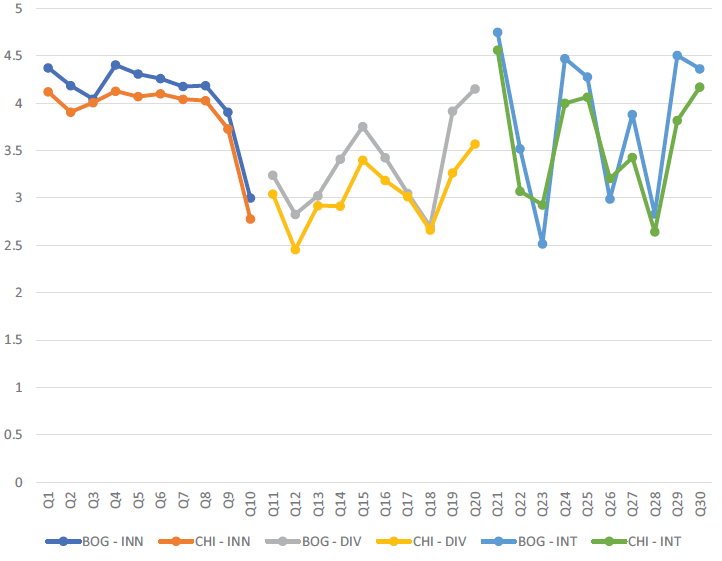
For HR diversity, the most reported aspects were the inclusion of (1) gender, (2) age and (3) education level diverse HR, which is coherent with legal and cultural conditions supporting the participation of women in the workforce (Hermans et al., 2017), incorporation of a young population combined with the effect of delayed retirement age, and task-relevant diversity inherent in most firms (Maznevski, 1994; Roberge & van Dick, 2010; Williams & O’Reilly, 1998). The least reported aspects were the inclusion of (1) first-language diverse and (2) handicapped/differently-abled employees and (3) the patronage of employees in short-term international assignments. The three limited aspects of HR diversity have logical explanations. Latin American countries are mostly unilingual and lack legal protection for differently-abled people. Also, Latin American firms are, for the most part, incipient to internationalization beyond the export of agricultural products or standardized manufactures while fending with limited budgets (Bortagaray, 2016; Bravo-Ortega et al., 2014; Brenes et al., 2008; Bustos, 2011).
For internationalization, the most reported aspects were (1) efforts to learn about foreign legal, political, economic, sociocultural and technological institutions and (2) adaptation of the firm to international standards. These findings concur with the literature that demonstrates that emerging market firms must first learn about international institutions before internationalization (e.g. Pino et al., 2020). Particularly, if the firm intends to participate in the global supply chain or provide commodities or regulated products or services, the firm must first adapt to international standards (Dutrénit & Katz, 2005; Hernández et al., 2016). The least reported aspects were (1) the export of know-how and (2) the attraction of inward FDI. These are also logically fitting with the reality of most Latin American firms; they lack technological R&D and innovation to produce exportable know-how (Crespi & Zuñiga, 2012; Pino et al., 2016), and Latin America lags behind other world regions as an FDI destination.
Multivariate Analysis
The data in Table 2 show that, with an integrated PCA of all 10 aspects of innovation and all 10 aspects of HR diversity, these aspects explain internationalization in 47% with an adjusted R2 of 0.47, p < 0.05. Of these twenty aspects, those marked with an asterisk (*) most impact internationalization.
Aspects of Innovation and Diversity that Impact Firm Internationalization
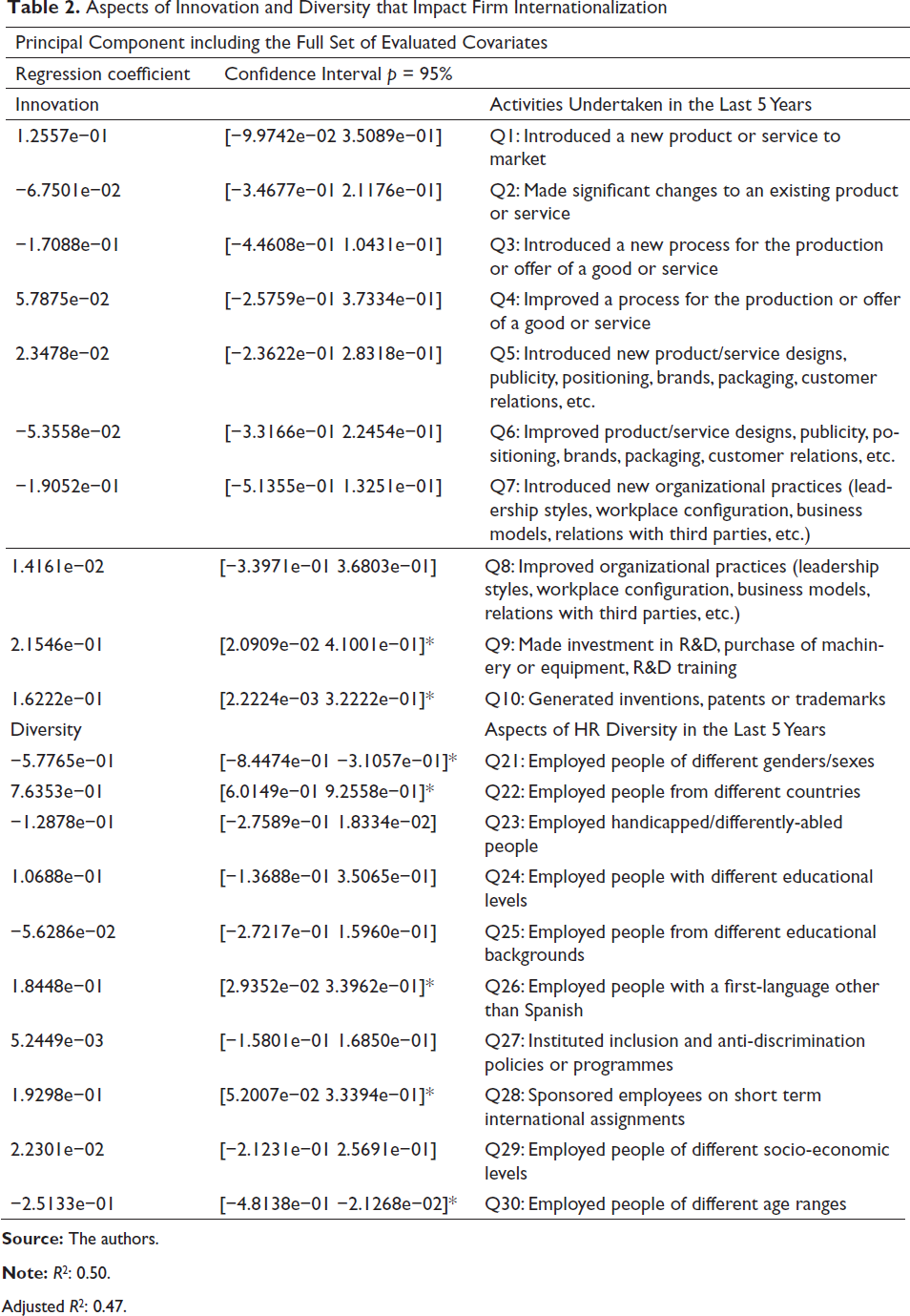
Adjusted R2: 0.47.
Upon conducting the PCA with only these two aspects of innovation and five aspects of HR diversity, as shown in Table 3, these aspects explain internationalization with an adjusted R2 of 0.46, p < 0.05. The two aspects of innovation that most impact internationalization are (1) investment in R&D, including the purchase of equipment and machinery (Q9), and (2) the generation of inventions, patents and trademarks (Q10). This finding concurs with general innovation literature explaining that innovative firms will seek to offset the fixed costs of innovation—particularly costly R&D—through international sales (Bustos, 2011; Ottaviano & Volpe Martincus, 2011; Van Beveren & Vandenbussche, 2010). On the other hand, general internationalization literature finds that product innovation is a particularly strong predictor of internationalization (Cassiman & Golovko, 2011; Villar et al., 2012), which is not the case in these Colombian and Mexican firms. Product innovation was the most reported type of innovation, but it has no significant impact on internationalization.
Aspects of Innovation and Diversity that Most Impact Firm Internationalization
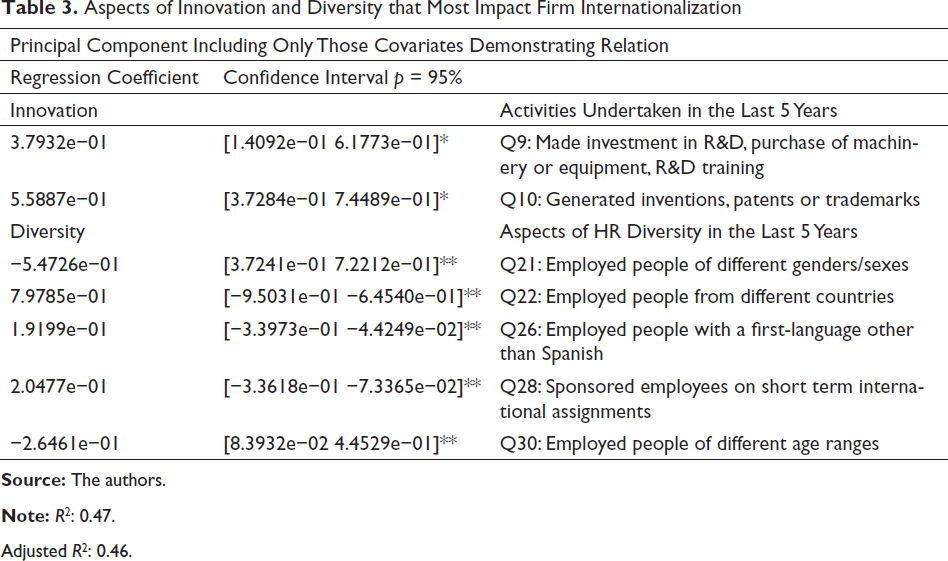
Adjusted R2: 0.46.
HR diversity impacts internationalization much more than innovation does. Refer to Table 3; these aspects of HR diversity, marked with a double asterisk (**), explain 46% of the entire 47% of internationalization that HR diversity and innovation can explain. The five aspects of HR diversity that most impact internationalization are (1) gender (Q21), (2) nationality (Q22), (3) first-language (Q26) and (4) age (Q30) diverse HR, and (5) the patronage of employees in short-term international assignments (Q28). Nationality and language diversity and patronage of employees in short-term international assignments are the most obvious, ubiquitous and superficial implementations of HR diversity for internationalization (Filippetti et al., 2011; Mendy & Rahman, 2019a, 2019b; Pino, 2018).
On the other hand, it is crucial to note that gender and age diversities have a negative impact on internationalization, which is unfounded in previous literature. There is evidence that internationalized Latin American firms are more prone to female participation and leadership (Hermans et al., 2017); however, there is no evidence in the other direction, that gender-diverse Latin American firms are either more or less prone to internationalization. This finding may be a cultural revelation. Latin American machismo (Hermans et al., 2017), combined with in-group collectivism, may complicate the inclusion of different genders and generations. If this is the case, HR diversity and internationalization would be competing, rather than complementary, foci of managerial attention.
The data in Table 4 show that, with an integrated PCA with all 10 aspects of internationalization and all 10 aspects of HR diversity, these aspects explain innovation with an adjusted R2 of only 0.20, p < 0.05. Of these twenty aspects, those marked with an asterisk (*) are those that most explain innovation, five relating to internationalization and one to HR diversity.
Aspects of Internationalization and Diversity that Impact Firm Innovation
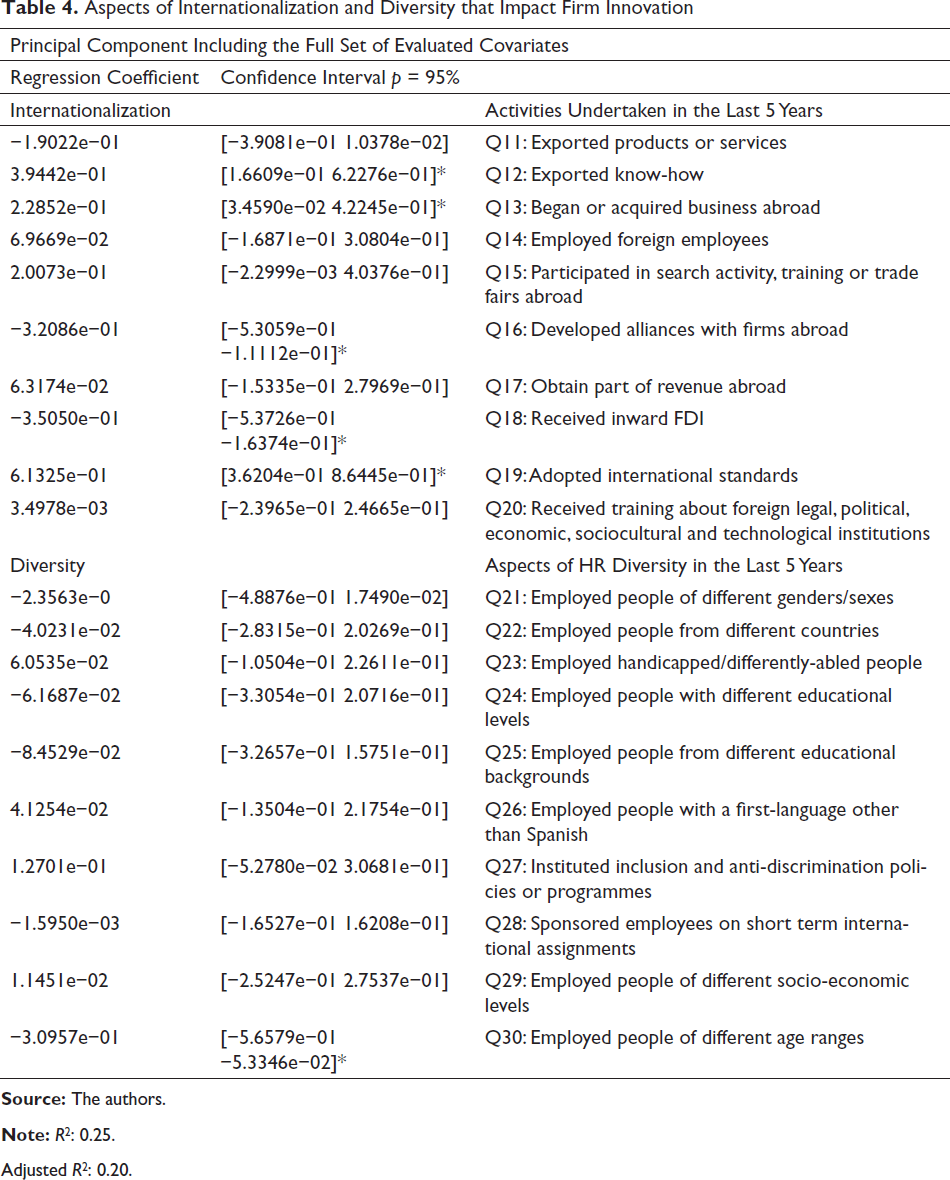
Adjusted R2: 0.20.
The aspects of internationalization most relevant in innovation are (1) export of know-how (Q12), (2) beginning or acquiring a business abroad (Q13), (3) developing alliances with a firm abroad (Q16), (4) attracting inbound FDI (Q18) and (5) the adoption of international standards (Q19). Since Latin America continues to emphasize the exportation of commoditized natural resources and standardized manufactures (Bortagaray, 2016; Bravo-Ortega et al., 2014), the adoption of international standards is a necessary precursor to internationalization. This, in turn, provides firms with an introduction to new perspectives and market demands that stimulate innovation (Chiva et al., 2014; Filippetti et al., 2011).
Attracting inbound FDI corresponds with the first path in the internationalization-innovation relationship in the OECD’s Trade and Innovation Project Committee (Kiriyama, 2012) and is typical of firms in the ‘catch-up’ phase (Criscuolo & Narula, 2008). This mode of internationalization provides technology diffusion, which, according to developed country literature, stimulates innovation. Beginning or acquiring a business abroad (outbound FDI) and developing alliances with a firm abroad are more associated with firms in the ‘pre-frontier’ and beyond phases (Criscuolo & Narula, 2008) and correspond with the second and third paths in the internationalization-innovation relationship in the OECD’s Trade and Innovation Project Committee (Kiriyama, 2012). As such, these modes of internationalization provide increased competition and learning opportunities, which foment innovation.
However, it is imperative to note that both attracting inbound FDI and developing alliances abroad are negatively associated with innovation in the Colombian and Mexican firms in this study. This is in tune with previous emerging market- and Latin America-specific literature that finds that firms in these regions, being far from the innovation frontier, receive FDI or are targets for international alliances not for their innovation capabilities but rather for their access to populous home markets or natural resources (Crespi & Zuñiga, 2012).
The export of know-how is an unexpected internationalization activity for Latin American firms, given that the majority are in the ‘catch-up’ phase (Crespi & Zuñiga, 2012), so there is the assumption that these exports were to other countries within the region rather than to global markets. This assumption would be consistent with the literature on Latin American internationalization (e.g. Deepak, 2009; Pino et al., 2016). Still, the export of know-how indicates that the firm is already at the innovation forefront and can utilize this position to export its knowledge (Altomonte et al., 2013). This internationalization, in turn, provides further innovation stimulus, thus forming a virtuous cycle (Chiva et al., 2014; Filippetti et al., 2011).
The only aspect of HR diversity that significantly impacts innovation is age diversity (Q30), which is negatively associated. Again, this finding differs from previous literature. Yet, there is a logical explanation. Particularly older generations are more culturally bound to the ‘psychological contract’ inherent in the autocratic and paternalistic management styles, which entail deference to hierarchy (Davila & Elvira, 2012; Lenartowicz & Johnson, 2002), preference for clarity, order and structure (Purohit & Simmers, 2006), and loyal silence in exchange for labour protection (Castaño et al., 2015; Davila & Elvira, 2012).
Upon conducting the PCA with only these five aspects of internationalization and one aspect of HR diversity, as shown in Table 5, these aspects explain innovation with an adjusted R2 of 0.19, p < 0.05. In synthesis, the results in Tables 4 and 5 indicate that internationalization has little influence on innovation—and HR diversity even less so—in the Colombian and Mexican firms in this study. This concurs with previous literature finding that internationalization only increases innovation activity in Latin America when there is supporting national policy (Crespi & Zuñiga, 2012), that endogenous sources of knowledge have weak to null impact on firms’ innovation activity (Bernal-Torres & Blanco-Valbuena, 2017), and that exporting firms have lower rates of innovation activity than do non-exporting firms (Crespi & Zuñiga, 2012).
Aspects of Internationalization and Diversity that Most Impact Firm Innovation
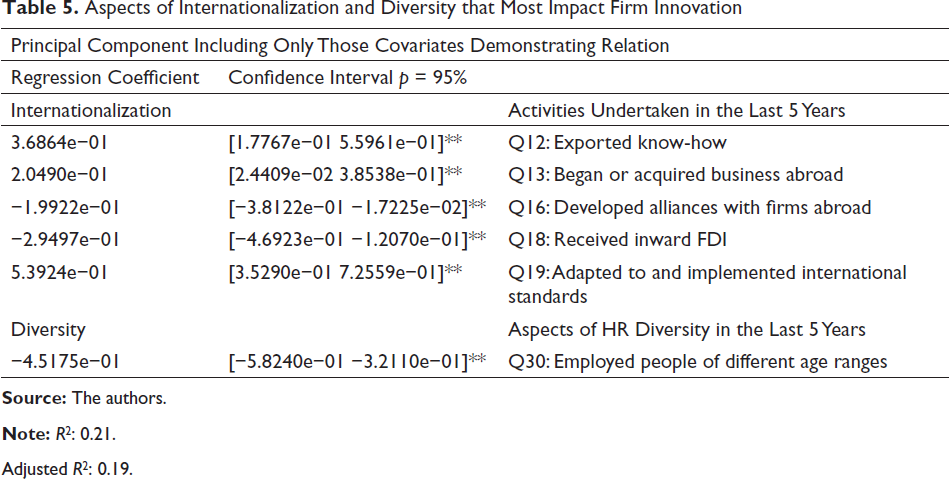
Adjusted R2: 0.19.
In summary, the findings of this study on HR diversity, innovation and internationalization do not seem to sit well with the assumptions providing basis to the four hypotheses. H1 (HR diversity positively impacts firm innovation activity) is not supported. The only aspect of HR diversity that significantly impacts innovation is age diversity, which is negatively associated.
Hypothesis 2 (HR diversity positively impacts firm internationalization intensity) is only partially supported. While five indicators of HR diversity significantly impact internationalization intensity, the direction of the impact is not consistent nor coherent with previous literature. Nationality and language diversity and patronage of employees in short-term international assignments significantly and positively impact internationalization intensity. However, gender and age diversity significantly and negatively impact internationalization intensity.
Hypothesis 3 (firm innovation activity positively impacts firm internationalization intensity) is not supported. The only two aspects of innovation that significantly and positively impact internationalization are (1) investment in R&D, including the purchase of equipment and machinery, and (2) the generation of inventions, patents and trademarks.
Hypothesis 4 (firm internationalization intensity positively impacts firm innovation activity) is not supported. The aspects of internationalization most relevant in innovation are (1) export of know-how, (2) beginning or acquiring a business abroad, (3) developing alliances with a firm abroad, (4) attracting inbound FDI and (5) the adoption of international standards. Both attracting inbound FDI and developing alliances abroad are negatively associated with innovation, and all indicators have a minimal impact on innovation.
Hypothesis Test with Logistic Regression and Univariate and Multivariate Regression Analysis
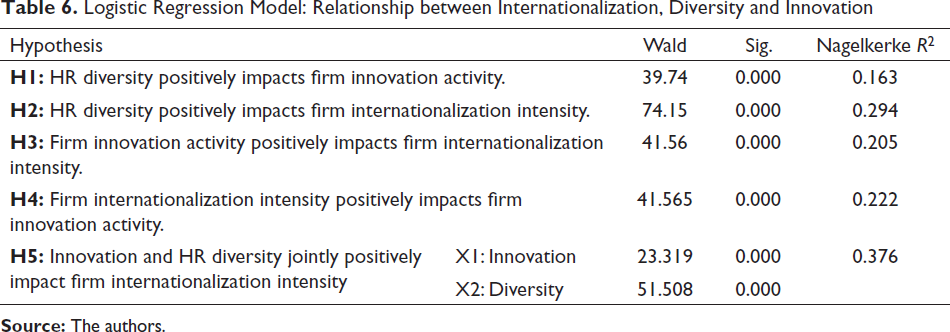
Table 6 shows that according to the logistic regression model with p-value < 0.05, HR diversity in firms has a very low impact (R2 = 0.163) on innovation and also (R2 = 0.294) on internationalization. Similarly, innovation (R2 = 0.205) has a very low impact on internationalization, and conversely, internationalization (R2 = 0.222) has a very low impact on innovation. However, when innovation and HR diversity are considered simultaneously, the impact of the two variables (R2 = 0.376) on internationalization is somewhat greater than if the impact of each variable is measured separately.
Logistic Regression Model: Relationship between Internationalization, Diversity and Innovation
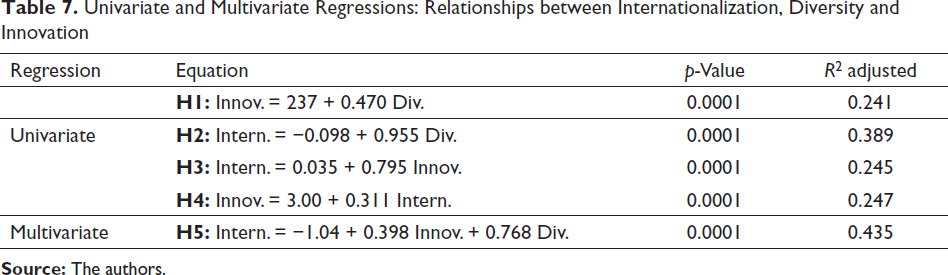
The data in Table 7, the result of univariate linear regression with p < 0.05, confirms that diversity (R2 = 0.241) has very low impact on innovation and (R2 = 0.398) on internationalization. Also, innovation (R2 = 0.247) has a very low impact on internationalization and conversely, internationalization (X1) (R2 = 0.245) has a low impact on innovation (Y). In addition, the multivariate regression also confirms that, jointly, innovation (X1) and diversity (X2) (R2 = 0.435), do have a somewhat higher impact on internationalization.
Univariate and Multivariate Regressions: Relationships between Internationalization, Diversity and Innovation
Conclusions
The results of the study show that aspects, such as human resource diversity, innovation and internalization are moderately important in the activity of the medium and large companies participating in the study in the cities of Bogotá, Colombia and Chihuahua, Mexico. Such research results serve as a reason for reflection by the entrepreneurs themselves, the academics and those responsible in government entities for the promotion of business competitiveness, since these variables are strategic for business performance, and much more so in crisis situations.
The analysis of the data and the relationship between the three variables indicates that although in companies from developed economies the diversity of HR and innovation significantly explain the process of internationalization of companies, this is not usually the case in the companies studied. This situation becomes a challenge to be overcome by these companies if they intend to be sustainable and take advantage of the benefits of globalization.
On the other hand, the results of the study also indicate that the diversity of HR and internationalization in the companies studied have little impact on their innovation processes, which contrasts with the findings on that relationship in companies based in developed countries and which is one of the important strategies that these companies leverage to build competitive advantage. Therefore, this becomes another challenge to be overcome by companies in emerging economies.
In general, the results of the logistic regression model and the univariate and multivariate regression model confirm that, separately, innovation and diversity have a very low impact on the behaviour of internationalization; but, jointly (innovation + diversity), the impact on internationalization is a little more pronounced. On the other hand, individually, internationalization and diversity also have a very low impact on innovation. With these results, both the logistic regression test and the univariate and multivariate regression tests reject the five hypotheses proposed in this research. In summary, with the data from the two statistical tests, the rejection of the five research hypotheses is confirmed, which is striking because the theoretical review on the subject suggests that the three variables are highly correlated, at least in firms in developed countries.
Theoretical Implications
This study contributes to the literature by exploring the relationships among HR diversity, innovation activity and internationalization intensity. At the same time, it contributes to the literature on emerging markets by providing evidence of firm behaviour in Colombia and Mexico, which are two key economies in Latin America. To the best of the authors’ knowledge, this study is the first to explore this triadic relationship in this emerging market context. Extant, developed market-based literature suggests that HR diversity is a significant predictor of both innovation and internationalization. Equally, this literature consistently finds innovation to be a clear contributor to internationalization and vice versa. However, the results of this study imply that Latin American firms do not perform as developed country-based literature would indicate, which is a contrast that can be explained by: In the case of Mexico, the sample consisted of foreign firms from advanced industries that assemble in the Mexican maquila sector in which the large part of innovation and internationalization stems from the foreign multinational’s headquarters. Although the Mexican subsidiaries in the maquila sector feature a high degree of human resource diversity, this does not contribute to higher innovation and internationalization stemming from Mexico. In the case of Colombia, the firms analysed for the large part produce low value-added products and services and generate low levels of innovation with few links to internationalization. Colombian firms, similarly to Mexican companies, feature high levels of human resource diversity, which are not appreciated to foster either innovation or internationalization.
Practical Implications
The study provides empirical evidence on the relationships between the diversity of HR, innovation and the internationalization of companies, which serves as input for business managers and government representatives responsible for guiding the productive transformation and competitiveness of companies, and for improving decision-making on the design of policies and programmes, and more so now that companies seek to recover from the different implications caused by the multiple and severe challenges brought about by the COVID-19 pandemic.
Limitations and Future Research
This study is not without its limitations and, thus, provides many avenues for future research. These findings are based on a survey to a single informant in each firm and at the cross-sectional, rather than longitudinal, level; so, there are methodological limitations that could be improved upon. As this is the first study—to the best of the authors’ knowledge—to examine the HR diversity–innovation–internationalization triad in the Latin American context, the authors chose to take an exploratory approach and thus decided upon Principal Components Analysis to identify the most relevant indicators within each of the three variable sets. Future research will benefit from a causality approach using Structural Equation Modelling, for example.
The research model examines the impact of HR diversity upon internationalization and innovation. While there is extant literature to support the hypotheses of positive impacts of internationalization and innovation on HR diversity, this study did not contemplate those impacts. The authors made this decision because HR diversity is not a goal of most Latin American firms, as it often is in US or European firms. Since internationalization and innovation are indeed the goals of most Latin American countries and many Latin American firms, the authors chose to focus on these two outcomes, with diversity as a possible instigator. Future research into diversity as an outcome would be recommendable.
This study is specific to Colombia and Mexico; generalizability across Latin America is uncertain and requires further study. Research on leadership styles in Latin America demonstrates significant similarities across the region (Behrens & Medeiros, 2020; Castaño et al., 2015; Hermans et al., 2017), with Latin America (and Ibero-America) consistently clustering as one unit in global culture studies (Hofstede, 2001; House et al., 2004). Similar historical, political, religious, legal and lingual legacies across much of Latin America lead to similar national cultures and predominant values, which in turn influence work-specific values and behaviours, management styles and leadership effectiveness (Behrens & Medeiros, 2020; Castaño et al., 2015; Silva Santos et al., 2019; Susaeta et al., 2013). Specific to this study, Colombia and Mexico share many cultural traits and leadership styles (Castaño et al., 2015). There is evidence, however, that Latin America is not a homogeneous cultural bloc. While most studies find region-wide similarities, these same studies find country-specific organizational behaviours and leadership (Castaño et al., 2015; Susaeta et al., 2013). For example, power distance, individualism, and masculinity vary more significantly across the region than long-term orientation and uncertainty avoidance (Hofstede, 2001). Even in countries with similar national culture values, the methods of managerial adaptation to the values may differ. Thus, controlling for specific management styles is another avenue for future research.
Management demographics is another consideration for future study. The attributes of various leadership types might influence organizational participation in HR diversity, innovation and internationalization. Age and generational differences could be a fruitful avenue for future study given the varied experiences of older TMT and MMT members over recent decades in many countries in the region. Management nationality is another avenue. Might foreign leadership (potentially culturally insensitive or ineffective) inhibit innovation processes?
Future research should also delve deeper into organizational characteristics. Economic sector, industry, company ownership profile, company age, number of employees, financial structure and performance and market share would provide interesting nuances. Also, this study only questioned the intensity of HR diversity, innovation and internationalization activities. The extensity of these activities may provide more insight. How long have firms participated in each of these activities and with what strategic level of participation? Might this study be capturing the initial adverse effects of incipient activities from which the firms will recover over a certain timespan?
Footnotes
Acknowledgment
The authors are grateful to the anonymous referees of the journal for their extremely useful suggestions to improve the quality of the article. Usual disclaimers apply.
Declaration of Conflicting Interests
The authors declared no potential conflicts of interest with respect to the research, authorship and/or publication of this article.
Funding
The authors received no financial support for the research, authorship and/or publication of this article.
