



Abstract
Drawing on insights from the knowledge-based view of the firm, we introduce a path that links founders’ founding experience to organizational design choices in tech-based ventures that instill absorptive capacity, which, in turn, allows them to produce innovation output at scale. We hypothesize that founders’ recognition of the importance of knowledge management, and their acquisition of skills to implement knowledge management systems effectively, underlie this venture-building path. We also suggest that this path is stronger when experienced founders have been exposed to venture capital investors in their prior ventures. We test our theoretical predictions with a longitudinal sample of 1,560 U.S. tech-based ventures.
Introduction
Tech-based ventures, defined as young, knowledge-intensive firms that dedicate substantial resources to in-house scientific and technological activities (Hsu, 2007; Zahra & Bogner, 2000), have produced many significant innovations over the past few decades. The way knowledge is acquired, created, and translated into innovative output within these ventures is powerfully shaped by their founders and their unique experiences (Baron & Hannan, 2002). For example, founders’ experiences shape both the opportunities they identify and the way they organize the knowledge and processes required to turn these opportunities into innovation (Corbett, 2005; Foss et al., 2013). Founders’ prior founding experience is especially intriguing in this regard because it gives them superior abilities to identify opportunities through advanced pattern-recognition skills (Baron & Ensley, 2006) and to apply better heuristics for where to focus when designing the organization so that their goals are best achieved (e.g., Rocha & Pozzoli, 2024). Perhaps unsurprisingly, previous research has shown that founding experience positively influences innovation, for example, because improved opportunity recognition allows founders to develop especially impactful innovations (Lahiri & Wadhwa, 2021; Tzabbar & Margolis, 2017).
While the literature at the intersection of founders’ founding experience and innovation has clarified how founders “individually” excel at innovating (Tzabbar & Margolis, 2017), the role of their abilities to make better “organizational design choices” (e.g., hiring specific types of employees or establishing certain processes and routines) that support ventures’ capacity to produce innovation outputs remains underexplored. Unlike the previously studied path that focuses on how founders are directly involved in innovation processes, we conceptualize this path (which we label the “venture-building path”) as indirectly operating through founders’ organizational design choices that enable their ventures to innovate. To shed light on this path, we build on scholarly discussions about how founding experience relates to venture-creation abilities (Gruber et al., 2012; Rocha & Pozzoli, 2024; Symeonidou & Nicolaou, 2018) and frame them within knowledge-management processes that support ventures’ innovation outputs.
Addressing this gap has value from both theoretical and practical perspectives. The theoretical question of how founding experience influences innovation is underexplored (not only through the lens of a venture-building path), despite innovation’s importance to ventures’ long-term growth and thereby the broader entrepreneurship literature (Audretsch et al., 2006; Tzabbar & Margolis, 2017). As a result of this gap, we lack a comprehensive theoretical understanding of the mechanisms by which founding experience influences a venture’s innovation outcomes. In practice, understanding how and under what conditions founding experience fosters innovation can inform ecosystem stakeholders responsible for capital allocation and policy frameworks to encourage innovative outcomes. Therefore, we ask: How does founders’ founding experience influence ventures’ innovation output through a venture-building path?
Considering the particular challenges of tech-based ventures, especially their knowledge intensity (Hsu, 2007), we address this research question by drawing on the knowledge-based view (KBV) of the firm (Grant, 1996). The KBV suggests that to achieve sustainable competitive advantage, firms need to integrate absorptive capacity into their organizational design so they can “recognize the value of new, external information, assimilate it, and apply it to commercial ends” (Cohen & Levinthal, 1990, p. 128). Our central argument is that founders’ founding experience helps them recognize the importance of knowledge management as a strategic resource for tech-based ventures (McGuire, 2021; Wiklund & Shepherd, 2008) and equips them with skills to effectively structure the venture as an “institution for integrating knowledge” (Grant, 1996, p. 109). We argue that this awareness makes them more adept than founders without such experience at making absorptive-capacity-related organizational design choices that promote effective knowledge management and ultimately strengthen innovation output in their ventures.
In particular, we argue that founders with (compared to without) founding experience are more likely to strengthen absorptive capacity’s three dimensions of knowledge-building (absorptive effort), a formalized knowledge stock (absorptive knowledge base), and internal procedures that promote the diffusion of knowledge (absorptive process) (Song et al., 2018). We also suggest that the effect is stronger for founders with prior venture capital (VC) investor exposure than for founders without such exposure, each relative to ventures with founders without prior founding experience, because exposure to VC investors provides access to professionalized venture-building knowledge, governance insights, and networks (Hsu, 2007), which increases both the awareness of and skills for implementing all three elements of absorptive capacity. We empirically tested our conceptual framework using a unique 10-year longitudinal dataset of 1,560 U.S.-based tech-based ventures founded in 2010, which was enhanced by machine-learning classification of LinkedIn data on more than 200,000 individuals and patent records.
Our study makes several contributions to the literature. First, research at the intersection of founding experience and innovation has predominantly emphasized how related knowledge enables founders to recognize opportunities and develop impactful innovations themselves (Lahiri & Wadhwa, 2021; Tzabbar & Margolis, 2017). We extend this work by shifting the focus to a “venture-building path,” showing that prior founding experience (especially with VC investor exposure) is associated with the creation of venture-level absorptive capacity that enables the entire venture’s capacity to innovate at scale.
Second, we contribute to the literature on implications of founders’ organizational design choices (Alexy et al., 2021; Burton et al., 2019; Eesley & Roberts, 2012), which has studied the influence of founders introducing additional management layers (Grimpe et al., 2019; Yang et al., 2020), optimizing task allocations (Brattström, 2024; Haeussler et al., 2019; Jung et al., 2017), or installing domain experts (Katila et al., 2017) for venture outcomes. We add to this research by specifying three distinct design choices that jointly constitute ventures’ absorptive capacity in tech-based ventures and by estimating their individual and combined associations with subsequent innovation output. This perspective offers a granular view of how specific organizational design choices shape ventures’ ability to generate innovation output.
Third, we extend research at the intersection of absorptive capacity and firm innovation (Song et al., 2018), which has primarily examined the consequences of absorptive capacity (Makri et al., 2010) rather than its antecedents. We foreground an underexplored individual–organizational bridge by theorizing and testing a path in which founder experience serves as an individual-level antecedent of organizational-level absorptive capacity, which in turn shapes organizational-level innovation outcomes (Volberda et al., 2010). This perspective explicitly links founder characteristics to the emergence of organizational capabilities, thereby connecting prior research treating absorptive capacity as residing in a founder (Symeonidou & Nicolaou, 2018) with (a more substantial) literature stream treating absorptive capacity as an organizational-level construct (Cohen & Levinthal, 1990).
Theory and Hypotheses
Founding Experience and Venture Innovation
The broader literature on the role of founding experience in shaping entrepreneurial outcomes indicates that founders with such experience differ significantly from those without it. For example, this body of research contends that the tacit knowledge gained from founding a venture provides founders with superior abilities to identify and evaluate opportunities using advanced pattern-recognition skills (Baron & Ensley, 2006; Ucbasaran et al., 2009), better heuristics for where to focus in orchestrating resources (Gruber et al., 2012; Symeonidou & Nicolaou, 2018), and how to use the social networks they develop to access those resources (Hsu, 2007; Zheng et al., 2020).
This literature stream provides ample starting points for examining how founding experience influences innovation outcomes, but only a few studies follow this path. For example, Tzabbar and Margolis (2017) demonstrated how advanced skills in recognizing opportunities, derived from founding experience, help founding teams develop breakthrough innovations. Lahiri and Wadhwa (2021) examined differences among founders with founding experience by examining how the interaction between technological and industry-relatedness in previous and later ventures enhances impactful innovation. Other research relates founding experience to self-reported innovativeness (Lafuente et al., 2019; Marvel et al., 2020), opportunity identification (Ucbasaran et al., 2009), or innovation investment (Carbonara et al., 2020). Consistent with the broader literature on founding experience, these studies tend to focus on how founding experience optimizes founders’ ability to generate innovation outcomes themselves.
However, these studies are less concerned with the founders’ knowledge of how to build a venture (Baron & Hannan, 2002), such as their learned awareness of factors (e.g., sophisticated knowledge management; Wiklund & Shepherd, 2008) underlying venture success or their better heuristics on how to master typical tasks when creating a venture (Eesley & Roberts, 2012; Politis, 2005). We draw on these elements to introduce a “venture-building path” that operates through founders making organizational design choices that enable their ventures to develop innovation. An early idea on an organizational design feature that links founding experience with innovation is the concept of absorptive capacity (Debrulle et al., 2014; Wehner et al., 2015), a key feature of the KBV.
The KBV and Absorptive Capacity
The KBV posits that a firm’s competitive advantage depends on how effectively it develops and deploys knowledge, its most important resource (Barney, 1991; Grant, 1996). Absorptive capacity is a key mechanism that translates a firm’s embedded knowledge into outcomes (Cohen & Levinthal, 1990) through investments in knowledge-building (absorptive effort), formalizing and using a knowledge stock (absorptive knowledge base), and internal procedures that promote the diffusion of knowledge (absorptive process) (Song et al., 2018; Zahra & George, 2002). All three dimensions of absorptive capacity positively influence how knowledge flows into and through an organization to create innovation (Song et al., 2018; Volberda et al., 2010).
The Role of Founding Experience in Creating Absorptive Capacity in Tech-Based Ventures
Tech-based ventures are highly knowledge-intensive (Hsu, 2007) and typically characterized by high levels of uncertainty. In such an environment, these ventures must invest in and cultivate absorptive capacity to manage the knowledge that can drive innovation and performance (Fotopoulos, 2023; Gassmann & Keupp, 2007). However, the ability to do so is typically lacking at ventures’ inception (Tzabbar & Margolis, 2017; Zahra & Filatotchev, 2004). During the early years and beyond, how ventures acquire, disseminate, and exploit knowledge is mainly shaped by their founders and their idiosyncratic experiences (Baron & Hannan, 2002; Fern et al., 2012). Our central argument is that founders’ founding experience helps them recognize the importance of knowledge management as a strategic resource for tech-based ventures (McGuire, 2021; Wiklund & Shepherd, 2008) and equips them with skills to effectively structure the venture as an “institution for integrating knowledge” (Grant, 1996, p. 109), through developing all three dimensions of absorptive capacity: absorptive effort, absorptive knowledge base, and absorptive process (Song et al., 2018).
First, we argue that founders with founding experience, compared to those without, are more likely to make organizational design choices that strengthen absorptive effort—that is, investing in building knowledge. In particular, we argue that their founding experience sharpened their awareness of how operational employees help the venture create new knowledge quickly, ahead of competitors (Fotopoulos, 2023), thereby laying the basis for generating innovation and strengthening their future competitive advantage (Tzabbar & Margolis, 2017). We also expect that their prior founding experience equips them with specialized hiring practices to attract operational experts (Rocha & Pozzoli, 2024). We argue that founders with founding experience (compared to those without), when founding a tech-based venture, are more likely to channel these learnings into expanding their ventures’ operational human capital in R&D and technology-focused roles to install a “radar” for acquiring and assimilating external technological knowledge (Nickerson & Zenger, 2004; Song et al., 2018) and solving technical questions.
Second, we argue that founders with founding experience are more likely than those without to develop a strong absorptive knowledge base, that is, a venture’s accumulated stock of technological knowledge and external sources of expertise (Song et al., 2018). Founding experience increases founders’ awareness of the value of codified and routinized knowledge—for efficiency gains, for professionalizing R&D activities, and for protecting intellectual property (IP) (Agarwal et al., 2004; Shane, 2000). In their prior ventures, they are likely to have experienced both the risks of not protecting IP (De Vries et al., 2017) and the reputational and auditability benefits of patenting and formalized knowledge for external stakeholders (Blind et al., 2006; Veer & Jell, 2012). Moreover, founding experience likely teaches founders to synchronize efforts to codify knowledge with planned human resource investments to prepare for scaling (Symeonidou & Nicolaou, 2018). When founding a new tech-based venture, we argue that such founders are therefore more likely to broaden and codify the venture’s technological knowledge base, protect it through mechanisms such as patenting or internal formalization, and institutionalize relationships with knowledgeable external stakeholders (e.g., VCs).
Third, we expect that founders with founding experience are more likely than those without to develop the absorptive process dimension by creating process-instituting governance structures that enable knowledge diffusion (Song et al., 2018). In their prior ventures, such founders are likely to have learned the importance of delegating decision authority and introducing additional management layers to cope with parallel activities and information flows (Burton et al., 2019; Grimpe et al., 2019). They also likely learned about the value of installing “boundary spanners” (Zobel et al., 2024) who connect internal and external knowledge sources and report back to the founders. Moreover, founding experience makes founders knowledgeable about optimal task allocation, such as leveraging technology domain experts as governance-instituting actors (Jung et al., 2017; Katila et al., 2017). When founding a new tech-based venture, we argue that founders with such experience are therefore more likely than those without to establish top (e.g., Chief Technology Officer [CTO]) and middle management (e.g., Vice President R&D) positions in technology-related areas and to task these managers with creating processes that enable knowledge diffusion and facilitate the conversion of individual knowledge into venture-level knowledge (Song et al., 2018).
Conversely, founders without founding experience may underestimate the importance of and are less effective in implementing the three dimensions of absorptive capacity because they lack the firsthand insights from founding experience, for example, regarding specialized hiring (Rocha & Pozzoli, 2024), experiences with patenting (De Vries et al., 2017) and other ways to formalize and design optimal governance of the ventures’ knowledge management. Therefore, we posit:
Next, we consider the heterogeneity in founders’ experiences during their founding processes, particularly whether the founder was exposed to VC investors in previous ventures (Osses et al., 2024). VC investors serve as an early form of governance and exert significant influence on how founders manage their ventures (Hellmann & Puri, 2000). Therefore, exposure to VC investors changes founders’ awareness of and development of the skills required to manage a venture professionally, including the ability to create and channel knowledge into commercializing their ventures’ innovations (Pahnke et al., 2015). Such exposure also gives founders better access to resources (Pahnke et al., 2015), helping them implement organizational design choices that require, for example, access to specialists for hiring. Based on these considerations, we suggest that the effect of founders’ founding experience on the establishment of absorptive capacity in the venture is stronger for founders with prior VC investor exposure than for founders without such exposure, each relative to ventures without founders with prior founding experience.
For the absorptive effort dimension, we expect this stronger effect to stem from founders’ frequent interactions with VC investors who served as “venture builders” (including support with operational tasks) in their previous ventures (Pahnke et al., 2015). We argue that through these interactions, they became even more aware of the importance of operational roles to a venture’s success and learned from typical blueprints of investors (DeSantola et al., 2023) how to enhance their knowledge inflows by hiring operational and specialized staff (Rocha & Pozzoli, 2024). Additionally, their institutionalized relationships with these VC investors give them better access to networks for hiring for their current ventures.
For the absorptive knowledge base dimension, we assume that this stronger effect is because, in their prior venture(s), VC investors likely actively urged founders to protect their IP via patents to safeguard their investments (De Vries et al., 2017) as well as creating the conditions for smooth auditability in subsequent funding rounds (Hsu, 2007). Additionally, we assume that these founders, in previous ventures, received extensive training and support in scaling operations by coordinating complementary assets (such as codified knowledge and human resources) and in carrying out related activities like patenting and establishing relationships with key stakeholders (Pahnke et al., 2015).
Finally, we argue that this stronger effect also applies to the absorptive process dimension. VC investors often require metrics such as product roadmaps or R&D timelines, take board seats on the venture (Pahnke et al., 2015), and induce changes in the ventures’ organizational structure, such as introducing middle-management positions (Hellmann & Puri, 2000). We argue that founders who have interacted with such governing investors in prior ventures are more likely to see the value of establishing process-instituting governance arrangements and can use VC investors’ blueprints to structure task allocation, delegate decision authority, or facilitate boundary-spanning activities that support smooth knowledge transfer throughout the organization (Lee et al., 2001; Zobel et al., 2024). Again, these founders’ relationships with VC investors give them access to networks for hiring senior management, such as CTOs.
Conversely, founders with founding experience without exposure to VC investors might relatively undervalue systematic processes for knowledge acquisition and assimilation, thereby placing less emphasis on expanding the three dimensions of absorptive capacity. They also forgo the governance insights, mentorship, social capital, and knowledge spillovers that VC networks can provide (Hayter, 2013; Lee et al., 2001). Therefore, we propose:
Absorptive Capacity as a Catalyst for Innovation
Next, we argue that, in line with the broader absorptive capacity literature (Makri et al., 2010; Nooteboom et al., 2007), higher levels of all three dimensions of absorptive capacity enable tech-based ventures to create more innovation output, for example, reflected in higher numbers of patent applications.
First, we argue that higher levels of absorptive effort help tech-based ventures to search for and incorporate external knowledge effectively by quickly recognizing emerging technologies or market gaps (Volberda et al., 2010), which are the primary drivers of innovation in tech-based ventures. We also contend that the operational human resources who are employed in technology roles serve as a radar for spotting and envisioning the emergence of new technologies and preparing their transformation into new products or services (Song et al., 2018), thus benefiting their ventures’ innovation output (Makri et al., 2010).
We also argue that a substantial absorptive knowledge base, as reflected in, for example, a broad set of patents, helps tech-based ventures to assess the relevance and usefulness of external knowledge (Zahra & George, 2002). A strong knowledge base not only enables the venture to form new associations between its current and external knowledge (Cohen & Levinthal, 1990) but also offers opportunities to use this current knowledge to find new solutions to problems (Carlo et al., 2012), thus increasing the venture’s innovation output.
Finally, we contend that higher levels of absorptive process provide tech-based ventures with process-instituting governance structures that facilitate knowledge diffusion and integration (Lewin et al., 2011), so these ventures can connect individuals’ knowledge (Song et al., 2018) and integrate their diverse and unique ideas and expertise into the venture, thereby accelerating the transformation of external knowledge into innovation output (Toft-Kehler et al., 2014). All in all, we hypothesize:
To conclude our conceptual model, we argue that at least part of the positive effect of founders’ founding experience on innovation output (beyond the founders’ improved ability to craft innovation themselves; Tzabbar & Margolis, 2017) is mediated by founders’ organizational design choices relating to absorptive capacity. Therefore, we hypothesize:
Methodology and Data
Sample
We draw on a rich longitudinal dataset of 1,560 U.S. technology ventures founded in 2010. Examining a single founding cohort shields the analysis from macroeconomic shocks like the 2008–2009 financial crisis while enabling a longitudinal view (2010–2019) of ventures’ development and innovation outputs (Yli-Renko et al., 2001). We started with the full sample of U.S. tech-based ventures founded in 2010, as reported in Crunchbase, 1 a widely used database that covers U.S. ventures and their investment histories (Ko & McKelvie, 2018; Rieger et al., 2025). Then we restricted our sample to ventures for which we could access data in Crunchbase and LinkedIn (Block et al., 2014; Chirico et al., 2020) on whether the ventures’ founders had founded a venture before and their previous ventures’ (VC) funding histories. This process resulted in 1,799 ventures with complete information on founders.
To capture how the ventures’ organizational design developed over time, we combined a large-scale data-extraction approach with manual verification to collect data from LinkedIn on all present and past employees since the ventures’ foundation in 2010 (see Online Supplemental Material A). This process generated more than 200,000 individual profiles for 1,696 ventures because we included both current and past employees who were part of the venture at any point over these 10 years. We then classified all job titles using a RoBERTa-based NLP model, trained on approximately 8,000 hand-coded cases (i.e., until the approach was sufficiently reliable) and validated through manual checks, to identify R&D and tech roles, and categorized them into five hierarchy levels (from board to non-managerial employees 2 ). This approach enabled us to reconstruct each venture’s evolving R&D and tech organizational structure annually, which was pivotal for measuring how its absorptive capacity evolved. To account for the fact that ventures that have founders who have founding experience differ systematically from ventures that do not in terms of factors like founding team size, location, and industry (Conti & Roche, 2021), we applied propensity score matching to balance observables based on a dummy variable indicating the presence (absence) of at least one founder with founding experience, which left a sample of 1,560 ventures (for more information, see Online Supplemental Material B). We organized the dataset as a venture-year panel, tracking ventures while Crunchbase showed them as continuing to operate and while they maintained an active website (Blaseg & Hornuf, 2024), which we verified by web-scraping all ventures’ historical websites (see Additional Analyses for more information on the web-scraping approach). We monitored ventures through the end of 2019 and applied right-censoring to those that were still active at that point.
Founding Experience
In line with earlier studies (Lafontaine & Shaw, 2016; Symeonidou & Nicolaou, 2018; Toft-Kehler et al., 2014), we measure founding experience as the number of prior ventures founded by any member of the founding team before 2010, based on Crunchbase data and cross-validated via LinkedIn. For H2, we decompose this count measure into two variables: founding experience with VC exposure, capturing the number of prior ventures that secured VC funding, and founding experience without VC exposure, capturing the number of prior ventures that did not obtain VC funding. Including both variables simultaneously in our models allows us to assess whether the effects on our focal dependent variables are stronger for founders with prior VC investor exposure than for founders without such exposure (each relative to ventures without prior founding experience). 3
Absorptive Capacity
In line with Zahra and George (2002) and Song et al. (2018), we conceptualized absorptive capacity as a three-dimensional construct encompassing absorptive effort, absorptive knowledge base, and absorptive process. We used principal component analysis (PCA), a widely used method for aggregating multidimensional constructs while accounting for the data’s underlying structure (Schumacher et al., 2020; Song et al., 2018), to operationalize each dimension based on multiple inputs from our archival data. The PCA approach allowed us to mitigate differences in scale by transforming input variables into standardized z-scores, extracting the principal components that capture the maximum variance across dimensions, and weighting subcomponents based on the first principal component loadings, thus ensuring that the variables’ contribution to the index matches their importance (Abdi & Williams, 2010). To further ensure construct validity, we validated the three-dimensional structure using survey-based measures based on a sub-sample of founders in our dataset (see Additional Analyses section for details).
We followed earlier studies on knowledge-building investments (Estrada et al., 2010; Huang et al., 2015) in operationalizing absorptive effort as the number of operational full-time equivalents (FTEs) employed in R&D and technology roles (excluding those in managerial roles) and that number’s year-on-year increase. We operationalized absorptive knowledge base using an observable patent-based measure, being the breadth of its technological knowledge, measured as the total number of distinct International Patent Classification (IPC) classes cited by the venture’s patents up to t-1 (cf. Custódio et al., 2019; Hall et al., 2001). We also consider the number of unique investors, which indicates access to external knowledge reservoirs (Lee et al., 2001; Stettler et al., 2025), as an additional indicator. 4 We operationalized absorptive process using the presence of a Chief Information Officer (CIO) or CTO as an indicator of governance structures dedicated to instituting processes that enable knowledge management. We also accounted for the number of FTEs in managerial R&D and technology-related roles to reflect a venture’s leadership’s commitment to coordinating knowledge (and boundary spanning) in support of innovation (Song et al., 2018). Using these inputs, we constructed an absorptive capacity index as the weighted sum of PCA-derived indices for absorptive effort, absorptive knowledge base, and absorptive process. 5
Innovation Output
To operationalize ventures’ innovation output, we retrieved patent data from the United States Patent and Trademark Office by combining fuzzy-matching algorithms on assignee names with subsequent manual verification to ensure accurate links between ventures and patents (Mann & Sager, 2007). To guard against under- or over-counting, we manually cross-checked cases in which a venture’s legal name differed from its common trade name. The resulting patent records provide each filing’s number and technological class, which we aggregated to the venture-year level. Our focal dependent variable is innovation output, measured as the number of patent applications per venture per year, a widely accepted proxy for innovative activity in entrepreneurship and innovation research (Sunder et al., 2017). We used patent applications, rather than the grant date, to capture a venture’s engagement in knowledge creation and technological advancement closely to when the engagement occurred (Osses et al., 2024). 6
Control Variables
We included a set of control variables at the venture, founding team, and industry levels that relate to founding experience and innovation output. At the venture level, we controlled for founding team size, measured as the number of co-founders at the time of a venture’s founding, because large founding teams may bring the diversity of resources that can facilitate knowledge integration and innovation (Eesley et al., 2014). We also controlled for venture size, measured as the log-transformed number of FTEs, as the literature suggests that large ventures tend to have access to more resources that allow them to pursue innovation (Tzabbar & Margolis, 2017). We used funding received as a binary variable to distinguish ventures that secured VC funding from those that did not, since external funding can provide ventures with financial slack and strategic support, but also to account for the influence of investors on building absorptive capacity themselves, thus supporting ventures’ innovation trajectories (Pahnke et al., 2015). In addition, we included location in a venture hub, a dummy variable that indicates whether the venture is located in a central entrepreneurial cluster like California, Massachusetts, or New York, as ventures that operate in these hubs may benefit from dense innovation ecosystems, strong network effects, and increased access to specialized resources (Ter Wal et al., 2016). Finally, we controlled for venture age to account for timing effects in our panel and the stage in which a venture operated in a particular year (Park & Tzabbar, 2016).
At the founding team level, we considered gender composition, measured as the share of male entrepreneurs on the team, since gender diversity in these teams may enhance a venture’s ability to recombine knowledge to solve problems (Xie et al., 2020). We also included the average education level of the founding team, in line with Lien et al. (2022), as higher education is often associated with greater absorptive capacity and more effective knowledge recombination. In addition, we controlled for the founding team’s working experience, measured as the average number of years of the founding team members’ working experience, as a proxy for the team’s depth of expertise and managerial competence.
At the industry level, we classified the ventures based on their four-digit SIC codes using Homburg et al.’s (2014) classification scheme. We included industry dummies since industries have varying levels of technological intensity, regulatory constraints, and competitive pressures, all of which can influence ventures’ ability to translate founding experience into innovation outcomes (Eesley et al., 2014).
Estimation Approach
We used random-effects regressions with clustered-robust standard errors at the venture level to test our hypotheses related to the three dimensions of absorptive capacity (Petersen, 2009). We chose a random effects specification because our independent variable does not vary over time. We employed a zero-inflated negative binomial (ZINB) regression model to test how absorptive capacity’s dimensions influence innovation output and to account for overdispersion and the large number of zero-patenting venture years that are typical in our measurement of innovation output. The ZINB model simultaneously estimates the likelihood of a venture’s filing for patents and the number of active applications (Blundell et al., 2002; Im & Shon, 2019). Because innovation outcomes materialize with a delay, we used a 1-year lead of innovation output relative to the predictors (Chirico et al., 2020). We employed bootstrapped mediation analyses with 5,000 resamples (Engel et al., 2023) to test our mediation models and estimate the indirect effect of founding experience on innovation output through the three dimensions of absorptive capacity.
Results
Table 1 presents descriptive statistics and pairwise correlations for all key variables. The variance inflation factor values remain well below a conservative threshold of 5 (Hair et al., 2019), suggesting that multicollinearity is unlikely to be an issue. Tables 2 and 3 report the results of our tests of H1, H2, and H3, while Figure 1 and Figure 2 visualize the mediation model that corresponds to H4 and H5.
Correlations, Mean, Standard Deviation, Minimum and Maximum for Key Variables.
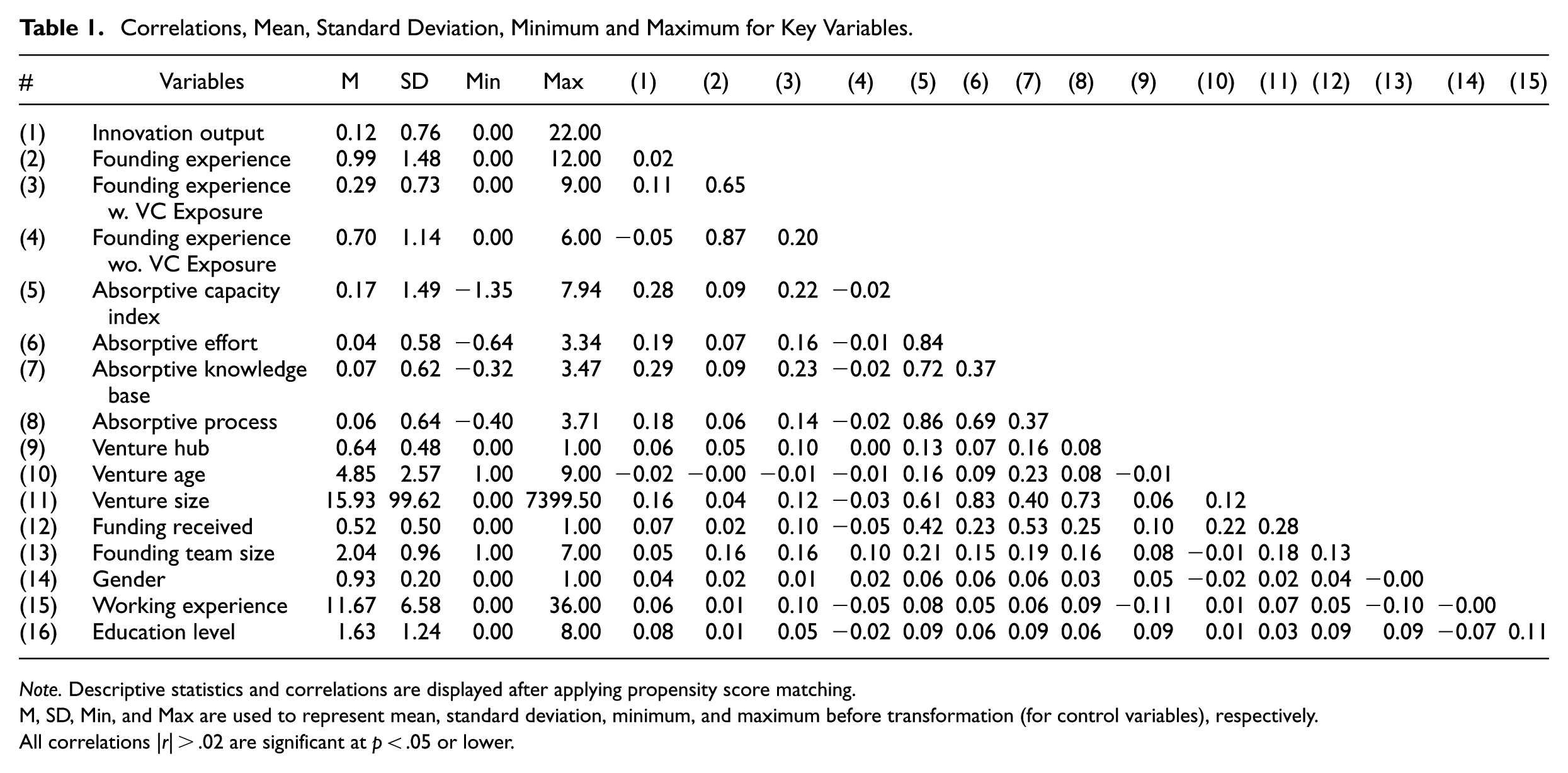
Note. Descriptive statistics and correlations are displayed after applying propensity score matching.
M, SD, Min, and Max are used to represent mean, standard deviation, minimum, and maximum before transformation (for control variables), respectively.
All correlations |r| > .02 are significant at p < .05 or lower.
Random-Effects (Models 1–4), ZINB (Models 5–6) to Test H1 and H3.
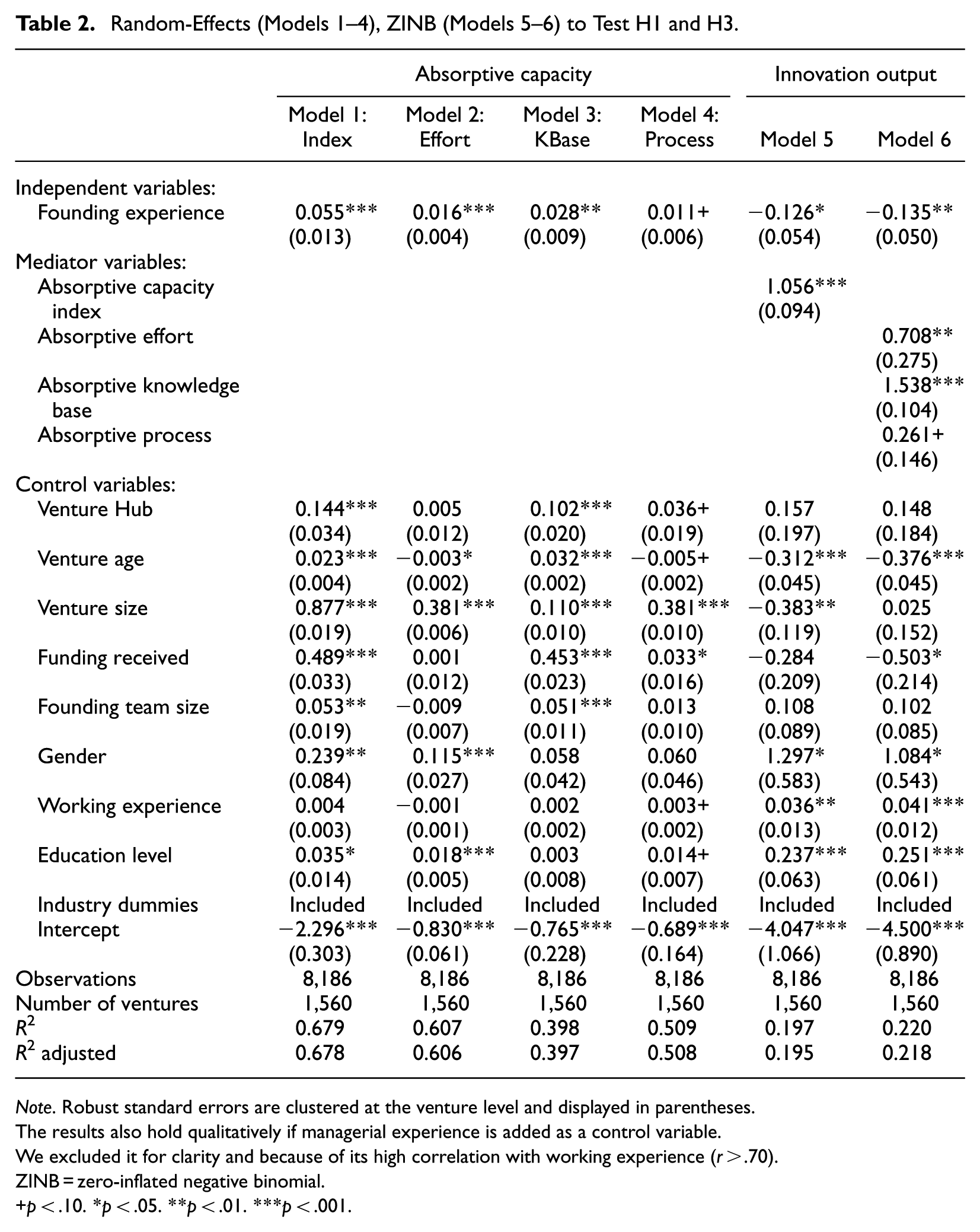
Note. Robust standard errors are clustered at the venture level and displayed in parentheses.
The results also hold qualitatively if managerial experience is added as a control variable.
We excluded it for clarity and because of its high correlation with working experience (r > .70).
ZINB = zero-inflated negative binomial.
p < .10. *p < .05. **p < .01. ***p < .001.
Random-effects (Models 1–4), ZINB (Models 5–6) to test H2.
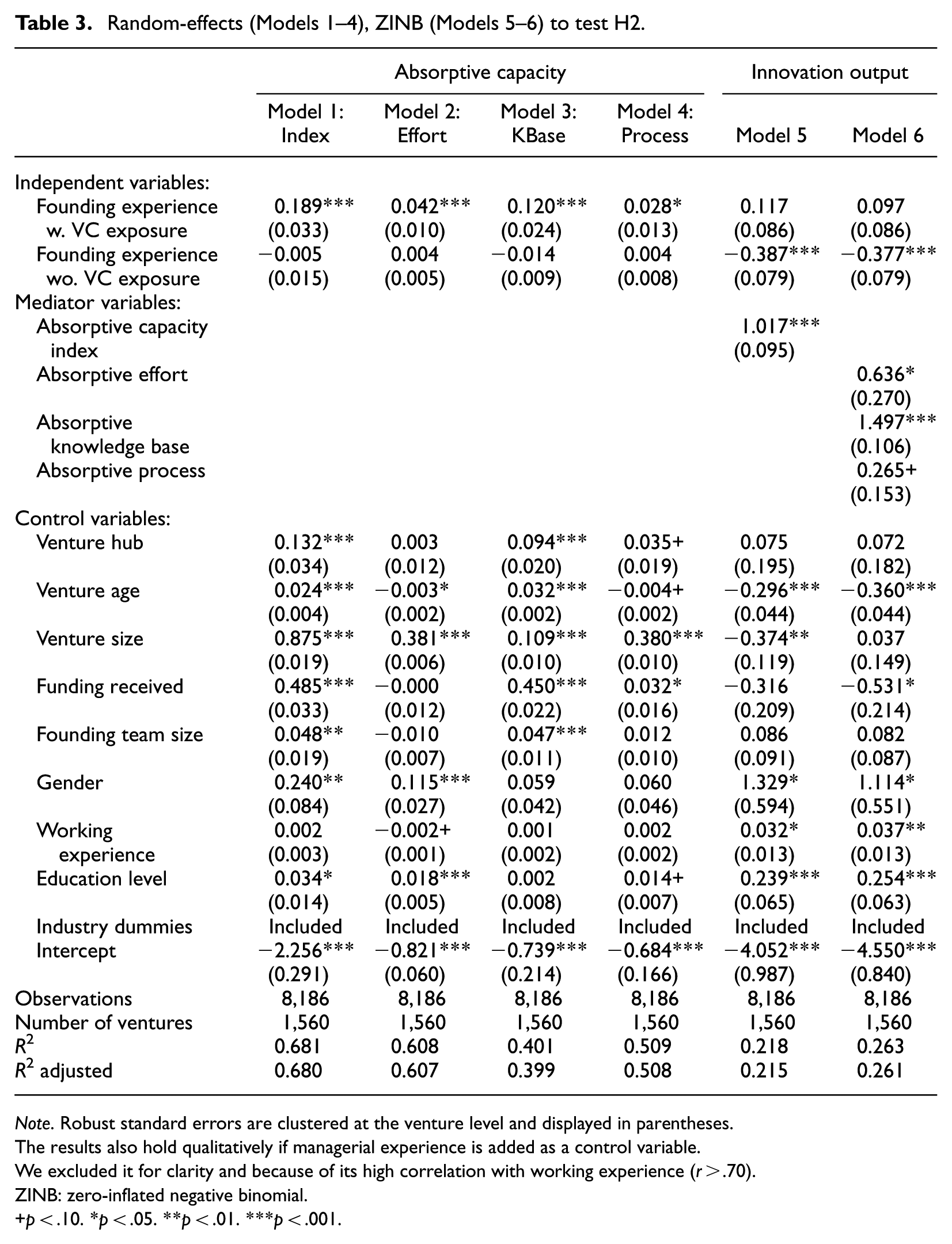
Note. Robust standard errors are clustered at the venture level and displayed in parentheses.
The results also hold qualitatively if managerial experience is added as a control variable.
We excluded it for clarity and because of its high correlation with working experience (r > .70).
ZINB: zero-inflated negative binomial.
p < .10. *p < .05. **p < .01. ***p < .001.

Graphical representation of the mediation model (H4).

Graphical representation of the mediation model (H5).
Our empirical analysis supports that founding experience positively relates to ventures’ three dimensions of absorptive capacity, as shown in Table 2’s Models 1 to 4. Founding experience is positively related to overall absorptive capacity (β = 0.055, p < .001) as well as to absorptive effort (β = 0.016, p < .001) and absorptive knowledge base (β = 0.028, p < .01). The association with absorptive process is positive and marginally statistically significant (β = 0.011, p < .10). We therefore regard H1a, H1b, and H1c as (marginally) supported. In H2, we posited that these effects are stronger for founders with prior VC investor exposure than for founders without such exposure, each relative to ventures without founders with prior founding experience. When we simultaneously included the two variables that reflect these types of experience in our empirical models, only the effect of founding experience with VC investor exposure was statistically significant across all three dimensions of absorptive capacity (and consistently larger in magnitude), as shown in Table 3, Models 1 to 4. These findings support H2a, H2b, and H2c. 7
H3 suggested that the three dimensions of absorptive capacity are positively related to ventures’ innovation output. Table 2’s Models 5 to 6 show that the absorptive capacity index is a statistically significant predictor of innovation output (β = 1.056, p < .001) and that, individually, absorptive effort (β = 0.708, p < .01) and absorptive knowledge base (β = 1.538, p < .001) are positive and statistically significant predictors of innovation output. Absorptive process is also positive and marginally significant (β = 0.261, p < .10). We therefore conclude that H3a, H3b, and H3c (marginally) are supported.
H4 and H5 posit that (conditional) indirect effects link founding experience to a venture’s innovation output through absorptive capacity. In Figures 1 and 2, we visualize and report all relevant estimates. The indirect path from founding experience to innovation output through the absorptive capacity index is positive, and the confidence interval does not include zero (β = 0.060, 95% CI [0.050, 0.070]). Results are similar for each individual indirect path: absorptive effort (β = 0.011, 95% CI [0.004, 0.019]), absorptive knowledge base (β = 0.044, 95% CI [0.037, 0.051]), and absorptive process (β = 0.003, 95% CI [0.001, 0.006]). These results support H4a, H4b, and H4c. To test H5, we repeated this procedure but calculated separate indirect effects for ventures whose founders had founding experience with and without VC investor exposure. Our hypothesis is supported when the confidence interval for the difference between the two indirect effects does not include zero, which holds for all three dimensions of absorptive capacity. For example, for the absorptive capacity index, the mediated effect is larger for founding experience with VC investor exposure (β = 0.197, 95% CI [0.168, 0.230]) than it is for the group without (β = −0.006, 95% CI [−0.015, 0.003]), with the confidence interval of the difference not including zero (β = 0.203, 95% CI [0.171, 0.239]). We report the differences and the corresponding confidence intervals for all three individual effects in Figure 2.
Additional Analyses
To confirm the robustness of our main findings and generate additional insights into the relationship between founding experience and innovation, we undertook additional primary data collection to support construct validity for our novel measures of absorptive capacity; used alternative specifications of dependent (and independent) variables; and addressed potential endogeneity issues. For brevity, we summarize the most important additional analyses below and provide further information in the Online Supplemental Material.
Construct Validity for Absorptive Capacity
To cross-validate the archival measure of absorptive capacity, we designed a nine-item survey (three items per sub-dimension) adapted from established absorptive capacity instruments (Flatten et al., 2011; Jansen et al., 2005). The items are displayed in Table 4. After a pre-test with 50 Prolific respondents, the questionnaire was distributed via LinkedIn to founders in our sample; 106 usable responses were obtained after discarding submissions completed in < 100 seconds or linked to expired survey links.
Exploratory Factor Analysis and Validation of Absorptive Capacity Measurement.
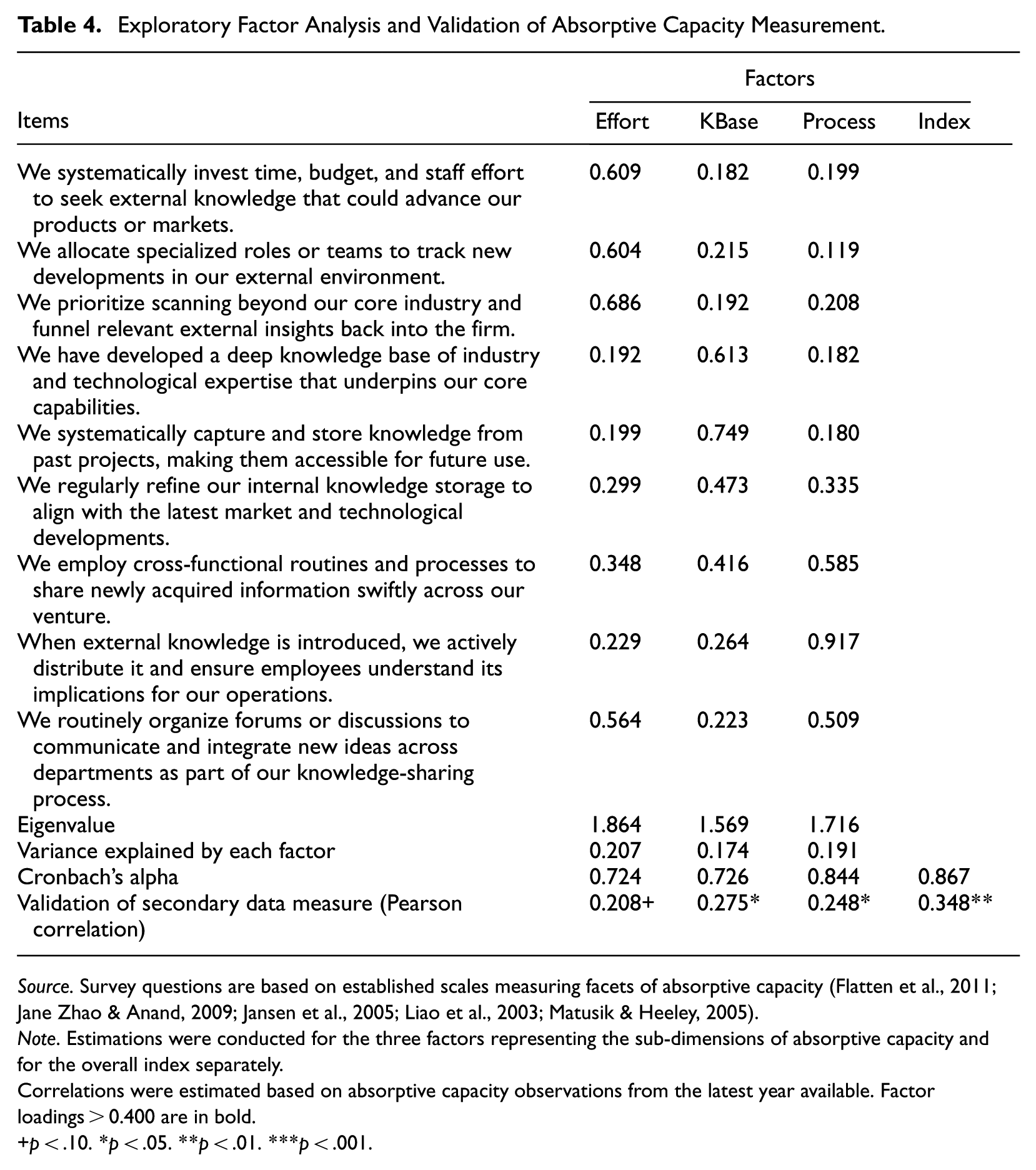
Source. Survey questions are based on established scales measuring facets of absorptive capacity (Flatten et al., 2011; Jane Zhao & Anand, 2009; Jansen et al., 2005; Liao et al., 2003; Matusik & Heeley, 2005).
Note. Estimations were conducted for the three factors representing the sub-dimensions of absorptive capacity and for the overall index separately.
Correlations were estimated based on absorptive capacity observations from the latest year available. Factor loadings > 0.400 are in bold.
p < .10. *p < .05. **p < .01. ***p < .001.
Cronbach’s alpha met conventional thresholds (Nunnally, 1978) for all three sub-scales—α = .72 for absorptive effort, α = .73 for absorptive knowledge base, and α = .84 for absorptive process—and reached α = .87 for the combined nine-item index, indicating satisfactory internal consistency. A restricted three-factor exploratory factor analysis (Preacher & MacCallum, 2003) ensured that each item loaded ≥.40 on its intended factor (i.e., the respective absorptive capacity dimension; Stevens, 2009). Two items assigned to the absorptive process dimension displayed secondary loadings above .40, but their primary loadings remained ≥.40 on the intended factor, supporting convergent and discriminant validity.
For each venture, we computed average scores for each sub-dimension and for the overall scale, then correlated these scores with the corresponding archival measures for the most recent year available. Correlations were positive and statistically significant—overall absorptive capacity index: r = .35, p < .01; absorptive effort: r = .21, p < .10; absorptive knowledge base: r = .28, p < .05; absorptive process: r = .25, p < .05. These values exceed the r > .20 benchmark often used as evidence of convergence across independent data sources (Grijalva et al., 2020; Richard et al., 2009) and compare favorably with meta-analytic findings on self-report versus archival correlations (Vazire & Carlson, 2010).
Alternative Indicators of Innovation Outcomes
Our theorizing and empirical tests focused on innovation output to align with our goal to explain how ventures produce innovation at scale. However, earlier studies also focus on innovation impact (Tzabbar & Margolis, 2017) or ventures’ orientation toward (product) innovation (Marvel et al., 2020). To complement our main analysis, we introduced two additional dependent variables: innovation impact and innovation orientation. For each venture-year, we used our patent data to construct a measure of innovation impact as the sum of forward citations received by a patent each year, adjusted for its technology class (Custódio et al., 2019). Re-estimating our analyses with this alternative dependent variable reveals qualitatively similar effects for the absorptive capacity index. In the dimension-specific models, absorptive effort is the only dimension with a statistically significant second-stage coefficient (absorptive knowledge base is marginally significant), and the confidence intervals of the indirect effects of founding experience on innovation impact via both absorptive effort and absorptive knowledge base do not include zero. We also collected historical data on all ventures’ websites, scraped via a longitudinal protocol from Haans and Mertens (2024), to calculate a measure of a venture’s innovation orientation based on a high-tech innovativeness dictionary drawn from McKenny et al. (2018). The results mirror our main findings. We explain and interpret the coefficients of related analyses in Online Supplemental Material C1.
Addressing Endogeneity Issues
Finally, we conducted three additional tests to address reverse causality (e.g., that innovation output also drives absorptive capacity) and omitted variable concerns (e.g., unobserved factors that could influence both founding experience and ventures’ innovation output) that may have biased our results (see Online Supplemental Material C2). To address concerns about reverse causality, we led the dependent variable by 2 years instead of one, as a longer time gap would weaken the mediation path if innovation output is the actual driver of absorptive capacity. However, all results remain qualitatively unchanged. We addressed endogeneity concerns related to the relationship between the mediator and the dependent variable using a control-function approach, a recommended remedy when the outcome is nonlinear (Papies et al., 2017). We explain the approach and the choice of instrument to that end in Online Supplemental Material C2. The results remain similar after correcting for endogeneity, suggesting that they are unlikely to be purely endogenous. To address omitted-variable bias, we calculated the Impact Threshold of a Confounding Variable, which estimates the minimum effect size a confounding variable must have on both the independent and dependent variables to render the observed relationship insignificant (Bendig & Hoke, 2024; Frank, 2000). An unobserved factor would have to correlate at least .079 with both founding experience and absorptive capacity and .234 with both absorptive capacity and innovation output to threaten our statistical inference. All impact factors remain below these thresholds. 8
Discussion
We find a positive association between founders’ founding experience and their organizational design choices related to establishing absorptive effort, absorptive knowledge base, and absorptive process. These effects are stronger for founders with prior VC investor exposure than for founders without such exposure, each relative to ventures without founders with founding experience. We also find that these choices are positively related to the innovation output of tech-based ventures. Our work contributes to the literature on founding experience, founders’ organizational design choices, and to the broader literature on absorptive capacity.
First, research at the intersection of founding experience and innovation has predominantly emphasized how related knowledge enables founders to better recognize opportunities and develop impactful innovations themselves (Lahiri & Wadhwa, 2021; Tzabbar & Margolis, 2017). We extend this work by shifting the focus to a “venture-building path,” showing that founders’ prior founding experience (especially with VC investor exposure) is associated with the creation of venture-level absorptive capacity, making the venture a more effective “knowledge management institution” (cf. Grant, 1996), so the entire venture can produce innovation output at scale. Shedding more light on this venture-building path shifts the focus of this literature stream from founder-centric to venture-centric theorizing, which may help clarify inconclusive findings regarding whether founding experience is “good or bad” (Eggers & Song, 2015; Toft-Kehler et al., 2014). For example, once we account for absorptive capacity in our empirical models, the direct association between founding experience and innovation output becomes small and even turns slightly negative, whereas the indirect path via absorptive capacity remains consistently positive. This pattern neatly aligns with conflicting arguments regarding the value of founding experience that discuss, for example, cognitive entrenchment (Eggers & Song, 2015; Marvel et al., 2020) on one side, and enhanced pattern recognition (Baron & Ensley, 2006; Eggers & Song, 2015) on the other; aspects that may balance each other out. Yet, the role of founding experience in making sound venture-building decisions may offer a more robust explanation for superior innovation outcomes, as our results imply. This view supports the “learning by doing” argument (Lafontaine & Shaw, 2016) typically evoked in this literature stream, but emphasizes that what is learned must be transferred to the entire venture.
Second, we contribute to the literature on implications of founders’ organizational design choices (Alexy et al., 2021; Burton et al., 2019), which has studied the influence of founders introducing additional management layers (Grimpe et al., 2019; Yang et al., 2020), optimizing task allocations (Brattström, 2024; Haeussler et al., 2019), or installing domain experts (Katila et al., 2017) for venture outcomes. Especially in an entrepreneurial context, designing an organization that will pursue an initially identified opportunity is the founders’ primary task; yet, further study in this area is warranted, as, for example, reflected in a call from Burton et al. (2019, p. 251)—“how and why do teams with different demographic characteristics and different levels of human capital organize their venture differently? Does this mediate the relationship between team composition and performance?”—remaining unaddressed. We add to this research by exploring the antecedents and impact of three distinct yet complementary design choices that jointly constitute absorptive capacity in tech-based ventures, and by determining their individual and collective importance for ventures’ subsequent innovation output, hence offering a granular view of how founders’ organizational design choices drive venture outcomes. For example, we find consistent positive associations between founding experience and innovation output operating through the path of organizational design choices that strengthen absorptive knowledge base and absorptive effort, but not so robust evidence for the absorptive process dimension. While we acknowledge the coverage limits of the absorptive process dimension (i.e., due to data restrictions, we measure process-instituting governance arrangements), we cautiously interpret this finding as indicating a greater importance of a stronger knowledge base and operational capacity in searching for and processing external knowledge at scale for innovation output in tech-based ventures. In terms of innovation impact, the most robust pathway runs through absorptive effort. This dimension is the only significant second-stage predictor, even though mediated effects via both absorptive effort and absorptive knowledge base are statistically significant. Taken together with our main findings, we conclude that the absorptive knowledge base and effort dimensions (Song et al., 2018) provide a strong foundation for generating high volumes of innovation output, whereas impactful innovations are relatively less dependent on the current knowledge base, but relatively more associated with sustained investments in operational R&D and technical roles.
Third, we extend research at the intersection of absorptive capacity and firm innovation (Song et al., 2018), which has primarily examined the consequences of absorptive capacity for innovation (Makri et al., 2010; Nooteboom et al., 2007) rather than its antecedents. With our theorizing and empirical approach, we directly relate to research calls like that of Volberda et al. (2010, p. 932) who note that “we have little knowledge of the effect of […] key individuals’ impact on absorptive capacity.” We add to this gap by showing that founders’ founding experience (including VC investor exposure as an important nuance [Osses et al., 2024]) increases the likelihood that a tech-based venture develops absorptive capacity. In doing so, we illuminate an underexamined “individual–organizational bridge” that explains the emergence of absorptive capacity. Rather than treating absorptive capacity as a purely organizational given, we theorize and test a path in which founder-level experience translates into organizational-level absorptive capacity and, in turn, into organizational-level innovation outcomes (Volberda et al., 2010). This perspective explicitly links founder characteristics to the emergence of organizational capabilities, thereby connecting prior research treating absorptive capacity as residing in a founder (Symeonidou & Nicolaou, 2018) with (a more substantial) literature stream treating absorptive capacity as an organizational-level construct (Cohen & Levinthal, 1990).
Our findings also offer insights for founders, investors, and policymakers who wish to promote innovation. For founders, merely having founding experience does not guarantee success in innovation, as they must design an organization that incorporates external knowledge efficiently through absorptive capacity. As for investors, they should evaluate founders’ ability to develop advanced knowledge processes and help founders strengthen their ventures’ capacity to acquire, share, and apply external knowledge, thereby increasing the likelihood that innovation outputs will be ready for commercialization. For their part, policymakers and other stakeholders should encourage training or subsidies to formalize knowledge practices and integrate such training into support systems such as incubators and accelerators. This approach can strengthen ecosystems and increase the likelihood of innovation outputs that feature quantity and quality.
Limitations and Future Research
Our study’s limitations point to promising directions for future research. First, we acknowledge constraints in capturing the core concepts of our work. For example, due to data limitations, we approximated the absorptive process dimension through “process-instituting governance arrangements” within the venture, such as having a CIO or CTO. Similarly, for the absorptive knowledge base, we relied mainly on an observable patent-based measure, which captures the most important but not all ways of building a knowledge base (e.g., it does not explicitly capture the formalization of internal knowledge). Although we successfully validated all operationalizations of the absorptive capacity dimensions with our survey, we emphasize the need for future research to develop additional methods to observe these dimensions (especially absorptive process) through archival data. Additionally, we see potential in using interviews with venture founders to further explore organizational design choices affecting absorptive capacity and innovation outputs in tech-based ventures.
Second, future research could explore additional configurations of how founding experience can be situated in a venture (Tzabbar & Margolis, 2017). For example, studying venture teams that include a founder who failed in a prior venture and a novice, or a founder who led a prior venture to an IPO, could reveal how these knowledge combinations influence the development of absorptive capacity and its implications for innovation.
Third, we focused on tech-based ventures, which are highly knowledge-intensive. Expanding the sample to include a broader range of industries would clarify the boundary conditions of our findings. 9 For example, the roles of experience in the same industry or an outside industry (Fox et al., 2023) and macro-level industry dynamics may serve as subgroup differentiators in such a broader context.
Supplemental Material
sj-docx-1-etp-10.1177_10422587261415931 – Supplemental material for Founding Experience and Tech-Based Ventures’ Innovation: The Mediating Role of Absorptive Capacity
Supplemental material, sj-docx-1-etp-10.1177_10422587261415931 for Founding Experience and Tech-Based Ventures’ Innovation: The Mediating Role of Absorptive Capacity by Adrian Noah Brandenburg, Jannis von Nitzsch, Victoria Willcke-Berg and Andreas Engelen in Entrepreneurship Theory and Practice
Footnotes
Declaration of Conflicting Interests
The authors declared no potential conflicts of interest with respect to the research, authorship, and/or publication of this article.
Funding
The authors received no financial support for the research, authorship, and/or publication of this article.
Ethical Considerations
Not applicable.
Consent to Participate
Not applicable.
Consent for Publication
Not applicable.

Data Availability Statement
Not applicable.
Supplemental Material
Supplemental material for this article is available online.