



Abstract
This article aims to obtain a set of erotic and gory pictures from the International Affective Picture System (IAPS) for use in studies across India. Additionally, it compares the ratings of a representative Indian sample with North American norms. Using the Self-assessment Manikin, adult Indian participants rated 72 arousal-matched IAPS pictures on emotional dimensions of arousal, valence and dominance. The ratings of the Indian and North American samples for valence were similar, but arousal and dominance ratings differed significantly. According to the valence–arousal relationship, the Indian sample’s emotional reactions to the unpleasant pictures compared to the pleasant ones were stronger. The Indian sample’s affective space of valence and arousal had a more curved and deeper boomerang pattern than the North American sample. The divergences in arousal and dominance ratings are attributed to cultural differences in interpreting affective information specific to erotic and gory pictures. Although there are marked similarities between the Indian and North American ratings, careful consideration of country-specific normative ratings is recommended for erotic and gory IAPS pictures.
Introduction: Theoretical Background of IAPS Stimuli in Emotion Research
Emotions pervade almost every domain of human life, and a substantial body of research is dedicated to studying emotions (Cacioppo & Gardener, 1999; Gupta, 2011, 2012, 2016, 2019, 2022; Gupta et al., 2019; Gupta & Deák, 2015; Zajonc, 1998). Many experimental psychology and neuroscience research studies necessitate the use of images that depict actual social and non-social situations (Gupta & Singh, 2021; Gupta et al., 2016; Quigley et al., 2014). Several internationally available databases with normative ratings have been developed to provide a standardised set of emotion-inducing static visual stimuli for experimental investigations and theory building. For example, the Karolinska Directed Emotional Faces (KDEF; Lundqvist et al., 1998), the Montreal Set of Facial Displays of Emotion (Beaupré et al., 2000), the Japanese and Caucasian Facial Expressions of Emotion (JACFEE; Ekman & Matsumoto, 1993–2004) and the NimStim (Tottenham et al., 2009) provide pictures of static facial expressions, while databases such as the International Affective Picture System (IAPS), the Open Affective Standardized Image Set (OASIS; Kurdi et al., 2017), the Geneva Affective Picture Database (GAPED; Dan-Glauser & Scherer, 2011) and the Emotional Picture System (EmoPicS; Wessa et al., 2010) contain pictures across diverse subject matters. The IAPS, developed by the NIHM Center for the Study of Emotion and Attention (The University of Florida; Cuthbert et al., 1996; Lang et al. 1995,–2008), is one of the most frequently used databases across the world.
Owing to its universal applicability, better experimental control, language-independent rating procedure and ease of interpretation, IAPS has consistently been used as an essential methodological tool in experimental studies, especially in psychophysiological reactions (e.g., Bradley & Lang, 2000; Bradley et al., 1992, 1999, 2008; Choi et al., 2017; Codispoti et al., 2006), cognitive and emotional processing (e.g., Aluja et al., 2015; Azevedo et al., 2005; Cohen et al., 2015, 2016; Grabowska et al., 2011; Hajcak & Dennis, 2009; Hot et al., 2006; Junghöfer et al., 2006; Schupp et al., 2004, 2006) and psychological illnesses and disorders (e.g., Baglioni et al., 2010; Kensinger et al., 2002; Quirk & Strauss, 2001; Wessa & Flor, 2007; Yiend & Mathews, 2001).
Since its conception, IAPS has undergone several additions and alterations; the latest version of IAPS comprises 1,182 coloured photographs that illustrate a range of items and circumstances, including pictures of animals, domestic utensils, food, landscape settings, plants, vehicles, weapons, mutilation and erotica. Each picture induces a range of emotionally charged responses represented by arousal, valence and dominance (Bradley & Lang, 1994; Lang et al., 1995–2008). Valence represents the pleasant or unpleasant quality of the emotional experience; arousal refers to physiological or psychological activation intensity. Lastly, dominance indicates the perceived subjective control over the affective experience. The Self-assessment Manikin (SAM) is employed to obtain the emotional reactions of individuals on these three dimensions. SAM is a pictorial figure composed of a rating scale (range 1–9); the valence SAM depicts a smiling/happy-frowning/unhappy continuum, the arousal SAM represents an excited/wide-eyed-relaxed/sleepy continuum and the dominance SAM represents a large/dominant-small/non-dominant continuum. Individuals select a manikin along the continuum to indicate their emotional responses to each picture (Bradley & Lang, 1994; Lang et al., 1995–2008).
Validation of IAPS Stimuli: Similarities and Differences Across Cultures
Although the IAPS pictures are standardised according to the normative ratings of a large North American sample of young adults, the stimulus selection for experimental studies might disregard the culture-based differences in the perception, reactions and interpretation of the picture content across languages, countries and cultures. Culture encompasses exposure to certain life situations and beliefs, leading to different emotional responses: some pictures may be perceived as more or less pleasant or unpleasant, or more or less arousing, or more controlled or in control, by certain groups than by others (Matsumoto et al., 1988; Mesquita, 2001; Mesquite & Walker, 2003; Schimmack et al., 2002). Several studies on IAPS have shown comparable psychometric behaviour and confirmed the applicability of the original normative ratings across cultures (Deák et al., 2010; Drače et al., 2013; Dufey et al., 2011; Grabovac & Deák, 2019; Huang et al., 2015; Lang et al., 1995–2008; Lasaitis et al., 2008; Lohani et al., 2013; Moltó et al., 1999, 2013; Ribeiro et al., 2005; Hu et al., 2005; Silva, 2011; Verschuere et al., 2001; Vila et al., 2001), and age groups (Backs et al., 2005; Gong & Wang, 2016; Grühn & Scheibe, 2008; Keil & Freund, 2009; Pôrto, 2006; Pôrto et al., 2008, 2011; Ueno et al., 2019). A boomerang-shaped distribution of ratings in the valence–arousal relationship (Bradley et al., 2001; Lang et al., 1998) was obtained in all these studies despite variability in the type and size of the sample, the number of pictures being rated and the testing procedure.
The results of the Brazilian (Lasaitis et al., 2008; Ribeiro et al., 2005), Spanish (Moltó et al., 1999, 2013; Vila et al., 2001), Indian (Lohani et al., 2013), Serbian and Hungarian (Grabovac & Deák, 2019) and Bosnia and Herzegovina (Drače et al., 2013) valence ratings were comparable to the US standardisation, but arousal scores were higher than the US ratings. One Chilean study showed that the emotional pictures were rated more arousing than the US sample (Dufey et al., 2011). Another study showed lower arousal ratings by the Chilean sample (Silva, 2011); the valence ratings were equivalent in both studies. The ratings of the IAPS pictures by a sample of the European Portuguese were lower on the valence dimension and higher on the arousal dimension than the US sample (Soares et al., 2015). But Barke et al. (2012) found that the German sample’s picture ratings showed opposite trends compared to those in the study by Soares et al. (2015). The Lithuanian sample also gave lower arousal ratings but equivalent valence ratings compared to the US normative ratings (Mačiukaitė et al., 2015). The Flemish sample (Verschuere et al., 2001) and the Hungarian data (Deák et al., 2010) showed similar ratings for valence and arousal when compared to the US norm. For dominance, the Flemish (Verschuere et al., 2001) and Spanish (Moltó et al., 1999, 2013; Vila et al., 2001) ratings were lower than North America ratings, but higher for the Hungarian sample (Deák et al., 2010), the Chilean sample (Silva, 2011), the Colombian sample (Gantiva-Díaz et al., 2011) and the Indian sample (Lohani et al., 2013). Soares et al. (2015) found that European Portuguese participants rated dominance lower than the American participants, while some studies found no difference in dominance (Drače et al., 2013; Lasaitis et al., 2008; Ribeiro et al., 2005). The results across validation studies are mostly consistent along the valence dimension, but the arousal and dominance dimensions seem vulnerable to variations. Still, a boomerang-shaped distribution characterised the valence–arousal relationship in all the validation studies.
Nevertheless, there has been no comparison between the Indian and North American standardisations of erotic and gory IAPS pictures. The IAPS validation study on the Indian sample did not include these categories due to cultural sensitivities (Lohani et al., 2013). In the Chinese validation of IAPS, Hu et al. (2005) found marked differences in the emotional ratings of Chinese and American adults for erotic IAPS pictures. Another cross-cultural study on Chinese undergraduate students showed that the erotic pictures induced more frequent negative reactions in Chinese female participants than American female participants and strongly suggests modifications of IAPS norms for their suitability in Asian cultures (Huang et al., 2015). In the German adaptation (Grühn & Scheibe, 2008), the German sample perceived erotic pictures as less pleasant and more arousing than the US sample. In one of the earliest cross-cultural studies conducted using 60 IAPS pictures on a sample of German university students, researchers found a stronger association between valence and arousal ratings than the US students (Hamm & Vaitl, 1989).
Further, the German sample assessed the erotic pictures as less pleasant and arousing than the US sample. Studies have reported pronounced differences across emotional response channels while viewing highly arousing positive and negative pictures than neutral pictures (Calvo & Avero, 2009; Ribeiro et al., 2007; Schupp et al., 2004, 2007; Straube et al., 2008). Since India and North America represent collectivist and individualist cultures, respectively (Mesquita, 2001), and cultural differences might influence the perception of emotions, we speculated that the emotional reactions elicited by IAPS pictures would differ between the two samples.
The Current Study: Validating Erotic and Gory IAPS Stimuli in Indian Sample
The present study aimed (a) to compare the emotional ratings of erotic and gory pictures between the Indian and North American samples and (b) to obtain a standardised set of erotic and gory pictures for use in studies across India. We compared the mean ratings and correlations on three dimensions obtained for 72 pictures in the Indian and North American samples. We predicted incongruities in the arousal and dominance dimensions between the two samples based on the cross-cultural evidence. We expected the typical boomerang distribution of the valence–arousal relationship; pictures (either erotic or gory) rated as extremely high or low on the valence dimension would be rated highly on the arousal dimension. Consistent with earlier findings, we predicted that the Indian sample would also show negativity bias and positivity offset (Ito & Cacioppo, 2005; Ito et al., 1998).
Method
Participants
Sixty-seven adults (36 males and 31 females) contacted via telephone or emails consented to participate in the online study. Still, during the application of the instrument, seven people left the study before completion. In the end, sixty people (31 males and 29 females, age range = 18–39 years, Mage = 23.8 years, SD = 4.8 years) completed the study; 39 of the participants were undergraduate or postgraduate students, and 21 were employees from diverse educational and occupational domains. The participants were right-handed, had normal or corrected-to-normal vision and had no ongoing psychiatric or neurological disorder.
Materials and Procedure
Initially, we selected 108 pictures from a total of 1,194 pictures from the recent IAPS database (Lang et al., 1995–2008). The authors intentionally extracted the pictures that depicted human objects: pictures considered as (a) erotic (relating to or tending to arouse sexual desire or excitement) and (b) gory (involving or showing violence and bloodshed) were included. Finally, 72 pictures were adopted, with 36 erotic (positive) and 36 gory (negative) pictures. We excluded the following pictures: those that (a) showed significant gender-related differences in the normative ratings of valence and arousal; (b) were ambiguous in the illustrated content or for Indian culture or (c) had low-standard photographic quality. We matched the erotic and gory pictures on arousal ratings, t(35) = −0.236, p = .81. The chosen stimuli included pictures of erotic couples, headless bodies, burn victims and dead bodies. The slide numbers of the selected IAPS pictures are given in Appendix A.
The experiment was designed on a 15.6-inch colour monitor (60 Hz; resolution of 1,920 × 1,080 pixels) using the builder interface of Psychopy 3 software (Peirce et al., 2019). The study was conducted via Pavlovia, an open-source online experiment repository for generating stimuli and recording responses (Open Science Tools, Nottingham, United Kingdom). Stimuli parameters such as font size, picture size and resolution were kept constant for different monitors. We displayed the pictures in their actual size (1024 × 768 pixels). The ratings were collected in an online setting individually. Before the session began, the individuals filled out sociodemographic information (e.g., age, gender, handedness, educational qualification, nationality). They were informed that the goal of the current study was to assess people’s reactions to pictures with respect to different situations in life. They were forewarned that if they found the content unsuitable for viewing, they may choose not to participate or may quit during the study.
If the individuals gave consent, they were given the instructions for the picture rating task. Participants were required to seat themselves at a distance of 60 cm in front of their monitors. They were told that 72 pictures would be displayed consecutively and were required to rate each picture mandatorily in terms of ‘how it made them feel while viewing it’. The ratings were collected through a computerised version of SAM on three scales: valence, arousal and dominance, ranging from 1 to 9 (Bradley & Lang, 1994; see Figure 1). The valence scale represents the happy versus unhappy emotional extremes: 1 being totally unhappy, annoyed, dissatisfied, despaired and bored and 9 being totally happy, pleased, satisfied, hopeful and interested. The arousal represents excited versus calm extremes: 1 being totally relaxed, calm, dull, sleepy and unaroused and 9 being totally stimulated, excited, lively, alert and aroused. The dominance scale constitutes controlled versus in-control extremes: 1 being totally controlled, influenced, obedient and guided, and 9 being totally in control, influential, dominant and independent. Participants could express their intermediate feelings or neutral responses by choosing the number 5, that is, if the participant felt neither happy nor unhappy on the valence scale, neither calm nor excited on the arousal scale, and neither controlled nor in control on the dominance scale. Participants were asked to respond as quickly and honestly as possible.
Rating Screen Presented in the Study. The Participants Moved the Slider Along the 9-point Scale Below the Respective SAM Figures for the Three Dimensions and Pressed the Space Key After Completing the Three Ratings.
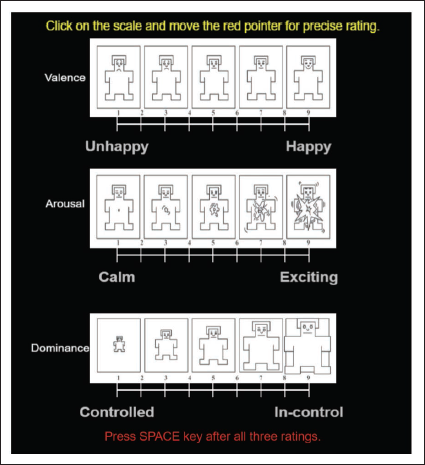
The study began with two practice pictures (one erotic and one gory), which displayed the presentation format and instructions for the rating procedure. The practice pictures were taken from the internet and were similar to the IAPS pictures. The trial started with the instruction ‘Get ready to view the image’, which appeared on the screen’s centre for 5 s. After the 5 s period passed, the IAPS picture was presented at the centre of the screen for 6 s, and the participants were instructed to pay close attention to it. The ‘picture screen’ was followed by the ‘rating screen’ with the instruction, ‘Click on the scale and move the red pointer for precise rating’ written at the top (Arial font 14). SAM with rating scales was displayed below it; the valence scale was presented just below the instruction, the arousal scale in the middle and the dominance scale at the bottom. The end points of the valence scale were marked as ‘unhappy’ and ‘happy’, those of the arousal scale as ‘calm’ and ‘exciting’ and those of the dominance scale as ‘controlled’ and ‘in-control’. The picture was rated by placing the triangle pointer over the figure or between two figures. The scales remained on the screen until the three ratings were completed, after which the participant pressed the ‘space’ key for the next picture (see Figure 1).
After a brief practice, the participants attempted the test session, which followed the same trial structure as the practice session. The pictures were presented in a random sequence to each participant. No more than three pictures of the same category appeared on consecutive trials to control for habituation effects. There were no inter-trial breaks. Once the participants had given ratings for all pictures, they were debriefed and later received a monetary incentive to complete the study. The entire study took, on average, 45–50 min. SPSS 25.0 was used for analysing all the rating scores (IBM, Armonk, NY, USA).
Results
To analyse cross-cultural differences between the Indian and North American ratings for erotic and gory IAPS pictures, we considered judgements for the selected data set from both samples.
Valence, Arousal and Dominance: Comparison of Mean Ratings and Range Values
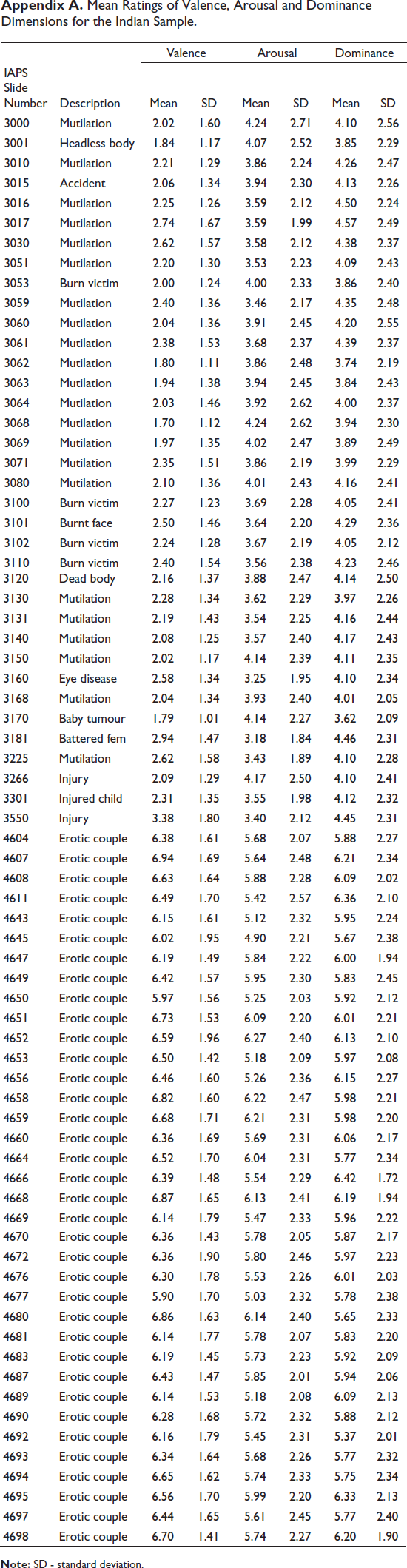
We calculated the mean ratings of valence, arousal and dominance dimensions for each picture for the Indian sample (see Appendix A for mean ratings). To compare the Indian (Ind) and North American (NA) samples, t-tests were conducted across the three dimensions and two picture categories.
All pictures: There was no significant difference in valence ratings between the two samples (Ind: M = 4.33, SD = 1.50; NA: M = 4.20, SD = 1.54, t(142) = 0.334, p = .738, d = 0.08). There were significant differences in arousal (Ind: M = 4.73, SD = 2.29; NA: M = 6.36, SD = 2.17, t(142) = 12.18, p < .001, d = 0.73) and dominance ratings (Ind: M = 5.04, SD = 2.26; NA: M = 4.45, SD = 2.11, t(142) = 3.015, p = .003, d = 0.27) between samples.
Erotic pictures: There were significant differences in valence (Ind: M = 6.42, SD = 1.64; NA: M = 6.58, SD = 1.81, t(70) = 2.047, p = .045, d = 0.1), arousal (Ind: M = 5.68, SD = 2.28; NA: M = 6.35, SD = 2.05, t(70) = 8.179, p < .001, d = 0.31) and dominance ratings (Ind: M = 5.96, SD = 2.17; NA: M = 5.75, SD = 2.10, t(70) = -3.35, p < .001, d = 0.1) between the two samples.
Gory pictures: There was a significant difference in valence (Ind: M = 2.24, SD = 1.37; NA: M = 1.82, SD = 1.27, t(70) = 5.290, p < .001, d = 0.32), arousal (Ind: M = 3.77, SD = 2.29; NA: M = 6.37, SD = 2.30, t(70) = 21.85, p < .001, d = 1.13) and dominance ratings (Ind: M = 4.12, SD = 2.36; NA: M = 3.15, SD = 2.12, t(70) = –10.53, p < .001, d = 0.4).
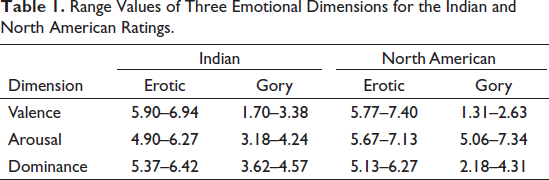
The association between the Indian and North American ratings was the highest for valence (0.99), followed by dominance (0.95), all p < .001 and arousal (0.15), p = .20. The range values (see Table 1) indicate that the Indian sample rated the erotic pictures less extremely on all three dimensions. The gory pictures were rated less extremely on the arousal dimension than the North American ratings. The pictures 4683 (erotic couple), 4649 (erotic couple) and 3062 (mutilation) were rated most similarly by the two samples on the dimensions of valence, arousal and dominance, respectively. The pictures rated most differently by the two samples on the dimensions of valence, arousal and dominance were 4660 (erotic couple), 3010 (mutilation) and 3102 (burn victim), respectively.
Range Values of Three Emotional Dimensions for the Indian and North American Ratings.
The Valence–Arousal Relationship in a Bi-dimensional Affective Space
To further compare the emotional judgements of the two samples, we plotted the IAPS ratings of the erotic and gory pictures in a bi-dimensional affective space of arousal and valence and excluded the dominance dimension as it barely accounts for the variability in affective ratings (Bradley, 1994). The pictures represented high (pleasant) or low (unpleasant) valence, with 5.00 as the cut-off value. For each affective space, that is, pleasant and unpleasant, we conducted a correlational and regression analysis between the valence and arousal scores. The analyses generated two slopes and intercepts, one for each category of pleasant and unpleasant pictures.
Correlation Analysis
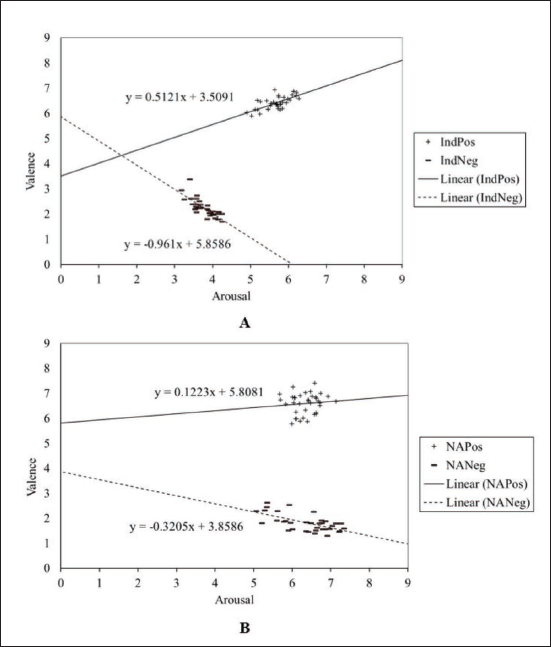
Although the Indian ratings for erotic and gory pictures fall on a boomerang-shaped distribution, the distribution was still more curved and deeper than the North American sample (see Figure 2A). The mean scores of most of the pleasant pictures for the Indian sample were concentrated around the midpoints, ranging from 5 to 6 on the arousal scale, and were more scattered than unpleasant pictures, ranging from 3 to 4 on the arousal scale. The pleasant pictures had a significant positive association (r = 0.686, p < .001) and the negative pictures had a significant negative association (r = −0.783, p < .001) between valence and arousal ratings. The strong positive relationship shows that pleasant pictures correlate with higher control over the emotional state. In contrast, the strong negative correlation shows that the unpleasant pictures induced more overwhelming emotions, and the slope value confirmed it (for the pleasant pictures: 0.51; for the unpleasant pictures: 0.96). This finding also suggests that the Indian sample rated the unpleasant pictures as more arousing than the pleasant pictures. Nevertheless, the arousal ratings of the unpleasant pictures were lower than those observed in the pleasant pictures. Compared with the North American sample (see Figure 2B), the mean scores of the most pleasant pictures were concentrated around points 6–7 of the arousal scale and were more scattered than the unpleasant pictures, ranging from 5 to 7 on the arousal scale. There was no significant positive association for the pleasant pictures (r = 0.100, p = .560); however, a significant negative association was observed for the unpleasant pictures (r = −0.626, p < .001) between valence and arousal ratings. Thus, the North American sample rated highly unpleasant as more arousing, as shown by the slope value (0.32).
Regression Analysis
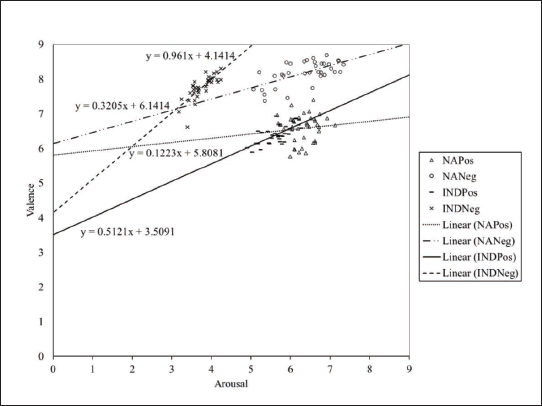
To compare the regression lines of the erotic and gory pictures, we reversed the valence ratings of gory pictures by subtracting the valence score from 10. If we look at Figure 3, the within-group examination of the Indian sample revealed that the intercept for the pleasant pictures (3.50) was smaller than that of the unpleasant pictures (4.14), but the slope of the unpleasant pictures (0.96) was greater than that of the pleasant pictures (0.51). The North American sample also exhibited a smaller intercept for the pleasant pictures (5.80) than for the unpleasant pictures (6.14). Similarly, the slope of the unpleasant pictures (0.32) was greater than that of the pleasant pictures (0.12). As predicted, we found a negativity bias in the Indian sample, reflected by a steeper slope for the unpleasant pictures than the pleasant pictures. Contradictory to our prediction, the Indian sample did not show positivity offset, represented by a greater intercept for the pleasant pictures than the unpleasant pictures. Comparing the two samples’ between-group slope and intercept values revealed smaller intercepts and larger slopes in the Indian sample than the North American sample. Closer scrutiny of the distribution showed that the relatively rated low-arousing, positive and negative pictures accounted for the variance in ratings between the samples. The North American sample rated low-arousing, positive and negative pictures as equally less pleasant and unpleasant, respectively, than the Indian sample. But the Indian sample rated the low-arousing negative pictures as slightly more unpleasant than the low-arousing positive pictures rated as pleasant.
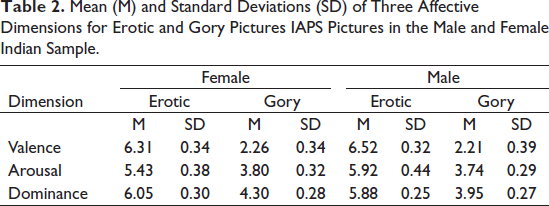
We also explored gender-related differences in the Indian sample by calculating mean ratings on three dimensions for each picture, which collapsed across participant gender. There was no significant gender difference on any dimension, p > .10, for all. However, there were crucial gender differences in the ratings of erotic pictures (see Table 2). Males rated the pictures as more pleasant and more arousing (valence: t (35) = 3.179, p < .001, d = 0.64; arousal: t(35) = 6.80, p < .001, d = 1.18) but lower in dominance, t(35) = 2.81, p < .001, d = 0.54 than females. There was a significant difference in the dominance dimension for gory pictures, with females rating them significantly higher than males t(35) = 6.02, p < .001, d = 1.1.
Mean (M) and Standard Deviations (SD) of Three Affective Dimensions for Erotic and Gory Pictures IAPS Pictures in the Male and Female Indian Sample.
Discussion
Emotional perception, experience and expressions are often characterised by variability. Understanding the cultural underpinnings of this variability may help better grasp the complexities of human emotions. The present study evaluated cross-cultural differences between the Indian and North American ratings of arousal-matched, erotic and gory pictures extracted from the IAPS database for subsequent application in emotion research in the Indian context. We used the self-assessment manikin for collecting ratings on the three affective dimensions of arousal, valence and dominance.
Tracing Consistencies and Inconsistencies Between Indian and North American Ratings
In line with the predictions, for all 72 pictures, the Indian and North American ratings were comparable for valence, but the arousal and dominance ratings differed. The arousal rating was considerably lower, while the dominance rating was higher in the Indian sample than the North American sample. In contrast, the results of a previous validation study on young Indian adults showed that the arousal rating was higher but the dominance rating was lower than the North American sample (Lohani et al., 2013), possibly because the subset did not include erotic and gory pictures. The lowest arousal rating for the Indian sample was 3.18, while for the North Americans, it was 5.06. The lowest dominance rating for the Indian sample was 3.62, while for the North American sample, it was 2.18. The Indian sample rated the erotic pictures as less pleasant and arousing but more in control than the North American sample. The gory pictures were rated as more unpleasant and in control but less arousing by the Indian sample than the North American sample. The higher dominance ratings might be assumed to originate from the collective social identity (Brewer & Gardner, 1996) associated with an interdependent culture that might serve as an effective control mechanism and implicitly influence affective perception and experience, especially with violent pictures.
This study specifically examined the relationship between valence and arousal for erotic and gory IAPS pictures. Overall, pictures rated as highly unpleasant were also rated as more arousing by the two samples. However, the Indian sample rated highly pleasant pictures as highly arousing, unlike the North American sample. The negative pictures had stronger correlations and showed a steeper slope with lower dispersion than the positive pictures (e.g., Gantiva Díaz et al., 2011; Vila et al., 2001). Both samples showed negativity bias but not positivity offset for these groups of pictures. The stronger relationship between valence and arousal in the gory pictures than in the erotic pictures in the Indian sample indicates that the Indian subjects are more emotionally reactive to the unpleasant IAPS pictures than the pleasant ones. The relationship suggests that the aversive information associated with defensive motivational systems generated greater activation, owing to its adaptive value for survival (LeDoux, 1996; Lang et al., 1998), compared to the pleasurable stimuli related to the appetitive motivational system (Bradley et al., 2001).
However, a fascinating difference between the arousal and valence relationships for the pictures was observed. Although the distribution of ratings in the affective space is comparable to that obtained in previous IAPS validation studies, the boomerang shape of the distribution for Indian ratings was deeper and more curved than the North American ratings. In the North American standardisation, the distribution of IAPS pictures in the valence–arousal affective space shows that the pleasant and unpleasant pictures are ascribed high arousal states and are located in the upper right and lower right quadrants, respectively. However, the Indian ratings showed a slightly different distribution pattern. The unpleasant pictures are positioned in the lower left quadrant, while the pleasant pictures are located in the upper right quadrant, inching towards the centre on the abscissa (neutrality in arousal). Such variations in valence–arousal ratings have some potential explanations based on cultural differences in interpreting affective information specific to erotic and gory pictures. One of the critical reasons could probably be cultural norms against sex, which are heavily ingrained in Indian society. In a collectivist culture like India, the idea of sex, sexual desire and sexuality is expected to be hidden and their expression is considered counterproductive for maintaining harmonious interpersonal relationships. This censorship often causes young adults in Asian cultures (Gong & Wang, 2016; Tsai et al., 2006) to suppress their desires and express positive affect with lower intensity, especially women. A study that assessed mate preferences in young Indians indicated that despite the cultural changes, both males and females continue to regard chastity as valuable, and prior sexual experiences are considered to be of little importance to a potential mate (Kamble et al., 2014). Even violent and gory pictures are not a part of Indian culture and are neither glamorised nor freely exhibited for general audiences. Another reason could be in the way the concept of arousal is defined. More importantly, semantic and conceptual interpretations of arousal may vary between languages and populations, an argument often stressed by researchers (Dufey et al., 2011; Grühn & Scheibe, 2008; Lasaitis et al., 2008; Ribeiro et al., 2005).
The gender differences in the intensity of arousal, valence and dominance strongly suggest differential processing of erotic and gory pictures for males and females (Drače et al., 2013; Dufey et al., 2011; Huang et al., 2015; Lang & Bradley, 2007; Silva, 2011; Soares et al., 2015; Yi et al., 2006). The finding that males perceived positive pictures as more arousing than females is possibly linked to more activation in men than in women caused by erotic pictures. The higher dominance ratings by females for erotic and gory pictures suggest that they have a higher level of perceived control over the affective stimuli.
Limitations and Conclusion
Our study finds additional evidence to support the idea that culture plays a crucial role in the way individuals perceive, experience and express emotions; however, there are some limitations. First, the intentional extraction of the pictures and the relatively small sample size might affect the generalisation of the present finding. Second, the current study obtained ratings from a fairly large subset of erotic and gory pictures. The repetitive presentation of high-arousing IAPS pictures might have resulted in habituation effects (Codispoti et al., 2006), and the pictures were evaluated with less arousal as the session proceeded. To conclude, our study provides a diversified pool of erotic and gory stimuli that would permit better control and manipulation for comparability studies in emotion-oriented research (e.g., studying the impact of affective inductions on cognitive processing, the effects of valence and arousal on perception and expression and the study of developmental differences in emotion processing). As we furnish further evidence to support culture-specific emotional reactions, evaluations and subjective experience, future research studies in India should consider high- and low-valence, arousal-sensitive stimuli based on the normative ratings obtained from the representative Indian sample. In the current study, we observed that many pictures were rated similarly, but some showed differences between the Indian and North American ratings of arousal, valence and dominance. Although there were parallels between the two samples for erotic and gory IAPS pictures, using Indian normative values is advisable for studies on the Indian population.
Mean Ratings of Valence, Arousal and Dominance Dimensions for the Indian Sample.
Author Contribution
Both authors designed the study. SL performed data acquisition, SL and RG analysed the data and wrote the manuscript. Both authors revised and reviewed the manuscript.
Footnotes
Declaration of Conflicting Interests
The authors declared no potential conflicts of interest with respect to the research, authorship and/or publication of this article.
Ethical Approval
The study was approved by the ethical committee of the Indian Institute of Technology Bombay. All procedures performed in studies involving human participants were in accordance with the ethical standards of the institutional and/or national research committee and with the 1964 Helsinki Declaration and its later amendments or comparable ethical standards.
Funding
This research was supported by the University Grants Commission con8ngency fund (378/(NETNOV2017)) to Ms Surabhi Lodha, and IRCC, IITB seed grant (RD/0518 IRCCSH0-013) to Prof Gupta.
Informed Consent
Informed consent was obtained from all individual participants included in the study.
