



Abstract
To aid in understanding the determinants of negative interpersonal and intergroup behaviours, this research tested theories specifying which appraisals of events would be associated with distinct negative emotions felt towards other individuals. To test hypotheses, we analysed survey responses from 128 MTurk workers and undergraduates in the USA who wrote about current and prior experiences of either anger, contempt, dislike, or hatred, and rated scales measuring hypothesised appraisals and emotional responses. As predicted, anger was associated with perceiving another person as blocking one’s goals, whereas contempt was associated with perceiving another person as beneath one’s standards; and anger, contempt, dislike, and hatred were each associated with perceiving events as motive-inconsistent and caused by another person. However, only one item measuring prospective control fit the predicted pattern of anger and contempt involving higher control potential than dislike and hatred. These results replicate and extend previous findings on appraisal-emotion relationships in India and the United States. Similarities and differences across cultures in appraisal-emotion relationships are discussed and applied to intergroup relations in developing societies.
Introduction
Intergroup conflict is a perennial problem in developing societies (e.g. Tripathi et al., 2018), as well as developed ones (e.g. Abramowitz & McCoy, 2019). For example, recent issues of this journal have highlighted conflicts between Hindus and Muslims (e.g. Tripathi et al., 2019), tribal and non-tribal populations (Kharshiing, 2020), and Arabs and Jews (Hadar, 2019). In response to perceptions of harm attributed to outgroup members, whether group members seek revenge versus reconciliation (e.g. Gausel et al., 2018) can have profound consequences for the physical survival, economic outcomes, and psychological well-being of the people involved and for their societies (e.g. Hoeffler & Reynal-Querol, 2003).
In addition to the political, social, economic, and ideological causes of conflict, attention has recently been drawn to the contribution of emotional responses (e.g. hope, fear, anger, contempt, and hatred) to determining the behaviours of group members, and the course that conflict takes (e.g. Halperin et al., 2011; Rosler et al., 2017; Tausch et al., 2011). For example, distinct emotions may serve as proximal or mediating variables that intensify or constrain responses to perceptions of collective victimisation by outgroup members (e.g. Tripathi et al., 2018).
In a study of Hindu and Muslim students from universities in northern India, Tripathi et al. (2018) found that in both religious groups, conciliation (coming together to resolve a conflict peacefully and enhance mutual understanding) was the most preferred response across norm violations. However, emotions influenced the extent to which retaliation (responding in kind) or retribution (having norm violators punished by authorities) was preferred by some members of each group. For Hindus, anger was most associated with retaliation; while for Muslims, anger (in response to Hindus mocking the Prophet) was most associated with retribution (perhaps because retaliation would be riskier for minority Muslims than majority Hindus; Tripathi et al., 2018, p. 254).
These results suggest that factors other than emotions (e.g. calculation of likely consequences) influence the choice among behavioural responses; or that there are cultural or group differences in behavioural responses to particular emotions. It is also possible that the way behavioural responses were measured in the Tripathi et al. (2018) study influenced the results. That is, participants were asked to think of how they would respond to hypothetical norm violations. Perhaps if Muslims as well as Hindus were actually in the situations that were described, more consistent patterns would be observed. As Tripathi et al. (2018, p. 256) suggest, ‘Emotions once evoked write their own scripts.’ Strong emotions once elicited may not be so easily constrained by calculations about consequences; or particular emotions may have typical effects on behaviour, in addition to the influence of perceived consequences as well as organised efforts to promote communal violence (Brass, 2005).
It is also possible that a wider range of emotions must be differentiated for consistent patterns to emerge. For example, hatred is an emotion that has been associated with more destructive consequences than anger (Halperin et al., 2011). Fischer et al. (2018) propose that hatred’s action tendency is to eliminate its targets, whereas anger typically aims instead to change targets’ behaviour. Thus, hatred might be associated with retaliation or revenge-seeking across cultural groups, and anger more typically with verbal aggression (Averill, 1982) or protest (van Stekelenburg & Klandermans, 2013), which allows for the possibility of concession and reconciliation.
In a study of emotions actually experienced towards other individuals, Fischer and Roseman (2007) found that felt anger predicted derogation of others, whereas felt contempt predicted breaking relations (e.g. wanting to have nothing to do with the contemptible persons). Reviewing a century of research on prejudice, Fiske (2002) concluded that the majority of people rarely respond to outgroups with open hostility or punishment, but rather by withholding ‘basic liking and respect’ and choosing to avoid or exclude outgroup members from interactions. Steele (2020) found that interpersonal dislike (as distinct from anger, hatred, and contempt) was uniquely associated with avoidance of others.
If behavioural responses to anger, hatred, contempt, and interpersonal dislike are distinct, what causes each of these emotions? Insofar as many social scientists are ultimately concerned with minimising the death and destruction that has often resulted from intergroup conflicts (e.g. Brass, 2005), this is a very consequential question for research. Given the potentially harmful impact of social behaviours such as aggression (Forgas et al., 2011), social exclusion (Fischer & Manstead, 2016), avoidance (Fiske, 2002), and attempts to eliminate outgroup members (e.g. Staub, 1989), it is of particular interest and importance to know their distinct determinants. If these behaviours result in part from different negative emotions, then understanding the causes of these particular emotions may have added urgency.
Appraisal theory holds that different emotions result from different combinations of evaluations of situations and events (e.g. Moors et al., 2013). According to many appraisal theories, perceiving events as inconsistent with one’s goals, concerns, or motives results in negative emotions (e.g. Lazarus, 1991); and perceiving such events as caused by other people results in interpersonal negative emotions, such as anger, contempt, dislike, and hatred (e.g. Roseman, 2013).
According to Roseman (2013), anger and contempt both result from a combination of appraisals of motive-inconsistency and causation by other persons, with appraisals of relatively high control potential (e.g. that something can be done about the eliciting event). Adding an appraisal of the event as a goal obstruction produces anger, whereas appraising it as an intrinsic problem (e.g. another person’s negative trait) produces contempt. An appraisal of low control potential (that nothing can be done about the eliciting event) produces the emotion of dislike towards other people instead of anger or contempt (cf. Ortony et al., 1988).
Much theorising (see Sternberg, 2005) but less empirical research has been devoted to hatred. Fitness and Fletcher (1993) studied hate, as well as anger, jealousy, and love in marital relationships. Hate was typically elicited by perceived humiliation or bad treatment, whereas anger was a response to treatment appraised as unfair. Fischer et al. (2018) propose that hatred is felt in response to the perception that another person or group has a stable (unchangeable) negative disposition (a malevolent nature characterised by immoral and malicious intent).
A good deal of theory and research on appraisal-emotion relationships either implicitly assumes that they are identical across cultures, or has studied them within one or a limited number of societies. Yet, there may be differences as well as similarities across cultures in the appraisals associated with particular emotions (Mesquita & Frijda, 1992). Roseman et al. (1995) compared determinants of anger, fear, and sadness in India and the USA. They found cultural differences in the relative levels of both appraisals and emotions. Recalling unwanted events, Indian college students perceived less motive-inconsistency, viewed other people less as causes of those events, and reported feeling less sadness, and anger in response to those events than did American college students. When those cultural differences in appraisal were taken into account, the cultural differences in emotional responses disappeared. This provided evidence of cross-cultural similarities in the appraisal determinants of emotions—at least for these particular emotions in these two cultures.
Here we present results of a study testing hypothesised appraisal determinants of the emotions of anger, contempt, hatred and interpersonal dislike. The data are from a study of emotions felt towards individuals and are from a single culture (the United States). But these data are from actually experienced emotions, rather than hypothesised scenarios. Moreover, this is, to our knowledge, one of the only existing data sets encompassing experiences of all four of these socially relevant interpersonal negative emotions within a single study (which maximises comparability to facilitate their differentiation; see Martinez et al., 2022, for other recent research that does this). Building on prior findings of cultural differences within larger patterns of cross-cultural similarities (Roseman et al., 1995), in the discussion section of this paper we will consider the extent to which the patterns we observe are likely to be unique to the American context or generalise as well to developing societies.
Method
Study Overview
Online participants were asked to describe in writing a current experience of either anger, contempt, dislike, or hatred (randomly assigned via Qualtrics software) and then answer closed-ended questions about their appraisals and emotional responses in those experiences.
Participants
A power analysis based on previous findings for differences in responses between the emotions of anger and dislike (Roseman et al., 1994) determined that 96 participants (24 per each of the four conditions) would provide a statistical power of 0.80 to test hypothesised differences among emotions. To have sufficient power allowing for anticipated attrition, 290 high reputation Amazon MTurk workers (see Peer et al., 2014) and 64 students from an urban public university were initially recruited to be participants in this study. From this initial recruitment sample, we excluded data from respondents who (a) according to manipulation checks reported on an experience in which they said another emotion was felt with equal or greater intensity than the one they were assigned, (b) did not complete the study, (c) misunderstood the meaning of contempt as ‘content’, (d) reported on emotions toward themselves, (e) gave incoherent responses, or (f) asked to have their data discarded (see numerical breakdown in Appendix A).
The final retained sample included 121 MTurk workers (58 women and 63 men) and 7 undergraduates (3 women, 2 men, 1 non-binary, and 1 ‘agender’). Eligible participants were native English speakers (so that possibly subtle differences among emotion terms such as anger, contempt, dislike, and hatred would be better understood) residing in the USA (to minimise cultural variation in the meaning of those terms). MTurk workers received $7.50 for participation in the approximately 60-minute survey; undergraduates received one course credit.
Procedure
To reduce biases associated with within-subject designs, each participant filled out a questionnaire for only one emotion (anger, contempt, dislike, or hatred). The questionnaire asked participants t.
choose and describe an experience of their assigned emotion; answer closed-ended questions about hypothesised appraisals that might be causing (or, in the case of prior experiences, have caused) their emotion; answer manipulation check questions assessing whether their assigned emotion was felt most intensely of the interpersonal negative emotions being studied; rate the intensities of a larger set of emotions that they might be feeling; answer demographic questions.
Data from additional questions about the emotional experience (e.g. its duration and responses made while feeling the emotion) are beyond the scope of the present paper.
Choosing an Emotion Experience
To minimise memory errors and memory biases, each participant was first asked to think of someone who is currently making them feel their assigned emotion rather than any other emotion (cf. de Rivera et al., 1989). 1 For example, a participant assigned to the anger condition was instructed to:
Think of someone who is making you feel
Participants then typed the initials of the person, or anything else that would remind them who the person was; explained why they felt the assigned emotion towards this person (rather than the other three emotions being studied); and provided a title for their experience.
Finally, to best elicit each participant’s assigned emotion and focus participants on its causes and responses, we adapted a written induction task that had participants describe the events leading to their emotion and specify the direct cause of that emotion (cf. Tracy & Robins, 2006, Study 3).
Manipulation Checks
Three separate pairwise relative emotion intensity questions were included as manipulation checks to assess whether participants were reporting on an experience in which their randomly assigned emotion was felt more than each of the other interpersonal negative emotions being studied. For example, participants in the anger condition were asked to: ‘Please compare the extent to which you are feeling anger vs. contempt toward someone in this experience,’ with the rating made on a 9-point scale ranging from I feel anger very much more than contempt to I feel contempt very much more than anger. Only participants whose ratings for the non-assigned emotions were less than 5 were included in our data analyses (cf. Tong, 2010).
Appraisal Measures
After describing the cause of their emotion, participants were instructed to answer the appraisal questions based on the emotion’s cause. For example, participants in the anger condition were instructed to ‘Answer the questions in this part of the survey based only on what is leading you to feel anger RATHER THAN contempt, hatred, or dislike toward someone.’ In a randomly determined order held constant across participants, 27 closed-ended questions asking about situational elicitors, appraisals, and emotion phenomenology were then presented. Below, we report the data for the 10 questions measuring those appraisal variables that were proposed to characterise one or more of the four interpersonal negative emotions being studied. 3 These questions adapted wording previously used to measure the same (or related) appraisals (e.g. Roseman et al., 1996) and employed the same response format. Wording for all 10 appraisal questions is presented in the tables below.
Motive-inconsistency Items
Two 9-point bipolar scales measured appraisals of motive-inconsistency. Using anger as an example, one item asked participants to select a point on a scale ranging from ‘My
Other-person Agency Item
A 9-point unipolar scale measured the appraisal of other-person agency. Ratings ranged from ‘My [
Control Potential Items
Four 9-point scales measured varying conceptualisations of control potential. For example, ratings on one item ranged from ‘My [
Problem Type Items
Instrumental versus intrinsic problem type appraisals were measured by three 9-point bipolar scales. For example, ratings were made on a scale ranging from ‘My [
Emotion Intensity Ratings
Nineteen closed-ended questions asked participants to rate how intensely they felt anger towards someone, contempt towards someone, dislike towards someone, hatred towards someone, 14 other positive and negative emotions spanning the affective spectrum and physical pain as part of their assigned emotion. Responses were given on 9-point scales from not at all to very intensely.
Results
Manipulation Check Data
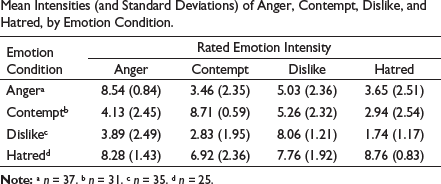
Appendix C reports the mean rated intensity (and standard deviation) of each measured emotion for each emotion condition (e.g. the rated intensity of anger, contempt, dislike, and hatred in experiences of anger, contempt, dislike, and hatred). It confirms that, after exclusion of cases in which another emotion was experienced as much or more than the assigned emotion, the mean intensity of the assigned emotion was rated highest in that condition.
Analytic Strategy
All data analyses were performed using SPSS (version 28). Participants were grouped by their assigned emotion, and group means for each closed-ended appraisal item were calculated. Ratings for the various questions that might have measured motive-inconsistency, control potential or problem type—or different conceptualisations of each of these appraisals—were not combined due to the low alphas reported above. For comparability across measures, we re-scaled the 9-point appraisal ratings to 5-point scales.
Hypotheses for motive-inconsistency and other-person agency appraisals were tested using one-sample t-tests. These allowed us to determine whether the mean appraisal scores for each emotion condition were significantly elevated, as predicted, above a comparison ‘test value’. For example, the observed motive-inconsistency appraisal means in the anger, contempt, dislike, and hatred conditions were each compared to the scale midpoints (3 on the 5-point scales, midway between motive-consistent and motive-inconsistent). The other-person agency appraisal means in each condition were compared to the minimum value on that appraisal (1 on the 5-point scale, which would indicate that a participant thought their emotion was not at all caused by another person). These comparisons yielded directional (one-tailed) t-tests of whether each of the interpersonal negative emotions was appraised as motive-inconsistent and caused by someone other than oneself.
For control potential and problem type appraisals, we used ANOVAs with linear contrasts to test hypothesised differences between experienced emotion groups. Each analysis generated a t-value that provided a directional (one-tailed) significance test of the hypothesised differences between the mean scores for the various emotion conditions.
Were Appraisals of Motive-inconsistency and Other-Person Agency Characteristic of Anger, Contempt, Dislike, and Hatred?
Table 1 reports mean scores for the motive-inconsistency and other-person agency appraisal items for each emotion condition, along, with our predictions. With the exception of one motive-inconsistency appraisal item for anger (which was elevated but not significantly), for all four emotion conditions, the mean scores for each appraisal were significantly greater than the test values. Thus, as predicted, appraisals of motive-inconsistency were more characteristic (than appraisals of motive-consistency) of anger, contempt, dislike, and hatred experiences; and perceiving an event as caused by another person was characteristic of all four emotions.
Means of Motive-inconsistency and Other-person Agency Appraisal Items for Each Emotion Condition, with Significance Tests.
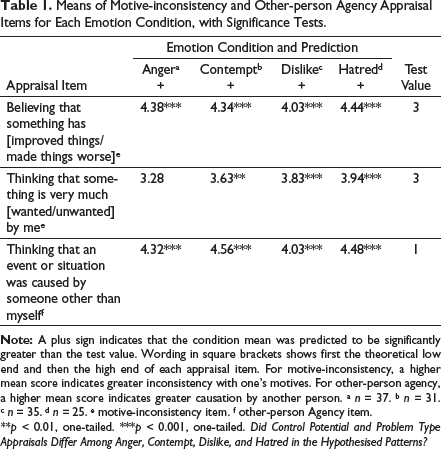
**p < 0.01, one-tailed. ***p < 0.001, one-tailed. Did Control Potential and Problem Type Appraisals Differ Among Anger, Contempt, Dislike, and Hatred in the Hypothesised Patterns?
Control Potential
Table 2 gives mean ratings for the various control potential items. To test the prediction that control potential would be higher in anger and contempt experiences than in dislike and hatred, we ran linear contrasts. The means and contrast tests show that only the item measuring prospective control potential item fits predictions: ‘thinking that there will eventually be something I can do about this situation’ was rated as causing anger and contempt more than dislike and hatred. Thinking there is something I could eventually do to influence someone [italics added here] was equally low across emotions. Thinking that I do not or should not have to accept something got relatively high ratings in all emotions except dislike; and thinking that something could one day be corrected or avenged received moderate ratings that did not differ significantly across conditions [italics added].
Means of Control Potential Appraisal Items for Each Emotion Condition, with Contrast Tests.
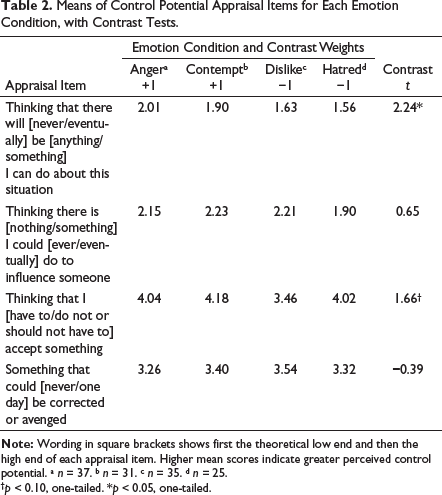
†p < 0.10, one-tailed. *p < 0.05, one-tailed.
Problem Type
Mean scores for problem-type appraisal items are presented in Table 3. To test whether anger experiences would be characterised by instrumental problem type appraisals (goal blockages) and contempt by intrinsic problem type, the contrast weights for anger and contempt were respectively −1 and +1. (Contrast weights for dislike and hatred experiences were 0 because problem-type appraisals were not predicted to be differentially characteristic of either emotion.)
Means of Problem Type Appraisal Items for Each Emotion Condition, with Contrast Tests.
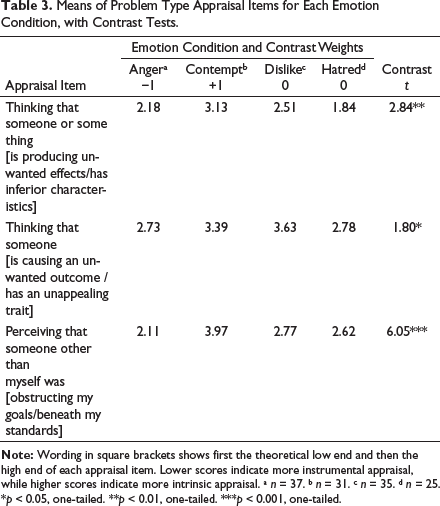
*p < 0.05, one-tailed. **p < 0.01, one-tailed. ***p < 0.001, one-tailed.
As predicted, all three problem type appraisals showed that instrumental appraisals (e.g. goal obstructions) were differentially rated as causing participants’ anger, while intrinsic appraisals (e.g. someone is beneath standards) were rated as causing participants’ contempt.
Discussion
Five of six appraisal items supported hypotheses relating motive-inconsistency and other-person causation to anger, contempt, dislike, and hatred; and appraisals of instrumental versus intrinsic problem type distinguishing anger versus contempt. However out of four control potential items, only the one measuring prospective control potential distinguished these emotions as predicted. We now briefly discuss each of these findings.
Perceived Motive-inconsistency and Other-person Causation Are Characteristic of Dislike and Hatred, in Addition to Anger and Contempt
We found that all four interpersonal negative emotions were generally rated as caused by another person, and as motive-inconsistent. These findings replicate results from other studies on anger (e.g. Smith & Ellsworth, 1985) and contempt (e.g. Frijda et al., 1989), including a study in which agency appraisals were manipulated, and perceived anger was measured (Roseman, 1991, which provides causal evidence). They fit not only our hypotheses, but hypotheses proposed by other theorists about determinants of anger (e.g. Smith & Kirby, 2011) and contempt (e.g. Hareli & Weiner, 2002). Moreover, they extend existing literature by linking motive-inconsistency and other-person agency appraisals to the understudied emotions of interpersonal dislike and hatred.
Instrumental Versus Intrinsic Problem-type Appraisals Distinguish Anger Versus Contempt
In contrast to inconsistent findings from previous research (e.g. Roseman et al., 1996), results from this study consistently supported hypotheses distinguishing anger and contempt as responses to perceived instrumental versus intrinsic problems. Appraising another person as obstructing one’s goals, producing unwanted effects, or causing an unwanted outcome was rated as differentially causing anger; whereas perceiving someone as being beneath one’s standards, having inferior characteristics, or having an unappealing trait was rated as differentially causing contempt. These results support the proposal that perceived instrumental problems elicit attack emotions (such as anger and guilt, which attempt to alter someone’s behaviour), whereas appraising problems as intrinsic elicit rejection emotions (such as contempt and shame, which seek to move relatively unalterable aspects of persons away from the self; Roseman, 2013).
An Appraisal of Prospective Control Potential May Distinguish Anger and Contempt, Versus Dislike and Hatred
As mentioned earlier, we asked four questions that may have measured slightly different conceptualisations of control potential. Our results supported hypotheses only for the item representing one’s perceived ability to eventually do something (versus never being able to do anything) about the situation. This suggests that an appraisal of prospective control potential (being able to do something about a motive-inconsistent situation in the future) best distinguishes anger and contempt from dislike and hatred.
In contrast, all four emotions may be characterised by a low perceived ability to change the situation or the other person that had elicited these emotions in the first place (thus explaining why the item about being able to influence someone got equally low ratings across emotions). However, with regard to prospective control potential, even if people are unable to alter what has already happened, they may still be able to do something about it (e.g. take action that makes up for what occurred, or makes it less likely to happen again). For example, in response to the perception that a minority outgroup member has humiliated a member of the majority in-group (such as, in India, a Muslim cutting a lock of a Hindu’s hair in the scenario presented to participants by Tripathi et al., 2018), the majority group member may think (or be encouraged to think) that by retaliating in kind (or with greater force) he can prevent such norm violations from happening again, and feel anger at or contempt for the norm violator.
The two remaining control potential items may have measured more hypothetical or imagined control, and therefore not distinguished as well among the four emotions. For example, regardless of whether they will eventually be able to do something about a motive-inconsistent event, people may feel that hypothetically they should not have to accept it. Similarly, people may imagine that any negative event might or might not one day be corrected or avenged, regardless of whether they actually have the potential to do so.
Thus, it is possible that prospective control potential is the best way to conceptualise this appraisal and understand its relationship to different interpersonal negative emotions. However, additional research is needed to replicate comparisons among these varied conceptualisations, and test whether only prospective control potential consistently differentiates anger and contempt from dislike and hatred.
Strengths, Limitations, and Future Research
This research has several methodological strengths. In addition to directly comparing four different interpersonal negative emotions within a single study, 91% of our data came from participants’ reports about emotions they were currently experiencing. This is in contrast to the vast majority of research on appraisal–emotion relationships, which analyses data from hypothetical scenarios (e.g. Smith & Lazarus, 1993) that may not capture actual emotional responses; or from recalled experiences (e.g. Frijda et al., 1989), which are subject to memory errors and biases (e.g. inflation of emotion intensity; Parkinson & Manstead, 1992, 1993).
An important limitation is that results reported here do not establish causality. We manipulated the emotion participants were asked to describe rather than the appraisals proposed to elicit them. Reports about appraisal determinants may be mistaken—participants may not know the causes of their emotional responses (Nisbett & Wilson, 1977). Thus, although our findings provide some evidence consistent with hypotheses, they do not establish that any of these appraisals actually cause anger, contempt, dislike, or hatred. (For some causal evidence about appraisal-emotion relationships, see Roseman, 1991; Roseman & Evdokas, 2004).
A second important limitation is that the data reported here came only from participants in America. Though our findings on motive-inconsistency and other-person causation replicate prior results from India as well as the USA (Roseman et al., 1995), and we have given examples of appraisals and interpersonal negative emotions in the Indian context (above), these results can only suggest hypotheses about appraisal–emotion relationships in developing societies. Each of our hypotheses must be tested again in cultures such as India, Iran, and South Africa.
Applications: Appraisals and Emotions in Developing Societies
To what extent are our findings likely to generalise to developing societies? Like Roseman et al. (1995), Scherer and Wallbott (1994) found cultural differences in absolute levels of various emotion-relevant appraisals. For example, participants from Africa blamed other people more for negative events than participants elsewhere, which the authors suggest may result from the prevalence of beliefs about witchcraft in African cultures. Yet, for all seven emotions that those researchers studied (joy, sadness, fear, anger, disgust, guilt, and shame) there were similarities across cultures in the appraisal patterns that elicited each emotion.
Boiger et al. (2018) question whether emotions such as anger have invariant properties, and suggest that emotions’ appraisals and action tendencies vary both within and between cultures. They find, for example, that some instances of anger in Belgium, the USA, and Japan manifest other-person blame and aggression, while other instances are characterised by self-blame and inaction. However, Ellsworth and Tong (2006) have established that it is possible to be angry at oneself, and Roseman (2018) suggested that instances of self-directed anger involve treating the self as if it is another person (as in self-chastisement).
Thus, research to date includes multiple findings of cross-cultural commonality in the appraisals that elicit specific interpersonal negative emotions, but still uncertainty about whether these and other appraisal-emotion relationships are truly universal. The obvious implication is that more research on this question is needed to determine the extent to which our findings do or do not generalise to particular developing societies.
While acknowledging the uncertainty and the need for further research, let us consider what might be the implications for the prospect of minimising the most pernicious aspects of intergroup conflict if our findings on the appraisal determinants of anger, contempt, dislike, and hatred generalise across cultures as suggested by the majority of the research cited above.
Promoting Alternatives to Hatred
We noted previously that behavioural responses in hatred (e.g. involving attempts to eliminate perceived opponents) are more destructive than those of anger (which aim to alter others’ behaviours but allow for the possibility of reconciliation). Insofar as hatred, as opposed to anger, is elicited in part by appraisals of powerlessness (low control potential), then by articulating how a group could eventually do something about its legitimate grievances (motive-inconsistencies)—e.g. by voting against political candidates who have caused or would exacerbate them—then concerned group members and leaders could perhaps help transform hatred into the less destructive emotion of anger (directed towards those who are really responsible for the problems). For example, Alonso (2010) found that granting more political autonomy (which involves increased control potential) to the Basque region in Spain helped to dramatically decrease public support for ETA terrorists.
Promoting Alternatives to Contempt
We also noted that responses of contempt (which tend to involve breaking contact and relationships with the emotion’s targets) can also be more harmful than behaviours of anger. Insofar as we found that contempt, as opposed to anger, is elicited by appraising others as having characteristics that are beneath our standards, then concerned group members and leaders could try to conceptualise and depict the majority of outgroup members as admirable (e.g. meeting or exceeding standards of ability and morality), even if some of them have caused harm (which can be addressed by appropriate sanctions on those individuals, or by restorative justice interventions; Leidner et al., 2013). Building on our findings, and interventions shown to be effective in changing views of outgroups, this could be accomplished by presenting multiple exemplars of outgroup members who, in the eyes of in-group members, possess these traits (see McIntyre et al., 2016).
Promoting Alternatives to Interpersonal Negative Emotions Generally
Preferable to substituting one interpersonal negative emotion for another would be to reduce or undo all of them. Insofar as each of these emotions is dependent on appraising events as caused by other people, one approach to accomplishing this is by altering appraisals of outgroup members as causally responsible for an in-group’s negative outcomes. This could be achieved through a reduction in group-based ‘othering’ (Powell & Menendian, 2016), for example, via increased contact (Pettigrew & Tropp, 2011) and interaction (Tripathi, 2021). Most desirable, of course, would be to replace negative intergroup emotions with positive ones. Insofar as negative emotions are elicited by appraisals of motive-inconsistency, this approach involves highlighting or creating situations in which outgroup members help or benefit in-group members, for example, via cooperative (Deutsch, 2014) or altruistic (Wilson, 2015) actions.
As illustrated by the decades of research that have been needed to specify the conditions under which intergroup contact does or does not succeed in reducing prejudice (e.g. Paluck et al., 2019), none of these approaches to reducing intergroup conflict is likely to be simple or easily implemented, whether in developing or developed societies. We suggest only that research on the contribution of different interpersonal negative emotions to conflict behaviours, and the cultural specificity or cross-cultural generality of the elicitation of particular emotions by particular appraisals, can clarify and advance our understanding and the possibility of affecting these most important outcomes.
Appendix A
Number of MTurk Workers and Undergraduates Removed for Each Exclusion Criterion.
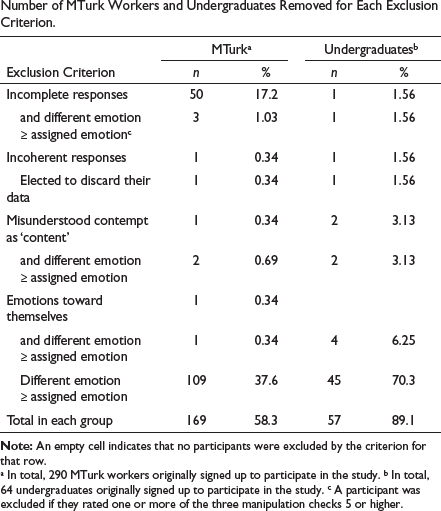
a In total, 290 MTurk workers originally signed up to participate in the study. b In total, 64 undergraduates originally signed up to participate in the study. c A participant was excluded if they rated one or more of the three manipulation checks 5 or higher.
Appendix B
Appraisal Measures.
The stem and scale anchors for the 10 items measuring the appraisals that we report on are given below for the current emotion experience questionnaires. The numbers included in square brackets in this Appendix are used to indicate the anchor that was positioned on the left side of the scale [1] and the anchor that was positioned on the right side of the scale [9] and were not shown in Qualtrics. An asterisk (*) indicates that responses to a question were reverse-scored to measure an appraisal shown in Table 2 or Table 3.
Motive-inconsistency:
My [emotion] is caused by thinking that something is very much wanted by me [1] to My [emotion] is caused by thinking that something is very much unwanted by me [9].
My [emotion] is caused by believing that something has improved things [1] to My [emotion] is caused by believing that something has made things worse [9].
Other-person Agency:
My [emotion] is not at all caused by thinking that an event or situation was caused by someone other than myself [1] to My [emotion] is very much caused by thinking that an event or situation was caused by someone other than myself [9].
Control Potential:
My [emotion] is caused by thinking that there will eventually be something I can do about this situation [1] to My [emotion] is caused by thinking that there will never be anything I can do about this situation [9].*
My [emotion] is caused by thinking that I have to accept something [1] to My [emotion] is caused by thinking that I do not or should not have to accept something [9].
My [emotion] is caused by thinking there is nothing I could ever do to influence someone [1] to My [emotion] is caused by thinking there is something I could eventually do to influence someone [9].
My [emotion] is caused by something that could never be corrected or avenged [1] to My [emotion] is caused by something that could one day be corrected or avenged [9].
Problem Type:
My [emotion] is caused by perceiving that someone other than myself was beneath my standards [1] to My [emotion] is caused perceiving that someone other than myself was obstructing my goals [9].*
My [emotion] is caused by thinking that someone is causing an unwanted outcome [1] to My [emotion] is caused thinking that someone has an unappealing trait [9].
My [emotion] is caused by thinking that someone or some thing has inferior characteristics [1] to My [emotion] is caused by thinking that someone or some thing is producing unwanted effects [9].*
Appendix C
Mean Intensities (and Standard Deviations) of Anger, Contempt, Dislike, and Hatred, by Emotion Condition.
Footnotes
Acknowledgements
The authors are grateful to Ashley Goodvin, who helped develop hypotheses and item wording for studying hatred; and to Steven Katz, Grace Grady, and Alberly Perez, for helpful comments on prior versions of this manuscript.
Author’s Note
Amanda Steele is now at the Department of Experimental Psychology, University of Oxford, United Kingdom.
Declaration of Conflicting Interests
The authors declared no potential conflicts of interest with respect to the research, authorship and/or publication of this article.
Funding
The authors disclosed receipt of the following financial support for the research, authorship, and/or publication of this article: Data collection for this research was supported by Rutgers University-Camden, in an Arts and Sciences Dean’s Undergraduate Research Fund Grant to Amanda Steele, and a Dean’s Graduate Student Research Fund Grant to Ashley Goodvin.
Notes
Prior Publication
Means from 3 of 10 appraisal items in this paper were previously presented in Ashley Goodvin’s Master’s Thesis ‘Is Hate a Distinct Emotion?’, which tested hypotheses that differ from those presented in the present publication.