



Abstract
Durganand Sinha found that attitudes formed from a preceding experience influenced participants’ responses to the succeeding one in a laboratory experiment on memory (Davis & Sinha, 1950). He also found that the people of Darjeeling who were affected by the landslide in 1950 had spread rumours to make sense of their surroundings via cognitive and emotional responses (Sinha, 1952). In this article, the author pays tributes to Sinha by making a new case for the importance of attitudes-and-attraction experiments in bolstering his earlier findings. That attitude similarity effects on attraction are stronger when the correctness of the participant’s views is objectively unverifiable rather than verifiable matches with the evidence for efforts about meaning among the Darjeeling residents in the absence of information. Likewise, validation of one’s attitudes by peers and then experiencing positive affect in attraction represent the very same respective cognitive and emotional urges of the Darjeeling people during the post-landslide period. These findings jointly validate Sinha’s views on the prevalence of attitude-driven responding, fusion between responses and sequential relation between cognitive and emotional urges in everyday life.
Introduction
In the early 1980s, Durganand Sinha, an Indian psychologist, and I participated in a national symposium on Experimental Social Psychology at the University of Allahabad. In his chapter in the subsequently edited volume of the symposium proceedings (Pandey, 1981), Sinha (1981) argued:
The aim of social psychology is to understand and explain the social reality. (p. 217)
Byrne (1971)
…forced the subject [participant] to act as a passive information-processing machine than as an active agent who is information-seeking and information-generating. It amounts to a gross distortion of reality. (p. 220)
It is
…possible to have scientific neatness with social relevance if the scientist accepts the challenge of complexity posed by social phenomena, …he faces the problem squarely, and brings his inventiveness from the point of view of precision, measurement, and demands of science at the same time meaningful and not divorced from reality. (p. 227)
In reply to Sinha’s foregoing observations, I argued in the symposium and subsequently wrote (Singh, 1981) the following:
…experimental social psychology has been criticized for its heavy reliance on experimentation as a research method…. I take the position that…[experimental] social psychology is to grow even more scientific in the years to come. (p. 229) The idea of similarity-attraction relation is not new, nor did Byrne claim it to be new. However, his simple paper–pencil experiment yielded evidence for an unambiguous causal link between attitude similarity and attraction…. It is good to have internal validity, statistical conclusion validity, construct validity, and external validity in any causal inference. (p. 233)
A heuristic processing of the aforementioned five quotations may result in erroneous opinions that Sinha (1981) was against performing experiments on social behaviours, and that I (Singh, 1981) was opposed to his advocacy. On the contrary, the facts are that Sinha started his research in psychology using experimental methods, and that I have been committed to experimental research throughout my career. In this article, therefore, I pay my tributes to Durganand Sinha by making a case for (a) the importance of experiments in social psychology, (b) the order in which cognitive and emotional components of attitudes may operate in the interpretation of one’s social milieu and (c) the active and dynamic roles that humans always play in the laboratory and field studies in psychology.
Memorial Lecture
In the Professor Durganand Sinha Memorial Lecture 1 in 2016, I revisited our 1980 debate by selecting two of Sinha’s earlier articles. One was based on an experiment on memory in the laboratory (Davis & Sinha, 1950), and the other was based on a survey of rumours in a naturalistic setting as well as two small experiments on transmission of factual statements to others and on perceptual judgments of a broken house (Sinha, 1952). Let me first describe those studies further.
In Davis and Sinha (1950), university students read or did not read a story about family dynamics at Time 1, saw or did not see a picture of a family wedding at Time 2, and recalled the contents of either the story or the picture at Time 3 spaced over 4–28 days and even a year. Recollections of the picture presented at Time 2 were highly influenced by the attitudes formed from the story read at Time 1. Likewise, many of Time 2 picture details intruded into Time 3 recollection of Time 1 story. It was noted, therefore, that ‘[recalls of] the story did not escape the influence of the stream of experiences which preceded and succeeded it’ (p. 49). Stated simply, the seemingly independent attitude-induced schemata tended to overlap and fuse with one another.
Following the Darjeeling landslide in 1950, Sinha (1952) collected reports of rumours about essential supplies of electricity and water and about plights of railways and roads among the affected people. In an experiment on the transmission of rumours by tourists (N = 10), he presented a factual statement about the damage and traced the distortions in reporting that information across people. In another experiment on perception of a damaged palatial house, he told tourists (N = 6) that the house ‘looked crooked’ and solicited their responses (p. 205). Rumours among the affected residents were exaggerated and conflicting as if they were trying to make sense of their immediate surroundings. Rumours transmitted by the participants in the experiment illustrated dramatisation and exaggeration as well. Perceptual judgments by participants in the experiment evinced imagined distortions in the crooked house, suggesting the role of anxiety and insecurity in spreading rumours in the region. Thus, Sinha agreed with Allport and Postman (1948) that rumours ‘satisfy…cognitive and emotional urge to understand and comprehend’ (p. 206) one’s surroundings.
Three considerations guided my choice of the preceding two articles. First, as of 8 December 2016, they were among the most cited articles by Sinha. Second, Pandey (1998) had adjudged the 1952 article as ‘an example of his [Sinha’s] scientific creativity and responsiveness to the problems of his immediate surroundings’ (p. 691) and, no less important, the ideas in both papers called for a fresh unravelling of the order of mediating influences on cognitive and emotional components of attitudes while acknowledging the complexity of fusion between responses that Davis and Sinha (1950) had pointed out.
To me, the foregoing two articles by Sinha made five key points. First, humans actively seek and generate information instead of passively processing the information given. Second, they understand the social world through their attitudes. Third, people have cognitive and emotional urges to understand, predict and control their environment. Fourth, the cognitive and emotional urges activated are often related (fuse or overlap) but distinct processes. Finally, psychologists should study people’s understanding of their reality.
In this article, I present evidence for Sinha’s early ideas and for findings from more recent experiments on attitudes-and-attraction (Singh et al., 2017), and I reiterate the importance of experiments in accessing what may be an emergent reality in any setting. I further show that people seek validation of their attitudes through social comparison more when their views are physically unverifiable rather than verifiable, and that those who succeed in validating their attitudes feel positive and thus get attracted toward others. In particular, the cognitive (validation) and emotional (positive affect) processes are not only distinct (i.e., correlated but empirically distinguishable) but also sequential (i.e., Validation ↓ Positive affect) in fostering attraction from similar attitudes.
The Attraction Paradigm
Attitude—a central concept in social psychology—refers to a mental state that manifests itself by either positive or negative evaluation of an object, event or person by the individual person (Allport, 1935). Eagly and Chaiken (1993) reiterated the same when they defined attitude as ‘…a psychological tendency that is expressed by evaluating a particular entity with some degree of favor or disfavor’ (Eagly & Chaiken, 1993, p. 1). Thus, one’s attitude toward premarital sexual relations can be measured by a 6-point Likert-type scale as illustrated further.
Premarital Sexual Relations (Check one of the following six statements)
2
In general, I am very much against premarital sexual relations. I am against premarital sexual relations. I am mildly against premarital sexual relations. I am mildly in favour of premarital sexual relations. I am in favour of premarital sexual relations. I am very much in favour of premarital sexual relations.
Consistent with the prevailing operationalisation of attitude, the top three statements of the scale are anti premarital sexual relations, but the bottom three statements are pro premarital sexual relations. Besides, the three statements on the either side differ in the magnitude of disfavour or favour.
Students enrolled in an introductory psychology module first participate in a Survey of Attitudes that includes multiple contemporary controversial issues such as premarital sexual relations illustrated earlier. When the participant arrives at the laboratory later, he/she is provided with a fictitious Survey of Attitudes allegedly completed by a same-sex unknown student. Before meeting that future interaction partner, the participant examines the faked attitude survey, forms an opinion of the partner and then expresses attraction toward him/her along Likert-type scales (e.g., interested in knowing, intention to meet, enjoying working together and so on).
The manipulations of similar versus dissimilar attitudes (i.e., the independent variable (IV)) depend upon how the participant himself/herself had responded to the scales in the initial Survey of Attitudes. The simulated similar attitude of the partner is always checked one step apart on the same side of the scale of the participant’s own response. For example, if the participant’s response was Statement 2 of the issue in the previous survey, then his/her hypothetical interaction partner’s similar attitude would be either Statement 1 or 3 in the fictious survey. In the case of the original endorsement of Statement 1 or 3, however, a similar attitude would necessarily be Statement 2.
A dissimilar attitude in the fictitious survey is always checked three steps apart and on the other side of the scale of the participant’s own response. Thus, responses to Statements 1, 2, 3, 4, 5 and 6 of the above scale are made dissimilar by checking Statements 4, 5, 6, 1, 2 and 3, respectively.
Notably, the secretly prepared attitude survey is anchored at the participant’s own attitudes to involve him/her deeply in information processing. For controlling variables confounding with the manipulated attitude similarity or dissimilarity, the actual meeting between the participant and the partner never takes place. Moreover, the simulated attitude survey removes the background information about the interaction partner. Consequently, attraction response emanates from only the manipulated attitude similarity.
Since Byrne’s (1961) first experiment on attitude similarity and attraction on undergraduate students of psychology at the University of Texas, Austin, it has repeatedly been found that the greater the similarity between the attitudes of two persons, the greater the attraction between them (e.g., Byrne & Nelson, 1965; Montoya & Horton, 2013; Singh, 1974; Singh & Ho, 2000; Tan & Singh, 1995). Further, that very experiment led to establishment of the attraction paradigm in which the emphasis was essentially ‘on the way in which research is conducted [in personality and social psychology] and on the way in which both theoretical and applied research may be seen to grow out of a base relation[ship]’ (Byrne, 1971, p. 414). However, Sinha (1981) felt uncomfortable with the artificiality and simplicity created in such experiments because the individual participant might have been turned into ‘a passive information-processing machine’ (p. 220).
Active Versus Passive Information Processing in Experiments
When a psychologist studies the effect of an IV or stimulus (S) on the dependent variable (DV) or response (R) without postulating any variable intervening between them as in the behaviouristic S ↓ R view (Skinner, 1953), the participant can undeniably be viewed as passive. However, when the IV effect on the DV is presumed to travel through one or more unknown variables within the organism (O) as in the S ↓ O ↓ R view (Woodworth, 1938), the human participant actively connects what had gone before a variable with what might come after it. Such a dynamic view on the human mind was articulated by Tyndall (1872), Chair in Natural Philosophy, Royal Institute, London, well before the founding of the Laboratory of Psychology at the University of Leipzig in Germany in 1879:
Every occurrence in nature is preceded by other occurrences which are its causes, and succeeded by others which are its effects. The human mind is not satisfied with observing and studying any occurrence alone but takes pleasure in connecting every natural fact with what has gone before it, and with what is to come after it. (p. 1)
A latent variable that transmits the known IV effect to the measured DV is called mediating variable (MV) (Baron & Kenny, 1986). Evidence for an MV implies an active rather than passive role of the participant. Supporting such an interpretation, the post-1986 experiments identified five mediators of attitude similarity effects on attraction. For example, positive affect (Singh et al., 2007b, 2008, 2014), inferred attraction (Condon & Crano, 1988; Singh et al., 2007b, 2008, 2014), respect (Montoya & Horton, 2004; Singh et al., 2007a, 2014) and trust (Singh et al., 2015, 2016, 2017) have all been found to be the mediators. Therefore, I regard the participants in the attitudes-and-attraction experiments as cognitively affluent and dynamic people (Singh et al., 2014, 2015, 2017) rather than as passive information processing machines (Sinha, 1981) as will be discussed and illustrated further.
Validation in Similarity-Attraction
To Sinha (1952), ‘[t]he prevalence of so many conflicting reports was due to the absence of reliable information [emphasis mine] about the condition of the railway, roads, electricity and water’ (p. 207) in Darjeeling. I interpret those conflicting and exaggerated rumours characterised by dramatisation and imagined distortions among the victims and tourists as their on-the-spot or context-sensitive attitudes formed. Given the uncertainty about the correctness of those attitudes, moreover, people in the region might have been pursuing what White (1959) termed as effectance motivation, that is, an urge for certainty and a feeling of being able to know, predict and control one’s environment (Byrne & Clore, 1967).
Humans tend to evaluate themselves and others against objective or physical standards that are readily available (Singh, 2020). However, physical standards rarely exist for evaluating their beliefs and opinions. According to Festinger (1950), ‘an opinion, a belief, an attitude is “correct,” “valid,” and “proper” to the extent that it is anchored in a group of people with similar beliefs, opinions, and attitudes’ (p. 272). Hence, people look to opinions of peers as a benchmark for identifying ‘correct’ opinions (Festinger, 1954). One way of doing so is to learn that another person holds similar attitudes (e.g., Petrocelli et al., 2007; Petty et al., 2002).
When similarity with peers signals correctness of one’s views, and that correctness satisfies a motive for accuracy, certainty, desirability, prediction and/or control of one’s environment (Festinger, 1954; Heider, 1958; Pittman, 1998; Singh, 2020; White, 1959), validation by agreement should then draw people together. Such validation is particularly needed when there is no objective standard for checking on the accuracy of the belief or rumour, as given in Sinha (1952). Thus, validation-driven attraction effects would be stronger when the accuracy of one’s views is physically unverifiable rather than verifiable. Consistent with this possibility, Byrne et al. (1966) had reported that attitude similarity effects on attraction were stronger when the accuracies of one’s views were low rather than high in physical verifiability.
Singh et al. (2017, Experiment 1) refined the aforementioned finding in a novel way. They crossed view verifiability 3 with similarity between the partner and the participant. Further, they measured the participants’ perception of the other’s views, validating their own before asking how attracted they felt toward the stranger. 4 They predicted both the validation and attraction responses to be influenced more strongly by similarity when the views expressed were low (i.e., an attitude) rather than high (i.e., a fact) in verifiability. If validation does mediate similarity effects on attraction, then conditional mediation effects of similarity via validation should be stronger when participants’ views pertained to unverifiable attitudes than objectively verifiable facts (i.e., moderated mediation; Muller et al., 2005).
In two confirmatory factor analyses (CFA) of the responses to the four validation and four attraction items in AMOS, Singh et al. (2017) did find a much better fit of the two-factor rather than the alternative single-factor measurement model to the data: χ2∆(1) = 282.36, p < .001. The correlation between the two responses was also moderately positive, r(182) = 0.44, p < .01, indicating that validation and attraction were correlated but distinct constructs. This finding supports the possibility of fusion yet distinction between responses that Davis and Sinha (1950) envisaged.
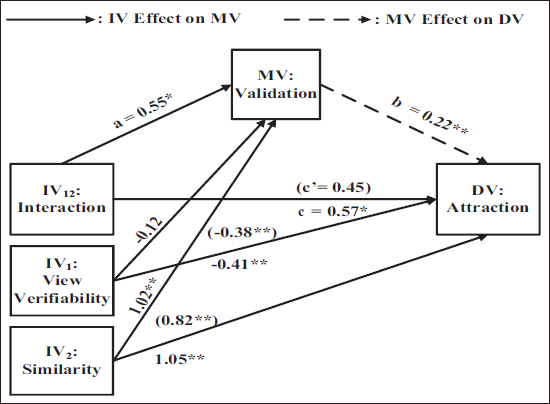
More interestingly, similarity effects on the validation and attraction responses were stronger when the participants’ views were about unverifiable attitudes than verifiable facts. That led to a PROCESS Model 4 analysis of mediation in SPSS (Hayes, 2018). The centred interaction term served as IV12, the two centred main effect variables of verifiability (IV1) and similarity (IV2) as the covariates, validation as the MV and attraction as the DV. The 95% confidence interval (CI) of the indirect effect of attitude similarity via validation (IE = the path coefficient for the IV12 effect on the MV (a) x the path coefficient for the MV effect on the DV when both the IV12 and the MV jointly predict the DV (b)) was generated using 5,000 bootstrap resamples. An IE was accepted as being statistically significant only when its biased-corrected 95% CI excluded zero.
In Figure 1, I display the unstandardised regression coefficients from the foregoing analysis. Note that the path coefficients from IV12 ↓ MV (a) and from IV ↓ DV (c) were statistically significant; so was the path coefficient from MV ↓ DV (b). The interaction effect in validation reliably mediated the interaction effect in attraction, IE = 0.12, 95% CI: 0.01, 0.33. Importantly, the conditional indirect effects of similarity on attraction through validation were stronger when the manipulated views were about attitudes low in verifiability, IE = 0.29, 95% CI: 0.07, 0.55, than about facts high in verifiability, IE = 0.17, 95% CI: 0.05, 0.36.
The foregoing results are important in two ways. First, they conceptually replicate an early finding of moderation of similarity effect by the view verifiability in a new participant population in Asia and a much different period from that of Byrne et al.’s (1966) study in the United States of America. Second, and no less important, they demonstrate the mediating role of validation in attraction in a way never done before. While these results validate Sinha’s findings of fusion between processes (Davis & Sinha, 1950) and effort after meaning among Darjeeling residents in the absence of reliable information (Sinha, 1952), they also dispel his earlier doubt (Sinha, 1981) about realism in the settings or dynamism among participants in an experiment.
Validation Leading to Positive Affect but Not Vice Versa
Byrne and Clore (1970) abandoned validation for positive affect (from reinforcement by attitude similarity) as a mediator without investigating how the two constructs were related. That seemed premature because validation of one’s attitudes by those of peers can bring about the very positive affect that was later proposed as being necessary for attraction (Byrne, 1971). In fact, perceiving similarities with others validated one’s own beliefs (Reis & Shaver, 1988), which, in turn, heightened one’s positive mood in relationship satisfaction (Morry, 2007).
When positive affect lost out to the MV of inferred attraction and respect (Singh et al., 2007b) or inferred attraction, respect and trust (Singh et al., 2015) in multiple-mediation model tests, it became theoretically and analytically important to revisit the early mechanisms of validation and positive affect in attraction. Such an experiment was crucial for also validating Sinha’s (1952) view that both the cognitive and emotional urges drive one’s understanding of the current surroundings.
In early reported mediation tests, positive affect qualified as an MV when it was used alone but not when it was pitted against other potential MVs (e.g., Singh et al., 2007b, 2015). Singh et al. (2015, 2017) attributed such anomalies to the widely used parallel mediation model in which the MVs are treated as equally close or distal to the DV and as independently carrying the IV effects to the DV (Singh & Rai, 2021). Given that the MVs and the DV were correlated but distinct constructs, Singh et al. (2017) argued for a sequential mediation model in which the effects of a preceding MV presumably also travel through the succeeding one.
Singh et al. (2017) proposed that validation may be the first response to the IV but that the second response of positive affect may be influenced by both the MV of validation and the IV of attitude similarity. Because of the assumed serial dependency (d21) of positive affect (MV2) on validation (MV1), there would be an additional IE of the preceding MV via the succeeding one (i.e., IE via MV1 ↓ MV2 = a1d21b2, Hayes, 2018, p. 171). Thus, MV1 that may not otherwise qualify as such in a parallel mediation model can instead be effective through MV2 in the sequential mediation model. If this explanation has any merit, then neither the parallel mediation model (see the top diagram of Figure 2) nor the alternative sequential mediation model in which positive affect precedes validation (see the bottom right diagram of Figure 2) can tease out the fusion that occurs between the two mediators.
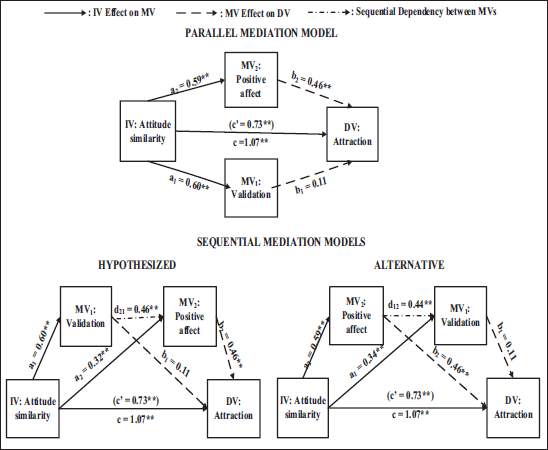
Toward the foregoing goal, Singh et al. (2017, Experiment 2A) manipulated attitude similarity alone and measured validation (α = 0.82) and positive affect (α = 0.70) 5 in counterbalanced orders before attraction (α = 0.86). The fit indices were again better when validation and positive affect were treated as distinct constructs in a CFA than when they were treated as the same construct, χ2∆(1) = 37.44, p < .01. The correlations between pairs of three measures ranged from 0.45 to 0.54, ps < .01, again showing fusion yet distinction between responses (Davis & Sinha, 1950).
Attitude similarity had significant effects on validation, positive affect and attraction. The IEs of attitude similarity on attraction were also greater than zero when either validation, IE = 0.19, 95% CI: 0.08, 0.36 or positive affect, IE = 0.30, 95% CI: 0.15, 0.50, had served as a single mediator. When the two had served as parallel MVs as in the top diagram of Figure 2, however, validation lost out to positive affect (see Table 1 for the IEs and 96% CIs) as if Byrne and Clore (1971) were correct in abandoning the validation of effectance motivation for positive affect from similar attitudes (Singh, 1974).
Indirect Effects (IEs) of Attitude Similarity via Validation and Positive Affect Along with Their 95% CI under Parallel and Sequential Mediation Models.
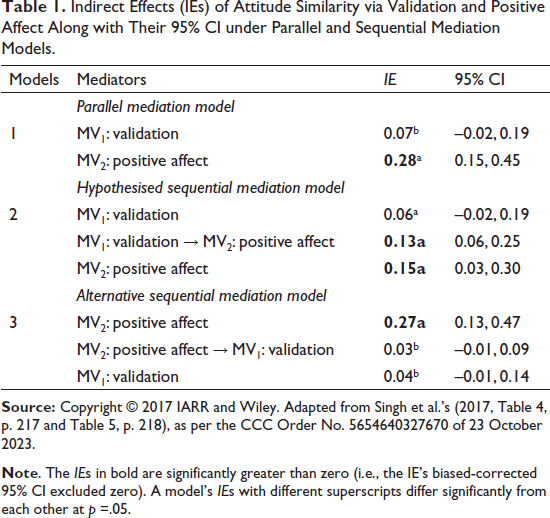
In the test of the hypothesised sequential mediation by PROCESS Model 6 (Hayes, 2018), validation and positive affect were specified as MV1 and MV2, respectively. In the alternative sequential-mediation model, their orders were reversed. In the bottom left and right diagrams of Figure 2, I display the unstandardised regression coefficients for the respective hypothesised and alternative sequential-mediation models. In Table 1, I report the IEs and their corresponding 95% CIs from the three double-MV models tested. Validation determined attraction through its sequential effects on positive affect as in the hypothesised sequential mediation model but not in the other two alternative models.
As Byrne et al. (1966) had originally envisaged, validation treated alone did mediate between attitude similarity and attraction. When considered alongside positive affect, validation played a causal role in the sequence of mediators leading from validation to positive affect but not vice versa. Put simply, validation seems to have created attraction from attitude similarity in the IV ↓ MV1 ↓ MV2 ↓ DV order alone. Accordingly, attitude similarity effects on attraction can now be explained better by recognising validation as a precursor of positive affect in a much more complex causal chain of other previously known mediators (Singh et al., 2015, 2017) than by altogether abandoning it for positive affect (Byrne & Clore, 1970). Evidence for correlation yet distinction between constructs and for a sequential relation between validation and positive affect in relationship development further solidify Sinha’s early views (Davis & Sinha, 1950; Sinha, 1952) on the causal role of attitudes, fusion between constructs and interplay of cognitive and emotional urges in understanding of one’s immediate surroundings.
More Mediators and Their Sequential Relation
In both Figures 1 and 2, there are significant direct effects (c’) of attitude similarity on attraction. What does such a partial mediation by either validation or validation and positive affect considered together as MV1 ↓ MV2 order imply? There are more mediators (Rucker et al., 2011) than what were considered in these experiments. This possibility has merit because the inclusion of trust (Singh et al., 2015, 2017) in multiple-MV tests rendered the direct effects of attitude similarity as nonsignificant. To me, validation and positive affect are early-occurring processes that boost the effectiveness of other later-occurring cognitive MVs of respect (Montoya & Horton, 2004; Singh et al., 2007a), inferred attraction (Condon & Crano, 1988; Singh et al., 2007b) and trust (Singh et al. 2015, 2017). Thus, attraction can be fostered by manipulating the distal MVs and measuring the MV of trust proximal to attraction.
When positive affect (Singh et al., 2007b, 2008, 2014) and inferred attraction (Condon & Crano, 1988; Singh et al., 2007b, 2008, 2014, 2015)—the two known MVs of similarity-attraction—were themselves manipulated as IVs and when the trust (α = 0.86) 6 and attraction (α = 0.90) responses were used as the MV and the DV, respectively, the interaction effect in trust fully mediated the interaction effect in attraction (Singh et al., 2018). While the interaction between the two manipulated MVs confirmed their sequential dependency, moderated mediation by trust reiterated the proximity of trust to attraction (Singh et al., 2015, 2017).
The aforementioned findings from correlational (Hayes, 2018) and experimental (Spencer et al., 2005) tests of sequential mediation open a new avenue for sustaining or modifying the attraction paradigm (Byrne, 1971). Likewise, they suggest that rumours exaggerated with a core truth, pure fabrications, religious interpretations and/or predictions by Darjeeling residents along with their anxiety and insecurity (Sinha, 1952) might have been sequentially dependent cognitive and emotional responses to their plight created by the rather unusual landslide. Thus, causal inferences from attraction experiments can be adjudged to have all four types of validity: internal, construct, statistical conclusion and external (Cook & Campbell, 1976).
General Discussion
The debate between Durganand Sinha and me in the early 1980s was on whether experimental social psychology can truly capture the key features of social phenomena. Throughout my career, I have firmly held that experiments can do so. The debate in the 1980s only jolted my research in directions I would not have otherwise taken, including exploration into three of Sinha’s earlier ideas. The obvious outcome is that we know much better now than before about what those psychological processes are and how they are related in interpersonal attraction from attitudes (Singh et al., 2014, 2015, 2016, 2017, 2018).
In more general terms, people are as active and dynamic information processors in the laboratory (Singh, 1991, 2011) as they are in real life (Singh, 2020; Sinha, 1952; J. Sinha, 2022). They navigate and master the social world through cognitive and emotional processes. The key contribution of recent attitudes-and-attraction experiments thus lies in validating Sinha’s (Davis & Sinha, 1950; Sinha, 1952) earliest findings of importance of attitudes, fusion between responses, and relation between cognitive and emotional urges driving one’s understanding of the environment. Such similarity between the early views of Sinha and those of mine have been keeping us attracted (Byrne, 1961, 1971) rather than repelled (Rosenbaum, 1986; Singh & Ho, 2000), despite our earlier debate (Singh, 1981; Sinha, 1981).
Regarding Sinha’s (1981) recommendation for always investigating the reality, I could not find a better answer than what Ledgerwood (2016), Professor of psychology at the University of California, Davis, USA, had suggested for improving research practices in psychological science:
Any set of results, whether empirical or simulated, give us only a partial picture of reality. Reality itself is always more complex. If we want to study it, we need to be honest and open about the simplifying choices that we make so that everyone—including ourselves—can evaluate these choices, question them, and explore what happens when different choices and assumptions are made. (p. 663)
To the aforementioned, it can be added that the evidence for precedence of validation to positive affect in attraction from attitudes coming from simple experiments, a simplifying choice by me, does represent behaviours of people active on social media websites (e.g., Facebook, Twitter, WhatsApp and so on) across the globe. Is not it possible that the number of ‘likes’ from peers one receives—a kind of validation—for every post on social media platforms makes the person ‘feel happy’ (i.e., positive affect) (see e.g., Chen & Sharma, 2015; Zell & Moeller, 2017)? Through a proper conceptualisation and operationalisation of variables and responses to such social media platforms, future researchers can also validate or refute the findings of the experiments performed heretofore on relationship development (Singh et al., 2014, 2015, 2016, 2017, 2018).
The convergence of my recent findings with those of Sinha (Davis & Sinha, 1950; Sinha, 1952) has a message to younger generation of psychologists as well. Those who are unfamiliar with the processes already identified or who may view older works that are not as good as newer ones ought to revisit the past literature. As Clarke (2016), Professor of Physiology, Monash University, Australia, had correctly written on his blog:
7
I have met young scholars who are not familiar with [the] earlier literature and they think that older works are not as good as [are] newer ones. That is simply not true. Many old scientific papers were very well-written, applied the same scientific rigor, and their processes were just as valid as today’s experiments. They can be very valuable to any researcher.
I believe the same about the initial contributions of Sinha (Davis & Sinha, 1950; Sinha, 1952) to psychology.
A Tribute
I am indeed privileged and blessed that I got to know Durganand Sinha who positively influenced my personal and professional life. I am also fortunate to be among those who still carry forward his theoretical and methodological bequests to psychological science in India (Mishra, 2017; Misra, 1998; Naidu, 1992; Pandey, 1998). I wish that Durganand Sinha were among us today to see how I have steadily been responding to his challenges to experimental social psychologists in India (Sinha, 1981)! I miss him dearly.
Footnotes
Declaration of Conflicting Interests
The author declared no potential conflicts of interest with respect to the research, authorship and/or publication of this article.
Funding
The author received no financial support for the research, authorship and/or publication of this article.
Notes
*
‘Based on the author’s Durganand Sinha Memorial Lecture at the 26th Annual Conference of the National Academy of Psychology (NAOP) held on 30 December 2016 at the Indian Institute of Technology, Madras and subsequent journal publications. This version has benefitted from comments and suggestions of Shivganesh Bhargava, Naureen Bhullar, Braj Bhushan, Colleen F. Moore, Sudhir Kumar Pandey, Mahendra Singh Rao, Kumar Rakesh Ranjan, Krishna Savani, Jai B. P. Sinha, Rakesh Kumar Srivastava and Ritu Tripathi.’
