




Abstract
This cross-sectional study was conducted at a district headquarters in southern India. The investigators have interviewed both the common people and health care providers about the snakes and snake bite management practices. It is observed that the majority of the participants could not identify the snakes properly. Russell’s vipers (27.33%) and saw scaled vipers (8%) are the least identified by them and have many misconceptions about the snake bite management protocols to be followed, both as first aid and as institutional care. 90% believe in the use of tourniquets above the bite site, only 52% have knowledge about the use of crepe bandage, 20% believe in incising the wound to bleed out venom, and only 20% know to immobilize the limb to halt the flow of venom systemically.
Introduction
Snakes are reptiles and have inhabited this earth much prior before mammals. Owing to their nature of hunting and defense, they bite, and many snakes inject venom. The National Crime Records Bureau 2023 report says that there were 10,144 cases of reported snakebites in India. 1 The World Health Organization has declared snakebite as one of the neglected tropical diseases in 2017. 2 Apart from significant morbidity and mortality, snake bites also threaten the financial stability of the victim’s family, especially in low and middle-income countries. 3 It is said that India does not have a shortage of antivenoms, but the improper distribution of healthcare infrastructure, antivenoms do not reach remote places. 4 It is a known fact that not all snakes are venomous, also not in all venomous snakes’ bites venoms are injected, as some are dry bites. 5 This knowledge among people is very little, 6 and people die of fear rather than venom. The study area, Kolar, is located in the southern plains region of Karnataka in India. 7 It is geographically located between 12° 46° and 13° 58° North latitude and 77° 21° and 78° 35° east longitude. It is bounded by Karnataka state province on the west, Andhra Pradesh state province on the North-East and Tamil Nadu state province on the south. The major sources of employment are agriculture, dairy farming, sericulture and floriculture. 8 Hence, it is more common for the residents of Kolar to confront snakes and manage snake bites. Hence, this study was conducted to know the existing knowledge about snakes and snake bite management practices and beliefs among people.
There are numerous myths about the snakes, their existence, their eating habits, etc. Some believe them as Gods, and some consume them as food.
The public and health care providers’ knowledge about different types of snakes, management of snakes as first aid and institutional management are very important in preventing morbidity of snake bites.
Aims and Objectives
To assess the knowledge and awareness about snakes and snakebite management among the residents of Kolar, with emphasis on its medico-legal and forensic relevance in the evaluation and documentation of snakebite cases.
Material and Methods
This was a questionnaire-based, cross-sectional study approved by the SDUMC Institutional Ethics Committee on 29/09/2023 with reference number: No.SDUMC/KLR/IEC/361/2023-24.
As adults are active workers in farm fields and exposed to snakes at workplaces, all participants above the age of 18 years who consented to participate in the research were included, while non-consenting participants and those who could not comprehend the questionnaire were excluded.
The data was collected between October 2024 and November 2024. Using the formula 4 pq/d2, taking “p” as 21% from the previous study, 9 “q” as 79% and 5% for “d,” the estimated sample size was more than or equal to 265. The sample was divided as Farmers = 50, Students of non-medical degree college = 50, Teachers of non-medical degree college = 50, ASHA workers = 50, Ambulance drivers/First responders/Group D employees at hospital = 50, Medical officers = 50.
Hence, a total of 300 was considered as the sample size. The above participants were categorized as “common people” (Farmers, Students and Teachers) and “Health Care Workers” (ASHAs, Ambulance drivers, First responders, Group D employees at the hospital and Doctors).
A semi-structured proforma in Google Form was used to obtain data by direct interview, and showing images when needed.
The data obtained was entered into a Microsoft Excel sheet and analyzed using Epi Info software.
Observations and Results
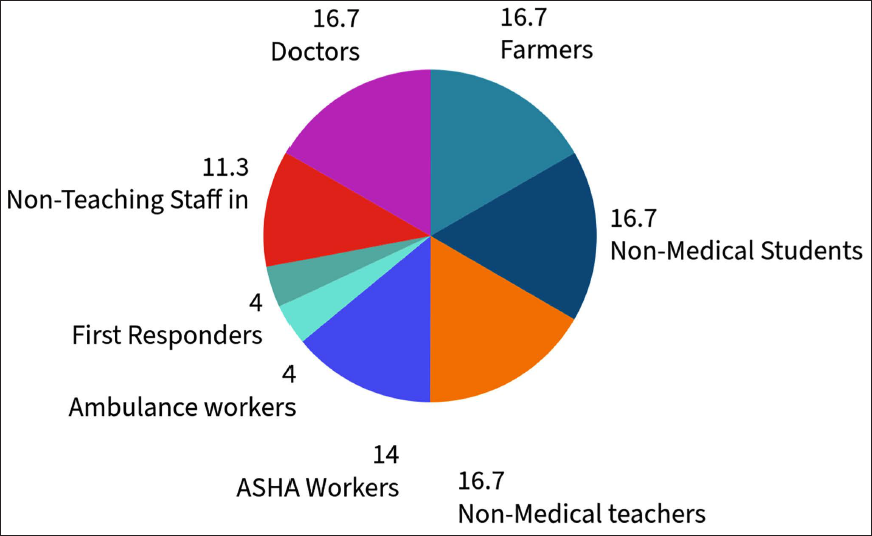
We interviewed 300 residents of Kolar (Figure 1). The majority of the participants were males (59.66%, n = 179) compared to females (40.34%, n = 121).
Distribution of Interviewees by Their Profession.
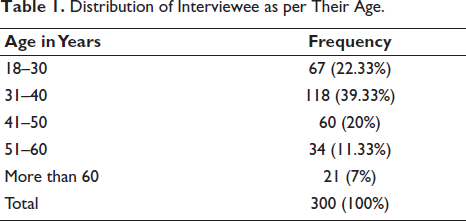
The median age of these participants was 39.19 years (IQR = 31–48). The majority were in the age group of 31–40 years, that is, 39.33% (n = 118), followed by 18–30 years, 22.33% (Table 1).
Distribution of Interviewee as per Their Age.
Interview with the common people:
1. Knowledge about snakes:
a. Have you ever witnessed a snake alive?
Yes = 94% (n = 141), No = 6% (n = 09)
b. Mention some different types of Snakes you know.
Naagara Haavu (Cobra) = 100% (n = 150)
Hebbavu (Pythons) = 100% (n = 150)
Kaere Haavu (Rat snakes) = 96% (n = 144)
Kolaka Mandalada haavu (Russel’s viper) = 90% (n = 135)
Kattu haavu (Banded krait) = 80% (n = 120)
Kaalinga sarpa (King cobra) = 78% (n = 117)
Hasiru haavu (Green vine snakes) = 45.33% (n = 68)
c. Identify these Snakes
The images of commonly found snakes in and around Kolar were shown
Common Cobra = 100% (n = 150)
Green vine snake = 100% (n = 150)
Banded krait = 86% (n = 129)
Rat snake = 54% (n = 81)
King Cobra = 47.33% (n = 71)
Russell’s Viper = 40% (n = 60)
Saw scaled viper = 8.66% (n = 13)
d. Mention some facts about the Snakes you know, or you heard of (Open-ended)
Snakes remember their enemies for 11 years and take revenge
Snakes with more hissing noise are poisonous
Female snakes are more dangerous
Snakes sighted at farm fields are guardians of farms sent by the god, hence they are not killed. While snakes sighted in residential areas are dangerous, they are killed
The venomous snake bites alter the taste sensation of humans
The people bitten by snakes are fed with red chilli powder. If they can sense the taste, then the snake would probably be non-venomous.
2. Knowledge about Snake bites:
a. Have you ever witnessed/heard of someone being bitten by a snake?
Yes = 100% (n =141)
b. Do you know that some snakes are non-poisonous too?
Yes = 92.66% (n = 139), No = 7.33% (n = 11)
c. Do all the individuals bitten by snakes die?
Yes = 65.33% (n = 98), No = 34.66% (n = 52)
d. Do you know anything about “Dry bite”?
Yes = 7.33% (n = 11), No = 92.66% (n = 139)
3. Knowledge about the Snake bite management: (Open-ended)
a. Use of tourniquet: 95.33% (n = 143) mentioned, and 4.67% did not
b. Use of crepe bandage: 23.33% mentioned (n = 35), 76.66% (n = 115) did not and 9.33% (n = 14) were unaware.
c. Incise the bite site and let it bleed: 73.33% (n = 110) mentioned, and 26.66% (n = 40) did not
d. Suck out the venom from the bite site: 4% (n = 6) mentioned, 96% (n = 144) did not and 3.3% (n = 5) were unaware
e. Any herbal or traditional methods they know or heard of: 4.66% (n = 7) mentioned, 95.33% (n = 143) did not
Use of calotropis leaves extract (Smeared at bite site)
Use of yellow flower plant (Horse herb) leaves extract (Asked to drink with water)
Use of tamarind seeds (Kept as whole to imbibe the venom from the bite mark)
Making a hen to pick at a bite mark (To remove venom)
f. Use of Snake antivenom: 73.33% (n = 110) mentioned, 24.66% (n = 37) did not and 2% (n = 3) were unaware
Interview with the health care workers:
1. Knowledge about Snakes:
a. What are the common snakes of this region?
Common cobra = 100% (n = 150)
Russel’s viper = 100% (n = 150)
Rat snake = 100% (n = 150)
Common krait = 91.33% (n = 137)
b. Identify these snakes
(The images of commonly found snakes in and around Kolar were shown)
Common Cobra = 100% (n = 150) identified correctly
Green vine snake = 100% (n = 150) identified correctly
King Cobra = 100% (n = 150) identified correctly
Banded krait = 96% (n = 144) identified correctly
Russell’s Viper = 27.33% (n = 41) identified correctly
Rat snake = 14% (n = 21) identified correctly
Saw scaled viper = 8% (n = 12) identified correctly
2. Knowledge about snake bites:
a. Do you know that some snakes are non-poisonous too? 100% (n = 150) mentioned the correct response
b. Will all the individuals bitten by snakes die? 100% (n = 150) mentioned the correct response
c. Do you know anything about “Dry bite”? 40.66% (n = 61) knew, 11.33% (n = 17) did not and 48% (n = 72) were unaware
3. Knowledge about the snake bite management:
a. Have you ever attended any CME/Workshop/Lecture about the snake bite management protocols? 8.66% (n = 13) attended and 91.33% (n = 137) did not
b. How do you advise the public about first aid in the management of snake bites? (Open-ended)
i. Use of Tourniquet: 93.33% (n = 140) mentioned and 6.66% (n = 10) did not
ii. Use of crepe bandage: 52% (n = 78) mentioned and 48% (n = 72) did not
iii. Incising the wound: 20% (n = 30) mentioned and 80% (n = 120) did not
iv. Immobilize the limb: 20% (n = 30) mentioned and 80% (n = 120) did not
v. Reach a hospital quickly: 100% (n = 150) mentioned
c. About the Snake antivenom: 100% (n = 150) mentioned
Discussion
The snake and human encounters cause thousands of snakebites every year, resulting in emergency medical conditions in India. 10 As per the National Crime Records Bureau 2023 report, there is a rise of 0.6% incidents of snakebites from 2022. In 2023, there were 10,144 snakebites reported, and of them, 10,118 resulted in deaths. 1
In this study, in the interview with the common people, they could recall a few snake names, while the names of the common cobra and pythons were recalled by all the participants. In a survey at Kannur district of Kerala, it was observed that only 67.5% people had knowledge about snakes and their identification. 11
While the people could recall a few snake names, many could not identify them properly with the images shown. The common cobra (Referring to the spectacle mark) and green snake (Green color) were identified correctly by all the participants. While only 40% identified the Russel’s viper correctly, and 8.66% people identified the saw-scaled viper. Commonest snakes like Russel’s viper, saw-scaled viper and rat snakes were not identified. In a study by Ishan Pathak et al., it was observed that only 72% people identified common cobra and 29% for Russel’s viper, and only 38% could identify venomous and non-venomous snakes. 11 In a survey to assess the knowledge of snakes by Sunil M Doshi et al. at Gujarat, it was observed that more than 50% of the respondents identified all the snakes as venomous. 12
The myths people have about snakes were identified. There were religious myths, myths about the behaviors of snakes and treatment-related myths of these. The myths “Snakes with more hissing noise are more dangerous” and “Female snakes are more dangerous” are important myths (behavioral) to be busted to help people be aware of dangerous snakes.
Other myths like “The people bitten by snakes are fed with red chilly powder, if they can sense the taste then the snake would probably be non-venomous” and “The venomous snake bites alter the taste sensation of human” are a proof that the myths (Treatment related myths) of people are also to be analyzed scientifically as a neurotoxic snake venom can alter the perception of taste by human. In a study by Jonatha et al., it was concluded that the myths about snakes are dangerous both to the existence of humans and snakes. Human emotions and assumptions are likely the source of these myths. 13
All the participants had heard about snake bites, while 7.33% people had no idea that a few snakes could be non-venomous too. This is important as it is a known fact that the majority of people die of fear in non-venomous snake bites. 14 92.66% of the participants had no idea about dry bites. In a study by Saumyadeep Bhaunik et al., it is observed that 96% of people have a fear of death, and the majority suffer post-traumatic stress disorder following a snake bite. 15
About managing snake bites, 95.33% people referred to using a tourniquet above the wound site, 76.66% people do not use a crepe bandage, 73.33% people prefer incising the bite site to let the venomous blood flow out, and 4.66% people knew a few herbal medications for the treatment of snake bite. These misconceptions about the management of snakebites deviate from the standard recommendations from national health advisories. 16 In a study by Meenakshi et al., it was observed that about 46.2% people had inadequate knowledge, 33% had moderately adequate knowledge about snake bite management practices. 17 These deep-rooted wrong practices, like the use of tourniquets and bleeding techniques, stem from traditional beliefs, lack of awareness, and poor dissemination of evidence-based guidelines on snakebite management, particularly in rural areas.
According to the Karnataka Forest Department Common cobra is the most frequently identified snake in and around Kolar. 18 The common cobra, green vine snake, king cobra and banded viper were identified by all the health care providers in response to the images shown. It was observed that only 27.33% identify Russel’s viper, 14% for rat snakes and 8% for saw-scaled viper. It is important for a health care provider to properly identify the snakes and differentiate venomous and non-venomous snakes. In a study by Sunil Sapkota et al. at Bhutan, it was observed that only 3% of health care providers were very confident about identifying snakes, and about 50% were moderately confident. 9
It was observed that 100% of the participating health care workers knew that a few snakes are non-poisonous too, and not all people bitten by snakes die. In a study by Sunil Sapkota et al. in Bhutan, 9 it was observed that only 3% of healthcare providers were very confident about identifying snakes, and about 50% were moderately confident.
A 40.66% of health care providers knew the concept of “Dry bite.” Required in reassuring the patient and judiciously using snake antivenoms. There are reports about the death of patients due to an anaphylactic reaction to the snake antivenom. While this is wrongly attributed to envenomation. In a study by Vinod S Deshmukh et al., it was observed that 5.88% of patients had severe anaphylactic reactions to snake antivenoms. 19 In another study by Rashmi Hooda et al., it was observed that adverse reactions were present in 43% of the children following treatment by anti-snake venom injections. 20
The knowledge about snake bite management is updated from time to time in continued medical education programs, workshops and lectures on snake bite management. In our study, it was observed that 8.66% participants have only participated in such programs, while the majority have not. The Health and Family Welfare Department, government of India, in its action plan to halve the snakebite morbidity and mortality by 2030, has also discussed the need for such programs. 14
It was noted that 93.33% mentioned tying a tourniquet, and 52% for the use of a crepe bandage to halt the flow of lymphatics. This is alarming as the standard guidelines issued by the government of India recommend a loose tourniquet above the wound with a crepe bandage and not to incise the wound or suck out the venomous blood, nor use herbal medications. 14 In a study by Sunil Sapkota et al. in Bhutan, it was observed that only 43% of health care providers were very confident about providing proper first aid to patients of snake bite. 8 This proves the need for such CMEs, workshops and lectures to correct the knowledge of snake bite management in health care providers.
The authors believe that there is an immediate need for focused and regular community awareness programs and training/workshops for healthcare workers on evidence-based snakebite management, as recommended by the national guidelines from time to time. Wide-spread dissemination of the National Snakebite Management Protocol (MoHFW, 2017) and WHO-SEARO Guidelines (2016) through health education campaigns can close the existing knowledge gaps and, in turn, help in reducing preventable deaths from snakebites.
Conclusion
In our study, we conclude that people have many myths and misconceptions about snakes. The health care providers are to be provided with updated knowledge on snake bite management through continued medical education programs, workshops, etc. In Forensic Medicine perspectives, the findings are crucial in understanding community perceptions, assessing contributory negligence in snakebite deaths, guiding medico-legal opinions, and framing public health recommendations that reduce morbidity, mortality, and litigation related to snake envenomation.
Footnotes
Acknowledgement
We sincerely acknowledge the Indian Council of Medical Research (ICMR) for supporting our study as part of the ICMR-STS 2023 program.
Declaration of Conflicting Interests
The authors declared no potential conflicts of interest with respect to the research, authorship, and/or publication of this article.
Ethical Approval
Ethical clearance for the study was obtained from the SDUMC Institutional Ethics Committee on 29/09/2023 (Reference No.: SDUMC/KLR/IEC/361/2023–24).
Funding
The authors received no financial support for the research, authorship, and/or publication of this article.
Informed Consent
A participant information sheet was provided to all participants, and informed written consent was obtained from each participant prior to enrollment in the study.
