




Abstract
Envenomation by poisonous snakes is an occupational hazard that causes considerable morbidity and mortality worldwide. Deaths due to snake bite envenomation in the Asian subcontinent contribute to the major part of the global burden of disease. Venomous snakes are found all over the world, and their envenomation leads to a significant proportion of loss of life every year. The present cross-sectional retrospective study was conducted from 2015 to 2019 in the Department of Forensic Medicine and Toxicology at Late Shri Lakhi Ram Agrawal Memorial Government Medical College, Raigarh (Chhattisgarh), to know the pattern and distribution of cases according to year and season, activity and period of survival of the victims in all age groups and both sexes. In our study, 2.72% of all autopsy cases involved snake bite incidents. Maximum cases occurred in the rainy season, that is, 60.66% and at night times (63.93%). Male victims (68.85%) outnumbered female victims (31.15%), and the most commonly affected age group belongs to 21–30 years, that is 36.07%. In most cases, the site of bite was the lower limb (65.57%), and the survival period was 0–6 hours, which is 52.46%. The majority of cases were reported in the agricultural field (49.18%). The majority of snake bites are accidental and require public awareness and speedy transportation of the patient to the medical facilities within the golden period. Ensuring the availability of Anti Snake Venoms and trained staff at the grassroot level may reduce the number of fatalities due to snake bites.
Introduction
Snake bite is an occupational hazard, causing considerable morbidity and mortality worldwide. 1 Worldwide, there are around 2,400 species of snakes, of which 10% are poisonous to human beings. 2 In Asia, up to two million people are envenomed by snakes each year, while in Africa, there are an estimated 4,35,000 to 5,80,000 snake bites occurring annually that need treatment. 3 Snakes can be classified into two categories: (a) poisonous and (b) non-poisonous. In India, around 90% of snake bites are caused by the ‘big four’ snakes-common krait, Indian cobra, Russell’s viper and saw-scaled viper. According to WHO, it has been estimated that in India alone, as many as 2.8 million people are bitten by snakes, and 46,900 people die from snake bites every year. 4 In India, non-reporting of snake bite cases in hospitals in time remains the most common cause behind fatality. 5 Again, in the Indian context, snake bite is one of the critical medical emergencies, especially in rural populations, where the challenges of limited transport access, non-availability of Anti Snake Venom (ASV), and inadequate treatment facilities need to be addressed at elementary levels to diminish the sufferings of human life. Chakma et al. (2020) 6 had discussed various reasons that could be attributed to the high mortality and morbidity due to venomous snakes and also provided recommendations on policy decisions, improvement on the quality of venom and anti-snake venom and promoting awareness on how to avoid snake bites. Doshi et al. (2019) 7 had made a significant task to aware urban and rural populations with respect to snakes and snake bite management. The present study was also aimed for educational purposes as well as to help the investigating agencies in the correct identification of snake bite cases and correlation with circumstantial findings.
Materials and Methodology
The present cross-sectional retrospective study was conducted in the Department of Forensic Medicine and Toxicology at Late Shri Lakhi Ram Agrawal Memorial Government Medical College, Raigarh (Chhattisgarh). Permission from the institutional ethical review committee was taken before the commencement of the study. All the post-mortem records of snake bite cases autopsied at the mortuary of Kirodimal Government Hospital, Raigarh (Chhattisgarh), were considered for the research study. All cases other than snake bites were excluded from the study. People of all age groups from both sexes were included in the study. The study was conducted from April 1st, 2015 to March 31st, 2019 (four years). All the snake bite envenomation cases were arranged after applying different criteria, such as year and season-wise distribution, age and sex-wise distribution, pattern of snake bite and the activity and period of survival of the victims. Then the data was tabulated and subjected to statistical analysis.
Observations and Results
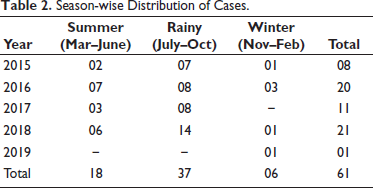
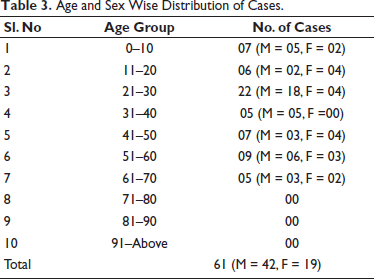
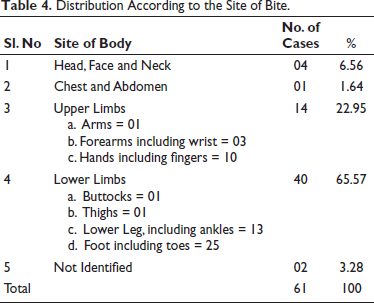
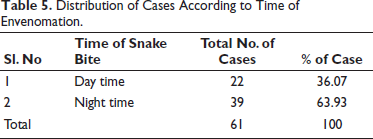
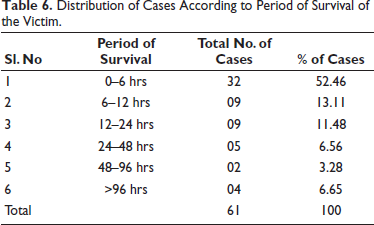
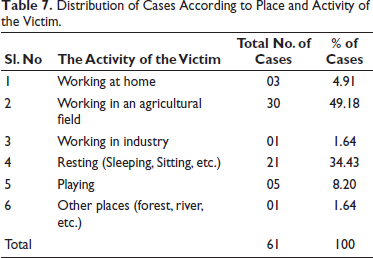
In our study, 2.72% of total cases of autopsy were snake bite cases. We have found the maximum number of cases of death due to snake bites in the rainy season that is 60.66% and at night times (63.93%). The maximum number of victims were males (68.85%) followed by females (31.15%), and the most commonly affected age group belongs to 21–30 years, that is 36.07%. In maximum cases, the site of the snake bite was in the lower limbs (65.57%). In most cases, the survival period was 0–6 hours, which is 52.46%. In most snake bites occurred while the victim was working in an agricultural field (49.18%). Table 1 shows year-wise distribution of envenomation cases compared with total autopsy cases during the period of four years. The study shows that out of a total of 2,244 cases of autopsy, 61 cases of death were due to suspected snake bite, that is 2.72% of total cases of autopsy. Table 2 shows season-wise distribution of cases. In our study, the maximum cases of snake bites were found during the rainy season (60.66%), followed by the summer (29.51%). The least number of cases (9.84%) were recorded during the winter season. Table 3 shows the distribution of cases based on age and sex. According to table, the maximum number of victims belonged to the age group of 21–30 years, that is 36.07%. Male victims and female victims were 68.85% and 31.15%, respectively. The males were predominantly affected in all age groups except 11–20 years and 41–50 years. The table also shows that no case of snake bite was recorded after the age of 70 years. Table 4 shows that in the maximum number of cases, the site of the snake bite was in the lower limbs (65.57%). In the lower limbs majority (95%) of bites were found in the foot and adjacent parts like the ankles. In upper limbs, the most common site of bites was the hands, including fingers in 71.43% of cases. The table also shows that in most cases (96.72%) the site of snake bite on various body regions was clearly identified, whereas in very small number of cases (3.28%) the site of snake bite on any part of body was not identified. Table 5 shows the distribution of cases according to the time of incidence of snake bite. Maximum cases of snake bites occurred during the night (63.93%). This can be attributed to the fact that most victims were bitten while resting or sleeping at night. Table 6 shows the survival period of the victims. In the maximum cases (52.46%), the victims could not survive beyond six hours. Out of the total 61 cases, only four victims survived for more than 96 hours. Table 7 shows the distribution of cases according to the place and the activity of the victims at the time of the snake bite. According to the table, the maximum number of cases occurred while the victim was working in an agricultural field (49.18%). In 34.43% of total cases, the victims were bitten by poisonous snakes while resting.
Year-wise Distribution of Cases.
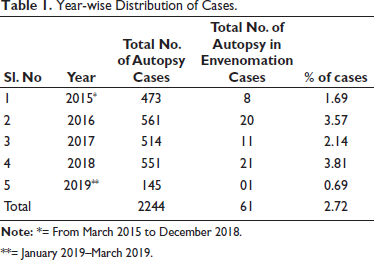
**= January 2019–March 2019.
Season-wise Distribution of Cases.
Age and Sex Wise Distribution of Cases.
Distribution According to the Site of Bite.
Distribution of Cases According to Time of Envenomation.
Distribution of Cases According to Period of Survival of the Victim.
Distribution of Cases According to Place and Activity of the Victim.
Discussion
In our study, 2.72% of the total autopsy cases were due to snake bite, which closely matches with the study of Yogiraj et al. (2013), 8 where they found that 2.62% of total autopsy cases were of snake bites. We have found that the maximum number of cases of deaths due to snake bites were autopsied in the rainy season that is 60.66%, which is closely matching with the study of Singh et al. (2015). 9 In the present study, the maximum number of victims belonged to the age group of 21–30 years, that is, 36.07%, which closely matches with the study of Hareesh et al. (2018), 10 where they had reported 34.28% of the victims in the same age group. In most cases, snake envenomation occurred at night (63.93%), this finding closely matches with the study of Ali et al. (2018), 11 where they found that 67.1% of the total number of cases occurred at night. In maximum number of cases, the site of the bite was in the lower limbs (65.57%), which closely matches the study of Singh et al. (2015), 9 and Anjum et al. (2012), 12 where they found that in 67.09% and 69.2% of the cases of snake bite respectively, the bite mark was in lower limbs. In our study, the exact site of snake bite was clearly detected in maximum (96.72%) cases and minimum number (3.28%) of cases, the site of bite was not found in any body part of victims, the same finding was observed in the study of Jakhar et al. (2022) 13 at a tertiary care hospital in Haryana, where the researcher had confirmed that in very minimum number of cases evidence of bitemarks may not be found in the body of victims. In the present study, the survival period for the greatest number of victims was within 6 hours, that is 52.46%, which closely matches with the study of Anjum et al. (2012), 12 that is 48.5%. The percentage of male victims and female victims was 68.85% and 31.15%, respectively in our study, which also matches the study of Anjum et al. (2012) 12 where they found the total number of male victims to be 68.7% and female victims to be 31.3%, respectively. In our study the maximum number of snake bite cases occurred while the victim was working in the agricultural field (49.18%), this finding also closely matches the study of Singh et al. (2015) 9 and Anjum et al. (2012), 12 where they found that 48.10% and 48.5% of snake bite cases respectively occurred while the victims were engaged in some agricultural activities.
Conclusion
Despite significant mortality and morbidity, snake bite remains an unnoticed disease in large parts of India. In our study, the epidemiological distribution of snake bite cases, their patterns, frequency, and seasonal variations nearly match with most of the studies in other geographic regions of India. Some other victim-related parameters, like activities and survival period of the deceased, were also showing consistent results. The study will add some value to the academicians and will also help the state agencies in statistics to strategize their plans. Still, more studies and research need to be done and analyzed in Chhattisgarh before taking sufficient preventive and corrective measures in a particular region. It is also worth mentioning that in case of death due to snake bites, the dependent family of the deceased gets compensation from the government, but it is not possible to recompensate the substantial loss of a family member through any means. Therefore, public awareness regarding first aid in snake bite cases, along with precautionary measures during peak snake bite seasons, should be taken. Also, the availability of ASV and critical care treatment facilities should be developed at the basic level to bring down the death rate.
Confidentiality
The identity of the deceased and autopsy surgeon was not disclosed.
Footnotes
Declaration of Conflicting Interests
The authors declared no potential conflicts of interest with respect to the research, authorship, and/or publication of this article.
Ethical Approval
IEC of Late Shri Lakhiram Agrawal Memorial Govt. Medical College had conferred their permission vide S. No/Med./Ethics Commi./2021/66, Raigarh, Dated 24/03/2021.
Funding
The authors received no financial support for the research, authorship, and/or publication of this article.
Informed Consent
The informed consent has been obtained for the study.