




Abstract
Botanical evidence refers to plant-based elements gathered and analysed during forensic investigations to establish relationships between persons, items, and crime scenes. This form of evidence can comprise a wide range of plant components and derivatives, including leaves, seeds, pollen, flowers, stems, timber, fruits, spores, and tiny plant parts. This study looks into the efficiency of a physical approach for creating latent fingerprints on the leaves of the money Plant (Epipremnum aureum). Considering the forensic relevance of botanical evidence, this study seeks to investigate alternate surfaces for fingerprinting analysis, namely, plant leaves, which are frequently found at the scene of crimes. The physical methods tested were black powder dusting and neon orange powder dusting. This pilot study population consisted of 30 participants from the Delhi population. Healthy money plant leaves were collected, and a finely ground black powder was prepared and applied evenly onto the leaves’ surface. Excess powder was gently removed to reveal potential fingerprints, which were then documented using a stereomicroscope. Comparative analysis was conducted using the finger mark grading scale system and SPSS Software version 27. The findings show a significant difference in the efficacy of both techniques. The mean value of black powder is higher than the mean value of fluorescent orange powder. The p value shows a higher significance in the results. Black powder, which is widely accessible, non-toxic, and easy to use, may be applied to the surfaces of money plant leaves to more effectively establish individual characteristics on plant leaves.
Introduction
Forensic Science has been the subject of intense global scrutiny over the past decade. 1 A discipline’s identity and nomenclature are fundamental to its future viability and strategic value. Forensic science has developed as a field of enquiry over time and is often considered a ‘patchwork of sciences’ that can be applied to questions relevant to forensic investigations. 2 The term ‘forensics’ or the ‘forensic sciences’ can convey the idea that it is a multifaceted discipline utilising techniques and methods ranging from ‘parent’ or ‘core’ disciplines to ‘forensic’ issues. The name ‘forensics’ presents a nomenclature challenge. Technically, ‘forensic’ is an adjective that originally described ‘belonging to, utilised in, or suitable for the courts’. As a result, the term ‘forensic science’ came to describe the science used to solve legal problems. In forensic botany, plant sciences are employed in legal matters; for instance, crimes such as murder, abduction, and others can be solved, and the cause of death of the victim can be determined by using plants or plant-based items as evidence. Forensic Botany is an integration of Botany and Forensics. 3 Plants are commonly used for both pleasurable and aesthetic functions, such as food, fibre, medicine, and more. However, the relationship between plants and crimes such as poisoning (which can be suicide, accidental, or homicidal) and their use as trace or transfer evidence in civil and criminal cases is expanding daily. When plants are linked to criminal activity, forensic botany plays a vital role. 4 Botanical evidence can aid in narrowing down investigations and exonerating innocent individuals. Leaves can differentiate between main and secondary crime scenes by tracking the parent plant and soil type, making them crucial botanical evidence. This study was inspired by various leaf variations, which criminals often overlook but can provide crucial breakthroughs in cases like the Danzing murder case in Florida. Forensic botany has the potential to provide valuable evidence during criminal investigations. Moreover, this field remains underutilised due to a lack of expertise and botanical knowledge among examiners. If a plant part, especially a leaf, is found at a crime scene, it is simple to identify the plant and its preferred soil type for growth. Determining the plant can help establish the sample’s origin and link the crime scene to the suspect.
Latent fingerprints remain the gold standard for personal identification in forensic science due to their uniqueness, permanence, and legal acceptance. Traditional surfaces such as glass, metals, plastics, and paper are commonly examined, but in real crime scenes, perishable and unconventional substrates like plant leaves may also retain fingerprints. The forensic significance of developing latent fingerprints on leaves lies in their frequent presence in outdoor and indoor settings, including gardens, balconies, and offices. Any suspect or victim may leave clues or evidence while committing a crime (e.g., during assault, trespassing, or concealment of evidence). Since leaves are organic, accessible, and often overlooked substrates, their ability to hold ridge details offers investigators additional avenues for evidence recovery.
Despite the importance of this possibility, limited research has explored which development techniques work best on plant leaves. The money plant (Epipremnum aureum) was selected because its broad, waxy, resin-coated leaves closely resemble natural substrates commonly found at crime scenes, making it an ideal candidate for experimental evaluation.5–12
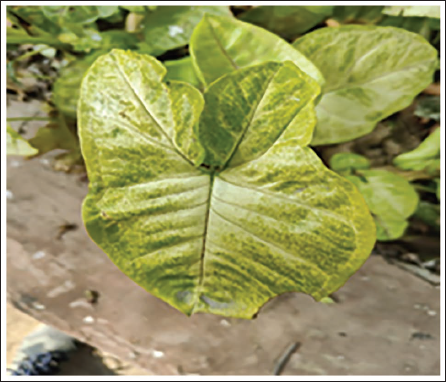
Money plant, also known as Golden Pothos, Devil’s Ivy, or Devil’s Vine, is a popular household plant found in homes, businesses, cafes, and shops, as shown in Figure 1. It is a forensically important plant. Two effective methods for developing latent prints on money plant leaves are black powder and fluorescent orange powder. Black powder is used to detect fingerprint residues, while fluorescent powders, like Coumarin-6, were used in the late 20th century to create latent fingerprints on complex backgrounds.13–15
Money Plant Leaf.
Study Design
This study is a cross-sectional comparative experimental study, involving 30 participants from the Delhi population, with proper consent and ethical approval obtained from the department. The pre-defined inclusion criteria specify fresh money plant leaves, medium-sized leaves to ensure uniformity in texture. Physical methods (black powder and fluorescent powder) and exclusion criteria are based on leaves that are damaged or diseased, very small or overly mature, and leaves exposed to extreme environmental conditions.
Materials
Plant leaves: fresh money plant leaves plucked from the plant.
Fingerprint powders: black powder and fluorescent orange powder.
Brush: used for the application of black fingerprint powder and fluorescent fingerprint powder.
Stereomicroscope: for visualisation of developed latent fingerprint.
Method
Sample Collection
Thirty plant leaves were collected carefully to preserve natural oils and surface features, ensuring they remain intact and free from contamination.
Surface Preparation
Clean the surface of plant leaves to remove any debris or loose particles to ensure a smooth and even surface for effective powder application.
Fingerprint Deposition
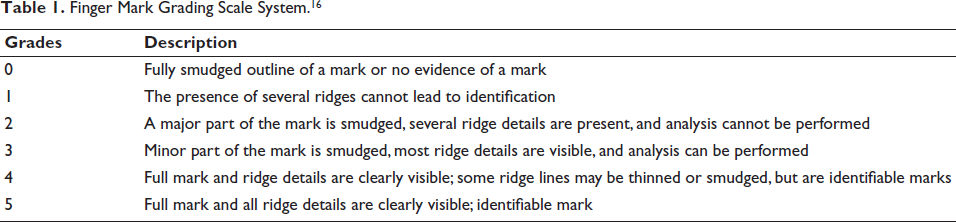
Plain (flat) fingerprints were deposited using the right thumb of volunteers. Donors were instructed to wash and air-dry their hands 15 minutes before deposition to minimise external interference. Both complete and partial fingerprints were included to reflect realistic scenarios. Black powder and fluorescent powder were applied. All developed prints were photographed with a high-resolution digital camera. Fingerprint clarity was scored using a standardised 5-point ridge detail clarity scale (0 = poor, 5 = excellent), as shown in Table 1.
Finger Mark Grading Scale System. 16
Comparative Analyses
A comparative analysis was done using the finger mark grading scale system as presented in Table 1, 16 to establish the efficacy of the technique based on the development of latent fingerprints.
Statistical Analyses
All the records were computed in a tabulated manner in an Excel sheet, and descriptive statistics were analysed using SPSS Software version 27.
Results
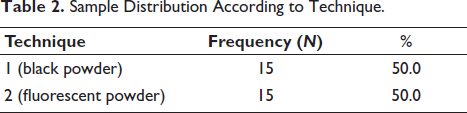
The dataset is evenly distributed for both black powder (coded as 1) and fluorescent powder (coded as 2), which were applied to an equal number of samples (15 each), as shown in Table 2 and Figure 2.
Sample Distribution According to Technique.
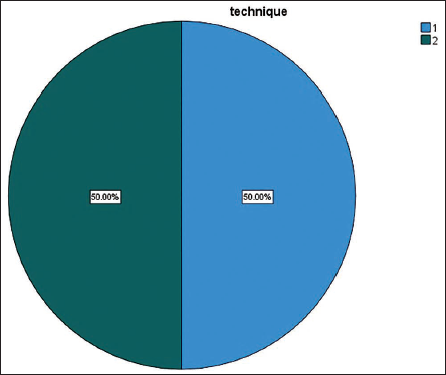
Sample Distribution According to Technique.
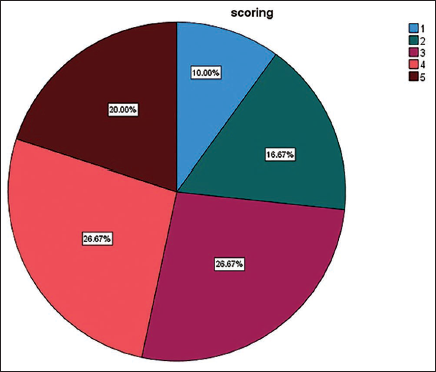
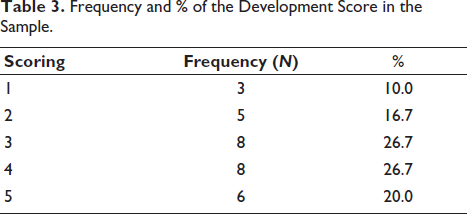
The majority of fingerprints (73.34% = Scores 3, 4, and 5) were of good to excellent quality, meaning they contained sufficient ridge details for forensic comparison.
Only 26.67% (Scores 1–2) were of poor or fair quality, indicating limited forensic value.
The largest groups were Scored 3 (good) and 4 (very good), each making up 26.67% of cases. This suggests that most developed prints fell into the usable range for forensic identification.
Twenty percent achieved a score of 5 (excellent), suitable for comparison in forensic identification, as illustrated in Table 3 and Figure 3.
Frequency and Percentage of the Developmental Score in the Sample.
Frequency and % of the Development Score in the Sample.
Forensic Significance
This distribution demonstrates that the majority of latent fingerprints developed on money plant leaves were of sufficient quality (Score ≥ 3) for forensic use. The relatively high percentage of prints in the Score 4–5 range indicates that the chosen technique (especially black powder) is capable of producing identifiable ridge details. The presence of some low scores reflects natural variability due to surface properties of leaves and powder adherence limitations—highlighting the importance of selecting the right technique.
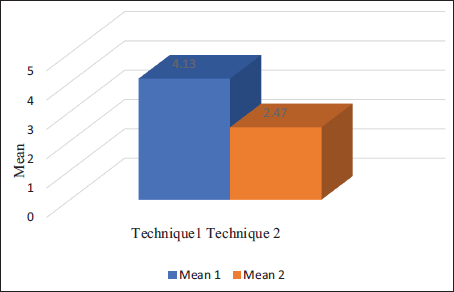
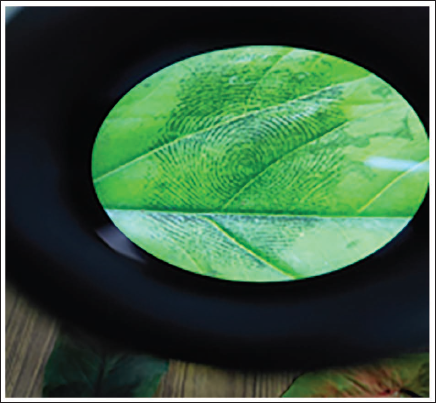
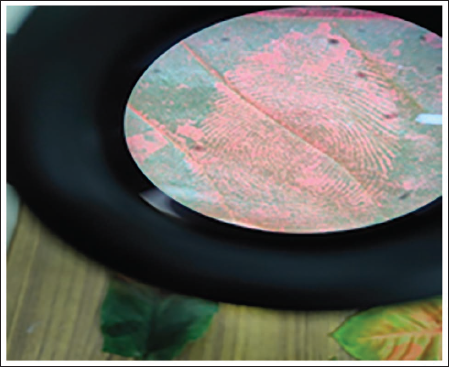
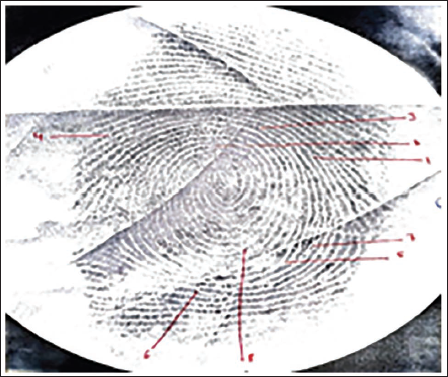
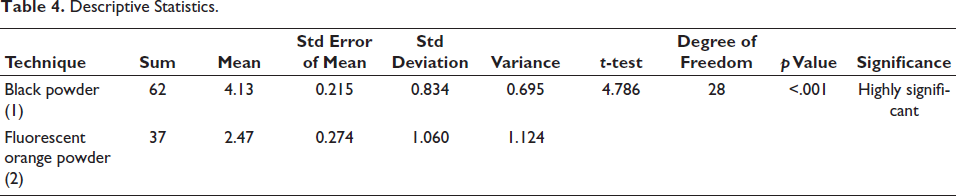
The comparative descriptive statistics between the two techniques are shown in Table 4. The mean value of black powder is (4.13 ± 0.834), which is higher than the mean value of fluorescent orange powder, which is (2.47 ± 1.060). The p value is <.001, which shows the higher significance in the results. The comparative bar graphs of scoring, frequency and mean of developed latent fingerprints on money plant leaves are shown in Figure 4. Images captured during the performing procedure are illustrated in Figures 5, 6, and 7.
Comparative Means of Technique 1 (Black Powder) and Technique 2 (Fluorescent Powder).
Developed Print Using Black Powder.
Developed Print Using Fluorescent Powder.
Individual Characteristics Identified.
Descriptive Statistics.
Discussion
The study on forensic botany aimed to identify linkages between criminal activities and evidence, such as plants or debris found at crime scenes. It was conducted under controlled laboratory conditions, tested only two physical powder techniques, and had a modest sample size. Degraded plant parts can be identified using DNA sequencing and bimolecular techniques. Past studies have shown that botanical evidence can solve issues like accidental, homicide, and suicidal issues. The study compared the efficiency of a methodology for developing latent fingerprints on money plant leaves using the powder method as botanical evidence.17–28
New approaches and techniques are constantly being created and updated to the traditional procedures, especially in the field of latent print development. Numerous methods have been used by different workers to visualise latent prints on various substrate types, including cyanoacrylate technique, iodine fuming, silver nitrate soaking, ninhydrin dipping, chemical powders, organic base powders, heat therapies, dyes, and light sources. The most popular technique for developing latent prints on a variety of surfaces in the past was powder dusting. The fingerprint powder sticks to the perspiration and other residue left on the fingerprints when it is applied to the afflicted region.29–37
Powder-based methods have long been believed to be quite easy and effective for smooth and semi-porous surfaces. Previous studies found that ordinary black powder, Swedish black powder, and magnetic powders consistently produced high-quality ridge features on fruits, vegetables, and other food substrates (Trapecar et al., 2012; Ferguson et al., 2013). Innovations using everyday household ingredients like turmeric, cocoa, custard powder, and lemon powder further show the accessibility and low toxicity of powdering procedures (Garg et al., 2011; Rohatgi et al., 2014).38–41
The use of developmental scoring (0–5) allowed objective evaluation of fingerprint clarity. The majority of fingerprints developed using black powder scored in the range of 4–5, suitable for comparison in forensic identification. Fluorescent powder, while able to produce some identifiable prints, yielded a higher proportion of scores in the 1–2 range, limiting its forensic reliability. This suggests that in real-world scenarios where plant leaves may be encountered at crime scenes, black powder offers investigators a more dependable option for ridge detail recovery.
This study demonstrates that plant leaves can be used as carriers of latent fingerprints in outdoor crime scenes. This is particularly important as leaves can provide complete and identifiable ridge details, expand the scope of forensic botany and strengthen the multidisciplinary integration of forensic sciences.
The study introduces a comparative approach to money plant leaves, a substrate not previously examined in detail. The application of a developmental scoring system and statistical validation via t-test adds methodological rigour. It bridges a gap in forensic literature by highlighting the importance of considering botanical surfaces in fingerprint recovery.
Despite these strengths, several limitations must be acknowledged. The study was conducted under controlled laboratory conditions; environmental influences such as humidity, sunlight, and wind were not examined. Only two physical powder techniques were tested; chemical and hybrid techniques could yield different outcomes. The sample size was relatively modest, and future work with larger samples would increase reliability.
Conclusion
Overall, the findings of this study emphasise that while fluorescent powders have utility on conventional substrates, black powder remains the superior technique for latent fingerprint development on money plant leaves. This conclusion not only contributes to the academic literature but also provides investigators with practical insights for real-world forensic applications, where unconventional surfaces may hold the key to identification.
Footnotes
Acknowledgements
The authors extend their heartfelt gratitude to the previously reported work done by researchers. The authors are also thankful to all the participants. I would like to thank Dr G. S. Sodhi and Senior Fingerprint Expert Mr Ravi Kant, Finger Print Bureau, Delhi Police, for their constant guidance.
Availability of Data and Materials
All data is available to authors.
Consent for Publication
The authors grant permission for publication of this article in both print and electronic formats.
Declaration of Conflicting Interests
The authors declared no potential conflicts of interest with respect to the research, authorship and/or publication of this article.
Ethical Approval
Ethical clearance was obtained from the Ethical Committee of the Department of Anthropology, University of Delhi, India (Ref. No. Anth./2022–23/636).
Funding
The authors disclosed receipt of the following financial support for the research, authorship and/or publication of this article: The work is partially supported by the University Grants Commission for providing a fellowship to Jyoti Verma (Ref. No. Sch/139/Non-NET/Anthro./Ph.D./2022-23/756).
Informed Consent
Informed written consent was obtained from all participants prior to data collection.
