




Abstract
DNA evidence has been used in India in criminal and civil matters since 1989. Despite the use of DNA fingerprinting evidence in trials, it is not ‘generally accepted’ by Courts, as against the technique of fingerprinting, which has been used for decades as incriminating evidence. Further, its acceptability as forensic evidence in Indian courts has been challenged, citing relevance and reliability. The current article provides a review of the conventional principles of evidence admissibility in courts and its pertinence related to DNA evidence in India in the backdrop of civil and criminal case laws of the country.
Introduction
DNA profiling is a technique used to chemical divide the DNA complex into fragments that form a unique pattern and then to match that identity profile with the pattern obtained by similarly testing a suspect’s blood specimen. 1 DNA profiling, as a forensic test, was first put to use by Sir Alec Jeffreys in 1985 in the case of a maternity dispute. 2 It was first applied to a criminal investigation in 1986 in England after two girls, aged about 15 years, were found raped and strangulated near the village of Narborough. 3 It arguably has been the most dramatic advancement that has ever occurred in the field, but its acceptance, especially in the Courts, has not been without challenges. 4 Though DNA evidence has met the challenges in some countries through scientific reasoning and legal scrutiny, it happens to be in a struggling phase in India. Science has no borders for its acceptability; however, the novel scientific evidence must meet the standards of legal acceptability according to the constitutional and legislative provisions of different jurisdictions. This article attempts to clear the issues regarding the current status of the admissibility of ‘DNA evidence’ in India.
Background: Acceptability of New Scientific Evidence
Scientific evidence is accepted by courts only if it stands the scrutiny of legal tests set by case laws. These legal tests or guidelines for scientific evidence have not been adequately explored or discussed in Indian courts for DNA evidence. A review of such legal tests is discussed, followed by their applicability in Indian courts as regards DNA evidence.
Legal Tests and Cases
The admissibility of scientific evidence has evolved through the legal challenges of accepting it. The acceptance of evidence depends on its relevance and reliability. Various tests that apply before evidence is admissible are as follows:
Whether the theory or technique can be or has been tested (its falsifiability, refutability or testability); Whether the theory or technique has been subjected to peer review and publication; The known or potential error rate of a technique; Whether the theory or technique has received ‘general acceptance’. Novel evidence must go through the rigour of Daubert before it is admissible. Exclusions owing to procedural errors are usually beyond the control of the expert witness. Reliability factors relating to the exclusion of expert witness testimony may include failure to address reliability in the context of the case, use of unfounded statistics, failure to adhere to recognised standards, insufficient documentation of analysis, inability to clearly explain the methodology, custom experiments, lack of objective standards, the existence of observer bias, unrealistic proficiency testing and the insufficient relationship of expertise to facts of the case.
8
The scientist should properly explain to the jury the nature of the match between the stain found at the crime scene and the suspect. The scientist should give the frequency of occurrence with which a matching DNA profile is likely to be found in the population. It might be appropriate if the scientist has the necessary data and statistical expertise to say how many people might be found to have matching profiles in the relevant section of the population. The jury would then decide, on all the information available, whether the stain originated from the suspect or some other individual with a matching DNA profile.
False positive results may occur while processing DNA matches. They may occur due to mislabelling, mixing the wrong ingredients or failing to follow routine precautions against contamination. Although the probability of such a false positive may be between 1 in 100 (0.01) and 1 in 1,000 (0.001), its impact on the strength of DNA evidence does not decrease if other pieces of evidences are fairly strong to implicate the accused. However, in cases where other pieces of evidence against the suspect are less, ignorance of the true probability of error creates a disturbing element of uncertainty about the value of DNA evidence.
However, courts may have different views on ‘random match probability’ and ‘Bayes theorem’. As regards ‘random match probability’, 12 it is held that the statistical interpretation of DNA evidence is undeniably strong evidence pointing to a conclusion that the accused was the source of the incriminating DNA but is not the direct evidence of that fact. However, when DNA evidence is analysed in the light of non-DNA evidence by Bayes theorem, 13 it is likely to be rejected as it involves subjectively attaching numerical values to evidence and usurps the role of the jury. Thus, the court laid down a proper approach in this case by saying that the judge must treat the statistical evidence along with the other circumstantial evidence, not allowing it to displace or overwhelm the consideration of all material evidence. Similarly, if there is any evidence like an alibi, which suggests the absence of the accused while the crime was committed, it cannot be overtaken by DNA statistical evidence.
Legal Fallacy
While arguing the question of the probability of a match/no match of the DNA evidence in a court, one has to take into account two fallacies: the prosecutor’s fallacy and the defendant’s fallacy.
These can be dealt with by the following two questions:
If we assume that the accused is innocent, what is the probability of his DNA sample matching with the one recovered from the scene of the crime? If we assume that the DNA profile of the accused matches with the one recovered from the scene, what is the probability that he is innocent?
This was explained by the US Supreme Court in MC Daniel v. Brown, 588 US 120 (2010) 14 :
If we consider that the frequency of a DNA profile match is 1in 10,000 and that the suspect’s DNA profile matched with the one from the crime scene, the prosecutor may erroneously express that there is only a 1 in 10,000 chance that the suspect is innocent. (Prosecutor fallacy)
However, taking the same argument further, if the population of the city is 1,00,000, then there are at least 10 individuals in that city alone who would possess the same DNA profile as the suspect. The defence may argue that just in the city alone, there are at least 9 more people who could have committed the crime. (Defendant’s fallacy)
Medical Predicament
It is a known fact that monozygotic twins have 100% similar DNA profiles. Theoretically, there are conditions wherein the DNA of two individuals may match. It has been observed that the individuals who had undergone successful bone marrow transplants show a true mixed profile of recipient and donor (in buccal and fingernail samples) or purely a donor’s profile (in the blood), with the exception of hair, wherein the recipient’s profile remains unmixed. Similarly, stem cell transplants may raise the risk of identical DNA, and such possibilities may have serious implications in civil and criminal law. 15
Indian Scenario
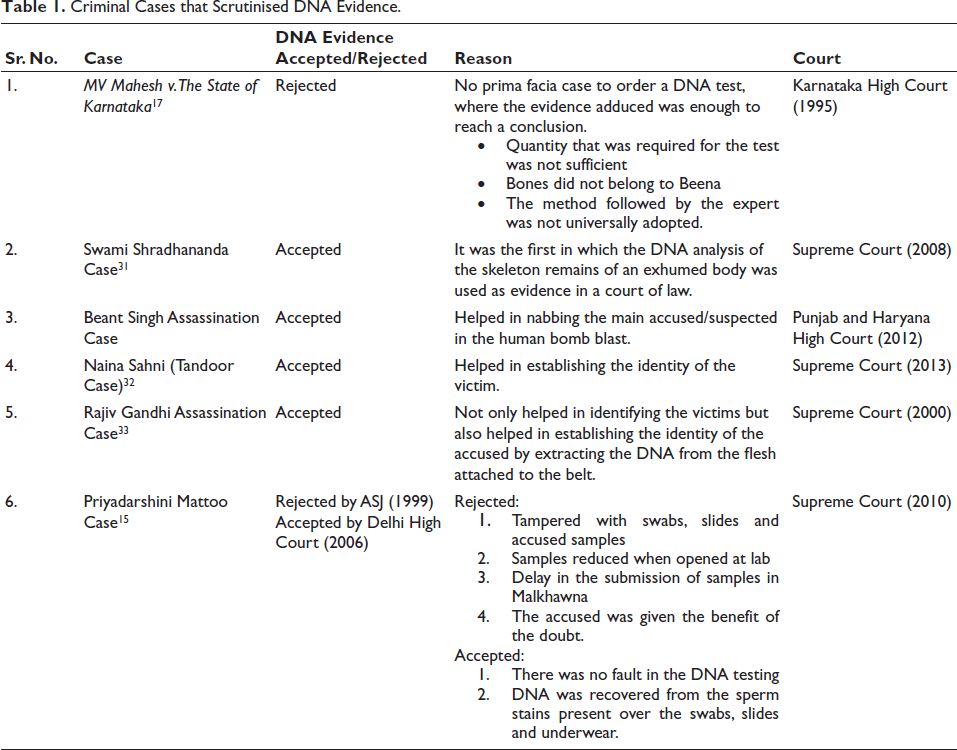
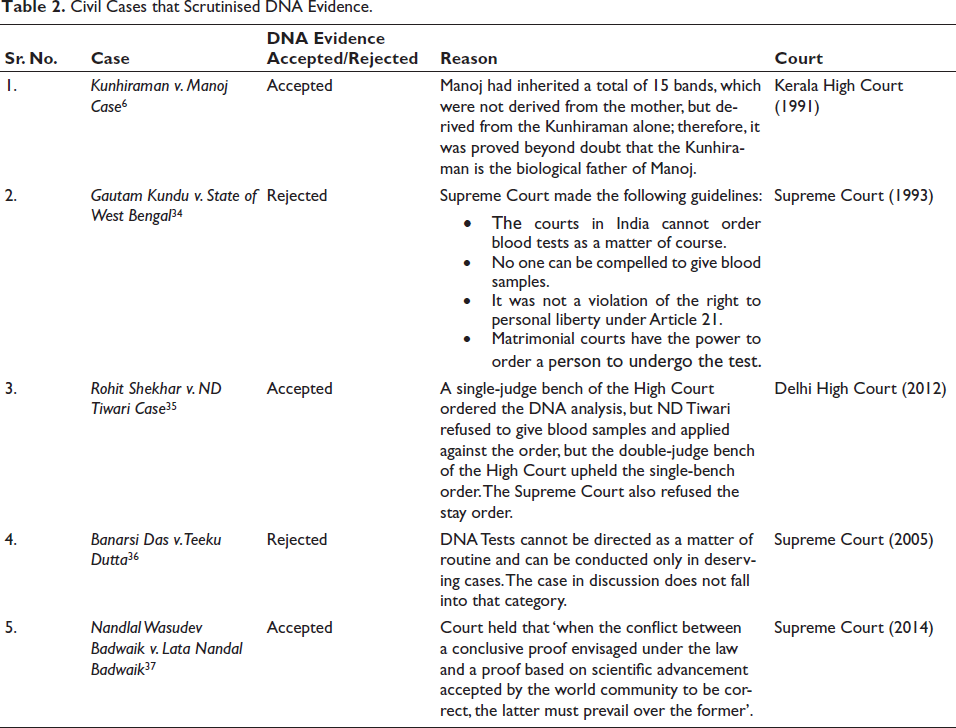
The admissibility of DNA evidence in Indian courts can now be discussed considering the guidelines and various standards for accepting novel scientific evidence. Tables 1 and 2 summarise some of the seminal cases in India, both civil disputes and criminal cases. The first case where DNA evidence was accepted in India dates back to 1989 and 1991 when it was used in a paternity case.6, 12, 15, 16 ‘General acceptance’ by the scientific community was sought in its initial proceedings. Similarly, population statistics were used in an argument to prove the admissibility. 6 Since then, the DNA results are being given due recognition by Indian courts, and in most cases, it is accepted that if the DNA result does not match, then the identity of the person is not established and vice versa. 15
Criminal Cases that Scrutinised DNA Evidence.
Civil Cases that Scrutinised DNA Evidence.
In the case of MV Mahesh v. The State of Karnataka 17 and Priyadarshini Mattoo, 18 reliability factors not related to expert witnesses resulted in the rejection of the DNA evidence. The rigour of DNA evidence was tested by Daubert’s guidelines without directly referring to them. It is apparent that in such cases while the court takes judicial notice of scientific evidence, conclusions are drawn by balancing the probative value of the evidence against the danger of unfair prejudice, confusion of issues or misleading the jury.
Population statistics for ‘random match probability’ has been a contentious issue and has recently been raised in the Arushi murder case by a London-based genomic expert. 19 It was highlighted that DNA evidence submitted by the prosecution was not powered by ‘random match probability’, that is, the lack of data regarding the frequency of alleles in the population. Doheny’s case also highlighted the same contentious issue. Of late, population statistics of allele frequency are available through various studies from West Bengal, 20 Andhra Pradesh, 21 Karnataka, 22 Arunachal Pradesh, 23 Madhya Pradesh, 24 and other subsets.25, 26 These studies showed that there was genetic polymorphism to such an extent that these databases can be used for forensic identification. However, this argument remains unexplored by the Indian courts. The probable reason may be that DNA profiling complexities are perceived untenable and incomprehensible by defence counsel so as to explore its fallacy or that the frequency statistics may be beyond 10−9 (achieved by analysing 10 STRs). Indian laboratories are analysing 16 STR loci, the product rule frequency of which may exceed the world population. Nevertheless, even though DNA profiling achieves exceedingly high levels of individualisation, it does not theoretically indicate uniqueness.
Another lagging area is the inappropriateness of DNA technology. In the world scenario, the Technical Working Group on DNA Analysis Methods (TWGDAM, 1988), National Research Council I (1992), National Research Council II (1996) and Scientific Working Group on DNA Analysis Methods (SWGDAM, 1999) were formed to address the general applicability and appropriateness of DNA technology to forensic science. They also acted as a forum to discuss issues, conduct studies and reach a consensus on the DNA methodologies to use. 27 It was stated that due to these working groups, now there remains no problem that could prevent the full use of DNA evidence in any court. 28 However, the use of DNA profiling as established evidence is still in the budding stage, and the government is struggling to legislate the ‘DNA Technology (Use and Application) Regulation Bill, 2019’ which purportedly intends to introduce the use of DNA for forensic and other purposes, provides guidelines for the appropriateness of DNA technology, administration and licensing of DNA laboratories and also seeks to create DNA database. 29 However, till it sees the light of day, the reliability and relevance of DNA evidence depend on legal ‘acceptance’ by the Apex Court.
By reviewing the seminal cases from India, a summary of the admissibility of DNA profiling evidence can be as follows:
The DNA technique and its scientific validity have received a judicial notice and have not been found to be disputable. It is accepted as such. As evidence, it withstood the standard of admissibility as mandated by Section 45 of the Indian Evidence Act, of 1872.
30
Expert scientific evidence is covered by Section 45, in which the relevance of an expert’s opinion is closely connected with competency. Therefore, courts were considering the competency of the expert as a criterion for admissibility rather than the reliability of the scientific theory or technique he used for arriving at a conclusion. Its admissibility as per Daubert’s guidelines was considered, but each of its principles was not tested in every case. Population statistics and random match probability were discussed in a few cases. However, courts did not refute the evidence even if such statistics were not up to the mark. Effects of other errors like false positives on the evidence reliability seemed to be unexplored. The evidentiary value of DNA profiling was refuted only on grounds of sample handling and strength of the chain of custody thereto. Courts have considered DNA evidence in corroboration with other non-DNA evidence in cases that may have varying cogency. A review of judgements shows that isolated DNA evidence was not presented by the prosecution to incriminate the accused. DNA evidence was used for incriminating the accused and also for excluding the innocent. DNA evidence was given priority over Section 112 of IEA related to the paternity dispute. Many cases have relied upon ‘general acceptance’ or ‘acceptance by the courts’ as reasoning for the admissibility of forensic evidence. However, it is reasonable to comment that ‘acceptance by the courts’ does not qualify as ‘general acceptance’ under Daubert.
Footnotes
Declaration of Conflicting Interests
The authors declare no potential conflicts of interest with respect to the research, authorship, and/or publication of this article.
Ethical Approval
Not applicable.
Funding
The authors received no financial support for the research, authorship, and/or publication of this article.
Informed Consent
Not applicable.