




Abstract
A fingerprint is an impression or residue left on any material or surface by the friction ridged skin of the fingers. Fingerprints remain unchanged throughout the lifetime of a person, which serves as a unique characteristic for each individual. The uniqueness of fingerprints lies in their ridge patterns, which are formed during foetal development. There are three types of fingerprints that can be found at the crime scene: patent, latent and plastic fingerprints. Latent fingerprint deposited on different surfaces can be developed with different developmental techniques. Latent fingerprints deposited on non-porous surfaces are developed using a physical method by using various dusting powders such as green fluorescent, pink fluorescent, black powder, aluminium flake, etc. Due to the degradation of fingerprint residue, the development of aged latent fingerprints with a suitable technique for each type of surface might be challenging for a Forensic Scientist. The present study aims to identify the dusting powder that can best develop a time-dependent, clear, and visible latent fingerprint on a non-porous surface. Fingerprints were obtained on glass, wood, and plastic; fluorescent, white, and black powders were used to develop them over a period of 60 days, once every two days. It was found that fluorescent powder was the most effective for developing the fingerprints with very good visibility (Score 5) on glass and wood substrate, while on plastic, the white powder was effective with very good visibility (Score 5). Thus, this study can help in deciding the method to be used in such a situation without causing further delay and loss of vital evidence.
Keywords
Introduction
A fingerprint is an impression or residue left on any material or surface by the friction ridged skin of the fingers. Fingerprint pattern has ridges, which are the raised portions of the skin, and furrows are deep grooved portions between the ridges. 1 Fingerprints remain unchanged throughout the lifetime of a person, which serves to be a unique characteristic for each individual. Even identical twins have different fingerprints. Due to this uniqueness, fingerprints are relied upon to establish the identification of a person. There are three types of fingerprints that can be found at the crime scene: patent, latent and plastic fingerprints. Latent fingerprints are invisible prints formed due to the fingerprint residue (NaCl, amino acids, proteins, lipids, lactic acid, urea, uric acid, creatinine) on different surfaces.2, 3 Patent fingerprints are visible to the human eye and can be created by the presence of blood, grease or dirt, etc. Plastic fingerprints are three-dimensional impressions on cast or wax. 1 A fingerprint found at a crime scene helps narrow down the list of possible suspects and also helps identify a person by matching it with known fingerprints. They are considered conclusive evidence in the court of law and help in the conviction of a criminal/civil case.
Latent fingerprints deposited on different surfaces can be developed by various techniques. The method of development of a latent fingerprint depends on the type of surface it is deposited on. The surfaces from which a fingerprint can be obtained are broadly classified into porous and non-porous. Porous surfaces are those that have pores and allow materials to pass through them. Examples of porous surfaces are paper, fabric, cardboard, etc. Non-porous surfaces have a tight cellular structure, and hence passage of material through them is difficult, for example, glass, wood, etc. Due to this compositional difference, the method of development of latent fingerprints on the surfaces is different.
Latent fingerprints deposited on non-porous surfaces are developed by a physical method that involves the use of dusting powders such as green fluorescent, pink fluorescent, black powder, aluminium flake, etc. Chemical methods such as ninhydrin, iodine fuming are used to develop the latent fingerprints found on porous surfaces.
The second consideration to look for while developing the fingerprints is the time between the deposition of the fingerprint to the time of development. Fingerprints deposited on a surface, if developed on the same day as deposition, can be developed with good quality, with the ridges being visible. When there is a delay in the recovery of the fingerprints from the time since deposition, the quality might be affected by factors such as weather, humidity, type of surface, and perspiration, leading to its degradation. 1 Physical variables and environmental considerations might lead to changes in the composition of fingerprint residue, potentially over time. 4 This may influence the quality of visibility of fingerprints after enhancement. Because fingerprint residue breaks down over time, it can be challenging for forensic scientists to develop aged latent fingerprints. In a study by Mohammad Yusof Omar et al., it is said that if a fingerprint is left for a longer time without development, it is less likely to be helpful in the identification of an individual. 5 Hence, the present study aims to identify the dusting powder that can best develop a time-dependent, clear and visible latent fingerprint on a non-porous surface.
Material and Methods
Study Design
The cross-sectional study was conducted to assess the effectiveness of various dusting powders in developing latent fingerprints on non-porous surfaces over time.
Methods
Three non-porous surfaces were chosen for this study. This included varnished wood, plastic, and glass. Latent fingerprints were then collected from those who consented to the study on these surfaces. The fingerprints collected from 30 consenting participants were plain fingerprints, which involved pressing the fingers against the surface. Each individual had to give three plain fingerprints on each of the three non-porous surfaces. Hence, a total of 270 fingerprints were collected for all three non-porous surfaces put together. After the collection of fingerprints, the principal investigator developed the latent fingerprints on each surface with the help of a desirable development technique. Each day, three fingerprints collected from the different participants on every chosen surface were developed using three different dusting powders: green fluorescent, Black and White powders. Once every two days for a period of 60 days (i.e., every 48 hours the fingerprints were developed for a total period of 60 days) was the time interval for time-dependent development of the fingerprints.
The dusting of fingerprint powders was performed using a feather fingerprint brush on a non-porous surface. The photographs were taken after the development of latent fingerprints. The photographs were taken using a digital camera. The different dusting powders on each of the non-porous surfaces were compared for their efficacy in developing the old fingerprints. The developed fingerprints using different development techniques were given a score for the comparison; by analysing their quality after the enhancement by three different observers independently to avoid observer bias, and a mean score was then assigned.
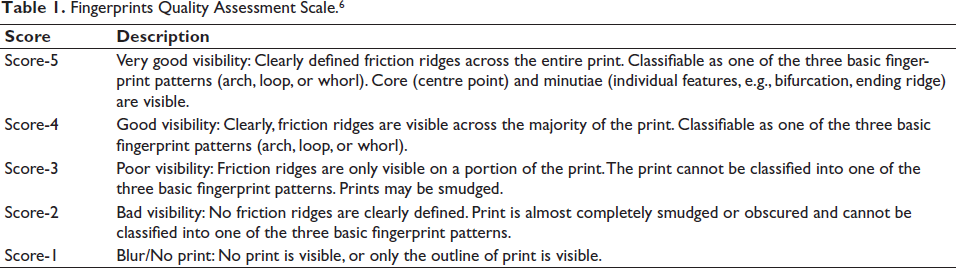
The scale used for giving scores for developed fingerprints was the Fingerprint Quality Assessment Scale 6 (Table 1). Each developed fingerprint was given a score from 1 to 5, depending on the visibility, with 5 being highly visible and 1 being blurred or no print by three independent observers to avoid bias. Based on the score of the developed fingerprint, the development techniques were compared among the different surfaces for their ability to develop latent fingerprints on non-porous surfaces and the maximum time period up to which the particular dusting powder developed visible aged fingerprints was also deciphered. A statistical analysis was carried out to determine the significance of the developmental techniques.
Fingerprints Quality Assessment Scale. 6
Statistical Analysis
Appropriate statistical analysis was performed using the SPSS software version 25.0. The significance of the study was determined using the Chi-square test, which helps to compare observed frequencies with expected frequencies. The Friedman test was done to analyse the best powder that can be used to develop good quality latent fingerprints on a particular surface.
Results
Based on the Fingerprint Quality Assessment Scale (Table 1), Scores of 5 and 4 were considered to be good visibility scores, and the time period up to which this score was obtained was taken to be the best-suited time up to which a particular powder used was sensitive in detecting the latent fingerprint.
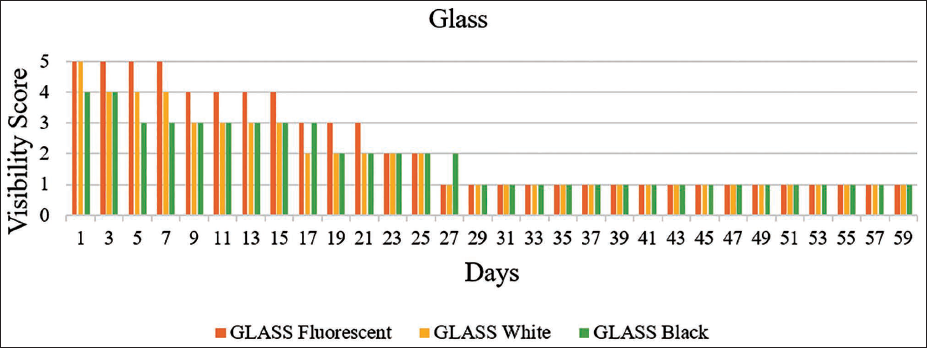
Accordingly, Figures 1, 2 and 3 give the visibility score comparing the three dusting powders used on the various non-porous surfaces at different durations of time. It can be observed that the fluorescent powder on glass developed the latent fingerprints with very good visibility (5) up till 7th day and with good visibility (4) up to 15th day, while the white powder on the same surface developed the fingerprints with very good visibility (5) only on the 1st day of deposition and with good visibility (4) till 7th day. In contrast to this, the black powder developed fingerprints with a maximum score of 4, which is of good quality till the 3rd day only (Figure 1).
Visibility of Developed Fingerprint Using Different Dusting Powders on Non-porous (Glass).
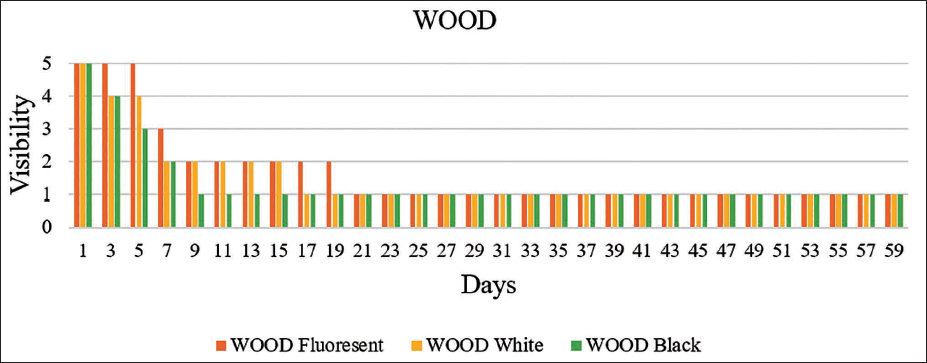
Visibility of Developed Fingerprint Using Different Dusting Powders on Non-porous (Wood).
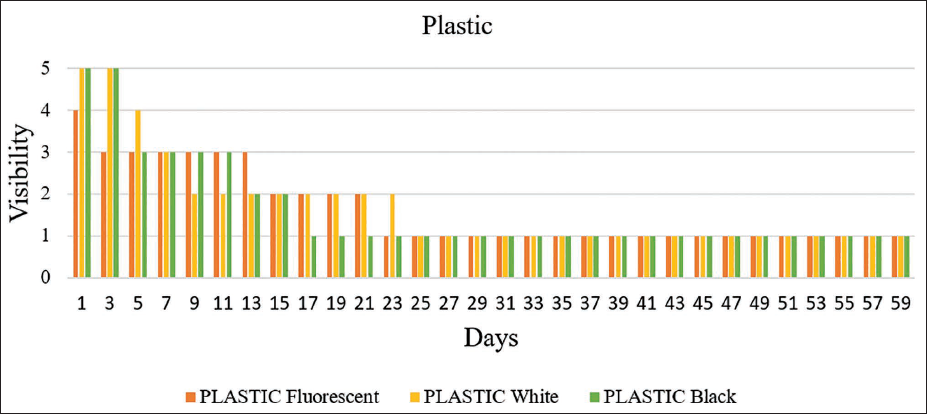
Visibility of Developed Fingerprint Using Different Dusting Powders on Non-porous (Plastic).
On the wood again, it was the fluorescent powder that developed the fingerprints with very good visibility (5) up to the 5th day, while the white powder had Score 5 only on day 1 and thereafter till the 7th day, it developed the fingerprints on wood with only Score 4, good visibility. However, the black fingerprint powder on wood showed Score 5 for fingerprint development on Day 1 and Score 4 until Day 3 (Figure 2).
On plastic, it was only white and black powder that gave Score 5, that it very good quality for the development of fingerprints till Day 3, while fluorescent had a score of only 4, and that also only on Day 1 (Figure 3).
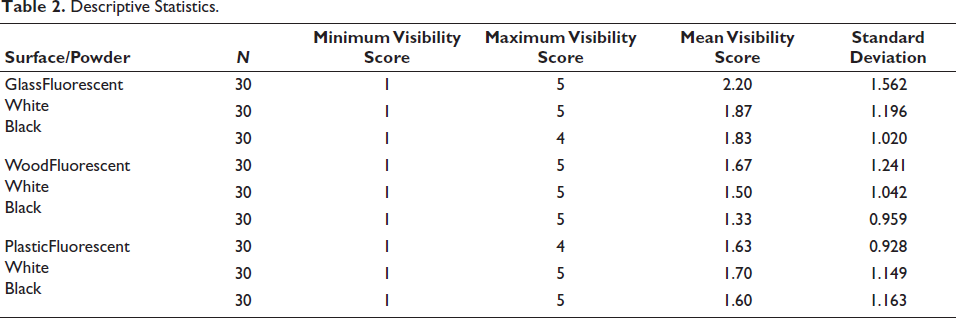
The descriptive statistics with the minimum, maximum and mean scores for the development of fingerprints on different surfaces using various powders are given in Table 2. As seen, it is observed that the maximum score obtained was five for all surfaces using the various powders except for black powder on glass and fluorescent powder on plastic, which developed fingerprints with a maximum score of only 4.
Descriptive Statistics.
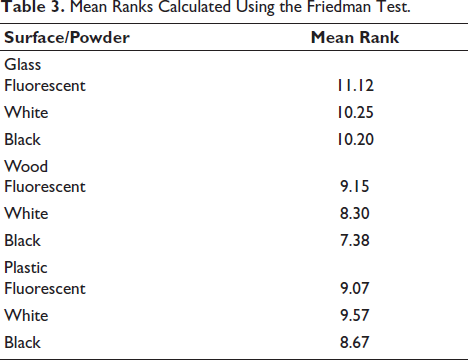
Mean ranks (Table 3) calculated using the Friedman test for each development technique based on the scoring given for images of developed fingerprints on all different surfaces revealed that the highest mean ranks were for fluorescent powder on glass (11.12); fluorescent powder on wood (9.15); white powder on plastic (9.57) as compared to other development techniques on respective surfaces.
Mean Ranks Calculated Using the Friedman Test.
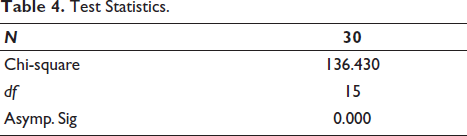
The null hypothesis was taken to be that there is no difference in the development of fingerprints at various time intervals on different non-porous surfaces using various dusting powders. However, as shown in Table 4, the significance of the study was found to be .000 (p < .05), which indicates that the study rejects the null hypothesis.
Test Statistics.
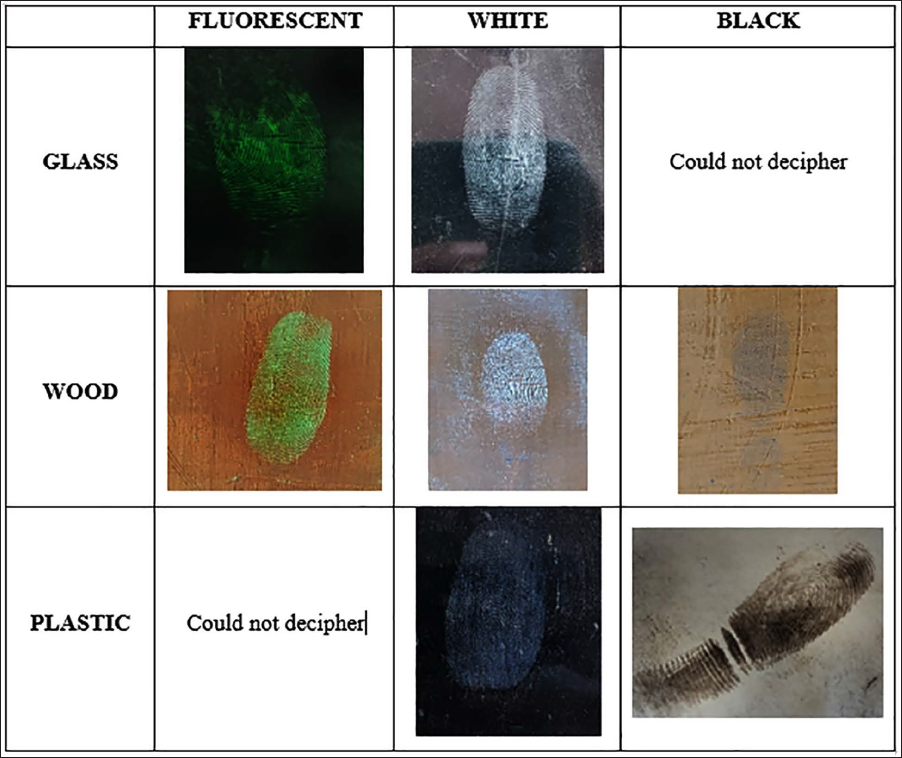
As shown in Figure 4, the images revealed that the developed fingerprints using different dusting powders on various surfaces over a period of time show distinct variations in clarity and visibility, highlighting the effectiveness of each fingerprint dusting powder.
Images of Fingerprints Developed Using Different Dusting Powders on Different Surfaces.
Discussion
The present study was conducted to develop latent fingerprints on different non-porous surfaces for a period of 60 days with an interval of 48 hours using various dusting powders with the aim of comparing them in their ability to develop good-quality fingerprints in a time-dependent manner.
Based on the observation, the quality of the latent fingerprint developed reduced as the days passed. The physical methods that developed the fingerprints with visibility scores of 5 and 4 on the Fingerprint Quality Assessment Scale were considered to be the best methods for the development of fingerprints. Those that developed with scores of 3, 2 and 1 were considered to be of not much help in the identification of fingerprint patterns. The Friedman test revealed that fluorescent powder was best for developing latent fingerprints on glass and wood, and for plastic, white powder was the best.
In the present study, the three different fingerprint powders used have shown different results on each of the three surfaces used. Based on the results, it was observed that fluorescent powder is best suitable to develop latent fingerprints on glass and wood for a longer period of time, while white or black powder is best suitable to develop the fingerprints on plastic surfaces.
A study by Muhammad Yusof et al. revealed that black magnetic fingerprint powder was superior to black fingerprint powder as it developed fingerprints for a longer period. 5 A comparison study by Nich Wongsongja et al. was focused on determining the remaining period of latent fingerprint on three different types of plastics and with two development techniques, such as black powder dusting and superglue fuming. The development of fingerprints was performed at different time intervals and concluded that both methods were reliable to enhance fingerprints for a longer duration, of which superglue was effective to develop until 120 hours (5 days). 7
Krystyna Baniuk explains that the physical and chemical properties of a surface are known to influence the durability of fingerprint traces. Surfaces such as glass, metals, and some kinds of plastic materials are conducive to good preservation of fingerprint traces for a long time due to their smoothness and non-absorptive property, whereas rough and absorptive surfaces cause the sweat and grease content of fingerprint residue to spill over because of their unevenness, and get absorbed by the capillary vessels of the inner structure of the surface. 8
Aline Girod et al. conducted a qualitative and quantitative review study, which concludes that finger-mark composition is complex and varies both in the initial residue immediately after contact and in the residue as it ages. The study identifies five key factors influencing this composition: donor characteristics, deposition conditions, nature of the substrate, environmental conditions, and enhancement techniques. 9 Giorgia De Paoli et al. revealed in their research, amino acids in fingerprint residue degrade rapidly when exposed to higher temperatures than in ageing at room temperature. 10 Research by Nia E. Archer et al. found that aged fingerprints initially showed an increase in material detected, which is thought to be due to the breakdown of wax esters and/or triglycerides into fatty acids. This theory is supported by the observation that the levels of several fatty acids in the fingerprint residue initially increased and then declined, indicating that fatty acids are initially produced but later subject to degradation and loss. 4
The study conducted by De Alcaraz-Fossoul et al. explores the degradation patterns of latent fingerprints over time under controlled indoor environmental conditions. Researchers analysed both sebaceous (greasy) and eccrine (sweaty) prints on glass and plastic surfaces across a 6-month period, simulating real-world scenarios. Sebaceous prints were found to be more durable than eccrine ones, and glass surfaces preserved fingerprint details significantly better than plastic. 11
The comparison study by Sri Adelila Sari et al. revealed that black powder revealed latent fingerprints more clearly than cyanoacrylate glue. Black powder provided higher contrast, especially on non-porous surfaces like plastic and CDs. Cyanoacrylate glue was less effective, which might be due to the surface type. 12 A review study by Upadhyay S and Yadav B examined various methods for developing latent fingerprints on human skin. They found that Magnetic Jet Black and Swedish Black powders, as well as the chemical method using Ruthenium Tetroxide (RTX), produced the most reliable results. Cyanoacrylate fuming, although commonly used, was less effective on deceased skin due to condensation. 13
A review study by G. S. Sodhi concludes that the physical method of developing latent fingerprints, which involves the dusting technique with powder, is the easiest and preferred procedure as it does not require any specialised equipment. The dusting powders are also flexible for changes pertaining to colour, composition and particulate size in their formulation, which can be less expensive and harmless. 14 The study conducted by Sara Moreno et al. revealed that fingerprint powders with basic compositions, such as carbon and oxygen, which are usually present in black powders, yield clearer and higher-quality fingerprints. Similarly, powders with smaller and more uniform particles are more effective in binding with the fingerprint residue, resulting in better prints. 15 A study presented by Soumalya Roy et al. reveals a novel powdering technique using candle carbon powder to decipher latent fingerprints on different surfaces. The carbon powder, which is commonly found in households and used for everyday purposes, is readily available and economical, offering a simple and cost-effective solution for fingerprint detection. 16
Research by P. Boonyaras et al. concludes that the effectiveness of latent fingerprint detection using fluorescent powder dusting is highly influenced by the combination of powder colour, background colour, and light source. 17
Conclusion
Fingerprints are considered strong evidence in court due to their uniqueness and the reliable methodology used for identification. From the observations and results of the present study, fingerprints can be developed on different surfaces by the conventional method. The study proves that among the three different dusting powders, fluorescent powder was the most effective for developing the fingerprint with good visibility on glass and wood substrate, while on plastic, the white powder was effective. The results of the study reveal that glass and wood substrates showed very good visibility (5) of latent fingerprints after development for 7 and 5 days, respectively. In our study conditions, plastic substrates generally preserved fingerprints for up to 2 days, after which the quality significantly diminished.
Hence, this study has enabled deciphering the best-suited powder that can be used to develop time-dependent latent fingerprints with good visibility. This study aims to address the challenges faced in developing old or aged fingerprints found at crime scenes. If a crime is discovered after a few days and a fingerprint is found on the crime scene or if new fingerprints are collected from a crime scene during a revisit/re-examination, the results of this study can probably be used for real-time crime scene investigation to understand which method would be best suited to develop them. The valuable time of the investigator or a Forensic Scientist will be conserved when a suitable method to develop the fingerprint is known. The benefit of a good-quality fingerprint will result in the successful identification of a person.
Footnotes
Authors’ Contribution
The study was conceived and defined by Ms Priyanka. Sample collection and processing performed by Ms Keertheeswari. Reading and scoring of the fingerprint was done by Dr Ganesh and Ms Hima. Study guided, protocol defined and manuscript drafted by Dr Sneha S. Dr Priyadarshee Pradhan corrected the manuscript.
Data Availability
Not applicable.
Declaration of Conflicting Interests
The authors declared no potential conflicts of interest with respect to the research, authorship and/or publication of this article.
Ethical Approval
The study was conducted after approval from the Institutional Ethics Committee, following the guidelines prescribed (CSP-/23/APR/127/374).
Funding
The authors received no financial support for the research, authorship and/or publication of this article.
Informed Consent
Informed consent was administered among the participants, and after obtaining consent were included in the study.
