




Abstract
Useful piece of forensic evidence that can help identify suspects is a handprint. In order to reduce the number of possible suspects, anthropometric study of handprints offers vital information for calculating size and sex. The goal of the current study was to investigate how stature and hand and handprint dimensions relate to comparative human identification. One hundred adults from Eastern Uttar Pradesh—fifty males and fifty females—made up the study sample. A stadiometer was used to measure the participants’ stature, and they provided handprints using ink pads. A digital vernier caliper was used to record eight anthropometric parameters for both hands. Males were 167.70 cm tall on average, while girls were 160.27 cm tall, according to statistical study. The right palm length was the best predictor of stature in females, whereas the first digit length in males had the highest connection. For both males and females, the standard error of estimation (SEE) varied from ±6.9 cm to ±8.17 cm. Measurements of handprints showed comparable dependability, with females showing smaller SEE ranges for both hands. The study demonstrates the usefulness of hand and handprint dimensions in forensic anthropology by highlighting how they can accurately predict sex and size. These results highlight the significance of region-specific anthropometric data for enhancing human identification accuracy, supporting investigations by lowering suspect pools, and aiding in the development of specialized forensic databases.
Keywords
Introduction
A forensic anthropologist’s job today entails more than just studying skeletal remains; with increased international migration (both legal and illegal), crime and natural disasters that result in large numbers of fatalities, it is frequently necessary to examine living people or deceased individuals’ body parts. A practicing forensic anthropologist has a basic level of skill that includes the capacity to create a biological profile (autobiography—sex, age, ethnicity, and stature) for the identification of human beings, either by reconstruction of the remains found at the scenes or by comparing the existing records. A biological profile, along with other skeletal markers (such as antemortem pathology), can help determine the identity of unidentified skeletal remains. For investigating authorities, this profile efficiently reduces the number of probable matching individuals; subsequent identification can be accomplished using traditional markers. 1 For many years, forensic anthropologists and medical professionals have been fascinated by the close correlation between certain body components and stature. The dimensional relationship between body segments, which is frequently utilized in contemporary forensic practice,2, 3 enables the reconstruction of the body’s original stature.
An examination of recent research indicates that height can be precisely forecasted based on the lengths of distinct long bones in the upper and lower limbs,4, 5 along with the width and length of the foot and footprints.6–8 Moreover, linear measurements of the hand and handprints also play a role in this prediction,9–11 along with the length and breadth of the foot, have proven to be reliable indicators for stature prediction.
Even in the absence of complete proof, the precise relationships between the measurements of different anatomical regions can be utilized to identify victims or body remains. The most frequent physical evidence found at crime sites is handprint evidence. The key to identifying a perpetrator is thought to be obtaining their distinctive fingerprint pattern, 12 although this may not always be possible. Handprints prove especially advantageous in determining an individual’s gender and height as they originate from the most prominently visible part of the hand, offering insights into the actual size of the individual’s hand that left them at a crime scene. 13 In a vast and diverse country like India, a universal formula for estimating stature may not apply due to the presence of different topographical terrains as well as heterogeneity in cultures and ethnicity across the entire subcontinent. Hence, the primary objective of this research was to assess the precision and dependability of using measurements of hand and handprint measurements for stature estimation within the Eastern Uttar Pradesh population. This is the first of its kind to be conducted for providing baseline data in the loco-regional population and to utilize this for further studies.
Material and Methods
Material
This cross-sectional study was carried out at a tertiary care hospital after taking ethical approval from the Institutional Ethics Committee. A total of 100 young and healthy individuals comprising 50 males and 50 females aged 19–26 years in Eastern Uttar Pradesh were taken as per calculated by the calculated sample size mentioned below. Before taking the measurements, informed consent was acquired from the participating individuals. Subjects with no obvious pathology or a history of previous surgical/cosmetic treatments on the hand were included. This study excluded participants with spine deformities such as kyphosis and scoliosis, as well as those with previous hand injuries as a result of accidents, congenital deformity, etc.
The sample size was selected to give sufficient power to identify gender differences in hand measurements as well as associations between hand/handprint measurements and stature.

Using the Fisher z technique, ≈85 subjects were needed to detect a correlation of r = 0.30 (α = 0.05, 80% power); 50 subjects per group are needed to detect a between-group standardized mean difference of d ≈ 0.56. In order to find moderate correlations and moderate-to-large gender differences, we recruited 100 healthy participants (50 men and 50 females). This allowed for modest multivariable logistic modeling (≈5 predictors) without experiencing significant overfitting.
Method
Collection of Handprint
Every participant’s right and left handprint was captured using an inkpad and nonreactive, non-indelible ink. Gently, the hands were pressed onto the ink pad, then gently pressed onto white paper to create the outline of a handprint. Following the paper’s drying period, eight measurements in total were taken, as previously reported in previous studies.7, 11, 14–16
Measurement of Stature
A stadiometer was employed to ascertain the standing height of each participant. Subjects were directed to stand upright and barefoot on the level base, aligning their head with the Frankfurt plane and ensuring their back made contact with the stadiometer’s vertical board. Following that, the measurement in centimeters from the heel to the highest point on the head was taken by adjusting the sliding bar.
Measurement of the Handprint
Anthropometric measurements for both the right and left hands of each participant were obtained utilizing a digital vernier caliper (Mitutoyo, Japan), adhering to the landmark criteria established in prior investigations.7, 8 All measures utilized in this study are depicted in Figure 1.
Human Hand Showing Various Hand Measurements. a: 1st Digit, b: 2nd Digit, c: 3rd Digit, d: 4th Digit, e: 5th Digit, f: Palm Length, g: Hand Breadth, h: Hand Length.
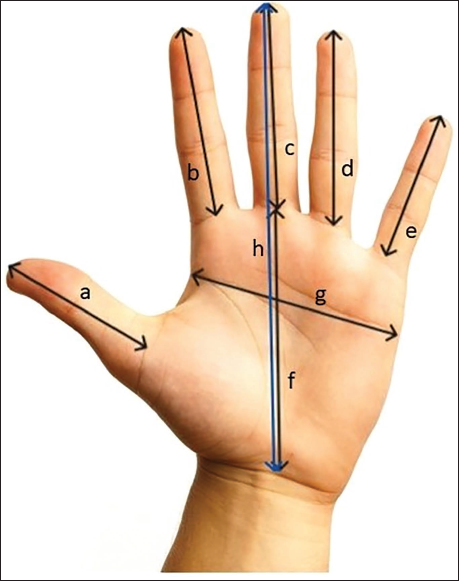
Hand breadth (HB): Distance between the outermost point on the head of the second metacarpal to the innermost point on the head of the fifth metacarpal.
Hand length (HL): Distance from the mid-point of the distal transverse crease of the wrist to the furthest forward projection of the skin on the middle finger.
Palm length (PL): The measurement from the wrist’s distal transverse crease to the proximal flexion crease of the middle finger.
Thumb (1D); Index (2D); Middle (3D); Ring (4D); little (5D) Finger length: The distance from the proximal flexion crease of each finger to its respective fingertip.
Statistical Analyses
The data collected was entered into Microsoft Excel. The SPSS V 26.0 software was then used for statistical analysis. The dimensions of the hand and handprint that showed a significant link with stature were put into a regression model for the assessment of stature. Stepwise regression analyses were conducted to formulate a regression equation for predicting stature based on diverse hand and handprint measurements. The standard error of estimate (SEE) was determined by the disparity between the measured stature and the stature estimated through the application of the regression equation.
Results
Descriptive Statistics
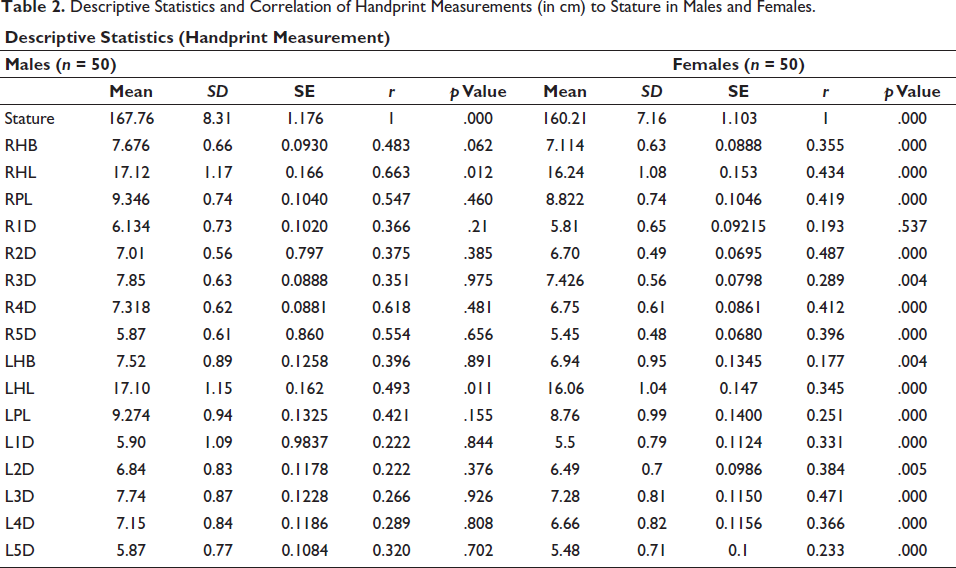
The average height measured for males was 167.70 cm (SD 8.33), while for females, it was 160.27 cm (SD 7.20). Tables 1 and 2 present the mean, standard deviation, and stature correlation for each of the eight hand and handprint measurements (left and right for both sexes). The mean, Standard deviation and standard error are shown in Table 1. Among males, the hand measurements that showed the highest correlation with stature were the first digit of the right hand and in females, it was the right palm length.
Descriptive Statistics (Hand Measurement).
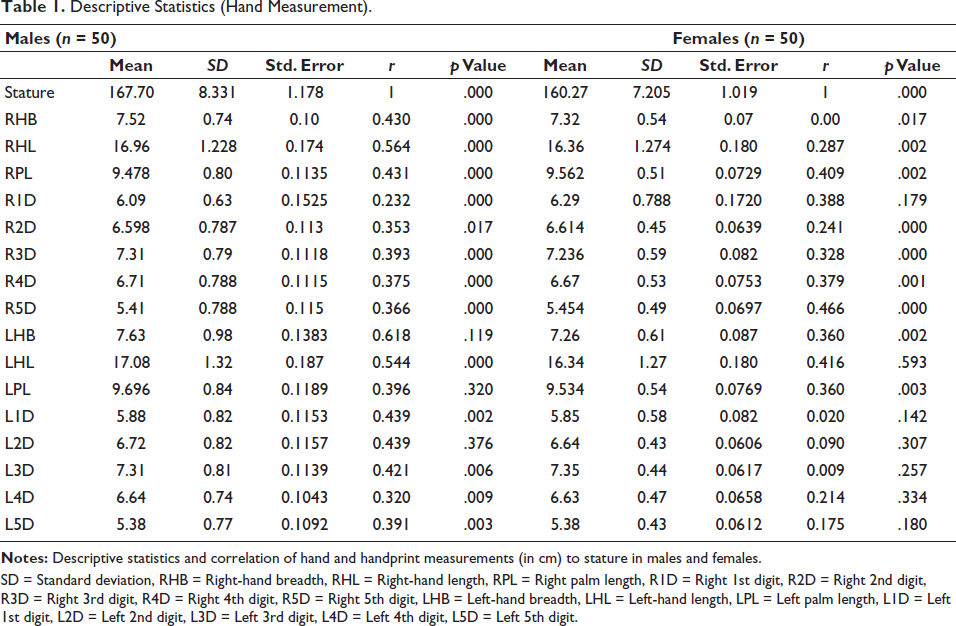
SD = Standard deviation, RHB = Right-hand breadth, RHL = Right-hand length, RPL = Right palm length, R1D = Right 1st digit, R2D = Right 2nd digit, R3D = Right 3rd digit, R4D = Right 4th digit, R5D = Right 5th digit, LHB = Left-hand breadth, LHL = Left-hand length, LPL = Left palm length, L1D = Left 1st digit, L2D = Left 2nd digit, L3D = Left 3rd digit, L4D = Left 4th digit, L5D = Left 5th digit.
Descriptive Statistics and Correlation of Handprint Measurements (in cm) to Stature in Males and Females.
Variability in Hand and Handprint Dimensions on Both Sides (Bilateral Variation)
A two-sample t-test was employed to examine bilateral variance in hand and handprint measurements. Among males, significant differences (p < .05) were observed in right-hand breadth (RHB), right-hand length (RHL), palm length (RPL), first digit (R1D), second digit (R2D), third digit (R3D), fourth digit (R4D) and fifth digit (R5D) measurements of their right hands and left-hand length (LHL), left first digit (L1D), third digit (L3D), fourth digit (L4D), and fifth digit (L5D) of their left hand. Similarly, females exhibited significant differences (p < .05) in RHB, RHL, RPL, R2D, R3D, R4D and R5D of their right hand and LHB and LPL of their left hand (Tables 1 and 2).
Correlation Between Stature and Hand and Handprint Measurements
The correlation coefficients (r) between stature, hand, and handprint measurements are reported in Table 1. In males, LHB (r = 0.6218) had the highest correlation with stature, followed by RHL (r = 0.564). Similarly, among females, R5D had the highest correlation value (r = 0.466), followed by LHL (r = 0.416), while RHB had the lowest association with stature. In terms of handprint measurements, the RHL showed the strongest correlation in males (r = 0.663), while the R2D showed the strongest association in females (r = 0.487) (Tables 1 and 2).
Simple Linear Regression
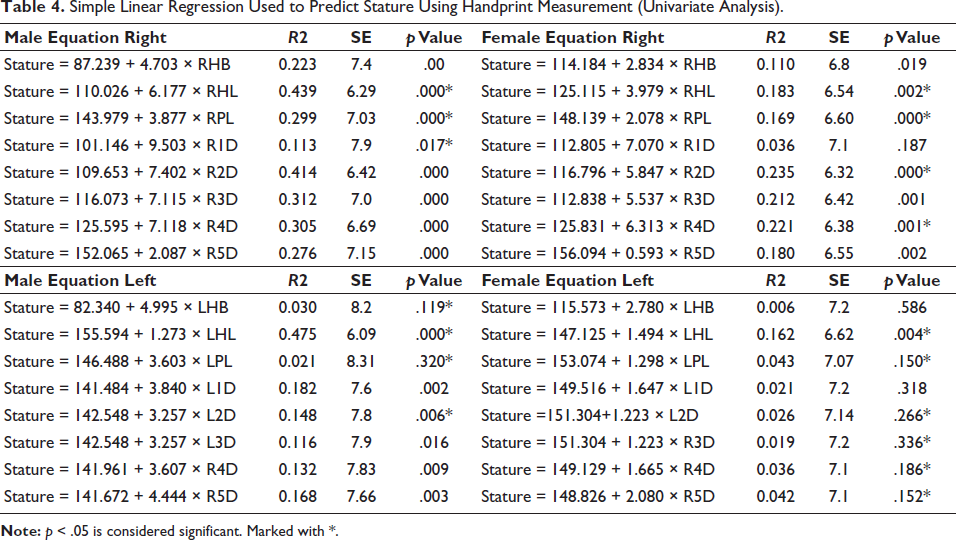
Tables 3 and 4 show the simple linear regression equations used to determine stature by measuring the hands of the subjects and handprints individually for sex and side. The standard error of estimation (SEE) forecasts the discrepancy between the estimated and actual stature. A low SEE suggests higher reliability in the estimated stature. In this investigation, the SEE of simple linear regression equations for males ranged from ±6.9 to ±8.17 cm for right and ±6.6 to ±7.98 left-hand measures, respectively. SEE for females for right-hand measurements ranged from ±6.32 to ±7.1, and for left-hand measurements showed ±6.62 to ±7.2. Handprint measurements for males ranged from ±6.29 to ±7.9 cm for right and ±6.09 to ±8.31 cm for left handprint measurements, and for females, right handprint measurements ranged from ±6.32 to ±7.1 cm and left handprint measurements ranged from ±6.62 to ±7.2 (Table 4).
Simple Linear Regression Used to Predict Stature Using Hand Measurement (Univariate Analysis).
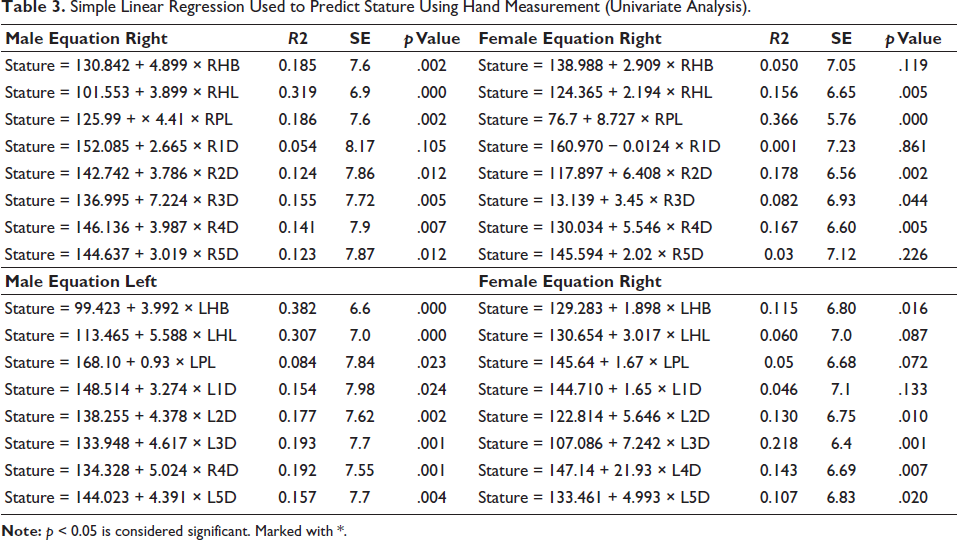
Simple Linear Regression Used to Predict Stature Using Handprint Measurement (Univariate Analysis).
Multiple Regression
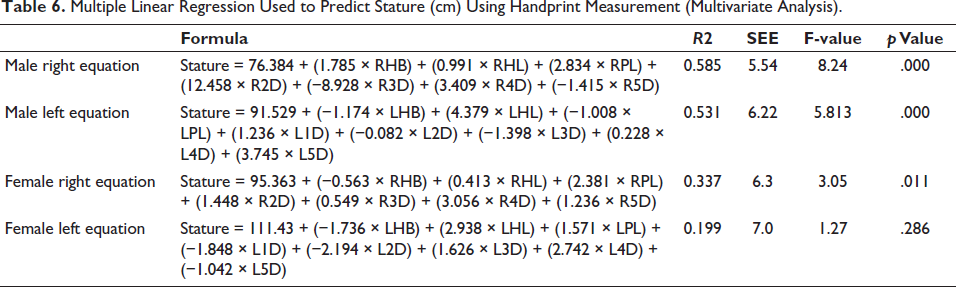
Tables 5 and 6 show sex-specific bilateral multiple regression models for estimating stature using various combinations of variables for hand and handprint measurements. Only the most accurate models developed through stepwise analysis are shown. Multiple regression models based on hand measures, males have the lowest SEE at ±6.64 cm, while females have the lowest at ±6.89 cm (Table 5). For handprint, males have the lowest SEE at ±5.54 cm and females at ±6.3 cm (Table 6).
Multiple Linear Regression Used to Predict Stature (cm) Using Hand Measurement (Multivariate Analysis).

Multiple Linear Regression Used to Predict Stature (cm) Using Handprint Measurement (Multivariate Analysis).
Discussion
Forensic inquiry involving the anthropological profile of unknown human remains must include the determination of stature. When hand impressions are provided, our findings can assist in identifying an individual who has been involved in or harmed in a crime. Conventional forensic and archaeological human remains examination is well-known to be based on estimation of bio-demographic factors such as stature, age, weight, and gender. Stature is regarded as the most important attribute for identifying an unknown person and is typically measured using the lengths of the limb bones. Recent research by Jasuja and Singh, as well as Ahemad and Pukait, have employed handprint measurements to correlate with stature.9, 17 In forensic sciences, it is essential to statistically quantify both error and uncertainty. This pertains not only to the level of error linked with forensic standards but also to the accuracy and precision of the raw data, such as measurements, from which these standards are derived.
Aligned with previous research findings, the present study identified statistically significant bilateral asymmetry in diverse hand and handprint measurements for both males and females. Significant differences were found between males in various metrics, including RHB, RHL, RPL, R1D, R2D, R3D, R4D, and R5D on the right hand and LHL, L1D, L3D, L4D, and L5D on the left hand. Similarly, females showed significant differences in RHB, RHL, RPL, R2D, R3D, R4D, and R5D on the right hand and LHB and LPL on the left. This bilateral variance implies that while hand and handprint measures can be utilized for stature assessment, the side of the body assessed should be taken into account for improved accuracy.
In men, the strongest link was identified between stature and left-hand breadth (LHB), with a correlation coefficient (r) of 0.6218, followed by right-hand length (RHL), which had a correlation of 0.564. These findings are consistent with those published by Abdel-Malek et al., who found that hand breadth and length are strong predictors of stature in many populations, emphasizing the stability of these measurements across demographic groupings. 18 The correlation of stature with HL is in accordance with the previous studies by Krishan & Sharma in the North Indian population, Rastogi et al. in South India, Ishak et al. in Western Australia, and Laulathaphol et al. in Thai populations.7, 11, 15, 19 Furthermore, Trotter and Gleser revealed that long bone measurements, including those of the hand, are robust markers of an individual’s height, further supporting the significant correlations found in the current study. 20 Females showed the strongest link with fifth digit length (R5D) (r = 0.466) and left-hand length (LHL) (r = 0.416). This is congruent with the findings of Habib and Kamal, 10 who discovered that finger lengths, particularly the fifth digit, are accurate predictors of stature in Egyptian populations. Moreover, Williams and Rogers discovered that specific cranium and hand measurements, including finger lengths, are efficient for sex determination and stature estimation in forensic instances. 21
The establishment of a positive linear relationship among stature, hand and handprint measurements facilitated the creation of multiple regression equations applicable for accurate stature estimates within the Uttar Pradesh population. In the context of simple linear regression, the observed range of SEE for measurements of both left and right hands, as well as handprints, was comparatively lower for females than for males. This outcome aligns with the findings of Nandi et al., 22 who similarly reported that females exhibited a stronger correlation between hand, handprint measurements, and stature. Also, the slight reduction in SEE suggests a marginally higher reliability for stature estimation in females compared to males. The study by Rastogi et al. supports these findings, as their research indicated that hand dimensions are reliable predictors of stature, especially in females. 19 The observed gender disparities in the growth and development of the skeletal system may be attributed to the impact of both genetic and environmental factors. 23 As a result, new sex-specific stature estimation models based on hand and handprint measurements can be developed. Multiple linear regression was used to predict stature from hand measures. Supporting the perspectives of earlier scholars (Krishan & Sharma; Ishak et al.; Zulkifly et al.), the multiple regression equations formulated for both men and women exhibited enhanced predictive accuracy compared to equations derived from single variables. Right-hand measurements showed a significant difference between the genders. SEE was observed for the male right hand at 6.95 and the left hand at 6.64, and for females, SEE was observed for the female right hand at 6.91 and the left hand at 6.89. As a result, the findings indicate that right-hand measurements were more accurate for identifying stature from hand measurements. Multiple regression models demonstrated even more precision when measuring handprints. Males had the lowest SEE at ±5.54 cm, while females had ±6.3 cm. This improved accuracy is comparable with the findings of Giles and Klepinger, who discovered that integrating numerous handprint dimensions into regression models considerably increased the reliability of stature estimations in forensic situations. 24 Their findings demonstrated the reliability of handprint measures as predictors of stature, particularly when utilizing multiple regression approaches. The current study’s findings demonstrate that the projected accuracy of stature estimation differs by population. Moreover, these equations exhibit optimal performance when applied to the population from which they were derived. This underscores the importance of establishing criteria specific to each population for precise stature determination. Additionally, the results underscore that measurements of hand and handprint offer a dependable and accurate means of estimating stature. The limitations of the current study are notably tied to its relatively small sample size. To enhance the robustness and applicability of the conclusions, further research with larger and more diverse samples, particularly encompassing various ethnic groups within Uttar Pradesh, is warranted. This study provides one of its kind to provide data for Eastern Uttar Pradesh, which can be used as baseline data for conducting further research and providing anthropological measurements for identification.
Conclusion
This study revealed a noteworthy positive correlation between participant stature and handprint parameters, as evident by the student’s t-test and correlation coefficient. Moreover, it demonstrated that handprint and phalangeal length print measurements exhibit high reliability in estimating stature for forensic applications. While the precision of anthropometric hand measurements for determining stature is firmly established in specific populations, the use of handprint data remains relatively novel. This study presents credible statistical methods for estimating stature using hand and handprint measurements, emphasizing the significance of bilateral variances and the use of multiple regression models. These findings will not only benefit forensic anthropology by improving the accuracy of stature assessment from incomplete remains but will also help in constructing more precise, population-specific models for use in forensic and anthropometric investigations.
Footnotes
Abbreviations
cm: Centimeter
Ref no: Reference number
SD: Standard deviation
Declaration of Conflicting Interests
The authors declared no potential conflicts of interest with respect to the research, authorship, and/or publication of this article.
Ethical Approval
The study was approved by the University Research Ethical Committee, King George’s Medical University (Ref. No. 2567/ethics/2023).
Funding
The authors received no financial support for the research, authorship, and/or publication of this article.
Informed Consent
Written consent was obtained from all participants who voluntarily agreed to take part in the study, in accordance with the principles of the Helsinki Declaration.
