




Abstract
Stature is one of the important criteria for establishing identification of unknown person/dead body. It is measured as standing height of the person but reconstruction of stature becomes difficult when dead bodies are mutilated, burnt or skeletonized. Anthropologists throughout the world have tried to estimate stature from bones and mutilated and dismembered remains of dead bodies. Authors under this project tried to reconstruct the stature of 200 healthy students (100 males and 100 females) between 19 and 25 years of age by measuring parts of their upper and lower limbs such as distal part of upper limb (forearm including hand), hand, leg and foot. Standing height and per-cutaneous length of these parts were analysed statistically by using (a) formula
Regression equations and multiplication factors of parts of limbs are summarized as follows:

Forearm and hand
2.42x + 56.64
2.31x + 59.5
3.67
3.73
Hand
5.1x + 67.9
4.8x + 70.2
8.5
8.7
Leg
2.34x + 63.9
2.17x + 65.4
3.73
3.73
Foot
3.35x + 82.6
3.42x + 75.8
6.49
6.65
Stature calculated by regression equations and multiplication factors were compared by the actual standing height and it was found that the results of regression equation are close to the actual height that is, ±3 cm. In reconstruction with multiplication factors, the calculated heights were more than ±5 cm in a large number of cases. This shows that multiplication factors are less reliable than regression equation.
Introduction
Reconstruction of stature from bones and mutilated remains is always a challenge for forensic pathologist. Anthropologists, all over the world, are trying to develop a simple and accurate formula for estimation of stature.1–6 Authors, in a project, tried to reconstruct stature from the parts of upper and lower limbs, that is, from (a) distal part of upper limb (combined length of forearm and hand), (b) hand, (c) leg and (d) foot7–10 separately in males and females from same participants. A direct correlation was observed between standing height and per-cutaneous length of distal part of upper limb, hand, leg and foot and multiplication factors and regression equations were derived. The authenticity of these formulae was assessed by reconstructing the stature by putting the value of length of respective body parts in regression equation or by multiplying with multiplication factors and compared with actual height.
Materials and Methods
After ethical approval of pilot project, 200 healthy students (100 males and 100 females) of Meerut between 19 and 25 years of age were selected for this study irrespective of their caste, religion, dietary habits and socioeconomic status. Students having significant growth disorders, deformities, bony anomalies and fracture/amputation were excluded to rule out any abnormal result.
After taking consent, the standing height and length of both side of distal part of upper limb (forearm including hand), hand, leg and foot of all the participants were measured. The stature was measured on stadiometer without shoes as a distance between standing surface to the highest point on the head in mid-sagittal plane. The combined length of forearm and hand was measured as distance between the tip of olecranon process and the tip of middle finger by sliding calliper.
The length of hand was measured between the midpoint of wrist to tip of middle finger for which students were requested to put their hand on plane white paper on which tip of styloid process of radius and ulna and tip of middle finger were marked with pencil. A line was drawn between the tips of two styloid processes and the length of hand was measured as the distance between the mid-point of line to tip of middle finger.
For the length of leg, the subject was requested to put his/her leg on a table/stool and distance between the table top to the most prominent point of medial condyle of tibia was measured. The length of foot was measured between the most prominent point of heel to tip of great toe by marking these points on white paper. These measurements were compiled on master chart and also on excel format in computer.
Regression equation was derived by using the formula
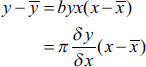
y = Standing height (stature)
x = Length of body part (forearm and hand, hand, leg or foot)
ύ = Co-relation coefficient between standing height and corresponding length of body part
The mean and standard deviation of standing height and mean and standard deviation of length of right and left side of body parts and average of both sides were calculated, from which their correlation coefficient with standing height was derived. Practically there was no significant difference in the lengths of right and left side body parts, and regression equation for the estimation of stature was derived from the average length of both sides separately in male and female. The stature was estimated with the formula
Observation and Results
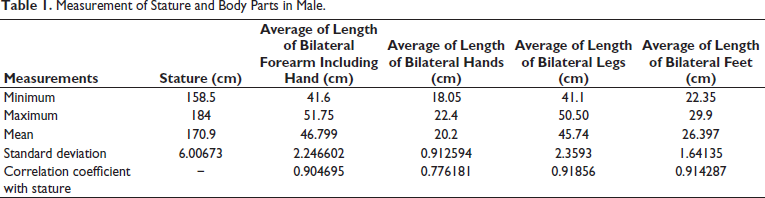
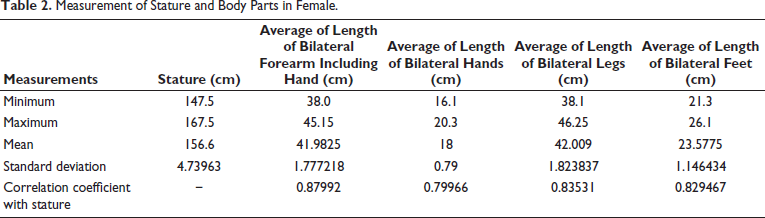
All the measurements were compiled on master chart and also on excel format in computer to calculate minimum, maximum, mean and standard deviation of stature and also of average of length of both side body parts and their correlation coefficient with stature. The data for male and female are summarized in Tables 1 and 2.
Measurement of Stature and Body Parts in Male.
Measurement of Stature and Body Parts in Female.
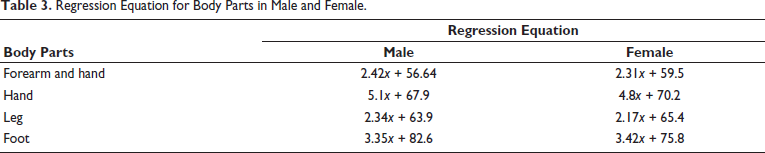
The regression equations for estimation of stature from different body parts, distal part of forearm (forearm and hand), hand, leg and foot in male and female were derived by using formula
Regression Equation for Body Parts in Male and Female.
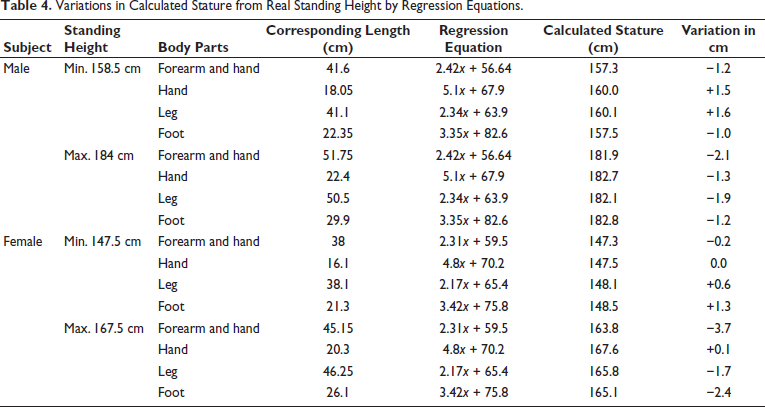
By putting the value of x in different situations, statures were calculated and compared with the corresponding real standing height. The calculated height in all the four parameters was found close to real standing height, ±3 cm in majority of the cases (Table 4).
Variations in Calculated Stature from Real Standing Height by Regression Equations.
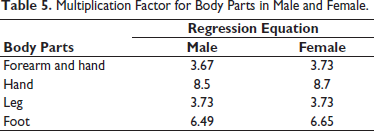
The multiplication factor is calculated as ratio of average of standing height with average length of the parts of both side limbs (distal part of upper limb, hand, leg and foot). It is derived separately in male and female. Multiplication factors of above four parts are shown in Table 5.
Multiplication Factor for Body Parts in Male and Female.
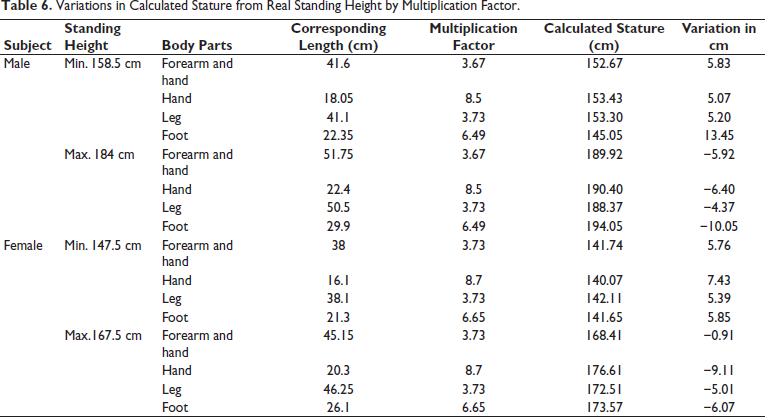
Statures were calculated from the per-cutaneous measurements of part of limbs by multiplying the multiplication factor and compared with the corresponding real standing height. The calculated height in all the four parameters was more than ±5 cm to real standing height in large number of cases (Table 6). Thus, regression equations are more reliable in reconstruction of stature than the calculation done by using multiplication factors, which is less consistent with actual height.
Variations in Calculated Stature from Real Standing Height by Multiplication Factor.
Discussion
Estimation of stature is a crucial requirement in post mortem examination of dead bodies especially when they are un-identified and badly decomposed, mutilated or skeletonized. A direct relationship was observed between length of different part of upper and lower limbs and standing height by different workers.11–13 A direct relationship was observed between standing height and the length of distal half of upper limb (combined length of forearm and hand) in a study by Sushil et al. 14 and multiplication factor is nearly similar to our study. The similar results were also observed in other studies observed for the estimation of stature from dimensions of hand and foot.15–19 Regression equations and multiplication factors are derived separately for males and females. The length of right and left side of limbs or their parts are almost the same in most of the cases and so are the regression equations and multiplication factors for both side arms. So, the role of right and left side measurements in determination of stature is statistically insignificant. The calculated stature from regression equations of body parts was close to actual height, less than +/−3 cm in most of the cases. With multiplication factors, when statures were calculated, the errors varied from −10.05 cm to +13.45 cm, of which the difference of more than +/−5 cm was seen in large number of cases. Hence, multiplication factors are statistically inferior and less reliable than regression equations.
Conclusion
There is a direct relationship between standing height and length of upper and lower limbs in both the sexes.
Regression equations and multiplication factors are most often used to reconstruct stature.
Regression equations and multiplication factors are derived separately in male and female for the reconstruction of stature from the length of distal part of arm (combined length of forearm and hand), hand, leg and foot.
Calculated statures from regression equations are close to the actual height, less than +/−3 cm in most of the cases.
Calculated statures from multiplication factors, the errors vary from −10.05 cm to +13.45 cm, of which the difference is more than +/−5 cm in large number of cases.
Regression equations are statistically superior and more reliable than multiplication factors.
Footnotes
Declaration of Conflicting Interests
The authors declared no potential conflicts of interest with respect to the research, authorship and/or publication of this article.
Ethical Approval
The ethical approval has been obtained from the ethics committe for the study.
Funding
The authors received no financial support for the research, authorship and/or publication of this article.
Informed Consent
Not applicable.