




Abstract
Identity of the dead and mutilated is an essential part of medico-legal investigations. Stature estimation, being an identity marker, is easier in a living subject as it is usually measured as standing height; however, difficulty arises when a dead body is decomposed or skeletonized. Various bones have been employed to develop regression formulas for stature estimation. Regression formulas developed for one population may not be suitable for stature estimation in another population. So, there is a need to develop population-specific regression formulas for stature estimation. The study was conducted to develop a regression formula for north Indian population (medical students) for stature estimation using percutaneous length of humerus bone. The study was conducted on 90 participants in the age group of 18–23 years undergraduate medical students at MMMC&H, Solan, Himachal Pradesh. There was a linear relationship between length of humerus (both sides) and stature in both males and females. In males, each 1 cm increase in length of right humerus leads to 0.672 cm increase in stature, while with 1 cm increase in left humerus leads to 0.666 cm increase in stature. In females, each 1 cm increase in length of right or left humerus leads to 0.813 cm increase in stature. The present study shows a linear relationship between stature and humerus length in both males and females. So, stature can be estimated with effective precision from humerus bone that may help in the identification of remnants of unidentified bodies by means of regression equations.
Introduction
Identification of the dead and mutilated is an important aspect of medico-legal investigations. 1 Estimation of stature in living individuals is relatively straightforward, as it is measured as standing height. However, difficulty arises when the body is decomposed, mutilated, skeletonized, or when only dismembered limbs or body parts are available for post-mortem examination. Numerous multiplication factors and regression equations have been developed worldwide to estimate stature from long bones.2–7 Although various long bones have been used for stature estimation, 8 bones of the lower limb contribute most to stature and therefore form the basis of most predictive equations. 9
Regression equations developed by Western researchers show an error of 5%–8% when applied to the Indian population 10 due to racial variations in limb proportions and differences in length of limb bones relative to stature.6, 11 Regression formulas derived from major long bones are considered more accurate than those based on bones of the hands and feet. Trotter et al.12–14 developed regression equations based on cadaveric stature and femoral length, while Suman Babu R15, 16 studied stature estimation using forearm bones. Studies have also been conducted on different populations, such as Chilean and Japanese groups17, 18 however, equations derived for one population may not be suitable for another due to differences in genetics, nutrition, lifestyle, and climatic conditions. 19 Studies have been done by various authors on stature estimation from other body parts like hands, trunk, intact vertebral column, individual long and short bones, foot and footprints, etc.20–23
Stature is defined as the natural height of a human measured from the vertex to the floor in the anatomical position.24–26 Body height represents the cumulative length of various bones and appendages, and a definite proportional biological relationship exists between these structures and total stature. This relationship assists forensic experts in estimating stature from dismembered or mutilated body parts. 27 Numerous studies have demonstrated a positive correlation between stature and long bone length, making such relationships valuable in forensic and anthropological investigations.28, 29
Two methods of stature estimation are commonly used: anatomical and mathematical. Due to the frequent non-availability of complete skeletal remains at crime scenes, forensic experts often rely on the mathematical method, which can be applied even when a single bone is available. 30 Although reconstruction of stature from skeletal remains is well established, population-specific regression equations are essential for accuracy.31–33 Regression formulas for stature estimation from various bones have been developed by many authors34–37 based on well-documented skeletal remains of European White or African Black Ancestry.
In India, documented skeletal remains are scarce,38, 39, 44 which limits the development of reliable population-specific formulas. Consequently, percutaneous measurements of long bones may offer a practical alternative for stature estimation in mutilated remains, reducing errors associated with applying equations derived from other populations. 39 Given India’s multi-ethnic diversity and regional variation in body proportions, the present study was conducted to develop regression equations for stature estimation in a north Indian population using the percutaneous length of the humerus, similar to the approach described by Trotter et al. 12
Aims & Objectives
The study was conducted to develop a regression formula for north Indian population (medical students) for stature estimation using percutaneous length of humerus bone
Null Hypothesis
There is no significant relationship between the percutaneous length of the humerus and the stature of an individual.
Alternative Hypothesis
There is a significant positive correlation between the percutaneous length of the humerus and the stature of an individual, and stature can be reliably estimated from humeral length.
Materials & Methods
The present study was cross-sectional with a study population of 90 participants (similar studies have been done previously on a similar sample size45–48) in the age group of 18–23 years as undergraduate medical students at MMMC&H, Solan, Himachal Pradesh, after getting ethical clearance from the institutional ethical committee vide reference no MMMC&H/ETH/16/122. The above age group was selected as skeletal growth is largely completed by 18 years, having stabilized stature. Focusing on healthy adults in this range minimizes variations from childhood growth or age-related shrinking, maximizing accuracy for medico-legal. The age of the selected subjects was confirmed & verified by using any of the following documents, like Aadhar card, pan card, passport, etc.
The procedure, aims & objectives of the study were explained to the participants, and a written, valid informed consent was taken from each of the participants in English and Vernacular. All participants were barefoot at the time of taking the measurements. The standing height of the subject was measured with the stadiometer. Measurements were taken by the same person to avoid personal error in methodology.
The students were measured for the following parameters:
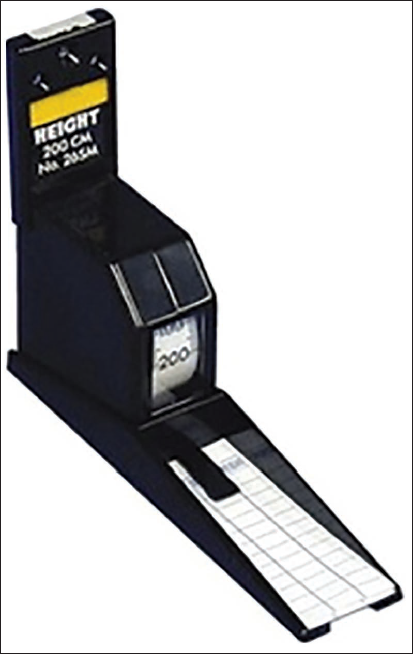
Height: It was measured as the projective distance between the standing surface and the highest point on the head (vertex) when the subject was standing barefoot on a standard anthropometric board (stadiometer in Figure 1) in anatomical position. The head was adjusted in Frankfurt plane (tilted slightly upwards), and the height was measured in centimeters by bringing the horizontal slide bar to the vertex and using measuring steel tape.
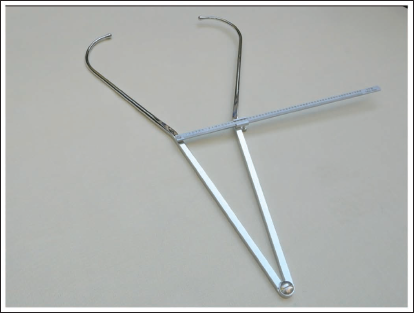
Percutaneous Length of humerus: It was measured from the clavicle’s acromial end along the arm’s posterior lateral aspect to the lateral epicondyle of the humerus 49 after asking the subject to do flexion at elbow joint and adduct the arm to make the bony projection prominent. Percutaneous measurements of the right and left humeri were taken using spreading calliper (Figure 2). Measurements of both sides were taken simultaneously.
Data Collection and Analysis
Results of the study were statistically analyzed by using SPSS v 26 statistical software. A pre-tested, semi-structured schedule was used for interviewing the study subjects. The confidentiality of the information was assured. The average differences between stature length and humerus length of both sides among females and males were calculated with the help of a t-test. Within a subgroup (male and female), the average difference between left and right humerus length was computed with the help of a paired t-test. In order to assess the relationship between stature length and humerus length (both sides), it was checked with the help of linear regression for both the male and female participants separately, as done by Trotter et al. 12 For each statistical test, the level of significance was 5%; thus, p < .05 was taken to be statistically significant.
Stadiometer to Measure the Height.
Spreading Calliper to Measure the Percutaneous Length of Humerus.
Results
Descriptive Summary
The present study was conducted on a sample of 90 participants (40 male and 50 female) in the age group of 18–23 years.
Within a subgroup of male participants, the average stature height was found to be 170.765 cm with a standard deviation of 5.649304 cm. The mean humerus length for right and left sides of male participants was found to be 27.523 (SD = 6.9621) cm and 27.575 (SD = 6.9812) cm, respectively (Table 1).
Stature and Humerus Length (Both Sides) in Males and Females.

The average height for female participants was 158.114 cm with a standard deviation of 6.2748 cm. The mean humerus length for right and left sides of female participants was found to be the same at 13.904 cm with a standard deviation of 3.737 cm (Table 1).
The average stature and humerus length (both sides) were found to be statistically higher for male participants in comparison to females, each with a statistically significant value of p < .0001. The average length of left humerus was found to be more than the average length of right humerus in the male participants; however, this change was not statistically significant (p = .444). The average humerus length for female participants was the same for both sides.
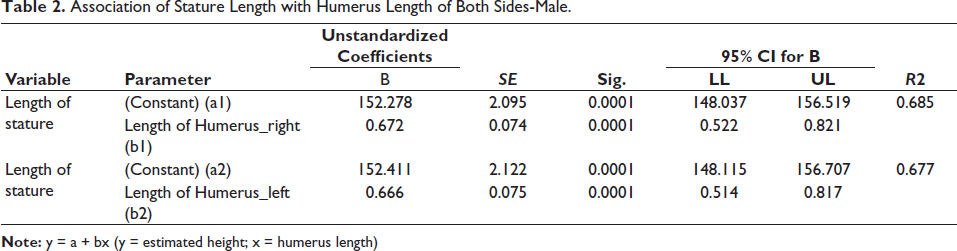
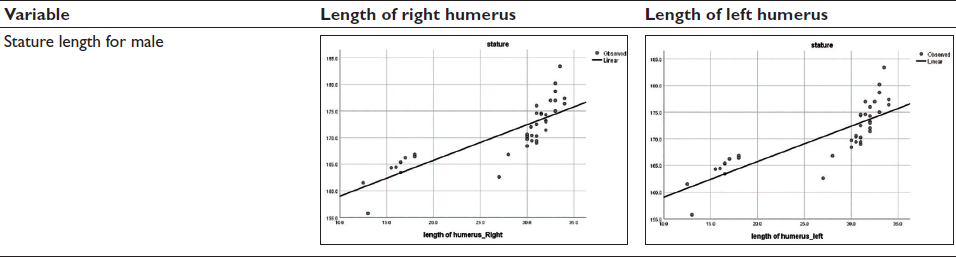
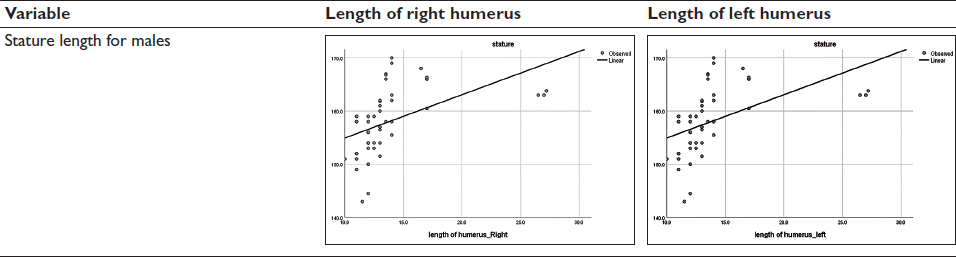
Association of Stature length with Humerus length of both sides: Male participants: The length of right humerus was associated with stature. Each 1 cm increase in the length of right humerus leads to a 0.672 cm increase in the stature. Similar to this, the length of left humerus was also found to be associated with stature and with 1 cm increase in left humerus will lead to 0.666 cm increase in stature. This indicated that stature shows a linear relationship with humerus length for both left and right sides (Table 2).
Association of Stature Length with Humerus Length of Both Sides-Male.
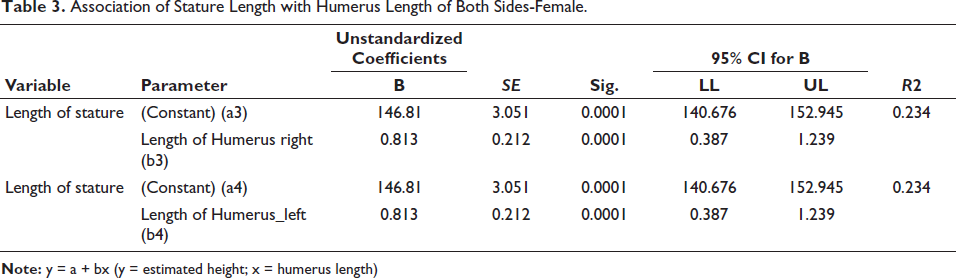
Female participants: The length of right and left humerus was associated with stature. Therefore, with each 1 cm increase in the length of right or left humerus leads to 0.813 cm increase in the stature. In case of female participants, too, the relationship between stature and humerus length (both sides) shows a similar linear trend (Table 3).
Association of Stature Length with Humerus Length of Both Sides-Female.
Discussion
The present study evaluated the relationship between stature and percutaneous humeral length in 90 subjects and demonstrated a clear sexual dimorphism in both stature and humerus length. Males exhibited significantly greater mean stature and humeral length than females, and a statistically significant linear relationship was observed between stature and humerus length on both sides in both sexes.
Stature
In the present study, the mean stature of male participants was 170.77 ± 5.65 cm, while that of female participants was 158.11 ± 6.27 cm. The difference in mean stature between males and females was statistically significant (p < .0001), indicating a clear sexual dimorphism as shown in Table 1. This finding is consistent with previous studies conducted by Chandragirish et al., 40 who reported mean statures of 163.16 ± 4.55 cm in males and 156.83 ± 3.77 cm in females.
Similar trends were also reported by Ajeesh PP 42 and Sujith Sreenivas C in a study on deceased individuals, where males had a mean stature of 163.84 ± 7.09 cm and females had a mean stature of 150.73 ± 6.18 cm. Prateek G et al. 43 likewise observed higher mean stature in males (167.73 ± 6.72 cm) compared to females (153.18 ± 5.16 cm).
The comparatively higher mean stature observed in the present study may be attributed to improvements in socioeconomic conditions, nutrition, and healthcare in the studied population, which are known to influence physical growth patterns.
Humerus Length
The mean right and left humerus lengths in male participants were 27.52 ± 6.96 cm and 27.58 ± 6.98 cm, respectively, whereas in female participants the mean humerus length was 13.90 ± 3.74 cm on both sides. The difference between males and females was statistically significant (p < .0001), further confirming sexual dimorphism in upper limb dimensions as shown in Table 1.
These findings are in agreement with those of Chandragirish et al., 40 who reported a greater mean humerus length in males (31.55 ± 1.56 cm) compared to females (30.15 ± 1.07 cm). K. Winter et al. 41 also reported higher mean humerus length in males than females using post-mortem computed tomography measurements. Similar observations were made by Ajeesh PP 42 and Sujith Sreenivas C, as well as by Prateek G et al., 43 all of whom demonstrated significantly longer humeral lengths in males compared to females.
Such variations in humeral length across studies may be influenced by population-specific genetic factors, measurement techniques, and environmental conditions.
Correlation Between Humerus Length and Stature in Males
In male participants, both right and left humerus lengths showed a statistically significant positive correlation with stature. Each 1 cm increase in right humerus length corresponded to a 0.672 cm increase in stature, while a 1 cm increase in left humerus length resulted in a 0.666 cm increase in stature. This confirms a linear relationship between humerus length and stature in males as shown in Table 2.
These findings are consistent with those reported by Chandragirish et al., 40 K. Winter et al., 41 Ajeesh PP 42 and Sujith Sreenivas C, and Prateek G et al., 43 all of whom demonstrated a significant positive correlation between humerus length and stature, reinforcing the reliability of humerus length as a predictor of stature in males.
Correlation Between Humerus Length and Stature in Females
Similarly, in female participants, both right and left humerus lengths exhibited a significant positive correlation with stature. For every 1 cm increase in humerus length, stature increased by approximately 0.813 cm. This indicates a strong linear relationship between humerus length and stature in females as well as shown in Table 3.
These results are in concordance with previous studies by Chandragirish et al., 40 K. Winter et al., 41 Ajeesh PP 42 and Sujith Sreenivas C, and Prateek G et al., 43 all of whom reported statistically significant correlations between humerus length and stature in female populations.
Implications
The findings of the present study highlight the usefulness of percutaneous humerus length in estimating stature, particularly in forensic and anthropological contexts where complete skeletal remains may not be available. The observed sex-specific differences underscore the importance of using population- and sex-specific regression equations for accurate stature estimation.
Limitations
This study has a few limitations. First, it was done in an age group of 18–23 years due to the non-availability of other age groups in a medical college. However study could also include other age groups to ascertain the relationship studied. Second, a study was done on living subjects (due to the non-availability of an optimal number of post-mortem cases), but it could be replicated on dead subjects to ascertain if a similar relationship exists or not. Third, a study was done on a limited sample size (only consenting subjects were taken); however, it could be done on a large sample size to reduce the sampling error, which makes the results more precise and representative of the whole population
Conclusion
The present study demonstrates a statistically significant and positive linear relationship between percutaneous humeral length and stature in both male and female subjects. Males exhibited greater mean stature and humerus length compared to females, highlighting clear sexual dimorphism. The strong correlation observed between humerus length and stature on both the right and left sides confirms the reliability of the humerus as a predictor for stature estimation.
These findings support the use of percutaneous humerus measurements as a practical and non-invasive method for estimating stature, particularly in forensic investigations, anthropological studies, and medico-legal cases where complete skeletal remains are unavailable. The study emphasizes the importance of applying sex-specific regression equations to improve the accuracy of stature estimation within a given population.
Footnotes
Declaration of Conflicting Interests
The authors declared no potential conflicts of interest with respect to the research, authorship, and/or publication of this article.
Ethical Approval
A prior approval was obtained from the Institutional Ethics Committee.
Funding
The authors received no financial support for the research, authorship, and/or publication of this article.
Informed Consent
Written informed consent was taken from each participant.