




Abstract
Exhumation, the process of retrieving buried remains, is critical in medicolegal investigations, particularly in cases of suspicious or unnatural death. In India, exhumations are conducted under strict legal protocols to determine the cause of death and to collect essential forensic evidence. This retrospective descriptive study analyzed 20 exhumation cases from June 2003 to August 2023 at a tertiary care hospital and teaching institution. Data were collected from police requisitions, postmortem reports, and inquest papers focusing on demographic details, burial conditions, postmortem changes, and the cause of death. Among the 20 cases, 65% involved male victims; predominantly those aged 15–55 years. Most of the cases (65%) were homicides. The retrieved dead body showed various decomposition changes depending upon the time interval between burial and exhumation and the depth of the burial site. The cause of death was determined in 70% of cases, with early decomposition yielding better forensic outcomes compared to advanced stages of decomposition or skeletonization. Exhumation provides invaluable medicolegal evidence, though challenges arise with prolonged burial. Improved forensic protocols and technology can enhance the accuracy of findings.
Introduction
Exhumation, derived from the Latin terms ex (out of) and humus (ground), refers to the process of retrieving a body from its burial site, primarily for legal or medical investigations. 1 In forensic practice, exhumations are vital for uncovering new evidence in cases where suspicions of unnatural death arise after burial or when additional clarification on the cause or manner of death is required. This procedure allows for post-mortem analysis long after burial, presenting a critical opportunity to assess factors such as trauma, poisoning, or diseases that may have gone undetected previously. However, the process is complex and must be meticulously managed to ensure the integrity of both the remains and the investigation. It is often complicated by factors such as body decomposition, environmental conditions, and burial durations, which can make forensic examinations particularly challenging.2, 3 In many countries, including France, Germany, and Scotland, specific time limits regulate exhumations; however, in India, there is no fixed period within which exhumation must be performed.4, 5 In India, the procedure is governed by strict legal protocols, with the Criminal Procedure Code (Section 176) mandating that an executive magistrate be present to oversee the process. 6 Furthermore, exhumation from consecrated grounds requires special authorization from appropriate religious or civil authorities. 6 Despite these challenges, a properly conducted exhumation can yield crucial insights that are essential for medicolegal justice, establishing identity, and addressing unresolved questions. This study on exhumation cases examines the various factors that can complicate forensic investigations, particularly in addressing medicolegal questions associated with such cases. This highlights the significant challenges that forensic experts face, including the effects of prolonged burial on the body and the complexities of interpreting postmortem findings.
Materials and Methods
This retrospective descriptive study was conducted in the Department of Forensic Medicine and Toxicology at the Pondicherry Institute of Medical Sciences, Puducherry, India. The study spans a period from June 2003 to August 2023 and includes 20 exhumation cases from Tamil Nadu and Puducherry.
For each case, a detailed examination was carried out, including the collection of basic demographic data such as age, gender, and burial conditions. The following factors were collected and documented for each case from the postmortem reports and inquest papers submitted:
Socio-demographic profile of victims such as age, sex, and religion. Primary intention of exhumation and relevant legal sections under which the case was registered. Time interval between the time of interment (burial) and exhumation, soil type, and dimension of the burial site. Body condition at the time of exhumation includes the degree of decomposition and postmortem changes. The cause of death, as well as any injuries noted.
All cases exhumed by our institute followed standard operating procedures throughout the exhumation process. A dedicated team, consisting of two forensic experts, two trained diggers, a mortician, a photographer, and an investigating police officer, conducted each exhumation. Graves were identified and opened in the presence of a magistrate, and measurements of the burial site were recorded. The area around the grave was marked, and any additional circumstantial evidence was photographed, tagged, and documented.
Once the body or coffin was located, care was taken to remove it from the grave without disturbing the potential forensic evidence. In most cases, the body was placed on a clean mat beside the grave; however, in certain instances, it was transported to the morgue in a body bag. A thorough autopsy was conducted using Ghon’s technique for organ evisceration. Routine histo-pathological and toxicological samples were collected and sent to a regional forensic science laboratory for further analysis. All procedures were photographed and documented using identification tags.
Results
Demographic Profile of Victims
This study examined 20 exhumation cases conducted between June 2003 and August 2023. The age of the deceased ranged from 3 days to 70 years, with a median age of 32 years. Among the cases, 65% (13) were male, and 35% (7) were female. Regarding religion, 17 cases were Hindu, one was Muslim, and two were of unidentified faith.
Investigation Procedure
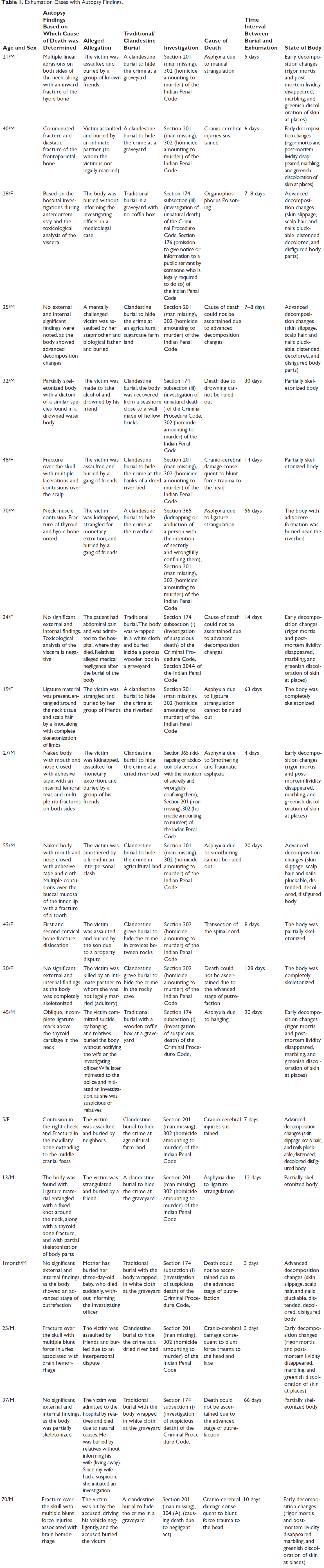
All exhumations were conducted under legal requisition from magistrates, as per Indian law. Fourteen cases involved suspected homicides investigated under Sections 302 and 201 IPC (Indian Penal Code), with burial intended to conceal evidence. Two cases were investigated due to death due to rash and negligent act under Section 304 (A) IPC and Section 176 CrPC (Criminal Procedure Code), and both these cases involved traditional burial practices. Four cases had allegations of suspicious or unnatural death, including poisoning and smothering, leading to investigations under Criminal Procedure Code Sections 176 (Table 1).
Exhumation Cases with Autopsy Findings.
Burial Practices and Locations
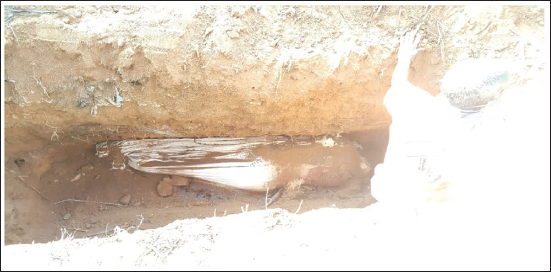
Of the 20 cases, 17 involved clandestine burials to hide crimes, while three cases were traditional burials. Traditional burials used porous wooden coffin box in one case and in other two cases the body was wrapped in ritual white cloth (Figure 1) and buried in their respective graveyards, while clandestine graves were primarily shallow and in isolated locations such as sea shore, riverbanks, dried river beds, isolated farmlands, in between rock crevices, rocky cave, and at places in old abandoned grave yards. None of the bodies was embalmed.
Exhumed Body Covered with White Cloth After Digging the Burial Site.
Time Interval Between Interment and Exhumation
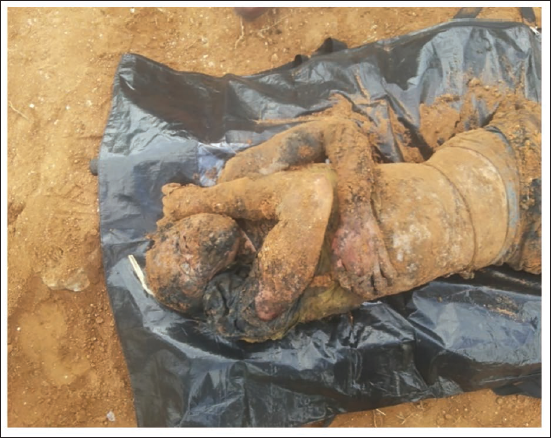
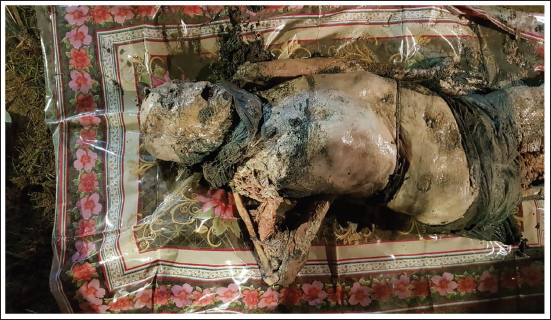
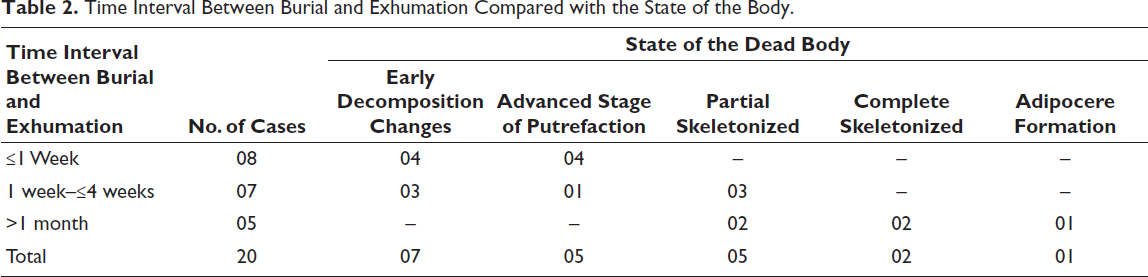
The time interval between interment and exhumation ranged from 3 days to 128 days. Of the 20 cases, eight were exhumed within one week, with 50% (four cases) displaying early decomposition changes and the other 50% showing advanced putrefaction (Figure 2). For exhumations conducted between one week and four weeks post-burial (seven cases), early decomposition was observed in 42.9% (3 cases), partial skeletonization in 42.9% (three cases) (Figure 3), and advanced putrefaction in 14.3% (one case). When exhumation occurred after one month (five cases), the majority exhibited partial skeletonization (two cases), complete skeletonization (two cases), and adipocere formation (one case) (Table 2).
Exhumed Body in the Advanced Stage of Putrefaction.
Exhumed Body in the Stage of Partial Skeletonization.
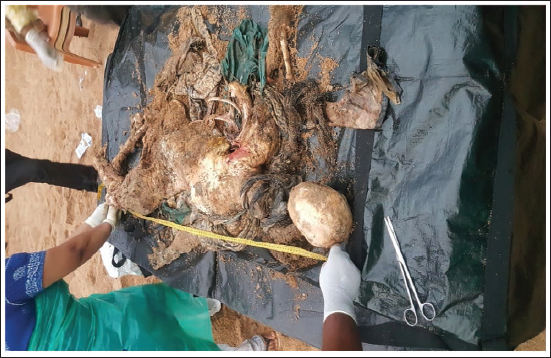
Exhumed Body Showing Ligature Material Around the Neck.
Time Interval Between Burial and Exhumation Compared with the State of the Body.
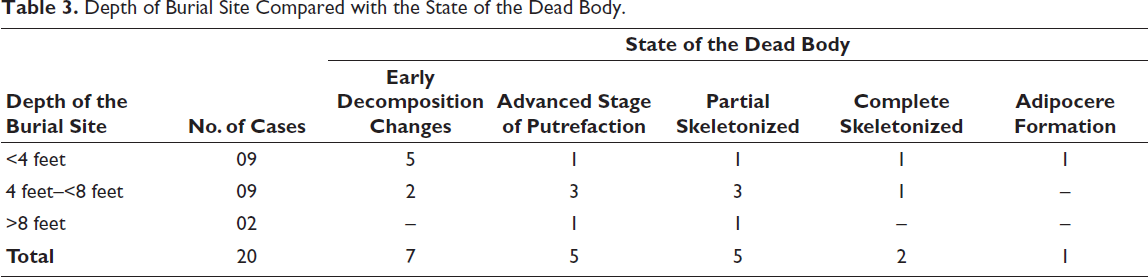
Depth of Burial Site and the State of the Body
Table 3 shows the relationship between the depth of burial and the state of decomposition. Of the nine bodies buried at depths less than four feet, five cases showed early decomposition changes, while the remaining cases exhibited advanced putrefaction (one case), partial skeletonization (11.1%), complete skeletonization (11.1%), and adipocere formation (11.1%). In burials between four and eight feet (nine cases), only 22.2% showed early decomposition changes, while advanced putrefaction and partial skeletonization each accounted for 33.3% of the cases. Additionally, complete skeletonization was observed in 11.1% of cases, with one case (11.1%) showing adipocere formation. For the two cases buried deeper than eight feet, one exhibited advanced putrefaction, and the other was partially skeletonized.
Depth of Burial Site Compared with the State of the Dead Body.
State of the Dead Body and Cause of Death Determination
Out of the 20 exhumed cases, the cause of death was determined in 14 cases (70%). Among the seven cases in the early decomposition category, six (85.7%) had a clear cause of death. These included cranial and cerebral injuries (three cases), thoracic injuries (one case), manual strangulation (one case), and smothering combined with traumatic asphyxia (one case). One case in this category remained inconclusive. In the advanced putrefaction category (five cases), the cause of death was established in three cases. These included poisoning (one case), cranial and cerebral injuries (one case), and smothering (one case), while two cases could not be determined due to the extent of decomposition. For cases with partial skeletonization (five cases), three had a clear cause of death: cranial injuries due to blunt trauma (one case), spinal cord transection (one case), and ligature strangulation (one case). The remaining two cases were inconclusive. In the complete skeletonization category (two cases), the cause of death was determined in one case as ligature strangulation (Figure 4), while the other case remained undetermined. The single case of adipocere formation was attributed to ligature strangulation due to the preserved condition of the body in a water-saturated burial environment.
Discussion
Exhumation cases are relatively uncommon in the literature but are critical in cases involving unnatural death, including homicides, suspicious deaths, poisoning, and criminal abortions.7, 8 The forensic examination following exhumation serves as the final resort for diagnosing deaths that have not been adequately investigated or examined. 9 The success of any exhumation depends on the technical equipment available for the task, as well as the preservation conditions of the body (including the duration of burial, the condition of the corpse at the time of burial, and other environmental factors). 7
Socio-demographic Profile of the Victims
The socio-demographic profile of the victims of this study is similar to that of the other studies conducted on exhumed bodies,8–11 whereas older victims of the age group of 41–55 years were predominant in the study conducted by Ingale et al. 12 Regarding religion, there were 17 Hindus, one was Muslim, and two were not determined in our study. This is consistent with the findings of Gitanjali 8 (14 cases of Hindu, 73.68%) and Ingale et al. 12 (16 cases of Hindu, 88.88%).
Reasons for Exhumation
In our study, most of the cases (18 out of 20) were interred for unlawful burial, and two cases were buried before completion of legal formalities. It is similar to the study by Kremer Sauvageau. 11 In 60% of cases, the most common indication for exhumation is primary suspicion of homicide (302 IPC), which is similar to studies conducted in Germany over 155 cases of exhumation in 30 years. 15 The other indications for exhumation in their study were (a) primary suspicion of intoxication, (b) possible medical malpractice, (c) accidents, including traffic accidents, and (d) clarification of cause of death, circumstances, or identity. In another study, the primary reason for exhumation was related to the grading and effects of pneumoconiosis in connection with the cause of death. 16
Time Interval Between Interment and Exhumation
The interval between time of interment and exhumation in our study ranged from 3 days to 4 months, whereas in other studies it ranged from 5 days to 20.5 years.8–15 The data shows a clear relationship between the time elapsed between burial and exhumation and the condition of the body. This trend indicates that as the time since burial increases, the degree of decomposition becomes more pronounced, with bodies transitioning from early decomposition to skeletonization and adipocere formation. These findings were similar to the study conducted by Stachetzki et al. and Karger et al.15, 16
Depth of Burial Site and State of Bodily Remains
The percentage of cases with early decomposition changes reduced from 55.6% in burial sites less than four feet to 22.7% in burial sites with depth between four and eight feet, to zero in cases of burial sites with more than eight feet. The relationship between the depth of burial and the state of decomposition also shows that shallower graves (<4 feet) tended to exhibit more early decomposition, while deeper graves (>4 feet) showed more advanced stages of decomposition, including skeletonization and adipocere formation, though the data set is too small for statistical significance.
Cause of Death and State of the Dead Body at Exhumation
In our study we were able to determine the cause of death 14 cases out of 20 cases (70%) whereas it varied in other studies by Grellner and Glenewinkel (78%), 10 Karger et al. (63%), 15 Gitanjali (42.10%), 8 However, in nearly 30% of cases, the exact cause of death remained uncertain, reflecting the inherent difficulties in post-exhumation forensic analysis, especially in environments where forensic infrastructure may be limited.
Determination of Cause of Death
The determination of the cause of death relied on detailed autopsy procedures, which included external and internal examinations, as well as supplementary investigative methods.
External Examinations: These focused on identifying visible injuries, such as abrasions, ligature marks, and other signs of trauma. For suspected strangulation, key findings included neck abrasions, fractures of the hyoid bone, and damage to the thyroid cartilage.
Internal Examinations: The internal assessment involved analyzing the cranial, thoracic, and abdominal cavities to identify trauma or hemorrhages indicative of blunt force injuries.
Smothering Cases: In smothering cases, specific autopsy findings, such as tears in the frenulum, contusions on the buccal mucosa, or fractured teeth, were critical. Adhesive tape or cloth found over the mouth or nose provided circumstantial evidence. Toxicological analysis was used to exclude other causes of death, and the absence of systemic findings further supported the diagnosis.
Ancillary Investigations: Histopathological examination of tissues revealed microscopic evidence of trauma or pathological changes. Toxicological analysis of viscera provided key findings in poisoning cases. Diatom analysis was particularly useful in drowning cases, confirming the presence of aquatic organisms consistent with drowning environments.
Integration of Findings: The combined use of autopsy findings, ancillary tests, investigative reports, and circumstantial evidence was vital for establishing the cause of death. This comprehensive approach was particularly crucial in advanced decomposition and skeletonization cases, where traditional autopsy techniques often faced limitations.
The present study determined that mechanical asphyxia (smothering–two cases, ligature strangulation–three cases, manual strangulation–one case) was determined as the cause of death based on the external visible injuries, presence of ligature material around the neck, presence of adhesive tape around the mouth and nostrils, along with internal frenulum tears and rib fractures in these cases. The details of these findings were described against each case in Table 1. Also in the present study, the cause of death was attributed to cranio-cerebral trauma (five cases), thoracic traumatic injuries (one case), and spinal cord transection (one case) based on the external and internal injuries, which were described against respective cases in Table 1. A single case of poisoning was determined based on the hospital investigations during antemortem stay and toxicological analysis of viscera.
Conclusion
This 20-year retrospective study of exhumation cases highlights the critical role exhumations play in forensic investigations, particularly in cases of unnatural deaths such as homicides and suspicious deaths. The findings emphasize the significant impact of environmental factors, burial depth, and the duration of burial on the state of the body, which directly affects the ability to determine the cause of death. Early exhumations often provided more useful forensic evidence, while advanced decomposition and skeletonization presented greater challenges in determining the cause of death. Ultimately, while exhumation presents various difficulties, it continues to offer families closure and provides essential evidence in legal and medicolegal contexts. Future improvements in forensic technology and protocols could enhance the accuracy and success of exhumation-based investigations, especially in cases with prolonged burial intervals.
Footnotes
Authors’ Contribution
All authors contributed equally to the preparation of this article.
Declaration of Conflicting Interests
The authors declared no potential conflicts of interest with respect to the research, authorship, and/or publication of this article.
Ethical Approval
All the data gathered from the exhumation and postmortem documents. Confidentiality of the deceased was maintained throughout this study at various stages. Ethical approval from the Institutional Ethical Committee was obtained.
Funding
The authors received no financial support for the research, authorship, and/or publication of this article.
Informed Consent
As this is a retrospective, record based study, and all the identifiable information have been de-linked from the study data, we requested and obtained a wavier of informed consent for this study.
