




Abstract
The manner of death is traditionally defined in the literature as the way in which an injury or disease occurred and produced a fatal physiological derangement in the body. However, in real-world practice, determining the manner of death is seldom straightforward or algorithmic. Autopsy surgeons often face significant challenges, especially when postmortem findings can simulate multiple possible causes of death, leading to considerable divergence from the theoretical framework. This dilemma becomes even more pronounced in cases where the body has been subjected to fire, further obscuring the interpretative process. We have discussed here the findings of postmortem examination of three cases in which the manner of death was investigated thoroughly by the authors. The manner of death, as determined through a logical and scientific autopsy, was found to be contrary to that considered by the investigating authorities. The significance of crime scene investigation and findings of thorough postmortem examination enabled the autopsy surgeons to comment on the possibility of the manner of death.
Introduction
In a study conducted in central India, out of all medico-legal autopsies, 2.94% homicidal cases were reported. Males outnumbered females with a ratio of almost 4.38:1. All the male victims were taken into consideration in this study. In our study, victims aged 21–30 years were most commonly involved (29 cases; 50.87%), followed by those aged 31–40 years (13 cases; 22.80%). 1 In the present era, the method of concealing crime has evolved. Now the criminals, albeit uneducated, learn various ways through social media or crime shows on TV to ravel the crime so that they can escape from the law and its prescribed rigorous punishments. Notwithstanding, the crime cannot be concealed as science and technology are evolving to contemporary criminal activities. The more common method of concealing crime is to vanish the identity of a person, which could be achieved by the destruction of facial features at a gross level and disintegration of the bones, that is, DNA at the micro level, and interestingly, both could easily be done by setting the dead body on fire. And the findings of postmortem burns and charring without a corresponding history increase the possibility of homicide. The authors of this case embarked to present a series of three different cases with the same mode, manner, and cause of death, having the same mindset of different assailants. The objectives of an autopsy must be fulfilled after the conduction of a postmortem examination, which includes determining the manner of death. In the literature, the manner of death is the mechanism by which an injury or disease is inflicted on the body, leading to permanent physiological derangement. 2
Case 1
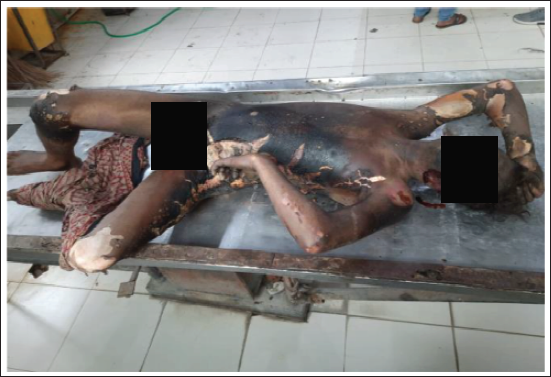
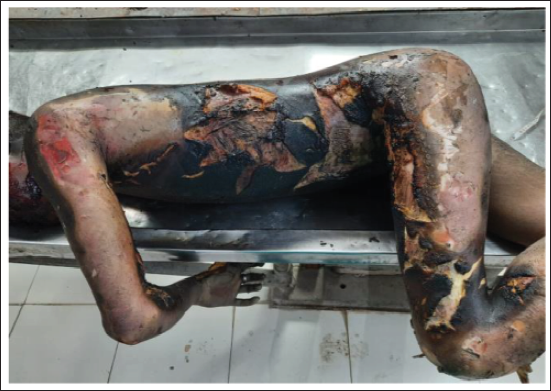
This case was brought by the police to the mortuary of the Department of Forensic Medicine, PGIMS, Rohtak, on a referral note of doctors from Civil Hospital, Bhiwani, with the comments: “As the case is of burns and the dead body has been found in a field, therefore referred for forensic experts’ examination for the sake of justice.” The apparent cause of death, as per police inquest papers, was mentioned as “due to burn injury,” that is, due to burns. The dead body was of an unknown and unclaimed male individual, allegedly a young adult aged approximately 30 years. This case was registered with the Daily Diary (DD) number in Section 174 of the CrPC, and the police had not suspected any foul play with respect to the cause and manner of death. On external examination, the whole body was naked except for a piece of cloth wrapped around the left leg of the deceased, which appeared to be part of a bedsheet. The whole body was charred at places, along with singeing of scalp and other body hair. Reddish fluid was seen coming out of the nostrils, as seen in Figure 1. Interestingly, there was no evidence of any red line of demarcation between burnt and unburnt regions, that is, the absence of any inflammation or vital reaction as depicted in Figure 2. Prima facie, the case appeared to be one of postmortem burns. However, the alleged history aroused suspicion of foul play, as the burnt body was recovered from a barren field with no apparent source of inflammable material or fire in the vicinity, making the possibility of accidental or suicidal burns unlikely.
Showing Charred and Burnt Remains of a Dead Body.
No Vital Reaction or Red Line of Demarcation in and Around the Burnt Region.
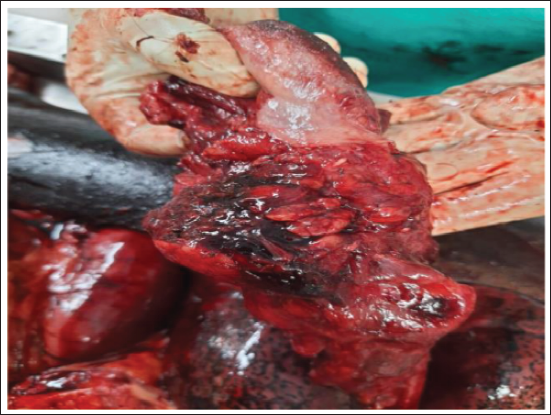
On external examination, no evidence of any physical trauma due to sharp or blunt force impact or any other sign related to the cause of death was found, except for apparent postmortem burns. On dissection of cranial, thoracic, and abdominal cavities, solid viscera were found deeply congested along with the brain. Layered dissection of the neck revealed extravasations of blood in the muscles in the vicinity of the hyoid and thyroid cartilage, as shown in Figure 3.
Extravasations of Blood in the Muscles of Neck.
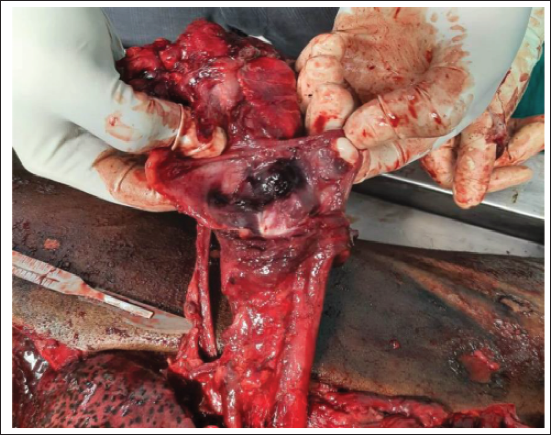
On further deep dissection, extravasation of blood was found into the lamina of thyroid cartilage and the surrounding musculature, as shown in Figure 4. Furthermore, no traces of carbonaceous soot particles were found within the tracheal lumen, which further confirmed the postmortem nature of burns. However, blood was preserved for the detection of carboxyhemoglobin (CO in blood), which was later found to be negative on chemical analysis. The cause of death had been opined as: “The cause of death in this case is asphyxia and its complications consequent to constriction of neck as a result of manual strangulation. However, the burns as described are postmortem in nature.”
Lamina of Thyroid and Surrounding Structures Showing a Bruised Area.
Case 2
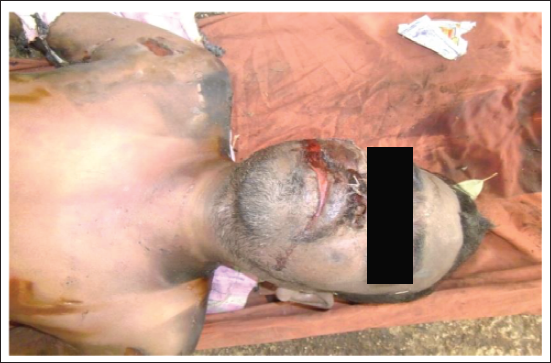
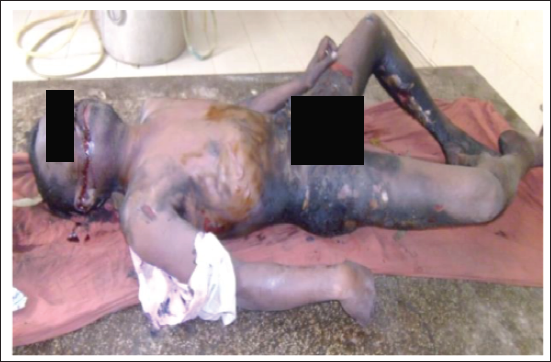
In this case, the body of an adult male was brought to PGIMS on the referral note of doctors from Panipat due to the lack of forensic experts at the Civil Hospital, Panipat. On external examination, the whole body was burnt and charred. Moreover, the lower abdominal and pelvic regions showed completely burnt off external genitalia, leaving behind a charred blackish stump of the penis. Again, there was no sign of vital reaction or red line of demarcation, as shown in Figures 5 and 6.
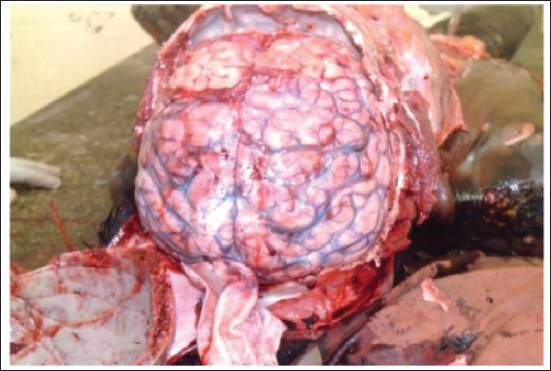
On dissection and internal examination, all the solid viscera, along with the brain, were found to be markedly congested, as depicted in Figure 7.
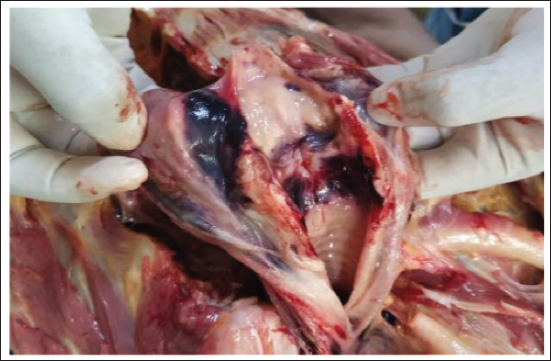
On layered dissection of the neck, diffused extravasations were appreciable in the muscles overlying the thyrohyoid region. Marked extravasations were also evident in the facets, superior horns, glottis, sub-glottis, adjoining laryngeal wall, and inner lamina of thyroid cartilage, as depicted in Figure 8.
After a thorough external and internal examination, the cause of death was concluded as “asphyxia and its complications consequent to constriction of the neck by means of hand, that is, manual strangulation/throttling, which is homicidal in manner. However, the burns over the deceased are postmortem in nature.”
No Red Line of Demarcation Between Burnt and Unburnt Area.
No Vital Reaction or Any Reddish Discoloration is Evident.
The Brain is Deeply Congested Due to Asphyxia and Venous Congestion.
Evidence of Throttling on the Inner Aspect.
Case 3
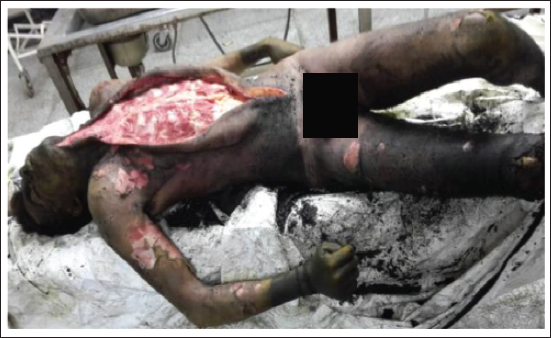
In the third case, the body of a young adult male was received, with charring and black discoloration, with no red line of demarcation, inflammation, or vital reaction between the burnt and non-burnt areas. Even the denuded or raw areas showed no reddish discoloration. There was no trace of any clothes except a black sacred thread around the right wrist (Figure 9). No injuries other than burns were present over the body; these burns were apparently postmortem in origin.
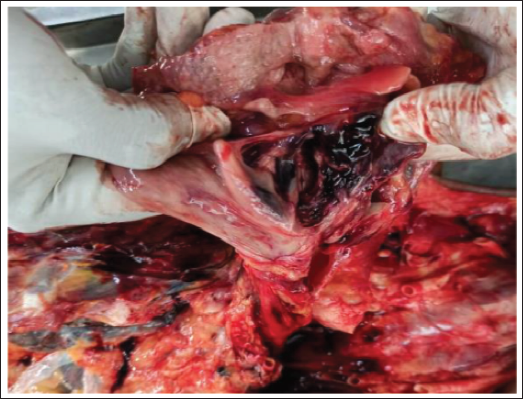
On internal examination, the general features of asphyxia, that is, marked congestion of solid viscera, were present. On local examination of the neck, prominent extravasations were evident in the upper part of the larynx, as shown in Figure 10.
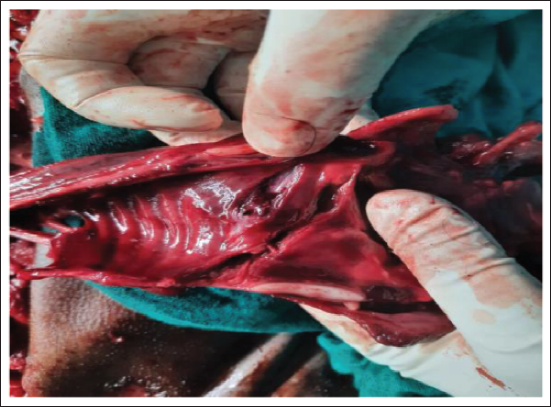
On further exploration, a through-and-through linear oblique fracture was found over the anterior wall of the larynx, which extended downwards over the adjoining upper part of the anterior wall of the trachea, as depicted in Figure 11. Infiltration of blood was present within the trabeculae of the fractured ends, suggestive of antemortem injury. Soot particles were absent from the tracheal lumen. Further blood analysis for CO or carboxyhemoglobin was found to be negative, which confirmed the postmortem nature of burns. The cause of death was concluded to be the same as above, that is, asphyxia. Its complications were consequent to constriction of the neck as a result of homicidal manual strangulation. However, the burns were inflicted on the victim after death and were postmortem in nature.
The Charred and Blackened Dead Body of a Male Individual.
Gross Extravasations in and Around the Upper Part of the Laryngeal Structures.
Showing Fracture of the Anterior Wall of the Larynx and the Adjoining Upper Part of the Trachea.
Discussion
In all three cases discussed above, a common finding was constriction of the neck by means of hands, followed by a method of disposal of the dead bodies, that is, postmortem burning to conceal the crime. This suggests that the assailants may have lacked any prior preparedness, as they used their hands to cause the death. Nevertheless, this does not mitigate the gravity of the killings of human beings; rather, the concealment of the crime through the destruction of the victims’ identities renders the perpetrators more culpable.
Similarly, case series reported in the literature, as well as institutional data, indicate that the predominant pattern of body disposal involves a combination of multiple methods of concealment. In published reports, burning and dismemberment have predominated.4–6 The latter often involves additional actions, such as burning or abandoning the body. 7 This pattern was also observed in 43 out of 55 cases in a recent retrospective study. 8 Nowadays, it has become a comparatively preferable method of homicide by constricting the neck either by hands or by ligature, followed by postmortem burning of the dead to destroy any evidence related to the identity of the body and the cause of death. A review of the literature across various databases indicates that most studies have focused on the simulation of injuries, while a very few have addressed the concealment of crime.
Conclusion
The present case series demonstrates that extensive postmortem burning is a common and effective concealment method in cases of homicidal strangulation; however, it cannot obscure the underlying cause and manner of death when crime scene findings are systematically integrated with meticulous autopsy examination. In all three cases, the absence of vital reactions in burnt areas, lack of soot in the airways, and negative carboxyhemoglobin levels, together with classic internal signs of asphyxia and neck trauma, clearly established homicidal manual strangulation with burns inflicted only after death. These observations reinforce that reliance on the external appearance of burns alone is misleading and may result in erroneous attribution of the manner of death as accidental or suicidal in charred bodies. This case series underlines the pivotal role of careful neck dissection, focused search for subtle laryngo‑hyoid injuries, and close correlation with scene circumstances in resolving apparently ambiguous fire-related deaths and in ensuring that concealed homicides are accurately detected and appropriately prosecuted.
Footnotes
Declaration of Conflicting Interests
The authors declared no potential conflicts of interest with respect to the research, authorship, and/or publication of this article.
Ethical Approval and Informed Consent
In this the authors have discussed cases which were brought by the investigating authority for medicolegal autopsy. In India, consent of relatives is not necessary for conducting autopsy in medicolegal cases. The particulars of deceased are not revealed in this case series and kept confidential with the authors. So ethical clearance is not necessary for this case series.
Funding
The authors received no financial support for the research, authorship, and/or publication of this article.