




Abstract
Exhumation plays a crucial role in forensic investigations, particularly in cases where the cause of death remains uncertain or suspicious. This study examines the medico–legal significance of exhumation in uncovering concealed homicides, with a focus on a rare case of fatal head injury identified post-exhumation. Exhumation, derived from the Latin term meaning “from the ground,” is a legally regulated process requiring judicial authorization under Bhartiya Nagarik Suraksha Sanhita (BNSS), previously governed by Section 176 of the Criminal Procedure Code (CrPC).
A unique case is discussed where a 30-year-old woman was secretly buried during the coronavirus disease 2019 (COVID-19) pandemic without a post-mortem examination. Upon exhumation two months later, autopsy revealed an extradural hematoma despite significant decomposition and an absence of cranial fractures. This highlights the importance of meticulous autopsy examination, even in cases of advanced decomposition. Comparative data from studies on exhumation cases indicate that determining the cause of death becomes increasingly challenging as the post-burial interval extends.
This case underscores the necessity of strict regulations regarding death certification, particularly during public health crises, and the role of forensic medicine in ensuring justice. It reinforces the need for exhumation in unresolved or suspicious deaths, demonstrating its potential in revealing hidden forensic evidence and aiding legal proceedings.
Introduction
The term Exhumation is derived from the Latin words ex (out of) and humus (ground), meaning “to bring to light,” especially after a period of obscurity or burial. 1 Exhumation is a Latin word, which means “from the ground.” Exhumation, which means “from the ground,” requires authorization from a judicial magistrate or an appropriate authority. 2
Exhumation is carried out for various religious, cultural, and social reasons in different parts of the world. 3 It is a complex, costly, and time-consuming process, requiring official permission from legal authorities. As such, it is performed only when a specific need arises. The process is strictly regulated and follows vigilant procedures. First, legal authorization must be obtained from the District and Sessions Judge, Additional District and Sessions Judge, or Judicial Magistrate under Section 196 of Bhartiya Nagarik Suraksha Sanhita (BNSS) previously it was done under Section 176 of the Criminal Procedure Code (CrPC).
The process of exhumation is not only significant from a legal perspective but also plays a key role in forensic investigations. It often serves as a vital tool for uncovering the truth in cases where the cause of death remains unclear or suspicious. Forensic experts utilize exhumation to collect crucial evidence that may be pivotal for solving a case, such as identifying poison or toxins in the body or examining trauma that was not immediately apparent at the time of death. In certain instances, advanced techniques like DNA analysis, toxicology reports, and histopathology can only be performed on remains exhumed after a long period of burial, making this process crucial for obtaining a comprehensive understanding of the deceased’s condition at the time of death.
This case report is unique because findings related to exhumation and decomposition are rarely observed. In our case, even after two months of exhumation, evidence of intracranial hemorrhage was found despite the absence of any bony fractures. Such cases are extremely rare and have been reported in only a few instances worldwide.
Case History
In April 2020, at the peak of the coronavirus disease 2019 (COVID-19) pandemic, a 30-year-old woman died under mysterious circumstances, reportedly following a fall in her home. Her husband took her to a private practitioner, where she was declared dead, and the cause of death was deemed natural, leading to the decision not to conduct a post-mortem examination. That night, he buried her in a cemetery without informing the police or involving any of her close relatives.
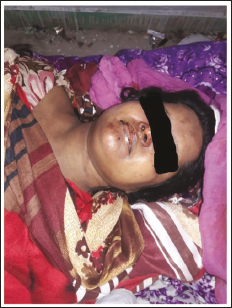
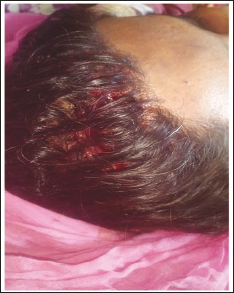
Two months later, as the lockdown restrictions began to ease, the woman’s brother, who lived in Uttar Pradesh, visited her husband to offer condolences. While speaking with neighbors and relatives, he learned that they had photographs of her head showing visible injuries at the time of her death (Figures 1 and 2). Suspicious after seeing the images, he immediately filed a complaint at the local police station, leading to the registration of an ADR (Accidental Death Report).
Following this, the Sub-Divisional Magistrate issued an exhumation order. The body was subsequently exhumed in the presence of the Sub-Divisional Magistrate, doctors, and police officers. It was then transported to the mortuary, where a post-mortem examination was conducted.
Head Showing Signs of Injury.
A Closer Look from Different Angle Showing Blood in Hair.
Post-mortem Findings
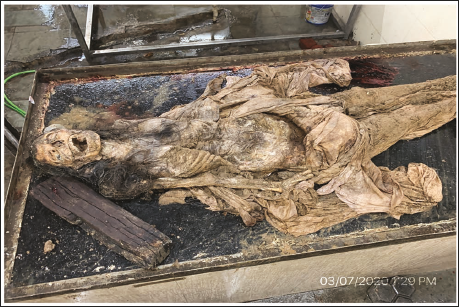
The body was recovered in an advanced state of decomposition, enshrouded in a dirt-laden, tattered white cloth heavily contaminated with mud and organic debris. The remains exhibited extensive post-mortem changes, with near-complete soft tissue loss over the craniofacial region, leading to exposure of the underlying skeletal structures, including the ribs, chest, and facial bones. The presence of long, black, curly hair, still adherent to the partially decomposed scalp, suggested female sex. Marked skeletonization was observed, particularly in the head and thoracic regions, with remnants of desiccated soft tissue clinging to the bones. The scalp hair exhibited easy pluckability, and a strong putrefactive odor was emanating from the remains, indicative of advanced decomposition (Figure 3).
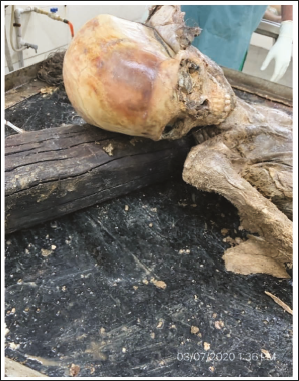
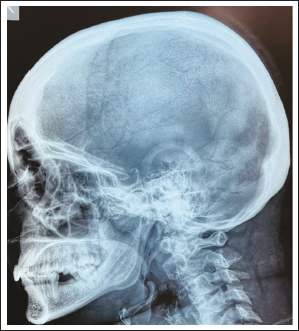
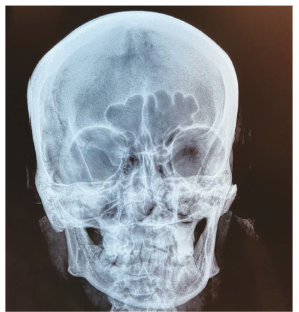
Upon cleansing and removal of extraneous debris, external examination confirmed extensive decomposition with partial preservation of soft tissue in select regions. The skull demonstrated brownish–black discoloration over the frontal bone (Figure 4). Internally, the visceral organs had undergone complete autolysis, appearing as an amorphous, black decomposed mass with no discernible anatomical features. Post-exhumation radiographic imaging did not reveal any skeletal fractures (Figures 5 and 6).
Exhumed Body Showing Signs of Decomposition and Skeletonization.
Brownish Black Discoloration Over Frontal Region of Skull.
Lateral View of X-ray Skull.
Anteroposterior View of X-ray Skull.
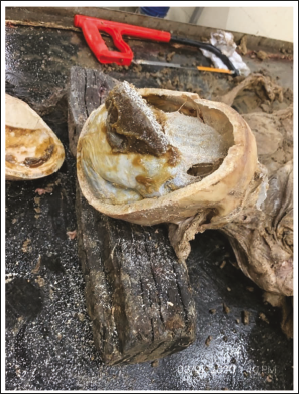
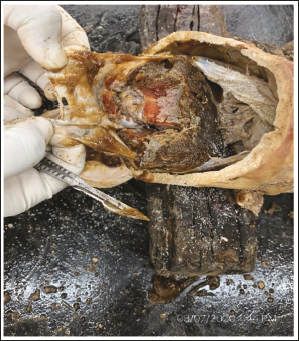
However, upon opening the cranial cavity, the dura mater was found to be intact, underlying which a well-demarcated, brownish-black semisolid mass measuring approximately 7 cm × 4 cm and weighing 110 grams was firmly adherent, consistent with an extradural hematoma (Figure 7). Further dissection of the dura mater revealed semisolid cerebral matter with diffuse brownish-black infiltration within the brain parenchyma, suggestive of significant post-mortem decomposition changes (Figure 8). Based on the collective findings, the cause of death was opined to be a fatal head injury.
Brownish Black-colored Semisolid Mass Firmly Adherent to Dura Mater.
Brownish-black Infiltration of Brain Parenchyma.
Discussion
The exhumation of human remains plays a critical role in forensic investigations, particularly in cases where the cause and manner of death remain uncertain. In the present case, the exhumation of a 30-year-old female who was clandestinely buried during the COVID-19 pandemic revealed crucial forensic evidence that contradicted the officially recorded cause of death. This underscores the importance of forensic re-examination in instances of suspicious deaths, particularly those occurring under exceptional circumstances such as a pandemic-induced lockdown.
In a retrospective study conducted by Rajesh Bardale et al., total 24 cases of exhumation were analyzed over a period of 10 years, out of which in 16 cases (66.6%) the cause of death was clearly determined at exhumation. Out of these 24 cases, in 5 cases the first autopsy was not conducted and the bodies were buried by criminals after killing the individuals. 4
One of the primary challenges in exhumation cases is the degree of decomposition, which can obscure or destroy important forensic evidence. In this case, despite the significant decomposition observed after two months of burial, key findings such as an extradural hematoma remained identifiable. The presence of such findings in the absence of any cranial fractures is a rare but documented phenomenon. This highlights the importance of careful examination of soft tissue remnants and skeletal remains, even in advanced decomposition states.
Another critical aspect of this case is the issuance of a false death certificate without a post-mortem examination. The deceased’s husband exploited the pandemic situation to avoid legal scrutiny, emphasizing the need for stricter regulations regarding the issuance of death certificates, particularly during public health crises. This case also illustrates how relatives’ suspicions and circumstantial evidence, such as photographic documentation, can prompt intervention by police and uncover the actual cause of death.
In a study by Shala Imran et al., 95 exhumations were conducted over two years. Among cases exhumed within three months, the cause of death was determined in 18 instances (18.95%) but remained undetermined in 27 cases (28.42%). For exhumations occurring between four and six months, the cause of death was identified in 15 cases (15.79%), while it remained unknown in 16 cases (16.84%). In the 7- to 12-month period, the cause of death was established in three cases (3.16%) and remained undetermined in eight cases (8.42%). When exhumation took place more than 12 months after death, the cause was determined in just one case (1.05%), with seven cases (7.37%) remaining unresolved. Overall, out of 95 cases, the cause of death was identified in 37 cases (38.95%), while it remained undetermined in 58 cases (61.05%). 5
In another report, the body of a 10-year-old girl was exhumed two years after burial. She had been sexually assaulted and strangled before being buried. The remains were recovered from a location identified by the accused, who had confessed to the crime. A detailed examination of the skeletal remains concluded that they belonged to a female aged 10–12 years, with an estimated height of 138–140 cm. DNA profiling confirmed her identity. 6
Similarly, in another case report the cause of death of a 73-year-old woman was initially certified as natural. The exhumation was ordered three weeks after the burial. At autopsy, there were findings suggestive of blunt force impact to occiput, thorax, and upper extremities and compression of neck. The findings at autopsy proved foreign intervention and suggested death due to suffocation. Exhumation and further autopsy contradict natural death established the cause of death beyond further suspicion. An obvious lack of meticulous and thorough post-mortem examination was probably the main reason for the misjudgment in this case. 7
From a medico–legal perspective, the present case reinforces the necessity of exhumation in cases where the cause of death is doubtful. The judicial authorization of exhumation under BNSS, previously under Section 176 of the CrPC, remains a crucial provision for ensuring justice.
The findings also highlight the forensic significance of examining all body cavities, as external examination alone may not always reveal the cause of death, particularly in cases involving closed head injuries. Furthermore, this case contributes to forensic literature by demonstrating that even after prolonged burial, intracranial pathology may persist in identifiable form, aiding in establishing the cause of death.
Conclusion
In conclusion, this exhumation case underscores the indispensable role of forensic medicine in criminal investigations, particularly in detecting concealed homicides. It highlights the medico–legal implications of fraudulent death certifications and the need for vigilance in death investigations, especially during public emergencies. The findings emphasize the necessity of thorough forensic examinations and reinforce the importance of exhumation as a tool for establishing the truth in suspicious deaths.
Footnotes
Declaration of Conflicting Interests
The authors declared no potential conflicts of interest with respect to the research, authorship, and/or publication of this article.
Ethical Approval
The ethical approval is taken from Institutional Ethical Committee of Rajiv Gandhi Medical College, Thane. The identity of the deceased was not revealed in the manuscript.
Funding
The authors received no financial support for the research, authorship, and/or publication of this article.
Informed Consent
The identity of the deceased has been anonymized and no identifiable personal information has been disclosed. Informed consent was not required for this case report as it involves a deceased individual and the information was obtained from medicolegal autopsy records.