




Abstract
Drawing on global production network research and conceptual explanations of the changing spatial divisions of labour, this article investigates the transformative effects of the dynamic interplay between strategic coupling and multiscalar changes across labour regimes in Central and Eastern European post-socialist sectoral trajectories. It interrogates critically whether sectors across peripheral regions have been able to slot themselves into lead firms’ transnational production systems, resulting in processes of value creation, value capture or value destruction. The empirical analysis reveals that the capacity of domestic resources to purposively match and align themselves to global lead firms and their strategic objectives is influenced by local historical legacies, spatiality, elite agency and labour agency, which combined to shape distinct meso-level transformations. The methodology is based on analysing the post-socialist transformation of three sectors in Romania, which have different historical legacies, institutional configurations, and spatial and temporal vectors of development, allowing us to trace interactions between different modes of strategic coupling or decoupling and labour regime reconfiguration. The central thrust of the article highlights how different modes of strategic coupling into global production networks, or decoupling from global production networks, are causally linked to the reconfiguration of labour regimes, leading to long-term regional socio-economic transformations.
Keywords
Introduction
Post-socialist economies in Central and Eastern Europe (CEE) have experienced distinct sectoral transformations in their restructuring, depending on the interplay between domestic resources’ strategic coupling with foreign capital and global production networks (GPNs) (Coe and Yeung, 2015; Yeung, 2015), and multiscalar changes in labour regimes (Campling et al., 2021; Smith et al., 2018). This article analyses the extent to which different sectors have inserted themselves into lead firms’ GPNs and captured value domestically. This has depended on their historical legacies from the socialist regime, their spatiality and the reconfiguration of labour regimes by domestic and international elites, through the workplace, through national legislation, through GPN power relations with lead firms and through pressures from international organisations (Coe and Hess, 2013). This article focuses on the processes that have accompanied the strategic coupling, or decoupling, of domestic resources into foreign-led GPNs to assess local value capture across different sectors.
The central theme of this article reveals the relationship between two forces – the integration of sectoral configurations into GPNs through strategic coupling, combined with shifts in labour regimes at different scales – as drivers of wholesale sectoral transformation. The argument of the article is that these two forces have gone hand-in-hand, and that without the co-option of elites – in domestic state and non-state institutions, international agencies and among company executives – and their purposive remoulding of labour regimes, multinational firms would not have been willing or able to integrate domestic resources into their GPNs.
The article analyses three sectors – coal mining, automotives and business services in Romania – with diverse histories, spatial legacies and institutions in terms of propensity for incorporation into GPNs and susceptibility to labour regime restructuring. We examine the processes of value creation, value capture or value destruction which lie behind the strategic coupling of domestic resources within GPNs. To unearth these processes, the article analyses domestic state initiatives and incentives that have accompanied foreign investment, training and educational initiatives which have underpinned reskilling the labour force, as well as how labour regimes have been restructured at the sectoral-level to entice foreign investment into a business environment that can be moulded to multinational firms’ demands.
Coal mining was in the vanguard of the old elites under socialist planning, having strong labour representation in government and strong unionisation (Cernat, 2006). This propped up high levels of economic inefficiency across the sector. A series of labour disputes in the early transition period resisting labour regime restructuring resulted in the demise of those labour leaders from a position of power, leading to the regional isolation of the industry and its exclusion from supply chains, with significant negative regional impacts. In the automotive sector, by contrast, there were pre-existing regional dynamics of GPN integration dating from the socialist period (Guga, 2017; Pavlínek, 2002). During transition, automotives experienced incremental upgrading and tighter coupling – in the form of structural and functional strategic coupling – which was facilitated by state policies and educational and training initiatives, concurrently bearing down on labour regimes’ restructuring despite considerable labour resistance. Firms within automotives – Renault and Ford – acted differently vis-à-vis their subsidiaries, affecting the form of strategic coupling into their GPNs, itself linked to the form of labour regime reconfiguration adopted by the firm. We compare these historical sectors with a much newer sector – business services – that from the outset was dependent on foreign capital (Capik and Drahokoupil, 2011; Gál, 2014). Upgrading of strategic coupling in business services has been achieved through increasing linkages between multinational firms and domestic state initiatives in industrial policy, education and training, mediated by a domestic industry association, the Association of Business Service Leaders (ABSL) Romania (Jipa-Muşat et al., in press; Kleibert and Mann, 2020). In this nascent sector, strategic functional coupling has been achieved by maintaining labour regimes that are weak on the collective and unionisation side, bolstered by strict labour legislation and labour codes (Ban, 2013). In all three cases, the structural transition of these Romanian sectors into or out of GPNs, which created or destroyed opportunities for value creation and value capture locally, have been accompanied by meso-level and firm-level structural reconfiguration of labour regimes.
The article is organised as follows. First, we start with a conceptual explanation of value capture, strategic coupling and labour regimes. Second, we provide an overview of the research methods. Third, we present the empirical analysis. Fourth, we summarise the main findings and highlight the main contributions in the conclusion.
Conceptual framework: value capture, strategic coupling and labour regime configuration
Countries formerly part of the ‘periphery’ of GPNs have become embedded into GPNs in constantly changing spatial divisions of labour (Kleibert and Mann, 2020; Pavlínek, 2022; Peck, 2017). The article brings together the reconfiguration of GPNs with the multiscalar shifts in labour regimes to trace distinct pathways of sectoral transformation. We apply this conceptualisation to CEE, using the case of Romania in post-socialist transition.
After the collapse of the Soviet Union, countries across CEE underwent substantial structural politico-economic transformation – downgrading and deskilling of industrial configurations such as extractive sectors in the early transition period, alongside policy frameworks and investment oriented towards services from the early 2000s (Bohle and Greskovits, 2013; Capik and Drahokoupil, 2011). The crises of the 1990s redirected state policy agendas from constructing domestic capitalist systems through privatisation towards reinforcing ‘competition states’ based on foreign direct investment (FDI)-led development models (Drahokoupil, 2009; Myant and Drahokoupil, 2011). This ushered in export-oriented production, controlled by local and regional subsidiaries of multinational firms operating within GPNs (Nölke and Vliegenthart, 2009). Lead firms coordinated GPNs, meaning production was no longer concentrated within the boundaries of a single firm or region. Low- and middle-income countries ceased promoting vertical integration and national champions via protectionist policies which often resulted in failure and industrial decline (Kleibert and Mann, 2020). Studies proposed that state policies should develop specialised niches within GPNs and nurture localised competencies (Yeung, 2015).
The GPN approach advances concepts of value creation, value enhancement and value capture to explain heterogeneous regional development (Coe et al., 2004; Coe and Yeung, 2015; Henderson et al., 2002). Value capture is a fundamental issue for countries because GPNs act as ‘vehicles for transferring the value captured between different places and regions’, meaning that they can equally drive in value or drive out value from different spaces (Yeung, 2015: 2). In general, value creation and enhancement have taken place through exports and employment, whereas value capture encompasses a range of higher-order processes that speak to learning, technology and innovation, and governance mechanisms. The possibilities that exist for value to be captured are defined by issues of government policy (how legal frameworks govern ownership structures and repatriation of profits); firm ownership (the extent to which firms are foreign-owned); corporate governance (the extent to which firms are governed by stakeholder considerations rather than shareholder primacy); the growth of networks among different actors (firms, state agencies, universities, research institutes, technology parks); and the linkages allowing innovation, exchange of knowledge and spillovers (Henderson et al., 2002). Vertical disintegration of production spurred value creation and enhancement in low- and middle-income countries, but questions remain about the ability of these spaces to capture value.
A fundamental aim of GPN research has been to understand how – and with what consequences – GPNs become simultaneously linked to and embedded within particular geographies (Coe et al., 2004). The ability of non-core regions to capture value is determined by the mode of strategic coupling. Strategic coupling as a heuristic is central to understanding regional development as an outcome of the purposive linking – or exclusion – of domestic resources to the demands of foreign investors by local elites. These include national-county-municipal state officials, domestic business leaders, trade union representatives, industry association leaders and heads of educational institutes who shape domestic industrial transformation, where power is unevenly distributed between lead firms and domestic players (Coe and Yeung, 2015; Yeung, 2015). Coe and Yeung (2015) emphasise three modes of strategic coupling with distinct capacities for value capture and configurations of control and dependency negotiated between foreign and domestic actors. Structural coupling refers to multinational firms outsourcing and offshoring low value-added, skill-intensive functions to new locations, driven principally by cost-cutting motivations. In this mode, foreign investment occurs primarily in special economic zones, is export-oriented and exhibits high degrees of ‘enclaving’ (Kleibert, 2015, 2017). This results in high dependency of domestic actors on foreign actors and marginal opportunities for domestic actors to capture value within the GPN. Functional coupling refers to firms establishing linkages – either multinational firms entering domestic markets or domestic firms becoming integrated in GPNs – driven by the cost–capability ratio rather than cost considerations alone (Coe and Yeung, 2015). Domestic actors have the potential for greater value capture, through upgrading opportunities of technology, labour, infrastructure and strategic relations (Yeung, 2021). Indigenous coupling occurs when domestic firms become integrated in the global economy and emerge as lead firms driving global production, offering the greatest opportunity for value capture and upgrading (Coe and Yeung, 2015). Furthermore, it requires long-term targeted state policies and incentive structures to link domestic resources into GPNs. To achieve value capture, low- and middle-income countries need to focus on establishing linkages between domestic and foreign firms, and using state policies and incentive structures to drive higher-order processes domestically. However, this begs the question – what happens to non-core regions which do not strategically couple into GPNs? Scholarship on extractive sectors in CEE shows how these regions are decoupled from GPNs, experiencing wholesale industrial downgrading and deskilling (Cernat, 2006; Zientara, 2009).
Reconfiguring labour regimes in post-socialist CEE political economies
We need to understand the complementarity between strategic coupling – or lack of it – of domestic resources into foreign-led GPNs and the transformation of labour regimes. As defined by Baglioni et al. (2022: 3), ‘labour regimes are seen as historically formed, multi-scalar phenomena resulting from the articulation of struggles over local social relations, and their direct or indirect intersections with the commercial demands of lead firms in global production networks’.
Smith et al. (2018) and Campling et al. (2021) stress three distinct but interacting nested scalar dynamics underpinning the construct of labour regimes and production politics: the workplace, the national and the GPN. The workplace labour regime refers to the labour process and the underlying relations of control, consent and resistance (Thompson and Smith, 2011). The workplace is nested in the national political economy, which comprises the regulatory framework for industrial relations and labour codes promulgated by the state, capital elites and labour representatives. Workplace dynamics have to be integrated in a GPN, whose governance structure dictates the distribution of power and opportunities between the lead firm and suppliers. Labour control and governance by lead firms across inter-firm relations within GPNs have interacted with localised labour systems, reconfiguring labour conditions and tensions (Locke, 2013). In post-socialist CEE countries, we see the nested scalar dynamics underpinning labour regimes and production politics being shaped by the pro-corporate market-conforming influences exerted by GPNs, with path-dependent and locally contingent workplace dynamics (Coe and Hess, 2013), including the effects of the state (Gereffi, 1994). Simultaneously, workplace labour regimes in the region are the outcomes of struggle and contestation over local social relations interacting with local and regional subsidiaries within GPNs at the workplace scale (Campling et al., 2021; Smith et al., 2018).
Wickramasingha and Coe (2022: 73) built on this understanding of the complex ‘intersection of labour governance and labour agency embedded in global production dynamics and territorially specific characteristics’. Global production dynamics comprise contract manufacturing relations, global governance mechanisms and transnational solidarity networks, while territorially specific characteristics include the national institutional structure, domestic capital, national trade unions and local labour markets. Their framework zooms in on the agency of labour, whereas previous research on labour regimes has focused more on labour governance. Their work treats labour governance and labour agency as part of the same analytical domain and argues for the agency of labour in driving change, capturing uneven labour outcomes within GPNs (Baglioni et al., 2022). Variation across labour regimes exists not only at the national scale, but also at the subnational (regional, local, workplace) and supranational scales, even within the same GPN.
Governments across the CEE region introduced radical processes of deregulation to collective bargaining agreements (CBAs) and trade union law (Birch and Mykhnenko, 2009; Myant and Drahokoupil, 2011). Several CEE countries abolished national-level collective bargaining and made it more difficult for unions to bargain at sectoral level while also implementing weaker forms of associational institutions to replace the traditional trade union model (Ban, 2013). Employment relations in the region are increasingly based on more flexible, irregular and individualised work contracts, with these new configurations contrasting with the more protectionist, coordinated employment relations associated with the industrial conglomerations of the socialist regime (Funk and Lesch, 2004).
We argue that strategic coupling would not have been possible without the alliance between international elites (of the World Bank, International Monetary Fund (IMF) and European Union (EU)) and local elites (of state agencies, foreign investors, industry associations and educational institutes) driving the restructuring and transformation of labour regimes at different scales. Domestic firms and sectors were made ready for integration and subordination to lead firm contracting practices in GPNs. Conversely, regions bypassed by multinational firms and their GPNs experienced labour unrest as labour tried to block the wholesale transformation of labour regimes (Selwyn, 2012). Therefore, the tension between responses in labour regimes to inclusion or exclusion from GPNs in restructuring transitioning economies needs further exploring.
Methods
Our article draws on primary data, collected through face-to-face interviews and archival research by the lead author, on the post-socialist transformation of three sectors in Romania. The sectors were selected to capture the distinct institutional configurations’ historical and spatial legacies. The analysis draws on findings from longitudinal, multi-sited and comparative research on coal mining, automotives and business services. Overall, 39 individual semi-structured interviews were conducted in 2017 and 2018 with participants, including 18 business services executives, 11 automotive executives, 3 state officials with responsibilities for industrial development, investment or labour, 3 strategic leaders in (public) higher education, 2 chambers of commerce representatives, 1 economic historian, and 1 private consultant in industrial relations. Interviews were carried out in Bucharest, Timişoara, Piteşti and Craiova (for more detailed interview information, see Appendix Table 1). All interviews were recorded, transcribed in full, back-translated and analysed using thematic coding, utilising the NVivo software package. When conducting our fieldwork for the automotive sector, we were given accompanied half-day company tours at Renault and Ford. Similarly, for the business services sector, we were given tours at Nokia, Wipro and Ipsos. Extensive archival research was utilised as a complementary research method, particularly for analysing dynamics across coal mining and automotives. The principal archives that we visited were the Romanian National Archives in Bucharest, which contain the richest collection of historical documents on the socialist regime and Romania’s trajectory of socio-economic development. This allowed us insights into industrial policies, government structures, negotiations between key executives, and highlighted distinctions between ‘old’ sectors representative of the socialist past and newer post-socialist sectors. Triangulation across executives, labour representatives, sectoral specialists and state officials was achieved by cross-checking emergent interview themes with archival themes and analysis of business press, technical reports and national official data.
Trajectories of value capture, strategic coupling and labour regime reconfiguration in Romanian coal mining, automotives and business services
Coal mining’s decoupling from GPNs
Coal mining had a long-established tradition in Romania pre-dating central planning of the state socialist period. Heavy manual labour and poor mechanisation was the rule before the socialist regime in 1948 (Velica and Shreter, 1993). In the context of socialist production, mechanisation of labour processes was pursued. The Jiu Valley was developed into a concentrated mono-industrial production base, standing at the core of the Romanian socialist industrial complex (Crowther, 1988).
Initially, the socialist state constructed an industrial policy framework based on external dependency on technological imports and foreign collaboration. Industrial upgrading was dependent on imports, negotiated by the Central Committee and foreign firms. From the mid-1970s, the central planning apparatus dismantled external dependency and replaced it with import substitution industrialisation. This policy framework prioritised reducing technological imports and intensifying domestic production via backward vertical integration. However, it did not allow sufficient time for indigenous production capacities to develop, and the abrupt elimination of imports resulted in the unavailability of high-quality components, process innovations, servicing contracts and training schemes (state official, Ministry of Machinery Construction, 4 May 2018, Bucharest). The sector had to rely on sub-standard components and poor quality, costly equipment.
While commercialisation and privatisation swept through most Romanian sectors after the Revolution in 1989, coal found itself subjected to the government’s protectionist tendencies and its strategic decision to retain control over its assets. Romanian coal mining was plagued by an acute financial crisis during the 1990s. The sector suffered from inherited structural problems, including obsolete technology, shortages of components, low levels of productivity, inefficient investments, poor management, excessive labour and extreme levels of accounts payable. Yet, it was still in favour with the government, receiving 56 per cent of the total national state subsidies awarded in 1997 (Larionescu et al., 1999). Rather than using these subsidies for modernisation, the Romanian government increased salaries and benefits to the coal labouring class and its leaders. Such levels of subsidisation were unsustainable in the face of the other demands on shrinking national budgets (Cernat, 2006). The early 1990s saw a series of miners’ protests – the ‘Mineriadas’ – as manifestations of labour elites’ power in the coal sector, which were crushed from the late 1990s onwards through processes of deindustrialisation and restructuring (Haney and Shkaratan, 2003).
In the late 1990s, the Romanian government and international organisations – initially, the World Bank and IMF and subsequently, the EU – targeted the Jiu Valley for extensive economic restructuring. The World Bank’s and IMF’s ‘Mine Closure, Environment and Social Mitigation Project’ and the EU’s ‘Strategy for the Mining Sector’ and ‘Transition Support Plan for the Communities and Regions Dependent on Coal Production’ sought to terminate the sector due to its concentrated, geographically remote, highly centralised, heavily subsidised state-based institutional configuration and its high levels of inefficiency and environmental damage. This triggered devastating effects on the coal mining labouring class and the mining region. The process demoted the coal mining unions and their labour elites’ position of power in making industrial policy. The restructuring was endorsed by Romanian state leaders: during the Mineriadas, President Constantinescu declared a national state of emergency, with tanks standing by in case the miners were to reach Bucharest. After the restructuring began, Prime Minister Radu Vasile was dismissive of his consultations with Jiu Valley trade union leaders, backtracking on promises not to close down the Dâlja and Bărbăteni mines and not to prosecute trade union leaders. International organisations and domestic state leaders saw the structural vulnerabilities of the region, which was not embedded in global-regional production networks, and decided that there was little advantage in giving domestic labour leaders room to shape industrial transformation across the sector.
Under the direction of the World Bank and IMF, the government provided loans to close down underperforming mines and facilitated alternative forms of regional development (Haney and Shkaratan, 2003). In addition, the government and the European Commission mapped out the ‘Strategy for the Mining Sector’ – an industrial programme to shut down mines, penalise inefficient sites and reduce jobs across sector. After EU accession in January 2007, the process of phasing out coal production intensified, in line with the EU’s energy and climate policy agenda. The Commission restricted the Ministry of Economy from awarding state subsidies to coal, unless they were utilised to restructure and terminate production activities. In 2012, under the direction of the European Commission, the Romanian government delivered the coup de grâce by driving the closure of over 90 per cent of mines and consolidating the remaining financially viable mines into two energy complexes (Visegrad Plus, 2015). In 2021, around 4000 coal miners remained, with the government intending to terminate all coal production by 2032 (Europa Liberă România, 2021).
The story of Romanian coal mining tells us what happens to peripheral regions that are bypassed by GPNs – and consequently, not allowed to strategically couple – resulting in isolated, excluded spaces (Werner and Bair, 2019). In this case, the concept of strategic coupling highlights the sensitive interplay between strategic objectives of lead firms’ GPNs and domestic resources, underscoring the fact that while having natural resources, physical infrastructure and skilled labour is a necessary condition for regional development, they are not in themselves sufficient (Coe et al., 2004). It also highlights what happens to sectors with labour elites that are perceived to be overly powerful and that encourage protest and resist structural change. Specifically, it shows how the crushing of the labour regime in the coal sector through an alliance of international and state leaders presaged further labour regime reconfigurations in other sectors (Guga, 2017). It encouraged foreign investors in other sectors, who witnessed the determination to topple the labour elites and reconfigure the labour regime in this vanguard industry, to take advantage of this greater labour flexibility based on liberal labour legislation to move their operations to Romania (Pavlínek, 2002).
Labour regime reconfiguration in coal mining
Romanian coal miners distinguish themselves as a unique sub-category of Romanian workers as in other countries (Larionescu et al., 1999). The mystique and conditions surrounding coal mining, which is geographically remote, defined by dark and narrow spaces underground, plagued by danger and expectations of sudden death, create conditions for community solidarity and highly localised power (Mitchell, 2013). Miner identity in Romania was shaped by its emblematic trade union – the Jiu Valley League of Miners’ Unions or the ‘Liga’ – and its charismatic leadership. During the early 1990s, coal miners saw their power and position in the state raised by President Iliescu, who, to ensure continuity of the old socialist guard into the newly formed capitalist regime, used the sector’s high levels of unionisation and collective bargaining to suppress political opposition. The alliance between political elites and coal miners allowed ‘old’ elites to hold onto power, restricting other competing political groups, thus guaranteeing the state’s continuous financial support towards the sector (historian, West University, 23 April 2017, Timişoara).
The reconfiguration came in the mid-1990s. Influenced by a European-level agenda to reduce pollution and the perceived inefficiency of coal and to enable transition towards a greener economy, the government’s relationship with the sector changed dramatically in the second half of the 1990s. The coal mining labour regimes lost the powers and protection conferred on them while under the stewardship of the Roman and Văcăroiu governments (1990–1996) in the early transition period. This weakening of labour power was propelled by the World Bank and IMF (1997–2003) and then by the EU (2004–onwards). The sector was bypassed by multinational firms and their GPNs due to its pro-labour configuration. The mass deindustrialisation and economic downgrading of coal mining was facilitated by the government through a legislative labour framework enabling voluntary dismissal of those employed in mining (Larionescu et al., 1999). In December 1997, the Romanian government propelled by the World Bank and IMF introduced a programme of labour contract buyouts. Enticed with generous compensation packages and regular unemployment benefits, many coal miners opted for voluntary termination of employment contracts, leading to an unexpected mass exodus of the workforce. By January 1998, 4 months after the legislation was implemented, the labour force had decreased by 36 per cent from 173,000 to 110,000 coal miners (Larionescu et al., 1999).
Consecutive governments orchestrated the downgrading and delegitimation of labour and its representatives, eroding coal miners’ privileged status within the overall labour class structure. Miners’ ability to engage in strike action was limited, as new legislation was passed to set out rules for strikes and introduce alternative mechanisms for mediating labour disagreements (Kideckel, 2001). Trade union membership collapsed, driven in large part by the programme of voluntary dismissal. The leadership of trade unions was gradually ousted or compromised, while simultaneously the ‘Liga’ became an instrument of leadership rather than representing the coal mining labouring class. The last straw came in January 1999, when while marching towards Bucharest against the announced plans to restructure the sector, miners were gassed, beaten and arrested (Cernat, 2006). The Liga’s uncooperative stance and trade union leaders’ antagonistic style paved the way for a wholesale restructuring programme – unlike the situation in Poland where restructuring was a highly cooperative process (Zientara, 2009). What we see is the transformation of labour’s power – from coal mining trade union leaders being elevated and working alongside national-level state agencies in driving industrial policy and controlling other political groups, to being ousted from the dominant coalition and having all their powers removed. This highlights how regions where labour tries to block the reconfiguration of labour regimes experience processes of decoupling and subsequent negative economic development outcomes. The converse is also true: that positive regional economic development requires lead firms and states to value the domestic resources within a region.
Automotives’ strategic coupling into GPNs
The rise of Romania as a peripheral automotive production region embedded in global-regional production networks has facilitated local value capture and strategic coupling. Subsidiaries in non-core regions have been externally controlled, specialising in high-volume, low value-added production and not engaging in non-production functions (Pavlínek and Ženka, 2016). Romanian automotive manufacturers – especially Renault – have demonstrated that peripheral subsidiaries can upgrade into non-production segments (Pavlínek and Ženka, 2011). Linkages between multinational firms and domestic actors, including the government, public education and industry associations, influenced the training of workers and managers and improved infrastructure. In addition, educational partnerships and the revival of vocational training – orchestrated by foreign firms, local universities and local technical colleges – have triggered spillovers and knowledge transfer across local subsidiaries.
The Romanian automotive sector was established in 1966 in the state socialist period (1948–1989), when the Romanian government owned and controlled this sectoral economy. Two Romanian-French agreements were signed: Dacia, formed an alliance through a licensing agreement with Renault in 1966, and Oltcit, formed a joint-venture with Citroën in 1976. The automotive sector was integrated in GPNs through these agreements, but with low value creation and value capture (Pavlínek, 2002). After the collapse of central planning in 1989, the sector was characterised by financial turmoil and outdated technologies. The FDI-driven restructuring process across the 1990s and 2000s stimulated the transfer of production methods, supply chain management strategies and knowledge and skills from the Western European core regions (Brincks et al., 2016). Two developments had transformative effects on the sector: the takeover of Dacia by Renault in 1999 and the takeover of Oltcit by Ford Motor Company in 2008. 1 Currently, the Romanian automotive sector is completely dominated by FDI and concentrated around these two multinational firms, which have selectively (re)integrated Romania in the periphery of the European automotive production system (Pavlínek and Ženka, 2011).
Romania’s (re)integration into core-based automotive production networks has been driven in part by factors that are shared across the CEE region, including low production costs, strong state development policies, geographic proximity and EU membership (Pavlínek and Ženka, 2016). The availability of talent, fostered through the country’s historical specialisation in technical-based skills, assisted this. Its industrial strength lay in the system of vocational training. This was gradually dismantled from the early 1990s at the national scale (Ban, 2013), but was preserved locally – although to varying extents – in and around the two cities of Piteşti and Craiova across technical institutes that supply Renault and Ford with its labour force. One can distinguish between the degree of embeddedness of the two firms in their local economies, with Renault becoming closely involved in an alliance between local technical colleges and the local university. 2 Renault subsidised R&D labs in the local university, was involved in curriculum design and delivery across the local university and technical colleges, and developed joint apprenticeships with the local university and technical colleges (education representative, Faculty of Automotive Engineering, 5 May 2018, Piteşti). The sector founded an umbrella organisation for all automotive manufacturers and components suppliers in 1996, ACAROM, which grew into a powerful business association that has been interacting with the government, ministry branches, chambers of commerce, public educational institutes and regional development agencies. The interaction between the firms and local-regional institutions differs significantly when it comes to how they try to shape the infrastructure. The Piteşti region where Renault is based has been historically characterised by a greater degree of institutional thickness (Amin and Thrift, 1995), with Renault being more deeply embedded and exhibiting stronger relations of cooperation, trust and cohesion with local-regional institutions. In contrast, the extent and nature of linkages between Ford and institutions in and around Craiova are shaped by more arms’ length interactions.
Both automotive manufacturers shaped important dynamics of follow-sourcing by encouraging their established and trusted suppliers to set up operations in the geographic proximity of where they assembled cars (ACAROM, 2015). Powerful core tier 1 components suppliers, including Continental, Bosch, Delphi, Daimler, Hella, Pirelli, Dräxlmaier, Schaeffler and Yazaki, set up greenfield operations in western, south and central Romania, with some establishing R&D facilities (Dudian, 2011). A limited number of domestic components suppliers, including COMPA, ELBA and GIC, have established tight linkages with foreign firms, fostering domestic R&D capabilities. However, Renault’s suppliers have been encouraged to a greater extent than Ford’s to relocate in proximity to the subsidiary. Around 70 per cent of supplies and components used at Piteşti are produced locally, whereas only 40–50 per cent of the ones used at Craiova are locally produced (corporate executive, Renault, 23 April 2018, Bucharest). The proportion of locally produced components is causally connected to the spatial pattern of density and distribution of suppliers, which is much higher at Piteşti compared to Craiova. In addition, the configuration of power relations between the lead firm and suppliers differs at the two plants. Renault’s production network is more relational than Ford, whereas Ford has a higher tendency to squeeze suppliers and put them in starker competition with one another (corporate executive, Ford, 3 May 2018, Craiova).
The government’s role in facilitating the upgrading and strategic coupling of Romanian automotives into GPNs has been pivotal. The government offered generous investment incentives to attract Renault and Ford, albeit significantly greater investment incentives to Renault than to Ford. In 1999, the Romanian government approved an incentive package worth US$750 million dollars for a period of 5 years for Renault, and in 2008 it approved the payment of €143 million in subsidies for a similar period to Ford (Bursa, 2008, 2014). Government-subsidised infrastructure included tax exemptions, training grants, job creation grants, provision of discounted land and creation of physical infrastructure (corporate executive, Renault, 7 May 2018, Bucharest). Interestingly, the Authority for State Assets Management ordered Ford to pay penalties for the non-fulfilment of its production target stipulated in the takeover contract and to give back state subsidies worth €57 million for the upskilling of workers (corporate executive, Ford, 3 May 2018, Craiova). Furthermore, the government also supported technology parks, R&D and business support centres particularly to Renault, which contributed to the functional upgrading of the foreign subsidiary. Apart from the production and assembly plant in Piteşti, Renault established Renault Technologie Roumanie and Renault Commercial Roumanie, the R&D centre and the marketing and sales centre, respectively.
Industrial upgrading for Renault in Romania has taken several forms. The most intensive type of upgrading experienced by the plant was process upgrading, which became a necessary precondition to raise its competitiveness. Renault made large capital investments in technology and machinery in production, while maintaining low production costs and driving up the quality of their products (corporate executive, Renault, 1 May 2018, Piteşti). 3 Several developments between 2003 and 2021 can be linked to product upgrading at the Piteşti-based automotive manufacturer, which focused on the assembly of more complex and sophisticated models. 4 Renault has increased its R&D activities in Romania, which represents a key driver of functional upgrading. In 2007, Renault opened Renault Technology Romania, the largest Renault engineering centre outside France, which employed around 2500 engineers in 2022 across three different locations in Romania. This facilitates technical support to Renault’s plants in CEE, Turkey and northern Africa, and designs, develops and tests vehicles on the M0 platform, previously carried out in France (corporate executive, Renault, 23 April 2018, Bucharest). The mode of integration at Renault can be classified as functional coupling, resulting from the higher value-added processes, R&D content, and technical and managerial skills.
In Craiova, by contrast, Ford’s subsidiary has produced smaller and more basic models: in parallel, two small SUV models and a small-sized engine. Ford’s mode of integration is classified as structural coupling due to the subsidiary’s initial role as a production and assembly platform and its increased focus on labour arbitrage (corporate executive, Ford, 4 May 2018, Craiova). Recently Ford’s strategy is changing however, announcing in 2021 its intention to focus on production and assembly of electric vehicles, making Craiova Ford’s third plant in Europe that produces only electric models. This follows Renault’s strategy of focusing on higher value-added activities, creating opportunities for functional coupling for Ford.
Labour regime reconfiguration in automotives
Some labour regime transformations across the auto industry manufacturing sector were instigated by the state. These were combined with differences in labour regime reconfiguration distinguishing Renault from Ford at the firm-level. Renault implemented an accelerated layoff programme with a buyout offered by the state. By the end of 2002, Renault management had laid off more than 11,000 employees (Guga, 2017). Ford did not replicate this process of labour-shedding, as Daewoo had drastically rationalised the Craiova plant a decade prior in what started as a promising joint-venture that quickly unravelled due to the 1998 Asian financial crisis. Both subsidiaries saw changes in workplace conditions consisting of higher production targets, flexibilisation of working time, extension of the working day and pressure to work at increasing production speeds on assembly lines under the enforcement of tighter supervision (corporate executive, Renault, 23 April 2018, Bucharest). These were accompanied by reductions in union membership, with regular union members opting to exchange jobs for the buyout offered by the state. However, formal labour representation is uneven – Renault has around 80 per cent unionisation while Ford has around 50 per cent unionisation, both decreasing from a level of 95 per cent in 1991 (corporate executive, Renault, 25 April 2018, Bucharest; corporate executive, Ford, 4 May 2018, Craiova), suggesting a harsher onslaught on union representation in the Ford subsidiary than in Renault’s. Collective organisation across both subsidiaries was weakened by state agencies, management and domestic media who blocked strike action, prohibiting the signing of CBAs, reducing solidarity and promoting individualism (historian, West University, 23 April 2017, Timişoara). Strikes and disputes erupted across the sector against the transformation of these labour regimes.
The industry is marked by heterogeneity in terms of how labour agency shaped different labour control mechanisms (Campling et al., 2021; Wickramasingha and Coe, 2022). Renault’s Piteşti subsidiary had a form of relational governance with the parent firm. Immediately after the takeover in 1999, a tradition was established at Renault involving the permanent participation of Renault’s trade union (SAD) leaders in all strategic decision-making ranging from firm product strategy to investment details to critical issues regarding labour restructuring, changes to working conditions or process upgrading (industrial relations consultant, Syndex, 27 April 2018, Bucharest). SAD’s tight control over the shopfloor in conjunction with its capacity to secure consensus eased Dacia’s smooth takeover by Renault, as well as a stable social climate during the restructuring that ensued post-takeover. In exchange for facilitating this, SAD’s leadership requested a comprehensive social plan accompanying the restructuring programme. This entailed getting Renault to agree to a staged 5-year labour-shedding programme, involving the departure of 11,280 employees, in 20 stages set 3 months apart starting from December 1999 (corporate executive, Renault, 26 April 2018, Bucharest). Moreover, during the episodes of unrest in the 2000s and 2010s, SAD was able to successfully challenge management and negotiate various pay increases, benefits and improvements in working conditions. In the words of a former Renault executive, SAD got pretty much everything it asked for: pay increases, yearly bonuses, gift vouchers, food vouchers, overtime pay, the speeding up of consultations, you name it. Combined this translated into a salary increase of 435 RON per month per employee, keep in mind that in 2006 the medium salary per month in Romania was around 600 RON. (25 April 2018, Bucharest)
Greater levels of trade union power and labour protection were achieved through these negotiations, while consensus was re-established between Renault’s management and SAD.
In comparison, at Ford, the plant is characterised by more captive governance structures, where the power asymmetries between management and labour are wider than at Renault. Management has consistently deployed tactics to drive down the bargaining power of the trade union by avoiding and delaying the signing of CBAs, persecuting trade union leaders and threatening the workforce with divestment (state official, Social Dialogue, 5 April 2017, Bucharest), leading to lower levels of unionisation there. There are also differences in the skills and capabilities of labour. The educational infrastructure developed later around Ford’s Craiova plant, having less of a focus on creative and analytical knowledge provision. Networks between Ford, the local university and local technical colleges were also weaker and have been gradually eroding since the takeover in 2008, with the plant terminating various ‘dual education’ partnerships historically established with local educational institutes (corporate executive, Ford, 3 May 2018, Craiova). Overall, these aspects accord a relatively higher bargaining power to Renault’s labour force vis-à-vis Ford’s, resulting in relatively better conditions at the workplace. This bears a strong correlation to the type of strategic coupling achieved by each subsidiary. More coordinated industrial relations have fostered a higher, functional form of strategic coupling at Renault than has occurred at Ford, showing how the two processes – of strategic coupling and labour regime reconfiguration – are interlinked.
More recently, however, trade unions’ powers have been further reduced by threats of labour automation and relocation of production deeper into the global South. Increasing commercial pressures at the top of the GPN coupled with higher profit margins recorded by Renault’s Moroccan subsidiaries and the gradual process of automation unfolding in Piteşti since 2012 have translated into reduced capacities of labour to organise in the Romanian subsidiary (corporate executive, Renault, 25 April 2018, Bucharest). Similar dynamics are unfolding at Craiova, where, following the acquisition of Ford Romania shares by Turkey-US joint-venture Ford Otosan, concerns have been raised about the relocation of production to Turkey (Romania-Insider, 2022). The combined threats of automation and divestment have been increasingly utilised by the management of both firms to create a more pliable workforce and more compliant trade unions, especially over changes in working conditions, work intensification, layoffs and the signing of a new CBA. Thus, it appears that the price of strategic coupling into GPNs and enhanced value capture is the downgrading of labour autonomy within the labour regime and the weakening of collective labour movements.
Business services’ strategic coupling into GPNs
While countries such as Ireland and India emerged as destinations for business services offshoring and outsourcing over the past three decades and have been studied in depth (Dossani and Kenney, 2007; White, 2004), CEE has only more recently been studied (Capik and Drahokoupil, 2011; Hardy and Hollinshead, 2016). The business services sector in Romania has emerged as an important export-oriented offshoring and nearshoring location in CEE over the past two decades. Romania is an interesting case, which has long been considered a laggard in CEE, especially compared to its neighbours, the Visegrád Four (Capik and Drahokoupil, 2011; Gál, 2014; Jipa-Muşat et al., in press). In 2020, the sector had grown to 179,000 employees, generating sector revenue of over €9 billion and accounting for 3.6 per cent of gross domestic product (Business Review, 2021; Economica.net, 2021). During the 1990s, multinational business services providers entering CEE economies were performing services for the domestic market (demand-driven FDI), including banking, insurance, accounting, law and consulting. From the early 2000s, technology transformed how work was organised and many services that had been safe from relocation became tradeable (Aspray et al., 2006). Peripheral regions in CEE perform not only routine call centre services, data entry, claims processing and medical transcription, but also incorporate jobs demanding high skills and knowledge (Guzik and Micek, 2008). CEE economies have seen a consistent increase in more skilled and higher value-added tasks such as R&D, platform and applications design, complex software development and sophisticated finance-banking solutions, which require high levels of expertise (Kleibert, 2021).
The FDI-driven Romanian offshore business services sector has created opportunities for local value capture and functional strategic coupling. Apart from the educated urban workers and managers, domestic beneficiaries of business services are horizontal actors shaping industrial transformation. Above all, universities and the sector’s association ABSL Romania have worked with state polities to shape infrastructure and real estate underpinning the sector. Another discernible direction of upgrading and value capture is the migration of business services FDI to second- and third-tier cities (corporate executive, Microsoft, 18 April 2017, Bucharest). Labour market saturation, rising costs and agglomeration diseconomies in Bucharest have meant that expansionary FDI has focused on second-tier cities such as Cluj, Timişoara and Iaşi, and more recently, on third-tier cities such as Braşov, Sibiu and Constanţa. Value capture and coupling would not have been possible, however, without lead firms’ and the government’s pressure to create a young, modern and flexible workforce. This positions Romania in-between India and the Philippines. Indian offshore business services have developed domestic lead firms, expanding internationally by establishing subsidiaries across advanced economies and other peripheral regions (indigenous coupling), while in the Philippines business services development is based on low-cost, highly export-oriented, ‘enclaved’ special economic zones (structural coupling) (Kleibert, 2015; Kleibert and Mann, 2020). Strategic coupling in Romanian business services lies between India’s and the Philippines’ business services sectors and can be characterised as functional coupling. Developed principally by private foreign developers, over 95 per cent of the sector is controlled by FDI and concentrated around multinational firms, coupling business services into these foreign firms’ global-regional production networks (Jipa-Muşat et al., in press). Local firms and self-employed service providers exist only in niche markets or serve other domestic small- and medium-sized firms, accounting for less than 5 per cent of the Romanian business services sector (corporate executive, Endava, 24 April 2018, Bucharest). In the 2000s, the majority of domestic firms found themselves unable to compete in terms of product quality and product scope, consequently being squeezed out of the market. Those who possessed valuable skills and knowledge in highly specialised niches were absorbed by multinational firms. One of the interviewees had been in such a position, his company acquired by Nokia and subsequently his entire workforce absorbed (corporate executive, Nokia, 19 April, 2017, Timişoara). Data for CEE countries show that business services firms report that between 95 and 100 per cent of services produced are exported, aimed at servicing either regional (European) or GPNs (Hardy and Hollinshead, 2016). Our interview participants confirmed this trend for Romania (corporate executive, Veeam, 11 April 2017, Bucharest; corporate executive, Nokia, 19 April, 2017, Timişoara).
Scholarship aiming to explain Romania’s type of coupling focuses on several factors (Peck, 2017; Sass and Fifeková, 2011). We highlight the availability and cost of highly educated elite labour, shaped through the supply of skilled labour specialised in computer sciences, engineering and business–finance, a legacy of the socialist regime’s industrialisation programme (Hardy and Hollinshead, 2016). Drawing on Hall (2017), we define elite labour as software developers, financial analysts, accountants, legal experts and other top-level managers of business services firms. These employees also have foreign language capabilities, with Romania deemed the most multilingual country in Europe after the Netherlands (Peck, 2017). Around 90 per cent of employees engaged in the firms from our sample possessed a university degree, the majority of them spoke one or more foreign languages and around 25–30 per cent of them possessed a Master’s degree (corporate executive, Accenture, 25 March 2017, Bucharest). Proximity to talent and infrastructure explains the geographic concentration of this sector, which is highly clustered around urban economies (Kleibert and Mann, 2020). The spaces are reconstructed according to an Americanised template of modernity characterised by gleaming ‘smart’ high-rise buildings spread across impressive campuses packed with entertainment and conspicuous consumption opportunities. This has led to a spatially demarcated economy driven by a process of enclave creation that is defined by superior business environments (Internet connectivity, physical infrastructure, bureaucratic framework) and increased remuneration opportunities compared to the traditional national economy (Jipa-Muşat et al., in press; Kleibert, 2017).
The existence of skilled labour alone does not explain the type of strategic coupling in Romania’s business services. Responding to underfunded and deficient educational provision, foreign investors established linkages with local universities and business agencies to reshape training and skills (education representative, Polytechnic, 11 May 2018, Timişoara). Foreign and domestic actors created sector-specific educational initiatives, such as jointly designed computer science curricula, joint delivery of applied information and communication technology (ICT) and business management courses, specialised labs and workshops, and internships to students (education representative, Polytechnic, 10 May 2018, Timişoara). The sector established an industry association for all business services firms in Romania in 2012, the ABSL. ABSL Romania emulates NASSCOM – the Indian non-governmental trade association and advocacy group representing the ICT and BPO sectors – focusing on development along three strategic directions: educational partnerships, knowledge sharing and managing state relationships. Through ABSL, business services firms participated in chambers of commerce, business incubators and business clubs, reshaping institutions to mitigate the problems of the local business environment (corporate executive, Wipro, 5 April 2017, Bucharest).
Learning and linkages were also established when foreign managers were relocated to Romania to direct local-regional subsidiaries of multinational firms. Initially, vertical investments were made by lead firms; however, over time there was knowledge transfer and skills upgrading shaping a class of new domestic managers. Exchanges and transnational placements occurred, placing domestic managers in different strategic locations across the GPN for training purposes. These domestic actors would then transfer corporate practices to their local subsidiary, replicating westernised production models (corporate executive, Nokia, 19 April, 2017, Timişoara).
State policies subsidising infrastructure contributed to Romania’s integration into business services GPNs. The Romanian government instituted an industrial policy programme called the National Strategy for Competitiveness (NSC) in 2014 to stimulate collaboration between firms and state institutions, develop human capital and education, and increase R&D towards a knowledge-based economy (Economie, 2014). Sectors such as business services and ICT were earmarked for strategic planning through a regional upgrading programme. The policy did not target business services exclusively but created favourable conditions of subsidised infrastructure and support mechanisms, encouraging the geographical clustering of foreign and privatised enclaves. While far from creating a knowledge-based economy, the NSC encouraged foreign investors to couple into national–regional institutions. The Ministry of Economy offered firms tax exemptions, including for profits reinvested in certain non-current assets, deductible allowances of 50 per cent for R&D expenses, tax deferrals for certain assets, postponement of VAT for imports and customs duties suspension (ABSL, 2015). The most important tax incentive was the income tax break for employees in software development (corporate executive, Ipsos, 22 March 2017, Bucharest). First introduced in 2001, the income tax break signalled the government’s recognition of business services and their integration into urban planning. Romania’s Prime Minister at that time noted that ‘the ICT sector is a priority activity that is expected to be stimulated, including via fiscal leverages’, establishing the Ministry of Communications and Information Technology (Profit, 2019). One interview participant revealed that the income tax break accelerated not only the number of business services projects but also the size of these foreign investments with firms hiring more talent (corporate executive, Genpact, 30 March 2017, Bucharest). We observe how labour trained and shaped in multinational firms has usually migrated to other multinational firms rather than driving an increase in business services self-entrepreneurship. This signals a type of ‘closed-circuit’, also identified by Hardy and Hollinshead (2016). The Ministry of Economy has also focused on attracting and locating FDI in specific geographical spaces through the allocation of cash incentives (Cojanu and Pȋslaru, 2011). In addition, municipal-county administrations have offered foreign investors land for construction or office space either for free or at reduced prices.
Labour regime reconfiguration in business services
As with automotives, business services’ strategic functional coupling into GPNs would not have been undertaken without a labour regime characterised by relatively pliable and compliant workers. Unlike automotives, a more liberalised labour regime typified the sector from the outset of FDI. In 2011, the Boc government introduced the most radical neoliberal reform to CBAs and trade union law since the fall of the socialist regime. CBAs could only be signed at the sector, group- or firm-level and applied only to signatory parties (Barbuceanu, 2012). The single, unique CBA was replaced by multiple, more individualised agreements. As per the New Labour Code, industrial action at the firm-level became illegal (Ban, 2013). The restructuring of the national labour regime drove the downgrading of trade union leaders’ powers, making remuneration for trade union-related activities unconstitutional and removing their protection against unlawful dismissal during office (Domnişoru, 2012). Institutional transformation at the national scale occurred in tandem with the transformation of the workplace scale (Jipa-Muşat et al., in press). Firms operate within regimes of just-in-time production, flexibilised labour and temporary predetermined employment to leverage a disciplined workplace labour regime (consultant in industrial relations, Syndex, 27 April 2018, Bucharest). The majority of business services firms institutionalised CBAs at the firm-level, effectively blocking labour organisation at higher levels and rendering any form of protest action illegal. Unionisation across the sector is low – under 10 per cent (corporate executive, Ipsos, 4 April 2017, Bucharest). To circumvent unionisation, employers encouraged employees to establish employees’ representative bodies. Established in 2011, the new framework conferred a lesser degree of protection than a trade union (Barbuceanu, 2012). The framework included a less defined role for employees’ representatives, no assistance in negotiations or disciplinary procedures with employers’ associations, no financial support or alliances with employees’ representatives in other companies, no dialogue with the government or employers over national-level working conditions, and the inclusion of managers in employees’ representatives bodies (industrial relations consultant, Syndex, 27 April 2018, Bucharest).
The transformation of the built environment and urban landscape have concurrently shaped an Americanised labour regime that bears strong similarities to other business services enclaves across India, the Philippines and Poland (Kleibert, 2021). The sector employs a high-skilled labour force, operating multilingually in direct interaction with brand-end players in the global North (Peck, 2017). With high levels of remuneration, business services labour is in stark contrast with other more ‘traditional’ Romanian occupations in terms of status, consumption and cultural styles. However, in comparison to primary and secondary conglomerations, business services employ a relatively small – yet highly cosmopolitan – segment of society, hence, creating moderate opportunities for inclusive growth and perhaps exacerbating existing inequalities (D’Costa, 2011).
Conclusion
The article teased out the complementarity between two interacting forces – strategic coupling into GPNs alongside the reconfiguration of labour regimes – applied to three historically and spatially distinct industrial sectors in post-socialist transition in Romania. We demonstrated how the interplay between strategic coupling and labour regimes operated in similar ways but with very different effects across meso-level scales. The purpose of having three sectors positioned differently in terms of their historical, spatial and institutional trajectories was to illustrate the role of state agencies, foreign investors, industry associations, educational institutes and labour in shaping post-socialist transformations. This has led to a bifurcation of the Romanian economy, as transition into capitalist development has produced institutional heterogeneity across different sub-national scales, with diverging sectoral configurations existing in parallel (Kleibert, 2015; Palier and Thelen, 2010).
Sub-national regional dynamics of GPN integration matter for local development in two ways. In their absence, regions can be marked by local elites and international organisations for regional decline. In conjunction, local development can be dependent on the flexibilisation of workplace and national labour regimes. The Jiu Valley coal mining region, having been protected and privileged as a sector and also in the vanguard of labour disputes, was effectively excluded from post-transition integration into GPNs. This followed wider institutional structural dictates, after the eclipse from power of sectoral labour elites and particularly, in the run-up to accession to the EU, falling into line with its structural mandate (Cernat, 2006). In contrast to coal, GPN integration of automotives in both Piteşti and Craiova regions increased post-transition as domestic firms were acquired by foreign capital and were integrated into global-regional production networks. However, this integration differed between Piteşti and Craiova, with Renault taking over the Piteşti plant from 1999 and Ford the Craiova plant from 2008. Despite a history of labour resistance over working conditions, the interplay between Renault, state agencies and educational establishments facilitated its local embeddedness through educational and training initiatives. Unionisation remained at a higher level in Renault than in Ford and the labour regime at the firm-level has involved labour representatives in strategic decision-making. The more consensual and cooperative labour regime has quelled labour resistance and facilitated FDI’s greater territorial embeddedness and the region’s fuller GPN integration. This led to a higher functional form of strategic coupling for Renault with greater opportunities for value capture and local development. This stands in contrast to the Ford plant, which has quashed unionisation more fiercely and operates a harsher labour regime towards collective bargaining. The more limited interplay between state agencies, educational institutions and Ford have meant more truncated structural coupling with less local value capture. In business services, processes of outsourcing and offshoring integrated domestic firms into multinational firms’ GPNs from the outset (Gál, 2014). The alliance between multinational firms and state agencies shaped labour market flexibilisation and crafted a favourable business environment (Kleibert, 2017). Collaborative networks with domestic universities and industry associations attracted foreign investors and drove a process of enclave development, which facilitated the sector’s functional coupling into GPNs. The absence of pushback and history of labour resistance over conditions meant that labour regimes were conducive to foreign investment from the outset. This set a precedent for spreading local development – from tier 1 (Bucharest) to tier 2 (Cluj, Timişoara and Iaşi) and finally to tier 3 cities (Braşov, Sibiu and Constanţa), and the subsequent proliferation of private sector urban development. The FDI-led upgrading and construction of physical infrastructure compensated for deficient urban planning and underfunded metropolitan state agencies.
The article emphasises how modes of strategic coupling into GPNs – or the lack of – need to be thought of alongside what was happening to labour regimes across the three sectors analysed. In all cases, we see a combination of downgrading of unionisation, reform of labour legislation to make collective action unfeasible, institutionalisation of individual agreements at the firm-level and the wiping out of previous collective sectoral bodies which had historically resisted some of the structural changes that were being brought about. Renault’s model in automotives stands out as a more attenuated version of this, with a different pathway being struck. Nevertheless, the basic linking of labour regime reconfiguration alongside the mode of strategic coupling stands; it appears that higher forms of strategic coupling go hand-in-hand with harsher forms of labour regime reconfiguration. This linking will apply to other sectors across peripheral and semi-peripheral regions looking to integrate into lead firms’ GPNs. Future research could assess the conditionalities attached to strategic coupling and upgrading, and their intertwining with the reconfiguration of labour regimes, as simultaneously locally contingent and path-dependent sets of mechanisms.
Footnotes
Appendix 1
Information on interview participants and interview setting.
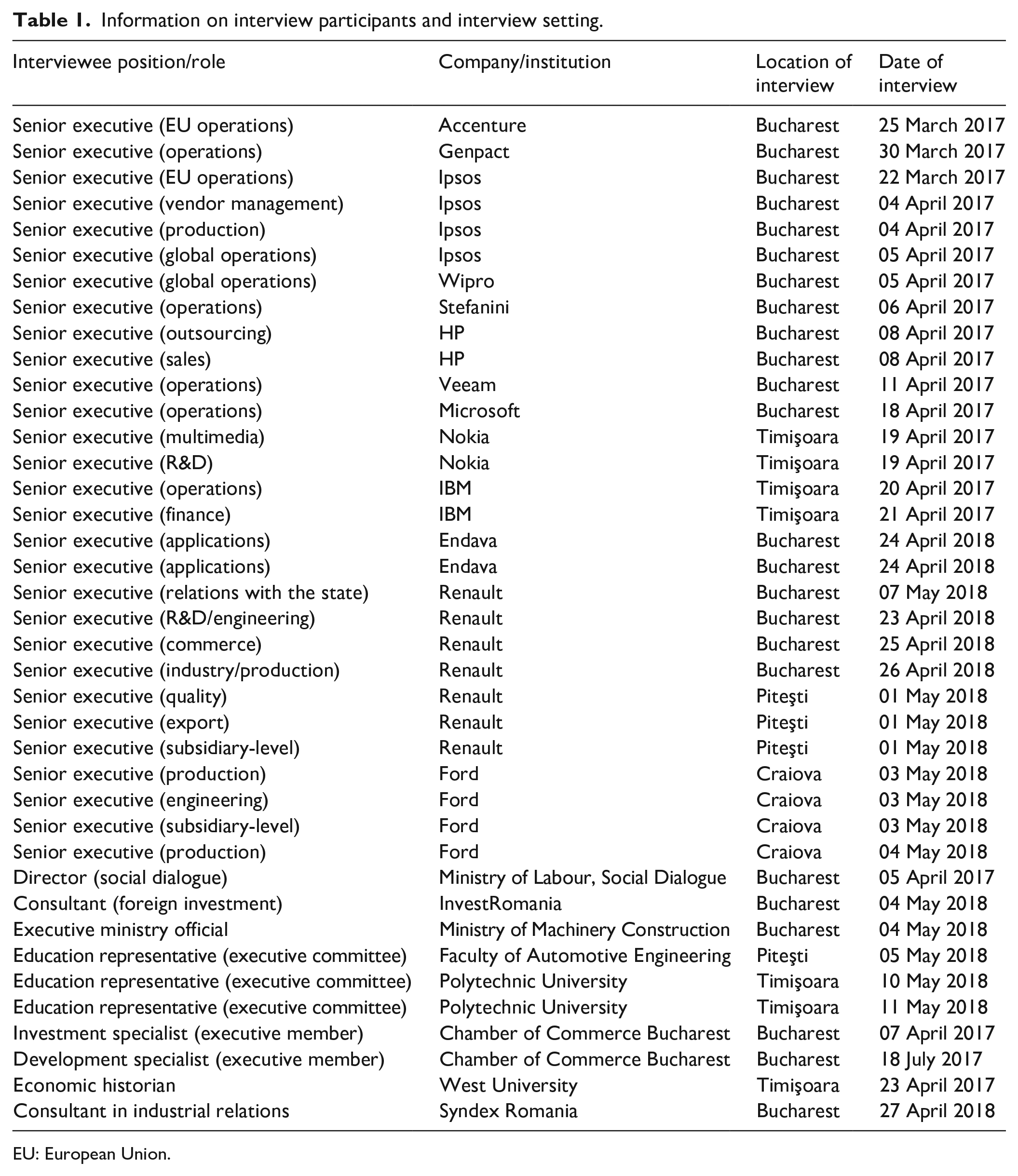
| Interviewee position/role | Company/institution | Location of interview | Date of interview |
|---|---|---|---|
| Senior executive (EU operations) | Accenture | Bucharest | 25 March 2017 |
| Senior executive (operations) | Genpact | Bucharest | 30 March 2017 |
| Senior executive (EU operations) | Ipsos | Bucharest | 22 March 2017 |
| Senior executive (vendor management) | Ipsos | Bucharest | 04 April 2017 |
| Senior executive (production) | Ipsos | Bucharest | 04 April 2017 |
| Senior executive (global operations) | Ipsos | Bucharest | 05 April 2017 |
| Senior executive (global operations) | Wipro | Bucharest | 05 April 2017 |
| Senior executive (operations) | Stefanini | Bucharest | 06 April 2017 |
| Senior executive (outsourcing) | HP | Bucharest | 08 April 2017 |
| Senior executive (sales) | HP | Bucharest | 08 April 2017 |
| Senior executive (operations) | Veeam | Bucharest | 11 April 2017 |
| Senior executive (operations) | Microsoft | Bucharest | 18 April 2017 |
| Senior executive (multimedia) | Nokia | Timişoara | 19 April 2017 |
| Senior executive (R&D) | Nokia | Timişoara | 19 April 2017 |
| Senior executive (operations) | IBM | Timişoara | 20 April 2017 |
| Senior executive (finance) | IBM | Timişoara | 21 April 2017 |
| Senior executive (applications) | Endava | Bucharest | 24 April 2018 |
| Senior executive (applications) | Endava | Bucharest | 24 April 2018 |
| Senior executive (relations with the state) | Renault | Bucharest | 07 May 2018 |
| Senior executive (R&D/engineering) | Renault | Bucharest | 23 April 2018 |
| Senior executive (commerce) | Renault | Bucharest | 25 April 2018 |
| Senior executive (industry/production) | Renault | Bucharest | 26 April 2018 |
| Senior executive (quality) | Renault | Piteşti | 01 May 2018 |
| Senior executive (export) | Renault | Piteşti | 01 May 2018 |
| Senior executive (subsidiary-level) | Renault | Piteşti | 01 May 2018 |
| Senior executive (production) | Ford | Craiova | 03 May 2018 |
| Senior executive (engineering) | Ford | Craiova | 03 May 2018 |
| Senior executive (subsidiary-level) | Ford | Craiova | 03 May 2018 |
| Senior executive (production) | Ford | Craiova | 04 May 2018 |
| Director (social dialogue) | Ministry of Labour, Social Dialogue | Bucharest | 05 April 2017 |
| Consultant (foreign investment) | InvestRomania | Bucharest | 04 May 2018 |
| Executive ministry official | Ministry of Machinery Construction | Bucharest | 04 May 2018 |
| Education representative (executive committee) | Faculty of Automotive Engineering | Piteşti | 05 May 2018 |
| Education representative (executive committee) | Polytechnic University | Timişoara | 10 May 2018 |
| Education representative (executive committee) | Polytechnic University | Timişoara | 11 May 2018 |
| Investment specialist (executive member) | Chamber of Commerce Bucharest | Bucharest | 07 April 2017 |
| Development specialist (executive member) | Chamber of Commerce Bucharest | Bucharest | 18 July 2017 |
| Economic historian | West University | Timişoara | 23 April 2017 |
| Consultant in industrial relations | Syndex Romania | Bucharest | 27 April 2018 |
EU: European Union.
Declaration of conflicting interests
The author(s) declared no potential conflicts of interest with respect to the research, authorship and/or publication of this article.
Funding
The author(s) received no financial support for the research, authorship and/or publication of this article.
