




Abstract
In recent debates concerning labour governance in global value chains (GVCs), it has been convincingly argued that the combination of public and private governance is necessary to effectively tackle workplace labour standards. This paper contributes to this debate in two ways. First, the paper demonstrates that an effective marriage of public-private governance is conditional on periods of economic and political stability. At times of instability and crises, the effective articulation of public-private governance can very quickly erode, resulting in the de facto degradation of labour standards. The paper argues that this is primarily due to the state relaxing social welfare standards with priority given to the survival of business. Second, the paper provides additional empirical evidence, contributing to existing debates arguing that the success of the articulation of public-private governance is primarily contingent on the strength of state regulatory capacity providing the framework within which businesses are regulated. We demonstrate how the erosion of public governance in periods of crisis allows employers to develop strategies to avoid compliance with, and undermine the effectiveness of, public labour governance mechanisms. The paper makes this case by examining the Sri Lankan apparel industry during the multiple crises that dominated the period between 2019 and 2024, spanning Easter attacks, the Covid19 pandemic, a sovereign debt crisis and geo-political conflicts.
Introduction
Early research on the globalisation of production argued that the influence of the state in the governance of global value chains (GVCs) was increasingly eroded by the commercial interests of lead firms who became the dominant players in the organisation and regulation of transnational production (Coe et al., 2008; Gereffi et al., 2005; Henderson et al., 2002; Mayer and Phillips, 2017). Despite recognising the continued importance of the territorial embeddedness of production networks, linked to ‘strategic coupling’ with place-based social, cultural and political formations (Coe et al., 2004; Henderson et al., 2002), a ‘global governance deficit’ was identified between the scale of production and the scale of regulation, especially with regard to working conditions in supply chains (Barrientos et al., 2011: 306). Consequently, it has been argued that private governance mechanisms, such as lead firms’ codes of conduct, emerged to fill a labour governance deficit, in the absence of state regulation (Barrientos et al., 2011; Esbenshade, 2004; Macdonald, 2014; Mayer and Phillips, 2017). Yet, in recent debates, a re-assertion of state authority is seen as vital to achieving improvements in labour conditions in GVCs (Alford and Phillips, 2018; Amengual and Chirot, 2016; Bartley, 2018). Reflecting a broader resurgence of theorisation of the state in GVCs (e.g. Coe and Yeung, 2019; Horner, 2017; Smith, 2015), there are emerging signs of a ‘regulatory renaissance’ in some developing countries in the form of strengthened labour regulatory institutions and increased legislative protection materialised through joint labour governance between public, private and civil society actors (Alford et al., 2024; Alford and Phillips, 2018; Mosley, 2017; Piore and Schrank, 2008; Ruwanpura, 2022a). Called ‘synergistic governance’ (Gereffi and Lee, 2016), it is argued that this form of combined governance can be more effective than separate forms of public and private governance in securing decent work in GVCs (Alford et al., 2024; Alford and Phillips, 2018; Amengual, 2010; Amengual and Chirot, 2016; Bair and Palpacuer, 2015; Bartley, 2011, 2018, 2022; Locke, 2013; Locke et al., 2007, 2009, 2013; Mayer, 2014; Mayer and Phillips, 2017).
This paper develops this debate over the relationship between public and private labour governance by arguing that the effectiveness of the combination of public-private governance is conditional on periods of economic and political stability. At times of instability and crisis, the effective articulation of public-private governance can very quickly erode. The paper also contributes additional empirical insights to illustrate arguments that the success of the articulation of public-private governance is primarily contingent on the strength of state regulatory capacity. We demonstrate how the erosion of public governance in periods of crisis allows employers to develop strategies to avoid compliance with, and undermine the effectiveness of, public labour governance mechanisms. We make this case by focussing on the Sri Lankan apparel industry. Sri Lanka has become one of the world’s leading apparel producers supplying to core global markets in the USA and the EU. In the pre-Covid19 context the country had established a reputation as an ethical sourcing location for apparel GVCs. This self-promoted image was one that the Sri Lankan state and manufacturers tried hard to maintain and was subscribed to by lead firms (Wickramasingha and Coe, 2022). Sri Lanka was able to maintain this reputation primarily due to establishing strong social welfare standards and labour laws, which resulted from labour struggles dating as far back as the early 1900s (Ruwanpura, 2012, 2016, 2022a). This is in contrast to many other apparel producing countries such as Bangladesh (Anner, 2020; Wickramasingha, 2022) and India (Carswell and De Neve, 2013; Mezzadri, 2017). Lead firms and Sri Lankan manufacturers for decades were therefore able to capitalise on these relatively strong domestic labour laws and promote apparel exports as ethically produced (Ruwanpura, 2022a). As such, Sri Lanka witnessed a close relationship between public and private labour governance over the period since the 1990s when lead firms’ codes of conduct became widespread.
A series of multiple crises occurring in Sri Lanka since 2019, however, have seen a rapid degradation of basic labour standards in the apparel industry resulting from the government and manufacturers prioritising economic recovery and the commercial resilience of the industry. One consequence has been deteriorating working conditions, revealing the structural deficiencies of public-private governance and the inability of lead firms’ codes of conduct to protect workers in times of crisis. This was compounded by the absence of the state from labour regulatory spaces, such as the inability and or unwillingness of state institutions to implement labour laws during the multiple crises. Against this context, lead firms’ codes of conduct were unable to enforce labour standards on the shop floor or protect workers’ rights in the same way that they had previously. Another consequence is the introduction of proposed labour law reforms, which if passed, will significantly de-regulate the Sri Lankan labour market.
The paper also examines an inherent limitation of public-private governance as illustrated by the Sri Lankan context; namely that the successful articulation of public-private governance is primarily contingent on the strength of state regulatory capacity. The paper highlights how lead firms’ codes of conduct depend on national labour standards for their legitimacy. The paper therefore challenges the dominant assumption that frames private regulation as a top-down intervention by global actors to strengthen national labour governance mechanisms (Amengual, 2010; Amengual and Chirot, 2016). Instead, we argue that public-private governance should be understood as multi-faceted and ‘grounded’ in specific contextual settings and practices (see also Bartley, 2022; Graz, 2022). This allows us to unpack the complexities, tensions and contradictions of public-private governance, and how and why private regulation intersects (or not) with different contexts and with consequences for working conditions.
The paper is structured as follows. The next section discusses the debate on public-private governance, its limits and our core contributions to the existing literature. Section 3 describes the research context. Section 4 outlines the research methods. Section 5 discusses the degradation of labour standards in the Sri Lankan apparel industry with a focus on workload, wages and job losses. Section 6 discusses the diminishment of the state’s regulatory role in labour governance and highlights the fracturing of public-private regulation. The paper concludes by considering the implications of the analysis for current and future research and for policy.
Public-private labour governance: Effectiveness, limitations and stability
The co-existence of, and mutual interactions between, public and private labour governance have been identified as leading to stronger and more effective improvements in working conditions in GVCs (Gereffi and Lee, 2016; Ruwanpura, 2022a). Private governance involves the voluntary initiatives of lead firms to regulate working conditions in supply chains, often via the use of supplier codes of conduct. Public governance includes state regulatory mechanisms such as legal and policy frameworks, standard setting and monitoring of compliance. State-led mechanisms of labour governance are often recognised as incomplete in design and plagued by ineffective enforcement in many developing countries, constrained by resources and a governance deficit arising from the globalisation of production (Barrientos et al., 2011).While private voluntary initiatives and codes of conduct emerged to fill this governance gap (Macdonald, 2014; Mayer and Phillips, 2017), private governance is also not without criticism. Commercial pressures operating between lead firms and their suppliers and a lack of commitment, resources and transparency have all been identified as limitations of private governance (De Neve, 2009; Esbenshade, 2012; Locke, 2013; Locke et al., 2009; Lund-Thomsen and Lindgreen, 2014; Ponte, 2019; Ruwanpura, 2016, 2022a).
It has thus been recognised that the combination of public and private governance is necessary to effectively tackle labour standards and environmental issues in supply chains (Alford and Phillips, 2018; Amengual, 2010; Amengual and Chirot, 2016; Gereffi and Lee, 2016; Locke, 2013; Locke et al., 2013; Mayer and Phillips, 2017). Locke et al. (2013), for instance, argued that private regulation can interact in a complementary manner with government regulations, and in certain cases substitutes for the absence of state governance. Other scholars demonstrated that private regulation, particularly lead firms’ codes of conduct, can strengthen and reinforce state regulatory mechanisms, especially where state regulation is not strong (Amengual, 2010; Amengual and Chirot, 2016). Amengual (2010), for example, found lead firms’ codes of conduct freed up limited state resources, thereby complementing state regulatory mechanisms in an ‘interactive ecology’. ‘Synergistic governance’ and a ‘regulatory renaissance’ between public and private systems have been seen as forms of joint regulation that are more effective in delivering sustainable improvements in working conditions in GVCs (Alford and Phillips, 2018; Amengual, 2010; Amengual and Chirot, 2016; Gereffi and Lee, 2016; Locke et al., 2009, 2013; Mayer, 2014). Extending this debate, Alford et al.’s (2024) most recent works explored ‘polycentric governance’ to recognise the intervention of social actors (i.e. trade unions and civil society organisations) in the forms of such synergistic governance.
Demonstrating the strength of such synergistic, public-private regulation requires recognition of the centrality of the state in governing GVCs (Alford and Phillips, 2018; Mayer and Phillips, 2017). While earlier research tended to see the state as largely irrelevant for labour governance in GVCs, or as being displaced by private governance mechanisms (Esbenshade, 2004; Gereffi et al., 2001; Jenkins, 2001; O'Rourke, 2003), it has become increasingly recognised that the state continues to play a pivotal role in overall labour governance (Alford and Phillips, 2018; Smith et al., 2018, 2021). Rather than replacing the state or compensating for its supposed absence, public and private regulations are intertwined in various ways where private regulation is articulated in the ‘shadow of the state’ (Abbott and Snidal, 2000), strengthening and re-enforcing state regulation (Amengual and Chirot, 2016; Locke, 2013), and generating an elaborate layering of rules, particularly with respect to implementation and monitoring (Bartley, 2011). The state’s critical role in defining the forms of public-private regulation is thus increasingly acknowledged in governing labour in GVCs, reflecting broader recognition of the importance of theorising the nexus of state/GVC relations (Horner, 2017; Smith, 2015).
Extending this research, our argument is that the effectiveness and sustainability of public-private governance is conditional on periods of economic and political stability. Using the Sri Lankan apparel industry as an example, the paper demonstrates that while public-private governance can effectively function during periods of relative stability when state regulations are largely unchallenged, it becomes rapidly undermined when the resilience of the economy becomes prioritised by the state during periods of crisis. For the last few decades, Sri Lanka has promoted itself as an ethical sourcing destination for apparel (Knutsen, 2004; Ruwanpura, 2012, 2016, 2022a; Sluiter, 2009; Wickramasingha, 2023; Wickramasingha and Coe, 2022; Wijayasiri and Dissanayake, 2009). The country maintained this reputation in part due to an active welfare state with historically high socio-economic standards including universal free education and healthcare, political democracy (Abeyratne, 2004; Ruwanpura, 2022a) and strong labour laws first institutionalised in the 1900s (Gunawardana and Biyanwila, 2008; Ruwanpura, 2016). Stringent labour laws regarding wages, working hours, termination of employment, statutory payments, child labour and employment of women were in place. This allowed the codes of conduct of lead firms operating in Sri Lanka to be largely compliant with national legal frameworks. Consequently, the Sri Lankan apparel industry was well ahead of many other apparel producing countries in the region in being able to align codes of conduct with existing national labour laws. The standards set in many lead firms’ codes of conduct were already established by Sri Lankan labour laws with a high level of compliance across supplier factories, albeit with the exception of freedom of association and collective bargaining (Gunawardana, 2010, 2014; Ruwanpura, 2022a). The industry largely complied with national labour standards with respect to national minimum wage, building safety standards, working hours, statutory payments and child labour, all of which were upheld by the state. The combination of strong national laws with lead firms’ codes of conduct therefore offered an effective platform for lead firms and Sri Lankan manufacturers to promote the Sri Lankan apparel industry as an ethical sourcing destination (Ruwanpura, 2012, 2016, 2022a; Wickramasingha and Coe, 2022). Sri Lanka thus exemplified an important synergy between public and private governance during this time.
This synergy began to unravel rapidly during the multiple crises experienced since 2019 – Easter attacks in 2019, the Covid19 pandemic, sovereign debt crisis and geo-political tensions. We argue this was primarily because the state gradually withdrew from its regulatory role in responding to these crises. This was despite the state’s initial commitments during the pandemic to ensure job security and payments of salary for garment workers during lockdowns (Ruwanpura, 2022b); discussed more fully later. The Sri Lankan state effectively supported a scaling down of benefits and conditions for apparel workers (Hewamanne, 2021; Ruwanpura, 2023, 2024; Wickramasingha and De Neve, 2022), and sought to reform labour laws influenced and supported by both commercial pressures and the need to establish economic competitiveness in the context of the crises (Kumarage, 2024). The Sri Lankan state’s response was primarily driven by internal political and economic turmoil arising from a multiplication of domestic crises, and worsened by the cascading and overlapping effects of the economic crisis brought on by Russia-Ukraine war. Within this context the state’s implicit approval for, and the introduction of, explicit measures designed to relax certain social welfare standards in the name of recovery and resilience of the economy legitimised unethical accumulation processes. It increased the risk of pushing apparel workers into precarity (Hewamanne, 2021; Ruwanpura, 2021, 2023; Wickramasingha, 2023), and eroded pre-existing commitments made by local manufacturers to national labour standards and of lead firms to uphold their own codes of conduct.
The Sri Lankan experience reveals an inherent limitation of the articulation of public and private governance; that the effectiveness of public-private governance is primarily contingent on the strength of state regulation (see also Bartley, 2018; De Neve, 2009; Goger, 2013; Hale and Shaw, 2001; Locke et al., 2009, 2013; Mayer and Phillips, 2017; Ruwanpura, 2016, 2022a). In moments of crises and in the diminishing presence of the state, the effectiveness of private governance in sustaining labour standards and conditions can erode rapidly, leaving apparel workers vulnerable to exploitative labour conditions.
Research context: The Sri Lankan apparel industry in crisis
The apparel industry is the most significant and dynamic sector in the Sri Lankan economy. In 2024, the industry was the primary foreign income earner, accounting for over 46% of total export revenue (International Trade Administration, 2024). The industry experienced a steady growth of apparel exports from $125.5 million in 1980 to $5.92 billion in 2022 (Athukorala, 2017; International Trade Administration, 2024). By 2024, the industry employed over 350,000 people – 15% of the country’s labour force – of which the majority were women (International Trade Administration, 2024). By 2022, the industry supplied for major apparel brands including Gap, H&M, M&S, Nike, PVH and Zara.
As with other apparel producing countries, the Sri Lankan apparel industry was significantly impacted by the Covid19 pandemic and the crises which followed. Multiple lockdowns disrupted apparel production activities and the movement of goods and people. Most garment factories operated at reduced capacity to adhere to social distancing regulations (Ruwanpura, 2021). Employers also had to deal with burgeoning Covid19 clusters with a significant portion of workers impacted by the virus and having to stay off work for weeks (Wickramasingha and De Neve, 2022). Imports were disrupted by the pandemic due to border closures and logistical issues where the transfer of raw material and finished goods were halted, delayed, or disrupted. This was a severe blow to an industry that relied on the import of raw material, including more than 70% of fabric and 70%–90% of accessories (Rajapakshe et al., 2023). Furthermore, as demand shrank in core markets with retail outlets closed during lock-downs, lead firms cancelled and/or reduced orders, with some firms not paying for the goods that were already delivered (AFWA, 2023; Manufacturer/3, June 2023). Following a long period of steady export growth, these crises impacted negatively on overall export levels in 2020, followed by an adjustment of the industry in 2021 and 2022, and a subsequent significant export downturn in 2023 (Figure 1). As the industry was still reeling from this turbulence following a long period of steady growth, the country experienced its worst economic crisis since independence in 1948. In March 2022, the government experienced a sovereign debt crisis and declared bankruptcy, having defaulted on foreign debt of over $55 billion (Ruwanpura, 2023). Without adequate foreign reserves, the government struggled to provide the population with the most basic needs such as fuel, electricity, gas, essential drugs and food. The economic crisis in turn led to major public riots that lasted for over 6 months culminating in the ousting of the then Prime Minister and President in July 2022 (Ruwanpura, 2023).
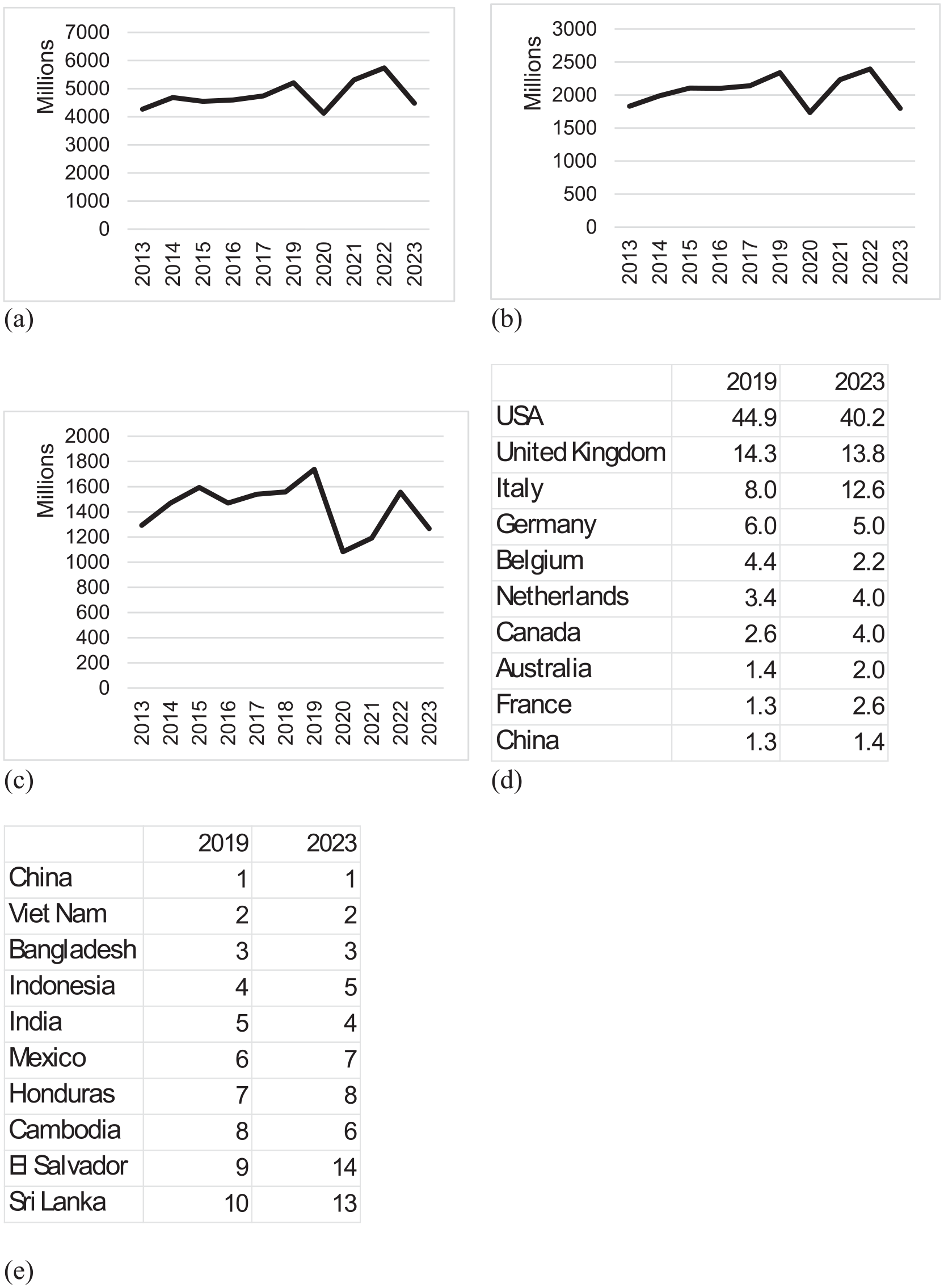
Key Sri Lankan apparel trade data, 2013–2023. (a) World exports ($). (b) Exports to US ($). (c) Exports to EU (€). (d) Top 10 export markets (% of total Sri Lankan apparel exports). (e) Rank position of apparel suppliers to the main US market. Source: a, b, d and e – elaborated from Comtrade database; c – elaborated from Comext database.
This situation was compounded by escalating geo-political tensions globally. The Russian invasion of Ukraine in 2022 saw a reduction in apparel orders due to the reduction of purchasing power in core European markets as the cost of living crisis hit (Lead firm/1, May 2023). Moreover, the war affected the distribution and sale of products in markets where lead firms had a strong presence (Lead firm/2, June 2023). All these factors reduced demand for production from lead firms, decreasing the revenue of Sri Lankan manufacturers who experienced a 25% reduction in orders compared to before the pandemic (Lead firm/3, August 2023). Furthermore, the United States’ Uyghur Forced Labour Prevention Act 2022 also affected the industry in Sri Lanka, resulting in the closure of five large factories (Wickramasingha, 2023). Export earnings from textile and garments in January 2023 declined by US$424.4 million (−18% compared to 2022; Ahlam, 2023). Over the 2020–2023 period as GDP growth rates fell, there has been a reduction in manufacturing wages, employment and value added, and the scale of apparel production compared to 2019. A significant period of negative growth of apparel exports was also evident compared to levels established in 2015 (Table 1).
Key economic and apparel industry indicators, Sri Lanka, 2015, 2019–2023.
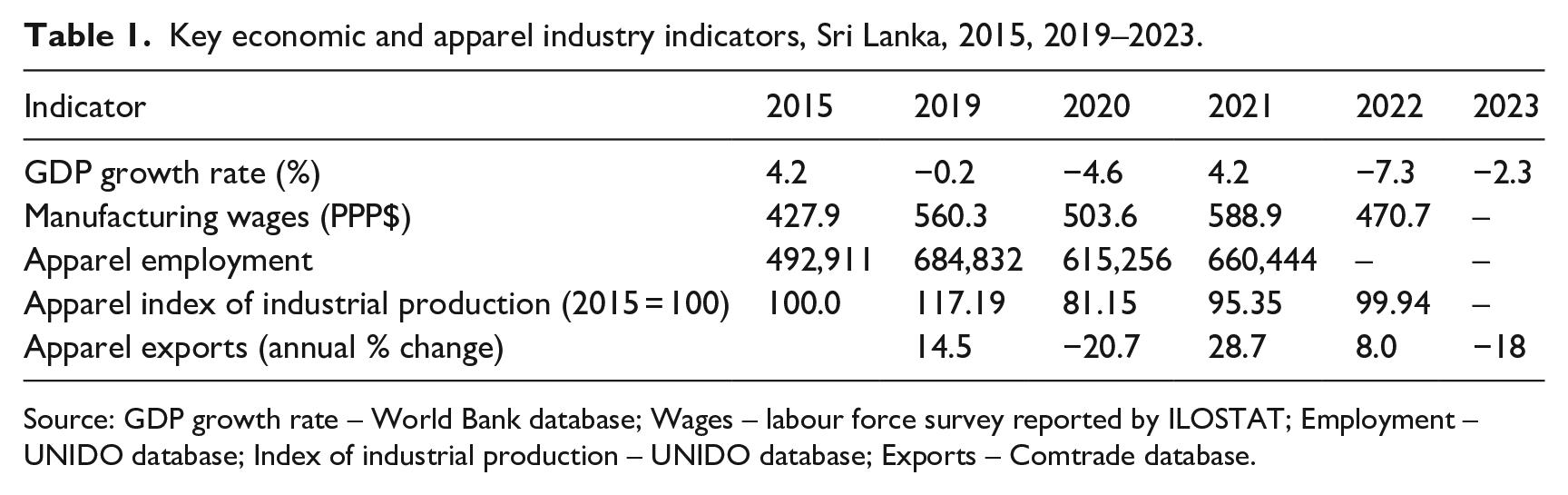
Source: GDP growth rate – World Bank database; Wages – labour force survey reported by ILOSTAT; Employment – UNIDO database; Index of industrial production – UNIDO database; Exports – Comtrade database.
What this has meant is an absolute and relative shrinkage of the Sri Lankan apparel industry. Between 2013 and 2019 there was a broadly steady growth in apparel exports, but this was impacted negatively by the pandemic and other recent crises (Figure 1). The first downturn in apparel exports took place in 2020. This resulted from the immediate reduction of orders from lead firms in the early days of the pandemic as well as the re-direction of production away from Sri Lanka as a response to the 2019 Easter attacks. Total apparel exports returned to 2019 levels in 2021 as manufacturers adjusted production activity during the pandemic, but 2022–2023 saw a further significant fall in exports resulting from the sovereign debt crisis, further reduction of export markets due to the Russian invasion of Ukraine, and the US ban on cotton from Xinjiang, China. While the main export partners have remained more or less constant since 2019, with the top 10 export markets continually accounting for 88% of Sri Lankan apparel exports, in the dominant US market (accounting for 40% of Sri Lankan apparel exports in 2023) Sri Lanka has fallen from 10th to 13th in the list of most important apparel suppliers (Figure 1). In this context, manufacturers scrambled to cut costs and make as much profit as possible from the austere economic conditions. Measures such as salary reductions and wage freezes, elimination of overtime, elimination of production incentives and bonuses, increased targets, furlough of workers for months, working at reduced capacity, and closure of factories for 3 days a week were implemented by Sri Lankan apparel suppliers (Union/1/3, June 2023; Union/2, May 2023). These measures created a social crisis in the apparel industry. Workers were pushed into extreme precarity and there has been a significant deterioration in working conditions (see below). The Sri Lankan apparel industry thus provides a clear example of how a perceived ethical sourcing destination for apparel production quickly unravelled as the articulation of public and private governance was undermined during multiple crises.
Research methods
The paper draws upon research conducted between 2020 and 2024, spanning the Covid19 pandemic, the sovereign debt crisis and the Russian invasion of Ukraine. The empirical research was conducted by the first author in three stages (Table 2).
Empirical data collection – Timeline and participants.

The first stage was carried out during a surge of Covid19 infections in Sri Lanka. Repeat interviews with four trade unions and civil society organisations were conducted, covering workers’ labouring and living conditions, factory health and safety standards, the spread of the virus in factories, pandemic responses by the government and manufacturers, the treatment and recuperation process of workers, and their eventual return to work. Interviews lasted between 20 and 40 minutes. Given pandemic restrictions, all interviews were carried out virtually.
The second stage was undertaken at the height of the Sri Lankan sovereign debt crisis. Interviews and focus groups covered working conditions, managerial practices, production regimes and the overall social and economic wellbeing of workers. A structured questionnaire was also administered to participants in a focus group for workers with an emphasis on pre-pandemic and post-pandemic wages, working hours and family income.
In the third stage most of the interviews were conducted face-to-face, and a minority online or via telephone. Interviews covered purchasing strategies of lead firms, inter-firm relations between lead firms and suppliers, the implications of multiple crises on sourcing and production, challenges and opportunities faced by lead firms and suppliers during the crises, changing patterns of labour governance and labour policies, how manufacturers, lead firms and the state responded to the crises, and the implications of these responses for working conditions. Focus groups were conducted with apparel workers after which a survey was administered covering pre-pandemic and post-pandemic wages, working hours, targets, benefits, health and safety and overall income. Combining the survey and focus group data allowed for the development of in-depth accounts of working conditions, managerial practices, production regimes and overall social and economic wellbeing of workers. All worker informants were sourced from the Katunayake and Biyagama export processing zones (EPZs). EPZs were chosen for their high density of apparel workers and the easy access via trade unions in contrast to stand-alone factories spread across different parts of the country. It is important to note that Sri Lankan labour laws are universally applicable across the country and do not differ in EPZs. Sri Lankan EPZs are governed by the same labour laws, therefore, the conditions discussed in this case study are generalisable beyond the EPZs.
The garment manufacturers and lead firms were selected for this study based on their size and importance in the industry. For instance, the manufacturers interviewed included large scale factories and small and medium scale factories (SMEs). Large scale manufacturers were among the top five manufacturers. Of these, three large scale factories were Sri Lankan owned and one large scale factory was foreign owned. Together, these four businesses owned the majority of the large scale garment factories in the country, thereby, having a significant stake in the industry. At least 80% of the workers selected for the focus groups were employed by these four large-scale factories. Lead firms selected were both European and American, and were major firms in the global apparel industry. All manufacturers selected for the study supplied for these lead firms. The worker engagement was planned specifically with this connection in mind with clear instructions provided to trade unions at the beginning of the study.
Finally, an interactive workshop was organised in June 2023 in Colombo to share the emerging findings with trade unions and civil society organisations and to discuss the common issues faced by workers. This workshop included 10 members of four trade unions and civil society organisations based in the two EPZs. Following this fieldwork, data were followed up with continued virtual discussions with informants when necessary. In addition to the data drawn from these different stages of fieldwork, the paper also draws on data from the first author’s doctoral research conducted in 2018, when referring to the pre-pandemic labour regimes of the Sri Lankan apparel industry.
The analysis of interview and other data followed a grounded research strategy (Corbin and Strauss, 2014), informed by the unfolding crises since 2019. Data were first coded according to the key research questions related to the wages and benefits, workload, working hours, job loss and overall working conditions in pre- and post-pandemic contexts. We then compared how workers’ conditions have changed over the crisis period. Using the existing literature on the Sri Lankan apparel industry, we also carried out a detailed analysis on the co-existence of lead firms’ codes of conduct and the Sri Lankan national labour standards. This revealed the dependence of lead firms’ codes of conduct on national labour laws, and how public-private governance has become fractured in the context of crises. Our overall analysis was an iterative exercise which, while being attuned to the theoretical concepts of labour governance, was grounded in the emerging findings (Charmaz, 2003; Corbin and Strauss, 2014). In this way, we were able to maintain an interative conversation between theory and practice, rather than simply testing a set of theoretical propositions. All interviews and focus groups are reported anonymously.
Three limitations of the research are worth noting. First, while manufacturers were interviewed both in and outside of EPZs, the research with apparel workers was limited to the two EPZs. EPZs consist of only about 20% of the total apparel workforce in Sri Lanka, with the rest of the workers scattered across the country (Union/3, August 2024). As workers outside of the two EPZs were not interviewed, the research is not necessarily fully representative of the wider apparel workforce. However, interviews with trade unions, civil society organisations and small and medium sized suppliers outside EPZs provided a means to triangulate the conditions reported in this paper with those across the industry. This is particularly so, given that most of the factories outside EPZs are owned by the same manufacturers with operations in the EPZs. Consequently, labour standards implemented across multiple factories were broadly similar across the country. Second, the crises and their aftermath in Sri Lanka were still developing and evolving at the time of writing. Consequently, further changes from those reported here are anticipated. Third, engagement with the government was limited. Due to the ongoing labour law reforms and crisis conditions, government representatives mostly declined to participate. Nevertheless, given the diversity of the profile of interview participants and when integrated with grey literature, we have calibrated data to obtain a good understanding of government strategies on labour conditions in the apparel industry during the crises.
Declining working conditions in the Sri Lankan apparel industry
During the multiple post-pandemic crises the Sri Lankan apparel industry has seen a notable deterioration in working conditions. This was due to the state relaxing its stance on certain labour regulations in its attempt to restore national economic competitiveness, fracturing the previously strong marriage of public-private governance in the apparel industry. Here we focus on two sets of working conditions which our participants highlighted as particularly impacted by the multiple crises: intensification of workloads and wages and the termination of employment.
Intensification of workloads and wages
The 1941 Wages Board Ordinance stipulates that Sri Lankan workers are paid at least the minimum wage set for the sector plus any contracted overtime, which the Ordinace referred to as ‘general minimum time-rate’ (Clause 20). In the apparel industry the minimum wage was set to be around $90. The Wages Board Ordinance strictly prohibits any deductions other than statutory payments such as those to the Employees Provident Fund (EPF) and Employees Trust Fund (ETF). Given that codes of conduct made reference to upholding national statutory requirements in Sri Lanka, wage payments in garment factories were largely governed by national legal requirements. In addition to basic wage and overtime payments, in the pre-pandemic context workers were able to earn a range of monthly incentives. These included attendance bonuses for coming to work every working day and production incentives for achieving daily production targets. Overtime was a constant in the pre-pandemic context, where workers were able to undertake 1–2 hours overtime during week days, and about 4 hours or more on Saturdays. Monthly production incentives were tied to daily production targets, that were divided into hourly targets, which in general most workers admitted that they were able to achieve in the pre-pandemic context (Surveys 1–7, May and June 2023). This meant, in the pre-pandemic context, workers were able to receive an average take home salary of between LKR35,000 and LKR45,000 ($196 and $252 based on 2019 exchange rates), although the national minimum wage was much lower. In the current crisis context, workers’ take-home salaries have reduced to between LKR25,000 and LKR30,000 ($81 and $98 based on June 2023 exchange rates); much closer to, if not below, the national minimum wage. This was primarily due to two dynamics. First, suppliers removed standard overtime, resulting in a loss of income for workers. In some cases, even when overtime and production incentives were owed to workers, managers did not pay them, citing company financial difficulties and loss of income during the pandemic: ‘They tell us that lots of factories are getting closed, and they tell us not to get this factory also closed’ (Focus Group/4, June 2023). In another factory, workers said that managers kept reminding them how lucky they were to just have a job and how many people were unemployed. Moreover, workers said that managers referred to workers in other countries not making the kind of demands that Sri Lankan workers did, implying that factory owners may leave the country and relocate elsewhere (Focus Group/1, June 2023). To quote a worker: Managers try to scare us. They tell us that even though we are working for a salary, in some countries there are people who work for the lunch packet. . . They tell us to hold onto our jobs. . . They tell us that if we go out we won’t get a job. No matter the issues, workers do not want to resign. So they stay even though the conditions are bad. . . Managers are deceiving us to make sure that we will remain in the job and do whatever they ask us to do. We are all scared about our job because in the current economic crisis, we need the job (Focus Group/1, June 2023).
Second, suppliers increased hourly production targets. Almost all surveyed workers said they found it very difficult to achieve these new targets, such that they were not able to earn production incentives (Surveys 1–7, May and June 2023; Focus Groups/1–3, June 2023): ‘Those days [before the pandemic] our target was about 50 pieces. Now the target [for the same style and piece] has increased to 90. They get us to do everything in 8 hours’ (Focus Group/1, June 2023). In another focus group, workers accused managers of increasing workload by allocating 10-hour targets into 9 hours (Focus Group/2, June 2023). Another set of workers from a different factory reported that managers had restructured the production process to re-allocate 1-hour targets to 45 minutes (Focus Group/2, June 2023). Moreover, during the crises most factories operated for only 4 days per week, citing a lack of orders. However, workers and civil society organisations believed managers had compressed five and half day’s work into 4 days, and 11 hours work into 9 hours thereby reducing overhead costs, and circumventing the payment of over-time and production incentives to workers (Union/1, June 2023; CSO/1, June 2023).
In one focus group workers said that they could not meet the new targets. As a consequence managers asked them to leave the job: ‘When we cannot cover the targets, they ask us to go home. They say there are enough workers waiting outside to come in’ (Focus Group/1, June, 2023). As a result, most workers involved in the research said they skipped meals or shortened their meal breaks by quickly eating their lunch to maximise working time to make the new targets. Workers said that they also did not drink water to avoid toilet breaks but that they never had to avoid meals or water breaks before the pandemic, revealing that these conditions were exclusive to the post-pandemic context. As one worker described: ‘They scold us when we can’t achieve the target. . . so we sometimes avoid going to lunch and tea. Those days, before the pandemic, it was fine . . . we did not skip lunch and tea’ (Focus Group/2, June 2023). Referring to this situation, a trade union said that ‘what workers are doing is not working. It is slaving. They are now intimidated by the managers. They are worried that if they don’t work hard, they won’t have a job’ (Union/1, June 2023).
With the inability to earn overtime and the new production incentives, workers’ take home salary reduced by about 30%. This was compounded by reduced purchasing power due to the debt crisis and currency depreciation (Ruwanpura, 2023, 2024). While the intensification of the labour process, per se, has not arisen from the increasing disjuncture between public and private governance, the increased targets that are almost impossible to achieve, and the resultant de facto reductions to breaks during the working day, mean that working conditions in the post-pandemic context have declined. Indeed, there are no stipulated laws in Sri Lanka that define the workload or impose a limit over the targets in the apparel manufacturing sector. Yet, the increased workload has provided the basis for the erosion of legally mandated wage and compensation standards.
These findings were consistent with a survey conducted by the Asia Floor Wage Alliance (AFWA) and Justice for Labour (JFL) in 2022, which found that across Bangladesh, Cambodia, India, Indonesia, Pakistan and Sri Lanka workers earned on average 25% less than in the pre-pandemic context, which AFWA referred to as ‘wage theft’ (AFWA, 2023). AFWA also found that seven in 10 workers across the six countries surveyed were not paid overtime in the post-pandemic context, indicating that this was common across the Asian apparel industry. As the AFWA study found, in 124 factories surveyed across the six countries, workers were owed $71 million on illegal layoffs, terminations, arbitrary pay cuts, unpaid wages for hours worked and gender discrimination in pay (Table 3, AFWA, 2023).
Unpaid wages to apparel workers in Asia.

Source: AFWA (2023).
While apparel workers were pushed into further precarity, the net worth of lead firms grew significantly in the post-pandemic context. Nike, VF and Levi’s for example authorised $18 billion, $7 billion and $750 million stock buyback programmes respectively between 2021 and 2022, a legal form of stock manipulation (AFWA, 2023). This is considered to have adverse implications on workers as there would be little money to invest in workers’ welfare, increased pay and benefits, and the nurturing of job growth and employment opportunities (Communication Workers America, 2020). As the AFWA argued, this was a ‘choice’ made by big brands to use the crises and recovery to enrich investors while ‘leaving hundreds of thousands of garment workers in financial ruin’ (AFWA, 2023: 4). This resonates with our Sri Lankan findings, where manufacturers accused lead firms of benefitting from the economic crisis. One Sri Lankan manufacturer, for example, explained how a lead firm wanted a discount in 2022 because the Sri Lankan currency had depreciated against the British pound (Manufacturer/3, June 2023). The lead firm’s rationale was that manufacturers now earned more in Sri Lankan rupees so they should reduce prices: ‘At a meeting, a UK based buyer wanted to slash prices because the pound was increasing in Sri Lanka. One month later after giving the discount, they wanted another 7.5% off. If we did not give that discount also, they would have gone elsewhere, to Bangladesh’ (Manufacturer/3, June 2023). As this manufacturer continued to elaborate: ‘there is guilt about workers, they are not paid well. . . but it is the buyers who are always capturing the gains’ (see also Anner, 2020 for Bangladesh). According to Sri Lankan suppliers, labour is their biggest cost, thus cutting labour costs is key to their competitiveness (Manufacturer/3, June 2023). When such a profit driven climate intersects with multiple crises, invariably it is social welfare standards that are compromised, with the resilience of the business prioritised. With their income and purchasing power reduced significantly during the crises, workers reported a range of implications for their social reproduction: that they were unable to do most of the things that they did in the pre-pandemic context including paying for children’s education, healthcare, helping parents and recreational activities (Surveys 1–7, May and June 2023). After paying for housing and bills, workers said that they struggled to eat two meals a day. Some workers confided that it was common for them to skip dinner (Union/1, May 2023).
Termination of employment
Sri Lanka boasts some of the strongest employment termination laws in Asia, governed by the Termination of Employment of Workmen Act 1971. Once an employee becomes permanent in the apparel industry after 6 months, it is very difficult for employers to terminate employment contracts, unless the employee has committed certain crimes. Terminations for economic reasons or poor performance are not legally permitted. For a termination to be legal, the employer has to comply with several requirements including written approval from the Commissioner of Labour for each case. Yet, in the current crisis context, de facto unlawful terminations of employment have been common, generating a significant sense of job insecurity among workers. Several large-scale factories owned by leading Sri Lankan manufactures have been permanently closed, citing reduced order levels and high production costs (Manufacturer/1, June 2023). Other factories operated at reduced capacity or opened only for 4 days a week. In most cases, manufacturers either furloughed or transferred workers to other factories also owned by them (Union/3, June 2023). Furlough extended for months, resulting in workers resigning voluntarily (Focus Group/2, June 2023). The result was that factories were not required to get permission from the labour department and they were not legally obliged to pay termination benefits to workers. In the case of transfers, it was often not possible for workers to transfer to factories in distant locations due to familial commitments (Union/1, June 2023). For example, a leading manufacturer had closed down a factory, citing lack of orders. Workers from that factory were transferred to the other factories owned by the manufacturer across the country. However, many workers found it difficult to relocate due to the distance from home and children’s schooling. These workers, constituting around 40% of the total workforce of the closed factory, were asked by managers to resign voluntarily (Focus Group/1, June 2023). As one worker said: ‘When we said we can’t transfer, they asked us to give a letter saying we are resigning by our own will because we do not want to transfer’ (Focus Group/2, June 2023). In this case too, factories did not have to pay termination benefits, as workers resigned voluntarily.
Voluntary resignations, which are unregulated by the state’s governance of employment rights, have become increasingly common in the apparel industry, allowing manufacturers to avoid stringent termination laws including the payment of termination benefits. For example, unions alleged that workers were forced to resign by managers who created conditions where it was not possible to remain at work (Union/2; CSO/1; Focus Groups/1, 2 and 4, June 2023). This was confirmed by a small-scale manufacturer who said this was an increasingly common practice among large-scale factories which he termed as ‘telling employees to leave by not telling them to leave’ (Manufacturer/4, June 2023). Job insecurity of workers was also noted by a lead firm auditor, who observed the increased transfers and voluntary retirement schemes in the industry (Auditor/1, June 2023). Trade unions alleged that the government was aware of these illegal resignations and transfers but turned a ‘blind eye’ (Union/1, 4 June 2023). According to a local civil society organisation, between 2020 and 2023, over 100,000 Sri Lankan apparel workers lost jobs (CSO/1, June 2023), almost one-third of the pre-pandemic workforce, although this was statistically not verified.
Similar issues of de facto employment downsizing have been identified in Bangladesh, Cambodia, India, Indonesia and Pakistan, with 1 in 10 workers across the region losing jobs permanently, 7 in 10 workers have been laid off and 8 in 10 workers have not been paid severance benefits in the post-Covid19 context (AFWA, 2023). In contrast to the other countries in the region, however, this was an unprecedented trend in Sri Lanka given its rigid termination laws, and previously relatively strong adherence to them. As CSO/1 argued, this amounts to illegal termination of employment, which the state had chosen to ignore in the context of the crises. Without the state’s protection of employment, it was clear that lead firms’ ethical codes had no impact on sustaining decent employment conditions. Being unemployed had profound implications for workers living through multiple crises marred by skyrocketing living costs and austerity measures that had further reduced the social welfare benefits of citizens, as Anner (2020) also found in the Bangladeshi context. All 104 workers involved in this research were pushed into poverty in the post-pandemic context, a trajectory confirmed by the broader AFWA (2023) research, where 7 in 10 workers fell into poverty.
Public-private governance and the absence of the state
The above accounts illustrate a rapid deterioration in working conditions in the Sri Lankan apparel industry in the post-pandemic crisis context. This was particularly due to weakened trade union action affected by the burgeoning and multiplying crises. At the beginning of the pandemic, trade unions significantly influenced the government’s pandemic response. Trade unions and civil society organisations active in the apparel industry sought to ensure the protection of jobs and salaries of workers lobbying both the Sri Lankan government and international civil society campaigns, such as the Clean Clothes Campaign and the AFWA (Union/2, May 2023; AFWA, 2023). This was instrumental in the establishment of the Tripartite Action Committee (TAC) in mid-2020 with representation from the government, employees and trade unions, reflecting a form of ‘polycentric governance’ (Alford et al., 2024). The TAC directed manufacturers to pay at least LKR14,500 ($79, which was closer to the national minimum wage) or 50% of the last drawn gross salary for all apparel workers during the pandemic lockdowns (Ruwanpura, 2021, 2022b; Wickramasingha and De Neve, 2022). The TAC also specifically stipulated that no workers can be terminated due to the pandemic. In this sense, the TAC secured payment of salaries and the jobs of workers during the lockdowns, even though not all workers benefitted from them as the implementation of TAC was uneven across the apparel industry (see Wickramasingha and De Neve, 2022). However, the TAC was a short-lived intervention, with specific mandates during the pandemic and was later dismantled when the country emerged from the pandemic.
Trade unions and civil society organisations later accused manufacturers of abusing some of the flexibility provided by TAC to employers during the pandemic to exploit workers with the onset of the subsequent sovereign debt crisis, mass public uprisings and geo-political conflicts. For example, manufacturers eliminated overtime and production incentives during the pandemic, citing financial difficulties (CSO/1, June 2023). The TAC did not define a time period for these reduced benefits. After the TAC was dismantled, there was no government directive that ensured manufacturers reversed the wages and compensation back to their original status. Civil society organisations claimed that, as a result, manufacturers continued to pay only the basic wage even after the lockdowns ended (CSO/1, June 2023). During the ensuing 3 years, this lack of intervention by the government resulted in the continued deterioration of working conditions, discussed in the previous section. State sponsored wage reductions during the pandemic, and the subsequent diminishing role of the state from regulatory spaces was thus instrumental in the downgrading of pay and conditions (see also Hewamanne, 2021; Ruwanpura, 2021; Wickramasingha, 2023; Wickramasingha and De Neve, 2022). In this sense, even though the TAC secured jobs and 50% of the wages for some workers during the beginning of the pandemic, it had lasting negative implications for working conditions in the apparel industry in subsequent years. This was compounded by weakened worker bargaining power at the onset of the crisis, where workers consistently reported that they were scared to protest for fear of losing their jobs. As trade unions and civil society organisations attested and workers’ focus group discussions confirmed, workers were ‘grateful to have their jobs’ in the context of the global crisis, deteriorating economy of the country, and closure of multiple factories (Worker Surveys 1–7, May and June 2023; Focus Groups/1/2/4, June 2023).
The precarious working conditions are therefore the result of the diminishing regulatory role of the state, alongside the ability of supplier firms to circumvent or relax the implementation of labour laws. This has allowed lead firms and manufacturers to reduce and evade obligations and commitments to labour standards (see also Appelbaum et al., 2003; Fudge and Strauss, 2013; Kalleberg, 2011; Theodore and Peck, 2013). Acknowledging this diminishing role of the state in regulatory spheres, an NGO argued that this was the result of the government’s need to avoid a situation of mass unemployment, and their need to prioritise political stability, economic recovery and the resilience of the apparel industry: The government’s attitude from the beginning was how to avoid a situation of mass retrenchment. We don’t want a situation where hundreds of thousands of workers [are] made redundant. What became the priority of the government was how do we keep the people on the payroll. If it means we have to relax certain labour standards, it is an acceptable compromise to avoid what was seen as the bigger problem which was not the violation of labour laws, but rather the loss of employment, loss of livelihood, and social crisis that it would cause the government (NGO/1, May 2023).
The implication here is that the state does not implement the letter of law with respect to certain labour provisions, but rather will maintain an ‘unregulated environment’ (see also Arnold and Pickles, 2011; Mayer and Phillips, 2017). This NGO informant noted that the government did allow some relief periods for employers in terms of reduced salaries, furlough and increased workload, but the government will not tolerate statutory rights being violated such as Employees Provident Fund and Employees Trust Fund. They further noted that these allowances were made in good faith which meant that there was an expectation that ‘once the industry . . . recovered, it will make good what was not paid’ (NGO/1, May 2023).
The risk here is that the hope that the industry will later pay back to employees will never materialise. Emerging signs suggest that degrading work conditions are likely to become a ‘new normal’ in the apparel industry. The proposed labour law reforms launched by the state in 2023 supposedly to promote an export-oriented economy (Colombo Telegraph, 2023; Technocrat/1, May 2023; Manufacturer/3, June 2023) is an example for this. The new Bill, if passed, will overhaul 13 labour laws extending working hours, eliminating overtime payments, removing restrictions on night work for women, removing unfair dismissal protection and dismantling the rights to unionise and collective bargaining (Chapter 3 of the draft Reforms; Union/2, April 2024; GUF, 2024; Labour Behind the Label, 2023). As of January 2025, the Sri Lankan Cabinet has submitted proposed reforms to the Legal Draftsman’s Department at the Attorney General for the preparation of the new Bill but the final outcomes remain unclear (see Wickramasingha, 2025 for a discussion of the proposed labour law reforms in Sri Lanka and their implications for apparel work).
It is important to note here that the reform process was carried out by the government and employers without adequate consultation with workers’ representatives. In particular, during public consultations of the labour law reforms held in 2023, the government removed two active trade union leaders representing the plantation and apparel sectors from the National Labour Advisory Council (NLAC). When trade unions filed a court case against this, the government suspended the NLAC meetings, and instead carried out the reform dialogues outside of NLAC (Union/2, July 2024). Trade unions and labour campaigns accused the government of providing a conducive platform for capitalists and the state to push for reforms that benefitted business agendas (Union/2, July 2024; Just Style, 2023). At the time of writing, six national trade unions have filed a Supreme Court challenge to the process in which the labour law reforms were formulated and the NLAC was removed from it (Union/2, January 2025). Consequently, as Union/2 confirmed, and following an International Labour Organisation’s observation on the matter (ILO, 2023), the NLAC was reinstated with the first meeting held in January 2025. At the time of writing, the Supreme Court’s verdict on the reform process was still pending, but trade unions anticipated a hearing with the Ministry of Labour with regards to this (Union/2, January 2025). It is difficult to predict at this point if the labour law reforms will be successful, particularly considering the change of government in November 2024.
In referring to the reforms, the Asian Labour Review (2023) and Human Rights Watch (2024) pointed out that the Sri Lankan’ government’s response to the economic crisis has undermined human rights, where regressive government policies and inadequate social protection have shifted the burden of the crises onto the most vulnerable. Through the re-regulation of the labour market, the Sri Lankan state has become the institutional architect of a labour market that increases the vulnerability of workers at the centre of business models favouring employers (cf. LeBaron and Phillips, 2019; Mayer and Phillips, 2017; Theodore and Peck, 2013). The pandemic and the subsequent economic crises have exposed a fundamental weakness of the alignment of public and private labour governance mechanisms, as the government relaxed regulations pertaining to compensation and termination of employment. Once the government vacated these previously strong regulatory spaces, labour conditions rapidly deteriorated in the absence of any meaningful intervention from lead firms. Our study provides additional empirical insights to the existing rich literature on the Sri Lankan context (Goger, 2013; Ruwanpura, 2012, 2013, 2016, 2022a), and show that private governance through codes of conduct can only be as effective as the local institutional framework in which it operates.
Conclusion
This paper contributes to debates on public-private governance mechanisms in two ways. First, we demonstrated that an effective marriage of public-private governance is conditional on periods of economic and political stability. In times of economic and political turmoil, when the recovery and resilience of industry is prioritised, public-private governance can fracture social forces with space opening up for the degradation of working conditions and de-regulation of labour markets. This is primarily due to the state relaxing its stance on social welfare standards with priority given to the survival of business. Second, the paper illustrates that the effectiveness of public-private labour governance is primarily contingent on the strength of state regulatory capacities. The Sri Lankan example demonstrates a dependency of lead firms’ private governance of labour on national labour standards for their legitimacy. This is because lead firms’ codes of conduct generally defer to national labour laws as the minimum reference point. When this happens, particularly in a country with stronger labour laws, public-private regulation can only be as good as the strength of national labour laws and the commitment of the state to enforce them. By comparing labour standards in the Sri Lankan apparel industry in the pre- and post-pandemic contexts (with falling wages, unlawful termination of employment and increased work loads), we have shown how the absence of the state in regulatory and monitoring spheres have resulted in the erosion of previously strong labour standards.
The paper has also shown the widely recognised inability of private labour governance to protect labour rights in GVCs (De Neve, 2009; Esbenshade, 2012; Locke, 2013; Locke et al., 2009; Lund-Thomsen and Lindgreen, 2014; Ruwanpura, 2012, 2013, 2016, 2022a). The breakdown of public-private labour governance in Sri Lanka illuminates three inherent characteristics of lead firms’ codes of conduct that limit their capacity to make meaningful interventions. First, given the voluntary nature of codes of conduct, they lack stability over time and can be challenged during moments of crisis (cf. Anner, 2022). Labour standards readily become lead firm and supplier ‘liabilities’ during crisis conditions, rather than an integral part of normal business operations. Second, inherent contradictions between codes of conduct and lead firms’ purchasing practices make it very difficult for lead firms to prioritise labour standards (Amengual et al., 2020; Bartley, 2022; De Neve, 2009; Locke et al., 2009, 2013; Ruwanpura, 2022a), particularly when their economic stability and profit margins are threatened. Third, the use of national labour standards as the reference point for codes of conduct carries a risk in situations where national regulatory frameworks erode during economic and political crises. The result of these limitations is that during periods of crisis when national regulatory frameworks may be restructured and weakened, fragile models of public-private governance can crumble.
Our analysis reinforces emerging arguments (e.g. Alford and Phillips, 2018; Bartley, 2022) that the state remains central to labour governance in GVCs. The paper illustrates the role that the state plays in not only securing decent work, but also driving and sustaining public-private labour governance. It highlights the need for analyses and policy frameworks to move away from a reliance on private regulation in labour governance, in order to carve out greater theoretical and empirical space to explore the tensions and contradictions in different forms of labour governance mechanisms. In this context, as with other scholars, our paper argues that public-private regulation must be understood as multi-faceted and ‘grounded’ in specific contextual settings and practices (Alford et al., 2024; Bartley, 2022; Graz, 2022), rather than as a universalised framework applicable in all contexts. The paper illustrates how an analysis of public-private labour governance informs understanding of the trajectories and relationships between private regulation and state governance across different contexts.
The paper also highlights an important future avenue of research, which is the role of social governance in times of crises. While the role of trade unions in mediating public-private governance in the Sri Lankan context was briefly addressed in this paper, the paper did not extend an incorporation of social governance more fully. As Gereffi and Lee (2016) and Alford et al. (2024) have emphasised, social governance, particularly national and grassroots civil society actors, significantly influence and mediate the power relations between private and state actors, even while shaping synergistic forms of governance. How such a synergy would play out in crises contexts, particularly in a situation when public-private governance is eroded warrants deeper scrutinty, which will also be important for policy interventions.
In the current study, we identify two notable policy and business implications to enhance multifacted governance particularly at times of crises. First, lead firms have a greater role to play in ensuring their codes of conduct are properly adhered to in times of domestic instability. The Sri Lankan case has shown that even the strongest systems of labour regulation and enforcement can fracture in times of crises. Therefore, relying on domestic labour laws and implementation mechanisms can compromise the legitimacy of private governance and the protection of workers’ rights. Second, while granting certain flexibilities on labour standards to employers during crises may be necessary, these flexibilities can however have adverse effects on workers if proper mechanisms to monitor the progress and impact of such flexibilities are absent. Such flexibilities should also follow with clear and designated timeframes and due diligence, in order to prevent the risk of them being adopted in the long-term by employers. In this way, public-private governance structures can be made more resilient to accommodate overlapping crises.
Footnotes
Acknowledgements
This work was funded by an ESRC New Investigator Grant (Grant number ES/W01212X/1; ES/W01212X/2) awarded to Shyamain Wickramasingha. The research was carried out with the full endorsement of the Social Sciences & Arts Cross-Schools Research Ethics Committee of the University of Sussex (Ref ER/AMS64/2). We thank our research participants for their valuable time, and trade unions and local civil society organisations in the Katunayake and Biyagama Export Processing Zones for facilitating the focus groups with workers. We are grateful to Dilmini Abeyrathne for providing research assistance in the field in Sri Lanka. We are indebted to Henry Yeung and three anonymous reviewers whose detailed and constructive feedback helped us improve this paper significantly.
Declaration of conflicting interests
The author(s) declared no potential conflicts of interest with respect to the research, authorship, and/or publication of this article.
Funding
The author(s) disclosed receipt of the following financial support for the research, authorship, and/or publication of this article: This work was supported by an ESRC New Investigator Grant (Grant number ES/W01212X/1; ES/W01212X/2)
Research involving human participants and/or animals
The study involved interviewing human participants. All ethical approvals for this was obtained prior to the fieldwork from the Social Sciences & Arts Cross-Schools Research Ethics Committee of the University of Sussex.
Informed consent
Each interview participant was informed of the project in detail and the explicit consent of the participants were obtained prior to the interview.
