




Abstract
This study examines the nature and implications of linkages between multinational corporations and local institutions across peripheral regions. Analysing the development of outsourced and offshored business services in Romania, the study highlights the role of firm–education–industry association linkages in driving the territorial embeddedness of multinational corporations into host country regions. Firm–education–industry association linkages facilitated changes in higher education curricula to supply firm-specific skills, the development of advanced technical and management skills, and a programme of state policies privileging foreign capital. While this industrial and institutional transformation facilitated Romania’s move up the value chain into more advanced business services, it simultaneously drove forms of corporate capture and dependency, reproducing a flexible, co-opted workplace labour regime.
Keywords
Introduction
The transnational outsourcing and offshoring of services have driven a radical remapping of the global economy by allowing low- and middle-income countries to become integrated in global production networks (GPNs). Technological innovation, changes in work organisation and the emergence of new sources of cheap, skilled labour spurred the unbundling of services, which were previously produced and consumed in global North regions (Kleibert, 2021). As part of this ‘new stage in the evolution of the global economy’ (Gereffi and Fernandez-Stark, 2010: 6), service jobs became tradable (Feuerstein, 2013), being first relocated to low-cost domestic sites, before traversing national borders and being transferred abroad. Within this ‘outsourcing complex’ (Peck, 2017), the availability of low-cost, skilled labour is a primary asset utilised by low- and middle-income countries to lure in multinational corporations (MNCs) (Capik and Drahokoupil, 2011; Kleibert, 2015b), thus creating both challenges and opportunities for local institutions.
The political-economic agency of firms – MNCs in particular – has long been recognised as fundamental (Campling, 2021). MNCs actively seek to condition regulatory environments and local institutions in host countries in their favour (Puente and Schneider, 2020; Sanfelici and Halbert, 2019). Arguably, these strategies of institution harnessing, enhancing and bending result in the transformation of local conditions to meet the commercial demands of lead firms within GPNs (Hardy and Hollinshead, 2016). With dynamic and mobile MNCs, power asymmetries between firms and local institutions are high, potentially fostering corporate capture and resulting in negative developmental outcomes such as economic downgrading, social instability and labour regime degradation (Miszczyński, 2019; Murphy, 2019). However, in the case of advanced business services, MNCs may potentially engage in a process of ‘active embedding’ to shape a skilled workforce, involving the negotiated aligning of local institutions to MNCs’ strategic objectives (Kleibert, 2015a; Manning et al., 2012).
In the case of advanced business services, strategic partnerships are set up between MNCs and local institutions to engage in explicit upgrading strategies regarding labour upskilling and state policy. Scholarship on local intermediaries highlights their centrality in territorially embedding MNCs and negotiating favourable spatial conditions on behalf of foreign investors (Kleibert and Mann, 2020). In Central Eastern Europe (CEE), linkages between firms, higher education and industry associations have been principally driven by the underlying concerns of aligning higher education with lead firms’ requirements and mitigating gaps within the wider business environment. These linkages are set up to reconfigure state policy, update curricula, (re)create urban infrastructure provision and facilitate transition into higher value-added activities (Hardy and Hollinshead, 2016). This ‘close collaboration’ has also been made possible through targeted techno-industrial policy and the region’s relatively high base level of technical education, a historical legacy inherited from the socialist era (Gál and Ptaček, 2011). Consequently, CEE regions have been able to move beyond services-oriented enclaves, characterised by limited opportunities for value creation and low value-added services (Kleibert, 2015b), instead engaging in higher value-added functions and increased GPN integration (Jipa-Muşat et al., 2024). Nevertheless, the cost of upgrading and superior GPN integration is MNCs shaping processes of regional corporate capture (Murphy, 2019; Phelps et al., 2005) and dependent development (Ban, 2013; Nölke and Vliegenthart, 2009).
This study analyses the interactions between business services MNCs, higher education institutes and industry associations to understand how these linkages reshaped higher education provision, fostered advanced skills development, and reconfigured state policy and state–capital coordination. A multi-actor GPN approach is taken, focusing on firm- and industry-level dynamics and treating labour and its collective organisations as enrolled into them (Coe and Hess, 2013). The study produces an empirically grounded analysis of a middle-income country’s GPN integration into global systems of business services, going beyond the more studied cases of India, Ireland, the Philippines and Poland (Dossani and Kenney, 2007; Kleibert, 2021; Micek et al., 2011; White, 2004). It examines the role of multiple actors involved in the growth of business services in Romania. The empirical account focuses on linkages between MNCs, higher education and industry associations as a strategy of territorial embedding, concomitantly deployed by foreign investors and local institutional actors. The emergence of Romania’s business services industry as a central offshoring and nearshoring site in Europe after 2000 has been one of the most important developments in the country’s post-socialist era.
The study addresses the following research questions: What kind of linkages exist between MNCs, higher education and industry associations in Romania? What are the developmental outcomes of these linkages? It argues that close collaboration between firms, higher education and industry associations resulted in changes in higher education curricula with an emphasis on the supply of more firm-specific skills, development of advanced technical and management skills, and supportive policy cadres across the industry. These linkages facilitated deeper forms of territorial embeddedness of firms, which were able to move up the value chain and engage in higher value-added services. In turn, this has allowed Romania to avoid – to an extent – dynamics of corporate capture by MNCs, who typically relocate lower value-added, routinised activities to peripheral and semi-peripheral regions, articulating them into GPNs primarily to take advantage of their low-cost labour and real-estate structure (Kleibert, 2015a).
The study is organised as follows. The next section outlines the conceptual framework, followed by the research methodology. The locational advantages of Romania’s business services industry are analysed. The empirical discussion traces linkages between MNCs, higher education and industry associations, and spotlights the developmental gains resulting from these linkages as well as pitfalls and conditionalities that are often attached to developmental trajectories. The study concludes by highlighting the main contributions and emphasising the implications of this research.
Outsourcing and offshoring business services
This section raises some important issues concerning the conceptualisation of business services outsourcing and offshoring. A long list of terms has been utilised to capture what is called the ‘outsourcing complex’ (Peck, 2017), including business process outsourcing (BPO), knowledge process outsourcing (KPO), information technology enabled services (ITES), business process management, financial services and business services (Kleibert, 2021; Sass and Fifeková, 2011).
The fact that outsourcing and offshoring are often used interchangeably poses a challenge. Outsourcing is the decision to buy products or services previously produced internally by another firm. The expectation is that the supplier will make client-specific investments to match the lead firm’s strategic needs and objectives. In essence, outsourcing underscores the fundamental questions of why firms exist, whether a firm should make or buy (whether it should use hierarchies or markets) and what should a firm make or buy, which have been analysed using transaction cost economics (Williamson, 1975), core competences (Prahalad and Hamel, 1990), evolutionary and resource-based theory of the firm (Penrose, 1959; Winter, 1975) and dynamic capabilities (Eisenhardt and Martin, 2000; Teece et al., 1997). Processes of outsourcing are not new; however, their entry into the mainstream business lexicon is more recent, being connected to specific organisational transformations across the 1980s such as the rise of flexible specialisation (Piore and Sabel, 1984) and then gaining new impetus during the 1990s in relation to organisational changes such as downsizing (Pettigrew and Massini, 2003).
Offshoring is defined as the relocation of either manufacturing-oriented or services-oriented activities abroad. Like outsourcing, processes of offshoring are not new, dating back to the period of classic multinationalisation between the 1950s and 1970s, when foreign investment was motivated by ‘host country’ characteristics or ‘locational advantages’ such as low labour costs, available skills or abundant natural resources (Hymer, 1976). Following this period of moving labour-intensive manufacturing to developing countries (especially across South-East Asia and Latin America), processes of offshoring were expanded to a wide range of business services from the late 1980s onwards. What is new about the current wave (post-2000) of business services offshoring is that activities are not designed to serve the host country, rather to cater to the needs of the home country and/or other global operations (Kenney et al., 2009).
But terminological confusion persists around the outsourcing versus offshoring dynamic (Kleibert, 2021). While outsourcing means subcontracting functions to a third-party provider, this may be located within the same country or abroad involving a degree of offshoring (Sass and Fifeková, 2011). Offshoring, the spatial phenomenon that is shaped by and shapes the relocation of a function across national borders (Aggarwal et al., 2008), may be delivered by a subsidiary (captive offshoring) or by a third-party provider (offshore outsourcing). A distinct concept is nearshoring, which emphasises greater geographic proximity to the home country (Peck, 2017). Most business services firms across CEE fall under the captive offshoring type, with CEE also being a key nearshoring destination (Jipa-Muşat et al., 2024). In the early 2000s, most local firms were unable to compete in terms of scope and quality with incoming MNCs, their only competitive advantage lying in delivering cheap and specialised services tailored to local market conditions (Hardy and Hollinshead, 2016). Local firms that possessed valuable know-how in a particular niche were typically bought and integrated within MNCs (Jipa-Muşat and Prevezer, 2023). Consequently, business services production in CEE takes place predominantly in MNCs’ subsidiaries.
The distinction between horizontal and vertical foreign investments needs to be clarified. CEE shifted from predominantly horizontal (market-seeking) investments during the 1990s to predominantly vertical (efficiency-seeking) investments from the early 2000s onwards (Capik and Drahokoupil, 2011). Incoming vertical investments were principally motivated by the availability of low-cost labour and real estate, as well as other locational benefits (investment incentives, Internet connectivity, simplified bureaucratic procedures, EU membership) (Sass and Fifeková, 2011). These foreign investments were highly export-oriented, with an export intensity of almost 100 per cent (Gál, 2014). After the initial investment when they relocated, MNCs made further investments according to their expansion plans, consistent with their gradual transitioning away from cost factors and increasingly towards market potential and quality ones (Hardy and Hollinshead, 2016).
Important questions have also been posed regarding the unbundling of business services – particularly, how have business services GPNs been reconfigured geographically and how has the (new) international spatial division of business services labour been reorganised? Spatially, core functions are retained in financial hubs in the global North, whereas labour-intensive back-office functions have been increasingly relocated to the global South during the past three decades. Initial studies of offshore business services across peripheral and semi-peripheral regions focused on Ireland and India (Dossani and Kenney, 2007; White, 2004). Only more recently has consideration been given to CEE (Capik and Drahokoupil, 2011; Gál, 2014; Micek et al., 2011) and the Philippines (Kleibert, 2015a, 2015b; Kleibert and Mann, 2020). Within CEE, the focus has been primarily on the Visegrád-Four (Sass and Fifeková, 2011), with little attention being paid to Romania until very recently (Jipa-Muşat et al., 2024; Jipa-Muşat and Prevezer, 2023).
Conceptualising business services through the GPN prism also raises issues. Two perspectives emerge. The first spotlights the role of business services as intermediaries which support primary and secondary sector GPNs (Kleibert, 2021). The second posits that business services should be treated as GPNs in their own right (Jipa-Muşat et al., 2024). Coe and Yeung (2015: 24) emphasise that ‘GPN analysis is something that can and should be applied to all industries in the global economy. Most importantly, a plethora of business services, including finance, logistics, information technology services, human resource management’ should be interrogated as GPNs in and of themselves. The second perspective is adopted across this study.
Conceptualising territorial embeddedness through business services MNCs
MNCs are defined as firms owning and controlling outputs of goods or services produced in more than one country (Buckley and Casson, 2009). Large, global MNCs are increasingly traversing and operating across borders, fostering increased economic interdependence across different regions (Rugman and Verbeke, 2004). These MNCs use different entry modes into different regions, which are consistent with different degrees of control, resource commitment and dissemination risk (Hill et al., 1990). An MNC will decide on its entry mode depending on the strategic relationship the lead firm envisages between itself and the foreign operations. Business services industries across CEE are predominantly concentrated around wholly owned subsidiaries of MNCs (Gál, 2014).
Processes of outsourcing and offshoring have driven the changing spatial divisions of labour, adding new levels of complexity to the territorial organisation of GPNs, the growing fragmentation of global-regional production and the power dynamics driving the hierarchical context of inter-firm relations and networks (Coe, 2021; Werner, 2019). Lead firms are capturing an increasingly unequal share of the global economic pie, utilising market power mechanisms, law, the tax system and intellectual monopoly to do so, resulting in increasingly skewed value distribution across GPNs (Quentin, 2022; Rikap, 2021). The vertical disintegration of production geographically through longer and more complex GPNs has resulted in a relocation of routinised work from developed to low- and middle-income countries for purposes of labour arbitrage (Mezzadri, 2017; Peck, 2017; Pickles and Smith, 2016). Countries and regions formerly part of the ‘periphery’ have become gradually and selectively integrated into GPNs in new and changing spatial divisions of labour. In this reconstructed context, where production is sliced and reorganised with lead firms at the apex of GPNs, the unfavourable position of peripheral and semi-peripheral regions may affect the ways in which these regions are integrated into GPNs, sometimes reproducing their non-core position within the international division of labour (Coe and Yeung, 2015; MacKinnon, 2012).
Therefore, a fundamental concern of GPN research has been to capture how firms within GPNs become simultaneously linked to and embedded within the conditions of specific places (Coe, 2021; Coe et al., 2004). If regional-specific assets align with and complement the commercial needs of translocal actors, embeddedness will have positive consequences for regional economic development (Manning et al., 2012). Relations between states and their regions and MNCs are considered symmetrical when they encompass reciprocity and partnerships (Liu and Dicken, 2006; MacKinnon, 2012). This occurs when regions possess specialised, distinctive assets, giving them more bargaining power when negotiating with MNCs and fostering firms’ greater embeddedness. In contrast, regions plagued by asymmetrical state–capital relations are more likely to experience limited embeddedness (Coe and Hess, 2011; MacKinnon, 2012).
Territorial embeddedness signals the anchoring of firms in particular geographies and emerging linkages between them and local institutions (MacKinnon, 2012). GPNs may become territorially embedded in specific places due to existing regional assets, including linkages with suppliers and local intermediaries, skilled labour and supportive policy cadres (Henderson et al., 2002). Phelps et al. (2003) define the concept based on the intensity and quality of relations between translocal actors, local firms and local institutions, and the extent to which spillovers shape regional development trajectories. Consequently, the agency of firms and local institutions needs to be examined simultaneously to understand how processes of territorial embeddedness and development are co-shaped (Kleibert, 2014).
To increase their territorial embeddedness, MNCs need to transfer higher value-added operations, develop closer collaborative ties with local firms and intermediaries, invest in upskilling and increase local sourcing (Clark and Beaney, 1993; Kleibert, 2015a; Morgan, 1997). Embeddedness may be eroded over time as regions lose their advantages (Henderson et al., 2002). The rising cost of labour, land and resources will prompt firms to disembed from particular regions and relocate elsewhere, typically deeper within the periphery, undermining regional development and value creation (Pike et al., 2000). Equally, limited or a lack of territorial embeddedness will result in negative developmental outcomes, spurring possibilities of disembedding.
Economic geography and international business studies have shown that business services MNCs across peripheral and semi-peripheral regions are mostly characterised by limited territorial embeddedness (Capik and Drahokoupil, 2011; Kleibert, 2015a). This footlooseness raises concerns about the ability of such firms to provide any regional benefits – in terms of upskilling, technology transfers and local multiplier effects. In a study on offshoring business services to CEE and software programming to Ukraine, Hardy and Hollinshead (2016: 95) discuss the limited territorial embeddedness of MNCs and how learning happened within a ‘closed circuit’, meaning that spillovers were marginal. Similarly, Kleibert (2015b) showcases the export-orientation and highly ‘enclaved’ nature of offshore IT-BPO in the Philippines, emphasising the limited interaction between the industry and local economy typical of a branch-plant economy (Phelps et al., 2003). However, recent research demonstrated that Romanian business services are positioned somewhere between India, where local firms managed to capture a significant share of the global market and become GPN leaders, and the ‘enclaved’ case of the Philippines (Jipa-Muşat et al., 2024; Jipa-Muşat and Prevezer, 2023). The current study builds on this previous work and interrogates interactions between MNCs, higher education and industry associations as a mechanism for increasing the territorial embeddedness of firms in Romania’s business services industry.
Benefits of territorial embeddedness
MNCs involved in business services outsourcing and offshoring will facilitate skills upgrading through investments optimising training infrastructure (Kleibert, 2015a). These industry-specific initiatives are geared towards tailoring higher education to the needs of business services employers (Kleibert and Mann, 2020). However, higher forms of territorial embeddedness are difficult to achieve, as they depend on MNCs making investments in technical and managerial skills. Whether such investments are realised will depend on the region’s position within the value chain (Gereffi and Fernandez-Stark, 2010). A clear distinction needs to be made between BPO and KPO, and the skills and technology they engage with. BPO is divided into contact-centre work and back-office functions. Contact-centre work is reliant on a university degree, good foreign language proficiency, computer literacy and effective transferable skills (Kleibert, 2015a). Usually, any graduate can apply for this type of work regardless of disciplinary background, meaning that often graduates trained in highly specialised professions are attracted, which creates an employment-education mismatch (Magtibay-Ramos et al., 2008). Back-office functions include more specialised, occupation-specific activities including software development, market research, statistical analyses, accounting/payroll operations and paralegal work – constituting KPO-type activities.
In CEE, linkages between MNCs and higher education were shaped within an inherited context based on technical skills and applied research nurtured by state-owned companies, Academies of Science and universities during socialism (Gál and Ptaček, 2011). After 2000, CEE governments began implementing regional-national policy initiatives, targeting universities as avenues for increasing innovation and economic development (Ban, 2013). These initiatives were further bolstered by the region’s ability to tap into cohesion funds for creating knowledge infrastructures following EU accession. Although far from establishing a knowledge-based economy, interactions between firms, universities, regional-national state agencies and industry associations nurtured a supportive knowledge and innovation infrastructure (Capik and Drahokoupil, 2011). These linkages signal a so-called ‘triple-helix model’ within CEE business services industries (Saad and Zawdie, 2011).
While captured in the ‘triple-helix model’, the role of industry associations as powerful institutional intermediaries requires more attention. Industry associations have historically been active in negotiating with state agencies to create supportive policies and enhance the attractiveness of an industry to foreign investors (Karnik, 2012; Kleibert and Mann, 2020). Additionally, industry associations take on standard-setting and network-building roles by facilitating technological specialisation, knowledge sharing, relationships with state officials and improvements to education (Halbert and Rouanet, 2014; Hilbrandt and Grubbauer, 2020). In their analysis of offshore business services in Czechia, Slovakia and Hungary, Hardy and Hollinshead (2016) showcase how MNCs formed associations to engage in institution harnessing, enhancing and bending. This can manifest in organising joint recruitment-related activities, creating bespoke educational partnerships and nurturing advanced technical skills (Kleibert and Mann, 2020). One of the most well-known business services industry associations is NASSCOM. Developed in 1988, NASSCOM facilitated the increased territorial embeddedness of Indian firms and strengthened India’s competitiveness as an outsourcing and offshoring hub (Karnik, 2012). Business services MNCs relocating to CEE have established their own industry associations often by replicating NASSCOM.
The ‘darkside’ of territorial embeddedness
If states rely on MNCs to optimise skills and education infrastructure and shape state policy, this may increase the region’s external dependency. The varieties of capitalism (VoC) literature explores the particularities of dependent market economies (DMEs), such as the Visegrád-Four and Romania, spotlighting their comparative advantages as regions with abundant skilled – yet cheap – labour and a dependence on investments by MNCs from core regions, MNC-driven technology transfers, imported industrial goods and centralised decision-making by MNCs and foreign banks (Ban, 2013; Nölke and Vliegenthart, 2009). While these studies focus on manufacturing industries, CEE’s dependence on business services MNCs and its integration into business services GPNs allows us to apply the DME model to this industry.
Aside from the VoC literature, economic geography explores the so-called ‘darkside’ of GPNs through the concept of corporate capture. Corporate capture occurs when capital exerts asymmetrical control over the state, having primacy over the interests of local firms and institutions (Murphy, 2019; Phelps et al., 2005). Mobile, global firms are at the apex of these processes of corporate capture, seeking to assert their material interests over states (Phelps, 2008). Rutherford et al. (2018) showcase the variegated developmental trajectories of two Canadian regions, Ontario and Quebec. In Quebec, sub-national state agencies prioritised industrial initiatives supporting domestic business development by maximising foreign investment spillovers and building strategic relations between local firms, local institutions and MNCs. In comparison, Ontario’s sub-national state agencies prioritised foreign investments, fostering marginal spillovers and superficial linkages to local institutions. Contrasting the two regions, the authors demonstrate what happens when MNCs have hegemonic control over processes of development as opposed to when MNCs are kept in check by states. Miszczyński’s (2019) study of Nokia in Romania showcases another instance of more unidirectional corporate capture. Initially, the MNC spurred value creation via employment creation and the introduction of new technologies and industry standards. However, Nokia was poorly embedded into the region, disembedding only 4 years after production began, resulting in regional social instability and labour regime degradation.
Outsourced and offshored business services are less likely to be territorially embedded across low- and middle-income countries that exert DME characteristics (Kleibert, 2015a; White, 2004). Unlike home countries rooted in the liberal market economy or coordinated market economy logic (Hall and Soskice, 2001), business services destinations in the periphery or semi-periphery are based predominantly on low input–output linkages and a dependent position in the international division of business services labour (Magtibay-Ramos et al., 2008). In the absence of agentic local institutions, MNCs may reinforce or even further extend the dependent nature of host regions by distorting the configuration of regional training and education agendas (Phelps et al., 2005) and neoliberalising workplace labour regimes (Campling et al., 2021; Smith et al., 2018) to foster different forms of corporate capture (Murphy, 2019; Phelps, 2008). Therefore, it is essential to scrutinise the patterned role of firm–education–industry association linkages as an avenue for increasing the territorial embeddedness of business services MNCs in Romania and analyse whether the Romanian case matches these institutional features of limited embeddedness, increased corporate capture and dependency attributed to low- and middle-income host regions.
Research methodology
This study draws on semi-structured interviews on the growth of the Romanian business services industry. Archival research was utilised as a complementary research technique to better trace Romania’s economic development and distinguish between ‘old’ socialist manufacturing industries and new industries emerged in the capitalist era. Secondary sources including business and news reports, national statistics and publications of industry associations were also systematically collected and analysed. The principal business publications analysed were Business Review, Capital, Economica.net, Mediafax and Ziarul Financiar. Statistics were primarily collected from the National Institute of Statistics, Romania’s central government agency responsible for collecting regional-national statistics. Technical reports and communications of the Association of Business Service Leaders in Romania (ABSL), the leading organisation representing the Romanian business services industry, were collected and reviewed.
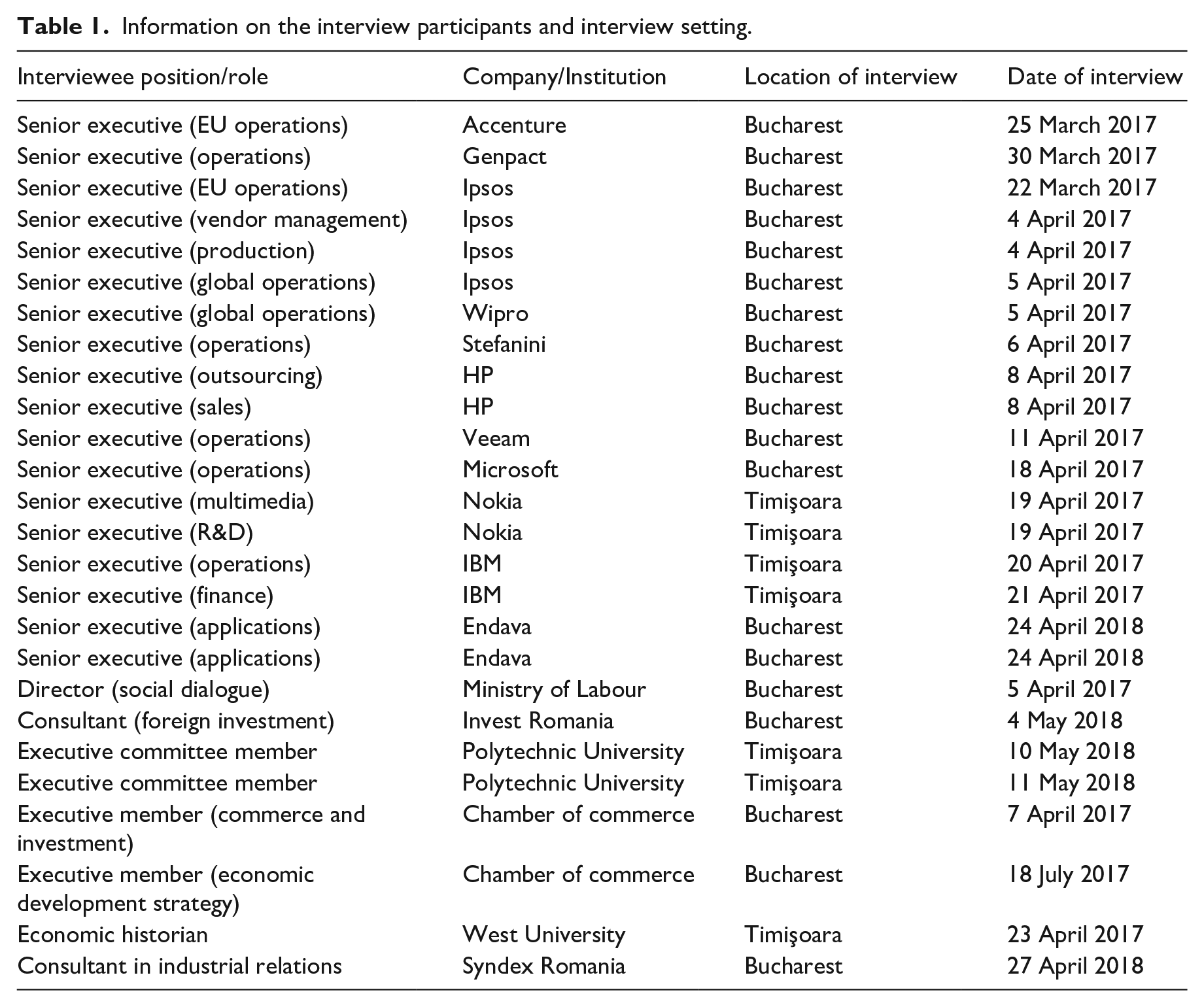
Twenty-six interviews, ranging in length from 1 to 2 hours, were conducted in 2017 and 2018 in two locations: Bucharest and Timişoara (see Figure 1). Interview participants included senior executives of business services firms, state officials with responsibilities for foreign investment or labour, higher education representatives, chambers of commerce leaders, an economic historian and a private consultant in industrial relations (for interview information, see Appendix 1). Interviewing an economic historian was important to better understand the institutional particularities, historical contingencies and place-based specificities of this new industry vis-à-vis former industries ‘vanguards’ of the socialist regime. Whereas interviewing a private consultant in industrial relations was essential to understand how business services firms appoint local institutional intermediaries to translate their interests and negotiate with state agencies the reconfiguration of labour policies and regulations to match firm needs (Phelps and Wood, 2006). Except for one, all interviews were conducted in Romanian. Interviews were recorded, transcribed in full, back-translated and analysed thematically. During fieldwork, I was given half-day tours at Wipro, Ipsos and Nokia.
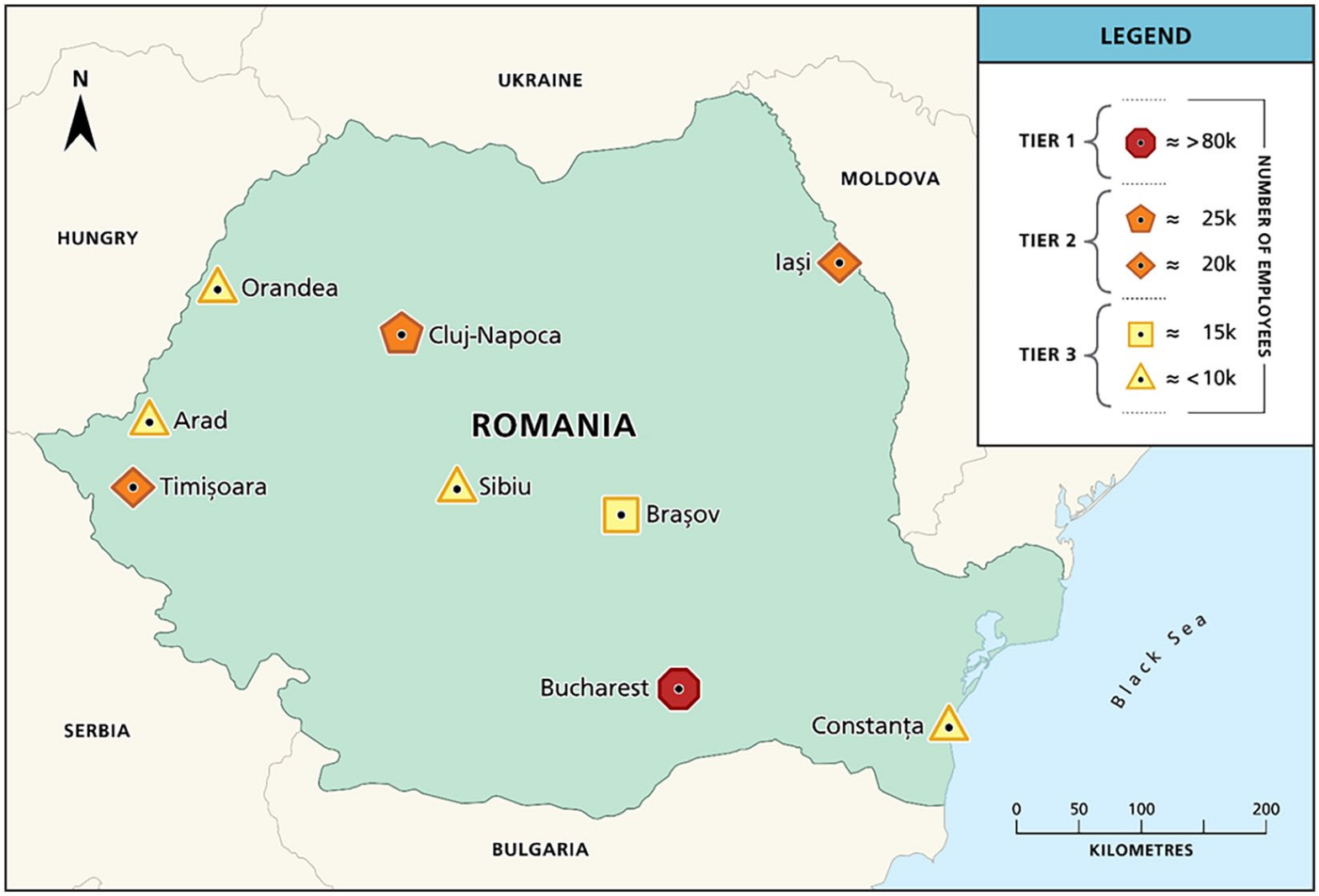
Spatial distribution of business services firms in Romania based on the number of employees.
All interviewed firms were MNCs, mainly from the United States and Western Europe, except for two which were from India and Brazil, emphasising Romania’s ascendancy as both an offshoring and nearshoring site. All firms had at least one strategic partnership with a local university. Ten out of 11 firms had formalised relations with municipal-regional state officials, being actively engaged in public–private initiatives targeting upskilling and infrastructure optimisation. Except for one, all firms were members of ABSL.
Business services in Romania
During the early post-socialist transition, Romania became embedded into manufacturing GPNs, with the importance of services foreign investments – especially business services foreign investments – growing from 2000 onwards (Jipa-Muşat et al., 2024). Cost-reduction considerations drove the relocation of business services to low-cost sites across CEE, especially considering that Romania is cheaper than the Visegrád-Four (Sass and Fifeková, 2011). The most important locational advantages include proximity to a highly educated, young workforce with multilingual proficiency and technical and financial expertise. After the Netherlands, Romania is considered the second most multilingual country in Europe (Peck, 2017). Geographic proximity and cultural affinity are regarded as central factors driving the transformation of the Visegrád-Four region into a popular business services destination (Capik and Drahokoupil, 2011). As evidenced in the following interview, geographic proximity and cultural affinity similarly help to explain Romania’s attractiveness as a key nearshoring location:
The primary attraction was the technical skillset and multilingual capability. People normally speak more than one language. English is a given. The ready availability of other Latin languages like French, Italian, Spanish, Portuguese etc. So, Romanians are multilingual. The second advantage was labour arbitrage, because Romania is just coming around the curve it is still behind in terms of labour costs than the rest of Europe. The third advantage was that while you are part of Europe you are also closer to European customers because of the cultural aspect. (Wipro, 5 April 2017, Bucharest)
Geographic and time zone closeness to corporate clients in conjunction with a shared history and broader processes of cultural harmonisation render Romania a safer, more accessible business services site in comparison to destinations such as India (Ipsos, 4 April 2017, Bucharest). Agglomeration economies and clustering benefits for firms encompass mainly urbanisation economies, including provision of cheap Grade-A office space located in Silicon Valley-type campuses, ultra-fast and secure Internet, and simplified bureaucratic procedures. Over the last decade, there has been a protracted regulatory shake-up, with state agencies bringing the business environment in compliance with international accounting, audit and legal standards – shaping a site of ‘smooth collaboration’ akin to the one highlighted by Peck (2017) when analysing the nearshoring model. This study demonstrates that while structural factors are important to attract MNCs to a particular location, the density of linkages between firms and sub-national institutional actors is equally important to attract MNCs and drive their territorial embedding into regions – as Kleibert (2014) shows when examining the agency of territorial institutions in creating the necessary (pre)conditions to stimulate the offshore services industry in the Philippines.
Over 95 per cent of firms across the industry are foreign MNCs. The industry is highly concentrated in Bucharest; however, MNCs have systematically expanded to tier-two cities since 2006 and tier-three cities since 2014 to deal with the increasingly tight labour market and cost pressures in the capital (Veeam, 11 April 2017, Bucharest; see Figure 1). In terms of industry structure, business services MNCs deliver the following types of functions: ITES (34%), financial services (28%), customer services (26%), human resources (21%), procurement (19%), project management (18%), business transformation (16%) and document management (15%) (Capital, 2019). Romania engages in a balanced mixture of lower and higher value-added activities, contrasting the predominantly lower-end call centre services that the Philippines and Kenya engage in (Kleibert, 2014; Kleibert and Mann, 2020). Romania’s diverse portfolio of lower and higher value-added business services is clearly illustrated in the following interview:
When I look at the broad spectrum, we do everything. I am doing simple work from talking to customers, solving basic issues like password resets to complex HR, admin and payroll activities to level 3 R&D work for customers like Microsoft. And I have seen level 3 work. Microsoft does it here in the GTSC, Oracle has 4000-plus people and they are also leveraging technical capabilities of employees here. (Wipro, 5 April 2017, Bucharest)
The contribution of this research needs to be understood in the context of how the Romanian case is representative of post-socialist economies and middle-income countries that have managed to insert themselves in the new international division of business services labour by upgrading. Processes of upgrading have been achieved on the basis of higher levels of human capital and technical capacity, and more symmetrical linkages between firms and local institutions which have broader developmental outcomes for host regions.
The industry has grown exponentially during the past two decades, from only 200 employees in 2004 to 179,000 employees in 2020 (ABSL, 2018; Economica.net, 2021). In terms of total revenue, it grew from approximately €500 million in 2012 to €9 billion in 2020 (Economica.net, 2021; Romania Insider, 2015), accounting for 3.6 per cent of Romania’s GDP (Business Review, 2021).
Firm–education–industry association linkages across Romania’s business services
The study expands on these different linkages and relations between lead firms and local institutions below as it operationalises the conceptual approach by zooming in on four ‘areas’ of collaboration and the economic, political and institutional transformations they have driven. First, firm–education–industry association linkages fostered recruitment-related activities aimed at increasing the number of graduates going into business services through job fairs, information-dissemination activities on job opportunities, career progression and remuneration, industry-led marketing and branding strategies, and internships. Second, firm–education–industry association linkages co-shaped teaching and curriculum development, with lead firms – in spite of the opposition of some territorial actors – influencing and distorting education policies and skills agendas according to their needs. Third, to compensate for the lack of a class of indigenous managers, firm–education–industry association linkages advanced an educational framework focused on higher-end technical and management skills, which in turn had broader developmental effects on the domestic business environment. And fourth, firm–education–industry association linkages transformed industrial, education and labour market policy, especially as lead firms actively inserted themselves into local policy agendas moulding them in their favour.
Facilitating recruitment
Recruitment-related activities are vital to ensure the continuous supply of highly educated, young graduates, with the industry’s fundamental concern revolving around its ability to attract a growing pool of readily available talent. MNCs in collaboration with universities and ABSL organise job fairs to market the industry (Accenture, 25 March 2017, Bucharest). To attract prospective workers, employers focus especially on job opportunities, career progression and remuneration, which are superior to traditional Romanian industries. Firms set up dedicated recruitment teams which establish linkages with universities to give presentations regarding job opportunities at their company (Endava, 24 April 2018, Bucharest). Special recruitment activities – ‘taster’ sessions or modules – are also organised jointly between MNCs and universities (Nokia, 19 April 2017, Timişoara).
An important recruitment-related activity is the organisation of internships between MNCs and local engineering-oriented universities. Students in their third and fourth year will often work part-time for a business services MNC. The role of internships is threefold: ensure the recruitment of a steady supply of graduates with higher-end technical skills, allow firms to be actively engaged in updating curricula and solving the employment-education mismatch, and enable firms to recover some of their investment in recruitment- and training-related activities. These findings match those highlighted by the wider business services literature (Jipa-Muşat et al., 2024; Kleibert, 2015a).
Firms engage in poaching, especially with regard to experienced engineers and middle-managers. Poaching practices are typically a major source of concern across the industry according to Kleibert (2015b), with one executive stating that workers go out at lunchtime but they never return (HP, 8 April 2017, Bucharest). The interviewee was highlighting the tight labour market in Bucharest’s Pipera industrial park, a phenomenon which has begun to manifest also in second-tier locations such as Cluj-Napoca and Timişoara. Poaching practices may have negative effects on the industry which is still maturing. A high turnover rate and the inability to retain workers in strategic positions may lead to labour costs rising too quickly, which could curb the industry’s competitiveness if left unchecked (Wipro, 5 April 2017, Bucharest). This phenomenon in fact occurred across multinational software firms in the Republic of Ireland during the 1990s and 2000s (White, 2004).
Curriculum (re)design
Curriculum (re)design largely involves the transformation of pre-employment training establishments by higher education and MNCs, which co-shape skills and education infrastructure according to industry needs. The following interview illustrates how business services MNCs in Romania deploy strategies of institution harnessing, enhancing and bending to reconfigure training and education similar to those observed by Hardy and Hollinshead (2016), while also highlighting the agency of territorial actors in imposing their own ideologies and translating MNC influences as witnessed by Phelps and Wood (2006):
Firstly, there is a steering committee within the university that includes representatives of large firms. Together they discuss if they need certain disciplines and specialisations. They meet often and discuss what needs they have in terms of training, what they need from us. And on the other side, we turn to them if we need equipment, financing, course materials. Furthermore, each academic can have relationships with various business leaders and together they develop projects with their firm, they get sponsorships for laboratories, equipment, research, etc. So, the relationship takes place on several levels. (Polytechnic University, 10 May 2018, Timişoara)
Considering business services’ heavy reliance on what Kleibert (2015b) calls highly skilled, primarily urban middle-class workers, the close collaboration between higher education and MNCs has been fundamental for curriculum adaptation. It compensates for the institutional deficiencies of the inherited post-socialist educational system, while also building upon the country’s historical specialisation in technical, financial and applied research disciplines (Gál and Ptaček, 2011). Firm–university partnerships consist of delivery of jointly designed computer science curricula, business management courses, specialised labs and workshops, and organising and financing internships (Polytechnic University, 11 May 2018, Timişoara). These partnerships allow students to have flexible schedules combining full-time study with part-time work at a regional business services MNC.
The push to establish collaborations with local engineering and computer science departments came from business services MNCs, who by the end of the 2000s became involved in curriculum adaptation to strengthen the local base of technical skills and create more firm-specific skills. This underscores what Campling (2021) calls the political-economic agency of MNCs or what Sanfelici and Halbert (2019) mean by stating that economic agents act as ‘urban policy-makers’. Rutherford et al. (2018) emphasise that a mismatch may occur between education institutes and MNCs, owing to the inability of the latter to articulate their long-term skills and knowledge needs far enough in advance for territorial institutions to reconfigure their different pathway degrees. The fieldwork did not reveal such a tension. It did, however, reveal the frequently conflicting goals of public and private sector actors. Specifically, the push by firms is often met with reluctance by different educational representatives to implement firm-centric education policies, who instead argue for more general, portable and lifelong skills. A similar phenomenon was observed by Kleibert (2015a) when analysing the agency of educational representatives in the Philippines, who tried to oppose more unidirectional education policy distortions and forms of MNC capture – although unsuccessfully.
Nevertheless, to a large extent, MNCs managed to impose their strategic agendas and ideologies over those of local institutions. By subsidising universities’ campus planning and development, firms gained the compliance of more apprehensive educational representatives. Particularly influential in reshaping education policy and training provision have been those first-mover MNCs who established the sector in the early 2000s, particularly – but not restricted to – players such as Microsoft, Genpact, HP, Wipro, Nokia and Cisco. Smaller local firms were largely excluded from these restructuring processes. Unable to compete with incoming MNCs, akin to Hardy and Hollinshead (2016), I found that most local firms were squeezed out of the market, with only those possessing specialised skills and knowledge being acquired and integrated into MNCs’ operations. This was the case with one interviewee whose company was acquired by Nokia, with the entire workforce being absorbed (Nokia, 19 April 2017, Timişoara).
MNCs have created a framework for continued learning to support their staff retention requirements. By becoming integrated within 4-year pathway degrees through the delivery of bespoke modules and internships, firms have repurposed the role of universities as ‘engagement programmes’ or strategic initiatives in education to foster the customisation of skills, drive staff loyalty and enhance firm reputation. Once employed, MNCs offer workers opportunities for continued development through a combination of short- and medium-term firm-specific and general training programmes (Nokia, 19 April 2017, Timişoara). Firm-specific training programmes can take place either within the local subsidiary or abroad across global-regional development centres. In case of the latter, engineers engaged in transnational training programmes act as ‘reverse diffusers’ – upon their return, their role is to transfer and embed the new skills, practices and culture acquired abroad (Jipa-Muşat et al., 2024). Whereas through professional-occupational skills development, MNCs stimulate generic skills development by focusing on personal development courses such as project management, time-planning and organisational leadership. These personal development initiatives are part of firms’ concerted efforts to train up domestic managers. In first- and second-tier cities, MNCs increasingly try to influence curriculum adaptation towards more firm-specific skills, while also fostering the generic skills necessary to form a cadre of domestic managers.
Institutional intermediaries such as ABSL act as coordinators, creating an alignment between the agendas of MNCs and territorial institutions. Established in 2012 by senior executives of several major business services providers including Wipro, HP, Genpact and Microsoft who sought to replicate NASSCOM, ABSL has actively engaged in partnerships focused on curriculum (re)design (Wipro, 5 April 2017, Bucharest). The following interview highlights the role of ABSL as a ‘coordinating’ agent acting on behalf of inward investors, which harnesses the bureaucratic machinery underpinning education and governments:
There are three important points as medium- and long-term strategic objectives of the Association. One is knowledge sharing between members, ultimately to learn from each other in terms of processes, market intelligence, technology and professional development. The second issue, or the focal point, is the creation of educational programmes in partnership, particularly, with universities. And the third objective is the relationship with authorities, central and local governments, and other institutions to further support the industry’s development in the medium- and long-term. (Microsoft, 18 April 2017, Bucharest)
The agency of institutional intermediaries in driving regulatory reform and translating between the interests and ideologies of foreign capital and local actors has been extensively discussed (Kleibert and Mann, 2020; Phelps et al., 2005; Phelps and Wood, 2006). The quote illustrates the institutional capacity of ABSL to lobby local-national state agencies for favourable state policy, training provision and labour regulations that match business needs. It also showcases existing triple-helix strategies between MNCs, with and through ABSL, higher education and state agencies aimed towards shaping curriculum development and adaptation. Nevertheless, there are business services leaders which emphasise that deficiencies persist and further education reform is needed to eradicate the employment-education mismatch (Veeam, 11 April 2017, Bucharest).
Managerial skills development
Developing a class of qualified local managers is crucial for regions to upgrade and move up the value chain. However, business services destinations such as the Philippines have been slow to develop high-level training and management institutes, with MNCs being reluctant to collaborate with local institutions to create technical and managerial skills provision (Kleibert, 2015a). In these instances, education institutes become captured by MNCs, who according to Phelps (2008) routinely seek to distort skills agendas in a way that matches their requirements for low-end routinised activities.
The case of Romania is different. During the industry’s early development, managerial positions were principally occupied by expatriates. This class of foreign managers was relocated to Bucharest initially, and afterwards, across other second-tier cities to set up the first Romanian business services operations (Jipa-Muşat and Prevezer, 2023). As evidenced in the following interview, over time these managers were called back and replaced by a new class of locally trained domestic managers:
Teams of Romanian managers get formed and are helped to grow. The CEO is still from the country of origin of the company where the headquarters is. However, there are now domestic intermediary managers that were formed as companies grew. These are the Romanian capitalists. (Endava, 24 April 2018, Bucharest)
Interview material also revealed that MNCs engage in the regular practice of sending domestic middle and senior managers abroad to take part in various transnational training schemes (Nokia, 19 April 2017, Timişoara). Beyond the acquisition of technical skills and knowledge, the purpose of sending managers on these types of training schemes is their understanding and acclimation to the home country culture (Jipa-Muşat et al., 2024). Upon their return, managers disseminate the skills and knowledge acquired and replicate the home country culture across the subsidiary – Kleibert (2015b: 898) calls this reproducing ‘islands of globalisation resembling First World environs’.
The linkages established between MNCs, higher education and ABSL have acted as an avenue for creating this new class of domestic managers by setting up educational collaborations aimed at offering advanced training and postgraduate management programmes. In 2016, several business services MNCs, ABSL and the Academy of Economic Studies (AES) Bucharest established a joint MBA course. Jointly delivered by AES academics and business services leaders, the 2-year programme is aimed at developing managers’ skills in areas such as project management, financial accounting, IT process management, enterprise resource planning and business process optimisation. The creation of advanced management programmes facilitates advanced skills development, as well as the continued education of already employed workers through high-quality accredited higher education courses, signalling that firm–education–industry association linkages are focused on more than just entry-level skills. As evidenced in the following interview, the postgraduate programme co-shaped by industry representatives, ABSL and AES acts as the preliminary phase of a wider public–private strategy to train a growing class of domestic managers:
As an industry we are doing a lot. We started partnering with universities, there’s a Masters programme which runs through ABSL, between ABSL and AES. This partnership with AES acted as a pilot project, which will then be rolled out and replicated at a national level. This is a concerted effort between us and the state. (Wipro, 5 April 2017, Bucharest)
This indicates that while there is a customisation of training and education policy according to firms’ needs, this has been accompanied by a countermovement – similar to that observed by Phelps et al. (2005) when interrogating the agency of education institutes in Wales – through which local institutions have been proactive in broadening developmental outcomes to benefit the wider business community. The fact that business services MNCs through ABSL collaborate with higher education to create a cadre of domestic managers tells us that the Romanian case has not been unidirectionally captured by MNCs to only satisfy their needs for labour-intensive, routinised activities. Instead, it points towards the agency of territorial actors, who according to Phelps and Wood (2006) may equally try to leave their imprint on processes of international economic integration. Furthermore, it illustrates the more symmetrical relations between the different arms of the state and capital, which are more reciprocal and consensual. Through the development of managerial skills provision, the Romanian case has enjoyed increased opportunities for skills upgrading and the ability to move into higher value-added business services. This is similar to India’s focused private sector investments in skills development, which have been crucial for its transition towards more complex and diversified services provision (Fernandez-Stark et al., 2011).
Reshaping state–capital coordination and creating supportive policy cadres
Romania’s transformation into a key outsourcing and offshoring hub has required ABSL to play an active role in reconfiguring industrial, education and labour market policy and state–capital coordination. The Association supports the industry’s development by participating in meetings with potential and existing foreign investors and facilitating interaction between them and regional-national state agencies. In this sense, ABSL works in close collaboration with Invest Romania, the governmental agency for foreign investments. In partnership, they organise joint government-business meetings to exchange information on local business conditions, discuss implementation of internationally aligned business standards, facilitate access to investment incentives and devise marketing strategies to ensure investors can easily tap into the talent pool (Ipsos, 4 April 2017, Bucharest).
ABSL interacts with state agencies to adapt bureaucratic procedures and education provision to investors’ operational needs (Microsoft, 18 April 2017, Bucharest). Joint consultations take place between ABSL and different key ministries (e.g. Ministry of Economy, Ministry of Public Finance, Ministry of Education) to reduce finance and audit procedures, simplify hire-and-fire practices and embed the skill requirements of firms into education planning. Akin to the role and influence of NASSCOM in the Indian business services industry (Karnik, 2012; Kleibert and Mann, 2020), these dynamics showcase how ABSL alongside the territorial arms of the state work together to reduce uncertainty in the business environment and customise training and education provision in firms’ favour. They also point towards the existence of a triple-helix interaction. Nevertheless, such close engagement may amplify the asymmetrical relations between MNCs and territorial institutions, with the latter privileging foreign investors rather than domestic ones. The following interview highlights how lead firms seek to influence education policies under the prerogative of bringing them in closer alignment with firms’ needs:
The biggest problem for foreign investors is the stability and predictability of the legislative framework. At the same time, we would like to be even more involved in educational initiatives to ensure adequate training of the workforce, in accordance with the requirements of this industry. (Veeam, 11 April 2017, Bucharest)
Corporate capture can be understood according to how MNCs actively condition policy to shape local labour markets and skills regimes. The possibility of capture increases in the absence of wider domestic business community involvement in education planning, as lead firms increasingly try to extract highly customised training incentives and recruit the most talented workers. The quote also highlights the persistence of some deficiencies in state The industry is in its infancy right now, it’s very far from mature and largely due to the ignorance of governing bodies, or the insufficient attention of governing bodies. So, I would strongly say that the industry has emerged in spite of the government, not because, but in spite. We are trying to do that with ABSL, but it takes a lot of effort. (Wipro, 5 April 2017, Bucharest)
ABSL assumed a leading role in pushing critical industrial policy to create a favourable taxation regime. Romania’s income tax break for employees in software-related operations has long been considered one of its central comparative advantages (Ipsos, 22 March 2017, Bucharest; Nokia, 19 April 2017, Timişoara). Proposed by business services representatives and rolled out in 2001 as part of an industrial policy programme titled ‘The new economy and the implementation of the information society in Romania’ (Government Ordinance no. 7/2001, 2001), the tax break initially targeted software development exclusively. However, it was gradually extended to cover a wider array of business services-related activities, while simultaneously income and qualifications criteria were lowered to enable more workers to benefit from it. According to interviewees, ABSL played a central role in extending the coverage of the tax break (HP, 8 April 2017, Bucharest). This shows how MNCs leverage the institutional capacity of industry associations to work collaboratively with state agencies in order to reconstruct the business environment according to their strategic needs (Jipa-Muşat et al., 2024). Moreover, it illustrates how state agencies are sensitised to the needs of MNCs through the customisation of incentives and specific techno-industrial policies.
Developmental outcomes of firm–education–industry association linkages across Romania’s business services
Increased territorial embeddedness: moving up the chain
The impact of firm–education–industry association linkages and triple-helix interactions drove the deeper territorial embeddedness of firms and enhanced Romania’s competitiveness as a key location for business services. It allowed the industry to escape the trajectory of other services destinations that have been articulated into GPNs by lead firms as low-cost regions specialised in low value-added, routinised activities such as the Philippines and Kenya (Kleibert and Mann, 2020). Through a focus on curriculum (re)design, advanced technical and managerial skills development, targeted state policy and state
Other developmental outcomes resulting from firm–education–industry association linkages and triple-helix interactions include improvements to the national education system. Higher education representatives view these industry partnerships as an opportunity to be ‘up-to-date with the newest market demands’ and to ‘optimise the curriculum’, thus reducing the employment-education mismatch and facilitating the smooth transition of graduates into employment (Polytechnic University, 11 May 2018, Timişoara).
Apart from skills upgrading, the proliferation of privatised urban planning and support infrastructure (maintenance companies, security agencies, restaurants, transportation) are also developmental implications of these linkages. Incentivising the construction of university facilities (IT labs and research departments, equipment donations, campus amenities) has allowed students and academics alike to reap these benefits (Jipa-Muşat et al., 2024). Triple-helix interactions have also spurred the formation of regional accelerators and incubators with a broad industrial focus, encompassing a wide variety of other industries (education, artificial intelligence, gaming, green technologies) (Nokia, 19 April 2017, Timişoara). While nascent in nature, these transformations of the built environment highlight how linkages recreate business conditions according to MNCs’ needs, creating development opportunities for actors beyond business services.
Corporate capture and dependent development: creating a co-opted workplace labour regime
The close collaboration of MNCs, higher education and ABSL resulted in corporate capture. Capture occurred in the form of a wholesale workplace labour regime reconfiguration. MNCs in conjunction with and through ABSL created a workplace labour regime based on flexible and individualised employment relations, standing in stark contrast to the more protectionist employment relations across traditional manufacturing and extractive industries in Romania (Funk and Lesch, 2004). Its central features include high intra-industry labour mobility, high turnover and a growing incidence of flexible work and pre-determined employment contracts (Capik and Drahokoupil, 2011). The neoliberal particularities of this newly created labour regime are captured in the following interview:
There is a greater degree of mobility that defines the current work framework, whereas the classic work model based on a fixed working schedule and location is no longer the rule. I have seen companies start to use temporary labour. This means that you are working in my company, but you are not employed by Veeam, instead you are employed by a company that deals with hiring labour and you are assigned to me. One thing I know is that as an employer it gives me more flexibility – call it a work-around – because normally it takes me a longer time to fire you. This way the risk is no longer with me, the burden is with the company that hired you (laughs). So, they moved the headache from me to them, and that’s a work-around. That’s what I’m seeing: more part-time, more flexible work, more temporary work, because multinationals have adapted. (Veeam, 11 April 2017, Bucharest)
Industrial relations were restructured by state agencies in collaboration with capital (Ban, 2013; Jipa-Muşat and Prevezer, 2023). Characterised by firm-level unionism and fragmented union structures, legislative changes at the national scale effectively blocked labour organisation at higher levels and classified any form of protest action as illegal (Ministry of Labour, 5 April 2017, Bucharest). MNCs with and through ABSL lobby different state agencies to ‘loosen up’ bureaucratic procedures and facilitate hire-and-fire practices (Wipro, 5 April 2017, Bucharest). Formal labour representation across the industry is low – under 10 per cent (Ipsos, 4 April 2017, Bucharest). When probed about the need for labour representation, MNC representatives stressed that this industry behaves very differently from other industries with ‘long and cumbersome’ union structures and collective bargaining agreements, and that trade unions are not needed (Ipsos, 22 March 2017, Bucharest).
Instead of promoting formal labour organisation, MNCs across the industry have steered workers towards establishing employees’ representative bodies. Legally established in 2011, employees’ representative bodies act a ‘soft’ form of labour representation that has been co-opted by capital. Part and parcel of the government’s systematic decentralisation of collective bargaining and amendment of the Labour Code, the new framework displaces the traditional trade union model, conferring less protection and decreased powers to organised labour. Some of its particularities include a vaguely defined role for employees’ representatives, inclusion of management in employees’ representatives (even in leadership positions), lack of dialogue with state agencies over national labour conditions, lack of alliances with other employees’ representatives bodies and lack of assistance when negotiating with employers’ associations (Labour Code update 2018, Law 53/2003). These findings confirm earlier evidence of institution harnessing, enhancing and bending deployed by MNCs to transform the new division of labour of business services across CEE (Hardy and Hollinshead, 2016), fostering dynamics of corporate capture and negative developmental outcomes.
These structural reforms of industrial relations institutionalised a neoliberal workplace labour regime across Romanian business services, bringing the industry’s labour regime configuration largely in line with the DME model (Nölke and Vliegenthart, 2009). This shows that higher forms of territorial embeddedness and upgrading come at a cost – to secure the ‘embedding’ of MNCs, states need to concede to the weakening of their labour (Jipa-Muşat and Prevezer, 2023). Equally, it demonstrates the political behaviour of MNCs in reinforcing or even trying to extend regions’ dependency on them.
Conclusion
This study exposes some of the developmental outcomes that peripheral and semi-peripheral regions engaged in business services experience as they become integrated in global-regional GPNs. Similar to other studies (Kleibert, 2015a; Manning et al., 2012), the analysis highlights the role played by firm–education–industry association linkages as vehicles fostering the deeper territorial embeddedness of firms into regions. Perhaps the most important effect of these linkages has been their ability to reconfigure the skills and knowledge composition of regions, shifting their specialisation towards more advanced technical and managerial skills – effectively enabling them to upgrade and move up the value chain and experience higher modes of GPN integration. Furthermore, these linkages had positive effects on employment and education transformation by updating and aligning curricula to labour market needs, thus narrowing the employment-education mismatch inherited from the socialist era. By leveraging state relations, MNCs were able to shape a favourable business environment in terms of taxation regime, business-friendly state policy, urban development provision and investment incentives (Jipa-Muşat et al., 2024), emulating institutional environments of home countries.
The analysis of Romania contradicts previous scholarship stating that business services across peripheral and semi-peripheral regions resemble branch-plant economies locked into low value-added, routinised activities with lead firms defined by limited territorial embeddedness (Kleibert, 2015a). Furthermore, the Romanian case is different from other business services destinations – including the Philippines and Kenya – where relations between firms, higher education institutes and industry associations are more arm’s length due to high levels of ‘enclaving’ (Kleibert and Mann, 2020). Unlike these cases where MNCs engaged in call centre operations are the most active in linkage creation, my investigation points towards the exact opposite – in Romania, advanced service providers are the most active in establishing linkages with local institutions. The reasoning behind this stems from MNCs’ desire to build on the inherited superior technical base and shape the business environment and labour market upon which strategic alliances and higher modes of GPN integration depend on.
However, not all regional developmental outcomes are positive. The cost of territorial embeddedness is a degree of corporate capture, stemming from the asymmetrical relations between MNCs and local actors. The case of Romanian business services confirms previous scholarship which argues that even increased local linkages and territorial embeddedness can result in corporate capture (Teixeira, 2024; Yeung, 2015). The industry embarked on a path of dependent development driven by MNCs’ strategies, which transformed the institutional and industrial environment of regions where they invested. Lead firms reconfigured labour regimes at the workplace scale according to the DME logic of firm-level unionism, temporary and flexible work, simplified firing procedures and the de facto creation of alternative co-opted forms of labour representation, effectively influencing a neoliberal labour regime.
An equally important concern represents the impact of labour casualisation manifested through the growing incidence of flexible and pre-determined employment contracts on the higher base of technical skills of the Romanian workforce. While employing a small proportion of temporary workers may allow business services firms to reduce the times and costs associated with hiring and firing and adjust more quickly to adverse macroeconomic conditions, over-reliance on temporary workers might reverse processes of skills upgrading and destabilise the structure of established firm–education–industry association linkages. High labour turnover and intra-industry mobility are likely to destroy the industry’s ability to attract, retain and train high-value engineers and managers, as well as dilute existing innovation capabilities and the residue of inherited technical skills and applied research. Furthermore, the mass migration of highly educated, young workers to Western Europe starting with the late 2000s and accelerating during the 2010s has resulted in the gradual drying up of excess labour (Ban, 2013) – a transformation which no doubt has further tightened the business services labour market. Future research should consider more carefully how these different factors – labour casualisation, turnover and out-migration – have influenced skills development across Romania’s business services.
Since the data for this study were collected in 2017–2018, it would be important for future studies to consider how the Covid-19 pandemic as an exogenous shock reshaped business services GPNs. Verbeke (2020) emphasises two interrelated GPN developments across both manufacturing-oriented and services-oriented industries: first, MNCs prioritising reshoring practices and strategic autonomy, and second, MNCs reducing specific assets and critical partnerships abroad. Thus, future research could interrogate the ways in which business services lead firms have chosen to reconfigure their GPNs and their ability to respond to exogenous shocks.
Footnotes
Appendix 1
Information on the interview participants and interview setting.
| Interviewee position/role | Company/Institution | Location of interview | Date of interview |
|---|---|---|---|
| Senior executive (EU operations) | Accenture | Bucharest | 25 March 2017 |
| Senior executive (operations) | Genpact | Bucharest | 30 March 2017 |
| Senior executive (EU operations) | Ipsos | Bucharest | 22 March 2017 |
| Senior executive (vendor management) | Ipsos | Bucharest | 4 April 2017 |
| Senior executive (production) | Ipsos | Bucharest | 4 April 2017 |
| Senior executive (global operations) | Ipsos | Bucharest | 5 April 2017 |
| Senior executive (global operations) | Wipro | Bucharest | 5 April 2017 |
| Senior executive (operations) | Stefanini | Bucharest | 6 April 2017 |
| Senior executive (outsourcing) | HP | Bucharest | 8 April 2017 |
| Senior executive (sales) | HP | Bucharest | 8 April 2017 |
| Senior executive (operations) | Veeam | Bucharest | 11 April 2017 |
| Senior executive (operations) | Microsoft | Bucharest | 18 April 2017 |
| Senior executive (multimedia) | Nokia | Timişoara | 19 April 2017 |
| Senior executive (R&D) | Nokia | Timişoara | 19 April 2017 |
| Senior executive (operations) | IBM | Timişoara | 20 April 2017 |
| Senior executive (finance) | IBM | Timişoara | 21 April 2017 |
| Senior executive (applications) | Endava | Bucharest | 24 April 2018 |
| Senior executive (applications) | Endava | Bucharest | 24 April 2018 |
| Director (social dialogue) | Ministry of Labour | Bucharest | 5 April 2017 |
| Consultant (foreign investment) | Invest Romania | Bucharest | 4 May 2018 |
| Executive committee member | Polytechnic University | Timişoara | 10 May 2018 |
| Executive committee member | Polytechnic University | Timişoara | 11 May 2018 |
| Executive member (commerce and investment) | Chamber of commerce | Bucharest | 7 April 2017 |
| Executive member (economic development strategy) | Chamber of commerce | Bucharest | 18 July 2017 |
| Economic historian | West University | Timişoara | 23 April 2017 |
| Consultant in industrial relations | Syndex Romania | Bucharest | 27 April 2018 |
Declaration of conflicting interests
The author(s) declared no potential conflicts of interest with respect to the research, authorship and/or publication of this article.
Funding
The author(s) received no financial support for the research, authorship and/or publication of this article.
