




Abstract
Objectives
The prevalence of guaiac faecal occult blood positivity among participants aged 50 in the Scottish Bowel Screening Programme showed a significant increase from 2007 to 2017. As a comparison, we examined the trend in the prevalence of faecal immunochemical test (FIT) positivity among participants aged 50 in the colorectal cancer screening programme of the Veneto region (north-east Italy) from 2006 to 2018.
Methods
The target population includes residents aged 50–69, who are invited to repeat the FIT every two years. The screening programme uses the OC-Hemodia latex agglutination test, with a cut-off for positivity of 20 µg of haemoglobin per g of faeces.
Results
Based on 182,275 FITs performed on participants aged 50, overall FIT positivity was 3.6% in 2006 (95% confidence interval (CI): 3.1–4.2) and 3.7% (95% CI: 3.4–3.9) in 2018, showing no significant trend (p = 0.19). The prevalence of positive test results was higher in males throughout the study period. No gradient was seen for men (2006 = 4.4%, 95% CI: 3.6–5.3; 2018 = 4.2%, 95% CI: 3.9–4.6; p = 0.10) or women (2006 = 2.8%, 95% CI: 2.1–3.5; 2018 = 3.2%, 95% CI: 2.9–3.5; p = 0.84).
Conclusions
In a FIT-based colorectal cancer screening programme in Italy, the test positivity over time was stable. Our findings suggest that the interpretation of faecal haemoglobin levels may not be geographically transferable.
Introduction
Rising trends in the incidence rates of colorectal cancer (CRC) in young adults have been reported in many Western countries.1,2 Goulding and colleagues recently explored this topic in relation to the use of screening programmes. 3 They examined the trend in the prevalence of guaiac faecal occult blood positivity among participants aged 50 in the Scottish Bowel Screening Programme, finding that positivity rates rose from 4.1% in 2007 to 10.8% in 2017.
A CRC screening programme based on the faecal immunochemical test (FIT) has been operating in the Veneto region (north-east Italy) since 2002. The target population includes residents aged 50–69, who are invited to repeat the FIT every two years. The programme uses the OC-Hemodia latex agglutination test, with a cut-off for positivity of 20 µg of haemoglobin per g of faeces (100 ng Hb/ml buffer). We sought to determine whether a trend similar to that reported in Scotland could be seen in the Italian programme.
Methods
We replicated the analysis performed by Goulding et al. in our programme and here report our data from 2006 (when the roll-out of the screening programme was completed) to 2018. We considered only the tests performed between October and May of each year, because a specimen collection device with a buffer formulation designed to improve haemoglobin stability in the event of high ambient temperatures has been in use since 2015.4,5 This change could increase the positivity of FITs performed in the hot season of the last study years, so we disregarded all tests performed from June to September.
Results
In our analysis, based on 182,275 FITs performed on participants aged 50, overall FIT positivity was 3.6% in 2006 (95% confidence interval (CI): 3.1–4.2) and 3.7% (95% CI: 3.4–3.9) in 2018, showing no significant trend (X2 for trend = 16.05, p = 0.19) (Figure 1). The prevalence of positive test results was higher in males throughout the study period. No gradient was seen for men (2006 = 4.4%, 95% CI: 3.6–5.3; 2018 = 4.2%, 95% CI: 3.9–4.6; X2 for trend = 18.54, p = 0.10) or women (2006 = 2.8%, 95% CI: 2.1–3.5; 2018 = 3.2%, 95% CI: 2.9–3.5; X2 for trend = 7.28, p = 0.84).
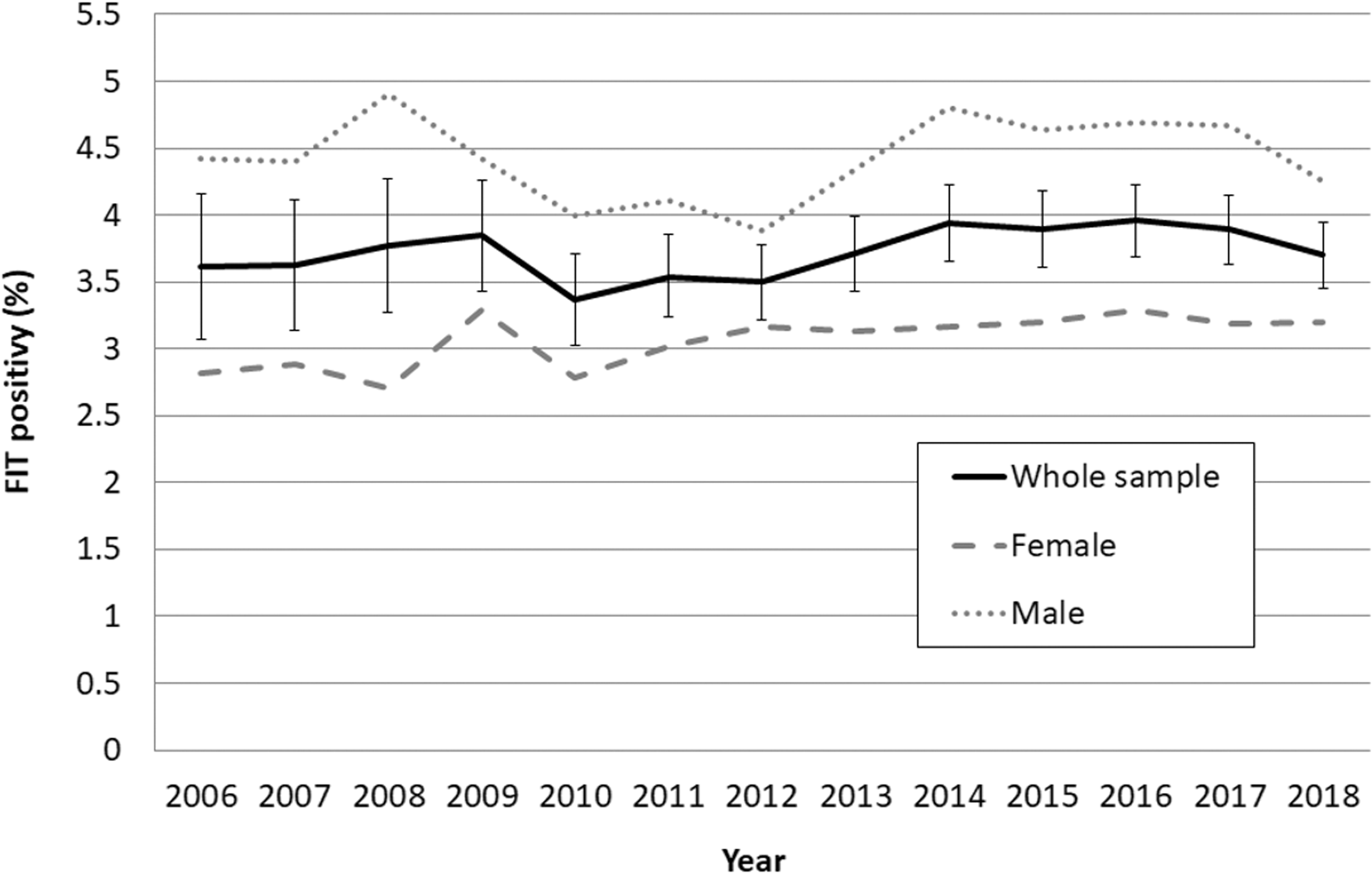
Change in the positivity rate of first faecal immunochemical tests among participants aged 50 in the Veneto Region’s colorectal cancer screening programme from 2006 to 2018.
Conclusion
Our findings differ from the results of the guaiac-based Scottish programme. The underlying reason(s) for this discrepancy are difficult to determine. A difference in background faecal haemoglobin levels between the two countries has been reported, with faecal haemoglobin concentrations in Italy being lower than those in Scotland. 6 In any case, our findings seem to suggest that the interpretation of faecal haemoglobin levels may not be geographically transferable.
Footnotes
Declaration of conflicting interests
The author(s) declared no potential conflicts of interest with respect to the research, authorship, and/or publication of this article.
Funding
The author(s) received no financial support for the research, authorship, and/or publication of this article.