



Abstract
Nowadays, high thermal conductive and good electrical insulating materials gain attention for compact and sustainable design in power electronics instruments like transformers, switches, cables. To cater for these needs, Boron Nitride (BN)/Banana Fiber (BF)/Epoxy based polymer composite is proposed which exhibits good electrical resistance and low dielectric constant. Banana fiber is chosen as it contains few lumens among the fillers and offers good mechanical strength. Boron Nitride and Banana fiber are reinforced with epoxy resin to form highly insulating polymer matrix composite material. Various samples are fabricated, containing 1/3/5 μm BN particle size, 1/3/5 wt % of BN and 0/2/4 wt % of BF derived from Response surface methodology based Box Behnken Design model using design of experiments approach. Further, Analysis of Variance is performed to obtain optimized levels of parameters using regression equation in MINITAB software. Also, experimental results and optimized results are compared leading to error analysis. High resistance of 346.68 Giga-ohms (86.67 ×10⁹ Ω-m resistivity) and minimum dielectric constant of 1.143 are obtained for combination of 3 wt % of BN, 2 wt % of BF and particle size of 3 μm which is considerable for good insulation purpose.
Keywords
Introduction
Plastic is extensively used in electrical field due to light weight, easy to manufacture, good insulation, cost effective, high strength and stiffness characteristics. Incorporation of fillers and natural fibers makes it most eminent among the composite not only in electrical but in mechanical and thermal perspectives also. Exploitation of natural fiber is more beneficial than synthetic fiber because of its recyclability, low density, lesser cost, good strength and stiffness.
Wang et al.1,2 investigated thermal as well as electrical properties of Boron Nitride filled epoxy polymer composites. In part I, during experimentation, authors achieved highest thermal conductivity. Electrical properties such as discharge resistance, breakdown strength were examined in part II. Mainly, smaller fillers enhanced thermal performance but degraded the dielectric properties due to the filler orientation, existence of annulled spaces, amount of fillers and surface amendment. h-BN (hexagonal boron nitride)/Silicon dioxide (SiO2) reinforced with epoxy and aluminum nitride (Al-N) combination offered high thermal conductivity of 12.3 W/m-K and breakdown strength of 75.1 kV peak/mm which was 260% higher than pure epoxy. Alternatively, epoxy conglomerated h-BN/Slica/Al-N combination provided superior breakdown strength but inferior thermal conductivity. To achieve maximum thermal conductivity, the orientation of h-BN filler should be parallel to direction of heat flow and also get higher breakdown strength due to lesser void space.
Tanaka et al. 3 found dielectric strength and thermal conductivity of Epoxy/BN filled composite with different filler sizes. It was observed that addition of nano composite does not affect breakdown strength. Also, there was no significant affect of h-BN up to 40 wt % compared to Al2O3. As filler content increased in c-BN (cubic Boron Nitride), breakdown strength significantly dropped down due to presence of void which could be removed by using different mixing processes. Finally epoxy/conglomerated h-BN/nano silica nano micro composite gave 20% more breakdown strength compared to epoxy composite.
Yu et al. 4 studied three interface structures of Al2O3 nanoparticles, untreated Al2O3 nanoparticles, γ-aminopropyl-triethoxysilane Al2O3 nanoparticles (Al2O3-APS) and hyper-branched aromatic polyamide grafted Al2O3 nanoparticles (Al2O3-HBP) to measure dielectric properties and its effects on morphological behavior. At low frequency, all molecular chains present in epoxy reoriented themselves which enhanced dielectric constant. Increase in AC voltage decreased dielectric constant because, decomposition occurred in polarization at high frequency. The dielectric constant for Al2O3-APS/Al2O3-HBP was little higher with 20 wt % of Al2O3-APS/Al2O3-HBP than Al2O3. Porous and voidable structure of nanocomposite caused deleterious effect and hence dielectric constant decreased.
Salunke and Gopalan 5 presented review on thermal and electrical properties of BN/Epoxy resin composite with the effect of different particle sized BN and filler content on it. Increase in BN content decreased dielectric permittivity which gave higher insulating BN nanosheets.
Perets et al. 6 fabricated multi-wall carbon nanotubes (MWCNTs) reinforced with organosilicon compound treated epoxy by introducing nanocarbon fillers (1–10 wt %) into graphite nanoplatelets (GNPs) and studied the temperature dependent percolation behavior of electrical conductivity. It was addressed that existence of BN increases electrical conductivity due to lesser contact resistance among fillers in GNPs based polymer composite material whereas augmentation of electro-conductive chains forms in MWCNTs polymer composite material.
Wang et al. 7 prepared Al (Aluminum) nanoparticle reinforced epoxy resin composite using ultrasonic dispersion hot-pressing method to investigate dielectric properties using spectroscopy illustrating various dielectric processes within a range of frequency 1–107 Hz. Improvement in mobility of chain was observed when glass transition temperature (Tg) was increased enhancing dielectric permittivity and conductivity.
Weng et al. 8 investigated highly thermal conductive polymer composite material made up of BN/epoxy resin with the use of surface treated h-BN and c-BN powders and studied the effect of various sizes of BN particles on electrical, mechanical and thermal properties. 20 vol % of h-BN offered 253% more thermal conductivity than c-BN. Also it enhanced its storage modulus but mutually overall gain in dielectric constant was comparatively lesser. A c-BN exhibited more dielectric constant than h-BN because diamond structure (3 dimensional) had more storage capacity of charge than graphite structure. All BN/epoxy resin sample showed dielectric constant value less than 4.5 which indicated its good electrical insulation behavior.
Samanta et al. 9 studied dielectric properties of Al/epoxy composite materials used in capacitors. Authors analyzed the effect of filler contents within 1 kHz–1 MHz frequency range with respect to formation of clusters and rise in interfacial polarization among the filler. Validation of results was carried out by means of different theoretical models such as Lichtenecker Model, Bruggman Model, Bottcher’s Model etc. for finding thermal conductivity and hardness and AC conductivity using charge transport mechanism to identify conduction mechanism.
Yuan et al. 10 selected graphene oxide (GO) as thermal conductive filler and polydopamine (PDA) as electrical insulator on the basis of their properties and performance. 0.96 vol % of GO-PDA offered 4.13 W/m-K and 4.56 W/m-K thermal conductivity across in-plane and through-plane respectively along with excellent insulation (>1014 Ω-cm).
Zhou et al. 11 analyzed thermal, electrical and mechanical characteristics of epoxy/h-BN, treated with silane which conferred higher thermal conductivity (1.2–1.34 W/m-K) with enhanced glass transition temperature compared to untreated h-BN. The dielectric permittivity increased with increase in h-BN and decrease with frequency. h-BN with 50 wt % offered less dielectric permittivity (>5.4) with minimum dielectric loss (>0.02) and higher dielectric strength (16 kV/mm) along with volume resistivity (6.3 × 10¹⁴ Ω-cm).
Pothan et al. 12 examined volume resistivity and dielectric constant along with loss factor of chemically treated Banana Fiber reinforced polyester matrix composite. Surface modification of fibers improved mechanical properties and electrical properties due to better filler-matrix interaction. Mainly, dielectric constant depends on fiber content whereas electrical conductivity is influenced by means of surface modification treatment (methacryloxy silane) and further, comparison was made with untreated fiber.
Venkateshwaran and Elayaperumal 13 appraised structural and mechanical properties of BF reinforced polymer composites. Banana fiber, categorized under cellulosic fibers, gave less moisture absorption ability (40 wt %) along with high tensile strength (142.9 MPa) than all other natural fibers. Mechanical/physical properties of BF reinforced with cement, biodegradable, thermoplastic and thermoset plastic were briefly discussed. Authors concluded that BF could be a good option to produce cost-effective and biodegradable composite materials used in various construction and automobile industries.
Islam et al. 14 investigated dielectric constant and dielectric loss tangent factor (tanδ) for smaller size BF reinforced with polypropylene prepared by hot-press moulding method. The dielectric constant depends on fiber content but temperature and frequency (up to 1 MHz) do not affect it. Conversely, dielectric constant is very low at higher frequency due to opposition in interfacial polarization for varying electric fields. It was noticed by Islam et al. that, tanδ is directly proportional to content of fiber reinforced at low frequency and inverse to the rise in temperature.
Ali et al. 15 stated that multivariable analysis and multi-criteria decision analysis could be used to choose a suitable natural fiber and recommended for food packaging applications. From analytical hierarchy, Hemp, banana and sisal natural fibers were ranked based on physical, mechanical, chemical, technical and environmental parameters.
Wang et al. 16 studied the effect of particle size and its content on thermal and electrical properties of BN/epoxy polymer composites. Dielectric permittivity decreased as BN content increased which signified it a good electrical insulator. As particle size of BN increased (up to 10 μm), breakdown strength reduced, whereas it was improved with reduction in particle size which weakened inception charge leading to build a strong macromolecular bond.
Tang et al. 17 inspected insulation properties and thermal conductivity of h-BN/epoxy polymer matrix composite along with the effect of temperature and mass fraction. As h-BN content increased, initially dielectric constant and then dielectric losses decreased. Further increase in h-BN content lowered the breakdown strength above the glass transition temperature.
Zhang and Stevens 18 prepared BN reinforced in ether of bisphenol-A resin and measured dielectric properties by Novo-control ALPHA-A high resolution dielectric analyzer to study the variation of BN fillers. Change in DC current remains constant even after the addition of BN up to 120°C but it increases dielectric constant along with glass transition temperature.
Huang et al. 19 summarized thermal conductivity along with the coefficient of thermal expansion for various materials considering the effect of filler size and shape, microstructure, surface treatment and hybridization of different fillers. Authors suggested that BN could be selected as filler to make thermally conductive and electrically insulating polymer composites.
Plesa et al. 20 listed the various applications of polymer composites for high voltage instruments and suggested different combinations of material could be used in electrical field with their scope.
Jayamani et al. 21 studied various dielectric properties of polymer composite made from jute and bamboo fibers reinforced with polypropylene. Increase in frequency decreased dielectric constant and highest value of interfacial polarization was noticed. Chemical treatment offered lesser dielectric constant because of reduction in voids along with decrease in moisture absorption capacity.
Salunke and Gopalan 22 investigated thermal conductivity of BN/BF/Epoxy polymer matrix hybrid composite with its potential applications in electronic field and emphasized more on electrical properties for future perspective.
Bhardwaj et al. 23 studied tensile and flexural properties of sugarcane fiber/BN/fly ash reinforced polymer matrix bio-degradable composite and investigated the effect of BN and fly ash on tensile and flexural properties respectively.
This paper discusses polymer matrix composite of BN/BF filled with epoxy resin to get maximum electrical resistance and low dielectric constant to get good hybrid insulating composite. The SEM of BN powder, as illustrated in Figure 1, shows microstructure of hBN powder. The effects of the particle size and content of BN along with BF on the electric properties, mainly resistance and dielectric constant, are examined. SEM micrographs of BN specifying size of 3 μm.
Here, BN and BF are reinforced with epoxy resin to make eco-friendly composite. Further, electrical resistance and dielectric constant measurements are carried out for different wt% of BN/BF to discover good electrical insulating green polymer composite material. ANOVA is performed to obtain regression equation and the same is validated with experimental results. Developed BN/BF/Epoxy polymer based composite offers good electrical resistance and hence it can be used as insulator in various electrical instruments.
Methodology
Different levels and parameters (wt% of BN, wt% of BF, Particle size of BN).

From BBD model, seventeen (17) samples are prepared as per flowchart stated in Figure 2. Initially, natural fibers are prepared in powder form and then mixed with different wt% of BN/Epoxy as mentioned in Table 2. Stepwise preparation of BN/BF/Epoxy composites. Possible combinations of samples for various parameters using BBD Model.

Materials
BN powder of 1 and 5 μm, Epoxy resin (LY556) and hardener (HY951) and Banana fiber (raw) are procured from Supervac Industries, Herenba instruments & engineers and Gogreen Products respectively.
Sample preparation
Samples are prepared with size of 50 × 50 × 10 mm3 as illustrated in Figure 3 with the help of sheet metal mould. BN/BF/Epoxy samples.
Electrical resistance (resistivity) measurement
Figure 4(a) shows Keithley 2450 Interactive SourceMeter instrument used to measure electrical resistance through VI characteristics feature using KickStart startup software. Firstly, the device is connected to front side to FORCE HI and FORCE LO terminals and then POWER is switched on ensuring source-measure function working properly. After that, FUNCTION button is pressed to select input parameters measurement range (Auto), source range (20 V), source voltage (10 V) and current (10 mA). At last OUTPUT switch is turned on to display voltage and current on screen and start cycle (+/− 10 V) on KickStart software to measure VI characteristics for a particular time period. Measurement of electrical resistance and dielectric constant. (a) Measurement of electrical resistance with Keithley 2450 Interactive SourceMeter and (b) Dielectric constant apparatus setup.
Dielectric constant measurement
Variable capacitor terminals are connected to front panel of apparatus as shown in Figure 4(b). Next, the value of variable capacitor is noted down as C1 by setting it to standard point at 100 PF and the control button sensitivity value is adjusted to 85 μA in such a way that maximum deflection should be from 85 to 90 μA. At this moment, without disturbing the system, test sample is inserted between two metal sheets and variable capacitor is varied until maximum deflection is achieved called as resonance condition. The value of variable capacitor is recorded as C2. Now, test sample is removed and variable capacitor is measured as C3 at resonance condition. Similarly, these steps are repeated to measure variable capacitors for remaining samples and dielectric constant (K) is calculated as per equation (1).
C1 Capacity of standard variable capacitor at resonance condition
C2 Capacity of standard variable capacitor at resonance condition containing test capacitor with sample
C3 Capacity of standard variable capacitor at resonance condition containing test capacitor without sample
Results and discussions
Electrical resistance (resistivity) by experimentation
Electrical resistance measured using Keithley 2450 Interactive SourceMeter.

It is observed that maximum resistance is offered by samples 2/4/6/8/13 containing 3 wt % of BN, 2 wt % of BF and particle size of 3 μm located centrally in BBD model. It indicates that it could be good electrical insulator as it exhibits resistance of 346.68 Giga-Ohms with resistivity of 86.67 ×10 9 Ohm-m.
Electrical resistance analysis (ANOVA)
Analysis of Variance (ANOVA) results.
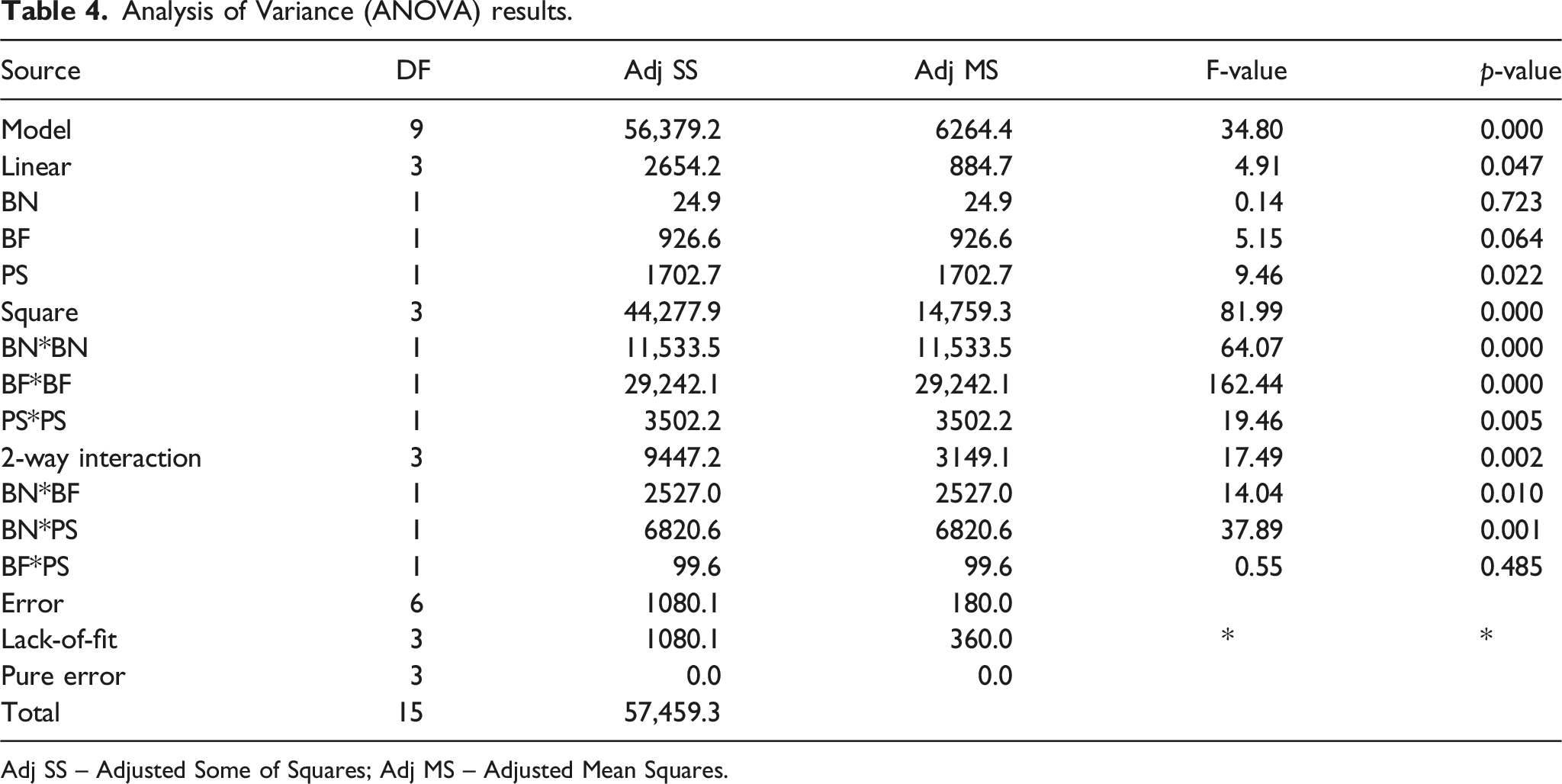
Adj SS – Adjusted Some of Squares; Adj MS – Adjusted Mean Squares.
Adj SS – Adjusted Some of Squares; Adj MS – Adjusted Mean Squares; F-Value signify to choose “Accept or Reject” the Hypothesis. p-value facilitates to discover the significance of results.
At first, regression equation is obtained to find the values of resistance for all 17 samples as per equation (2).
Comparison of resistance obtained by experimentation and regression equation.

It is noticed that an increase in content of BN/BF increases resistance and reaches up to certain value and then decreases if changes are made in particle size of BN. Significant content of BN/BF and particular BN size offer maximum resistance and serve as good insulator for shock resisting materials.
Effect of BN/BF/PS interaction is shown in Figure 5 and it is observed that all constituents equally contribute regarding resistance property. Surface plot for resistance versus BF/BN shows that combination of 3 wt % of BN and 2 wt % of BF gives resistance more than 300 Giga-ohms as per Figure 6(a). Effect of wt% of BN (a), Banana fiber (b), Particle size (c) on resistance. Surface plot for resistance versus BF/BN/PS. (a) Surface plot of resistance versus BF/BN, (b) Surface plot of resistance versus PS/BN and (c) Surface plot of resistance versus PS/BF.

Figure 6(b) shows surface plot of resistance versus PS/BN. Combination of 3 wt % of BN and medium particle size (3 μm) offers good resistance. It is noticed that larger particle size with lesser BN content exhibits excellent insulation property. On the other hand, a moderate particle size and 2 wt % of BF offer large resistance whereas resistance decreases after reaching a significant point as shown in Figure 6(c).
Effect of each parameter namely wt% of BN/wt% of BF/PS independently on resistance is shown in Figure 7(a) via plotting main effect plot. It is observed that at moderate level of all parameters such as 3 wt % of BN, 2 wt % of BF and particle size of 3 μm, maximum resistance is achieved. The significant amount of BF (2 wt %) gives highest resistance which ensures a good electrical insulation. (a) Main effects plot for resistance (b) Optimization Plot for resistance.
Criterion for optimization.

Error analysis between optimized and experimental results for resistance.

Dielectric constant by experimentation
Dielectric constant is calculated by measuring variable capacitance of standard specimen and test samples at resonance condition with the help of dielectric constant apparatus. Initially, variable capacitor of test sample is measured. Subsequently, standard capacitor values with and without dielectric material are noted down. Similarly, same procedure is repeated for identical samples. Then average value of dielectric constant is calculated using equation (1).
Experimental values of dielectric constant.

Dielectric constant analysis (ANOVA)
Analysis of Variance (ANOVA) results.
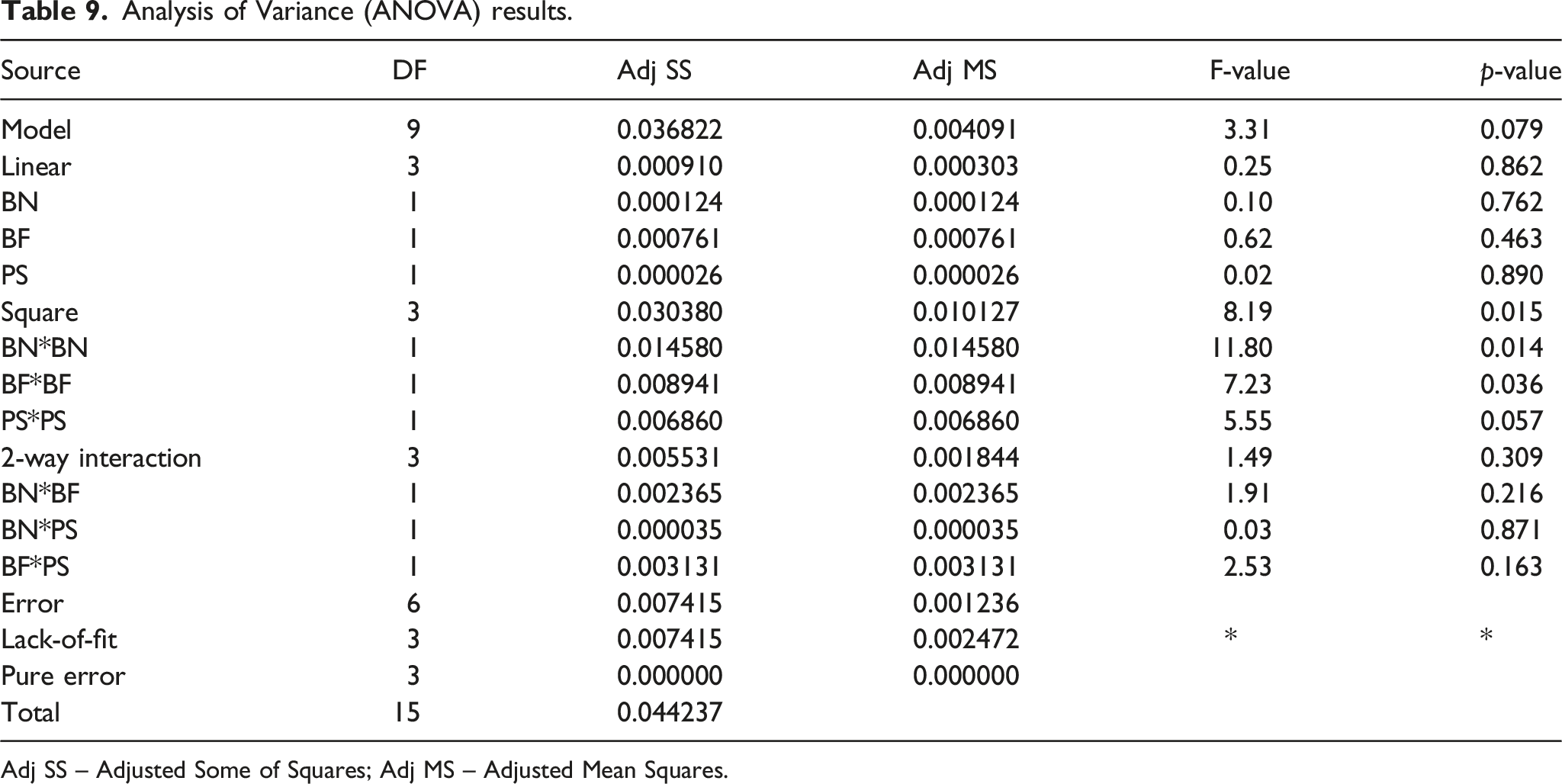
Adj SS – Adjusted Some of Squares; Adj MS – Adjusted Mean Squares.
Adj SS – Adjusted Some of Squares; Adj MS – Adjusted Mean Squares; F-Value signify to choose “Accept or Reject” the Hypothesis. p-value facilitates to discover the significance of results.
Initially, regression equation is formulated to find the values of dielectric constant for all 17 samples as per equation (3).
Error calculation between experimental values and regression equation.

Particular combination of BN/BF/PS offers less dielectric constant whereas dielectric constant reaches high with lesser and fine particle of BN. Hence, it can be concluded that minimum dielectric constant is achieved with the specific amount of BN/BF/PS. Thus, it acts as good insulator.
Figure 8 shows the consequences of each parameter on dielectric constant represented by Pareto chart. BF and BN contents mainly affect dielectric constant. The effect of BF/BN content on dielectric constant is illustrated by the surface plot presented in Figure 9(a). Dielectric constant for 3 wt % of BN and 2 wt % of BF shows less than 1.15 which indicates good electrical insulation property. Effect of wt% of BN (a), Banana fiber (b), Particle size (c) on dielectric constant. Surface plot of dielectric constant versus BN/PS/BF. (a) Surface plot of dielectric constant versus BF/BN, (b) Surface plot of dielectric constant versus PS/BN and (c) Surface plot of dielectric constant versus PS/BF.

Surface plot for PS/BN, shown in Figure 9(b), with 3 wt % of BN and 3 μm sized BN powder gives lowest dielectric constant but gives a maximum value at higher BN content and large particle size. Larger sized BN with increasing BF content offers a maximum dielectric constant which signifies poor resistance as visualized from Figure 9(c). Combination of 2 wt % of BF and 3 μm sized BN shows lesser dielectric constant and thus exhibits excellent insulation against electrical shock.
Main effective plot for BN/BF/PS, represented in Figure 10(a), is to understand the effect of each parameter on dielectric constant. Combination of intermediate content of BN/BF and moderate particle sized BN tenders minimum dielectric constant while either smaller or larger content tenders maximum dielectric constant which offers less resistance towards electric current. (a) Main effects plot for dielectric constant and (b) Optimization Plot for dielectric constant.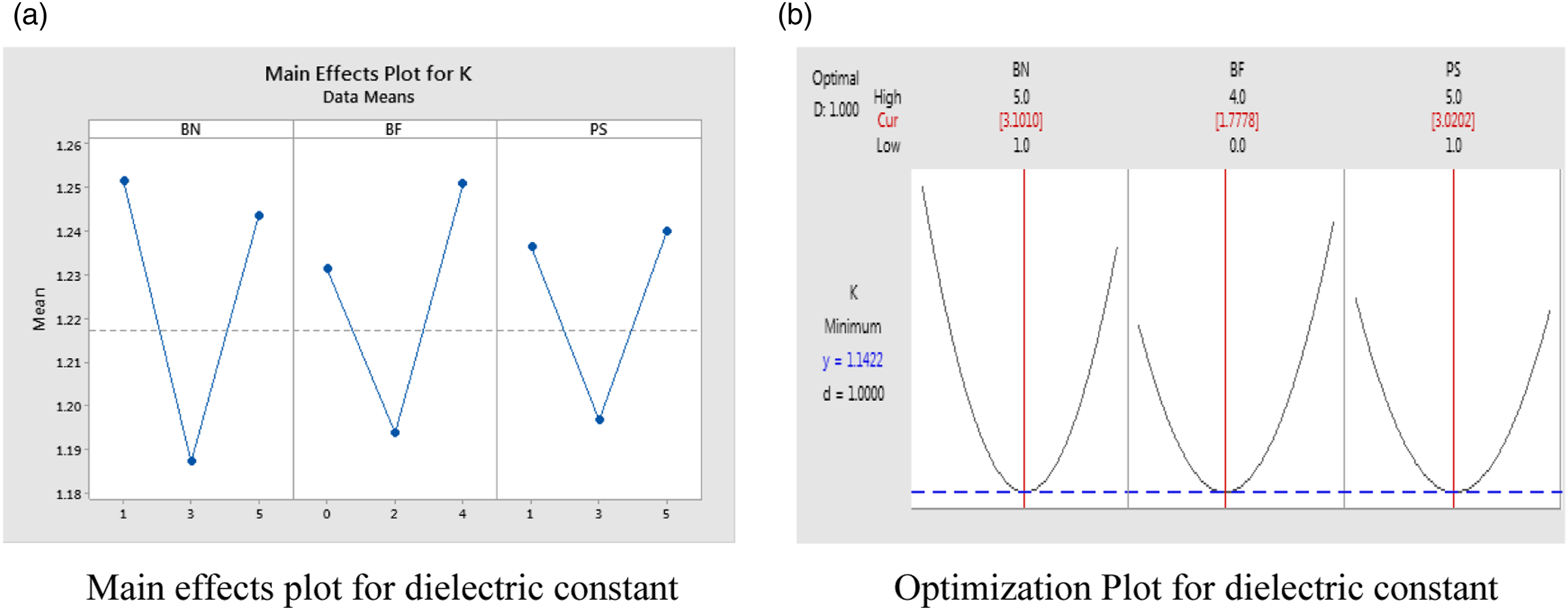
Criterion for optimization.

Error analysis between optimized and experimental results for dielectric constant.

Conclusion
Electrical properties such as resistance and dielectric constant of BN/BF/epoxy reinforced polymer matrix composite are investigated in this paper. Electric resistance and dielectric constant are measured using Keithley 2450 Interactive SourceMeter instrument and dielectric constant apparatus respectively. A BBD model using RSM technique is employed to study the effect of wt% of BN/wt% of BF/particle size on resistance. Regression analysis is performed to obtain regression equation for said properties based on experimental values using MINITAB software. Pareto chart, main effect plot and various surface plots are drawn to analyze effect of input parameters on resistance and dielectric constant correspondingly. Error analysis is performed to find % error for resistance and dielectric constant between experimental results and regression equation which are obtained less than 8% and 4% respectively.
Maximum resistance is achieved as 346.68 Giga-ohms (resistivity of 86.67 ×10⁹ Ohm-m) for 3 wt % of BN, 2 wt % of BF and particle size of 3 μm whereas minimum dielectric constant of 1.1429 is observed for the same constituents of BN/BF/PS. From optimization, it is understood that these combinations tender maximum resistance and less dielectric constant. This indicates developed composite offers good electrical insulation property which could serve as eco-friendly and green shock resistive composite material for human safety purpose in various electronic appliances.
Footnotes
Authors’ contributions
Dinesh Ramesh Salunke: Software, Validation, Formal analysis, Investigation, Resources, Data Curation, Writing - Original Draft, Writing - Review & Editing, Visualization, Project administration. Venkatachalam Gopalan: Conceptualization, Methodology, Resources, Supervision.
Declaration of conflicting interests
The author(s) declared no potential conflicts of interest with respect to the research, authorship, and/or publication of this article.
Funding
The author(s) disclosed receipt of the following financial support for the research, authorship, and/or publication of this article: Authors thank VIT management for funding of this work through “VIT-SEED grant”.
