



Abstract
It is highly important to determine how mechanical and dynamic properties of composite materials will change after impact loads considering the coupled effects of composite design parameters. For these reasons, three-point bending and vibration tests have been carried out for the carbon fiber reinforced thermoset and thermoplastic composites with various stacking sequences before and after low velocity impact, and it is expected that these results achieved from the current study will be beneficial for applications where high damping and impact resistance are demanded together. In this context, vibration tests were carried out under free-free boundary conditions, and their natural frequencies, flexural moduli and structural damping were obtained. Furthermore, three-point tests were conducted in the elastic region with 1 mm/min crosshead speed using a universal test machine, and thus flexural moduli of the composite specimens were obtained. The results were validated by comparing the flexural moduli obtained from the both vibration and three-point bending tests, found to be reliable and comparable. As a result of the current study, it was concluded that woven fabric reinforced composite specimens exhibited 50% higher specific damping capacity (SDC) but 70% lower flexural modulus than unidirectional specimens thanks to biaxially fiber alignment. On the other hand, specific damping capacities of the thermoset and thermoplastic composites with different stacking sequences have been examined, and it was observed that thermoset specimens exhibited unexpectedly 192% higher SDC compared to the thermoplastics. This was interpreted as even though thermoplastics are normally expected to exhibit more damping than thermosets, stacking sequence being more effective on damping responses. Apart from that, although there were slight changes in material properties due to degradation in structural integrity after 2 m/s and 3 m/s low-velocity impacts, it was not found to be significantly effective due to the limited damage areas.
Introduction
Composite materials are becoming increasingly indispensable for many industrial applications due to their specific properties such as high strength, damping and impact performance. These materials can be exposed to high stress levels due to resonance frequencies resulting in damages as matrix cracks, fiber breakage, delamination etc. 1 It is clear that amplitudes and stress levels at resonance can be reduced by improving damping properties. For this purpose, many researchers have conducted studies to determine dynamic properties and to find out ways to increase the damping performance of the materials.2–15 Damping is defined in different ways such as energy dissipation or conversion of mechanical energy to thermal energy. It is known that energy dissipation in a composite material depends on parameters such as matrix and fiber types, matrix-fiber interface, nanomaterials additive, stacking sequence, fiber orientation etc. In a study conducted by Doddi et al., 3 pineapple leaf and basalt fiber reinforced composites were manufactured and effects of the fiber orientations of the outer basalt layers on the tensile, flexural and damping properties were investigated. It was revealed that composite specimens in which basalt fibers aligned in transverse direction exhibited best damping value. Furthermore, best flexural responses and storage modulus were observed for the composite specimens in which basalt fibers aligned in longitudinal direction. In another study, Alshahrani and Ahmed 4 examined the effects of the stacking sequence on the flexural modulus, strength and crash-resistance of the composite materials, and stacking sequences were found significantly effective on the results. From this study, it was concluded that crash performance can be improved by adjusting the stacking sequences of the composite specimens. Bhudolia et al 6 conducted studies to optimize the fiber types, stacking sequence and fiber orientations of hybrid composites and it was found that Kevlar fibers in hybrid composite improved the structural damping. In another study, Khan et al. 7 experimentally examined the effect of Multi-Walled Carbon Nanotubes (MWCNTs) on damping and concluded that the use of nanomaterials improved damping as a result of sliding at the CNT-matrix interface. Furthermore, DMA analysis was used to show the improvement effects of CNT utilization on damping. Similarly, Subramani and Ramamoorthy 9 investigated the enhancement effects of MWCNTs additive with various weight percentages on the natural frequencies and damping of the composite shells. It was stated that 20% increment in natural frequencies and 7% improvement in the damping were achieved thanks to the 1 wt% MWCNTs addition. In another study, 11 Single-Walled Carbon Nanotubes and MWCNTs were used to observe effects of nanotube types and weight ratio and it was concluded that 5% MWCNTs caused 700% improvement in the damping ratio. Additionally, Shishevan et al. 13 investigated the effect of nanoparticles such as MWCNTs and Graphene Nano Platelets (GNPs) on the mechanical and dynamic properties and it was found that MWCNTs had better performance than GNPs.
Numerical models based on stress and strain energy are commonly utilized to determine the material damping.16,17 For instance, energy distribution in the longitudinal, transverse and shear directions can be used to estimate the damping of symmetrically laminated composites using normal stress, normal strain and shear strain. 17 A study claimed that there were many studies in the literature using two-dimensional stress states, but not too much dealing with three-dimensional ones. 18 Mahi et al. 19 experimentally validated a strain energy based-numerical model to determine the damping of unidirectional composite materials. It was observed that damping increased with frequency, and relatively high damping could be achieved between 40° and 60° fiber orientations. In another study, 20 Sahu and Das experimentally and numerically examined the vibration responses of the composite beams with transverse cracks. In the study, first-order shear deformation theory was used to investigate frequency-based crack response. It was concluded that vibration responses were significantly affected by the location and size of the cracks.
Correct measurement of a structural damping value is an important issue for reliable design of the components exposed to vibratory and noise conditions. As far as the vibration test is concerned, the specimens under the test somehow are interacted with measuring and exciting devices, and also with boundary conditions of the test set-up. Kadioglu and Coskun 21 carried out vibration tests under free-free boundary conditions by using a non-contact mechanism, with aiming to get reliable results. In the experimental set-up, specimens were stimulated by induced airflow and response was picked up with a laser Doppler vibrometer. In a study conducted by Geweth et al., 22 damping responses of aluminium plates under various boundary conditions, and hence effects of the boundary conditions on the damping performance were investigated. It was concluded that the lowest damping was observed when the specimens were suspended at nodal lines. Likewise, Fallström and Johnson obtained the natural frequencies and mode shapes of anisotropic plates using a TV-Holography. 23
Thermoset polymers are more preferred than thermoplastics owing to their good temperature resistance. Therefore, these materials are frequently utilized in products operating at high temperatures. Thermoset materials, which stand out with their stiffness, can be exposed to high amplitude and stresses in vibrational applications, and could experience failure. Although thermosets are less vulnerable to impact loads due to their brittle properties, thermoplastic materials absorb more energy and show greater toughness by virtue of chain slippage. 24 That’s why thermoplastics exhibit more plastic behaviour and have good damage tolerance and impact resistance. 25 For these reasons, thermoplastics are becoming increasingly favorable material for many industrial applications, and so, many studies are conducted to examine the mechanical, vibration and impact performance of thermoset and thermoplastic composites.26–31 Bhudolia et al. 27 reported that tubular composites produced using the innovative Elium thermoplastic resin showed 16.3% and 18.9% higher peak load and damage energy, respectively, under impact tests compared to carbon/epoxy tubes. It was claimed that more ductile and spreaded failure was observed in thermoplastic tubes. It was also found that thermoplastics had 21.7% higher structural damping and they showed more strain to failure and less delamination under flexural tests. In another study, 28 a new Methylmethacrylate (MMA) thermoplastic resin was used as matrix material and it was revealed that carbon/MMA composites have 13% and 74% higher damping than carbon/epoxy systems at room temperatures and glass transition temperature respectively. On the other hand, Irfan et al. 32 manufactured short carbon/glass fiber reinforced vinyl ester composites and investigated the fiber orientations and hybridization effects on the flexural responses. It was concluded that specimens with longitudinal fiber orientations exhibited better flexural performance than those with random fiber orientations. In another study, 33 thermoplastic polyurethane and carbon nanotube modified polyurethane thermoplastic was designed, and then interleaved into the interfaces of the carbon fiber reinforced plastics. From this study, it was stated that although carbon nanotube modified polyurethane thermoplastics had negative effects on mechanical properties, they had good damping behaviors. Thermosets have greater bending stiffness than thermoplastics. Hence, these materials exhibit lower load carrying and deformation capability under low velocity impact. 34 When epoxy and polyetheretherketone (PEEK) matrix systems are compared, PEEK matrix systems have been seen to exhibit higher damage tolerance. 35 Micro and macro level cracks may occur in the structures after impact loads. That’s why solution methodology based on Laplace transform technique was presented to examine the effect of partial surface cracks on vibration results. 36 In another study, Gunes and Sahin 37 investigated the effect of cracks with various geometric parameters on low velocity impact results and it was revealed that the crack geometry had significant effect on rigidity, peak force, interaction time, bending stiffness, elastic deformation etc. In addition, Lu et al. 38 examined the low velocity impact-induced damages for the thermoset and thermoplastic composites using a three-dimensional X-ray microscope. In this context, carbon fiber reinforced thermoplastic PEEK and thermoset Epoxy composites exposed to low velocity impact under various energy levels and damage mechanisms were investigated. As a result, it was concluded that thermoplastic exhibited better interlaminar and intralaminar properties. Furthermore, it was stated that delamination area for the thermoplastic composite was 54.78% of that in thermosets.
Impact loads cause various damage mechanisms 39 in composite materials and accordingly degradation in dynamic and mechanical properties. 40 On the other hand, composite materials exhibit different mechanical and dynamic behaviors depending on the design parameters such as fiber orientation, 41 resin material, 42 stacking sequence 43 etc. For that reason, it is highly important to determine dynamic and mechanical responses for the composites with various design parameters. It is clearly seen from the literature that there are many studies related to vibration and mechanical responses of destructed and non-destructed composites. However, no study has been found where the mechanical and dynamic properties of the composite materials were investigated taking into consideration coupled effects of composite design parameters. For that reason, in this study, it was aimed to investigate the coupled effects of composite design parameters such as fiber orientation, stacking sequence, resin materials on the mechanical and dynamic properties. In this context, unidirectional/woven carbon fiber reinforced thermoplastic (PEEK) and thermoset (Epoxy) composites were manufactured, and were exposed to vibration and three-point bending test after low velocity impact under various energy levels to define how mechanical and dynamic responses will change. In this way, natural frequency, flexural modulus and damping responses were evaluated after impact-induced local damages taking into consideration the coupled effects of composite design parameters.
Materials and methods
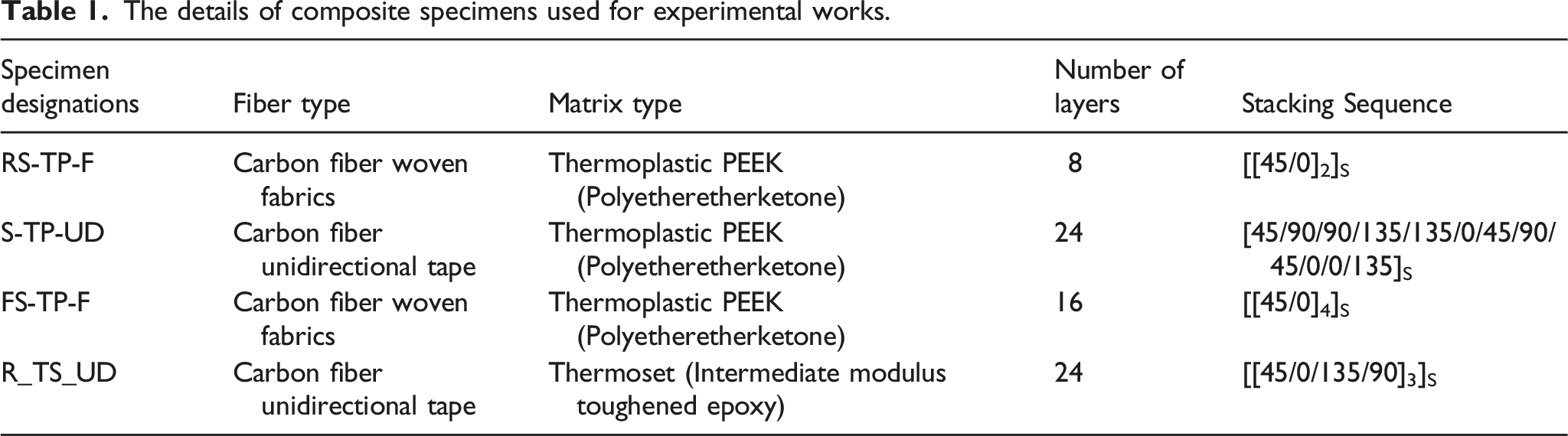
The details of composite specimens used for experimental works.
Geometrical details of specimens used for experimental works.

The low velocity impact tests were carried out according to the ASTM D-7136 standard using experimental set-up shown in Figure 1. In the experimental studies, a 5.6 kg impactor with a hemispherical tip was dropped from 20.39 cm and 45.87 cm corresponding to 11.2 and 25.2 J impact energy, respectively. The samples were subjected to the impact loading at 2 m/s and 3 m/s velocities, then same samples were tested under quasi-static three-point bending loads and also under non-destructive dynamic vibration conditions at low stress levels. When the impactor hits the material for the first time, it transfers some amount of kinetic energy to samples and rises again by converting the remaining energy into potential energy. This cycle continues until the total kinetic energy is consumed, and the impactor applies more than one impact to the material during this process. Therefore, low velocity impact set-up has an anti-rebound system that is used to avoid multiple impacts. In this system, the sensor detects the impactor movement so that the hydraulic pistons are opened immediately after the first impact to prevent repeated impacts. In this way, the residual energy transfer to the specimens is prevented, and the dynamic behaviors are evaluated under controlled impact energy. Before the experimental works, a fixed point was defined on the specimens to obtain the same conditions in all tests and it was ensured that impact was applied to the same point for all samples. Impacted and non-impacted specimens are shown in Figure 2. Experimental set-up for the low-velocity impact tests. Front surfaces of the test specimens used for experimental works: (a) non-impacted, (b) impacted with 2 m/s velocity and (c) impacted with 3 m/s velocity.

For the dynamic properties of specimens, vibration tests were carried out by using the experimental set-up is shown in Figure 3. Before the experimental works, the nodal points on the samples for the first bending frequency mode were defined and then the specimens with the defined points were placed on the ties connected to U-shaped supports that provided free-free boundary conditions. A non-contact mechanism was used to vibrate and to get response from the vibrating specimen, which resulted in obtaining accurate natural frequency and damping values of the specimens under the test. The specimens were excited by an induced airflow generated by a small plate connected to electromagnetic shaker. The sinusoidal excitation force with the desired amplitude and frequency was transferred to the shaker vibrating the samples, and response was received by using a laser doppler vibrometer. Responses were taken from three different points on the samples in order to get more reliable and repeatable results. The electrical signals transmitted from laser doppler vibrometer to oscilloscope were instantaneously converted to visual amplitude/frequency graphs and thus the resonance frequencies were investigated. Schematic representation of vibration test system for free-free boundary conditions.
In the current study, the bandwidth method was used to measure damping values of the samples, and the results were presented in specific damping capacity (SDC) that expressed as a percentage. The measurements were made at the resonance frequency which was obtained when the frequency of the shaker was coincident with the natural frequency of the specimen. Flexural modulus was calculated
44
by using equation (1) that is the natural frequency:
The samples were also subjected to the quasi-static three-point bending test that was conducted according to the ASTM D7264/D7264M-15 standard. To measure the quasi-static flexural modulus a force up to 250 N was applied to the samples within their elastic behaviour using a constant crosshead speed of 1 mm/min. Tests were repeated at least three times for each sample to see if the results are repeatable. Flexural modulus obtained from the both techniques, three-point bending and vibration tests, were compared to validate experimental results. It is important to note that the flexural modulus obtained from the quasi-static bending loading and the non-destructive vibration tests can be different due to stress levels.
Results and discussions
Experimental results obtained from vibration and three point bending tests for non-impacted specimens.

Experimental results obtained from vibration and three point bending tests for impacted specimens with 2 m/s velocity.

Experimental results obtained from vibration and three point bending tests for impacted specimens with 3 m/s velocity.

Results from the non-impacted specimens are shown in Table 3. It can be seen that RS-TP-F and FS-TP-F samples fabricated from thermoplastic resins and woven carbon fabrics with [[45/0]n]s stacking sequence have almost the same details except thickness (See Table 1). Although these specimens exhibited approximately the same SDC and flexural modulus, FS-TP-F showed greater natural frequency. The main reason for this is because the dimensions are extremely effective on the natural frequencies (see Equation (1)).
In order to determine the effect of woven and unidirectional fabrics on the properties of thermoplastic matrix composites, damping and flexural modulus of two specimens designated as FS-TP-F and S-TP-UD were evaluated. It is known that damping, defined as an energy dissipation, depends on the stiffness of materials. High stiffness usually means low damping or vice versa. It is also known that strength and stiffness of composite materials can be affected by changing fiber orientations. When the fibers are aligned in the loading directions, known as longitudinal loading, composites exhibit high strength and stiffness, since most of the stress would be carried by these fibers. The fibers can also be aligned in the transverse directions, in this case, composites have more damping as a result of decrement in the stiffness. It should be pointed out that, for woven fabrics, since fibers are biaxially oriented in the longitudinal and transverse directions, stress would be carried by fibers for both two axes. When compared to unidirectional composites, these materials generally exhibit less stiffness and higher damping as a result of less number of the fiber in the longitudinal direction. Therefore, utilization of woven fabrics as a reinforcement material had significant contribution to structural damping, which can be seen in Table 3 and Figure 4. It was found that, as to be expected, FS-TP-F had approximately 50% higher SDC because of biaxially fiber alignment. Moreover, significant reduction in the flexural modulus, approximately 70% lower than that of the unidirectional samples, was observed. Flexural modulus and Specific damping capacity results obtained from vibration tests for a non-impacted specimens.
Experimental results of the samples fabricated from unidirectional carbon tapes incorporated with thermoplastic PEEK and thermoset epoxy are shown in Tables 3–5 and Figures 4–6. It was obtained that thermoset composite samples had approximately 192% higher SDC. Normally, thermoplastic materials are expected to absorb more energy thanks to their chemical structure. Moreover, these materials can exhibit more plastic deformation by virtue of chain slippage and have less stiffness than thermosets. However, it was found that the results of the thermoset composite samples had 40% lower flexural modulus compared to those of the thermoplastic. It should be noted that matrix material is extremely important for all properties of composite materials but not the only effective parameter. Therefore, unexpected results for thermoset and thermoplastic samples can be interpreted as stacking sequence are more effective on the damping responses than resin material. Furthermore, unexpected results can be interpreted as the effects of anisotropy or permanent stresses caused by differences in production methods. Flexural modulus and Specific damping capacity results obtained from vibration tests for an impacted specimens with 2 m/s velocity. Flexural modulus and Specific damping capacity results obtained from vibration tests for an impacted specimens with 3 m/s velocity.

As mentioned before, samples were subjected to the low velocity impacts with two different energy levels. In the experimental works, impactor hits the samples and leads to flexural loading in the specimens. Under bending loads, it is well known that three basic types of static stresses, tensile, compressive and shear present in the sample during interaction times, which can cause either micro or macro damages in the composite materials such as fiber breakage, matrix crack, delamination etc. Depending on the level of the damages, it may cause a serious decrease in properties or material failure. In this context, mechanical and dynamic properties of composite samples were observed and the results for impacted and non-impacted ones are shown in Tables 3–5 and Figures 4–6. As can be seen from the figures, applied impact energy levels was not significantly effective on the samples and so caused the slight changes in the properties. For instance, specimen designated as FS-TP-F show nearly 6% increase in SDC with the consequent decrement in the flexural modulus as much as 4%. Therefore, it is fair to say as the applied impacts with 2 m/s and 3 m/s velocities have not considerable effects and the slight change in the properties can be attributed to local damaged areas.
As can be seen from Figure 7, bending and vibration tests were conducted to determine flexural modulus, and the results were compared to assess the effects of parameters, which were discussed in previous sections, such as dimensional details, fabrics textile, matrix materials, impact velocity etc. It was concluded that although there were slight differences between results, obtained from destructive and non-destructive tests, as a consequence of applied stress levels, both systems can be used to determine flexural modulus. It is also clearly seen from Figure 7, since the damage was located in the local area and impact velocity was not sufficient as pointed out in the previous paragraph, it was not observed significant changes in the flexural moduli. On the other hand, it was seen that there was a great difference in the flexural modulus values obtained from the vibration and three-point bending tests for some specimens. Especially, for the unidirectional thermoset specimens, designated as R-TS-UD, approximately %100 differences were observed. This difference was expressed as the result of aspect ratio (thickness to length ratios of specimens). When the geometric details of R-TS-UD and FS-TP-F were observed, it can be easily seen that these specimens have more thickness to length ratios compared to the others. For these reasons, it has been observed that the reliability of quasi-static tests decreases as the thickness to length ratio increases, and when the SD values are taken into consideration, the vibration results are more reliable and repeatable. Flexural modulus results obtained from vibration and three point bending tests.
Conclusion
In the current study, dynamic and mechanical responses for the unidirectional/woven carbon fiber reinforced thermoset and thermoplastic composites have been investigated after low velocity impact under 2 m/s and 3 m/s velocities. In this context, vibration and three-point bending tests were carried out, and experimental results were evaluated to determine coupled effects of composite design parameters on the material responses. Some significant outcomes achieved from the current study as follows: • When the RS-TP-F and FS-TP-F composite specimens are compared, it is clearly seen that they have the same design parameters except for the number of layers. The vibration results revealed that number of layers caused significant changes in the natural frequencies as expected, but was not significantly effective on the specific damping capacities. This shows that the natural frequencies can be adjusted by considering the resonance probabilities without affecting the specific damping capacities. • It was concluded from the experimental results that woven fiber reinforced composites exhibited less stiffness but higher structural damping than unidirectional composites. For instance, specimens in which woven fabrics were used as reinforcement materials showed approximately 50% higher SDC but 70% lower flexural modulus. This was attributed to the increment in fiber density throughout the transverse directions and correspondingly improved energy dissipation capacity. • When the S-TP-UD and R-TS-UD composites are compared, it can be seen that they have same design parameters except for the resin materials and stacking sequences. For that reason, specific damping capacities and flexural moduli have been examined to determine coupled effects of resin materials and stacking sequences, and thus it was concluded that thermoset composites exhibited unexpectedly 192% higher damping but 40% lower flexural modulus compared to the thermoplastics. It is well known that matrix materials are quite important but not the only influencing parameter on the composite material responses. The results obtained in this context have been interpreted as even though thermoplastics are normally expected to exhibit more damping than thermosets, stacking sequence were found more effective on the material damping. • When the flexural moduli from the three-point bending and vibration tests are compared, it is clear that the results are generally similar, and therefore both experimental systems can be used to achieve flexural modulus. However, it has been concluded that there may be deviations in the results depending on the applied stress levels and aspect ratio of the specimens, and hence the results obtained from the vibration tests are more reliable. Apart from that, considering the impact-induced damage effects on the material responses, it was revealed that low velocity impact with 2 m/s and 3 m/s were not significantly effective, and caused a slight variation depending on the local damage area.
Footnotes
Declaration of conflicting interests
The author(s) declared no potential conflicts of interest with respect to the research, authorship, and/or publication of this article.
Funding
The author(s) received no financial support for the research, authorship, and/or publication of this article.
