




Abstract
Multiscale hybrid composites were prepared using varying weight percentages (0 to 5) of multiwalled carbon nanotubes (MWCNTs) as nanofiller and a fixed weight percentage (20) of short glass fibres as micro filler (in polypropylene (PP) matrix. The shear and extensional viscosity of the composites was measured using a capillary rheometer. It was observed that even at higher shear rates the synergism of micro and nanofillers in the matrix significantly enhanced the melt viscosity. The complex nanotube network entanglement with micro fillers and PP chains imparted restrictions to the polymer chain movements. The prepared samples were subjected to thermal ageing at 100°C for 4 days in hot air oven. After ageing, multiscale composite with 3 wt% MWCNTs exhibited 28.57% enhancement in strain at break, whereas the tensile strength and modulus reduced by 6.8% and 8% respectively. The fracture toughness properties like strain energy release rate and critical stress intensity factor were not affected for multiscale composite at the optimum content of 3 wt% MWCNT, even after thermal ageing.
Introduction
The materials used in structural, automotive, impact resistant applications should possess significant tensile strength, modulus and good energy absorption capability. Instead of using conventional metallic materials, hybrid polymer composites in which multiscale fillers are incorporated could play a prominent role for crashworthy applications. 1 Thermoplastic polymer like polypropylene (PP) is commonly used in automotive and structural applications due to their low cost, easy processability and good mechanical performance. In many cases where the material is subjected to impact loading, the applicability of polypropylene reinforced composites are limited due to its poor toughness and energy absorbing capability. 2 To impart the aforementioned properties to the composites the nano reinforcements used are nanosilica, halloysite nanotubes,3,4 MWCNTs,5,6 graphene nanoplatelets7,8 titanium oxides,9,10 alumina, 10 nanoclay 11 and the major micro scale reinforcement used is glass fibre. 12 Diego Pedrazzoli et al. 13 reported the effect of varying amount of fumed silica and graphene nano platelets in the presence of PP-g-MAH on the microstructure and the thermo mechanical properties of PP matrix reinforced with glass fibres. The tensile strength and elastic modulus increased while elongation at break reduced as the content of both glass fibre and nanofiller increased. Karsli et al. 14 detailed the better dispersion of MWCNTs in PP matrix owing to the functionalization of CNTs with silane molecules. Gururaja et al. 15 reported that hybrid composites have now been established as highly efficient high performance structural materials where high tensile strength and modulus are required.
Polymers when subjected to prolonged exposure at elevated service temperatures can undergo both cross linking and scission of macromolecules.16,17 The influence of thermo-oxidative ageing on the static dynamic mechanical, thermal and morphology of glass fibre reinforced PBT composites at a temperature of 120°C was discussed by Zhang et al. 18 They reported enhanced thermal stability and shift in glass transition due to the effect of cross linking. Tomlal Jose et al. 19 reported that accelerated solar ageing deteriorated the tensile properties but maleic anhydride-modified PP resisted the degradation. Another group of researchers 20 reported the mechanical and thermal properties of aged PP/EPDM composites reinforced with bamboo/talc in the presence of maleic anhydride compatibilizer. They inferred that increase in fibre content and compatibilizer enhanced the tensile fatigue and after ageing tensile fatigue decreases due to weakening in polymer/compatibilizer bonding. The aged composites exhibited lower reduction in tensile strength and modulus with high content of maleic anhydride with regard to non-aged composites. Pydi Hariprasadarao et al. 21 revealed the thermal ageing behaviour of PP/HDPE (high density polyethylene) and observed that thermal ageing increases the percentage of elongation at break and decrease tensile strength and modulus of virgin PP and HDPE polymers. However, it is examined that the inclusion of nanoclay in PP/HDPE composites maintained the tensile strength and modulus and further decrement in tensile properties owing to thermal ageing was minimal. In another work 22 thermal ageing behaviour of hybrid composites reinforced with basalt fibres and hazelnut shells was discussed. They reported a significant decrease in tensile strength and modulus after thermal ageing owing to the decrease in molecular weight and change in the chemical composition of the composite structure. Thermo-oxidative ageing behaviour of short carbon fibre reinforced polyamide-6 composites in comparison with glass fibre reinforced composites was explained by Lin Sang et al. 17 They revealed that tensile strength of the composite was maintained while izod impact strength continuously decreased during ageing process owing to the interfacial debonding due to chain scission, oxidization and formation of chromophoric groups of polyamide molecules. In another work 23 it was discussed that percentage degree of crystallinity of polyamide/long glass fibre composites decreased which affects the crystalline structure and melting temperatures during ageing.
Liang et al. 24 investigated the apparent melt viscosity of polypropylene composites filled with aluminium hydroxide and magnesium hydroxide with temperature ranging from 180 to 200°C and apparent shear rate varying from 10 to 2000s−1. The melt shear viscosity increases linearly with increase in weight fraction of fillers. 24 The rheological behaviour of calcium carbonate and talc filled PP hybrid composites was reported by Samsudin et al. 25 At higher shear rates and 15 wt% loading of fillers the composites exhibited shear thickening at 220°C and the microscopic images proved that dense filler packing caused this behaviour. 26
An effort has been made to analyse the effect of thermal ageing on the mechanical properties of nano, micro and multiscale (hybrid) composites. Thermal ageing studies have been conducted to relate the suitability of hybrid PP/MWCNT/Glass fibre composites at elevated temperature environments. The impact strength and fracture toughness characteristics of the composites were studied after ageing in order to signify the influence of multiscale fillers in resisting degradation at elevated temperature. The mechanism that hinders the mobility of polymer chains due to the synergism of micro and nanofillers has been elucidated using rheological studies. To the best of our knowledge the thermal ageing studies and the rheological properties of multiscale (nano-micro) reinforced composites are not reported widely and particularly in PP/MWCNT/glass fibre polymeric system.
Experimental
Materials
The polypropylene granules purchased from Reliance Industries (Mumbai), India of grade Repol-H200MA has a melting temperature of 167.7°C and melt flow rate of 20 g/10 min (230°C, 2.16 kg). Carboxylic acid (1.5 wt% of -COOH) functionalized MWCNTs procured from United Nanotech Innovations Pvt. Ltd was used as the nanofiller. MWCNTs had an average length of 10–20 microns, diameter 20–30 nm and specific surface area of 210 m2/g .The glass fibres of average diameter 14 µm and length 3 mm was used as micro scale filler.
Composite preparation
Master batches of MWCNTs in PP prepared using an internal mixer was melt blended with correct proportions of polypropylene and 20 wt% of glass fibre in a counter rotating twin screw extruder with length to diameter ratio of 30. The screw speed was maintained at 100 rpm and the barrel zone temperatures of the extruder were kept 160°C, 180°C, 190°C and 210°C. The extrudate pulled out at the die zone of the extruder was then pelletized and injection moulded (processing temperature: 180 to 210°C) to standard tensile test specimens and nomenclatures are reported in Table 1.
Sample nomenclature of PP, nano and hybrid composites.

Characterization methods
The dispersion of carbon nanotubes in the matrix was investigated on ultrathin slices of composites using a JEM 2100 TEM (JEOL) transmission electron microscope (acceleration voltage of 200 kV). The samples for scanning electron microscopy were sputtered with 3 nm thick gold–palladium layer and the surface morphology was analysed using JEOL JSM-6490LASEM. The universal tensile testing machine was used to perform tensile tests at a constant cross head speed of 50 mm/min at room temperature. The shear viscosity of the composites was measured using Rosand Advanced Rheometer (RH2200, Malvern Instruments, UK, ASTM D3835) system with twin bore facility. All experiments were performed via 20 mm long die (L/D = 20 mm) in the left bore and the orifice die (zero length die) of the same diameter (1 mm) in the right bore. Thermal ageing tests were carried out in a hot air oven maintained at 100°C for 4 days and the dumbbell specimens were cooled to room temperature. The fracture toughness was studied using universal tensile testing machine UT40 equipped with a load of 20 kN at a crosshead speed of 1 mm/min. As per ASTM D5045 test standards single edge notch bending test was conducted and the critical stress intensity factor (Kc) and strain energy release rates (Gc) of the composites were calculated using the expressions.


where P: maximum load, B: breadth of the specimen, W is width of the specimen, a: crack depth and Ec: modulus of the composite.
Results and discussion
Scanning electron microscopy
It could be observed from Figure 1(a) that glass fibres are uniformly distributed and dispersed in the PP matrix. Further, the MWCNTs on the glass fibre surface confirms the presence of multiscale fillers in H3 hybrid composite (Figures 1(b) and (c)).

(a) SEM image of PP/glass fibre (G) composite (b) SEM image of a single glass fibre showing the presence of CNTs on the surface (H3 composite) (c) SEM image of the surface of glass fibre in hybrid composite (H3).
Transmission electron microscopy
Figure 2(a) represents the TEM image of N3 composite system showing the uniform dispersion of MWCNTs in the PP matrix. Figure 2(b) represents the TEM image of ‘H3’ composite system which clearly depicts the entanglement of high aspect ratio MWCNT fillers and Figure 2(c) delineates the uniform dispersion and distribution of MWCNTs in H3 composite system.

(a) Dispersion of MWCNTs in PP matrix in N3 composite (b) Entangled MWCNTs in H3 hybrid composite (c) Uniform dispersion of MWCNTs in H3 hybrid composite.
Rheological properties
Melt viscosity using capillary rheometer
The shear viscosity of neat PP, nano, micro and hybrid composites were carried out at 260°C with shear rates varying from 10 to 5000 s−1. The correction factor (Bagley and Rabinowitsch
26
) were incorporated to account the pressure drop at the capillary entry and the surface shear rate respectively. To estimate extensional viscosity (ηe) from shear viscosity data, Cogswell converging flow method was employed. Following the power law model, the assumption used is that the apparent shear viscosity (ηa) depends on apparent shear rate (


where ‘n’ is the power law index.
It could be observed that PP exhibits almost a constant viscosity at low shear rates (Figure 3) due to its semi crystalline nature. On the other hand at low shear rates (10 to 100 s−1) a significant increase in shear viscosity for nanocomposites could be identified.

The variation in shear viscosity with shear rate of neat PP and nanocomposites.
It should be noted that the MWCNTs have high surface area to volume ratio which aids notable interactions with polymer chains and could resist the flow. 27 At higher shear rates (above100 s−1) nanocomposites exhibited a drop in viscosity due to the shear thinning behaviour of nanocomposites. As shown in Figure 4 the addition of 20 wt% of glass fibres in PP matrix significantly raised the viscosity of ‘G’ composite at low shear rates. Beyond 100 s−1, there is a drastic decrease in viscosity of the composite owing to the incapability of micron size glass fibres to hold the PP chains at higher shear rates. Interestingly, for multiscale composites, in the region of shear corresponding to injection moulding (1000 to 10000 s−1) the viscosity drop with shear rate is gradual as against the abrupt nature exhibited by nanocomposites. This explains the synergism of multiscale fillers in PP matrix. It is noticed that till 3 wt% of MWCNTs in ‘G’ composite, the viscosity enhanced which could be attributed to the uniform dispersion of fillers, better entanglement density and adhesion characteristics. The formation of agglomerates at higher content of MWCNTs could lead to disentanglement and weak interfaces making the PP chains slip rather than anchor.

Shear flow curves of neat PP, micro and hybrid composites.
Rheological data could be used to estimate the power law index ‘n’ (
Flow index obtained from power law model.

The composite ‘H3’ exhibits higher elongational viscosity followed by ‘N3’ and ‘N1’composites (Figure 5). At low shear rates, the inclusion of MWCNTs increases the extensional viscosity and at higher shear rates the presence of MWCNTs is less effective. The behaviour portrayed by these composites explains the extended interaction of MWCNTs and entanglement of MWCNTs on PP chains and the alignment of CNTs in the direction of applied shear. The micro composite as expected could not contribute much on extensional viscosity as the glass fibres incorporated are stiff and brittle. The spike (around 10–12 s−1) in Figure 5 is assigned to strain hardening. It can be explained as the strengthening of polymer chains during large strain deformation. During extension of polymer chains, their alignment is predominant and as they come close to each other, interchain entanglements can occur resulting in localized constrained regions. In the presence of micro scale glass fibres in PP and multiscale fillers in the hybrid composites (G, H1, H2, H3 and H5), the entangled network of polymer chains along with fillers will be more strengthened, which enhances the resistance against the extensional flow due to large number of constrained regions.

Variation of extensional viscosity with extensional rate for neat PP, nano, micro and hybrid composites.
Thermal ageing
Tensile properties of thermally aged composites
The tertiary carbon atom present in PP is vulnerable to oxidative degradation which is recognized as free radical chain reaction at elevated temperature environments.
Thermal ageing reduced the tensile strength of PP by 11.6% and the reduction in strain % explains the fragility of PP (Table 3).
Comparison of stress, percentage strain and tensile modulus values of nano, micro and hybrid composites.

* BA: Before ageing *AA: After ageing.
The strain% of ‘N1’ composite reduced significantly which shows that the 1 wt% of MWCNT is not enough to anchor PP chains during ageing (Figure 6). With further increment of MWCNTs (3 wt %) in PP, the modulus of the composite decreases and at the same time, strain % of ‘N3’ composite is maintained. The energy absorbing capability of ‘N3’ composite is high which is manifested as higher strain% and this is indicative of the increase in toughness of the composites even after thermal ageing. In the case of glass fibre filled microcomposite, it could be detected that after ageing the brittleness of the composite has reduced and the elongation at break doubled. This characterizes the higher energy absorbing capability of ‘G’ composite and increase in toughness after ageing. However, an appreciable decrement in tensile strength and modulus of around 13% and 25% could be observed.

Comparison of stress-strain plots of neat PP and nanocomposites before and after thermal ageing.
In comparison with nanocomposites all hybrid composites after ageing exhibits significant enhancement in elongation at break (Figure 7). It is noticed that at 3 wt% inclusion of MWCNTs the tensile strength and elongation at break were maintained even after ageing. After 24 hours of thermal ageing at 100°C, sufficient time and temperature is provided for the relaxation and the gradual movement of polymer chains. 18 In the case of ‘G’ composites a notable decrement in modulus (2542 MPa to 1900 MPa) is seen due to the loosening effect and bulk movement of PP chains surrounding the glass fibre. On the other hand, in the hybrid ones, even though the bulk movement of polymer chains around micron size glass fibre exists, the slackened PP chains tend to coil with adjacent MWCNTs. Thus the applicability of hybrid composites under impact loadings and varying weather temperatures could be indicated.

Comparison of stress-strain plots of neat PP, micro and hybrid composites before and after thermal ageing.
Fracture toughness of thermally aged samples
With the incorporation of 1 wt% CNTs in PP, failure load increased by 6.6% after ageing (Table 4). From the appreciable increment in the Kc value (5.8%) and Gc (45.6%) in N1 composite with regard to PP, one could infer that the formation of micro cracks in the nanocomposites are hindered by MWCNTs.
The failure load, critical stress intensity factor (Kc) and strain energy release rate (Gc) of nano, micro and hybrid composites before and after thermal ageing.
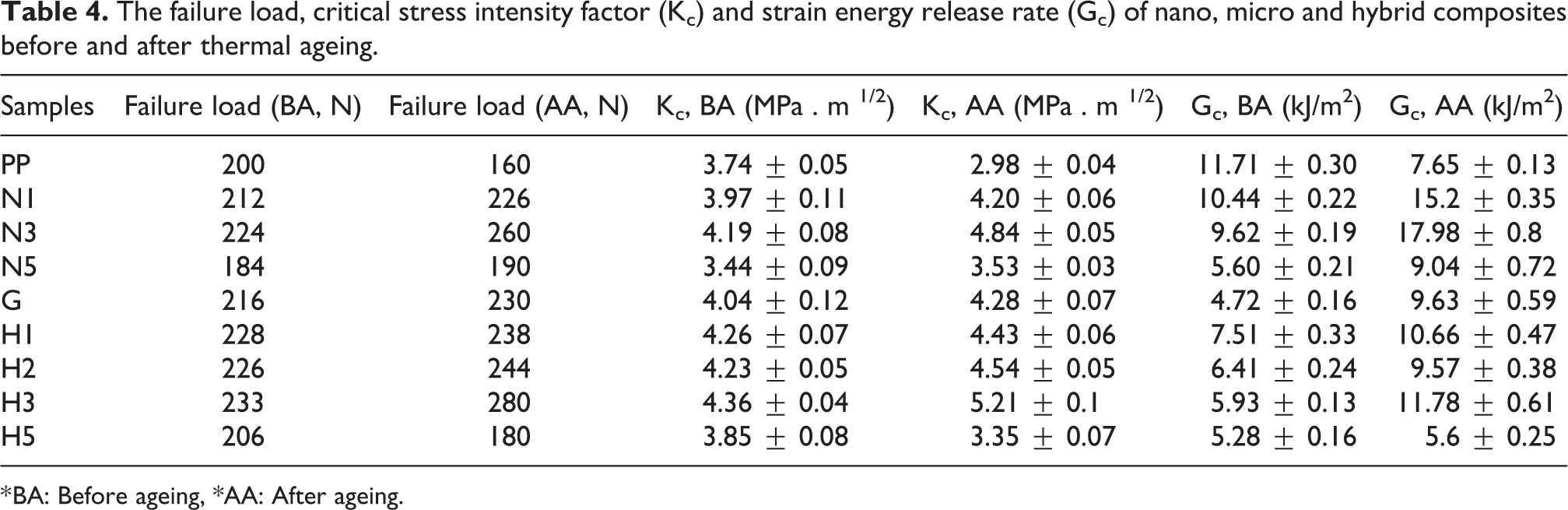
* BA: Before ageing, *AA: After ageing.
Furthermore, at 3 wt% of MWCNTs in PP matrix, Kc incremented by 15.5% and Gc by 87% respectively. The drastic change in the Kc and Gc value demonstrates the possibility of cross linking of segmented PP chains after ageing and anchoring of PP chains around MWCNTs which offer obstacles to the propagation of micro crack growth. Among the nano, micro and hybrid composites ‘H3’ composite exhibits highest critical stress intensity factor before and after ageing, and it could be observed that 19.5% increase in Kc occurred after ageing. One possible reason could be, the cross linking of amorphous polymer chains during ageing. Moreover, during heat treatment the residual thermal stresses present in the composite could have relieved and prolonged heating followed by slow cooling could help in the rearrangement of crystal structure. It should be mentioned that the strain energy release rate of ‘N3’ is high in comparison with ‘H3’ composite. It can be inferred that MWCNTs as single filler in PP matrix improve Gc and enhances ductile nature. Whereas, Kc value is highest in the presence of multiscale fillers and a reasonable strain energy release rate could be attained. This further reiterates the significance of multiscale fillers in overall property improvement of thermoplastic composites at normal room temperature and also after thermal ageing.
Impact strength after thermal ageing
The combined incorporation of micro scale glass fibre and nano scale MWCNTs in PP matrix appreciably increased the impact strength and ‘H3’ composite exhibited the highest value of 38.8 J/m (Table 5). The strong interface of nanocomposites promotes brittle fracture of the composites, due to the inherent brittleness of the fibre and absence of crack deflection at the interface even after ageing. In the case of microcomposites a 2% increase in impact strength could be observed after ageing. Among the thermally aged samples ‘H3’ composite exhibits highest impact strength value. The impact strength value of micro and hybrid composites enhanced even after ageing.
Due to weak interfaces of micro and hybrid composites relative to nanocomposites, possibility of micro voids are more, and upon impact loading, instead of sudden stress transfer as seen with strong interfaces, a cushioning effect is experienced. The loosened nature of polymer chains would have propagated the crack slowly and the chances for crack deflection around the voids will be high leading to greater energy absorption.
Impact strength of the composites before and after thermal ageing.

* BA: Before ageing, *AA: After ageing.
Differential scanning calorimetry and thermogravimetric analysis of aged samples
In the case of hybrid composites, i.e. for ‘H2’ and ‘H3’ slight increment in melting temperature (Tm) was observed, due to the formation of cross links in the polymer chains in the presence multiscale fillers (Table 6).
Comparison of thermal properties of aged and unaged samples obtained from DSC thermograms and TGA decomposition profiles.

A positive shift in peak crystallization temperature (Tc) could be observed for micro and hybrid composites after ageing, as the slackened PP chains tend to coil around MWCNTs and glass fibres. It is noticed that the percentage crystallinity of all the samples decreased after ageing. For PP, the reduction was maximum recording 9.6% fall. In nano and micro composites the decline in % crystallinity was around 5% whereas H3 composite exhibited only 1.6% which could be assigned to the synergism of multiscale fillers.
As shown in Table 6, the onset of degradation (To) after thermal ageing in ‘PP’ shifted to the negative side which shows a decrement in thermal stability of around 17°C and might be due to the quick degradation of scissioned PP chains. The ‘N3’ and ‘G’ composite could not maintain the resistance to the thermal degradation as effective as they could before ageing. In ‘H3’ composite the onset of degradation delayed by 19°C owing to the effective coiling of polymer chains at the optimum content of MWCNTs.
Conclusions
The rheological and thermal ageing studies carried out yielded following inferences. The strong entanglement of MWCNTs with PP chains and increase in MWCNT content in the PP matrix enhanced the shear viscosity and at shear rates higher than 100 s−1 a drop in shear viscosity was observed due to shear thinning nature of nanocomposites. After thermal ageing, the brittleness of the micro and hybrid composites reduced and their toughness raised. The elongation at break of ‘H3’ composite incremented by 28.5% in comparison with that of neat PP. The ‘N3’ composite revealed increment in Kc and Gc values by 15.5% and 87% and in ‘H3’ composite by 19.5% and 98.6% respectively after ageing. This might be due to the cross linking of certain segmented PP chains during thermal ageing. The anchoring of the polymer chains in the cross-linked regions with multiscale fillers restricted the micro crack propagation. The enhancement in ‘Tm’ of H3 composite is due to the cross linking of slackened PP chains and the regions where loosened PP chains coil with MWCNTs acts as nucleating sites for PP spherulitic growth which is evinced by the shift in Tc to higher temperatures.
Footnotes
Acknowledgements
The authors thank Sophisticated Testing and Instrumentation Centre (STIC), Kochi, India, for TEM analysis.
Declaration of conflicting interests
The author(s) declared no potential conflicts of interest with respect to the research, authorship, and/or publication of this article.
Funding
The author(s) received no financial support for the research, authorship, and/or publication of this article.
