



Abstract
This work reports on the mechanical and wear performance of epoxy composite reinforced with short betel nut fiber (SBF). Composite samples with different weight percentages (0, 2, 3, 4, 6, and 8 wt%) of fiber content are fabricated through hand lay-up route. Mechanical properties such as tensile and flexural strengths are evaluated by conducting tests as per appropriate ASTM standards. Sliding wear tests are performed on a pin-on-disc test apparatus as per ASTM G99 standard. A non-linear regression model is developed in accordance with face-centered central composite design (FCCCD) of Response Surface Methodology (RSM). An artificial neural network (ANN) approach is applied to predict the wear rate of the composite and compared with the RSM predicted results. It is found that with the incorporation of short betel nut fiber both tensile and flexural strength of the composite shows an increasing trend. It is also observed that reinforcement of short betel nut fiber enhances the wear performance of epoxy. Surface morphologies of the worn samples have been studied to analyze the wear mechanism of the composite samples.
Keywords
Introduction
Recently, natural fiber-reinforced polymer composites have acquired considerable attention due to their various attractive features like low cost, easy availability, high toughness, biodegradability, and high recyclability. Nowadays a substantial growth has been witnessed in the use of natural fiber-reinforced composites in various fields of application like in construction, aerospace, biomedical, and marine. In the case of automobile sector, several portions of vehicles such as door panels, dashboards, inside parts, and the manufacturing of bearings used for gears are also produced by natural fiber polymer composites.1–5
In the tropical and equatorial regions, fiber-based plants like coir, oil palm, banana, bamboo, and jute. are found in abundant quantity. Fibers extracted from these plants are proved to be an appropriate and powerful reinforcement for various kinds of thermoset and thermoplastic polymers.6–8 It is worth noting that the tribological properties of polymers can be improved with the reinforcement with some specific natural fibers. 9 Many research reports are available on the friction and wear performance of natural fiber-reinforced composite. Yallew et al. 10 studied the wear behavior of polypropylene-hemp fiber composite and determined that the wear rate and coefficient of friction are reduced with the reinforcement of fiber. Patnaik et al. 11 investigated the sliding wear behavior of pine-bark fiber-reinforced polyester composite and concluded that wear behavior is highly influenced by the fiber content in the composite. Ahmed et al. 12 evaluated the sliding wear performance of jute/epoxy composite filled with SiC/Al2O3 fillers and found that the addition of these fillers slightly decrease the wear rate of the composite. It also reveals that Al2O3 filled composite has higher performance than SiC filled composite.
Betel nut is a species of palm, which develops in high dampness content of soil. It is extensively found in East Africa, South Asia, and the Pacific islands. The outer layer of the fiber surface has trichomes and due to the occurrence of trichomes higher interfacial bonding can be obtained with the reinforcement of betel nut fiber in the polymer matrix.13–16 Many research reports are available on various characteristics of betel nut fiber-reinforced polymer composite. Hassan et al. 17 examined the mechanical properties of jute/betel nut hybrid composite and concluded that due to alkalization, the performance of composites is improved. Rahman et al. 18 investigated chemically treated hybrid coir/betel nut composite and observed that an equal proportion of fiber in the composite has better mechanical performance than composite containing fibers at a ratio of 3:1 or 1:3. However, in the authors’ knowledge, no work has been reported so far on the sliding wear analysis of short betel nut fiber-reinforced polymer composites using response surface methodology (RSM) and artificial neural network (ANN). Thus in the present research, the sliding wear behavior of short betel nut fiber-reinforced epoxy composite has been analyzed using RSM, and ANN is used for the prediction of the specific wear rate of the composites.
Experimental details
Materials
Properties of betel nut fiber.

Properties of epoxy resin.

Composite fabrication
Fabrication of composite with epoxy as matrix and short betel nut fiber as reinforcing material is done by a simple hand lay-up process. To fabricate the composite epoxy is mixed with hardener at a ratio of 10:1 by weight and various proportions of fibers are then added into the mixture and stirred with a glass rod so that fibers are uniformly distributed in the mixture. The mixture is poured into a cylindrical and a rectangular mold and allowed to solidify at room temperature. For easy removal of the castings silicone releasing spray is sprayed before pouring the mixture into the mold and a reasonable amount of load is applied on the casting. The cylindrical composites samples are fabricated with 0, 3, and 6 wt% of fiber content for sliding wear test and the rectangular composite samples are prepared with 0, 2, 4, 6, and 8 wt% of fiber content for flexural and tensile tests.
Mechanical properties
The tensile and three-point bending tests in the present research are performed in an Instron-5967 UTM machine to obtain the tensile strength and flexural strength of the composite samples. A total of three samples of each fiber content are tested in both cases and their average value is reported as the tensile and flexural strength of the composite. The tensile tests are carried out as per ASTM D-638 standard with a crosshead speed of 10 mm/min and the three-point bending tests are performed in accordance with ASTM D-790 with a crosshead speed of 2 mm/min.
Flexural Strength is evaluated by
20

Sliding wear test
A pin-on-disc test machine is used to investigate the dry sliding wear behavior of epoxy-SBF composites. The tests are conducted according to the ASTM G-99 standard. The specimen of size 4 mm radius and 30 mm length is used for the tests. The tests are conducted by fixing the emery paper of grit size P220 on the steel disc with a standard adhesive. The test specimen is then allowed to slide against the emery paper. A high accuracy digital electronic weighing machine (up to 0.001 mg accuracy) is used to measure the weight of the samples before and after performing the trial. The entire trial is conducted thrice to ensure consistency in test results. The different test parameters considered for the wear evaluation are sliding velocity, sliding distance, normal load, and fiber content.
Specific wear rate (Ws) of the composite is evaluated by
5

Response surface methodology
Control factors and their stages for sliding wear.

Artificial neural network
The concept of artificial neural networks is used in various engineering applications to solve different complex problems. Artificial neural networks are computing structures inspired by the genetic neural networks of the human brain. This network contains artificial neurons and its process information, which is used for the creation of a systematic model and optimization of the physical and nonphysical complex system. ANN works on the three fundamental principles, specifically (i) validation, (ii) training, and (iii) testing. The whole operation of ANN is performed in three layers, input layer, hidden layer, and output layer, which involves database training to estimation of input/output correlation. The data is given to the input layer, processed in the hidden layer, and finally, the outcomes are exported in the output layer. The detailed procedure of ANN is described by Kadi. 23 In the present work, ANN is used to predict the specific wear rates in different combinations of operating parameters.
Study of worn surfaces
A scanning electron microscope (JEOL JSM 6480LV) is used to obtain the micrographs of worn surfaces of epoxy-SBF composite. Before taking the images, the worn-out surface of test samples is coated with platinum with the help of a sputter coating machine (JEOL JFC-1600) to enhance the conductivity of the worn surface.
Results and discussion
Tensile strength
The tensile strength of composite samples with various proportions of fiber content (0, 2, 4, 6, and 8 wt. %) are measured and the results of the tests are graphically shown in Figure 1. It can be observed that up to 6 wt.% of fiber content the tensile strength of the composite shows an increasing trend. The increase in tensile strength of the composite may be due to the transfer of the major portion of the load from matrix to the fiber during tensile loading. However, further addition of fiber, decreases the tensile strength of the composite. The possible reason for this is that with the increase in fiber concentration weak interfacial bonding may occur due to the insufficient resin and the load was unable to transfer properly from matrix to fiber. A similar observation has been reported by Pokhriyal et al. and Rahman et al.24,25 Tensile strength of epoxy-SBF composites at different fiber loadings.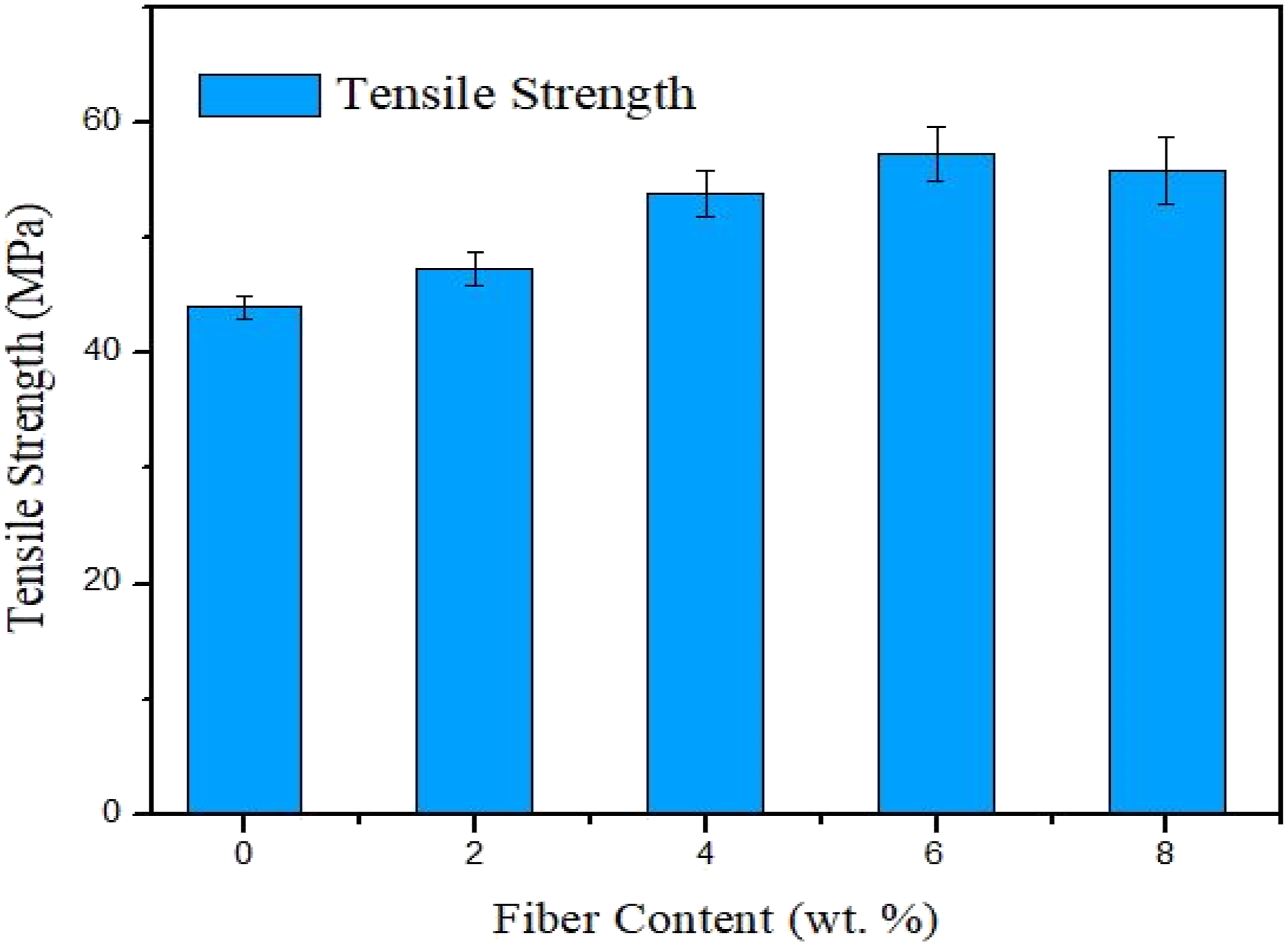
Flexural strength
Figure 2 shows the flexural strength of the epoxy-SBF composites at different fiber loadings. A monotonic increment in the flexural strength can be observed with the increase in fiber content in the composite. The reason may be because of the proper fiber-matrix interaction under the transverse loading during the test.
25
Flexural strength of epoxy-SBF composites at different fiber loadings.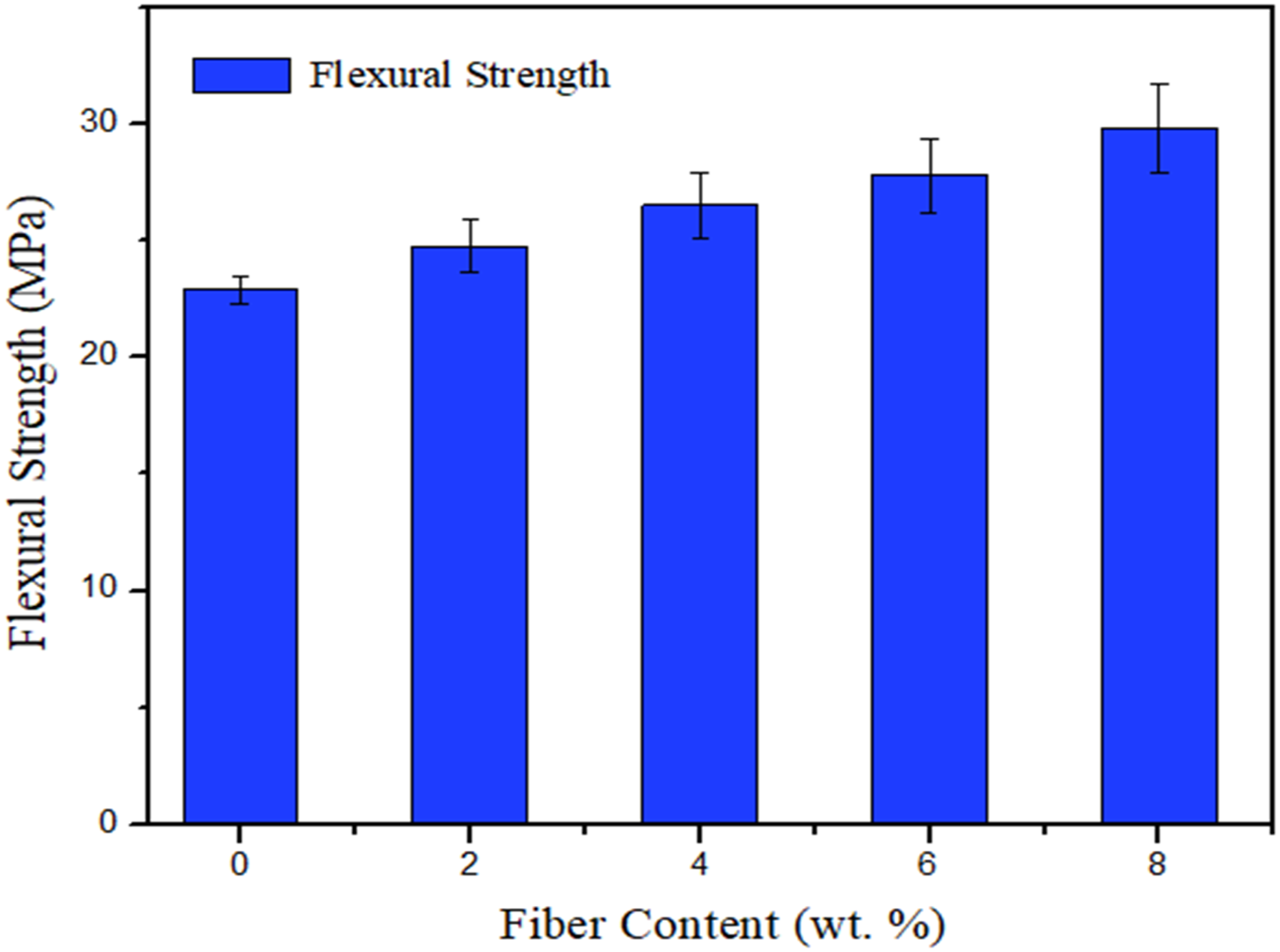
Specific wear rate
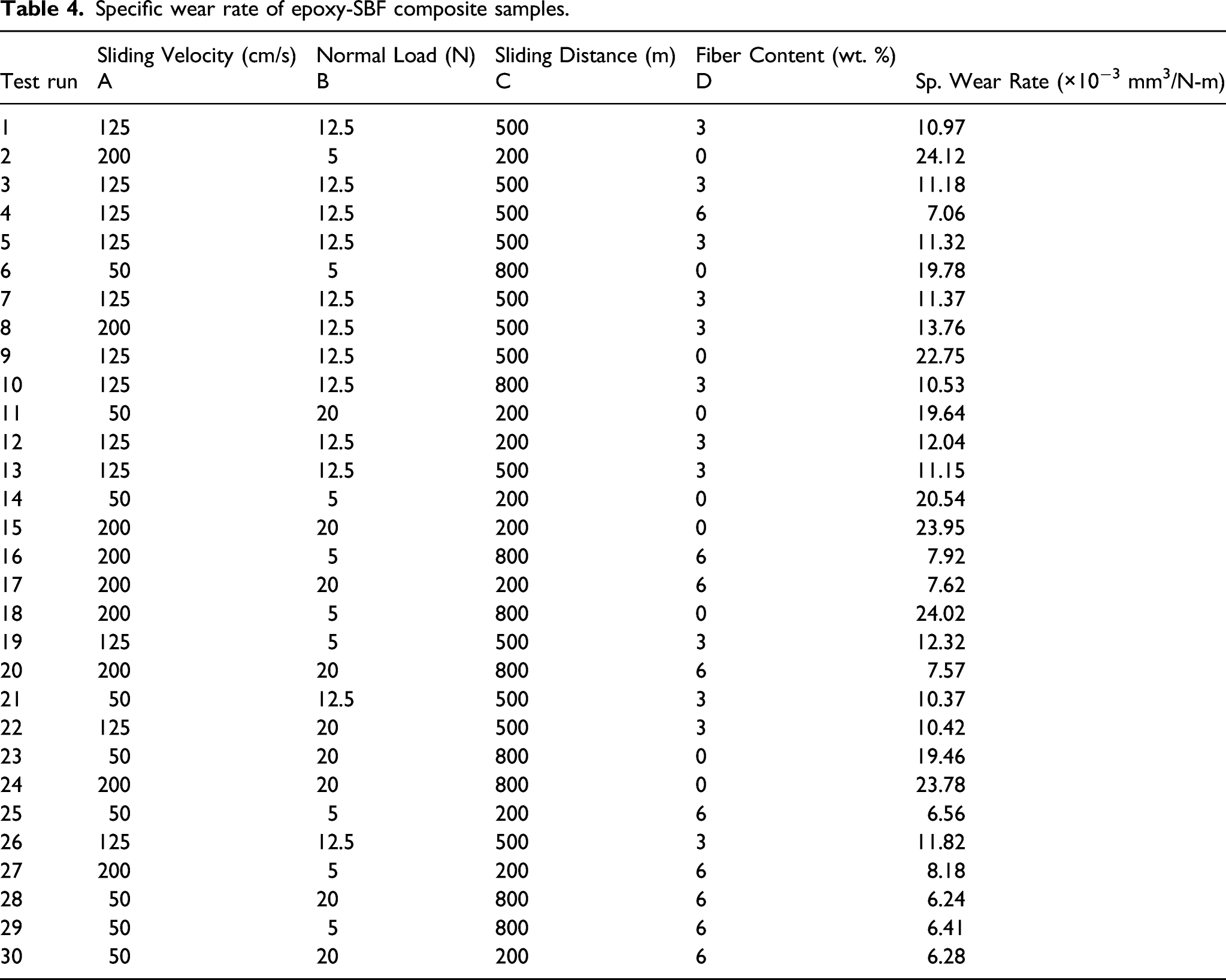
Specific wear rate of epoxy-SBF composite samples.
Analysis of RSM test results
ANOVA table for sliding wear rate of epoxy-SBF composite.

The predictive equation with regression coefficients obtained from the quadratic model of sliding wear rate analysis of epoxy-SBF composites is presented in
Figure 3 shows the normal probability plot for the residuals of the sliding wear rate. Residuals are the difference between experimental and predicted values. It can be noticed that the residuals are laid almost in a linear line, which shows that errors are normally distributed. The normal plot of residuals for epoxy-SBF composite.
Figure 4 shows the experimental and predicted specific wear rates of epoxy-SBF composite. It can be noticed that the results obtained from the proposed correlations are in good agreement with the experimental values. Predicted vs Actual specific wear rate of epoxy-SBF composite.
Effect of control factors on the wear rate
Figure 5(a) presents the impact of sliding velocity and fiber content on the specific wear rate of the composite. It is observed that with the increase in sliding velocity, the specific wear rate increases. This maybe because of the deterioration of mechanical properties of the composite as well as interfacial adhesion between the fiber and the matrix due to the generation of heat at the contact surface of the two materials with the increase in sliding velocity.
26
(a) Effect of sliding velocity and filler content on specific wear rate of epoxy-SBF composite. (b) Effect of fiber content and normal load on specific wear rate of epoxy-SBF composite. (c) Effect of fiber content and sliding distance on specific wear rate of epoxy-SBF composite.
Figure 5(b) shows the impact of normal load and fiber content on wear rate. It can be noticed that with the increase in wt.% of the fiber, the specific wear rate decreased. The reason behind this is, the reinforced fibers act as a barrier in the softening of the material surface due to the rising frictional heat during sliding. 27 This may also be due to the increase in hardness as well as the compressive strength of the composite due to the reinforcement of fiber in the epoxy matrix.24,27
Figure 5(c) shows the impact of sliding distance and fiber content on the wear performance of the composite. It can be seen that sliding distance has not much effect on the wear rate of the composite as compared to other factors.
Prediction of optimal conditions
Figure 6 presents the optimal condition at which the wear rate is minimum. The optimal set of control factors for the least specific wear rate (5.92 × 10⁻³ mm3/Nm) is found to be sliding velocity 50 cm/s, normal load 20 N, sliding distance 800 m, and fiber content 6.5 wt.%, where the desirability is one. Optimal conditions for the least specific wear rate.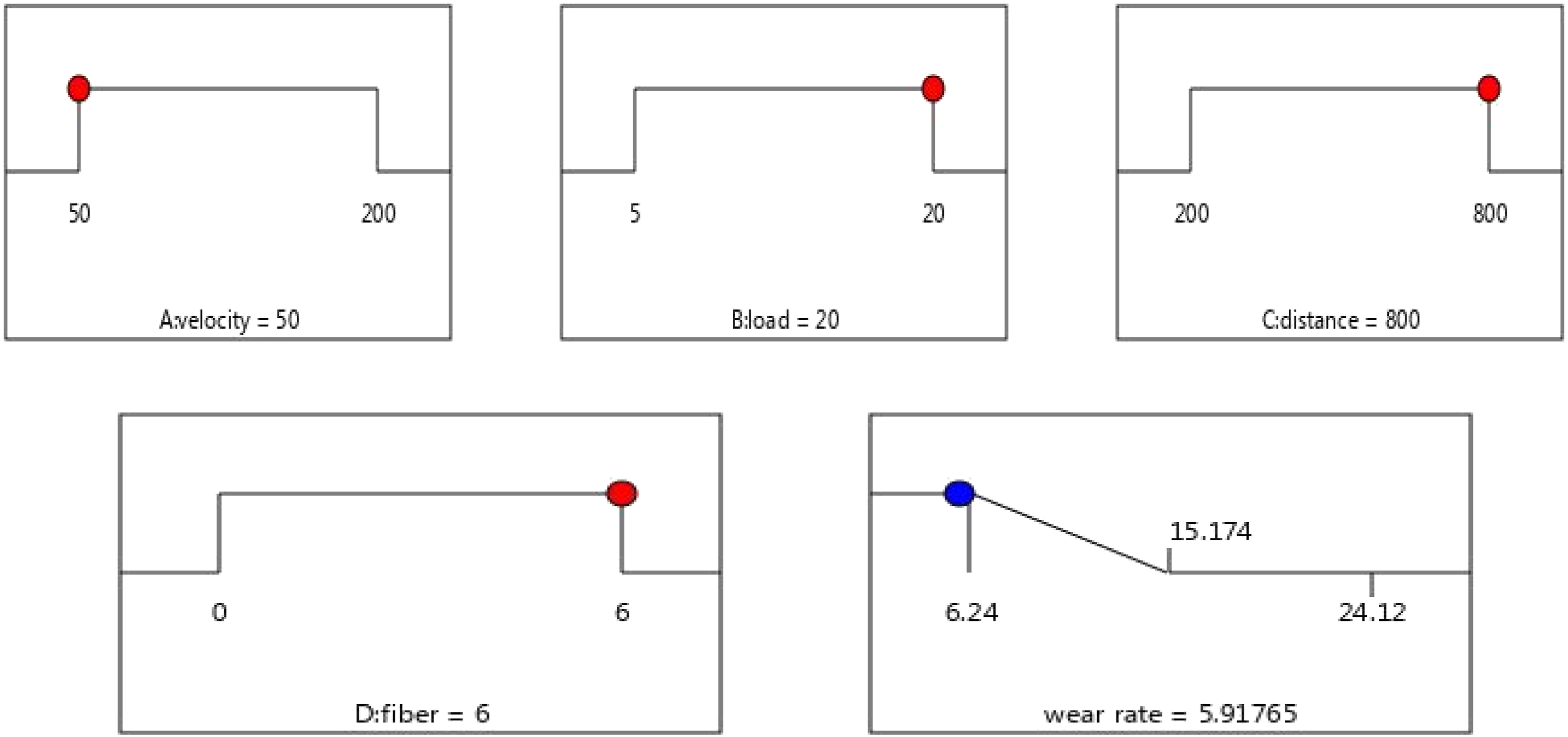
Prediction using artificial neural network
To predict the wear rate of the composite samples at various parametric conditions, a neural network based on the back-propagation ANN method has been developed using the existing experimental database. A neural network with the least error has been selected for training with the exploration of the number of networks by varying the values of input training parameters. To perform the ANN analysis, the values of the input parameters are normalized to lie in the range of 0–1. Figure 7 shows a regression plot of training, validation, testing, and all data sets. From the graph, it can reveal that the overall regression coefficient (R2) is 0.9894, which shows the developed neural network is appropriate for the prediction of the wear rate of the composite samples. Performance plots for sliding wear rate prediction of epoxy-SBF composite.
Comparison of experimental specific wear rate with RSM and ANN predicted results.

Morphological study of the worn sample
The morphologies of worn samples are shown in Figure 8. Figure 8(a) is the micrograph of a composite sample with 6 wt% fiber content after sliding over a distance of 200 m, at a speed of 200 cm/s and under an applied load of 20 N. Wear track, debonding, and formation of debris are clearly visible from this micrograph. Due to contact of samples with the rotating disc, development of wear track gradually begins. During the tribological test, fibers bear the maximum amount of applied load. Hence, as fiber wt% increases in the composite, debonding may occur in the fibrous region. Figure 8(b) represents SEM image of 3 wt% of fiber content tested at 500 m sliding distance, sliding velocity of 125 cm/s, and under a load of 12.5 N. Sliding direction is mentioned through wear track which indicates the plastic flow of material. Material removal due to plowing action as a result of repeated sliding can also be evident from this micrograph. SEM images of worn samples of epoxy-SBF composites (a) fiber content 6 wt.% and sliding velocity 200 cm/s (b) fiber content 3 wt.% and sliding velocity of 125 cm/s.
Conclusions
1. Successfully fabrication of epoxy-SBF composites at different wt.% of fiber contents is possible through simple hand lay-up route. 2. Mechanical properties of epoxy can be modified with reinforcement of betel nut fiber. 3. Using the RSM, a quadratic model is developed. From the ANOVA table, it can be concluded that fiber content and sliding velocity are major influencing factors affecting the specific wear rate of the composites. 4. ANN is used to predict the specific wear rates of epoxy-SBF composites. The predicted values of wear rates exhibited good agreement with experimental values which confirms the remarkable capability of the neural network used in the present study.
Footnotes
Declaration of conflicting interests
The author(s) declared no potential conflicts of interest with respect to the research, authorship, and/or publication of this article.
Funding
The author(s) received no financial support for the research, authorship, and/or publication of this article.
