




Abstract
In the present investigation, wear test is conducted on a pin-on-disc device at room temperature for both the age hardening and without age hardening conditions. Al7075 has been chosen as the matrix material. Hybrid aluminum metal matrix composites are produced utilizing stir casting route for enhancing the wear behavior and hardness number. The reinforcement used is silicon carbide with 5, 10, and 15 wt% and alumina as the reinforcement in 5, 10, and 15 wt%. In the aluminum matrix, microstructural characterization reveals homogeneous mixing of reinforcements. This investigation shows that the enhanced wear resistance is due to the increment weight fraction of reinforcement. By raising the sliding speeds, there is a reduction in the rate of wear and it reduces with increment in the sliding distance. With increasing weight fraction, there is decrement in the rate of wear of composites. In general, tribological property enhances because of the addition of the two reinforcements.
Introduction
Metal matrix composites (MMCs) comprise an alloy or a metal as the matrix and a reinforcement such as particles, short fiber, or whisker and/or long fiber. MMCs are a group of materials with perspective for a broad collection of applications in structural management. Their properties such as light in weight, superior strength, and resistance to wear are the requirement for the aviation and automobile industries.
Discontinuously reinforced MMCs are much less expensive to fabricate than continuously reinforced composites. Consequently, performance enhancement of the matrix comes at lower additional costs with discontinuous reinforcements compared with aligned reinforcements. Particulate-reinforced MMCs are not expensive to manufacture than reinforced composites. Accordingly, performance improvement of the matrix comes at lesser expense with particulate reinforcements compared with fiber-aligned reinforcements. In addition, particulate-reinforced composites exhibit the isotropic properties, 1 whereas the properties of composites with fiber-aligned reinforcements are highly anisotropic.
Hybrid aluminum metal matrix composite (HAMMC) materials are an excellent substitute to conventional materials because of the enhanced hardness, specific strength, and creep resistance properties. Based on the literature survey made, one can consider the Al7075-silicon carbide (SiC)/alumina (Al2O3; aluminum oxide) particulate MMC for automobile applications, such as pistons, camshafts, brake components, bearing surfaces, and cylinder liners, and aerospace applications, such as wing and fuselage (main body) of aircraft structure, internal aerospace engine components, and exhaust systems.
A surface phenomenon referred as wear will occur by relocation and separation of the material. It generally suggests a progressive loss of material and change of measurements over some undefined time frame.
The principle tribological considerations that manage the wear and friction properties of discontinuously reinforced aluminum composite can be categorized into two types: (i) mechanical and physical properties such as loads, speeds, surface finish, sliding distance, orientation of reinforcement, temperature, and environment and (ii) material factors, for instance, the type, size, size distribution, shape, reinforcement’s weight fraction, and the matrix microstructure. 2
The important parameter that influences the wear of materials is the microstructure. According to research reports, microstructure and mechanical properties have a correlation. On the other hand, to relate the wear techniques with microstructural characteristics only limited reports were used. The wear surface exhibits microstructural heterogeneity, which influences wear procedure since constituents, for example, incorporations, intermetallics, and scattered phases, have properties not quite the same as those of the matrix. The most imperative part of the microstructure is the distribution of second-phase particles. 3
AMCs are majorly impacted by the characters of the matrix and reinforcement material. The worn surface of the material, in dry sliding wear, is subjected to considerable work hardening. The layer, mechanically mixed layer (MML), is produced during wear of aluminum (Al) alloys, sliding against ferrous alloy. Due to the shift and combination of materials, under definite load and velocity range, MML is formed. The generated MML consists of materials from both contact surfaces. It was also reported that the hardness of the generated MML is greater than the bulk hardness of the composite. The generated MML is majorly responsible for the decrement of wear rate and holding up of transition to severe wear.
The literature survey gives the survey of the published material accessible on the influence of different types of reinforcements, volume/weight fractions, aging behavior, and size, with aluminum-based MMCs are a blend of two phases: one is referred as the matrix and the other as the reinforcement.
Singla et al. 4 developed Al alloy/SiCp composites of varying weight fractions of SiC (5–30%) by stir casting techniques using a two step-mixing method. Results showed that impact strength and hardness increased with an increment in weight percentage of SiC. Rajesh and Kaleemulla 5 –7 conducted experimentations such as hardness and wear behavior at as-cast and age hardened conditions on HAMMCs. The matrix material considered is Al7075, and the reinforcement material is SiC and Al2O3. From the results, it is clear that the HAMMCs have better properties as compared to unreinforced Al alloy.
Surappa et al. 8 studied the Al-silicon (Si) composite for their tribological behavior. In their study, they considered the automobile brake in a pin-on-disc (POD) tribometer. Al MMCs were utilized as a disc, whereas brake pad material forms the pin. From the outcomes, it is observed that the coefficient of wear and the fraction is varied with the load. Also as the coefficient of fraction decreases, wear rate increases. Deuis et al. 9 surveyed the wear behavior of the materials, and the development of fine equiaxed wear debris is related to a stable tribolayer on the worn surfaces. The critical parameters for adhesive wear are applied load, sliding velocity, the surface hardness of worn surface, and morphology in relative to the theories of wear encountered by the materials.
Radhika et al. 10,11 have conducted the experiments to evaluate the wear characteristics of Al/graphite (Gr)/Al2O3 hybrid MMC and suggested that the Gr reinforcement has boosted up the resistance to wear. This increment is due to the forming of a protective layer between the counterface and the pin. Addition of the reinforcement Al2O3 has considerable influence in reducing the rate of wear of the composite. Saleemsab Doddamani et al. 12 conducted experimentation on the wear behavior of Al-Gr MMC. From the results, it is found that the adding Gr particles has increased the resistance to wear of the MMC. Also, it is reported that the addition of Gr particles in Al reduces the friction than that of the base alloy.
Heat-treated material demonstrates the resistance to wear. 13 Because of the higher ductility and strength of the Al matrix, the effectual stress connected on the material surface along with the wear progression is less on account of the heat-treated alloys. This occurrence caused a reduction in the cracking propensity of the material surface when contrasted with the as-cast alloy. 14 The heat treatment did not drastically modify the morphology, but rather the matrix hardening by age hardening occurred, which prompted greater strength and hardness. 15 The yield strength and higher hardness of the material after this heat treatment condition may have the benefit of keeping generation of aluminum debris and reduction in its exchange to the steel surface. 16 Al-Qutub et al. 17 investigated the properties of Al6061 matrix reinforced with 10% volume fraction of Al2O3. Geng et al. 18 observed that an Al matrix composite was viably gotten using the self-proliferating high-temperature SiC particles. The composite was seen to be better in mechanical exhibitions to those of the composite with the normal status evaluation SiC particles. From the outcomes, it is reported that between Al and SiC, there exists a high-strength interfacial bond.
Li et al. 19,20 analyzed tribological behavior of the HAMMCs. Li et al 21,22 used graphene and Al2O3 to improve the tribological properties of HAMMCs. Graphene is a self-lubricating material, and it is the main reason that graphene can be used as a reinforcement in the hybrid composites. Al2O3 as reinforcement will increase the strength of the composite as compared to the base alloy.
Rajesh et al. 23 carried out the wear test on the Al SiC and Al2O3.
It is noticed from the literature that more research conducted on the wear characteristics of Al-SiCp and Al-Li/SiC MMCs. In this background, the research gaps indicate that there is a lot of scope for current researchers for investigation with the use of a combination of SiC and Al2O3 as reinforcement. Therefore, this research work will focus on wear behavior of HAMMCs. The main aim of the proposed research work was to develop the hybrid MMC to improve the strength and wear resistance characteristics of the material that generate MML.
Materials and processing
Materials
Al-7xxx alloys, for instance, 7075 are commonly used as a part of applications including transport, automobile, marine, and also in aerospace because of their high strength and low weight. The main constituents in the Al7075 are Si = 0.4%, zinc (Zn) = 6.1%, and magnesium (Mg) = 2.9%. The properties of the Al7075 are density = 2.85 g cc−1, ultimate strength = 480 MPa, elastic modulus = 75 GPa, Poisson’s ratio = 0.33, melting point = 650°C, and hardness = 6.61 GPa.
SiC is a ceramic material also known as carborundum. It is a blend of Si and carbon. It is an outstanding abrasive material utilized to prepare grinding wheel and other abrasive parts. Nowadays, the SiC material is formed into a technical grade better quality ceramic with excellent mechanical/physical properties. Some of the key properties of SiC utilized here are density = 3.1 g cc−1, melting point = 2730°c, molecular mass = 40.10 g mol−1, grit size = 16–100 grit, appearance = black, and hardness = 45.8 GPa. 19
Corundum (crystalline form of Al2O3) is widely used in industry. Al2O3 as a reinforcement is steadier with Al and withstand higher temperatures. Some of the key properties of Al2O3 utilized here are density = 3.69 g cc−1, melting point = 2072°C, mesh size = 100–200 mesh, appearance = white, and hardness = 30 GPa. 20
Composite hardness can be predicted using a micromechanics approach termed the rule of mixtures. Hardness of the Al7075-SiC/Al2O3 particulate MMC can be determined from rule of mixture and is listed in Table 1.
Hardness values of the Al7075-SiC/Al2O3.

Al: aluminum; SiC: silicon carbide; Al2O3: aluminum oxide/alumina.
Processing
Al7075-SiC/Al2O3 samples are formed at varied weight fractions of SiC/Al2O3 (5%, 10%, and 15%) utilizing stir casting technique. The Al slabs were melted in the furnace. In the wake of liquefying, liquid Al was superheated to 750°C. 5 The required measures of SiC/Al2O3 particles were added to the liquid Al while mixing with a stirrer at 600 r min−1. The liquid Al7075-SiC/Al2O3 was filled in a permanent mold and allowed to set. The Al7075-SiC/Al2O3 composite bars were taken out from the mold. The samples were set up from the as-cast combinations for investigation of the required properties. Shearing temperature (620°C) and shearing speed (600 r min−1) were the two process parameters that affect the composites. Test were conducted to examine the effect of processing parameters. The different process parameters were chosen to exert a hydrodynamic force on the molten material and to retain the best possible fluidity for the casting.
The microstructure, shown in Figure 1, of the Al7075-SiC/Al2O3 particulate composite confirms uniform distribution of the reinforcement. In the process of the mixing, a whirling of molten material is formed from the rotation of the stirrer through which the SiC/Al2O3 particles are drained into the melt. The force given for mixing the molten material with a mechanical stirrer beats the surface vitality hindrance because of poor wettability of SiC/Al2O3 by Al composite. Once the SiC/Al2O3 particles are moved into the molten Al, the dissemination is firmly influenced by certain flow transitions. From the momentum transfer and the outspread flow of melt, lifting of SiC/Al2O3 particles takes place and also causes prevention of particle settling in the matrix. Meanwhile, local hydrodynamic forces are induced on the particle grouping of SiC/Al2O3 particulates. These forces induced are capable of separating the clustering of SiC/Al2O3 particles, which in turn leads to homogeneous microstructure all through the cast segment.

Scanning electron micrograph shows the uniform distribution of particles of SiC/Al2O3: (a) as-cast Al7075, (b) 5% SiC/Al2O3, (c) 10% SiC/Al2O3, and (d) 15% SiC/Al2O3. SiC: silicon carbide; Al2O3: aluminum oxide/alumina.
A strong homogeneous microstructure between the reinforcement and the matrix helps in the load exchange from the reinforcement to the matrix. Thus, the break happens in the composite via the reinforcement and not along the interface. Despite the fact that the SiC/Al2O3 is a non–load-bearing ingredient, a solid particle/matrix interface helps the SiC/Al2O3 particles install themselves into the matrix legitimately, enhancing the crack resistance. It has been reported that during solidification, the interfacial relationship between the Al matrix and SiC/Al2O3 is enhanced. By reason of the uniform distribution and good bonding of SiC/Al2O3 particles in the Al matrix, Al7075-SiC/Al2O3 particulate composites have greater tribological properties such as good machinability, low wear rate, high damping capacity, and their outstanding properties.
Age hardening
The as-cast composite specimens were heat treated at a temperature of 465°C for 2 h, followed by rapid quenching in cold water. After quenching, the specimens are subjected to an age hardening (precipitation hardening) by heat treating at a constant temperature of 120°C for 05 h, followed by cooling in air to room temperature.
Energy-dispersive X-ray analyses
To determine the chemical composition of the Al7075-SiC, Al2O3 composites, energy-dispersive X-ray (EDX) measurements are carried out in the scanning electron microscope (SEM) on individual specimens. The EDX analysis indicates the foremost composition of Al7075-SiC, Al2O3 composites Si, Mg, iron, carbon, and Al. Small amount of oxygen is also observed. The signals of oxygen may arise from the contamination of the Al2O3.
Table in Figure 2 describes the atom percentage of Si, Mg, carbon, and Al. These outcomes specified that the chemical compositions of the Al7075-SiC, Al2O3 are consistent. The atomic percentage of carbon is higher than Si and Mg. The presence of carbon indicates the adding up of SiC, Al2O3 reinforcement with the Al7075 matrix. The content of Si (0.63–0.91) and Mg (0.6–2.54) indicates the presence of these compounds in the Al7075 alloy.

EDX profile analysis for the surfaces: (a) 0% reinforcement, (b) 5% reinforcement, (c) 10% reinforcement, and (d) 15% reinforcement. EDX: energy-dispersive X-ray.
From the EDX analysis (Figure 2), it is found that Al7075-SiC, Al2O3 MMCs are rich in both Si and Mg. The existence of MgAl2O4 at interfaces was confirmed in a detailed study on the interfaces in discontinuously reinforced MMCs. In all the compositions of Al7075-SiC, Al2O3, oxygen (O) content has been obtained. The content of O is due to the formation of Al2O3 on the top of the pits as the main compound on the surface.
The analysis of MML was carried out by utilizing EDX to study the degree of exchange of material from the disc to pin. O-mapping, in addition, is performed to know whether any sample of oxidation tested at along with Fe and O was likewise in age-hardened Al7075 reinforced with SiC and Al2O3 specimens. For the O present in an O2 molecule, there is no clarity whether it is an FeO2 or Al2O3.
Wear analysis
The dry sliding wear behavior of Al7075/SiC-Al2O3 HAMMCs and heat-treated (T6) Al7075/SiC-Al2O3 HAMMCs was conducted according to the ASTM G-99 standard testing procedure. Dry sliding wear experiments were conducted using a computerized POD wear apparatus (model: Wear & Friction Monitor TR-20) supplied by DUCOM, Bengaluru, India. The dry sliding wear tests are conducted by weight loss measurement technique and data were obtained from the experimentation for different loads, speeds, and compositions for as-casted and age-hardened conditions. SEM was carried out to understand the changes in worn surfaces with the addition of SiC and Al2O3 reinforcements.
The dry sliding wear behavior of Al7075 base alloy-Sic-Al2O3, HAMMCs, and heat-treated (T6) Al7075 base alloy-SiC-Al2O3 HAMMCs was conducted according to the ASTM G-99 standard testing procedure. Dry sliding wear experiments were conducted using a computerized POD wear apparatus (model: Wear & Friction Monitor TR-20) supplied by DUCOM. The machine comprises of high carbon EN-31 steel disc and a wear track diameter of 90 mm. The cylindrical specimen of 10 mm diameter and 30 mm height was utilized for wear tests. Wear tests conducted for three different normal loads, that is, 2, 4, and 6 kg, at fixed sliding velocities of 0.942, 1.8849, and 2.82 m s−1 for 200, 400, 600 r min−1, respectively, for about 5 min. During the wear test, height loss of the specimen was recorded and the corresponding volume loss and wear rate were calculated. Before and after the test, both disc and specimen were cleaned.
After the sliding wear test, the volumetric wear loss was calculated over sliding distances of 282.47, 565.48, and 848.23 m for 200, 400, 600 r min−1, respectively, for about 5 min at a load of 2 kg (19.62 N), 4 kg (39.24 N), and 6 kg (58.86 N). It was observed that the volumetric wear loss increased linearly with the increase in sliding distance in all the investigating composites. The volumetric wear loss reduced with increment in the content of SiC and Al2O3 reinforcements in MMCs when compared with base alloy. It shows the increased wear resistance of the composites. In HAMMCs, the reduced wear loss was observed when compared with the as-cast 7075 because of the existence of SiC and Al2O3, which acts as a solid lubricant 24 . At higher sliding distances, the temperature of the sliding surfaces increases, which causes softening of the pin surface which is in contact with the disc, leading to heavy deformation and results in advanced volumetric wear loss of the pin.
From the analysis, minimum wear loss was observed in Al7075-10wt%SiC-10 wt% Al2O3 HAMMCs. Dry sliding wear tests on hybrid Al matrix composites reinforced with SiC and Gr particle show that Gr particles were useful agents in rising resistance of dry sliding wear of Al2219-SiCp composites. Effect of distribution of Gr particles on wear behavior of Al composites with a weight percentage of Gr content is analyzed. They found that the existence of Gr particulate could enhance the wear resistance in composites.
When compared with the base matrix alloy, lower wear loss was observed in composites. Increased loads resulted in delamination leading to high volumetric wear of both the matrix alloys.
The comparisons of Al SiC and Al2O3 23 with Al SiC and molybdenum disulfide (MoS2) 24 are summarized in Table 2.
Comparison of Al/SiC-Al2O3 and Al/SiC-MoS2.
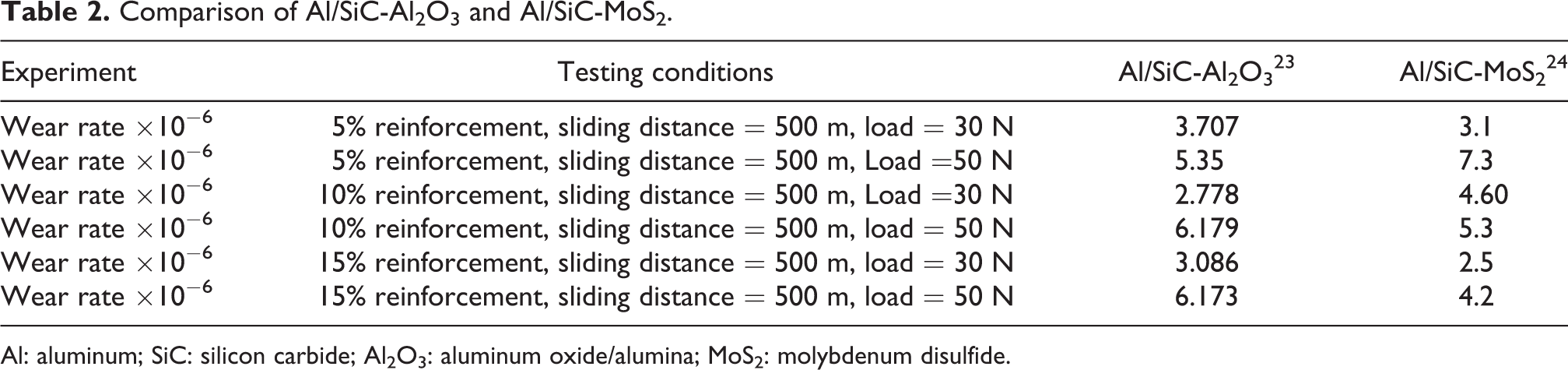
Al: aluminum; SiC: silicon carbide; Al2O3: aluminum oxide/alumina; MoS2: molybdenum disulfide.
From Table 2, it can be observed that wear rate of the Al/SiC-Al2O3 is more at higher loads as compared with Al/SiC-MoS2.
Microscopic wear behavior
Figure 3 shows the surface morphology of Al alloy composite tested under ambient temperature with load and speed. These wear scars are the primary characteristics of abrasive wear. On further analyzing, it has been found that grooves are fine on the worn pin surface of Al alloy. From the micrographs (Figures 3 and 4), some cracks have been seen and these are propagated in dissimilar directions. This might be due to strain hardening of Al-based MMCs with a load because of pulling up of hard-phase particles.

SEM of worn surface of HAMMCs (without heat treatment). (a) as-cast-2 kg-600 r min−1; (b) as-cast-6 kg-600 r min−1; (c) 5%-2 kg-600 r min−1; (d) 5%-6 kg-600 r min−1; (e) 10%-2 kg-600 r min−1; (f) 10%-6 kg-600 r min−1; (g) 15%-2 kg-600 r min−1; (f) 15%-6 kg-600 r min−1. SEM: scanning electron microscope; HAMMC: hybrid aluminum metal matrix composite.

SEM micrographs of worn surface of HAMMCs (age hardening). (a) as-cast-2 kg-600 r min−1, (b) as-cast-6 kg-600 r min−1, (c) 5%-2 kg-600 r min−1, (d) 5%-6 kg-600 r min−1, (e) 10%-2 kg-600 r min−1, (f) 10%-6 kg-600 r min−1, (g) 15%-2 kg-600 r min−1, (f) 15%-6 kg-600 r min−1. SEM: scanning electron microscope; HAMMC: hybrid aluminum metal matrix composite.
The enhancement in resistance of wear composite at short load is because of the existence of reinforcements in between the composites and the counterface contact surface, which forms a thin layer.
The morphologies of the worn surfaces of base alloy and both the composites in the as-cast and heat-treated condition after the wear test for an applied load of 2 kg (19.62 N) and 6 kg (58.86 N) were examined on an SEM. Figures 3 and 4 show the SEM of the worn surface of as-cast, 5, 10, and 15 wt% of HAMMCs. Figures 3 and 4 show the SEM of the as-cast MMCs and severe plastic deformation, which is seen as white patches that lead to higher wear.
Figures 3 and 4 show the SEM of 5 wt% SiC and Al2O3-reinforced HAMMCs, which shows that the degree of grooves formed represents the reduced plastic deformation. Figure 3 (e, f) and 4 (e, f) shows the SEM of 10 wt% SiC and Al2O3-reinforced HAMMC, and further reduced number of grooves and plastic deformation was observed. Similar microscopic behavior was observed for the as-cast HAMMCs. Figures 3 and 4 show the micrographs of the worn surfaces of the composites tested at 6 kg (58.86 N).
The micrographs show that a number of continuous grooves had appeared on the worn surface.
These parallel grooves are the evidence of micro plugging, and similar worn surfaces with increased severity were seen. Extensive plugging can be observed on the worn surfaces, which indicates the prominent wear mechanism in the composites. The reattachment of wear debris on the worn surfaces was also noticed. Composites exhibit the same worn surfaces after the 2 kg (19.62 N) and 6 kg (58.86 N). The wide and shallow grooves were noticed on the as-cast worn surface of composites, as shown in Figures 3 and 4, and small and fine grooves were noticed in heat-treated composites, as shown in Figures 3 and 4. The grooves on the worn surfaces of cast matrix alloy are courses and the plastic deformation at the edge is heavy. Similar behavior was observed in heat-treated aged composites, as shown in Figures 3 and 4. However, in reinforced heat-treated HAMMCs, worn surfaces were relatively smooth fine grooves and at the edge of the grooves slight plastic deformation was observed in composite.
Micrographs reveal the smooth surface with fine ploughing grooves. A similar trend was obtained for other researchers who have studied on Al6061-Al2O3 and Al7075-SiC composites with similar wear behavior. The as-cast matrix alloy grooves on the worn surfaces were coarse, and there is plastic deformation and the grooves edge is heavy when compared with the extruded matrix alloy.
To achieve the desired material properties, solidification condition and microstructures are very much useful. The strength of the composites depends upon secondary dendritic arm spacing, grain size, and so on. To understand the material behavior, study of microstructural behavior is very much important. The fractured surface shows brittle failure, in which deep dimples were present in all the experimental composites. This is evident from the shallow dimples that were observed in HAMMCs, which promote the brittle fracture.
Figure 4 shows the fractography of heat-treated base alloy, HAMMCs. The fracture surface shows suitable bonding between reinforcements and matrix alloy. The failure surfaces composed of pulled regions and a few cracked particles. The heat-treated composites show more dimples and plastic deformation was observed in HAMMCs as compared to as-cast composites. The fracture in both as-cast and heat-treated composite was promoted by delamination at the particulate surface. It was also seen that the plastic dimples in the fractured surfaces of the MMCs incremented, resulting in an increase in the strength of the composites. The fractography revealed a complex array of facets divided into several instances by a hint of remote dimples. Nonappearance of deep dimples showing brittle failure has exposed as dark and smooth surface. This shows the consequence of heat treatment and varies in the microstructure of the composites.
Worn surface of HAMMCs at different compositions and loads
The wear track obviously specifies the high magnitude of crater lines intimately packed at a high weight percentage of reinforcement as shown in Figure 5.

Worn surface of HAMMCs (as-cast). (a) Al7075, (b) Al7075 + 5% SiC+ 5%Al2O3, (c) Al7075+10% SiC+10%Al2O3, and (d) Al7075+15% SiC+15%Al2O3. Al: aluminum; SiC: silicon carbide; Al2O3: aluminum oxide/alumina; HAMMC: hybrid aluminum metal matrix composite.
Figure 6 shows the SEM micrographs of HAMMCs (age hardening). A homogeneous allocation of SiC and Al2O3 particles in the AMCs is noticed. A uniform circulation of the reinforcements in the matrix is necessary to form a composites with standardized mechanical properties. The agglomeration of particles is small. The worn surface of the MMCs leads to the formation of iron-rich layers. The worn surface shown in Figures 5 and 6 shows the white patches of iron oxide and exposed particles on the contact surface of Al7075+10%SiC+10%Al2O3 HAMMCs. Development of the FeO2 was less significant at medium load than that of lesser loads. Occurrence of Al2O3 and SiC was seen at the morphological surface. Figures 5 and 6 illustrate the features of the worn surface of Al7075-10%Sic-10%Al2O3 HAMMCs.

Worn surface of HAMMCs (age hardening). (a) Al7075, (b) Al7075 + 5% SiC+ 5%Al2O3, (c) Al7075+10% SiC+10%Al2O3, and (d) Al7075+15% SiC+15%Al2O3. Al: aluminum; SiC: silicon carbide; Al2O3: aluminum oxide/alumina; HAMMC: hybrid aluminum metal matrix composite.
The wear rate of heat-treated HAMMCs is lesser than that of HAMMCs. At a medium wear rate, the thermal effect on the appearance of the specimen was higher than at lower loads. Friction between the pin and disc promotes the temperature, which leads to plastic deformation. The smaller particles were pushed into the matrix layer, and the trailing edge particles come out when the surface becomes softer due to frictional heat. The larger particles still act as abrasive elements because the layer is not so thick at medium wear rates. At high loads, the thermal effect on the surface of the specimen was higher than at medium loads. Damage and deformation were seen on the worn surface of the MMCs and MMHCs as seen in Figure 7.

Worn surface of HAMMCs as-cast and age-hardened conditions. (a) Al7075+10% SiC+10%Al2O3 at 2 kg, 600 r min−1 (as-cast), (b) Al7075+10% SiC+10%Al2O3 at 4 kg, 600 r min−1 (as-cast), (c) Al7075+10% SiC+10%Al2O3 at 6 kg, 600 r min−1 (as-cast), (d) Al7075+10% SiC+10%Al2O3 at 2 kg, 600 r min−1 (age hardened), (e) Al7075+10% SiC+10%Al2O3 at 4 kg, 600 r min−1 (age hardened), and (f) Al7075+10% SiC+10%Al2O3 at 6 kg, 600 r min−1 (age hardened). Al: aluminum; SiC: silicon carbide; Al2O3: aluminum oxide/alumina; HAMMC: hybrid aluminum metal matrix composite.
Figure 7 shows SEM of worn surface of Al7075-10%SiC-10%Al2O3 HAMMCs at different loads, and at higher loads, the Al2O3 film becomes thick and uninterrupted, wrapping the total surface. This Al2O3 film acts like a sliding surface at critical velocity, the thin films were detached, and the wear rate was decreased. A thick film is plastically deformed, approaching a molten state that allows particles to move upward into the matrix without bearing any load at the beginning. The particles move upward and become dense and stop further movement. Thus, dense surface acts as a harder surface, and due to raise in hardness, the composite bears the higher transition. Due to the presence of asperities between the contacting surfaces, higher frictional coefficient was observed in all the composites. However, coefficient of friction was decreased after reaching the steady-state condition. The sliding surface was covered with Al2O3 and iron oxide layers.
Description of MML
Sliding wear can cause significant changes to the composite surface. These results in work hardening, the formation of wear debris, mechanical, and chemical mixing of wear debris to form layers. These layers are referred as MML (mechanical mixing of debris and contaminants) or “transfer layer” (material transferred from the counter face). It has been reasoned that MML formation occurs because of turbulent plastic flow induced by the onset of shear instability at a critical depth underneath the wearing surface. The formation of surface and subsurface deformation during wear test can be observed from SEM micrograph of Al7075 +10% Sic+10%Al2O3 at 6 kg, 600 r min−1 tested at 58.86 N load and a sliding speed of 2.827 m s−1 without heat treatment and age hardening of HAMMCs.
An increase in applied load means the supply of more energy, and a fraction of energy applied is converted to heat energy. When the applied load increases, the frictional heating becomes significantly high and results in localized adhesion of the pin surface with the counter surface because of the increase in the interface temperature. The surface material gets softened and dispersion of the asperities into the material is incremented extensively. This leads to the damage of MML that was formed during the course of sliding. Figure 8 demonstrates SEM pictures of the HAMMCs composite wear surface.

Worn surface of HAMMCs. (a) Worn surface of Al7075+10% SiC+10%Al2O3 at 6 kg, 600 r min−1 (as-cast) and (b) worn surface of Al7075+10% SiC+10%Al2O3 at 6 kg, 600 r min−1 (age hardening). Al: aluminum; SiC: silicon carbide; Al2O3: aluminum oxide/alumina; HAMMC: hybrid aluminum metal matrix composite.
The SEM illustrates various lengthy grooves and craters on the worn surface with the increment in load to 58.86 N at sliding speeds of 2.827 m s−1. From the SEM image it is observed that due to increase in load, wear behavior of the composite changes from abrasion to delamination. It is plainly seen that the MMLs are somewhere in the range of three and five times harder than the AA7075 alloy.
The particles present beneath the layer were hard and brittle than the matrix alloy. MML shows hardness around six times better when compared to the bulk composite. MML was absent on the worned surface of Al. Presence of these layers probably restricts the rate of wear. It is revealed to facilitate Al experienced a change from conversion from mild to severe wear at 58.86 N. It is comprehensible that the MML available on specimens experienced at load in the mild wear zone, while the MML was deficient on specimens which experienced severe wear. Due to superior rate of wear temperature raises at the specimen sliding surface, pin is softened and results in plastic deformation, it reacts with O and results in oxides. The interface layer affects the rate of wear. The thickness of MML increases with the raise in reinforcements.
Conclusions
From the investigation, the following conclusions were drawn on the mechanical and wear performances of the as-cast and T6 aging of HAMMCs-Al7075-SiC-Al2O3. Wear resistance of Al7075/Al2O3+SiC composites incremented with weight percentage. The reduction in wear rate is observed with increase of sliding distance, composition of the composites. It enhances with loads for age hardening and without age hardening. The age-hardened Al-7075/ Sic+Al2O3 composite shows excellent resistance to wear when compared to Al7075/Al2O3+SiC. It has the distinctive property with the addition of SiC and Al2O3. The microstructural characterization discovered the homogeneous circulation of the particle in the matrix system with minimal amount of porosity. The microstructural studies of SEM and EDX techniques show the homogeneous distribution of the particulates in the hybrid composites.
In T6 heat-treated (age hardening) Al7075-10wt%Sic +10 wt% Al2O3 HAMMCs, improved wear resistance was observed when compared to base alloy. Highest resistance to wear was observed in Al7075-10wt%SiC +10 wt% Al2O3 due to the presence of reinforcements. Further decrement in wear rate with increment in wt% of reinforcement for the desired sliding distances is observed. From the investigation, it was concluded that composites containing 10 wt% of SiC and 10 wt% of Al2O3 reinforcements with ageing exhibited superior mechanical and tribological properties
It is noticed the presence of MML in the mild wear regime. It is absent in the severe wear regime. Therefore, it is noticed that the nonformation of MML depends on the onset of severe wear. Reduced rate of wear with increment in MML thickness is noticed. The MML thickness increases by rising reinforcement composition up to 10%, and the development of hard MML (stable and thin) layer will give the finest resistance to wear.
Footnotes
Declaration of conflicting interests
The author(s) declared no potential conflicts of interest with respect to the research, authorship, and/or publication of this article.
Funding
The author(s) received no financial support for the research, authorship, and/or publication of this article.
