




Abstract
Polymer composites for structural applications are prone to damage emanating from cracks which are formed deep within the material where detection is not easy and repairing almost not feasible. Material cracking results in mechanical deterioration of pre-reinforced polymer composites utilized in microelectronic polymer-based components which can result in electrical failure. Micro-cracking occurring as a result of thermally and mechanically induced fatigue is additionally an established challenge in polymer performance. Self-healing composites are materials exhibiting capability of automatically recovering when damaged. They derive their inspiration through biological systems peculiar to the human skin which exhibit a natural tendency to undergo healing by themselves. Irrespective of their application, the instance cracks are formed within a polymeric composite and the structural integrity of the material is remarkably compromised. Therefore, this article elucidates very recently emerging advancements on self-healing composites. Challenges, prospects, future market disposition, and application of self-healing composites are also presented.
Keywords
Introduction
In previous years, huge interest has evolved in materials exhibiting self-healing for actual engineering applications in building and construction, aerospace, sporting materials, electronics, and robotics, due to propensity of these properties prolonging materials durability, reducing maintenance costs, and consolidating safety. Self-healing is bioinspirational as nature itself is constituted of self-healing composites. With regard to materials engineering, structurally inclined polymer composites are prone to damages, failures, and deterioration. Crevices, cracks, and voids form deeply in the interior of materials structure and are not easy to repair. Self-healing/repairing or mending is a microscale bottom-up technique providing the capacity of repairing damages and healing these cracks while still maintaining the structural integrity of the material. 1 Various polymers (thermosetting and thermoplastics) exhibit potentials for self-healing, while polymer composites and nanocomposites have been designed and fabricated to excellently exhibit this behavior. 2 Self-healing materials are smart materials that demonstrate the ability to autonomously heal damages caused as a result of their mechanical friction and with time efflux. Prior to damaging, the materials molecules readjust to enable replication of the original material. On the microscopic level, cracks initiation and other forms of damages vary the electrical, thermal, and acoustical properties of the material resulting in complete failure. These materials enable correction of these damages with or without human interferences. 2,3
Microencapsulation and vascular impregnation of self-healing agents in tubular networks are approaches to attain self-healing in materials. 3 However, these extrinsic routes result in significant deterioration of mechanical strength, and for the intrinsic approach, the healing capacity is latent within the material. 4 The healing is attained via reversible bonding in the matrix polymer. Polymers exhibiting reversible polymerization procedures have demonstrated great prospects for self-healing. These exclusive polymers, also referred to as “mendomers” or “dynamers”, consist of special bonds that reverse in response to an external stimulus such as heat, light, acidic conditions, and so on. This peculiar behavior has demonstrated self-healing polymeric behavior. Hence, a large mendomer reveals prospects of repeatedly healing itself such that the pristine material is restored. Through the usage of a unique molecular structure, the reversible bonding in mendomers can undergo engineering to act as a weak linkage which breaks when responding to stress thereby maintaining the stability of the permanent bonds. This is critically imperative for self-healing applications.
Generally, self-healing materials undergo designing to enable repairing of damages initiating at the micron scale, efficiently inhibiting damage propagation, and shelf life extension of the material. Microcapsules available within self-healing materials rupture on exposure to mechanical dent resulting in healing agents being released into the damaged site. These agents undergo polymerization and mixing, repairing the damage, and reconstructing structural and functional integrity. 5
Novel techniques including hollow glass fibers, optical fibers, and microcapsules have been applied in manufacturing specialized composites based on the intrinsic and extrinsic types. Hence, self-healing entails restoration of structural deformation by agents already incorporated within the material, similar to biological curing procedure in living organisms. 6
Fiber-reinforced composite materials exhibiting low weight and high strength are increasingly being utilized in electric cars, aerial vehicles, and wind turbines. However, the major risk in utilizing these materials lies in their inclination toward undergoing internal micro-cracks which are not easily feasible in detection and repairing with high potential of resulting in catastrophic failure. 7 The panacea to this challenge includes incorporating self-healing ability into these materials thereby inculcating into them the propensity for self-repair and feasibility of automatically restoring their mechanical performance and utilized in several applications as elucidated in Figure 1.

Some application areas of self-healing polymer nanocomposites.
In previous years, the quest for highly tough and durable structural materials for structural applications has continued to escalate. Nevertheless, with respect to other natural creatures, the ability to protect and defend does not depend singularly on their hard coating or shells but also in adaptation with regard to healing of the human skin and regeneration of the lizard’s tail. Thus, deriving their inspiration from this design, intelligent composite materials referred to as self-healing composites have been developed to exhibit capability of automatic recovery and adaptation to environmental variations in a dynamic way, unlike the conventionally tough and static composites. 8 By attaining self-healing capability, it is anticipated that safety and reliability will be enhanced, with reduction in the cost of artificial composites and extension of material shelf life.
Self-healing or self-autonomic repair is the tendency of a material to enact recovery from any form of damage automatically devoid or inclusive of any peripheral interferences. There are human-induced and naturally occurring self-healing materials. 9 The materials devoid of any exterior interference express autonomy and the material with human interference is non-autonomic, naturally. Materials architecture comes in varying forms such as in paint coatings, ceramics, metallic alloys, and concrete. 10 All these materials possess their own self-repairing modes. The varying mechanisms in self-healing involve releasing of healing agents (liquid agents including monomers and catalysts and hardening agents composed of hollow fibrous inclusions and microcapsules) into cracks which are incorporated into the polymeric system during development and manufacturing stage. 11
Application mode of self-healing materials includes self-healing polymeric composites, self-healing ionomers, self-healing anti-corrosion coating, self-healing processes in concrete, and self-healing of surface cracks in ceramics. 12 As a result of the ability to improve the shelf life of materials and reduction in the overall cost of the systems during their long-term application and utilization, self-healing materials have induced global research interest.
Moreover, the inclusion of functional materials has enlarged their scope of applications. Graphene, as a potential additive, has garnered great interest as a result of its large specific surface area, ultrahigh conductivity, high antioxidation attributes, thermal stability and high thermal conductivity, and good mechanical properties. 13 Combination of these parameters has resulted in the fabrication of graphene-filled self-healing composites for numerous applications. 14 -17
Health monitoring systems which are wearable have garnered great interest nowadays as a result of their great prospects for personal portable health monitoring and far-reaching medical perspective. 18 The sensors possessing excellent flexibility and stretchability are critical components capable of providing health investigative systems capable of continuously monitoring human body physiological signals devoid of any obvious discomfort and intrusion. The signals attained by these sensors including body motion, heart rate, breath, skin temperature, and metabolism are closely related with individual health challenges. 19
Stretchability of materials is a factor enabling electronic devices in conforming to irregular 3D structures, such as soft and movable entities. 20 Intrinsic stretchable equipments have prospective benefits of high surface area coverage. Stretchable self-healing electronics offers the capability of conforming to soft and nonplanar objects and to align with the motion of biological tissues. This enables its applicability in electronics such as biointegrated sensors with enhanced sensing efficiency and comfort for wearable, implantable, and prosthetic applications, in addition to provision of required form factors for bioinspired robotics and newer consumer electronics. 21,22
Therefore, this article elucidates recently emerging trends in self-healing materials with an inclusive attempt at summarizing recent advancements in fabrication techniques, fundamental and potential properties, and summary presentation of challenges and future expectations of these materials. Additionally, future market share is presented.
Self-healing materials market prospects (2018–2025)
The self-healing materials market is forecasted to worth an estimated US$4.1 billion by 2025 with a compound annual growth rate (CAGR) of 27.2% according to a recent study by Grand View Research, Inc as elucidated in Figure 2(a). Figure 2(b) shows the parameters susceptible to influencing the market trend of self-healing materials. 23
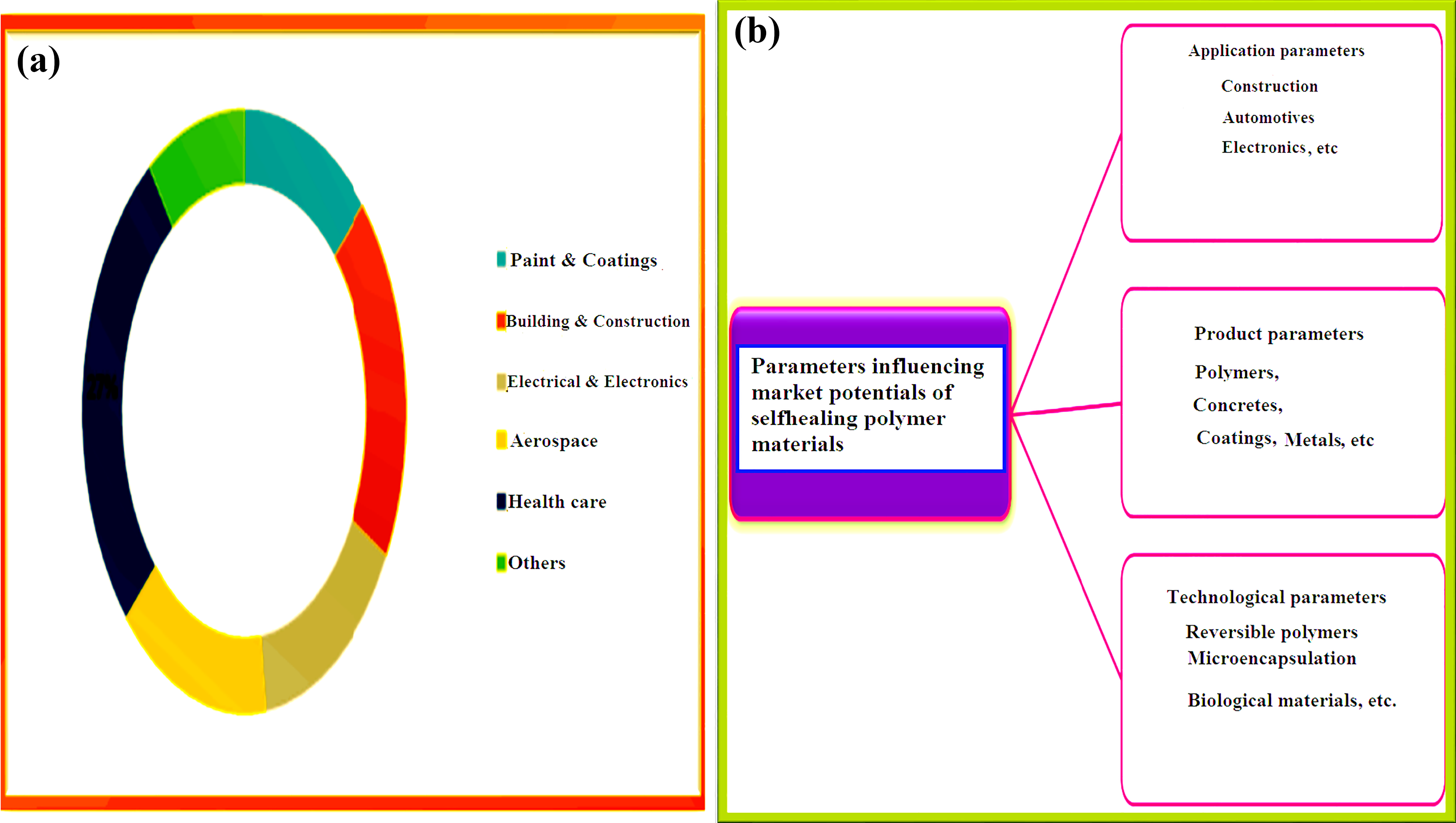
(a) Forecast of the market potentials of self-healing polymer materials from 2018—202523 and (b) parameters susceptible to influencing the market trend of self-healing polymeric materials.
From Figure 2(b), increasing desire for high-quality construction materials, improving infrastructural development, and urbanization are anticipated to anchor the market growth in the nearest future. In 2016, the global self-healing materials market size was valued at US$120.4 million. 23 The market trend of US self-healing materials is influenced by the presence of multinational companies engaged in continual researches and developmental initiation for discovering cutting-edge technologies. 24 The implementation of sophisticated expertise in supporting the expansion of product portfolio assists in capturing uncharted markets through the improvement of the customer’s base. These materials enable reduction of the frequency of the maintenance costs needed for the damage restoration, which is expected to be a key parameter driving the market growth in the future.
Insights into products
Generally, self-healing materials and polymers possess ability to improve the functionality of a broad range of materials in addition to prolonging their shelf life. These materials include coatings, asphalt, concrete, ceramic, metals, and so on. These peculiar materials assist in improving the effectiveness and performances through the adoption of advanced material design models. 24 Polymer composites are utilized in numerous engineering fields as a result of their inherent benefits such as chemical and physical stability, lightweight, and excellent processability. A pictorial illustration of self-mending process of polymeric materials is shown in Figure 3(a) to (d). Figure 3(a) shows the damaged part of a polymeric material, while Figure 3(b) shows the same part self-mended. Figure 3(c) shows a damaged polymeric component with Figure 3(d) showing the same component self-mended.Technological insights

(a to d) Pictorial illustration of self-mending of damaged polymeric components.
Self-healing materials can be classified into microencapsulation, reversible polymeric materials, shape memory materials, and biological materials systems. In 2016, reversible polymeric materials domineered the global market, as a result of their utilization in various industries specifically in the medical field. 23 Microstructures that are sensitive to stimulus are used in manufacturing membranes, micro-actuators, sensors, drug-delivery systems, and other specialized advanced micro-devices. Shape-memory polymers (SMPs) are applied in manufacturing shape-memory–facilitated self-healing coatings. 25 These surfaces assist in structurally repairing damaged surfaces while also restoring corrosion hindering attributes.
However, the development of microencapsulating technology is likely to attain momentum in future, as result of its ability at repairing polymeric composites after damages caused both mechanically and chemically. 26 Microspheres are available in substrates releasing their constituents at an appropriate period through utilization of various release mechanism, relative to the anticipated application of the encapsulated products. 27 A novel approach to traditional repairing techniques is capsule-based technology, and its functioning is relative to its healing effectiveness, prospects of existing development in microencapsulating agents, and size of microcapsules. 28 A schematic summary of self-healing mechanism and functionality-based applications of polymer nanocomposites is elucidated in Figure 4.

Schematic summary of self-healing mechanism of polymer nanocomposites, and their functionality based applications.
Application potentials
With regard to bioelectronic applications, sensors suffice and are generally elucidated into physical sensors measuring temperature, pressure, strain, and light; biochemical sensors, such as ion, DNA, metabolite; and protein sensors as shown in Figure 5. 22 Physical sensors are produced from polymers so as to provide flexibility, which enables easy measurement of pressure values up to few pascals. These sensors exhibit most sensitivity at room temperature. 29 Figure 5 shows a schematic elucidation of emerging specialized application areas of self-healing polymeric nanocomposites.

Emerging specialized application areas of self-healing polymer nanocomposites.
From Figure 5, varying plastic and organic electronic devices including organic thin-film transistors (OTFTs), organic light-emitting diodes (OLEDs), and organic photovoltaic (OPV) cells have undergone fabrication on 1-µm-thick films, which are just a tenth of kitchen-wrap thickness. In addition to semiconductive devices, there are numerous types of self-healable polymeric sensors. 20
In 2017, building and construction were the main application fields of the overall market and posited the greatest share composed of 27.4%. The electronics and semiconductors market is expected to witness a remarkable market growth by 2025. 23 The escalating socioeconomic need to erect hi-tech infrastructures and buildings in countries classified as emerging economies such as Asia Pacific and Latin America is anticipated to catalyze the development of the construction industries during the forecast duration. The automotive and transportation sectors have also experienced rising demand for self-healing materials. High-tech electronics companies such as Samsung and Apple have attracted utilization of self-healing materials in electronic devices including mobiles, laptops, and desktops.
Regional influences
In 2016, Europe occupied the largest size of the self-healing industry positing 31.9% market share. 23 Escalating purchasing power and increased spending by consumers, in addition to the increasing expansion of multinational companies, are expected to propagate the industrial development by 2025. Asia Pacific is anticipated to occupy the greatest market revenues in the nearest future, rapidly developing at a growth rate of 29.0% CAGR toward the end of 2025. 23 Escalating industrialization, dense population, and increasing direct foreign investments in the automotive and electronic sectors are the main parameters supporting the expanding regional growth. Self-healing materials reduce the cost of maintenance needed for healing damages, which are anticipated to be a major factor for market growth. 23
Insights into stretchable plastic bioelectronic materials
Plastic bioelectronics is a research field that takes advantage of the inherent properties of polymers and soft organic electronics for applications at the interface of biology and electronics. 30 The resulting electronic materials and devices are soft, stretchable, and mechanically conformable, which are important qualities for interacting with biological systems in both wearable and implantable devices. 31
Almost all bioelectronic devices that are available commercially depend on silicon microelectronics, which is the foundation for emerging information infrastructure and technology, including health care and medical devices. 18 Presently, numerous medical implants and devices such as electrocardiogram sensors, pacemakers, and smart endoscopes depend on silicon microchips. 19 -22
Advancements in miniaturization of silicon microelectronics with nanometer-scale accuracy have minimized the dimensions of these electronic modules, facilitating their being utilized as anchor for health monitoring. This variation has been made feasible via the stiffness and mechanical stability of the inorganic substrates utilized. In addition to the provision of favorable mechanical attributes for interfacing with biologically aligned tissues, plastics-electronics provide prospects for large area, multimodal, multipoint sensing. 18 -22
Moreover, utilization of organic semiconductive polymers has rapidly enlarged the scope of flexible displays to higher advanced and bidirectional devices including flexible and stretchable sensors, also referred to as artificial skins. 22 The issue related with advancement from flexible displays to sensory activities involves finding a route of monitoring the complexities, and dynamic structures of biologically inclined organs over a wide area with highly spatial and temporary resolution. Flexible wide-area organically inclined circuits having an active-matrix structure can be utilized in reducing both power use and the degree of wiring involved with regard to already established electronic devices.
Plastics bioelectronics materials evolvement
Organic electronics devices have undergone utilization in commercially available applications including photoconductive devices utilized in photocopying and laser printing, electro-chromic films, anticorrosion, and antistatic coatings based on conductive polymers, OLED displays and lighting, OPV cells, and OTFTs. 26 -28,30,31
The progress made with regard to soft implantable and wearable devices depends basically on these advancements in conductive and semiconductive polymeric materials but also on inclusive biomimetic attributes, such as stretchability, self-healability, and biodegradability. 18 -22 Stretchability is imperative for wearing comfort, for very close attachment to curved surfaces and motion components. Self-healability and biodegradability are also essential for plastic bioelectronics to exhibit greater biomimetic tendencies. Self-healability is vital for biological systems, and the inclusion of some degree of autonomy and repeatable self-healability into electronic devices would improve their robustness and durability, giving them the opportunity to be utilized in durable implants and devices. However, only a few investigations have researched into self-healable electronic devices. 32 Self-healability can be easily attained via the inclusion of dynamic bonds in insulative polymeric gels, such as hydrogen bonds, electrostatic interactions, and metallic–ligand bonds. 29,33,34 Composites consisting of metallic particles and self-healable polymers are the most potential materials to attain both high conductivity and autonomous repetitive healing. Reports abound of the prospective utilizations of these materials for electronic skins, transparent electrodes, and binders for battery electrode materials. 29,33,34 Two major areas of application of plastic bioelectronics include wearable (noninvasive) and implantable devices (Figure 6(e)) as illustrated in Figure 6(a) to (e). The superior ability of conformation and stretching of ultrathin-film plastic devices presents their susceptibility for use in wearables attached directly to biological, motion surface of the human skin (Figure 6(c)). 20 With regard to electrical performance, these materials have demonstrated effective performance for electronic artificial skin or e-skin 22 (Figure 6(b)) and usage of organic transistors (Figure 6(a) and (d)), for potential applications in robotics as illustrated in Figure 6.

(a to e) Diverse areas of application of self-healing plastics bioelectronics.
In line with this trend, scalable circuits structured for applications in stretchable wide-area sensors, utilize organically active matrices in the measurement of pressure and temperature distributions.
Self-healing routes
Extrinsic self-healing route
Extrinsic self-healing is also known as instantaneous healing mechanism. In this system, healing agents undergo capturing in hollow fibers, 35 microspheres, 36 and other containing entities. 37 -40 During operation, a crevice or breakage propagated in the polymer results in the release of healing agents in the performance of the healing mechanism. The process of crack propagation and failure in a material is elucidated in Figure 8.
Extrinsic self-healing approach is subsequently classified into two sets: capsule focused and vascular based. The mechanisms of extrinsic crack growth and self-mending are elucidated in Figure 7(b). The healing agents undergo encapsulation via the microencapsulating or vascular network. 41 Anytime a crevice occurs in these containers, healing substrates are released in the crack path while polymerization takes place and finally heals the crevice. The concept of microcapsular self-healing process is schematically elucidated in Figure 8(a). While Figure 8(b) illustrates the vascular self-healing process.

(a) Process of crack propagation and failure in a material and (b) mechanism of extrinsic crack growth and self-healing.

Schematic illustration of (a) microcapsule self-healing concept and (b) vascular self-healing process.
The main limitation of capsule-focused healing mechanism is its one-time healing orientation. 41 Conversely, embedment in the vascular network of healing substrates in the matrix polymer is a major challenge for researches with regard to their fabrication. In vascular self-healing materials, the capsules in microencapsulation are replaced by a vascular structure similar to a network of channels or distributaries or tunnel-like structures, 42 in which varying functionalized liquids have the capability of distribution as shown in Figure 8(b). These functionalized liquids also fill-up the gap on crack initiation thereby breaking the vascular network.
Intrinsic self-healing route
Intrinsic self-healing is also referred to as stimuli-responding self-healing and involves some kind of external stimuli such as thermal, photochemical, electrical, and moisture activation to initiate the process of healing, which is most attained by a bond-breaking and bond-rebuilding process. 43 Various reaction systems are used in enabling intrinsic healability in polymeric materials. Such as irradiation-initiated cycloaddition, 44 metathesis reactions, 45 photothermal ring-opening reactions, 46 photothermal metal–ligand complexation, 47 and redox-propelled host–guest complexation and de-complexation reactions. 48 Reversible covalent bonding based on Diels–Alder (DA) reaction for intrinsic healing is further discussed in the subsequent sections.
These materials are based on chain mobility and catch, reversible polymerizations, softening of thermoplastic phases, and hydrogen bonding, to initiate self-recovering. Thus, as a result of the reversibility of each of these reactions, varying healing activities are feasible. Thus, fabrication of intrinsic self-healing materials can be attained via six techniques including intrinsic self-healing material plan cycle, self-healable polymers in relation to reversible responses, self-healability from thermoplastic polymers, ionomeric self-healing materials, supramolecular self-healing materials, and self-healing by subatomic distribution. 49 In a recent study, the basic design ethics of intrinsic self-healing, polymeric materials with reversibility, and covalent bonding are defined. 50 A categorization of synthetic strategies relative to polymers, in addition to polymeric networks and their influence on performances, is expressed to attain further insight into established design strategies for healable materials. 51
A recent research reported the development of a new blend of polymer with thermally initiated shape memory and self-healing performance. The blend underwent preparation through combination with a self-healable ionomer (Surlyn 9520) and poly-cyclooctene with and devoid of crosslinking agents in varying ratios. 52 Results reveal that ionomer/crosslinked poly-cyclooctene blends of 70/30wt% resulted in polymers exhibiting partial macroscopic healing and repeatable shape memory characteristics. The novel polymer mechanism reveals both twin and triple shape-memory attribute and almost 100% stiffness recovery after healing of crosscuts at standard ionomer healing conditions. This study revealed a triple SMP with self-healability via a blending mechanism thereby creating the path for more durable materials focused on shape memory performances.
Synthesizing materials exhibiting high stretchability and self-healability properties are challenging. A novel poly(dimethylsiloxane) elastomer exhibiting high stretchability, room temperature self-healability, repeatable reprocessability, and controlled degradability has been reported via the inclusion of an aromatic disulfide bond and imine bond. 53 The fabricated elastomer exhibited a stretchability of over 2200% of its original configuration. Devoid of external stimuli, a damaged plate can heal thoroughly in 4 h. Additionally, the elastomer can undergo reprocessing multiple times devoid of any performance deterioration and degraded controllably in three routes. All these elastomers’ performances can be attributed to the unique twin-dynamic covalent sacrificial system.
Multi-functionalized shape memory materials based on epoxy resins (EP) with varying concentrations of chain-extended bismaleimide resins (CBMI) have been fabricated. The resulting EP/CBMI polymers have elevated glass transition temperature, excellent thermal stability, and good mechanical performances. Unlike traditional SMPs, EP/CBMI SMPs are capable of shape reconfiguration and self-mending. EP/CBMI polymers exhibit high cycle-life shape-memory attributes at elevated temperature, and their original shapes can undergo quick recovery within 21 s via thermal activation technique. Due to dynamic transesterification, EP/CBMI polymers exhibit plasticity and reconfiguration of their shapes when subjected to heating to dynamic transesterification temperature (200°C). Equally, EP/CBMI polymers also exhibited good healing performance, and a 77–86.5% fracture recovery of fracture toughness. 54
Polyurethanes are recognized for their fair mechanical performance, which is strongly required for numerous applications. Poly(ethyl-formal-disulfide)-based materials exhibit excellent self-healability because of the containing availability of exchangeable disulfide bonds, though their strength is relatively poor. Thus, through combination of the benefits of the two materials, the synthesis of self-healing polysulfide-based polyurethanes with a tensile strength of 2.62–5.80 MPa has been attained. These results imply that polysulfide-based polyurethane is an essential paradigm toward sustainable industrial applications. 49
Due to polymer chain mobility and molecular diffusion, numerous intrinsic self-healing polymers heal damages using reversible bonds and tend to be soft or gelly. However, for some polymers which undergo healing via bond reversibility, external stimulus triggers the healing procedure. This type of healing process is ascribed to a heat healing chemistry called DA reaction.
However, a tough self-healable polymer is required as it can be utilized as strong and low weight material for engineering applications. For a wide range of polyurethanes, the development of a disulfide-composed poly(urea-urethane) network, where aromatic disulfide diamine is utilized in establishing linkages for the trifunctional homopolymer of hexamethylene diisocyanates, in addition to aliphatic prepolymer chains resulting in the ready conversion of well-crosslinked network and an un-crosslinked structure has been conducted.
With regard to this linkage, the network exhibits the ability to balance two apparently contradictory forces, exhibiting simultaneously superior mechanical performances and high self-healable efficiencies devoid of any catalyst or external intervention. Additionally, these materials exhibit the capability of healing themselves continually thereby exhibiting strong prospects for industrial applications. 55
Applications of self-healing polymer composites
A major threat to human health is microbial diseases. Microbial attack is a major precursor to deterioration of polymeric self-mending materials. Therefore, the possession of antimicrobial properties is an important property of self-mending composites. A novel fabricated nanocomposite has exhibited significant antimicrobial action against Staphylococcus aureus, Escherichia coli, and Candida albicans as it contains sulfur-based compounds and polysulfanes which are considered to be antimicrobial agents. Self-mending nanocomposites have also aroused much interest in the medical sector. This is because they have shown great potential as anticancer drug conveyors. As a result of DNA biocompatibility, hydrogels exhibit promise for various environmental and biological applications.
The multi-responsive behavior of smart polymer underlies their applications in aerospace, textiles, drug delivery, hydrogels, anti-corrosive coatings, optical data storage, military, automotives, and so on. Self-repairing polymers, a form of smart polymers possess the ability of repairing themselves just the same as body living tissues. This specialized behavior results in improvement of its application as composites, aerospace coatings, microencapsulations, and so on. 56 -73
Conclusion, future perspectives, and challenges
Self-healable polymer nanocomposites exhibit a broad range of application potentials in numerous high-technological industries such as weaponry, biomedicals, and deep-space exploring. Self-mending hydrogels can be divided into soft and robust hydrogels with good mechanical properties suitable for applications in biomedicine. Robust self-mending hydrogels are applied in soft robotics, for instance, in implantable or wearable biosensors due to prolonged shelf life and mechanical performance as a result of damage or fatigue repair. Soft self-mending hydrogels exhibiting shear-thinning behavior are utilized in cell and drug conveyance and also in 3D printing as a result of injection via narrow needles and retention at appropriate sites. In the future, to enhance biomedical applications, self-mending hydrogels need to find solutions to several challenges such as the design of self-mending hydrogels possessing good biocompatibility and mechanical properties. Moreover, appropriate control of biodegradability is vital in self-mending hydrogels applied in tissue engineering and drug conveying.
Numerous potentials of self-mending and damage resistance exist for soft robotics in future, especially with regard to fault hindrance and self-mending of DA applied in soft sensors and electronics. Furthermore, the prospects of using self-mending elastomers and hydrogels in manufacture of inflatable actuators and hydrogels has been fulfilled. Presently, self-mending elastomeric nanocomposites tend to undergo rapid stress relaxation, thereby causing the loss of ability to returning to their original configuration. Notably, self-mending graphene/polymer composites are very promising intelligent/smart materials. However, not minding their rapid development numerous challenges need overcoming to improve their perspective in practical applications. For instance, as a component of self-mending composites, graphene can play a vital role in self-mending process due to their ability to undergo photothermal energy transformation. Here, graphene portends as an energy-absorbing agent for the rapid and efficient conversion of irradiation or sun light to thermal energy in order to improve the diffusion of polymer chains across the faulted interface, thereby enhancing the self-mending procedure.
Nevertheless, graphene-reinforced composites exhibit superior mechanical properties. However, the self-mending process may be hindered as a result of the interactions between graphene and polymers which may restrain the diffusion and motion of polymer chains. Additionally, the glass transition temperature of composites may vary after graphene inclusion, thereby affecting the self-mending effectiveness. In other words, the composite self-mending effectiveness may be reduced due to graphene inclusion. Thus, striking a balance between superior mechanical strength attained in the mix and high self-mending efficiency in graphene/polymer composites is a major hurdle. Also, enhancement of polymer/graphene compatibility while retaining the inherent attributes of graphene to a large extent in the composite is a major obstacle. Carbon nanotubes (CNTs) and halloysite nanotubes (HNTs) also present beneficial properties generally. Hence, CNTs and HNTs can prospectively improve mechanical properties of the composite materials, while containing and releasing healing agents, detecting strain cracks and temperature, and undergo self-mending equally. Finally, the unique attributes of self-mending materials in comparison with other materials present them as new alternatives in various applications. In the future, these materials can be utilized in numerous applications including turbine injectors, automobiles, spacecrafts, nuclear reactors, and specialized cutting devices.
Footnotes
Acknowledgements
The author is grateful to the Vice-Chancellor, Nnamdi Azikiwe University, Awka, Nigeria; Prof. Charles I Esimone for encouraging novel research studies and high-profile publications; Prof. Azman Hassan of Universiti Teknologi Malaysia (UTM), Manchester University, England, UK; and Federal University of Technology Owerri, Nigeria, for knowledge impartation.
Declaration of conflicting interests
The author(s) declared no potential conflicts of interest with respect to the research, authorship, and/or publication of this article.
Funding
The author(s) received no financial support for the research, authorship, and/or publication of this article.
