




Abstract
The relationship between surface- and bulk-related physical and mechanical characteristics of polypropylene (PP)-based composites filled with nanodiamond soot (NDS) particles was investigated. The tribological properties of a composite were considered as surface properties. Wear and friction coefficient values were measured using a steel pin-on-composite disk testing procedure under the justified set of test parameters. Loading of NDS particles to the PP matrix resulted in a drastic increase in the composite’s wear resistance. A significant increase in friction coefficient and contact temperature was observed for the composites with NDS content below a certain value assumed to be the percolation threshold for the selected processing method and components used. After the percolation threshold is reached, the friction coefficient decreases sharply and returns to the value characteristic of a filler-free PP. The effects observed were attributed to changes in properties of polymer matrix and composite melt.
Introduction
Polymer materials have found many applications in industry where such important characteristics as low bulk density, chemical resistance, and low friction coefficient are desirable. 1 In particular, polymers are often used as base material in production of gears, bearings, cams, and various functional coatings. 2
Unfortunately, in spite of low friction coefficient inherent to many polymer materials, they usually cannot offer high wear resistance necessary for practical long-term applications. 3,4 Since this situation is typical for a wide range of thermoplastic polymer materials commonly used in the industry due to the ease of processing, polymers of that class are often modified through loading of nanosized fillers to improve wear resistance. 5,6
To obtain efficient polymer composite materials with improved tribological properties a variety of fine fillers are successfully used: graphite, carbon fibers, multiwalled carbon nanotubes, and so on. 7,8 A special place among fillers is occupied by nanodiamonds (NDs). 9 An ND particle has unique spherical shape with diamond-like structure at the core and graphitic carbon at the outer shell. The superior properties and unique structural morphology of NDs make them attractive for use in the development of multifunctional polymer composites. However, the application of NDs in polymer (nano)composites is significantly less explored compared to other carbon nanomaterials, for example, carbon nanotubes and graphene. 10 At the same time, it was demonstrated that ND particles have a great potential as a filler for wear-resistant polymer composites based on various matrix polymers such as epoxy resins. 11 Currently, there is still not enough information on how efficiently NDs can improve the tribological properties of polycrystalline thermoplastic polymers, depending on the ND content in a composite. Considering the unique ways the ND particle clusters can be formed, affecting the formation of interconnected network at high ND concentrations in a matrix, 12 this question is of particular interest for the research community.
In this study, we used a detonation-synthesized nanodiamond soot (NDS) as a more affordable type of filler with characteristics close to those of NDs. Properties and methods of manufacturing NDS are well described in the literature. 13,14
The NDS is obtained at the post-detonation stage of an ND synthesis process, preceding the expensive final stage of NDs purification from detonation products. This reduces the cost of NDS fillers, making them an order of magnitude less expensive alternative to the pure ND filler.
The goal of this work was to develop an approach to production of NDS-filled polymer composites based on the thermoplastic matrix, such as polypropylene (PP), with optimal set of tribological characteristics. Such composites should combine low friction coefficient with high wear resistance and potentially possess the functionality provided by properties and characteristics of NDs.
Experimental
In this work, we conducted mechanical and tribological tests using test specimens fabricated of the nanocomposite based on PP matrix (Caplen 01030) with detonation-synthesized NDS filler produced by Elektrokhimpribor company (Russian Federation, Lesnoy city). 13,14
PP was compounded with NDS filler using a twin-screw microcompounder with the rotation speed of screw of 300 r min−1, at the temperature of 200°C. Concentration of NDS particles in the composite samples ranged from 2 wt% to 35 wt%. The pellets were then molded at the pressure of approximately 50 bar and temperature of 200°C to obtain test specimens in a form of flat disks of 70 mm in diameter and 1 mm in thickness.
We conducted tribological tests using a pin-on-disk-type testing machine (cylindrical stainless steel pin) in a dry friction mode (without lubricant) according to ASTM G99-05 procedure. Test parameters are listed in Table 1.
Tribological test parameters.

For each test piece, three replicate test runs were performed, measuring friction coefficient and contact temperature. Obtained results were averaged. Contact temperature was recorded with a thermocouple placed in the hole in a steel pin, 1 mm above the contact zone.
The normal load value was chosen based on the results of preliminary tribological tests of non-filled PP that demonstrated nonlinear relationship between the measured contact temperature and the increasing load (Figure 1). The drastic increase in contact temperature observed at normal load values of >15 N and accompanied by the increase in friction coefficient is highly undesirable as contact temperatures may get close to the melting point of PP (approximately 160°C). To avoid this, we decided to use normal load of 10 N, which is far enough from the transition value, but still can provide a wear rate sufficient for high accuracy measurements.

Friction coefficient (a) and contact temperature (b) versus test time for filler-free PP specimens at different normal load values (sliding speed 0.8 m/s).
To estimate the average wear, we used a Mahr (USA) MarSurf M400 profilometer-profilograph. Profile measurements were conducted at four diametrically opposite points of the track circle, three times in proximity of each point. After that, the results were averaged, and the cross-sectional area of the track was calculated.
Energy dispersion spectroscopy (EDS) study was conducted using a JEOL JSM-5300LV (Japan) scanning electron microscope with LINK ISIS 300 attachment for X-ray microanalysis.
Surface morphology of samples before and after friction tests was studied with a Bruker (USA) Multimode 8 atomic force microscope with the Nanoscope controller in the PeakForce Tapping mode.
Mechanical properties of composite films were studied by dynamic mechanical analysis (DMA) using a TA Instruments (USA) Q800 system. The samples were analyzed under tension in the temperature ramp mode (−60°C to 250°C) at constant frequency (1 Hz) and displacement (15 µm, deformation 0.1%).
The crystallinity of samples was studied by wide-angle X-ray scattering (WAXS) and differential scanning calorimetry (DSC) methods. WAXS patterns were recorded with a Bruker D8 Advance diffractometer (transmission mode, focusing germanium monochromator on the primary beam, copper K α radiation) within the scattering angle range of 2θ = 10–100°. To separate the reflexes, the OriginPro™ 2019b Build 9.6.5.169 software was used. The DSC traces of the samples were measured with a NETZSCH (Germany) STA 449 F3 synchronous TGA-DSC thermal analyzer at the heating rate of 10 K min−1.
Thermal conductivity of disk specimens (diameter 50.8 mm and thickness 1 mm) was determined per ASTM E1530-11 standard with a DTC-300 Thermal Conductivity Meter.
Results and discussion
Averaged friction and contact temperature curves for test specimens with different NDS content together with the test tracks profilometry data are shown in Figure 2.

Friction coefficient (a) and contact temperature (b) versus test time for filler-free and NDS-filled PP with different NDS content at the sliding speed of 0.8 m/s and normal pressure of 5 × 10⁵ Pa, (c) cross-sectional area of the wear track profile versus NDS content for the filler-free and NDS-filled PP (average of multiple points) for the sliding distance of 46 km.
Modification of polymer matrix with detonation-synthesized NDS filler results in a significantly reduced wear of a composite as compared to the filler-free PP (see Figure 2(c)), even at a very low NDS content (<2 wt%).
To check the possibility of increased wear of a steel pin during tribological tests of PP/NDS composites, we analyzed the EDS spectra of elements present on the surface of the composite specimen before (Figure 3(a)) and after (Figure 3(b)) a series of long friction tests. The analysis demonstrated that the quantity of Fe element presumably participating in a mass transfer process between the steel pin and the surface of the composite during tests was negligibly small even for qualitative analysis, both before and after the test runs for the filler-free and the NDS-filled PP. In addition, we conducted the special “inverted” tribological test (a composite pin on steel disk) for the friction pair (composite/steel) considered. The track profile obtained for the metal disk surface shows no significant changes in track cross-sectional area after the 8-h test run with the standard friction test parameters (Figure 3(c)).
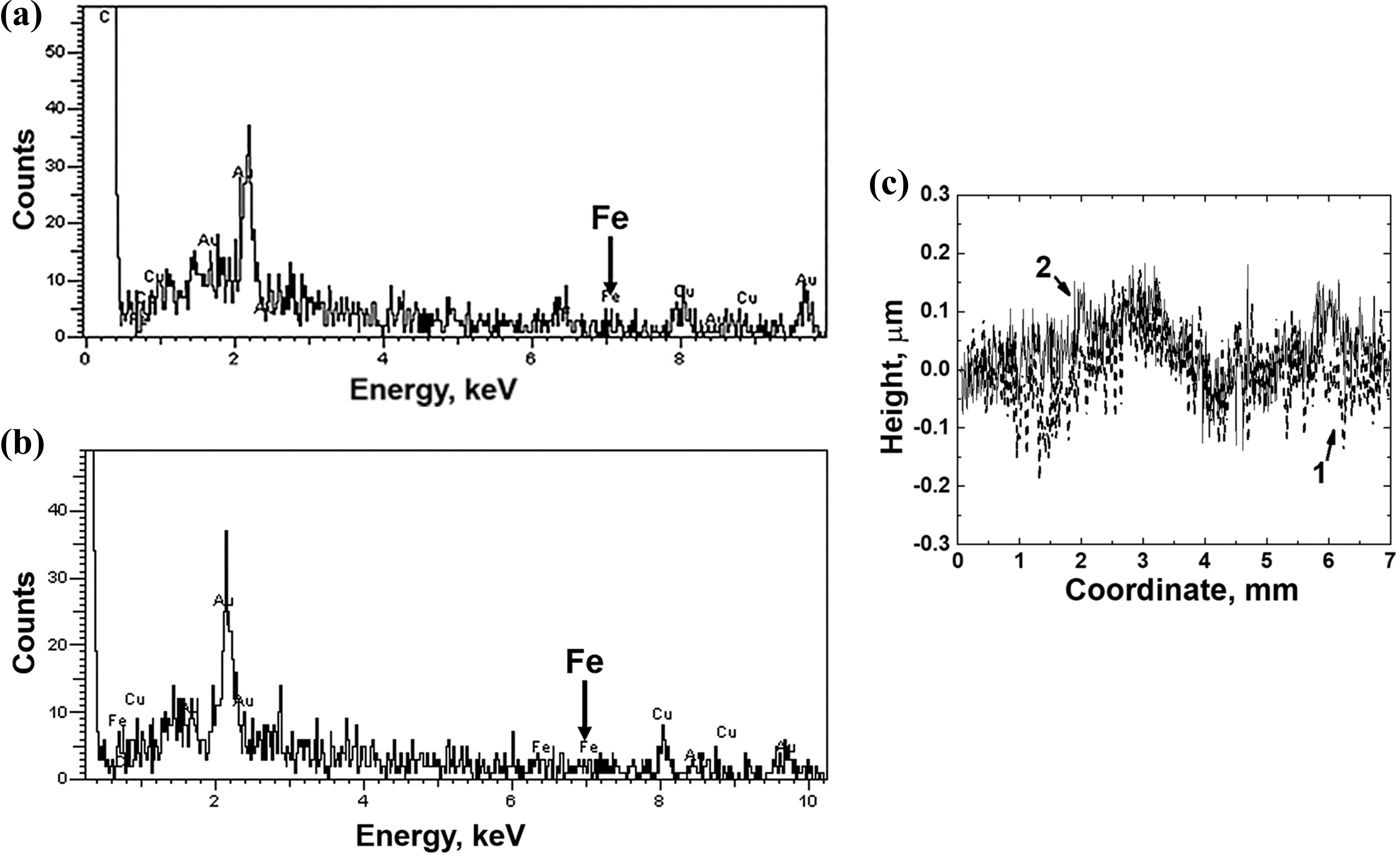
Results of EDS: (a) as-prepared surface of the NDS-filled PP (35 wt%), (b) the same surface after 69 km friction test run, (c) averaged track profiles on the steel disk surface before (1) and after (2) 23-km test run for PP-NDS composites (35 wt%) with cylindrical pin of 5 mm diameter and normal pressure of 5 × 10⁵ Pa.
The above findings show that modification of PP matrix with NDS particles does not have any noticeable effect on the erosion of a steel pin participating in the friction test.
Atomic force microscopy of the surfaces of the NDS-filled PP specimens provided the information on the distribution of NDS filler particles by contrasting them over the matrix background using the PeakForce Tapping technique in the adhesion work measurement mode (Figure 4). One can see that the filler (black regions in Figure 4) is distributed uniformly as separate particles in some areas of specimen surface or as aggregates in the other areas. The measured size of isolated particles is about 10 nm. It is also worth noting that during abrasion test NDS particles tend to form needle-like clusters (aggregates) oriented parallel to the sliding direction. This effect can contribute to the decrease in friction coefficient and wear for the friction pair considered (modified PP/steel) as compared to that of filler-free PP/steel.

AFM images obtained in the adhesion work measurement mode for the initial (a) and the abrasion worn (b) surfaces of the PP-NDS composites (35 wt% of NDS). The white arrow shows sliding direction during the test run.
Formation of strengthened “routes” from NDS particles can be attributed to the mass transfer process taking place between a composite material and a steel pin. 15 During this process, the polymer matrix is forced from the top layer of a composite, leaving mostly the NDS particles due to their stronger mutual interaction. Additionally, NDS aggregates may grow due to the fresh NDS particles fetched by the steel pin in the direction parallel to the sliding direction. Thus, we can assume that this phenomenon is independent from the NDS content in the PP matrix, since a significant decrease in wear can be achieved via mass transfer of NDS particles even at a very low NDS content, while at a high NDS content no mass transfer is actually needed to get the same result.
Tribological characteristics of composite materials being studied, such as friction coefficient and composite/steel pin contact temperature, are mostly influenced by the surface characteristics of a composite. At the same time, a threshold nature of tribological characteristics dependence on the NDS content (Figure 5) can be observed, which is obviously related to changes in bulk characteristics of the material. Particularly, loading of PP matrix with detonation-synthesized NDS filler leads to noticeable changes in dry friction coefficient and in contact temperature as compared to the filler-free PP, as long as the NDS content does not exceed a threshold-like value of approximately 20 wt% of NDS. In this regard, a study was conducted to attribute the threshold concentration value at which the change in surface characteristics of material takes place to the changes in bulk characteristics of material.

Friction coefficient and contact temperature versus NDS content for the filler-free and NDS-filled PP (for sliding speed of 0.8 m/s and normal pressure of 5 × 10⁵ Pa) averaged over stationary segments of the test curves in Figure 2(a) and (b).
Before studying the percolation effect, we have to make sure that this effect is indeed influenced by the NDS content only and not by the test parameters, which can have an unpredictable effect on the abrasion process for polymer composites as it was demonstrated in the past works. 16,17 To this end, we studied the influence of the steel pin sliding speed on the friction coefficient at the NDS content below the expected threshold value of approximately 20 wt% NDS. The obtained results are presented in Figure 6. The plots of friction coefficient versus pin sliding speed for NDS content of 5 and 10 wt% show the same qualitative behavior with increase in sliding speed. This result can be considered sufficient to prove that the effect of interest depends solely on the filler content in a composite material and is not influenced by the parameters of the tribological test.

Friction coefficient of PP-NDS composites for different NDS content versus steel pin sliding speed.
The percolation effect, if it does take place, might be expected to manifest itself in a sharp change in crystallinity, electrical conductivity, thermal conductivity, rheological, and other bulk properties of the material in question, as compared to the properties of the neat polymer.
Following these expectations, we investigated the influence of the NDS content on the crystallinity of PP in the composite materials using the DSC and X-ray diffraction methods (Figure 7). From X-ray scattering data, the crystallinity of PP was determined using standard procedure, 18 taking into account reflexes corresponding to the PP crystalline and amorphous phase that were separated from the NDS reflexes.

The normalized relative crystallinity change as a function of NDS content in PP/NDS composites, obtained with DSC and X-ray diffraction methods. The crystallinity of the filler-free PP sample was used for normalization.
It can be seen that changes in crystallinity of PP in a composite become pronounced at NDS content of about 20 wt%. Thus, at this level of NDS content, aside from the presence of large number of filler particles in the polymer matrix and their specific influence, the changes in properties and characteristics of a composite may also be caused by changes in the properties of a polymer matrix itself.
The observed discrepancy in the crystallinity values obtained separately with X-ray analysis and with DSC may be explained, for example, by a change in thermal properties of PP crystals, caused by expected increase in the volume of transcrystalline phase, resulting from the increase in filler content of PP-based composites. 19 By and large, we believe that the discrepancy between crystallinity values obtained by different methods has no essential influence on the investigation of percolation effect studied in this work.
In addition to crystallinity measurements, two other popular methods can be used to identify percolation effects in composites—by measuring electrical conductivity and by measuring thermal conductivity of composites. Unfortunately, the first method could not be used in our study because the NDS particles are not electrically conductive. At the same time, nonconductive nature of NDS particles eliminates possible influence of electrical currents present in materials during the tribological tests.
The second method proved to be insufficiently sensitive to demonstrate the expected percolation effect, as can be seen from the results of thermal conductivity measurements shown in Figure 8.
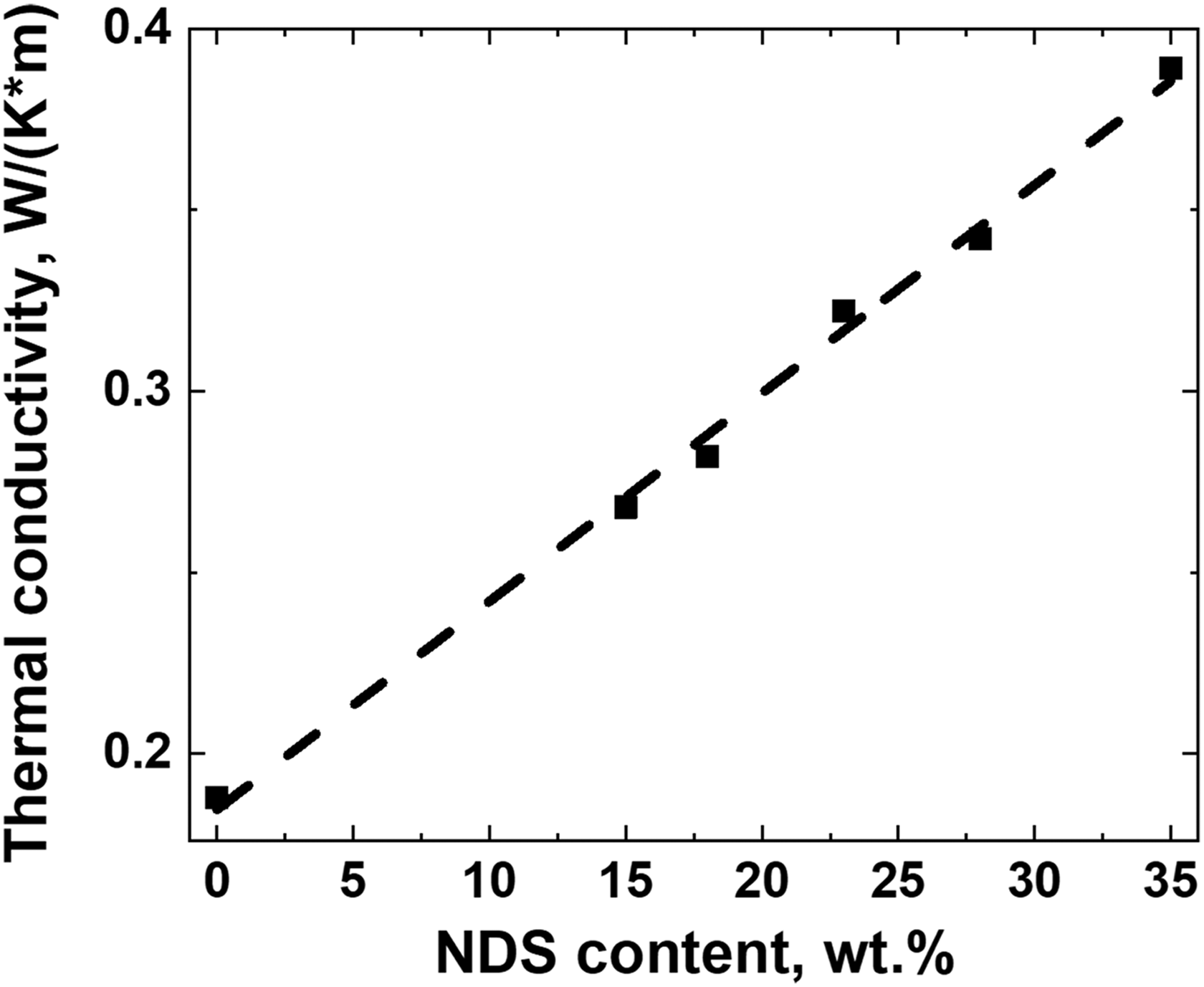
Thermal conductivity of PP/NDS composites versus NDS content.
The dependence of thermal conductivity on the NDS content does not show percolation nature and is approximately linear with increasing NDS content for PP/NDS composites. This can be explained as follows. As contact surface of dispersed NDS particles or of their aggregates inherently contains some amount of adsorbed polymer, their thermal conductivity can be comparable to that of a pure polymer, thus making it impossible to observe the percolation character of its concentration dependence. However, it may be possible to observe nonlinear nature of the relationship between thermal conductivity and filler content at higher NDS content values. 20
Additional information on the change in the bulk characteristics of composite materials with a variation in the NDS content was obtained using the DMA method (Figure 9).
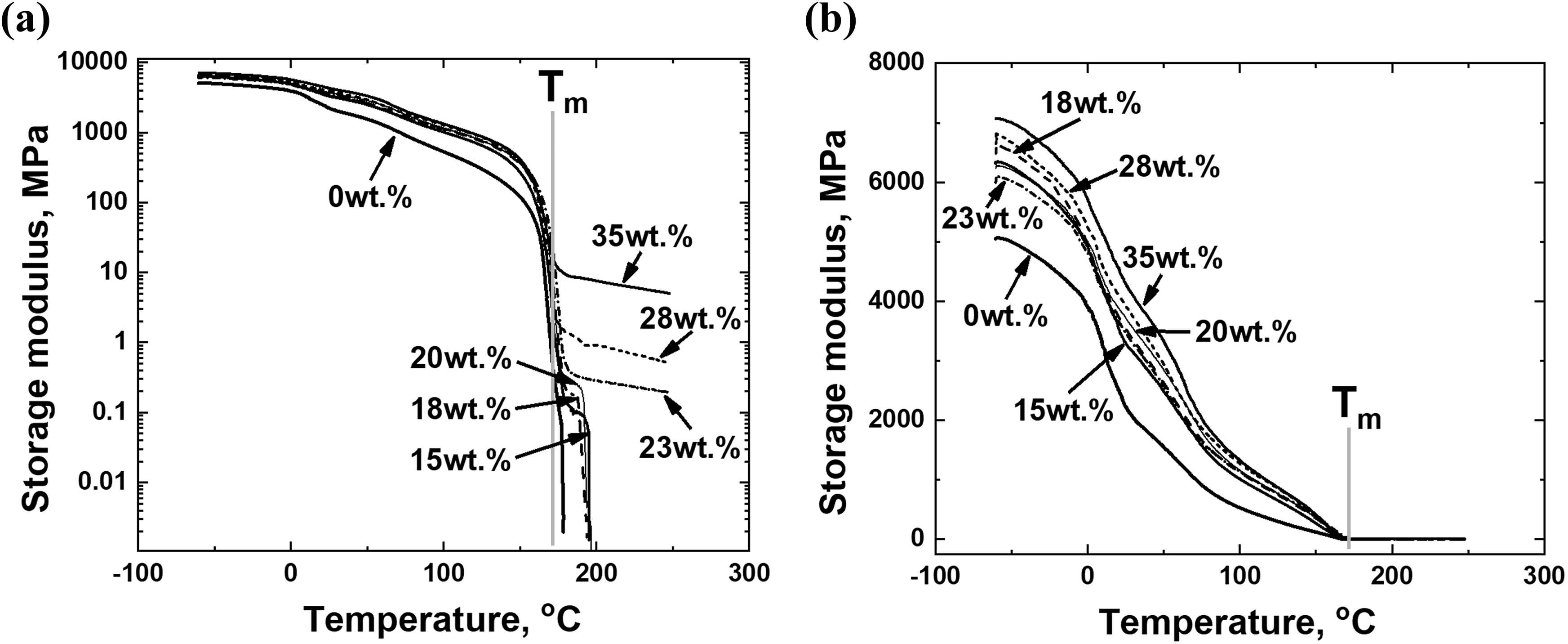
Storage modulus versus temperature dependence obtained using DMA for the PP/NDS composites with different NDS content (normal (a) and logarithmic (b) scale).
From Figure 9(a), no significant differences between storage modulus values for composites with different NDS content can be observed in the range of temperatures below the melting point of the PP (approximately 160°C). However, on a closer look at the temperatures above the melting point of PP (Figure 9(b)), one can see that characteristics of composite melts differ significantly from each other depending on the NDS content. Here a conclusion can be made that the melt viscosity changes significantly when the content of NDS filler is high enough (23 wt% and above). This value is close to the early estimate (approximately 20 wt%) and can be considered as the percolation threshold for the NDS content in the PP matrix.
The obtained results make it possible to conclude that the threshold nature of tribological properties dependence on the NDS content is associated with formation of NDS particles contacts network (percolation cluster of particles) within the bulk of a composite. However, it cannot be attributed to the thermal conductivity of filler particles or to their impact on mechanical characteristics of a composite in a solid state (below the melting point of PP), since these characteristics of a composite change linearly with increasing filler content for the investigated range of NDS content in the composites (Figure 8 and 9(a)).
To fully comprehend the effect of NDS filler on the tribological characteristics of composites, it is important to understand what temperature value exactly should be considered as the contact temperature. The temperature T(x) measured during the tests, where x is a distance between contact zone and a thermocouple position, cannot be deemed the value of the contact temperature T(0) 21 since the position x of the thermocouple during the tests was 1 mm away from the heat source (contact zone).
T(0) can be estimated using the Poisson equation
22
It should be noted that in our friction tests the heat transfer/cooling process can take place not only through a steel pin but also through a composite specimen, room atmosphere, and so on. Using the experiment parameters and measured thermal conductivity coefficient of a composite values, we can safely estimate the true contact temperature to be 50–65°C higher than T(x) value. Thus, the estimated true temperature of the contact surface is very close to the melting point of PP (approximately 160°C). Considering that friction can yield lower melting products of polymer destruction (as a result of mechanochemical processes), we can assume that for composites with NDS content below the aforementioned threshold (Figure 5) the interaction between the steel pin and composite surface will take place through a composite melt layer.
Considering all the obtained results, the most likely explanation of the observed phenomenon is a change in the number of cohesive interactions between NDS particles. This, in turn, results in a change in the melt viscosity of PP/NDS composite, related to an increase in tearing-off work for NDS particles or aggregates. Since a friction coefficient, among other things, accounts for the inter-surface adhesion component, 23,24 the friction force will be strongly dependent on how good the surface of a steel pin is wetted with polymer during the abrasion process.
When the NDS content is low enough, the filler can actively participate in a mass transfer between the composite and a steel pin in relatively large quantities, also increasing the volume of polymer involved in this process. It also acts in the abrasion process as an abrasive, increasing the friction coefficient and helping to translate the friction work into the thermal energy at the composite’s surface. 3,25 After the percolation threshold is reached, the number of interactions between NDS particles in a composite becomes very high, thus increasing the viscosity of a composite melt. This effect is called rheological percolation, and it has been actively investigated in recent years 26 for thermoplastic polymer nanocomposites.
As the result, the steel pin moving along the surface of a composite is not wetted as well as in the case of a less viscous melt. Since the work of friction forces is lower, there is less energy to dissipate at the surface of a composite, which is spent on polymer melting. Thus, the melt volume drops to almost the initial values for non-filled PP and so do the friction coefficient and the contact temperature in a polymer/steel pin system.
The increased thermal conductivity of the composite’s bulk (Figure 8) will obviously facilitate the thermal energy transfer from the surface to the bulk of material and help to decrease the melt volume on the surface of the composite during the abrasion process. However, the minor differences between thermal conductivities of NDS filler and PP can hardly explain drastic changes in the melt formation process observed with the increase in NDS content. Therefore, we can assume that observed percolation phenomena and reduction of melt volume are most likely associated with the composite melt properties, such as viscosity, and the properties of the matrix, such as crystallinity, which also affect the melt formation process.
Conclusions
Tribological, physical, and mechanical characteristics of the PP/NDS composites samples were investigated. We have established that loading of the polymeric matrix with NDS filler greatly increases the abrasion resistance of a composite compared to that of a filler-free PP.
We have also found that relations between tribological characteristics of PP/NDS composites and NDS content demonstrate a percolation character with the increase in NDS content. This can be attributed to a sharp rise in the number of contacts between NDS particles, which results in a higher viscosity of composite melts and hinders the participation of PP and NDS particles in a mass transfer process between the composite and the surface of a steel pin. Thus, we can conclude that to achieve the optimal characteristics of antifriction components and coatings made of composites based on thermoplastic polymers such as PP, the content of nanoparticles shall be greater than the percolation threshold value specific for selected method of processing and a filler type.
The results obtained can be used to develop a new class of composite materials characterized by low friction coefficients, high abrasion resistance, and low production costs.
Footnotes
Declaration of conflicting interests
The author(s) declared no potential conflicts of interest with respect to the research, authorship, and/or publication of this article.
Funding
The author(s) disclosed receipt of the following support for the research, authorship, and/or publication of this article: The reported study was funded by Russian Foundation for Basic Research according to the research project no. 18-29-19112.
