




Abstract
Collective narcissism is a belief that one’s own group (the in-group) is exceptional but not sufficiently recognized by others. It is the form of “in-group love” robustly associated with “out-group hate.” In contrast to private collective self-esteem (or in-group satisfaction, a belief that the in-group is of high value), it predicts prejudice, retaliatory intergroup aggression, and rejoicing in the suffering of other people. The pervasive association between collective narcissism and intergroup hostility is driven by a biased perception of the in-group as constantly threatened and out-groups as hostile and threatening. Collective narcissism is associated with hypersensitivity to provocation and the belief that only hostile revenge is a desirable and rewarding response. It arises when the traditional group-based hierarchies are challenged and empowers extremists as well as populist politicians. Instead of alleviating the sense of threat to one’s self-importance, it refuels it. The association between collective narcissism and intergroup hostility is weakened by experiences that fortify emotional resilience (e.g., positive identification with a community).
Keywords
He is nothing—but if he can identify with his nation, or can transfer his personal narcissism to the nation, then he is everything. . . . The individual satisfies his own narcissism by belonging to and identifying himself with the group. Not he the nobody is great, but he the member of the most wonderful group on earth.
The idea that a positive belief about one’s own group (the in-group) is associated with discrimination and hostility toward other people just because they belong to a different group (the out-group) has a long tradition in social sciences (e.g., Sumner, 1906). However, it has also been observed that people endorse positive beliefs about their in-group without being hostile toward others (Brewer, 1999). Analogously, studies differentiate self-esteem (a belief that one is of high value) from narcissism (a belief that one is superior and requires admiration and special recognition) and link only narcissism to interpersonal hostility (Brummelman, Thomaes, & Sedikides, 2016). Given that people project beliefs about themselves onto their in-groups (Gramzow & Gaertner, 2005), it is possible to differentiate collective self-esteem (a belief that the in-group is of high value and a reason to be proud; Crocker & Luhtanen, 1990; also called in-group satisfaction; Leach et al., 2008) from collective narcissism (a belief that one’s own group is exceptional but not sufficiently recognized by others; Golec de Zavala, Dyduch-Hazar, & Lantos, 2019) and to expect that only collective narcissism is associated with intergroup hostility.
Indeed, collective narcissism predicts intergroup hostility over and above collective self-esteem or other forms of positive in-group identification, mediates their association with intergroup hostility, and suppresses their positive association with intergroup tolerance (Golec de Zavala, Dyduch-Hazar, & Lantos, 2019). People can hold a collective narcissistic belief about various groups they belong to. Collective narcissism has been assessed (by means of the Collective Narcissism Scale; Golec de Zavala, Cichocka, Eidelson, & Jayawickreme, 2009) with reference to national, ethnic, ideological, and religious groups; professional organizations; football teams; students of the same university; gender (men); and fictitious groups. In all cases, it has made similar predictions for intergroup attitudes (Golec de Zavala, Dyduch-Hazar, & Lantos, 2019).
Entitlement, hostility, and resentment lie at the heart of collective narcissism. Any reason can be used to claim that the in-group deserves special recognition and privileged treatment: economic or military might, cultural sophistication, God’s love, even exceptional suffering. The reasons depend on what, according to the group members, positively differentiates them from members of other groups. People who endorse collective narcissism explicitly express the belief that their in-group is exceptional and that others do not evaluate it positively. However, they also do not associate their in-group’s symbols positively on the implicit, automatic level (Golec de Zavala et al., 2009) and harbor low self-esteem (Golec de Zavala, Federico, et al., 2019) but high self-entitlement (Golec de Zavala, Lantos, Bierwiaczonek, & Sedikides, 2020).
Collective narcissism is expressed by terrorists demanding that the West follow the righteous ways of Islam, by White supremacists claiming that they are “defending” the nation from “ethnic replacement,” or by incels—sexually frustrated men who are “involuntary celibates”—proclaiming that they hate all women. However, collective narcissism motivates more than just extremism. It lies behind voting for populist politicians, parties, and policies (e.g., Federico & Golec de Zavala, 2018; for a review, see Golec de Zavala & Keenan, in press; for a meta-analysis, see Forgas & Lantos, 2019). Given that collective narcissism shapes current political landscapes, it is important to understand its mechanisms and consequences (for a summary, see Fig. 1).
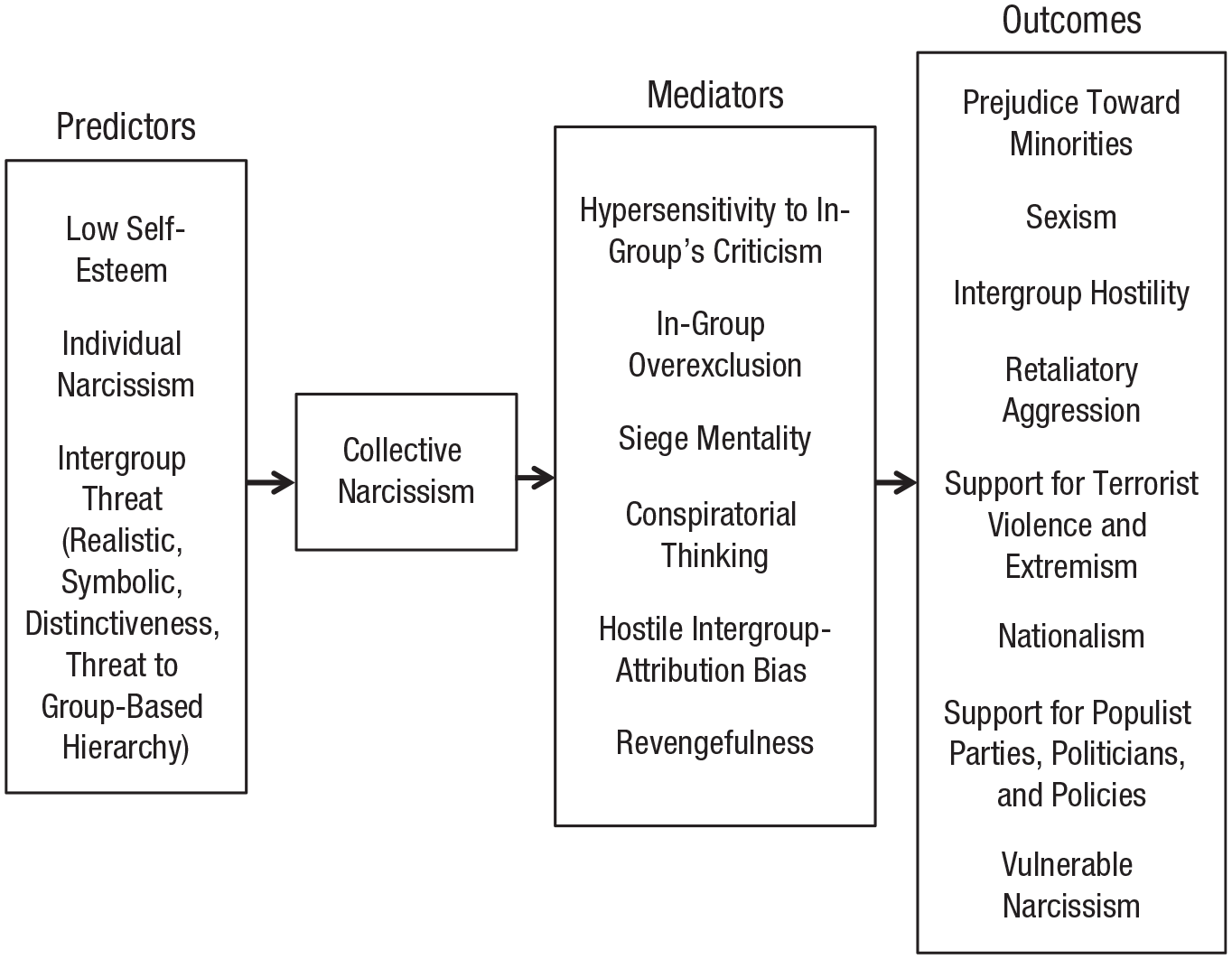
Collective narcissism: predictors, mediators, and outcomes.
Intergroup Hostility
Collective narcissism predicts nationalism, a confrontational international stance (Federico & Golec de Zavala, 2020) and attitudes that escalate intergroup conflicts (Golec de Zavala et al., 2009). For example, it predicted support for terrorist violence in radicalized social networks inspired by Islam (Jasko et al., 2020) and support for American retaliatory war in Iraq in 2003. Endorsing a collective narcissistic belief about Mexico is associated with perceiving the wall along the American–Mexican border built by the United States as an insult to Mexico and Mexicans and resulted in hostility toward Americans (Golec de Zavala et al., 2009).
Collective narcissism is associated with prejudice. For example, men who feel that their manhood is precarious endorse prejudice toward women (Golec de Zavala & Bierwiaczonek, in press). Collective narcissism predicts anti-Semitism in Poland, driven by the belief that Jews secretly conspire against Poles (Golec de Zavala & Cichocka, 2012). Poles who endorse collective narcissism want to hurt Syrian refugees because they perceive Syrian refugees as being hostile toward them (Dyduch-Hazar, Mrozinski, & Golec de Zavala, 2019). For the same reason, American collective narcissism is related to prejudice toward Arabs but not toward Asians or Europeans, who are not perceived as a threat (Lyons, Kenworthy, & Popan, 2010). Thus, collective narcissism is the form of “in-group love” persistently associated with “out-group hate.” What explains this relentless association?
Hypersensitivity to Insult and Exaggeration of Malevolent Intentions of Other People
Collective narcissism predicts experiencing intergroup situations in a manner akin to affective group-based relative deprivation: feeling angered that the in-group does not receive desired outcomes received by relevant out-groups (van Zomeren, Postmes, & Spears, 2008). However, the expectation that the in-group should receive better outcomes than the relevant out-groups is specific to collective narcissism. Collective narcissists are interested in privilege, not justice or equality. Thus, collective narcissism is likely to motivate violent and nonnormative rather than normative collective action in reaction to perceived group-based deprivation. Collective narcissism increases in response to perceived intergroup threat (Guerra et al., in press): symbolic (i.e., to the in-group’s values, esteem, or belief system), realistic (i.e., to material or physical security; Stephan, Ybarra, & Rios Morrison, 2015), and especially distinctiveness threat (i.e., threat of being indistinguishable from other people). However, collective narcissists also exaggerate the perception of intergroup threat and believe that their in-group alone faces the hostility of other people (Golec de Zavala & Cichocka, 2012; Golec de Zavala et al., 2009). In their view, the in-group never receives the outcomes it is entitled to. Thus, collective narcissism pertains to a “sore” in-group veneration permanently tinted by implicit doubts and the perception that the in-group is wronged by other people. Collective narcissists believe that the only appropriate and rewarding reactions to threats from other people are aggression and hostility (Dyduch-Hazar & Mrozinski, 2020).
In consequence, collective narcissists retaliate with excessive hostility in situations that require a stretch of imagination to be perceived as a threat or deliberate provocation. For example, after reading unfavorable comments about their national character coming from a foreign exchange student, Americans who endorsed collective narcissism expressed the intention to hurt and humiliate all compatriots of the criticizing student (Golec de Zavala, Cichocka, & Iskra-Golec, 2013). Collective narcissists who felt insulted by jokes made by a Polish actor about the government rejoiced in the news of his father’s terminal illness (Golec de Zavala, Peker, Guerra, & Baran, 2016). Collective narcissists symbolically hurt a voodoo doll representing a Syrian refugee because they believed that the revenge in the name of the group was “sweet” (Dyduch-Hazar & Mrozinski, 2020).
Collective narcissistic intergroup hostility is also inspired by conspiracy theories regarding the malevolent intentions of other people. For example, the association between Polish collective narcissism and hostility toward Russians is explained by a pervasive, unverified conspiracy theory that the plane crash that killed the Polish president and government officials in Russia in 2010 was perpetrated by the Russian government. Polish collective narcissism is associated with prejudice toward Germans because of the belief that Germans conspire with other European nations to deprive Poland of recognition of its prominent role in initiating the fall of communism in Eastern Europe (Cichocka, Marchlewska, Golec de Zavala, & Olechowski, 2016).
Collective narcissists are attracted to conspiracy theories because such theories suggest that other people question the special entitlement of the in-group out of malevolence and jealousy. Conspiracy theories justify constant vigilance to threats to the in-group’s image. They also provide a reassurance that the in-group is important enough to attract secretive plots from other people. Thus, the antagonistic belief in the malicious plotting of other people fuels the tendency associated with collective narcissism to adopt a posture of intergroup hostility.
The In-Group Overexclusion Effect
Collective narcissists are overvigilant not only to external threats but also to enemies within. Collective narcissism is linked to an exclusive and narrow definition of those who “truly” represent the in-group. Unlike people who positively identify with their groups, collective narcissists exclude in-group members who, in their opinion, reflect negatively on the in-group (the in-group overexclusion effect: Leyens & Yzerbyt, 1992).
For example, in the United Kingdom, collective narcissism motivated the Brexit vote because naturalized citizens and immigrants were perceived as a threat to the positive national identity of the autochthones (Golec de Zavala, Guerra, & Simão, 2017). In Poland, the collective narcissistic claim to exceptionality is based on the nation’s attachment to traditional Catholicism. Thus, the definition of national identity is closely linked to the teachings of the Catholic church. Being “truly” Polish means being stereotypically male, Catholic, and heterosexual. Such narrowly construed national identity is threatened by homosexual and nonbinary Poles, as well as nontraditional women. In consequence, in Poland, national and religious collective narcissism is associated with sexism (Golec de Zavala & Bierwiaczonek, in press) and homophobia (Golec de Zavala, Lantos, & Mole, 2020).
Contentious attitudes toward negatively valued in-group members are likely to be accompanied by the glorification of positively valued in-group members, including overlooking their transgression. Indeed, initial evidence indicates that in Poland, Catholic collective narcissism is associated with shaming the victims of pedophilia perpetrated by Catholic priests (Molenda, Marchlewska, Gorska, Lipowska, & Malinowska, 2020). Such attitudes harm rather than advance the in-group. They destroy the positive sense of pride, solidarity, and community but further increase collective narcissism.
When is Collective Narcissism More Likely?
Although it is overtly an assertion of the in-group’s greatness, collective narcissism does not have the group’s welfare at heart. Instead, the in-group’s image is used as a vehicle to satisfy frustrated self-importance and to protect the undermined self-esteem. Collective narcissism links low self-esteem and individual narcissism to intergroup hostility.
Undermined self-esteem
The negative association between self-esteem and intergroup hostility can be derived from social-identity theory. Social-identity theory predicts that low self-esteem should motivate group members to derogate out-groups, thus achieving positive in-group distinctiveness and boosting self-esteem (Tajfel & Turner, 1979). However, empirical studies did not find a reliable association between low self-esteem and out-group discrimination (e.g., Martiny & Rubin, 2016) or an association between positive in-group identification and out-group discrimination (e.g., Riek, Mania, & Gaertner, 2006) until collective narcissism was taken into account. Collective narcissism is negatively associated with self-esteem. At the same time, private collective self-esteem is positively associated with personal self-esteem. The positive overlap between collective narcissism and private collective self-esteem obscures the negative association between personal self-esteem and collective narcissism, which becomes visible only when this overlap is partialed out (Golec de Zavala, Federico, et al., 2019).
The association between undermined self-esteem and collective narcissism was predicted by the Frankfurt School scholars (e.g., Fromm, 1973) and status-politics theorists (e.g., Hofstadter, 1965). They suggested that in conditions that undermine self-worth, people used their in-groups instrumentally to boost self-esteem. A historical example of conditions that undermined self-esteem and produced a mainstream increase in collective narcissism was the Great Depression, which was followed by the widespread support for fascism. Analogously, the 2008 global financial crisis was followed by increased right-wing populism. The severe financial crisis undercut the stability of the traditional bases with respect to which people assessed their self-esteem. In addition, the social change that empowered many previously disenfranchised groups, such as ethnic minorities; women; or the lesbian, gay, bisexual, and transgender community, produced a sense of lost group-based privilege in members of the advantaged groups (Inglehart & Norris, 2016). Such conditions engendered uncertainty about self-esteem and produced social identities organized around the sense of lost importance and undermined self-worth.
When the undermined self-worth is invested in the in-group’s image, it cannot be easily separated from it. People stay committed to groups even if they do not derive the expected outcomes from their group membership. Indeed, results from longitudinal studies suggest that endorsing collective narcissism to compensate for low self-esteem is not successful. Although low self-esteem consistently predicts collective narcissism weeks later, endorsing collective narcissism does not predict an increase in self-esteem (Golec de Zavala, Federico, et al., 2019).
Frustrated personal entitlement
Studies suggest that endorsing collective narcissism does not improve but rather impairs personal well-being (Golec de Zavala, 2019). It does not improve self-esteem (Golec de Zavala, Federico, et al., 2019), but it increases the sense of frustrated self-entitlement. Collective narcissism is reciprocally associated with vulnerable narcissism (Golec de Zavala, Lantos, et al., 2020)—the presentation of individual narcissism characterized by frustration and resentment, which becomes salient when the grandiose expectations regarding the self are not confirmed by external factors and are not recognized by others (Krizan & Herlache, 2018). Vulnerable narcissism increases collective narcissism several weeks later, and collective narcissism results in increased vulnerable narcissism several weeks later. A situational increase in collective narcissism results in an increase in vulnerable narcissism (Golec de Zavala, Lantos, et al., 2020).
This suggests that investing the frustrated desire for personal recognition in collective narcissism is futile and, indeed, damaging. Instead of providing a relief, it feeds a self-reinforcing mechanism by which frustrated deservingness at the individual level of the self becomes implicated in the definition of social identity and, thus, in intergroup relations. It fuels a vicious circle of intergroup hostility.
What Can Be Done About Collective Narcissism?
The positive overlap between collective narcissism and nonnarcissistic collective self-esteem provides one way out of the vicious circle of intergroup hostility motivated by collective narcissism. Participating in positively valued in-groups increases and stabilizes self-esteem: Collective self-esteem mediates the positive association between personal self-esteem and collective narcissism (Golec de Zavala, Federico, et al., 2019). It can lower collective narcissism. Conversely, when collective narcissism becomes a dominant narration about the group’s identity and the role of collective self-esteem is marginalized (e.g., via centralization of power, social polarization, undermined solidarity, and detachment from local communities), individuals who feel uncertain about their self-esteem are more likely to turn against other groups, such as minorities, refugees, or nontraditional women, because they are motivated to protect the group in whose grandiosity their self-esteem is invested.
Given that collective narcissism overlaps with collective self-esteem, it is indirectly linked to psychological benefits of positive social identity: feeling socially connected, positive, and happy. This overlap mitigates the negative emotionality that underlies collective narcissism (Golec de Zavala, 2019). It links collective narcissism to self-transcendent emotions that bind people together and link them to something larger than their individual selves. Experiencing one such emotion, gratitude (i.e., feeling appreciative of positive aspects of experience) during mindful meditation, weakens the association between collective narcissism and prejudice. In future studies, researchers would do well to investigate whether other interventions that increase emotional resilience can reduce collective narcissism and weaken the association between collective narcissism and intergroup hostility.
Recommended Reading
Brewer, M. B. (1999). (See References). A historical classic; one of the first articles to indicate that positive attitude toward one’s own group does not have to be related to hostility toward other groups.
Brummelman, E., Thomaes, S., & Sedikides, C. (2016). (See References). A clearly written, comprehensive review for readers who wish to expand their knowledge on the distinction between self-esteem and narcissism.
Golec de Zavala, A., Dyduch-Hazar, K., & Lantos, D. (2019). (See References). A comprehensive, highly accessible overview of what is known about collective narcissism that presents the relevant research in more detail than the current article.
Golec de Zavala, A., Federico, C. M., Sedikides, C., Guerra, R., Lantos, D., . . . Baran, T. (2019). (See References). A representative empirical article that illustrates original research about collective narcissism that clarifies the selfesteem hypothesis of social-identity theory.
