




Abstract
This research tested the hypothesis that mindful-gratitude practice attenuates the robust association between collective narcissism and prejudice. In Study 1 (a between-subjects study using a nationally representative sample of 569 Polish adults; 313 female), 10 min of mindful-gratitude practice—compared to mindful-attention practice and control—did not decrease prejudice (anti-Semitism), but weakened the positive link between collective narcissism and prejudice. In Study 2 (a preregistered, randomized, controlled-trial study using a convenience sample of 219 Polish adults; 168 female), a 6-week mobile app supported training in daily mindful-gratitude practice decreased prejudice (anti-Semitism, sexism, homophobia, anti-immigrant sentiment) and its link with collective narcissism compared to a wait-list control. The hypothesis-consistent results emphasize the social relevance of mindful-gratitude practice, a time- and cost-effective intervention.
Keywords
In 2020, the U.S. Department of Homeland Security identified domestic terrorism—violence motivated by prejudice—as a primary threat to American national security, superseding the threat from other forms of terrorism. In 2021, the European Union Agency for Fundamental Rights reported no decreases in prejudice in Europe over the last 20 years, despite antidiscrimination directives having been ratified in 2000 (Fundamental Rights Report, 2021). In 2023, the Human Rights Watch Report indicated increases in prejudice based on gender, sexual orientation, race, and displaced-person status (Human Rights Report, 2023). The need for wide-ranging, cost-effective psychological interventions to decrease prejudice is pressing. Although effective interventions exist, it is unclear whether they reduce prejudice among prejudiced individuals (Pettigrew, 2021). We address this knowledge gap by focusing on mindful-gratitude practice, a meditative appreciation of positive aspects of experience (Garland & Fredrickson, 2019), and gratitude—a self-transcendent emotion that binds people together (Stellar et al., 2017; Wood et al., 2010). Specifically, we examine whether mindful-gratitude practice decreases prejudice among collective narcissists.
Collective narcissism, the belief that the greatness of the in-group is not sufficiently recognized by others (Golec de Zavala, 2011, 2023), is robustly linked to prejudice (Golec de Zavala & Lantos, 2020). This link is likely driven by collective narcissists’ defensive antagonism and inability to down-regulate negative emotions (Bagci et al., 2023; Hase et al., 2021; Golec de Zavala et al., 2019). If so, the association between collective narcissism and prejudice may be weakened by a mindfulness-based intervention that buttresses emotion regulation (Goldberg et al., 2022) and strengthens intergroup prosociality (Berry et al., 2022). We anticipated that collective narcissists, who embrace their prejudice, would not reject this intervention, because it does not explicitly target prejudice reduction but is consonant with improving well-being and down-regulating stress and anxiety, from which collective narcissists often suffer (Golec de Zavala, 2019).
Mindfulness and Prejudice Reduction
Mindfulness, the ability to focus on the present experience in a nonjudgmental way (Kabat-Zinn 2003), is negatively associated with prejudice (Chang et al., 2023; Oyler et al., 2022). Mindfulness can be trained, with positive consequences for prejudice reduction across various types of mindfulness-based interventions and prejudice or intergroup bias (Berry et al., 2020, 2022; Chang et al., 2023; Oyler et al., 2022). For example, 6 weeks of daily, recording-guided loving-kindness meditation supported by weekly classes decreased White participants’ implicit prejudice against homeless and Black persons in the United States (Kang et al., 2014). Involvement in a 6-week course of daily mindfulness and compassion meditation diminished Jewish Israeli teenagers’ prejudice against Palestinian Israelis (Berger et al., 2018). Eight weekly online mindfulness/cognitive behavioral therapy classes lessened affective polarization between Leavers and Remainers in post-Brexit Britain (Simonsson et al., 2022). Even short mindfulness interventions led to temporary reductions in implicit racial prejudice (Lueke & Gibson, 2015), and implicit (Stell & Farsides, 2016) or explicit (Parks et al., 2014) prejudice against homeless persons. However, no such intervention has been applied to dispositionally prejudiced individuals. Here, we tested whether mindful-gratitude practice decreases prejudice at high levels of collective narcissism.
Mindfulness and Emotional Deficits of Collective Narcissism
Collective narcissism is associated with deficits in the ability to down-regulate negative emotions (Golec de Zavala, 2023). It is linked to low self-esteem (Golec de Zavala et al., 2020), hypersensitivity to negative stimuli, self-criticism, and low mood (Golec de Zavala, 2019). Collective narcissists perceive other groups as a threat and react with defensive hostility (Bagci et al., 2023; Guerra et al., 2022). In contrast, collective narcissism’s close correlate, in-group satisfaction (having a favorable, but not exaggerated, evaluation of one’s in-group), is associated with high self-esteem and positive emotionality (Golec de Zavala, 2019). The collective narcissism–in-group satisfaction overlap suppresses the link between collective narcissism and low self-esteem and between collective narcissism and high prejudice (Golec de Zavala et al., 2020). Consequently, a focus on desirable aspects of communal experience may weaken the association between collective narcissism and prejudice.
Statement of Relevance
Intergroup hatred fueled by prejudice is one of humanity’s greatest challenges. The need for easy-to-implement and cost-effective psychological interventions to reduce prejudice is pressing in times of increasing societal polarization. Psychologists have suggested that meditation-based interventions may be an effective means of prejudice reduction. However, it is unclear whether such interventions can curtail prejudice among prejudiced individuals. We designed a novel intervention—a mobile-app-supported mindful-gratitude practice—to weaken the link between prejudice and one of its robust predictors, collective narcissism, which refers to a belief that the greatness of one’s in-group is not sufficiently recognized by others. A pilot experiment and a preregistered study demonstrated that mindful-gratitude practice attenuates the robust, positive association between collective narcissism and various forms of prejudice, such as anti-Semitism, sexism, homophobia, and anti-immigrant sentiment. This easily accessible intervention has the potential for widespread applicability in efforts to block prejudice.
Interventions involving the mindful practice of self-transcendent emotions are more effective in improving emotion regulation and prosociality than interventions targeted solely at experience monitoring or perspective-taking and decentering (Hildebrandt et al., 2017; Singer & Engert, 2019; cf. Berry et al., 2020). Mindful experience monitoring may soothe and prepare the nervous system, but gratitude opens the pathway to other self-transcendent emotions (Stellar et al., 2017). Also, guided mindful-gratitude practice is unlikely to raise demand characteristics (guessing that the intervention’s aim is prejudice reduction; Berry et al., 2020). Collective narcissists may be unwilling to engage in interventions explicitly aimed at prejudice reduction because they identify with their prejudice. Moreover, they may not alter their dominant emotional response during the experience-monitoring meditative practice (Hase et al., 2021). However, collective narcissists may respond to a mindful-gratitude practice that ostensibly asks them to count their blessings, and in the process they may increase emotional resilience (Wood et al., 2010) and curtail aggression (DeWall et al., 2012).
Overview
We tested two hypotheses: Mindful-gratitude practice reduces prejudice (H1), especially at high levels of collective narcissism (H2). We additionally tested preregistered H3: The expected effects are specific to collective narcissism. We conducted analyses involving alternative dispositional predictors of prejudice: individual narcissism, in-group satisfaction and in-group identification, right-wing authoritarianism, and social-dominance orientation. We obtained no significant interactions, affirming specificity in support of H3. We report those analyses in detail in the Supplemental Material available online.
Study 1 was a pilot between-subjects experiment (manipulation: mindful-gratitude practice, mindful-attention practice, control condition). Study 2 involved a randomized-control, mixed-design study, with training (mindful-gratitude practice, wait-list control) as a between-subjects factor and measurement (pretest, posttest) as a within-subjects factor. In both studies, we assessed national collective narcissism as an individual difference moderator and prejudice as an outcome. According to our reasoning, gratitude alone is ineffective in weakening the link between collective narcissism and prejudice; instead, gratitude is effective in the context of meditation. We tested the effect of nonmeditative gratitude in a separate study in which we assessed collective narcissism, manipulated gratitude (vs. pleasant emotions), and measured prejudice against Mexican Americans. Indeed, gratitude did not weaken the collective narcissism–prejudice link (see the Supplemental Material).
In Study 1, we compared the effects of two mindfulness practices (vs. control): training the ability to focus attention on positive aspects of experience for which one can feel grateful (mindful-gratitude practice; Stell & Farsides, 2016) and training the ability to focus attention (mindful-attention practice or meditative experience monitoring; Lueke & Gibson, 2015). We did so to test whether mindful-gratitude practice rather than mindful-attention practice weakens prejudice at high levels of collective narcissism. Informed by the Study 1 results, in preregistered Study 2, we used 6-week training in daily mindful-gratitude practice (vs. wait-list control) to fortify the ability to focus attention on, and feel gratitude for, the positive aspects of experience.
We conducted both studies in Poland, where national narcissism was embraced as a normative national-identity belief by the populist government (Golec de Zavala & Lantos, 2020). In Study 1, we assessed anti-Semitism, a prevalent form of prejudice in that country (Golec de Zavala et al., 2020). In Study 2, we assessed prejudice against groups targeted during that time by the Polish government: the Jewish minority, women, the LGBTQ community, and immigrants from Ukraine (prior to the Russian invasion).
Open Practices Statement
The preregistration of Study 2 can be accessed on the Open Science Framework (https://osf.io/s9mwa/?view_only=69a9c0fe16154641b3f018568c8fa4e0). Note that in the preregistration of Study 2 we labeled the experimental condition as “mindfulness training” instead of “mindful-gratitude practice,” which is the label we used in the article. Nevertheless, we also stated in the preregistration that by “mindfulness training” we meant the practice of “focusing on being thankful for positive aspects of the experience,” which is equivalent to mindful-gratitude practice. We changed the label in the article to clarify and highlight the difference between mindful-attention and mindful-gratitude practice.
Data, analyses codes, and Supplemental Material may be accessed here: https://osf.io/t7kxa/?view_only=39c692dbf3034e1593b07906cf3e635a.
A published article (Golec de Zavala, 2019) used different data from Study 1 to assess emotional correlates of collective narcissism. Only the collective-narcissism scale overlaps with the current article. Another article (Golec de Zavala, Ziegler, Keenan, et al., 2023) used different data from Study 2 to test the influence of mindful-gratitude practice on self-transcendent emotion and eudaimonic well-being. Only the mindfulness and gratitude scales (manipulation checks, Supplemental Material) overlap with the current article. Finally, a published manuscript (Golec de Zavala et al., 2024) used different data from Study 2, with no overlap with the current article.
Study 1
Method
Participants
We based our sample-size estimation on average effect sizes reported by studies testing the influence of brief mindfulness practice on prejudice ( f = 0.15; Lueke & Gibson, 2015; Stell & Farsides, 2016). We estimated the sample size required for a between-subjects design with three conditions (mindful-gratitude practice, mindful-attention practice, and control) and a continuous moderator (collective narcissism) for an alpha level of .05 and power of .80. Our estimation produced a sample size of 432 (G*Power 3.1; Faul et al., 2009). We increased the sample size to 500 to hedge against attrition. We collected, via the Ariadna Research Panel (https://panelariadna.pl), a nationally representative sample of 569 Polish adults (313 women, 256 men), ranging in age from 18 to 76 years (M = 44.79, SD = 15.28), in 2016. The larger final sample size is due to this panel’s policy to collect approximately 10% over the requested sample.
Procedure
Studies 1 and 2 were approved by the Ethics Committee at SWPS University of Social Sciences and Humanities (Decision No. 02/P/04/2020). We report descriptive statistics, correlations, manipulation checks, and ancillary analyses in the Supplemental Material.
After consenting to a study allegedly on body awareness and personality, participants responded to demographic questions and measures of collective narcissism, individual narcissism, in-group identification, and trait mindfulness. We administered these measures, and the items within each measure, in a separate random order. Next, we tested whether participants could hear the recording. Then we instructed all participants who passed the audio checks to sit comfortably, listen to an audio recording with their eyes closed, and follow the instructions. We then asked them questions about the recording’s content. Those who gave wrong answers could not proceed to the next stage.
Participants were randomly allocated to conditions via the Ariadna Research Panel’s randomization software. In the control condition (n = 208), participants listened to a description of human anatomy taken from a high school handbook. By using this active nonmeditative control condition, we were able to test an alternative explanation for the expected effect—namely, that the effect is due to listening to a generic recording that increases body awareness. In the mindful-attention practice (n = 181), participants followed a basic 10-min mindful-attention meditation (body scan) that involved directing attention to physical sensations of the body and moving attention from the feet to the head. This active meditative practice allowed us to test another alternative explanation, namely, that the expected effect is driven by meditative experience monitoring. In the mindful-gratitude practice (n = 180), the body scan included gratitude practice. Participants were requested to express gratitude toward each body part that they reflectively scanned. Next, we administered a mindfulness manipulation check, after which participants responded to a prejudice (anti-Semitism) measure. Finally, we probed participants for guessing the experiment’s purpose (nobody guessed correctly) and debriefed them.
Measures
Unless otherwise indicated, all response options ranged from 1 (completely disagree) to 6 (completely agree). We assessed collective narcissism with a 5-item Collective Narcissism Scale (e.g., “My group deserves special treatment”; Golec de Zavala et al., 2009). We assessed anti-Semitism with five items used in prior research conducted in Poland (Wójcik et al., 2011): “Jews do not like Poles,” “Jewish people have too much influence in the world,” “Israel’s foreign policies make me feel apprehensive towards Jewish people,” “Jewish people try to use their history to achieve their goals,” and “Talking about crimes perpetrated by Poles on Jewish people makes me apprehensive.” To ascertain that participants did not differ with respect to trait mindfulness, we assessed this variable before the manipulation; to assess the manipulation’s effectiveness, we measured state mindfulness. We describe those measures in the Supplemental Material.
Results
Participants did not differ on trait mindfulness before the experimental manipulation of mindfulness. Also, the manipulation was effective: Participants in the mindful-attention practice and mindful-gratitude practice combined reported higher state mindfulness than those in the control condition. Further, collective narcissism was positively associated with anti-Semitism (see the Supplemental Material).
To test H1 and H2, we ran hierarchical regression models with manipulation as a categorical predictor (0 = control, 1 = mindful attention, 2 = mindful gratitude), using indicator coding (attention 0 1 0, gratitude 0 0 1; for an alternative effect coding, see the Supplemental Material). We used collective narcissism as a continuous moderator and anti-Semitism as the outcome. Model 1 tested the effect of the manipulation, and Model 2 added collective narcissism and its interaction with the manipulation. We conducted these analyses using ordinary least squares multiple regression and carried out simple-slopes analyses using R. First, we ran robust regression to correct for outliers. We adjusted the standard errors for heteroskedasticity (hc4). We used bias-corrected bootstrapping to correct for nonnormality.
Contrary to H1, the Model 1 results indicated that the intervention did not affect anti-Semitism (Table 1). However, Model 2 yielded a significant Manipulation × Collective Narcissism interaction. Consistent with H2, a simple-slopes analysis revealed that the association between collective narcissism and anti-Semitism was significantly smaller and, indeed, nonsignificant in the mindful-gratitude practice compared to the mindful-attention practice and control condition where it was positive, significant, and virtually identical in size (Table 2, Fig. 1).
Anti-Semitism in Study 1
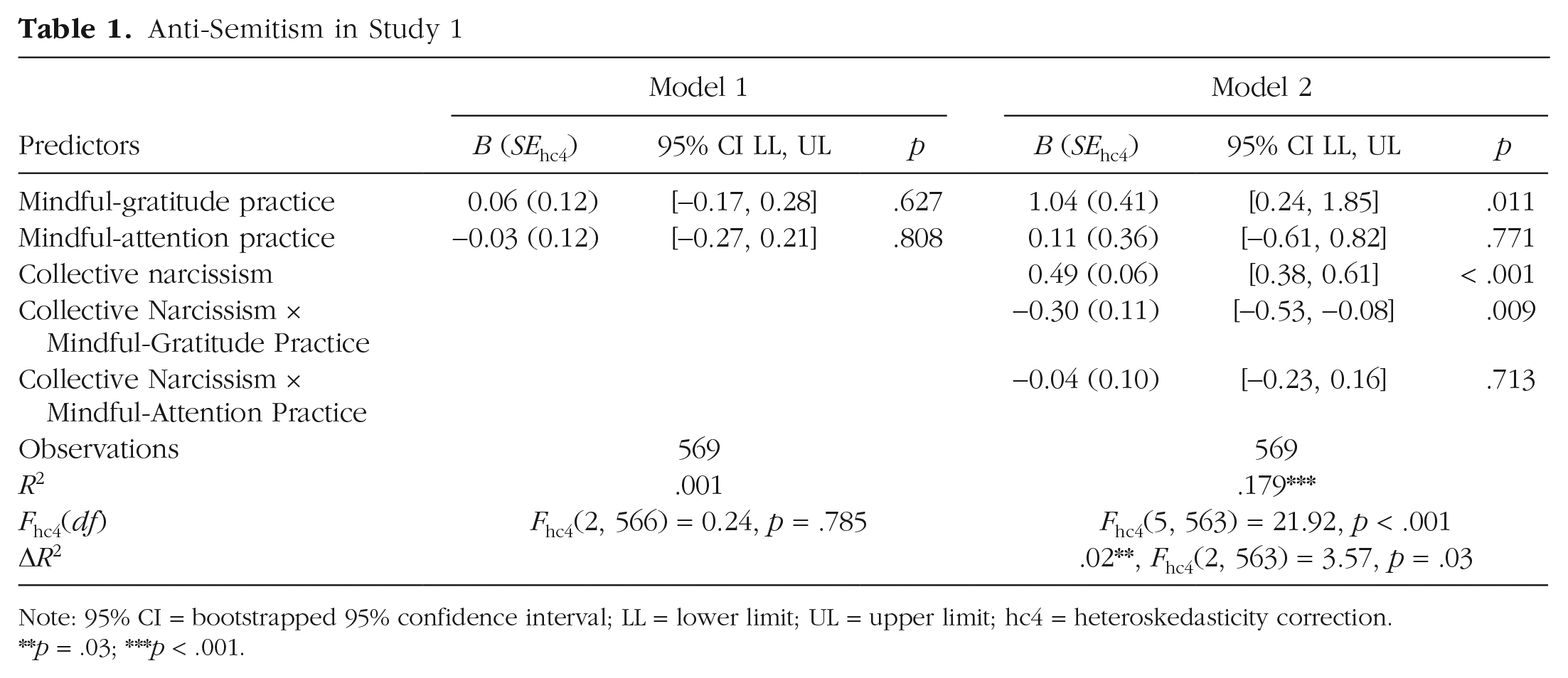
Note: 95% CI = bootstrapped 95% confidence interval; LL = lower limit; UL = upper limit; hc4 = heteroskedasticity correction.
**p = .03;
p < .001.
Simple Slopes for the Manipulation × Collective Narcissism Interaction in Predicting Anti-Semitism in Study 1
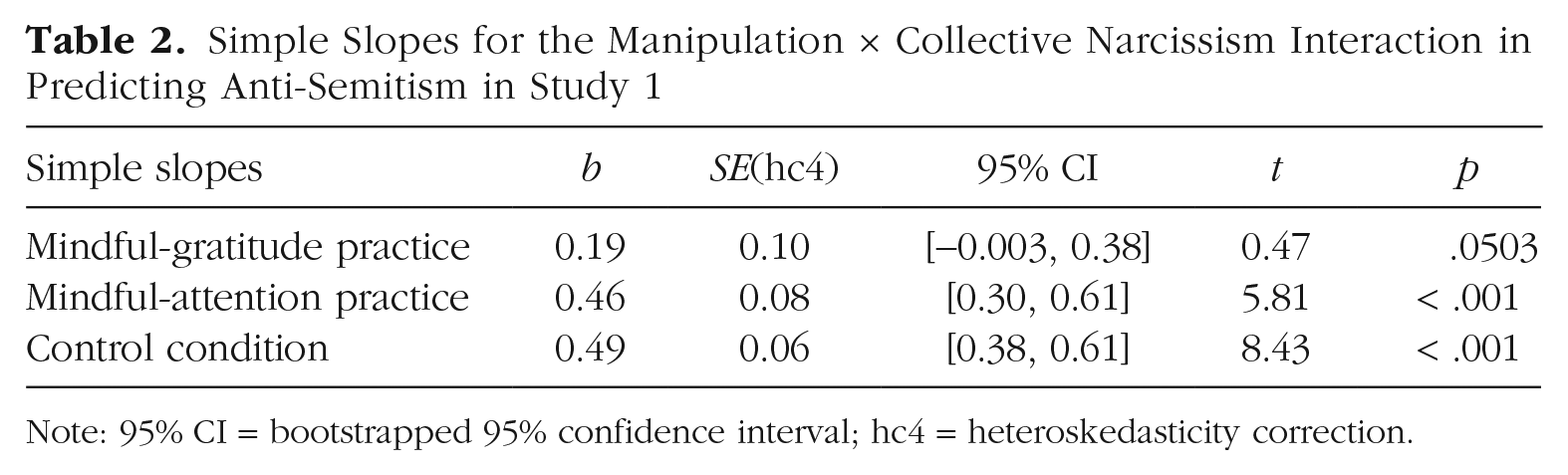
Note: 95% CI = bootstrapped 95% confidence interval; hc4 = heteroskedasticity correction.
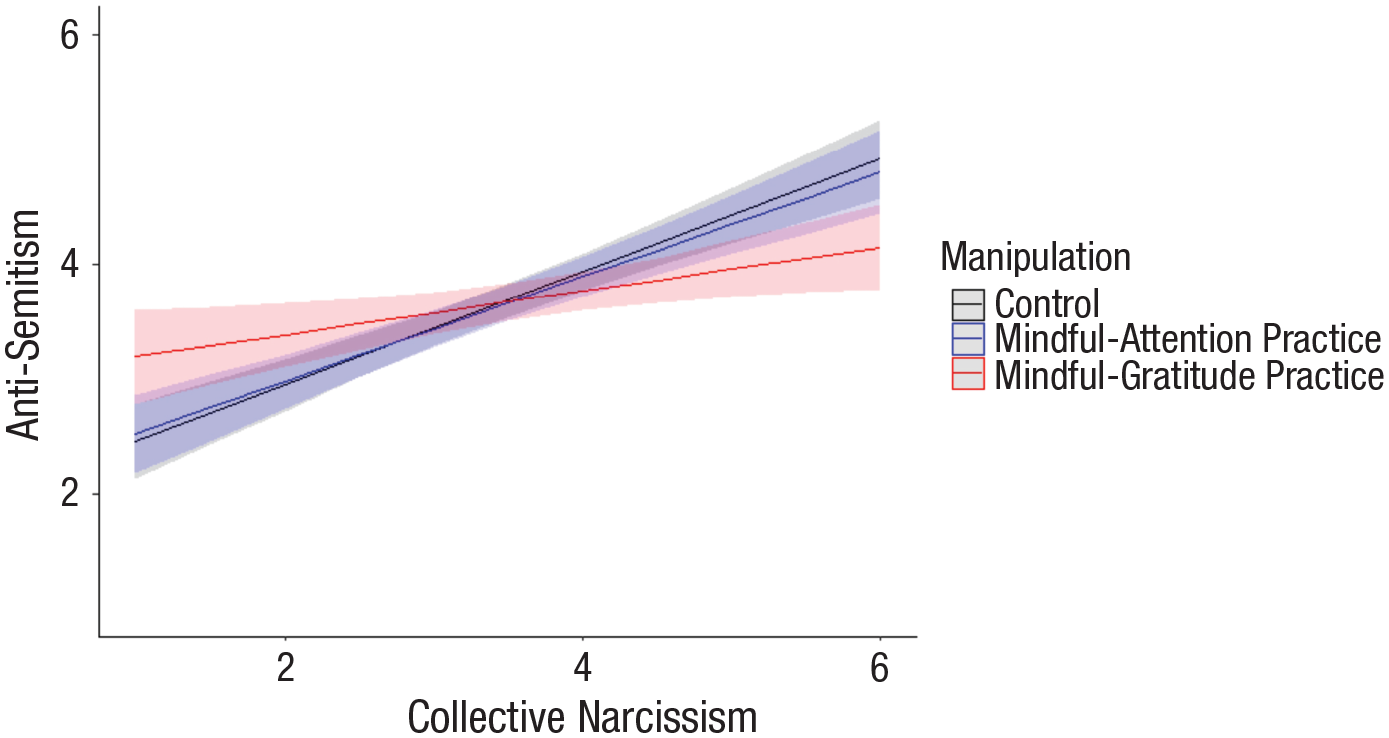
Anti-Semitism as a function of collective narcissism in the research conditions of Study 1. Shaded areas represent 95% confidence intervals.
The Study 1 results indicated that neither mindful-gratitude practice nor mindful-attention practice reduced anti-Semitism among participants. However, mindful-gratitude practice, but not mindful-attention practice, attenuated the link between collective narcissism and anti-Semitism. These patterns are consistent with literature showing that mindful-attention practice is insufficient to weaken the association between collective narcissism and the distress caused by the in-group’s exclusion by an out-group (Hase et al., 2021). Informed by the Study 1 results, we turned to the relevance of long training in mindful-gratitude practice.
Study 2
Method
Participants
We estimated the sample size in order to be able to run a mixed analysis of variance (ANOVA) involving a between-subjects (training) and a within-subjects (measurement) factor. We assumed a medium size of the between-subjects effect ( f = .25) and .50 correlation between levels of the within-subjects factors (pretest, posttest) on the basis of the average effects in the mindfulness literature as indicated by its meta-analytical summary (Oyler et al., 2022). We assumed an alpha level of .05 with power of .80, and we carried out the calculations via G*Power 3.1 (Faul et al., 2009). The required sample size was 98, typical for studies using the same methodology (Berry et al., 2022; Chang et al., 2023; Oyler et al., 2022). We exceeded this N to account for attrition and assure a high-powered study. Participants were 219 Polish adults (168 women, 48 men, 3 unrevealed) recruited via social media and university mailing lists between December 2020 and June 2021. Participants’ ages ranged from 18 to 62 years (M = 28.15, SD = 8.15). Although ANOVA and regression analyses controlling for baseline align with H1–H2 (see the Supplemental Material), the data-analytic strategy that we implemented differs from the preregistered one (see below) and is an improvement over it.
Qualification criteria
According to our preregistered criteria, participants were qualified to take part in the study if they (a) did not indicate preexisting mental-health problems, alcohol or drug use, or recent experience of trauma or crisis, and (b) had not engaged in meditative practices for more than 3 months (none had experience with mindfulness or meditative practices). 1 We invited 322 volunteers to respond to pretest measures, and we assigned them to the mindful-gratitude practice condition (n = 166) or the wait-list control condition (n = 156) via a randomization software (randomization.com). We received subsequent responses from 244 people—120 in the mindful-gratitude-practice condition and 124 in the wait-list control condition. After 6 weeks, we invited all participants to the posttest. Ten in the mindful-gratitude-practice condition and eight in the wait-list control condition declined.
Conforming to the preregistered criterion of low engagement, we excluded another seven mindful-gratitude-practice participants. Specifically, we excluded two who were absent from more than one training session per week, and five who made more than one mistake in answering recorded questions about what they had practiced. The final sample consisted of 219 participants (n = 103 in the mindful-gratitude-practice condition, n = 116 in the wait-list control condition). We compensated them with 450PLN (≈ US$100). We also compensated excluded participants, but with lower monetary amounts depending on length of involvement. We provide relevant information in the CONSORT diagram (see Fig. 2).
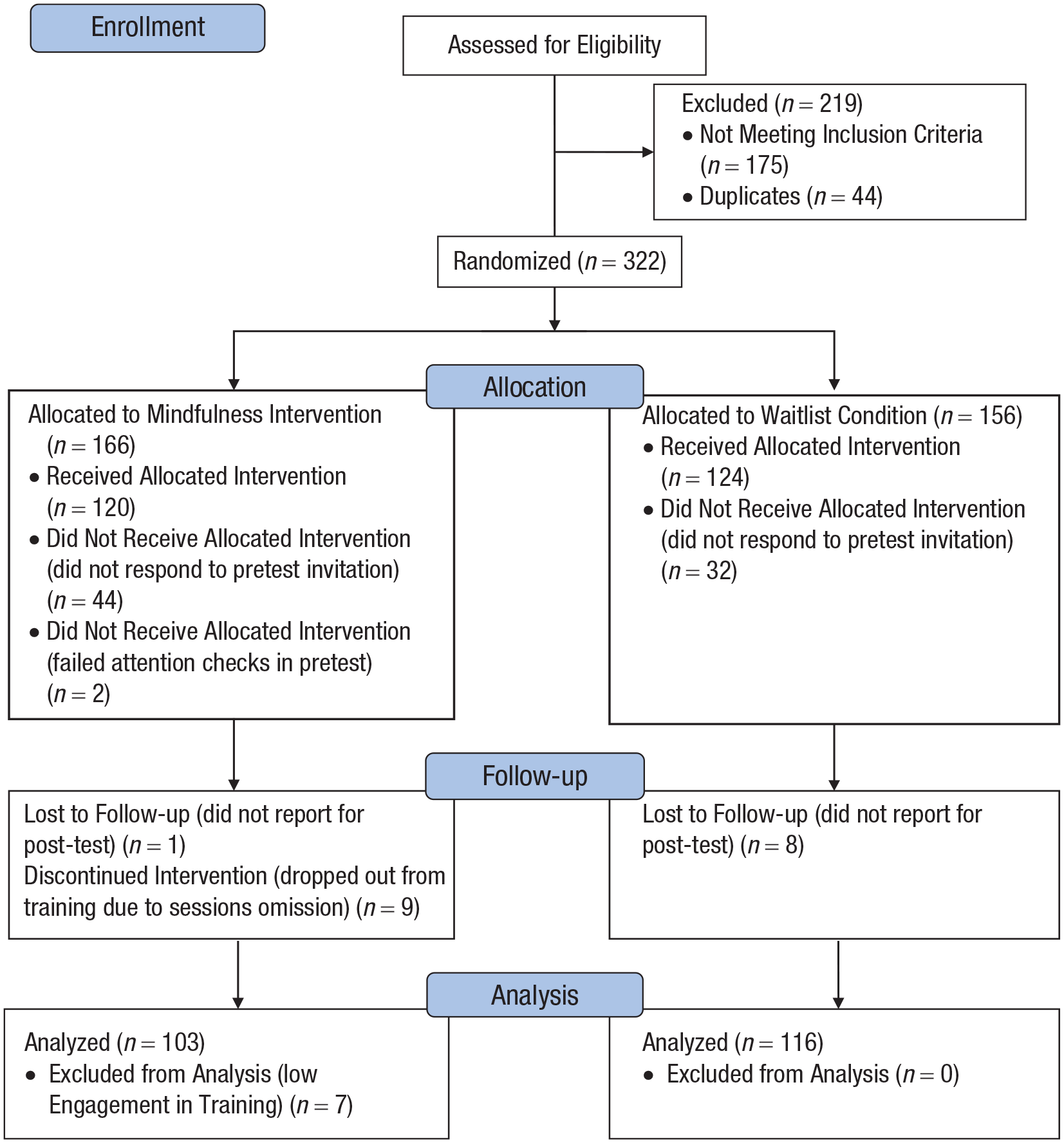
CONSORT (consolidated standards of reporting trials) flow diagram for sample selection of Study 2.
Procedure
All participants filled out the pretest measures asking for demographic data and information about their experience with mindfulness or meditative practices. Next, participants completed the study measures in separate random order and item order. Subsequently, they were contacted by experimenters (who were unaware of the hypotheses) for one-to-one online sessions. Participants in the mindful-gratitude practice condition were instructed on the installation and use of a mobile application supporting their training. They were requested to practice daily, in the morning, and in a quiet place where they could sit down and remain undisturbed for half an hour.
To complete a session, participants logged in, read the introduction describing the skills to be practiced, and followed the recorded instructions. The average duration of a session was 17 min. At the end of a session, the app asked questions to find out whether participants listened to instructions and were involved in the practice. The app allowed the experimenters to monitor participants’ progress. At the conclusion of the six weeks, all participants were invited to complete the posttest measures, which were identical to those of the pretest. Participants were also probed for suspicion (none guessed the hypotheses), remunerated, and debriefed.
Measures
Unless stated otherwise, response options ranged from 1 (definitely disagree) to 7 (definitely agree). We gauged the effectiveness of the manipulation by assessing mindfulness and gratitude (see the Supplemental Material).
We assessed collective narcissism as in Study 1. We assessed sexism with the 12-item short version of the Ambivalent Sexism Inventory (Rollero et al., 2014; e.g., “Women seek to gain power by getting control over men,” “Many women have a quality that few men possess”). We assessed homophobia with three items that we constructed for the study’s purposes. The items gauged endorsement of homophobic events and statements by Polish political figures: (a) “Archbishop Marek Je˛draszewski called LGBT+ people ‘rainbow plague’—I support the archbishop’s statement,” (b) “Gazeta Polska attached to their issue stickers area free of LGBT—the decision to give these stickers was right,” and (c) “The Pride Parade in Białystok was attacked by people unfriendly to LGBT+ communities—I support the behavior of these people.” We assessed anti-immigrant sentiment against Ukrainians, the largest immigrant group in Poland at the time, with a social-distance scale we developed consisting of six items (e.g., “I would have no objection to Ukrainian immigrants being employed in my place of work” and “Poland should increase help to Ukrainian immigrants”) and an intergroup threat scale (Cottrell & Neuberg, 2005) consisting of 10 items that referred to symbolic threat (e.g., “Ukrainian immigrants violate trust”) or realistic threat (e.g., “Ukrainian immigrants threaten our jobs”). The social distance and intergroup threat scales were highly correlated (pretest: .76, p < .001; 95% confidence interval, or CI = [.70, .81]; posttest: .73, p < .001; 95% CI = [.66, .79]), and so we formed an index by averaging them. Finally, we assessed anti-Semitism with a 12-item measure (Bilewicz et al., 2013) including traditional (e.g., “Modern Jews are responsible for the crucifixion of Christ”), modern (e.g., “Jews want to receive reparations from Poles for something that Germans did”), and conspiracy-based (e.g., “Jews seek to dominate the world”) anti-Semitic beliefs.
Analytical strategy
We applied an analytical approach that bypasses two common problems in assessing true change and its correlates: baseline equivalence and measurement error. Testing for factorial invariance allowed us to ascertain that the same construct was measured over time by the same scale in both research conditions. A structural-equation-model approach with a latent-change score allowed us to overcome the measurement-error problem (McArdle, 2009). Specifying a latent prejudice variable with multiple indicators allowed us to model an error-free variable that concisely summarized the prejudice measures. The latent-change score represents change in prejudice that is undistorted by measurement error or baseline differences (Henk & Castro-Schilo, 2016). Its correlations with collective narcissism in the mindful-gratitude practice condition and the wait-list control condition will also remain undistorted by measurement error.
First, we specified the latent variable models for prejudice. The average scores for each prejudice measure served as indicator parcels to reduce the number of measured variables and improve latent model fit (Hafer et al., 2020; Little et al., 2002). To evaluate model fit, we used common cutoffs (Hu & Bentler, 1998): a comparative fit index (CFI) of around .95, a root-mean-square error of approximation (RMSEA) < .08, and a standardized root-mean-square residual (SRMR) < .08. In case of model misfit, we followed Greiff and Heene’s (2017) guidelines identifying potential sources of it.
Next, we established temporal invariance of the latent prejudice variable. Strong factorial invariance is required to indicate that the latent-change variable is meaningful—that is, that the units of change are equivalent in the mindful-gratitude practice condition and the wait-list control condition at both pretest and posttest (Castro-Schilo & Grimm, 2018). We report details of these analyses in the Supplemental Material. The results show that the same variable was indeed assessed at both pretest and posttest across the mindful-gratitude-practice condition and the wait-list control condition.
Subsequently, to test whether training attenuated prejudice at high levels of collective narcissism, we specified three latent-change score models (McArdle, 2009). Such models allow for a latent-change score variable that accounts for individual differences in change, corrected for measurement error. To create the latent-change score, we first specified a model in which a latent variable for prejudice at posttest is regressed onto the same variable at pretest. The regression weight is fixed at 1 and the residual at 0. A further latent variable, change score, is specified in a way that allows capturing all differences between pretest and posttest. This variable now contains the error-free change. In a second model to test H1, we regressed the change score onto the training variable. A significant regression weight indicates that the change in prejudice differs between the mindful-gratitude practice condition and the wait-list control condition. The sign of the regression weight indicates the direction of this difference. In a third model to test H2, we added the manifest variable for collective narcissism at pretest, along with the interaction term between the relevant condition (mindful-gratitude practice, wait-list control) and the manifest variable for collective narcissism, as further predictors. In this way we examined whether collective narcissism moderated differences in change between conditions. We conducted the analyses using R and an interaction tool to generate codes for simple slopes of the interaction (http://www.quantpsy.org/interact/mlr2.htm).
Results
We present preliminary analyses in the Supplemental Material. Demonstrating the effectiveness of the manipulation, the results show that training raised mindfulness and gratitude. Also, participants did not differ at pretest with respect to measured variables, collective narcissism did not change from pretest to posttest, and collective narcissism was positively related to all measures of prejudice at both pretest and posttest.
We began by specifying a latent-change-score model that captured the change between a latent prejudice factor for pretest and posttest. Model fit for this latent-change-score model was good, χ2(21) = 21.497, p = .429, CFI = 1.00, RMSEA = .011, SRMR = .025. Variance for the latent-change score was significant (p = .017), indicating a substantial latent-change score. To facilitate the interpretation of the following models, it is helpful to examine the amount of variance explained in the change score when adding the model-specific predictors explained above. The amount was .02 for Model 1. This signifies a small baseline impact on change in prejudice over time.
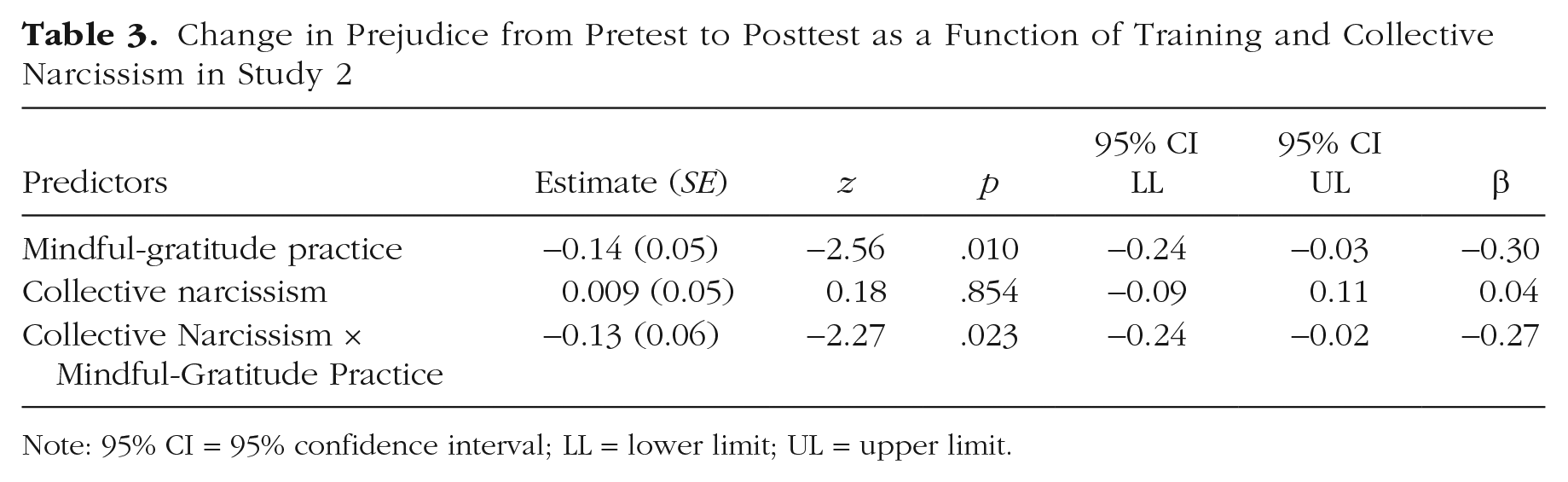
Next, to test H1, we added training as a predictor of the latent-change score (Table 3). Model fit was good, χ2(28) = 24.504, p = .655, CFI = 1.00, RMSEA < .001, SRMR = .024. The regression weight for training was significant (p = .011). On average, prejudice in the mindful-gratitude practice condition changed more relative to the wait-list control condition. Moreover, the sign of the regression weight (β = −0.305) indicated that prejudice decreased in the mindful-gratitude practice condition (coded 1) relative to the wait-list control condition (coded 0). Further, the amount of variance explained in the latent-change score increased to .109. Adding training as a predictor explained substantially more variance compared to the model that did not include it as a predictor, underscoring the effectiveness of training to explain the differences in change and thus in reducing prejudice.
Change in Prejudice from Pretest to Posttest as a Function of Training and Collective Narcissism in Study 2
Note: 95% CI = 95% confidence interval; LL = lower limit; UL = upper limit.
To test H2, we added the main effect of collective narcissism and its interaction with training as predictors of the latent-change score. Model fit was good, χ2(43) = 42.875, p < .477, CFI = 1.00, RMSEA < .001, SRMR = .03. The collective narcissism main effect was not significant. The interaction was significant and negative (β = −0.271, p = .019). The R2 increased to .182, reflecting the strength of the interaction (Table 3).
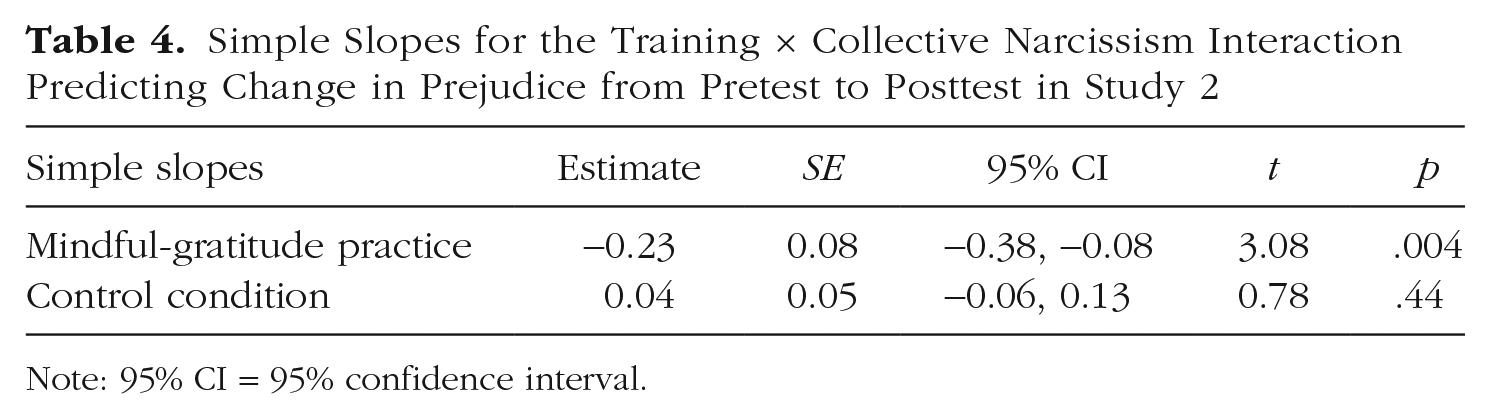
We proceeded to estimate simple slopes. We entered the values from the latent-change-score model of Table 3 into the online interaction tool to generate the R code for simple slopes presented in Table 4. As can also be seen in Figure 3, the link between collective narcissism and prejudice was positive (and nonsignificant) in the wait-list control condition, indicating that the association stayed the same over the 6 weeks. Supporting H2, the same association became negative in mindful-gratitude practice condition, indicating that the positive association between collective narcissism and prejudice gradually and significantly decreased among participants who practiced mindful gratitude for 6 weeks.
Simple Slopes for the Training × Collective Narcissism Interaction Predicting Change in Prejudice from Pretest to Posttest in Study 2
Note: 95% CI = 95% confidence interval.
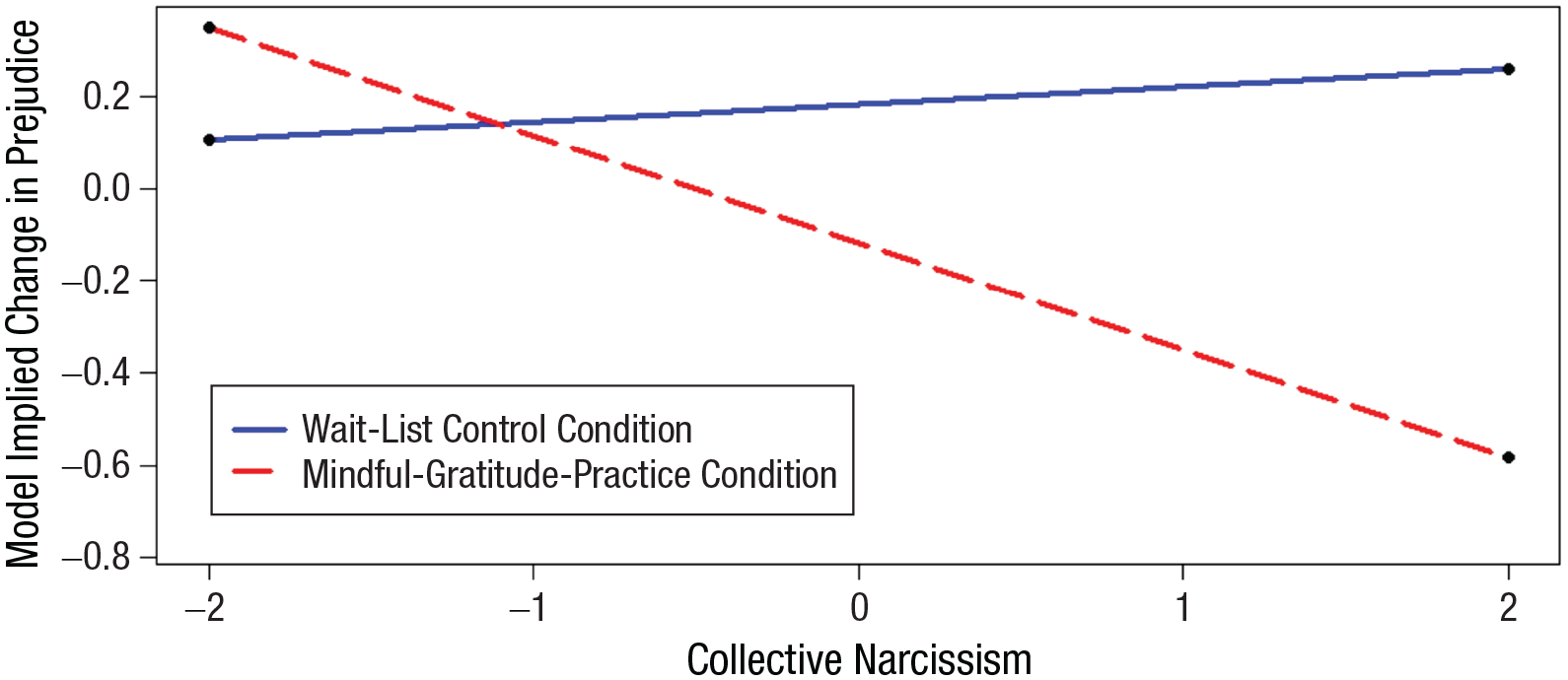
Training × Collective Narcissism interaction at pretest predicting change in prejudice from pretest to posttest in Study 2.
General Discussion
We hypothesized that mindful-gratitude practice attenuates prejudice, especially at high levels of collective narcissism. The results were generally consistent with the hypotheses. In Study 1, a brief mindful-gratitude practice did not decrease prejudice (anti-Semitism), but weakened the association between collective narcissism and prejudice. In Study 2, a 6-week, mindful-gratitude practice decreased prejudice (anti-Semitism, sexism, homophobia, anti-immigrant sentiment), and this decrease was pronounced at high levels of collective narcissism.
The findings advance the literature on prejudice, meditative practices, and collective narcissism. To begin, the findings generalize across various forms of prejudice. More important, mindful-gratitude practice reduced prejudice among individuals whose prejudice is motivated by collective narcissism, and specifically by that trait but not others (individual narcissism, in-group satisfaction and in-group identification, right-wing authoritarianism, social-dominance orientation). Also, it is mindful-gratitude practice rather than mindful-experience monitoring that attenuates the collective narcissism–prejudice link (Hase et al., 2021; cf. Berry et al., 2020). At high levels of collective narcissism, mindful-gratitude practice weakens prejudice, as it likely helps to down-regulate negative emotions and fortifies the capacity to experience gratitude. Our assertion is consistent with evidence that interventions involving mindful practice of self-transcendent emotions are more effective in improving prosociality than interventions focused on experience monitoring (Singer & Engert, 2019).
Additionally, the findings advance understanding of collective narcissism. They suggest that a mechanism underlying collective narcissists’ intergroup hostility is tethered to their undermined ability to soothe negative emotions and experience self-transcendent emotions. This claim is consistent with evidence that the positive overlap between collective narcissism and in-group satisfaction suppresses the association between collective narcissism and prejudice (Golec de Zavala et al., 2020). Because of this overlap, collective narcissists are able to take advantage of emotional resources associated with in-group satisfaction and experience positive, prosocial emotions (Golec de Zavala et al., 2020).
The findings also have applied value. The mobile-app-supported mindful-gratitude practice is cost-effective. It can be made easily available and can reach a variety of recipients, including those who are unmotivated to participate in prejudice-reduction interventions. Moreover, the mindful-gratitude practice may support members of advantaged and disadvantaged groups in their alliance to challenge prejudice. It may assist members of advantaged groups in understanding their privilege and members of disadvantaged groups in alleviating the emotional burnout of self-advocacy (Li et al., 2019; Verhaeghen & Aikman, 2020).
Limitations and future directions
One limitation of our research pertains to generalizability of the findings. Mindful-gratitude practice directly decreased prejudice when implemented for 6 weeks, but not as a 10-min exercise. Additionally, participants in Study 2 were volunteers, who self-selected for a mindfulness intervention. However, the Study 2 results are similar to those of Study 1, obtained in a nationally representative sample, thus increasing our confidence in their generalizability. But both studies were conducted in Poland; follow-up work should test our hypotheses in different cultural contexts.
Our work had other limitations. We did not use a passive control condition in Study 1. Thus, we were unable to draw a link between collective narcissism and prejudice in the absence of intervention. However, this link has been found in numerous cross-sectional studies (Golec de Zavala, 2023). Also, in Study 2, the experimenters who monitored participants in the mindful-gratitude condition were unaware of hypotheses, but not conditions. In an immediate follow-up study, we subjected the wait-list control-condition participants to mindful-gratitude practice for another 6 weeks. We analyzed daily mood changes comparing Study 2 mindful-gratitude-practice participants with the wait-list control-condition participants who underwent mindful-gratitude practice in the new study. We observed similar trajectories of mood change (Golec de Zavala, Ziegler, & Foerster, 2023), strengthening confidence in the validity of our findings. Finally, in both studies, we assessed prejudice via self-report. Future investigators will do well to diversify their methodology. They could also test the replicability of our findings in larger, representative samples, noting the duration of the effects.
Conclusion
Prejudice does not appear to subside and may increase. A timely issue is how to reduce it among individuals who are highly prejudiced. We found a way: through mobile-app supported mindful-gratitude practice. In two studies, this practice attenuated prejudice (anti-Semitism, sexism, homophobia, anti-immigrant sentiment) among collective narcissists. The intervention is unobtrusive, cost-effective, and easy to implement.
Supplemental Material
sj-docx-1-pss-10.1177_09567976231220902 – Supplemental material for Mindful-Gratitude Practice Reduces Prejudice at High Levels of Collective Narcissism
Supplemental material, sj-docx-1-pss-10.1177_09567976231220902 for Mindful-Gratitude Practice Reduces Prejudice at High Levels of Collective Narcissism by Agnieszka Golec de Zavala, Oliver Keenan, Matthias Ziegler, Magdalena Mazurkiewicz, Maria Nalberczak-Skóra, Pawel Ciesielski, Julia E. Wahl and Constantine Sedikides in Psychological Science
Footnotes
Transparency
Action Editor: Yoel Inbar
Editor: Patricia J. Bauer
Author Contributions
ORCID iDs

Notes
References
Supplementary Material
Please find the following supplemental material available below.
For Open Access articles published under a Creative Commons License, all supplemental material carries the same license as the article it is associated with.
For non-Open Access articles published, all supplemental material carries a non-exclusive license, and permission requests for re-use of supplemental material or any part of supplemental material shall be sent directly to the copyright owner as specified in the copyright notice associated with the article.
