




Abstract
Cardiac xenotransplantation is advancing rapidly from basic research to early clinical use, but its research landscape has not been comprehensively mapped. We conducted a bibliometric and science-mapping analysis of English-language articles and reviews in the Web of Science Core Collection (1964–2025). Using VOSviewer, CiteSpace, and Bibliometrix, we assessed publication growth, collaboration networks, citation impact, and topic trends. The field has grown steadily and has accelerated in recent years in parallel with key clinical developments. Collaboration is strongest among institutions in the United States, Europe, and East Asia, and a small number of authors and centers contribute a large share of publications. Most studies are published in specialty transplantation journals, whereas major breakthroughs often appear in general medical journals. Research topics continue to focus on rejection and complement biology, while newer work highlights gene-edited donors, biosafety, clinical trial readiness, and pig-to-human models. Overall, the field appears to be maturing toward clinical implementation, and these findings can help guide research priorities, funding decisions, and policy planning.
Introduction
Cardiac xenotransplantation (CXTx) is an important treatment method for patients with end-stage heart failure, yet its application is limited by the shortage of donor organs 1 . Pigs are similar to humans in terms of genetics and anatomical structures. CXTx based on pigs is a potential approach to addressing the donor shortage dilemma, but it faces challenges such as cross-species immune rejection, risks of genetic contamination, and ethical issues1–3.
Bibliometrics can present collaboration networks, journal influence, and research trends by systematically analyzing existing studies 4 . It depicts the knowledge structure and development direction of specific fields and complements medical research. In the field of CXTx, bibliometrics offers a highly efficient, low-cost method for researchers, including surgical teams 5 . It helps them quickly grasp technological developments, identify key authors and core literature, and optimize clinical protocols. This allows them to keep up with the academic frontier 6 . In addition, surgeons can expand their professional networks, share experiences, and promote multicenter trials by analyzing cooperation networks. This approach improves diagnosis and treatment decisions and advances scientific and technological innovation. Policy-makers and funding institutions can also use bibliometric analysis results to make informed decisions that support clinical practice and scientific research.
Although CXTx has achieved certain progress, there is a lack of comprehensive bibliometric studies. This study utilizes the Web of Science (WoS) database to systematically analyze the CXTx literature over the past 20 years, dissecting authors, institutions, countries, and scientific topics. Meanwhile, it constructs cooperation networks using VOSviewer, Bibliometrix, and CiteSpace software to reveal research hotspots and development trends, aiming to provide new perspectives and data support for the field’s development 7 .
Methods and data source
Data sources and literature search
Web of Science is a leading research platform across the natural and social sciences, the arts, and the humanities. It provides an independent, global citation database curated from trusted publishers 8 . A literature search was conducted in the Web of Science Core Collection (WoSCC), SCI-EXPANDED edition only. The search covered publications from 1964 through 1 November 2025 (search date: 1 November 2025). Records were exported as Plain Text (Full Record and Cited References). The search strategy combined terms related to cardiac transplantation, xenotransplantation, and animal or human subjects. These terms are summarized in Table 1. The final query (#1 AND #2 AND #3 AND #4) returned 1077 records. Publications categorized as articles or reviews (n = 981) and written in English (n = 956) were retained. Fig. 1 shows a flow diagram of study selection, detailing numbers at each stage (identification, screening, eligibility, and inclusion). After screening and deduplication, 706 records were included in the final bibliometric analysis. Early Access items were included and reconciled with final versions, where available, to avoid double-counting.
Search strategy in the Web of Science database.

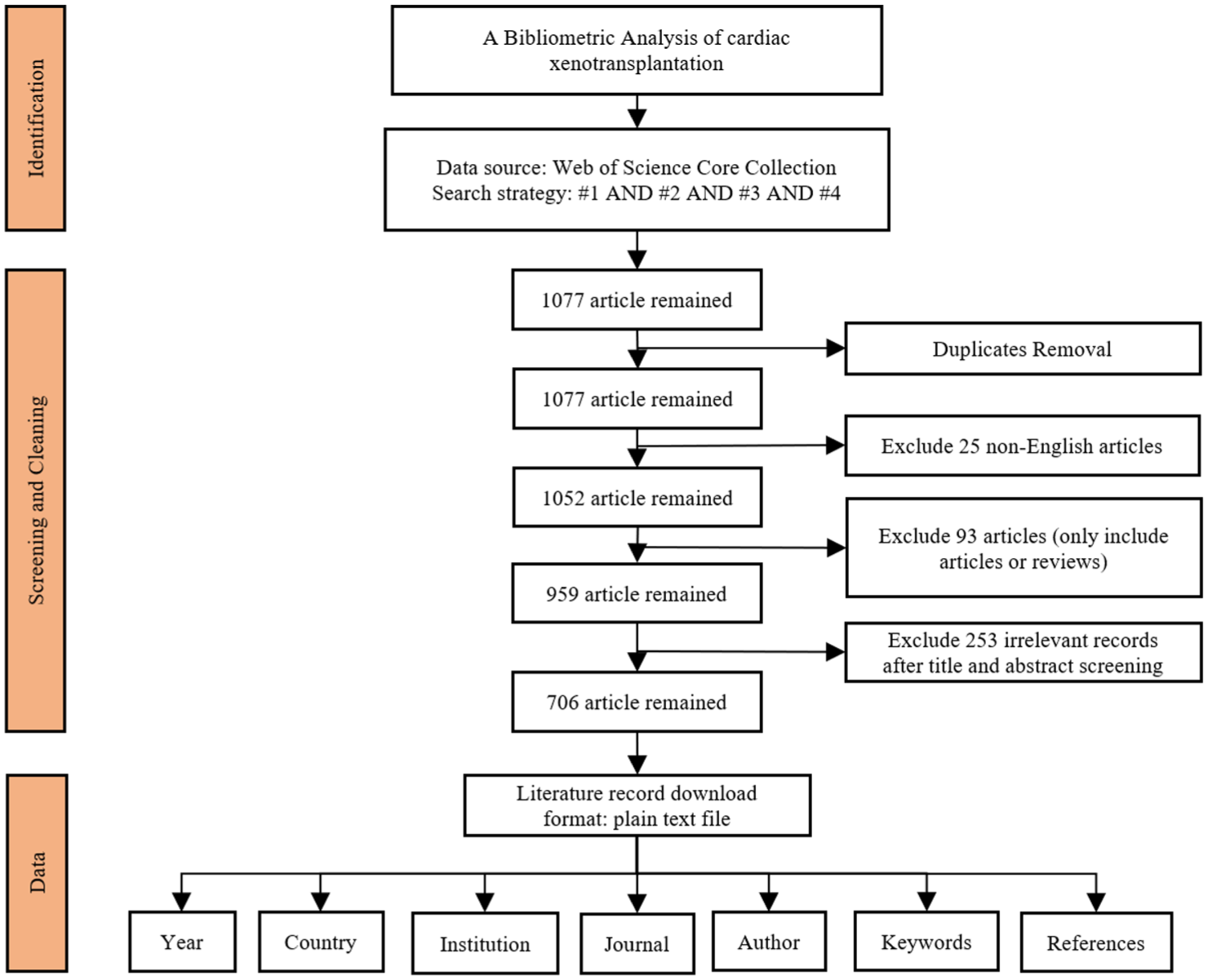
Flow diagram of study selection.
Study selection and quality control
Two independent reviewers (G.-Z.C. and Z.-Q.D.) screened titles and abstracts against a prespecified topic criterion. Only items entirely unrelated to cardiac xenotransplantation were excluded at this stage, and uncertain cases were escalated to full-text assessment. Disagreements were resolved by discussion or, when needed, third-party adjudication. To harmonize inclusion rules, the reviewers conducted a pilot screening of 100 randomly selected records before formal screening. Selection consistency was audited on a random 5% subsample of each reviewer’s decisions. Cohen’s κ with 95% confidence intervals was calculated. If a subsample showed >10% discrepancy, the reviewer’s entire batch was re-reviewed by the two auditors9,10. A flow diagram (Fig. 1) summarizes the numbers at each stage (identification, screening, eligibility, inclusion).
Deduplication, bibliometric mapping, and analyses
No duplicate records were identified after importing the WoSCC (SCI-EXPANDED) export (Plain Text, Full Record and Cited References); therefore, no additional deduplication procedures were required. Descriptive statistics (annual and cumulative output) were computed in Excel 2021. Networks and maps were generated using VOSviewer 1.6.20 and CiteSpace 6.3.R1, following established scientometric standards. For CiteSpace, time slicing spanned 1964 to 2025 in 1-year intervals, as described in references11–13. In VOSviewer, the minimum occurrence threshold was set to five for authors, sources, and author keywords. CiteSpace selected nodes per time slice using the g-index with k = 25, as referenced in Synnestvedt et al.
11
, van Eck and Waltman
12
. For similarity and normalization, VOSviewer applied the association strength method to construct co-occurrence and co-authorship matrices, following the approaches outlined in van Eck and Waltman
12
, Chen and Song
13
. Clustering and pruning in CiteSpace used the log-likelihood ratio (LLR) for cluster labeling, along with the Pathfinder and minimum spanning tree (MST) algorithms to remove redundant links, as specified in previous studies. Node size encodes productivity/frequency, and edge thickness encodes linkage strength (collaboration or co-occurrence). For the publication-growth model (Fig. 2), we used a power-law function

Trends in the number of publications for cardiac xenotransplantation. (a) Annual and cumulative publication counts from 1964 to 2025. Cumulative publications are shown as bars (green in the online version; left y-axis), and annual publications are shown as a line (orange in the online version; right y-axis). Publication growth follows a power-law trend (y = 0.5225x2.0377, R2 = 0.9414). (b) Average citations per year, aggregated by publication year (1964–2025).
Results
Summary of publication status
A total of 706 publications on cardiac xenotransplantation, published between 1964 and 2025, were analyzed. Annual publication output demonstrated a sustained increase over time (Fig. 2a) and, overall, the growth trajectory closely followed a power-law model, with the year index beginning from 1964. Notably, a surge in publications occurred between 1999 and 2001, followed by a brief decline in 2002 (n = 9). The field subsequently recovered, reaching historical highs between 2022 and 2025, with annual outputs of 32, 34, 37, and 36 publications, respectively. Citation impact, measured as the mean citations per year aggregated by publication year, values peaked in 2022 (mean = 9.22). Lower values were recorded in 2023–2025 (6.64, 3.42, and 1.62 citations per paper), which likely reflects indexing lag and incomplete citation accrual rather than a genuine decline in influence (Fig. 2b).
Study on national/regional publications
The citation trajectory at the national level shows persistent dominance by the United States, while Germany and China have exhibited notable increases in recent years (Fig. 3c). Geographically, international collaborations are concentrated along a corridor spanning North America, Western Europe, and East Asia. Within this structure, the United States anchors transregional connections with Germany, the United Kingdom, France, Switzerland, China, South Korea, Japan, and Australia. In contrast, collaborative links remain limited in South America and Africa (Fig. 3a). Consistent with this pattern, the co-authorship network forms a multi-hub configuration. The United States occupies the central position, while Germany and China act as secondary hubs. European countries such as England, France, Switzerland, the Netherlands, and Italy form a tightly clustered group. Australia frequently serves as a bridge connecting cross-continental collaborations (Fig. 3b). Among the 28 countries analyzed, the United States contributed the most publications, with 320 papers accounting for 45.3% of the total. Germany followed with 67 publications, England with 49, China with 46, and Australia with 29. By collaboration type, the United States recorded 239 single-country publications (SCP) and 81 multi-country publications (MCP), corresponding to 74.7% and 25.3%, respectively. Germany had 46 SCP and 21 MCP, while England had 27 SCP and 22 MCP. China contributed 37 SCP and 9 MCP, and Australia produced 17 SCP and 12 MCP (Fig. 3d). Among countries with 10 or more publications, Switzerland had the highest proportion of MCP at 62.5%. Italy followed with 54.5%, Canada with 46.7%, England with 44.9%, and Australia with 41.4%. In contrast, Japan (10.0%), South Korea (13.0%), and China (19.6%) showed a stronger orientation toward single-country research.
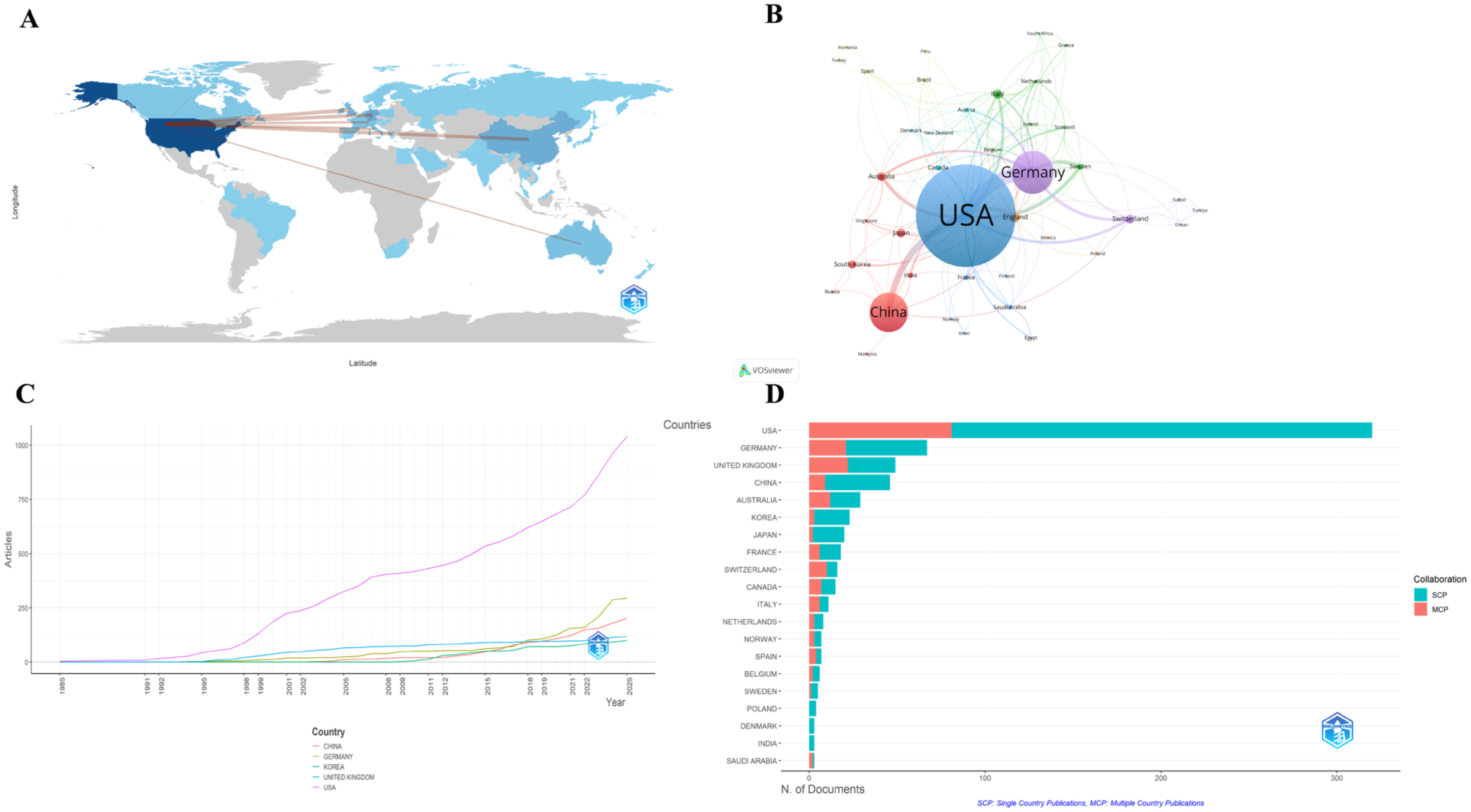
National collaboration in cardiac xenotransplantation. (a) Global co-authorship map. Lines represent international collaborations, and link thickness indicates collaboration strength. Node color reflects publication output. (b) Inter-country collaboration network. Node size indicates national output; link thickness represents collaboration frequency; node color denotes cluster structure. (c) Cumulative publication trends over time in major countries. (d) Stacked bar chart of corresponding-author country contributions, stratified by SCP (single-country publications) and MCP (multi-country publications).
Study on institution publications
At the institutional level, cumulative output followed three distinct phases. The first was an initial growth period from 1998 to 2001. This was followed by a plateau between 2005 and 2015. A pronounced acceleration began after 2019. These trajectories diverged clearly among top-performing institutions (Fig. 4a). In terms of total output, the University of Munich ranked first with 174 publications. Harvard University followed with 167, then Harvard University Medical Affiliates with 144, Harvard Medical School with 110, and Massachusetts General Hospital with 105. Other major contributors included Duke University, with 91 publications, and a cluster comprising the University of Pittsburgh, the University System of Maryland, the University of Maryland, Baltimore, and PCSHE, each reporting 71 publications (Fig. 4b). These results suggest a structural configuration combining a late-emerging leader with a coordinated ecosystem. The University of Munich has risen sharply in recent years, making it the leading contributor. Meanwhile, multiple Harvard-affiliated institutions demonstrate sustained and distributed output, reflecting a cohesive research network. This institutional pattern aligns with the field-wide growth observed at national and global levels.

Affiliations and institutional output. (a) Cumulative publication curves of leading institutions. The x-axis shows the year of publication (1985-2025). The y-axis represents the number of published articles. Each line indicates the cumulative output of an individual institution, enabling comparison of initiation time and publication growth rate. (b) Ranked bubble chart of institutional publication volumes. The x-axis indicates the number of published articles, and the y-axis lists institution names. Bubble size and color intensity are proportional to each institution’s publication output, with publication counts ranging from 70 to 174 articles.
Study on author’s influence
Author influence analysis revealed a pronounced head–tail distribution. A small group of contributors accounted for the majority of local citations. Cooper DKC led the field with 1430 citations, followed by Ayares D with 1090. Secondary contributors included Logan JS with 596, Platt JL with 585, Mohiuddin MM with 536, Singh AK with 507, Byrne GW with 483, Sachs DH with 441, Awwad M with 422, and Hara H with 413 (Fig. 5a). The author collaboration network exhibited a multi-cluster structure. Cooper formed the central hub of the network. Surrounding this core were tightly connected clusters led by Ayares, Hara, Mohiuddin, and Byrne, reflecting sustained co-authorship over time (Fig. 5b). Temporal analysis of author output showed long-term contributions by Cooper from the early 1990s through 2025, as well as continuous engagement by Ayares beginning after 2005. Distinct peaks in output were observed for Platt during the mid-1990s, for Wolf and Reichart around 2018, and for Mohiuddin in the early 2020s. These time-specific activity clusters converged on key field-wide inflection periods, notably 2016 to 2018 and again near 2022 (Fig. 5c). The three-field mapping in panel D illustrates structured connections among highly cited references, core authors, and dominant research themes. Influential references such as Byrne (2011), Mohiuddin (2022), and Cowan (2000) are closely associated with key contributors, including Cooper, Ayares, Byrne, and Mohiuddin. These authors consistently align with thematic clusters centered on gene editing, immune regulation, porcine donors, and cardiac xenotransplantation. The visual structure indicates a concentrated knowledge base shared across leading contributors, with coherent topic alignment reinforcing the field’s conceptual cohesion (Fig. 5d).
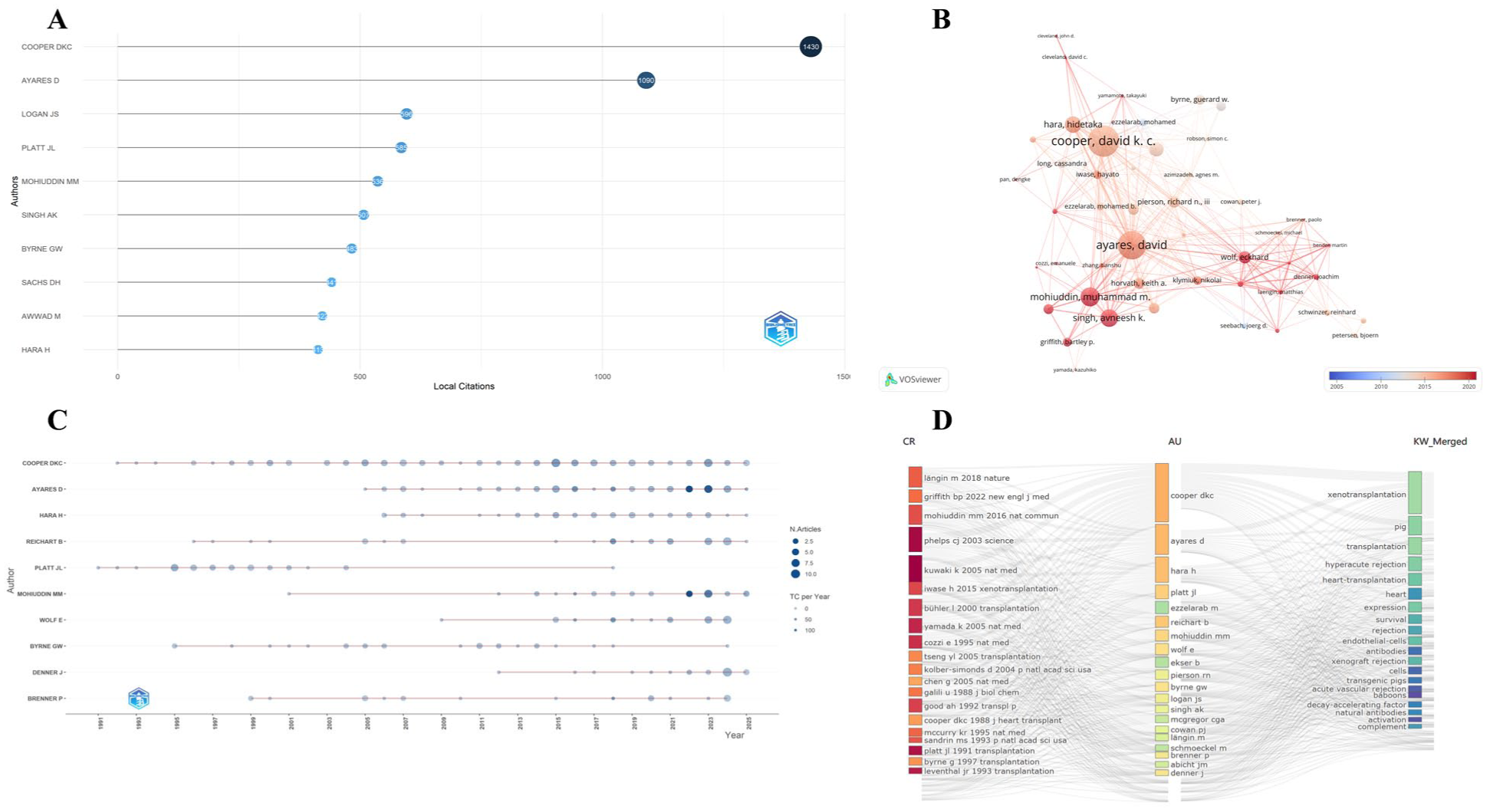
Authors and influence. (a) Scatter plot showing authors ranked by local citations; bubble size reflects publication count. (b) Co-authorship network with node size representing influence, edge width indicating collaboration strength, and node color showing average publication year. (c) Timeline of author-level publications, with dot size for output and color gradient for citation impact. (d) Three-field plot linking CR (cited references), AU (principal authors), and KW Merged (merged keywords) to visualize thematic connections.
Study on the journal
Study on publication volume and journal influence
High-impact literature and source journals demonstrated a clear concentration pattern. At the article level, the citation distribution was highly right-skewed. A small number of publications accounted for the majority of global citations. Foundational studies from the mid-to-late 1990s appeared in leading general medical and immunology journals, including Nature Medicine and Annual Review of Immunology. A second peak occurred around 2016 to 2018, with key publications in Nature Communications and Nature. In 2022, a major clinical milestone was published in the New England Journal of Medicine. These shifts reflect a transition from mechanistic research to translational and clinical application (Fig. 6a). At the journal level, output was mainly concentrated in two specialty journals: Xenotransplantation and Transplantation. Additional contributions came from transplant-focused journals, including Current Opinion in Organ Transplantation, Journal of Heart and Lung Transplantation, American Journal of Transplantation, Transplantation Proceedings, and Transplant International. Smaller portions appeared in surgery and immunology journals. This pattern suggests that the field is anchored in core specialty platforms with supplementary input from related disciplines (Fig. 6b).

Journals and global impact. (a) Scatter plot showing the most globally cited documents. The x-axis represents total global citations, and the y-axis lists individual documents. Each dot corresponds to a single article, with citation counts labeled to indicate relative influence across the literature. (b) Treemap depicting the distribution of journal publications. Each block represents a journal, and block area is proportional to the number of published articles. Labels display journal titles alongside publication counts, which range from 9 to 153 articles, highlighting the concentration of publications within leading outlets.
Visual analysis of cited journals of cutting-edge knowledge
Using a dual-map overlay analysis, we visualize the citation relationships between journals and highlight cross-disciplinary intersections. In Fig. 7, the citing journals are on the left, with the cited journals and colored paths representing the citation relationships. The thickest path highlights four core citation roots. The orange paths indicate that articles published in Molecular/Biological/Immunology are often cited in Molecular/Biology/Genetics and Health/Nursing/Medicine journals (Fig. 7). The green paths indicate that articles published in Medicine/Medical/Clinical are often cited in Molecular/Biology/Genetics and Health/Nursing/Medicine journals (Fig. 7). This figure demonstrates the interdisciplinary connections within the field.

The dual-map overlay and corresponding disciplines on cardiac xenotransplantation.
Study of keywords
Frequency and clustering analysis of keywords
At the topic level, keyword usage was highly concentrated around xenotransplantation, with surrounding terms focusing on rejection biology, complement activation, endothelial interactions, and porcine cardiac models (Fig. 8a). Temporal tracking identified 88 terms spanning 1992 to 2025, with a median year of occurrence in 2010. High-frequency entries included xenotransplantation, transplantation, pig, hyperacute rejection, expression, and heart transplantation. More recent activity emphasized terms such as costimulation blockade, genetic engineering, cytomegalovirus, and kidney (Fig. 8b). The treemap structure revealed a dominant lexical core centered on xenotransplantation and transplantation, surrounded by secondary clusters related to immune response, endothelial biology, and survival outcomes (Fig. 8c). The keyword heatmap showed persistent activity for core terms including xenotransplantation, hyperacute rejection, complement, and heart transplantation, alongside a recent intensification of themes related to genetically engineered porcine systems and clinical readiness (Fig. 8d).

Keywords and topic trends. (a) Word cloud of author keywords. Font size reflects keyword frequency. Larger terms indicate higher occurrence, with xenotransplantation occupying the central position. (b) Thematic trend plot across time. The x-axis represents publication year. The y-axis lists theme terms. Blue bands show periods of activity, and marker size corresponds to cumulative frequency. (c) Treemap of author keywords. Each block represents a term. The block size is proportional to the occurrence count, and labels display both frequency and relative proportion. (d) Temporal heatmap of author keywords. The x-axis shows the year. The y-axis lists keywords. Color intensity reflects frequency, with darker shades indicating higher activity levels.
Study of the Conceptual and Thematic Structure
Conceptual and thematic structures showed coherent organization across panels. The MCA map positioned xenotransplantation near the center with related terms radiating toward technique/model–oriented vocabulary (e.g. genetic engineering, knockout pigs, costimulation blockade, non-human-primate (NHP)) and toward general biological/clinical terms (e.g. transplantation, survival, rejection, endothelial-cells), indicating multiple recognizable clusters rather than a single dominant axis (Fig. 9a). Consistently, the strategic diagram allocated themes by centrality and density: Motor Themes (upper right) comprised highly central, well-developed topics such as heart transplantation, swine, porcine cytomegalovirus, virus safety, PCR, clinical trials, pig-to-human, xenoreactive antibodies, and gene expression; Basic Themes (lower right) included xenotransplantation, pig, complement, xenograft rejection, and animal model; Niche Themes (upper left) featured focused topics such as hyperacute xenograft rejection, adenosine, and ecto-5′-nucleotidase; and Emerging/Declining Themes (lower left) contained items like heart valve, decellularization, alpha-gal epitope, and porcine endogenous retroviruses (Fig. 9b).
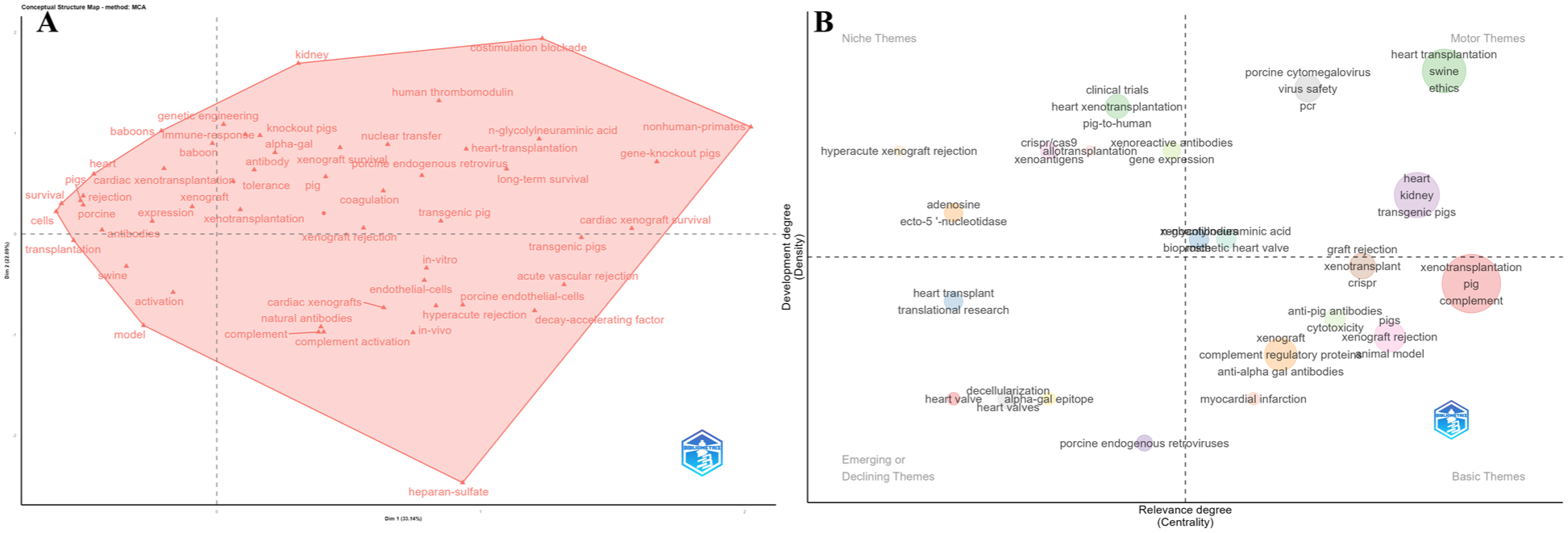
Conceptual and thematic structure of the field. (a) Multiple correspondence analysis (MCA) shows keyword clusters based on semantic similarity. (b) Thematic quadrant map plotting research themes according to relevance (centrality, x-axis) and development (density, y-axis). Quadrants indicate motor, basic, niche, or emerging/declining themes. Bubble size represents the number of related documents within each thematic cluster, ranging from 3 to 320 documents.
Discussion
Principal findings
As part of the overall analysis of publication trends, we observed that research on cardiac xenotransplantation remained at a low baseline and grew slowly from the 1960s to the 1980s. In 1964, the Hardy team performed the first chimpanzee-to-human heart transplantation 15 . The 1984 case of Baby Fae attracted widespread attention but did not yield a reproducible technical platform 16 . In 1999, the U.S. FDA restricted the clinical use of primate donors, prompting a shift in research focus from primates to porcine sources 17 . During the same period, immunological understanding of α-Gal and anti-Gal antibodies deepened further 18 . Strategies involving human complement regulatory proteins (CD55 and CD46) for cross-species graft protection were gradually established 19 . These advances coincided with a notable increase in publication output during the early to mid-2000s17–19. In 2003, α-Galactosyltransferase-knockout pigs were developed 20 . In 2005, this donor type achieved milestone-level survival in primate models, establishing a reproducible preclinical platform 21 . From 2015 to 2018, preservation strategies such as multigene editing and non-ischemic continuous perfusion reduced perioperative graft dysfunction22,23. Parallel studies reported longer-term survival in both heterotopic and orthotopic transplant models 24 . The publication slope increased again during this period. Between 2022 and 2025, the first pig-to-living human heart transplant, the deceased-recipient validation, and a second living recipient case were successively reported2,25,26. In summary, the inflection points in publication trends correspond temporally to key technological and clinical milestones.
Global and institutional landscape
The global and institutional landscape is multi-centered with defined national contributions. In the United States, early clinical trials were conducted in 1964 at the University of Mississippi Medical Center and in 1985 at Loma Linda University Medical Center15,16. A federal regulatory inflection was issued in 1999 by the U.S. Food and Drug Administration 17 . Foundational α-Gal immunology was reported in 1988 by UC San Diego/Scripps-affiliated laboratories 18 . Donor engineering advanced in 2003 at the University of Missouri with α1,3-galactosyltransferase-knockout pigs and in 2005 at Massachusetts General Hospital/Harvard with a reproducible GTKO pig-to-baboon cardiac model20,21. Clinical translation milestones included a 9-month primate survival program in 2022 at the University of Maryland School of Medicine 24 , living human xenotransplants in 2022 and 2025 at the University of Maryland Medical Center2,25,26, and deceased-human feasibility at NYU Langone Health in 2023 25 . In Germany, complement regulation with human decay-accelerating factor was demonstrated in 1996 at LMU Munich/Großhadern 19 , orthotopic life-supporting pig-to-primate transplantation was established in 2018 at LMU Munich/DZHK/Deutsches Herzzentrum München 22 , and cold non-ischemic continuous perfusion preservation was reported in 2021 by LMU with Nordic partners 23 . In Australia, CD46 transgenic pigs enabling complement protection were produced in 2004 at the Austin Research Institute/University of Melbourne 27 . Collectively, national systems and institutions co-determine progress: the United States—disease access and donor engineering; Germany—large-animal to orthotopic platforms; Australia—complement-barrier strategies. Cross-national efforts converge on preservation and immune control. Translation depends on regulatory frameworks, targeted funding, and high-output multidisciplinary centers.
Authorship structure and journals
At the author level, contributions cluster into clinical translation, orthotopic preclinical platforms, preservation, and donor/immunology engineering. In the United States, Bartley P. Griffith and Muhammad M. Mohiuddin led the first-in-human cardiac xenotransplantation and the preceding long-survival NHP program, establishing the clinical and immunologic playbooks2,24,26. Nader Moazami operationalized the deceased-human recipient model, standardizing perioperative and monitoring protocols 25 . In Germany, Bruno Reichart and Martin Längin developed reproducible, life-supporting orthotopic baboon models and, with Stig Steen, introduced cold, non-ischemic, continuous-perfusion preservation that reduced early graft failure22,23. Foundational engineering and immunology were advanced by David H. Sachs and colleagues via the GTKO-to-primate model (Kuwaki et al.) 21 , by the University of Missouri group (Phelps et al. 20 ) producing α1,3-galactosyltransferase-knockout pigs, by Uri Galili defining α-Gal/anti-Gal biology 18 , by Michael Schmoeckel’s team demonstrating protection with human decay-accelerating factor 19 , and by Beverly E. Loveland’s group establishing CD46 transgenic pigs for complement regulation 27 . Collectively, author centrality reflects national leadership patterns. The United States leads in donor engineering and first-in-human studies. Germany plays a central role in orthotopic transplantation and organ preservation. Australia contributes significantly through the development of complement-barrier strategies using humanized models.
Conceptual evolution, context, and implications
The conceptual architecture of cardiac xenotransplantation remains anchored in rejection biology, particularly natural antibody responses against xenoantigens such as α-Gal, Neu5Gc, and SDa, which mediate endothelial activation and microvascular injury1,28. These immunologic insights have driven successive waves of donor engineering, including targeted deletion of glycan epitopes and insertion of human regulatory genes for complement and coagulation pathways, now consolidated into multigene porcine platforms29,30. Orthotopic NHP models have played a pivotal role in establishing survival benchmarks and exposing perioperative cardiac xenograft dysfunction as a reproducible and dose-limiting barrier 23 . The introduction of cold non-ischemic continuous perfusion preservation significantly mitigated this failure mode, extending post-transplant survival to >180 days in reproducible settings 23 . These methodological advances underpin the field’s recent translational inflection. Deceased-human models further extend the preclinical continuum by enabling functional graft assessment under human physiologic conditions, high-resolution hemodynamic monitoring, and standardized perioperative drug regimens25,31. While their limited observation window precludes long-term immunologic readout, they offer a valuable surrogate for early-phase feasibility and safety testing. Month-scale immunologic durability remains within the remit of NHP surveillance 32 . This stratified platform progression is reflected in thematic mapping. High-density clusters persist around immune mechanisms and endothelial compatibility (“motor themes”), while transversal linkages such as “transplantation” and “survival” connect methodological subdomains. Recent thematic emergence centers on donor optimization, preservation, and early clinical validation—hallmarks of a system approaching translational readiness. Network structure remains multi-centric but U.S.-anchored, with clinical feasibility trials, decedent-human studies, and expanded-access protocols concentrated in a small number of institutional ecosystems 31 . These patterns imply actionable priorities for research and policy. First, structured international consortia—linking North America, Europe, and East Asia—should be supported to promote methodological harmonization, data standardization, and geographic diversity, particularly in zoonotic surveillance. Second, sustained concentration in specialist transplantation journals warrants a dual-channel publication strategy: maintaining field-specific rigor while disseminating major milestones to broader clinical stakeholders through general medical outlets. Third, thematic dominance of rejection-focused topics suggests the need for integrated programs that link mechanistic targets to clinical endpoints, supported by standardized definitions, interoperable registries, and transparent reporting to facilitate meta-analysis and cross-site synthesis.
Strengths and limitations
Strengths include the focus on cardiac xenotransplantation, multi-angle visualization (countries, institutions, authors, sources, and conceptual structures), and explicit attention to collaboration modes (SCP/MCP). Limitations are intrinsic to bibliometric designs: reliance on a single index (Web of Science) and English-language records, which may under-represent studies published in non-English journals or indexed primarily in regional databases, thereby biasing the portrayed geographic or institutional landscape. However, because cardiac xenotransplantation research is predominantly disseminated through English-language international journals and WoSCC provides broad coverage of core outlets, the impact of this restriction on the overall landscape and main conclusions is likely limited; nevertheless, country and institution-level rankings and collaboration patterns should be interpreted with appropriate caution. Potential name disambiguation and affiliation normalization errors, and time-lag in indexing and citation accrual for the most recent years. Topic labeling inevitably involves some subjectivity despite consensus procedures. Nevertheless, for xenotransplantation and related biomedical subfields, WoSCC offers curated, high-coverage indexing of core journals; while not exhaustive, reliance on WoSCC still yields a robust and representative portrait of the literature landscape33,34. These limitations are shared with prior mappings and should inform cautious interpretation of late-window trends and rank-order differences near the statistical margin. Despite these limitations, the overarching publication trends and the main thematic patterns identified here appear robust and are broadly consistent with major developments reported in the field.
Conclusion
This bibliometric analysis provides a systematic mapping of the global research landscape in cardiac xenotransplantation. The findings highlight a maturing field with sustained growth, increasing clinical orientation, and a centralized structure of authorship and institutional leadership. Geographically, collaborative activity is concentrated within a US–Europe–East Asia corridor, with the United States maintaining a dominant role. Thematically, research remains anchored in immunological mechanisms, particularly rejection and complement pathways, while translational priorities are reflected in the rise of topics such as gene-edited donors, biosafety, and clinical models. The field demonstrates strong specialization, with dissemination concentrated in dedicated transplantation journals. However, translational breakthroughs gain broader visibility through general medical outlets, underscoring inflection points in the evolution from experimental to clinical application. As xenotransplantation moves closer to real-world implementation, coordinated international collaboration, harmonization of ethical and regulatory frameworks, and sustained investment in clinically relevant research will be essential to advance the field and improve patient outcomes.
Footnotes
Acknowledgments Use of Artificial Intelligence Statement
Grammarly was used to assist with English-language editing (grammar, spelling, and clarity). No scientific content, analyses, or data were generated, modified, or interpreted using AI tools.

Ethics Approval
Not applicable.
Author Contributions
The study was conceived and designed by Shangxuan Li. Guanzheng Cui, Zhipeng Ren, Ziqiang Dai, Jiahong Wang, Gen Zhang, Dongsheng He, and Huan Wang were responsible for literature retrieval and data analysis. Xianzhi Wang and Xin Li contributed to data visualization and figure preparation. Dianyuan Li revised the manuscript for important intellectual content and supervised the overall process. All authors reviewed and approved the final version of the manuscript.
Funding
The authors disclosed receipt of the following financial support for the research, authorship, and/or publication of this article: This work was supported by the National Key R&D Program of China (2024YFC3406800, Frontier Biotechnology Key Project), the Suzhou Clinical Key Disease Diagnosis and Treatment Technology Special Project (LCZX202211), the Talent Introduction Program of Gusu College, Nanjing Medical University (GSRCKY20210101), the Gusu Health Talent Program of Suzhou (GSWS2022065), and the Suzhou “Science and Education Revitalization of Health” Program (QNXM2024033).
Declaration of Conflicting Interests
The authors declared no potential conflicts of interest with respect to the research, authorship, and/or publication of this article.
Data Availability Statement
Not applicable.
Statement of Human and Animal Rights
This article does not contain any studies with human or animal subjects.
Statement of Informed Consent
There are no human subjects in this article and informed consent is not applicable.