




Abstract
Background
T cell exhaustion refers to a state wherein T cells become less functional as a result of their prolonged exposure to cognate antigens. A wealth of T cell exhaustion-focused research has been conducted in recent decades, transforming the current understanding of this biologically relevant process. However, there have not been any comprehensive bibliometric analyses to date focused on clarifying the T cell exhaustion-related research landscape. Here, a bibliometric analysis was thus conducted with the goal of better elucidating the current state of knowledge and emerging research hotspots in this field.
Methods
The Web of Science Core Collection was searched for articles and reviews related to T cell exhaustion, with the CiteSpace and VOSviewer programs then being employed to analyze the countries, institutions, authors, references, and keywords associated with studies in this research space.
Results
In total, 2676 studies were incorporated in this analysis, highlighting progressive annual increases in the number of T cell exhaustion-focused publications over the study period. These publications were affiliated with 3117 institutions in 85 countries, with the USA and China being the largest contributors to the field. Of the 18,032 authors associated with these publications, E. John Wherry exhibited the highest publication count and the greatest citation frequency. Keyword analyses indicated that immunotherapy, T cell exhaustion, and PD-1 are the dominant foci for T cell exhaustion-related research.
Conclusion
These findings highlight the importance of collaborations among institutions and nations in order to further propel novel studies of T cell exhaustion. Efforts to unravel the signal transduction and transcriptional mechanisms underlying the onset of T cell exhaustion were also identified as an emerging hotspot in this field. Ultimately, these results support the pivotal status of T cell exhaustion research as a key direction for immunotherapeutic research and development efforts in the coming years.
Introduction
T cell exhaustion refers to a state wherein the sustained activation of T cells by tumors, chronic viral infections, or other stimuli results in the impairment of effector functionality that coincides with metabolic dysregulation and a lack of effective antigen-independent self-renewal. Exhausted T cells produce fewer cytokines than do normal effector T cells, express higher chemokine levels and a range of inhibitory receptors, and exhibit a markedly reduced capacity for proliferation.1–3 However, exhausted T cells are not devoid of all functionality, as they can still proliferate, produce effector molecules, and constrain the spread of viral infections or tumors within the body that can culminate in a form of conservative evolutionary adaptation in which the host cells and associated pathogens reach a stalemate.2,4
Efforts to modulate the receptors and pathways expressed by exhausted T cells have enabled the reversal of exhaustion phenotypes at the population level in some cases, with promising outcomes following vaccination, checkpoint blockade, and co-stimulatory agonist antibody treatment.1,5,6 These results have key implications for efforts to treat tumors and chronic viral infections. T cell exhaustion has become a hot research topic in recent years. Immunotherapy achieved by blocking the receptor PD-1 has now been shown to be effective against many known human cancers. More importantly, the study of T cell exhaustion has significant implications for vaccine prevention strategies for HIV, HCV, and potentially other diseases. 2 However, the molecular mechanisms that underlie the onset and developmental trajectory of T cell exhaustion remain poorly understood, and further research focused on the magnitude and durability of reversing such exhaustion is needed. T cell exhaustion is widely recognized as a pivotal mechanism underlying immune checkpoint regulation. Additionally, it is viewed as a resistance mechanism against cellular immunotherapies. However, the specific pathways, targets, and optimal cellular states required for effective immunotherapy remain to be defined. 7 Several critical questions regarding T cell exhaustion persist, drawing attention from researchers globally who are dedicated to advancing T cell research. Notably, the reliable identification of exhausted T cells poses challenges, and the capacity to consistently reverse exhaustion in human tumors is currently limited.
Bibliometric analyses enable the statistical analysis of a given research field, and they are often used for the systematic evaluation of medicine-related disciplines.8,9 Citation analysis is a key bibliometric approach that can offer insight into the characteristics and quality of studies published in a particular research space such that the developmental chronology of research in this field can be evaluated. Many studies focused on T cell exhaustion have been published by researchers throughout the world in recent years, with many articles having explored the drivers of T cell exhaustion, 10 related signaling pathways,11,12 the reversibility, targets, and extent of reversal,5,13 and the distinct characteristics of exhausted cells associated with tumors and chronic infections. 14 Despite the high volume of research output in this field, no quantitative analyses of progress in the T cell exhaustion research field have yet been conducted. This article was thus developed with the goal of addressing this knowledge gap by examining key trends in T cell exhaustion-related research through a bibliometric approach, providing an invaluable reference for scientists working in this field.
Materials and methods
Search strategy
Relevant articles were identified by searching the SCIE of WoSCC databases. To ensure that no biases would result from updates to these databases, all data were retrieved on March 12, 2023. An “advanced search” method was used with the following search terms: TS = “T cell exhaustion” OR “exhausted T cell*” OR “exhausted CD* T cell*”. T cell exhaustion-related search terms were derived from PubMed Medical Subject Headings (MeSH) terms, and “*” was used to replace any number of characters in order to yield a more comprehensive list of relevant studies. Studies eligible for inclusion in this analysis were (1) articles published between January 1, 2000 and December 31, 2022; (2) articles published in English; and (3) articles that were reviews or research articles (document type: “article” or “review”). The initial search strategy employed herein initially retrieved 3220 studies, of which 63 were published in 2023 and 5 were not published in English such that they were omitted. Of the remaining 3152 articles, all meeting abstracts, early access studies, editorials, corrections, letters, news items, book chapters, proceeding papers, and publications of concern were excluded. In total, 2676 manuscripts were retrieved through this search strategy (Figure 1), including 2133 articles and 543 reviews. All study search and data extraction efforts were independently completed by two investigators. Data extracted from relevant studies included the authors, institutions, countries, year of publication, and keywords. Flowchart of the screening process.
Data analyses
The basic characteristics of relevant studies and corresponding citations were assessed with the WoSCC, and the results were recorded in Microsoft Excel 365. Recorded data included H-index values, which serve as a measure of the scientific impact of scholars based on their number of publications and the number of citations for those publications. 15 The VOSviewer (v 1.6.19, Leiden University Science and Technology Research Center, the Netherlands) software was leveraged for the visualization of large-scale bibliometric networks highlighting collaborative interactions among countries and institutions, journal co-citations, and keyword co-occurrence. Bibliometric analyses were performed with the Bibliometrix R package (v 2022.12.0 + 353, RStudio team, MA, USA), which was utilized to identify the most cited articles, conduct keyword burst analyses, and assess international collaboration in this research space. CiteSpace (6.2. R1, Drexel University, USA) was used to analyze and visualize co-occurrence networks and to assess journal topic distributions, the categories of articles and associated citations, article co-citations, and citation burst analyses.
Results
Trends in T cell exhaustion-related publications and citations
Publication trends in a given field can be analyzed to gain insight into overall research trends in that particular scientific space. Annual published article numbers and cumulative publications from 2000 to 2022 are presented in Figure 2. Prior to 2006, there were no more than 2 publications per year in this field, whereas T cell exhaustion-focused research output steadily increased from 2007 to 2021, peaking in 2022. Annual and cumulative publication numbers.
Article output by different countries
Top 10 countries and regions associated with T cell exhaustion-related publications.

The annual publication volume by country/region is shown in Figure 3(a), with individual colors corresponding to particular countries and regions. Since 2006, the USA has exhibited the highest publication volume, while China’s publication output has increased substantially in recent years. To analyze international cooperation over the 23-year period in question, a cooperation analysis was next conducted (Figure 3(b)). This approach revealed that the USA exhibited the greatest number of international collaborations in this space, followed by China. The most common international collaborations for researchers in the USA were with researchers in Canada and Germany, whereas the USA was the most frequent international collaborator for researchers in China, followed by Canada. Cooperation among countries is represented by the links shown in Figure 3(b). VOSviewer was additionally used to construct a network for the 42 countries with at least 5 publications (Figure 3(c)), yielding a network with 42 nodes, 302 edges, and 9 clusters. The three countries with the greatest total link strength (TLS) in this network were the USA (TLS = 677), Germany (TLS = 274), and China (TLS = 230). Overview of research output by different nations. (a) Annual numbers of publications from the 10 most productive countries/regions from 2000 to 2022. (b) International cooperation from 2000 to 2022. (c) A citation network visualization diagram.
Analyses of institutional contributions to T cell exhaustion research
Top 10 institutions responsible for the publication of T cell exhaustion-related research.


Networks representing cooperation among institutions. (a) A citation network diagram visualizing publication contributions. (b) A citation overlay diagram visualizing publication contributions. (c) A citation density diagram for institutional contributions.
Journal and co-citation analyses
Top 10 journals and co-cited journals in the field of T cell exhaustion research.

A network analysis was additionally used to assess the citations in these journals (Figure 5(a)), with only the 107 journals with a minimum of 5 articles having been included in this analysis. The odes in this network are sized in proportion to the number of publications in that journal, revealing Frontiers in Immunology as the central journal in this network. Per the 2022 JCR standard, the top 10 journals in this field exhibited impact factors from 3.725 (PLOS ONE) to 17.694 (Nature Communications), with all of these journals thus being classified as Q1 and Q2 journals. Journal impact factors also reflect co-citation rates, which were analyzed as a means of detecting citations among journals (Figure 5(b)). This analysis only included the 108 journals with a citation count of at least 200. A dual overlay map was also generated using CiteSpace to assess the T cell exhaustion field (Figure 5(c)). This map represents journal topic distributions for both citing and cited journals. Two major paths were identified in this map: (i) molecular biology and immunology and (ii) medicine, medical, and clinical. The most commonly cited journals were those in the fields of molecular biology and genetics. Journal analysis visualization. (a) A citation network diagram corresponding to the journals in which relevant studies were published. (b) A network diagram visualizing journal co-citations. (c) A dual overlay map of journal topic distributions, in which citing journals shown on the left and cited journals on the right.
Author and co-cited author analyses
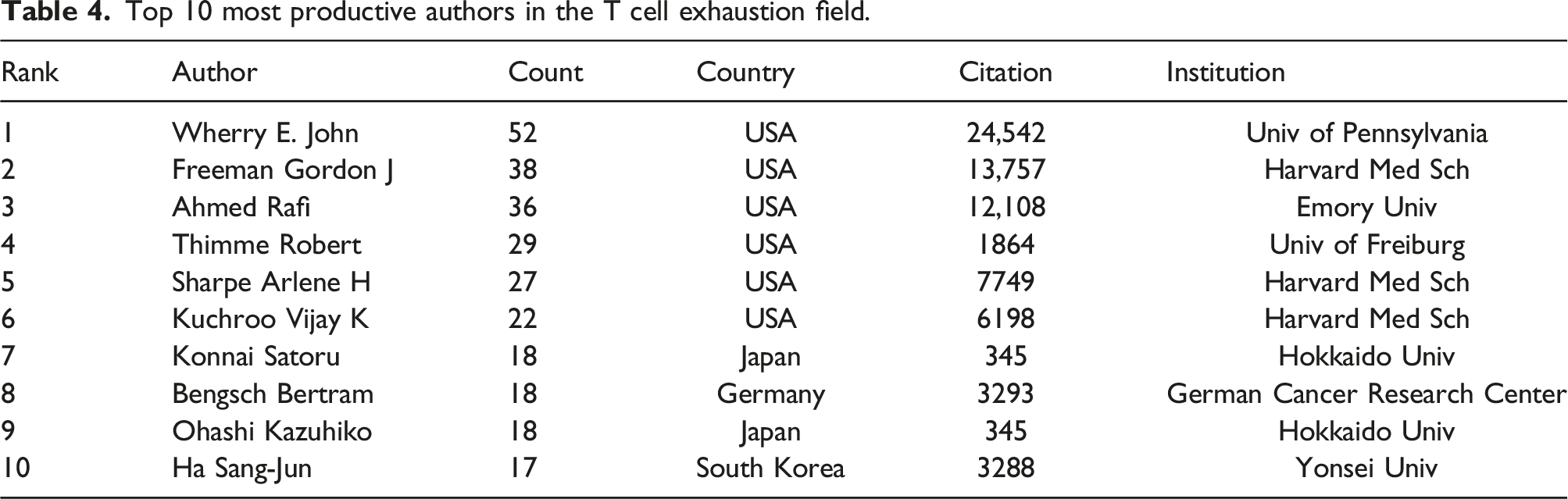
Top 10 most productive authors in the T cell exhaustion field.
Reference and citation burst analyses
Ten most highly cited articles in this field.


Co-citation analysis results.(a) A publication co-citation network. (b) The 22 categories established for relevant publications and associated citations. (c) A timeline view of these 22 categories of publications and associated citations. (d) The top 20 strongest citation bursts for individual references, with blue lines representing the period a study was published and the red line representing the citation burst period.
Keyword analyses
Keyword co-occurrence analyses can enable the effective identification of past and current research hotspots in a particular field. Accordingly, VOSviewer was utilized to perform visual keyword analyses. Of the 3951 identified keywords, 124 appeared more than 10 times such that they were selected for additional analysis (Figure 7(a)). Density visualization of these keywords revealed that the three most common keywords were “immunotherapy” (280 times), “T cell exhaustion” (274 times), and “PD-1” (239 times) (Figure 7(b)). The periods during which these keywords were mentioned were also visualized (Figure 7(c)). In a co-occurrence analysis of the 27 most commonly utilized keywords (Figure 7(d)), blue lines represent the period of time during which these keywords were used in relevant articles, while dots denote citation burst periods for these keywords. Visual analyses of T cell exhaustion-related keywords. (a) A network visualization of keywords. (b) An overlay visualization of keywords. (c) A keyword density visualization. (d) Keyword burst analysis results for the 27 most cited keywords, where blue lines represent the periods during which keywords appeared among the analyzed studies and dots denote the burst period for citations utilizing these keywords.
Discussion
A bibliometric study was herein conducted with the goal of better clarifying current trends in the field of T cell exhaustion-focused research. Unlike systematic reviews, bibliometric analyses can predict future areas of research in a given field based on the efficient synthesis of results published to date. The present study leveraged VOSviewer and CiteSpace to visualize and analyze the relationships among 2676 articles associated with 3117 institutions and 85 countries/regions. Bibliometric tools were subsequently employed to assess important publications, citations, countries, institutions, journals, authors, and research hotspots.
Annual publication output can provide a general overview of the progress of a given research field. From 2000 to 2005, T cell exhaustion-focused research output was minimal with 3 or fewer publications per year. From 2006 onward, however, the annual publication counts have risen steadily, peaking in 2022. Given the consistency of the recent steady growth in this field, this trend is projected to continue in the future.
The USA (1173 publications, 43.83%), China (699 publications, 26.12%), and Germany (260 publications, 9.72%) were the three countries with the highest publication counts, contributing to 79.67% of all publications in the field, emphasizing their status as leaders in this research space. The USA was the source of the highest annual number of publications from 2006 to 2020, although China exhibited rapid annual growth in terms of publication output in recent years such that it surpassed the USA and emerged as the country with the highest number of publications in 2021. Despite the publication of nearly three-fold more publications than German researchers, however, Chinese researchers exhibited significantly reduced international collaboration within this field (Figure 3). Efforts to establish international collaborations on the part of Chinese researchers may thus help further extend their influence in the field.
Harvard University contributed to the greatest number of T cell exhaustion studies. Analyses of institutional collaboration revealed two distinct clusters, with Chinese research institutions forming a separate cluster distinct from the cluster containing other institutions (Figure 4). This highlights the lack of academic exchange between Chinese research institutions and institutions in other countries. Given the recent surge in Chinese research output in this field, this lack of international academic exchange is likely counterproductive, restricting both the development of Chinese research efforts and the field as a whole. There is thus a clear need to eliminate academic barriers for researchers in China, the USA, and other nations so as to foster new opportunities for collaboration so as to accelerate T cell exhaustion-focused research efforts. There are also some bibliometric analyses that directly focus on the special issue of a certain region, allowing for precise analysis of research in a specific region. 16
The publication statistics for the most prominent journals in the T cell exhaustion field are presented in Table 3, revealing that Frontiers in Immunology, the Journal of Immunology, and the Journal for Immunotherapy of Cancer were the sources of the highest number of publications in this field. In a co-citation analysis, the Journal of Immunology exhibited the highest citation count, followed by Nature and Immunity. This result highlights the important status of T cell exhaustion-associated research in the immunology and cancer research fields, serving as a key topic of scholarly interest. For several decades, the Impact Factor (IF) has been a predominant metric for gauging the influence of scientific journals. It furnishes editors and publishers with quantitative data, facilitating the positioning of their journals relative to others within the same-subject category. While the Impact Factor serves as a broad indicator of a journal’s significance, its application requires judicious interpretation. The IF might reflect the journal’s popularity more than its intrinsic quality, and it does not necessarily correspond to the merit of individual articles within the journal. Consequently, authors might feel pressured to submit their work to journals with higher IFs, which may not always align with the true academic value of their research.
The top 10 most widely cited journals in this field were JCR Q1 category journals exhibiting high-impact factors, suggesting that T cell exhaustion-related research is prominently positioned in the broader academic landscape. When assessing co-cited authors, E. John Wherry exhibited the greatest publication output and the highest number of citations in the field, with his 2011 and 2015 review articles2,3 having been the focus of high levels of academic attention. Gordon J. Freeman and Rafi Ahmed were the second and third most productive researchers in the field, with a joint article published in 2006 by Freeman and Ahmed standing as the most frequently cited article in the field to date. 6
The number of citations an article garners is often indicative of its significance within a particular field. Those articles that amass the highest number of citations can be considered foundational or pivotal in that domain. As detailed in Table 5, there are four articles that have each amassed over 2000 citations. Notably, the most cited among these is Barber DL’s work titled “Restoring function in exhausted CD8 T cells during chronic viral infection,” published in Nature in 2006. This study elucidated that blocking the PD-1/PD-L1 inhibitory pathway rejuvenated the function of exhausted CD8 T cells. Furthermore, this research suggests an innovative strategy to enhance the effectiveness of therapeutic vaccinations by pairing them with PD-1/PD-L1 pathway inhibition. The second and third most cited articles are both reviews by Wherry EJ. A review article published in 2011 summarized the general phenotypic and functional portrait of exhausted T cells. His another review article published in 2015 summarized the molecular understanding of T cell exhaustion and new therapeutic targets for persisting infections and cancer. The last article with more than 2000 citations was Day CL’s article “PD-1 expression on HIV-specific T cells correlates with T cell exhaustion and disease progression” published in Nature in 2006. This article found PD-1/PD-L1 pathway of reversible T-cell impairment provides a potential target for enhancing the function of exhausted T cells in chronic HIV infection. It can be seen that the two most cited research articles were both published in Nature in 2006. The conclusions of these two articles laid the foundation for the important relationship between PD-1/PD-L1 and exhausted T cells.
Keyword analyses can offer valuable insight into key research themes in a given field, allowing for the identification of research hotspots and developmental frontiers. Common keywords identified in this study included immunotherapy, T cell exhaustion, PD-1, PD-L1, and tumor microenvironment (Figure 7). The predominant keywords prior to 2014 were primarily related to viruses and infections, whereas PD-1 and immune response-related keywords became more prominent from 2014 to 2018. As our understanding of T cell exhaustion mechanisms has advanced, research related to immunotherapy targeting this phenomenon has concurrently experienced rapid development. Given its central role in T cell exhaustion, the receptor PD-1 has emerged as a critical target for immunotherapy. Targeted interventions against PD-1 have demonstrated efficacy in treating various human cancers. Consequently, the effectiveness and limitations of immunotherapies addressing T cell exhaustion have become a focal point of research in recent years.
Hotspots and research trends
The epigenetic and transcriptional regulation of exhausted T cells
T cell exhaustion is a hallmark of many disease states, and the core genetic mechanisms that regulate this phenotype appear to be widely conserved in different diseases. 17 Temporal analyses of tumor-infiltrating lymphocytes (TILs) have revealed that chromatin remodeling occurs in T cells in two phases, 18 with the first phase occurring in the 5 days after T cell transfer, whereas the following phase occurs over a roughly 2-week period. While the numbers of differentially regulated elements associated with these two phases were similar, different transcription factors are involved in these processes. Researchers exploring the functional relevance of these regulatory elements sorted TILs at different time points and determined that it was possible to restore the effector functions of early exhausted T cells (PD-1hiCD38loCD101lo) upon their removal from the tumor microenvironment, whereas the same could not be achieved for late exhausted T cells (PD-1hiCD38hiCD101hi). Further flow cytometry-based analyses of antigen-specific T cells conducted in the context of chronic infections have revealed that progenitor-exhausted T cell populations are present in these systems. 19 These progenitor cells are capable of proliferating and undergoing self-renewal upon antigen-mediated stimulation. Transitory-exhausted T cells and terminally exhausted T cells have also been identified as exhausted T cell subsets. 20 The TOX transcription factor was also identified as a key regulatory mediator in exhausted T cells based on transcriptomic analyses of exhausted cells,14,21,22 with the knockout of TOX resulting in decreases in surface inhibitor receptor expression and enhanced proliferative activity in tumor and chronic infection model systems without affecting effector or memory cell populations in the context of acute infection. Recent studies have found that TOX4, a member of the TOX family, also plays an important role in the development of T cells.23,24 In contrast, TOX overexpression in T cells recapitulated the phenotypic characteristics of exhausted T cells.
The importance of T cell exhaustion in immunotherapy
T cell exhaustion is highly relevant to immunotherapeutic treatment strategies. Immune checkpoint blockade (ICB) therapies seek to restore the activation of immune activity by interfering with suppressive T cell signaling. The efficacy of ICB has been shown to be greatest in cases where the functional capacity of antigen-specific T cells remains intact. 25 Despite their benefits, ICB treatment efforts, including PD-1 blockade, cannot effectively induce the reprogramming of exhausted T cells.26,27 These results underscore the need to appropriately define different stages of the T cell differentiation process such that T cells in different stages can be reliably manipulated to enhance immunotherapeutic outcomes. T cell exhaustion is also relevant in other therapeutic settings, including efforts utilizing tumor-targeting chimeric antigen receptor (CAR) T cells. Subsequent studies have demonstrated that tumor-infiltrating CAR T cells exhibit a PD-1+TIM3hi phenotype with elevated TOX and TOX2 expression. 28 Chronic infections can also induce signaling that results in the exhaustion of CAR T cells.29,30 CAR T cells can thus exhibit a range of exhausted phenotypes.31,32 Effectively engaging host immune mechanisms can provide a more reliable and durable means of treating cancer while avoiding the persistent, deleterious side effects associated with aggressive chemotherapeutic treatment. It is thus vital that new approaches to overcoming therapeutic limitations be established, in part by more fully clarifying the key barriers to effective T cell responses.
Comparisons of T cell exhaustion and exhaustion in other immune cell populations
Other lymphocyte populations, including NK and B cells, can also become exhausted in a manner that partially overlaps with the characteristics of T cell exhaustion. While NK populations can exhibit phenotypic changes and impaired functional activity, no clear definition of NK cell exhaustion has yet been established. 33 In the context of functional impairment, NK cells exhibit aberrant activating and inhibitory receptor profiles that have been linked to exhaustion. 34 Key inhibitory receptor proteins expressed by these cells include killer cell immunoglobulin receptors (KIRs), CD94/NKG2A, and leukocyte immunoglobulin-like receptors (LIRs), whereas activating receptors include NKG2D and DNAX accessory molecule (DNAM-1).35,36 In the context of chronic CMV infection, numbers of NK cells exhibiting skewed KIR profiles consisting of both activating and inhibitor KIR expression rise, with decreased proliferation-related Ki-67 expression and reductions in the ability of these cells to secrete interferon-γ and granzyme B. 37 Tumor-related NK cell exhaustion has been linked to high levels of proliferation together with reductions in the activity of the activating T-box transcription factors eomesodermin and T-bet. 38 At present, consensus regarding which receptors are exhaustion markers is lacking, 33 and some research groups have suggested that more relevant markers of NK exhaustion include TIGIT, TIM3, and LAG3. 35
The exhaustion of B cells similarly entails the impairment of B cell functionality as a result of chronic disease or infection. 39 Such exhaustion is characterized by the upregulation of various inhibitory receptors together with reductions or unusual patterns of expression for various chemokines, chemokine receptors, and adhesion ligands, together with the impairment of proliferative activity in response to antigens and lymphocyte signals.40,41 In the context of HIV-1 infection, CD27-/CD21low tissue-like memory (TLM) B cells have been reported, and the lack of CD21 expression by mature B cells has been reported as a pathogenic hallmark.40,42 FCRL4 may also act as a key inhibitory receptor associated with the exhaustion of B cells in the context of chronic HIV infection. 39 Higher FCRL4 expression levels were noted in circulating atypical memory B cells in individuals infected with non-viral pathogens. 43 Atypical memory T B cells exhibit T-bet expression, with CD11c often serving as a surrogate marker given that most CD11c+ B cells are positive for T-bet. These T-bet+ B cells also exhibit the absence of CD21 expression and varying levels of CD27 expression. 44 The exhaustion of different lymphocyte populations including T, B, and NK cells can be broadly characterized by dysfunction as a result of antigenic overstimulation. However, consensus is currently lacking regarding how best to define B and NK cell exhaustion, in stark contrast to the clear definitions available for T cells. 45
Limitations
While bibliometrics offers a precise means to delineate research objectives and trends within a specific field, certain inherent limitations persist. First, we obtained data from only one database, WoSCC, and studies not included in WoSCC will be missed. However, the WoSCC database already contains most of the articles and related information in the fields we focus on. PubMed is also a suitable database for research in the field of biomedicine, as reported in some bibliometric studies. 46 However, collecting documents from multiple databases will result in duplicate of some documents. Second, the articles included in the analysis are as of March 12, 2023, so the current literature in 2023 is not included in our analysis. Third, we only included English-language literature for analysis and excluded non-English language literature. Nonetheless, our literature-based visual analysis is enough to allow researchers to easily understand the research hotspots and development trends of T cell exhaustion.
Conclusion
The present study is the first bibliometric study to have systematically examined the T cell exhaustion research space, highlighting the marked progress that has been made in this field over the past two decades. The visual analyses conducted herein highlight clear upward trends in research output in this field over time, with the USA and China having emerged as key leaders in terms of publication output. Efforts to further advance the current understanding of T cell exhaustion in the future should center on the augmentation of collaborative interactions between institutions and researchers from different countries and regions. The high-citation frequencies and international impact of many of the studies included in this analysis emphasize the importance of T cell exhaustion in the academic community. Key areas of active investigation in this field include analyses of the signaling and transcriptional pathways that govern T cell exhaustion and efforts to manipulate T cell exhaustion in order to achieve particular therapeutic outcomes.
Footnotes
Author contributions
ZL and YT conceived the study. HW and YT analyzed the data. ZL and HW wrote the manuscript. DL, JH, CZ, and FL re-examined the data. BQ reviewed and revised the manuscript.
Declaration of conflicting interests
The author(s) declared no potential conflicts of interest with respect to the research, authorship, and/or publication of this article.
Funding
The author(s) disclosed receipt of the following financial support for the research, authorship, and/or publication of this article: This study was supported by Guangdong Basic and Applied Basic Research Foundation (2022A1515111108) and Science Research Foundation of Aier Eye Hospital (AF2215D01).
