



Abstract
Recent years have witnessed rapid progress in mitochondrial transplantation (MT) as a novel strategy for restoring mitochondrial function in diverse pathological conditions, including somatic mitochondrial transfer and reproductive mitochondrial replacement therapy. With its expanding applications in regenerative medicine and disease modeling, systematic quantitative evaluation of the global MT research landscape remains limited. To address this gap, we performed a bibliometric analysis of publications indexed in the Web of Science Core Collection from 1996 to 2024, with cross-database validation using Scopus. CiteSpace, VOSviewer, and the R package bibliometrix were applied to assess publication trends, collaboration networks, co-citation patterns, and keyword co-occurrence. In total, 1104 articles and reviews were included. The results revealed rapid growth in MT-related research, with the United States and China as leading contributors. Mitochondrion emerged as the most influential journal, while Yamada Y, Harashima H, and McCully JD were recognized as key authors. High-frequency keywords highlighted major themes including mitochondrial transfer, mesenchymal stem cells, and ischemia–reperfusion injury. Emerging terms such as extracellular vesicles, tunneling nanotubes, and advanced delivery systems, particularly the MITO-Porter platform, reflected current research frontiers. Overall, this study provides a comprehensive overview of global research trends and evolving directions in mitochondrial transplantation.

Keywords
Introduction
Mitochondrial dysfunction is a pathological hallmark of diverse diseases, including neurodegenerative disorders (e.g. Alzheimer’s and Parkinson’s), cardiovascular conditions, metabolic syndromes, and aging-related pathologies 1 . As cellular powerhouses regulating energy production, apoptosis, and reactive oxygen species (ROS) homeostasis, mitochondria are fundamental to tissue viability 2 . Mitochondrial transplantation (MT) has emerged as a promising therapeutic strategy to restore bioenergetics by transferring healthy exogenous mitochondria into compromised cells via natural intercellular mechanisms—such as extracellular vesicles (EVs) and tunneling nanotubes (TNTs)3,4. This approach demonstrates significant potential to mitigate oxidative stress, enhance cellular resilience, and reverse disease progression in preclinical models5,6. Despite promising advances—including targeted delivery systems (e.g. MITO-Porter), stem cell-derived mitochondrial transfer, and CRISPR/Cas9-mediated mtDNA editing7,8—clinical translation faces challenges. Optimization of mitochondrial delivery, scalability of production, and ethical concerns regarding mitochondrial sourcing and genetic inheritance remain unresolved9,10. While these mechanistic insights have been extensively explored in experimental studies, how research efforts in MT have evolved at a global and thematic level remains less clearly defined. Recent comparative and conceptual studies have highlighted MT as an emerging therapeutic strategy that is increasingly discussed alongside, yet distinct from, mesenchymal stem cell–based approaches, reflecting growing efforts to define its unique research scope 11 . In parallel, recent experimental work has demonstrated the application potential of exogenous MT in specific disease models, such as peripheral nerve injury and nerve graft repair, underscoring expanding translational interest in this field 12 .
Bibliometric analysis is particularly well suited to this context, as it provides a quantitative and systematic framework for mapping research trends, citation networks, and collaboration patterns across evolving and interdisciplinary domains. This methodology enables assessment of the temporal evolution of MT research, identification of major contributing countries, institutions, and authors, and detection of emerging research directions. While existing narrative reviews have focused on specific mechanistic or clinical aspects of MT, no comprehensive bibliometric study has systematically examined the intellectual structure of the field as a whole. Here, we present a quantitative analysis of nearly three decades of MT research to map global trends, collaborative networks, and thematic evolution. By providing an evidence-based overview of the research landscape, this study aims to inform future investigations, support translational development, and contribute to discussions on clinical and ethical frameworks related to MT.
Methods
Core database and search strategy
The Web of Science Core Collection (WoSCC) was selected as the primary data source for this bibliometric analysis because of its standardized indexing, comprehensive citation metadata, and suitability for large-scale scientometric research. Literature retrieval was conducted on March 15, 2025, covering publications from January 1, 1996, to December 31, 2024. Only original research articles and review papers published in English were included. Records were retrieved from WoSCC and exported in plain text format with full records and cited references, including titles, authors, author affiliations, publication year, journal source, abstracts, author keywords, Keywords Plus, cited references, document types, and Web of Science subject categories. Automatic deduplication was performed based on unique identifiers, including Digital Object Identifiers (DOIs) and article titles. Subsequently, a data screening step was applied to ensure completeness of bibliometric information required for downstream analyses. Three records were excluded because complete metadata could not be exported from the Web of Science database at the time of retrieval. After screening, a total of 1104 publications were retained for bibliometric analysis. The literature selection and screening process are summarized in a PRISMA-style flow diagram (Fig. 1).

The flowchart for literature search, selection and analysis. TI: Title; AK: Author keywords; AB: Abstract.
Cross-database validation
To enhance the robustness and generalizability of the findings derived from WoSCC, an independent cross-database validation was conducted using the Scopus database, following established multi-database validation practices in bibliometric research. All validation procedures were completed in December 2025.
In Scopus, a search strategy logically equivalent to that used in WoSCC was implemented, employing the same set of keywords, Boolean operators, document types (articles and reviews), language restriction (English), and publication period (1996–2024). Rather than attempting record-level replication, cross-database validation focused on macro-level bibliometric consistency, including annual publication trends, leading contributing countries and territories, disciplinary category distributions, and keyword-based thematic validation.
Comparative analyses were performed using side-by-side visualizations to assess concordance between WoSCC and Scopus. Consistent patterns observed across databases were interpreted as evidence of the stability and robustness of the primary bibliometric findings.
Data processing
The analysis was performed using four specialized tools: CiteSpace (version 6.4.1), VOSviewer (version 1.6.20), the bibliometrix R package (available at https://www.bibliometrix.org), Scimago Graphica (version 1.0.46.0), and Microsoft Office Excel 2021. CiteSpace, created by Professor Chaomei Chen, is mainly employed to examine citation networks in academic literature, assisting researchers in recognizing emerging research areas and trends 13 . CiteSpace (version 6.4.1) was utilized for co-occurrence analysis (keywords), co-citation analysis (references), and burst detection across institutions, journals, and keywords, along with timeline visualizations of conceptual development. VOSviewer, developed by Leiden University in the Netherlands, specializes in creating and visualizing bibliometric networks, enabling co-citation, bibliographic coupling, and co-occurrence analyses 14 . VOSviewer (version 1.6.20) was used to create temporal evolution networks that illustrate co-occurrence and co-citation patterns across journals, countries, prominent authors, institutions, and keywords. Bibliometrix, an R package, offers a set of functions designed for scientometric quantitative analysis 15 . In this research, Bibliometrix was applied to visualize author historiography, institutional collaborations, highly cited countries/journals, reference citation patterns, and keyword co-occurrence networks through co-citation analysis, temporal mapping, and thematic evolution evaluation. Scimago Graphica (version 1.0.46.0) was utilized to create geographic visualizations of national research output and collaboration patterns. In addition, Microsoft Office Excel 2021 was used to analyze publication and citation trends. Full counting was applied for country-, institution-, and author-level analyses, such that each contributing entity was counted once per publication.
Parameter settings for bibliometric analysis
To ensure transparency and reproducibility of the bibliometric analyses, the main parameter settings applied in the different software tools are detailed below.
In CiteSpace (version 6.4.1), the time slicing was set from 1996 to 2025 with a slice length of 1 year. The g-index was used for node selection with k = 50, and the Pathfinder algorithm was applied to prune the networks. CiteSpace was employed for keyword co-occurrence analysis, reference co-citation analysis, burst detection, and timeline visualizations of thematic evolution.
In VOSviewer (version 1.6.20), full counting was adopted for all analyses, and association strength normalization was used to construct bibliometric networks. Author keyword co-occurrence analysis was performed using author-provided keywords, with a minimum occurrence threshold of six. Co-authorship networks were constructed for authors, institutions, and countries, applying minimum publication thresholds of five documents for each unit. Reference-related analyses included co-cited author and co-cited journal networks, with minimum citation thresholds set at 60 and 171, respectively. Journal co-occurrence analysis based on publication output was conducted using a minimum threshold of five documents. Network and overlay visualizations were generated in VOSviewer using primarily default layout and clustering algorithms, with minor adjustments to visualization parameters (e.g. layout and resolution) to improve graphical clarity, without altering the underlying network structure or analytical thresholds.
Within the bibliometrix package (R), full counting was likewise employed, enabling the construction of author historiography and collaboration networks, alongside analyses of country- and journal-level productivity, reference citation patterns, and keyword co-occurrence. In addition, the package was used to conduct thematic evolution analyses and temporal mapping of research trends.
Scimago Graphica (version 1.0.46.0) was employed exclusively for geographic visualization and layout optimization of collaboration networks, without introducing additional analytical thresholds. Microsoft Office Excel 2021 was used to analyze annual publication and citation trends.
Results
Trends and academic contributions in publications
The study employed a structured search strategy based on titles (TI), abstracts (AB), and author keywords (AK), ensuring broad inclusion of relevant literature (Fig. 1). The field has exhibited robust growth, with an annual publication growth rate of 14.2% and a cumulative reference count exceeding 49,642. As shown in Fig. 2a, annual publication output increased from fewer than 50 in 1996 to over 150 by 2024, with average citations per document reaching 37.91. The literature is dominated by original research articles (n = 800) and review papers (n = 304), as noted in Supplementary Table 1 and Fig. 2b. The cumulative publication trajectory and Price’s Law curve (Fig. 2a–d) indicate a consistent and accelerating trend, underscoring the maturation and rising influence of this research domain. The Scopus search (n = 1364) mirrored the WoSCC data set, with both exhibiting consistent annual growth and marked acceleration after 2010 (Supplementary Fig. S1). This alignment underscores the reproducibility of the research domain’s trajectory.

Overview of publications and citations in MT research (1996–2024). (a) The number of publications and citations per year from 1996 to 2024. The bar graph (purple) represents the number of publications each year, while the line graph (blue) represents the corresponding citations. (b) Distribution of document types. (c) Cumulative number of publications. (d) Price’s Law Growth Curve.
Analysis of cooperation between countries
The global co-authorship network (Fig. 3a, b) identifies the United States and China as central hubs, linked by dense bilateral ties (e.g. USA–China, USA–UK) that reflect a highly interconnected research community. In terms of productivity, China has demonstrated a rapid growth trajectory since 2015, surpassing the United States in annual volume (Fig. 3c, e) to lead the top 10 most productive countries (Fig. 3f). However, the United States maintains a steady output and holds the leading position in total citation counts (Fig. 3d), indicating enduring influence compared with China’s volume-driven but maturing impact. This landscape is robustly corroborated by Scopus data (Supplementary Fig. S2), which replicates the ranking of the United States and China as the field’s dominant core contributors.
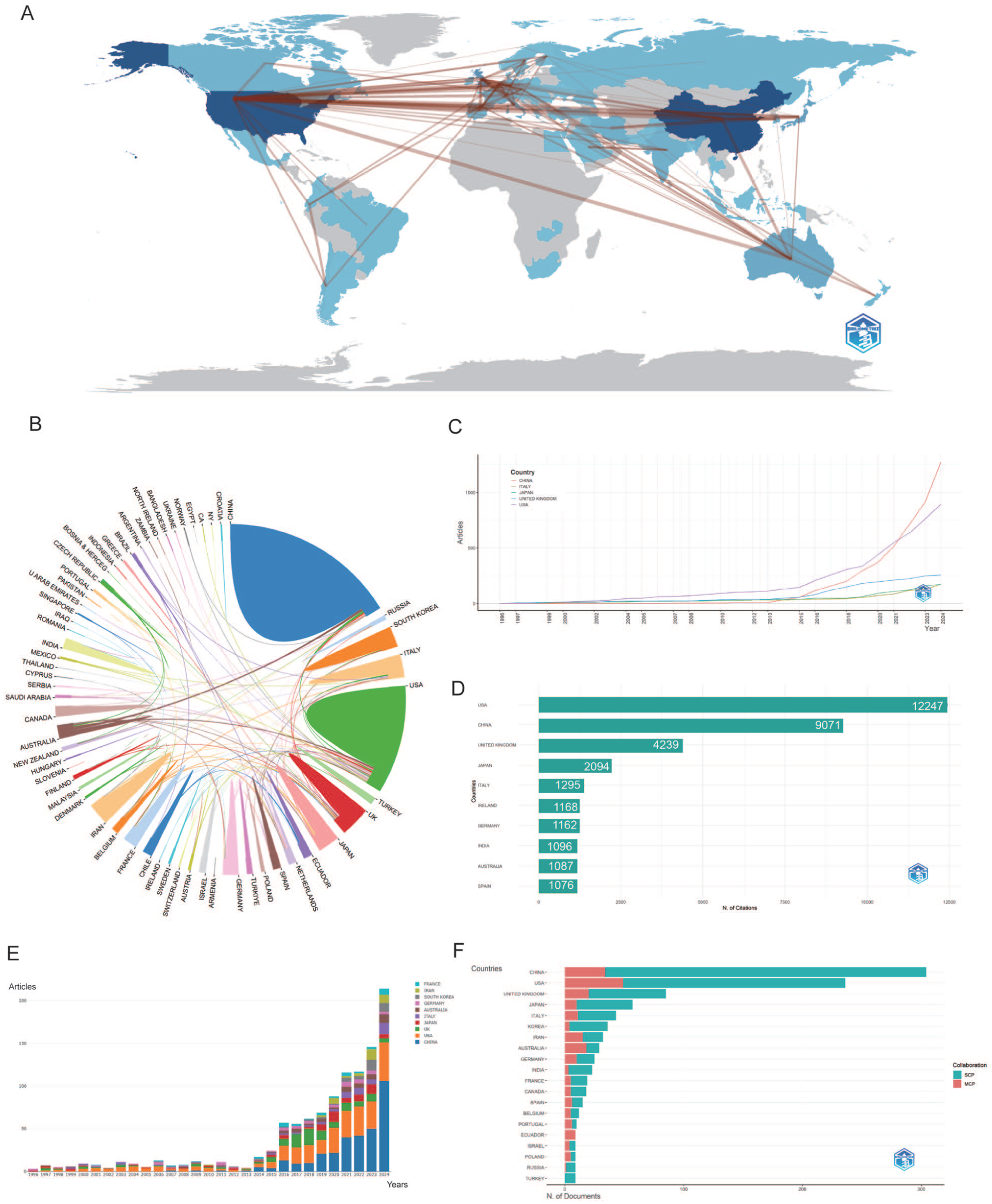
Global trends and collaboration networks in scientific publications in mitochondrial transplantation research. (a) Global collaboration map of co-authorship networks. Darker blue shades reflect higher publication output, with lines depicting international collaborative ties. The United States and China exhibit the densest connections. (b) Circular plot of international collaboration. (c) Country publication trends. The x-axis spans years, and the y-axis shows publication counts. (d) Country influence by citation impact. (e) Stacked bar chart of annual publications. (f) The top 10 countries responsible for the number of studies. MCP: Multiple-Country Publications; SCP: Single-Country Publications; OALM: Online Analysis Platform of Literature Metrology.
Analysis of cooperation between institutions
As shown in Fig. 4a, institutional collaboration formed distinct clusters, reflecting clear geographic and thematic alignment. Core institutions were predominantly located in China, the United States, and Europe, with the Chinese Academy of Sciences, Shanghai Jiao Tong University, Zhejiang University, and Sun Yat-sen University occupying central positions in the collaboration network, indicating strong connectivity and influence. Fig. 4b highlights institutional productivity, with the Chinese Academy of Sciences ranking first in publication output, followed by Shanghai Jiao Tong University, Zhejiang University, and Sun Yat-sen University, each contributing more than 30 publications between 1996 and 2024. Temporal trends (Fig. 4c) show limited institutional activity before 2010, followed by a marked increase thereafter, particularly after 2015. Overall, these results emphasize the dominant role of a small number of highly productive institutions in advancing MT research and reflect the field’s expanding global engagement.

Institutional contributions and collaboration networks in mitochondrial transplantation research. (a) Institutional collaboration network. Node size corresponds to collaboration extent, and colors denote distinct regional or institutional clusters. (b) Top affiliations by publication volume. (c) Institutional publication trends. The x-axis denotes years, and the y-axis shows publication counts.
Analysis of authors and co-cited authors
As shown in Table 1, Yamada Y leads in publication volume, with 18 articles and an h-index of 18, followed closely by Harashima H and McCully JD, each with substantial citation counts and consistent publication output. Notably, McCully JD has the highest total number of publications (22) and a leading g-index of 22, reflecting a strong and sustained academic impact since 2013. In terms of author influence normalized by career length, Del Nido PJ exhibits the highest m-index (1.333), indicating intensive contributions over a relatively short period. Co-authorship network analysis (Fig. 5a) illustrates several distinct collaborative clusters, with key researchers forming well-defined communities indicative of sustained partnerships. In parallel, the co-citation analysis (Fig. 5b) highlights foundational figures frequently referenced together in the literature. Scholars such as Spees JL and Gorman GS emerge as central nodes within the co-cited author network, suggesting their seminal works serve as intellectual cornerstones across diverse research groups.
Top 5 Authors on mitochondrial transplantation research (1996–2024).

TC: Total Citations; NP: Number of Publications; PY_start: Year of First Publication.

Co-authorship and co-cited authorship networks in mitochondrial transplantation research. (a) Co-authorship network: Nodes represent authors, sized by publication count. Colors indicate collaboration clusters. (b) Co-cited authorship network: Nodes, connected by collaborative publications, have edge thickness proportional to joint works. Clusters, marked by colors, reveal research groups.
Analysis of journals and co-journals
As presented in Fig. 6a and Table 2, Mitochondrion ranks first in total publication count and citation metrics, indicating its foundational role in the field. Other influential journals include the International Journal of Molecular Sciences, Stem Cell Research & Therapy, and Scientific Reports, which collectively demonstrate strong h-index and impact factor values. Fig. 6c illustrates long-term publication trends in core journals, while multidisciplinary journals such as Cells and Frontiers in Cell and Developmental Biology have exhibited notable growth in recent years, suggesting a surge in multidisciplinary engagement. The journal-source coupling network (Fig. 6b) reveals a structured clustering of journals based on shared citation behavior. Distinct clusters correspond to major disciplinary orientations, including a molecular and cellular biology–focused cluster centered on Mitochondrion and the International Journal of Molecular Sciences, and a stem cell and regenerative medicine cluster anchored by Stem Cell Research & Therapy and Cells. Inter-cluster linkages indicate ongoing knowledge exchange across disciplinary boundaries. Bradford’s Law analysis (Fig. 6d) reveals a clear concentration pattern in which a small number of core journals contribute a disproportionately large share of publications, followed by a long tail of journals with progressively lower output. This distribution confirms the presence of a well-defined core journal set that structures knowledge dissemination in MT research. Fig. 6e, f present the journal citation and co-citation networks, respectively. Fig. 6e shows that journal citation relationships are structured into discipline-oriented clusters, with Mitochondrion and International Journal of Molecular Sciences forming a molecular biology–focused core, while Stem Cell Research & Therapy and Cells anchor a translational and regenerative medicine cluster. Fig. 6f further reveals several tightly knit co-citation groups, in which journals such as Mitochondrion, International Journal of Molecular Sciences, and Stem Cell Research & Therapy are frequently cited together. These journals occupy central positions in the co-citation network, suggesting that they represent shared intellectual foundations and serve as key knowledge sources underpinning MT research.
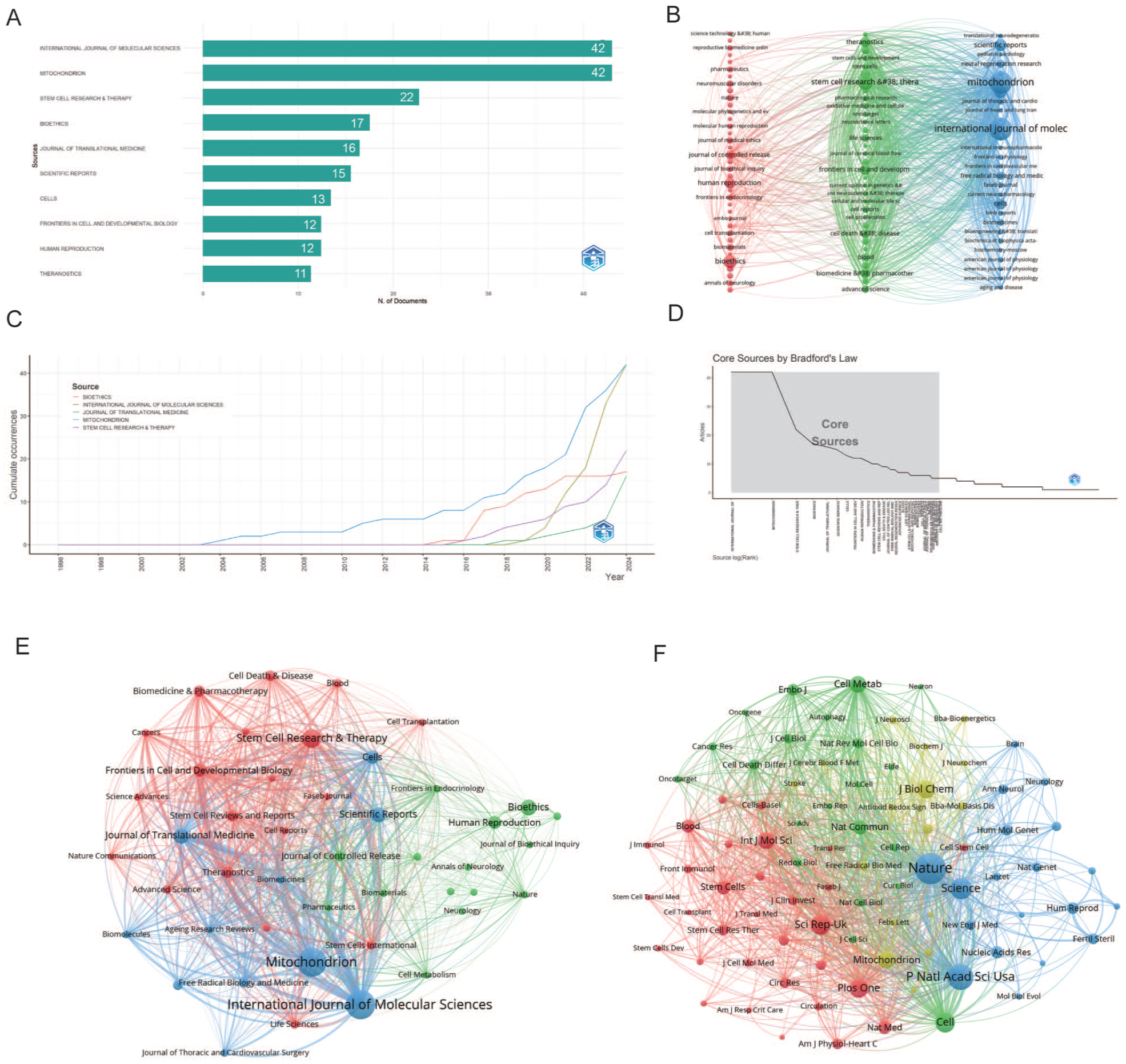
Comprehensive analysis of journals and citation networks related to mitochondrial transplantation research. (a) Top journals by publication count: X-axis shows article numbers; y-axis lists journals. (b) Journal-source coupling network: Nodes represent journals, sized by publication or citation frequency, and edges represent coupling strength between journals. Journals that frequently cite similar references are grouped into clusters (red, green, blue), revealing thematic relationships among publication sources. (c) Top 5 journals’ publication trends (d) Bradford’s Law analysis: Identifies core journals based on publication distribution. (e) Journal citation network: Nodes represent journals, connected by citations. Colors (green, blue, red) highlight thematic clusters of frequent inter-citation. (f) Journal co-citation network: Nodes, sized by co-citation frequency, are linked by co-citation ties. Colors denote clusters of commonly co-cited journals.
Top 10 influential journals on mitochondrial transplantation research (1996–2024).

IF: Impact Factor; JCR: Journal Citation Reports.
Analysis of references and articles
As summarized in Table 3, the most cited publication is the 2012 Nature Medicine article by Islam et al. 3 , which introduced the concept of mitochondrial transfer from stromal cells to alveoli, accumulating 1111 citations and setting a precedent for cell-based mitochondrial therapy. Other seminal works include studies by Gorman et al. 1 and Spees et al. 4 , each with over 700 citations, contributing key insights into mitochondrial diseases and intercellular transfer mechanisms, respectively. These articles not only reflect early breakthroughs but also continue to serve as cornerstones for contemporary investigations. A more nuanced understanding of the intellectual structure is provided through co-citation network visualization (Fig. 7a), where references are grouped into thematic clusters based on modularity analysis. These clusters encompass topics such as stem cell therapy, mitochondrial dynamics, ischemia-reperfusion injury, and neurodegeneration, indicating the multidisciplinary nature of the field. The timeline view of co-citation clusters (Fig. 7b) reveals the temporal evolution of these knowledge domains, with recent clusters highlighting emerging interest in EV-mediated mitochondrial transfer and metabolic regulation. Furthermore, Fig. 8 identifies the top 25 references with the strongest citation bursts, reflecting periods of intense scholarly attention. Notably, several citation bursts have occurred in the last 5 years, suggesting that the field is rapidly evolving.
Top 25 most cited publications based on bibliometrix analysis(1996–2024).

DOI: Digital Object Identifier.

Network visualization of references in mitochondrial transplantation research. (a) Clustered co-citation network: Nodes, sized by citation frequency, are grouped by modularity with keyword labels for major clusters. Edge thickness reflects co-citation strength; colors highlight thematic diversity. (b) Timeline view of co-citation clusters: Each horizontal line represents a cluster, with nodes signifying highly cited references over time. Node size reflects citation frequency; colors correspond to different clusters. The X-axis shows publication years, revealing the temporal evolution and activity span of each research topic in mitochondrial transplantation.

Top 25 references with strongest citation bursts in mitochondrial transplantation research. The burst timeline shows the periods during which these bursts occurred, with red segments indicating the time intervals when each reference received heightened attention.
Analysis of keyword analysis
Keyword analysis provides insight into the thematic structure and evolving research focuses in the field of MT. As illustrated in Fig. 9a, the keyword co-occurrence network reveals a highly interconnected structure, indicating several well-established research themes. Core keywords such as “mitochondrial transfer,” “mesenchymal stem cells,” “ischemia–reperfusion injury,” and “oxidative stress” show high frequency and central positioning within the network, forming the backbone of research on both mechanistic pathways and therapeutic applications. Keyword clustering further delineates major subfields, including regenerative medicine, neuroprotection, and metabolic regulation, reflecting the multidisciplinary nature of MT research. The keyword timeline visualization (Fig. 9b) demonstrates a progressive shift from early studies centered on mitochondrial dysfunction toward increasing attention to intercellular transfer mechanisms, such as EVs and TNTs. Consistent with this trend, the overlay visualization (Fig. 9c) highlights several emerging keywords in recent years, including “exosomes,” “cell-free therapy,” and “metabolic reprogramming,” reflecting growing interest in non-cellular and mechanistically refined therapeutic strategies. Finally, the keyword density map (Fig. 9d) identifies major research hotspots concentrated around stem cell–mediated mitochondrial delivery and inflammation modulation, underscoring the field’s transition toward greater mechanistic sophistication and translational relevance.

Keywords mapping of in mitochondrial transplantation research. (a) Keywords co-occurrence network: Nodes represent keywords, sized by occurrence frequency (larger = more frequent), with edges indicating co-occurrence and colors denoting thematic clusters. (b) Keywords timeline: Nodes, sized by frequency and colored by cluster, illustrate the temporal evolution of research topics. (c) This visualization illustrates the relationships between keywords, where nodes represent keywords, and edges indicate their co-occurrence. Node size reflects the frequency of the keywords, while colors represent different thematic clusters, highlighting how these keywords are connected within the research landscape. (d) Keywords density visualization: Keywords are shown with density coloring, where warmer colors (yellow) indicate areas with a higher frequency of keyword occurrence, revealing hotspots in mitochondrial transplantation research.
To further evaluate the robustness of these thematic patterns, a cross-database validation was conducted using author keywords derived from the Scopus database and analyzed with identical parameters. Comparison of the Scopus- and Web of Science–based keyword co-occurrence networks revealed a high degree of consistency in core research themes, with “mitochondrial transplantation,” “mitochondrial transfer,” and mitochondrial function–related terms occupying central positions in both networks (Supplementary Fig. S3). Although the relative prominence of specific keywords differed between databases—with the Scopus network placing greater emphasis on mechanistic and technological aspects and the Web of Science network more prominently highlighting clinical, reproductive, and ethical contexts—the overall thematic structure remained highly comparable. At the disciplinary level, both databases consistently situate MT research within closely related domains, including cell biology, biochemistry and molecular biology, medicine, neuroscience, and pharmacology (Supplementary Fig. S4). Collectively, these findings support the stability and generalizability of the field’s core research themes across databases.
Discussion
MT has emerged as a promising and innovative strategy to directly address cellular bioenergetic deficits by delivering functional exogenous mitochondria into damaged cells, thereby restoring aerobic respiration, reducing oxidative stress, and enhancing cell survival. Its therapeutic potential is increasingly demonstrated across diverse preclinical models of neurodegenerative, cardiovascular, and ischemic diseases, positioning MT as a potential paradigm-shifting intervention beyond conventional pharmacotherapy. The following discussion interprets key patterns revealed by co-citation and keyword analyses, with emphasis on dominant research themes, their interconnections, and translational considerations.
Mechanisms of intercellular mitochondrial transfer
Our analyses identify mechanistic investigations as a central and structured dimension of MT research. Keyword co-occurrence (Fig. 9a) exhibit a core–periphery architecture in which EV-mediated and TNT-mediated mitochondrial transfer constitute the dominant, interconnected core, while processes related to mitochondrial dynamics and quality control appear as closely associated contextual elements.
EV-mediated transfer represents the most prominent mechanistic theme, as evidenced by its dense centrality within the networks. EV-related terms consistently link “mitochondrial transfer” with experimental systems based on stem or progenitor cells. Highly cited studies within this cluster focus on EVs derived from sources such as bone marrow mesenchymal stem cells, examining their capacity to package and deliver mitochondrial components to recipient cells16,17. The prominence of this theme likely arises from a combination of biological plausibility and experimental practicality: EV-mediated transfer provides a well-established mode of intercellular communication while offering a platform that can be readily isolated, characterized, and applied across diverse preclinical models. This accessibility may account for the frequent co-occurrence of EV-related keywords with disease-associated terms. Importantly, the central position of EV-mediated transfer reflects sustained investigative activity rather than established therapeutic superiority.
TNT-mediated transfer forms a distinct but thematically linked secondary cluster. TNT-related terms show a coherent presence within the networks, reflecting continued interest in direct, contact-dependent mitochondrial exchange. Seminal studies associated with this theme describe TNTs as actin-dependent intercellular conduits and investigate their involvement in models of cellular stress and tissue injury18,19. Interest in this pathway appears to be driven by its potential role in rapid, localized intercellular support, particularly under conditions where immediate mitochondrial rescue is hypothesized to influence cell survival.
In addition to discrete transfer routes, the networks consistently associate MT with broader mitochondrial quality control processes, including mitophagy and oxidative stress regulation20-25. These associations suggest that mitochondrial transfer is frequently examined within integrative frameworks of organelle homeostasis and stress adaptation rather than as an isolated mechanism.
Overall, the mechanistic landscape of MT research is characterized by thematic plurality. Multiple intercellular transfer pathways are investigated in parallel, without convergence toward a single dominant paradigm, reflecting both the biological complexity of mitochondrial exchange and the exploratory, hypothesis-generating stage of the field. The prominence of these mechanisms in co-occurrence networks reflects not only their biological significance but also their growing experimental tractability and broad application across multiple disease models.
Disease-related research contexts in MT
The keyword co-occurrence network (Fig. 9a) identifies two closely connected disease-oriented clusters centered on neurodegenerative and cardiovascular disorders. Their prominence does not imply confirmed therapeutic efficacy; instead, it highlights experimental contexts in which mitochondrial dysfunction is both pathophysiologically central and amenable to modeling.
The neurodegenerative disease cluster, encompassing conditions such as Alzheimer’s disease, Parkinson’s disease, and ischemic injury models, represents one of the most prominent application-oriented domains in the MT literature. Its density reflects a shared experimental focus on neuronal vulnerability to bioenergetic failure and oxidative stress. Highly cited studies within this cluster primarily employ neurological models to explore MT under conditions of acute injury or chronic degeneration26-30, confirming the central nervous system as a key domain for exploratory MT research.
A second coherent cluster is formed by cardiovascular diseases, including heart failure and ischemia–reperfusion injury. The visibility of this cluster reflects the heart’s high metabolic demand and susceptibility to mitochondrial impairment as major drivers of research attention. Representative studies focus on preclinical cardiac models to investigate MT-related effects on mitochondrial bioenergetics and cellular stress responses21,31,32.
Taken together, these clusters illustrate a research landscape that preferentially utilizes disease models with well-characterized mitochondrial pathophysiology as tractable systems for probing MT mechanisms and research potential. From a bibliometric perspective, the concentration of MT studies in neurodegenerative and cardiovascular disease models underscores the research community’s focus on tractable systems and the evolving funding priorities in the field.
Technological and translational aspects of MT
In parallel with mechanistic and disease-associated themes, bibliometric patterns point to the emergence of technological developments alongside persistent translational challenges.
Technological developments in MT research
Recent literature demonstrates increasing attention to engineering strategies aimed at enhancing mitochondrial delivery and manipulation. This trend is reflected by citation bursts associated with the MITO-Porter delivery system and the appearance of keywords such as CRISPR/Cas9 and metal–organic frameworks (MOFs)33-37. Although these topics do not yet occupy the densest regions of the network, their emergence indicates a growing focus on improving delivery specificity, efficiency, and genetic modulation.
Challenges in clinical translation
The recurrent co-occurrence of keywords related to mitochondrial stability, delivery efficiency, scalability, and standardization highlights sustained awareness of translational barriers within the field. The prominence of delivery-oriented journals further suggests that optimization of mitochondrial transport remains a recognized challenge. Together, these patterns reflect an ongoing discussion within the literature concerning the transition from preclinical exploration toward potential clinical application. The emergence of technologies like MITO-Porter and CRISPR in recent years is evidenced by citation bursts, reflecting a surge in both interest and experimentation in mitochondrial delivery systems and genetic modification strategies.
Ethical considerations
In addition to mechanistic and translational themes, ethical considerations constitute an important and distinctive dimension of MT research, particularly in the context of reproductive mitochondrial replacement therapy (MRT). Bibliometric patterns indicate that ethical issues are not peripheral but embedded within the intellectual structure of the field, as reflected by the co-occurrence of keywords related to mitochondrial donation, assisted reproduction, and ethics, as well as the prominence of bioethics-oriented journals among influential publication venues. The ethical discourse surrounding MRT primarily centers on concerns related to germline modification, donor–offspring relationships, and long-term intergenerational consequences. These issues have contributed to the emergence of a specialized body of literature that intersects reproductive medicine, genetics, and ethical governance, forming a distinct yet interconnected thematic cluster within the broader MT landscape10,38. From a bibliometric perspective, the coexistence of somatic MT and reproductive MRT literature underscores the dual scientific and ethical trajectories of the field. Importantly, ethical considerations appear less prominent in somatic MT research, which is predominantly framed within therapeutic and translational contexts. However, as delivery technologies advance and clinical applications expand, ethical discussions related to donor sourcing, consent, and long-term safety may gain increasing attention. The bibliometric evidence suggests that ethical discourse in MT research is dynamic and context-dependent, evolving alongside scientific and technological developments rather than remaining static.
Strengths and limitations
This study provides a systematic, data-driven overview of the MT field by delineating its intellectual structure and thematic evolution using reproducible bibliometric methods. The integration of co-citation and keyword analyses reduces subjective bias while capturing dominant research patterns across a broad literature base.
Several limitations should be acknowledged. The analysis is constrained by the scope of the selected databases and search strategies. In addition, bibliometric indicators reflect patterns of scholarly communication and attention, which serve as proxies for—but do not equate to—scientific progress or clinical maturity. Furthermore, this study focuses on macro-level research structures and thematic patterns; no stratified sensitivity analyses (e.g. exclusion of specific subdomains such as reproductive MRT) were conducted, which may limit domain-specific inferences. Future studies integrating bibliometric approaches with experimental or translational analyses may yield more detailed insights into specific MT subfields. Although cross-database validation supports the robustness of our findings, future studies incorporating additional databases, such as PubMed, may further refine coverage, particularly for clinically oriented publications.
Conclusion and future direction
This study presents a comprehensive bibliometric overview of MT research over nearly three decades. By integrating publication trends, collaboration networks, co-citation structures, and keyword co-occurrence analyses, we characterize the intellectual landscape and thematic evolution of the field from early conceptual exploration to its current multidisciplinary expansion. Building upon the current intellectual landscape, the future trajectory of MT research will hinge on addressing several interconnected challenges to advance from promising preclinical strategy to viable clinical therapy. A primary focus must be the deeper mechanistic integration of distinct transfer pathways, such as EV- and TNT-mediated delivery, to establish a unified regulatory framework governing mitochondrial trafficking and functional integration within recipient cells. Concurrently, research must expand into a broader spectrum of mitochondriopathy models while employing more physiologically relevant systems to rigorously validate long-term safety and efficacy. Technologically, the field requires significant innovation in delivery platforms to overcome critical barriers in targeting, efficiency, and controllability, moving beyond proof-of-concept toward optimized, smart nanocarriers and engineered donor mitochondria. In parallel, the establishment of standardized, scalable protocols for mitochondrial sourcing, isolation, and quality control under good manufacturing practice (GMP)-compliant conditions is a non-negotiable prerequisite for clinical translation. Furthermore, as the technology matures, proactive and ongoing ethical discourse must evolve in tandem with scientific progress, particularly concerning donor consent and long-term biological consequences, to inform responsible regulatory pathways. Ultimately, realizing the therapeutic potential of MT demands a concerted, interdisciplinary effort that synergizes fundamental discovery, translational engineering, and ethical foresight to navigate the complex journey from bench to bedside.
Supplemental Material
sj-docx-1-cll-10.1177_09636897261427903 – Supplemental material for The landscape of mitochondrial transplantation: A bibliometric analysis
Supplemental material, sj-docx-1-cll-10.1177_09636897261427903 for The landscape of mitochondrial transplantation: A bibliometric analysis by Xiaojuan Yang, Miaohui Wang, Xuhang Fan, Minheng Zhang, Siyao Chen, Yue Liu and Haixia Fan in Cell Transplantation
Footnotes
Acknowledgements
None.

Ethical Considerations
This study did not involve human participants or animal subjects. As such, ethical approval was not required for this research. All data used in the analysis were collected from publicly available databases and published literature, ensuring compliance with relevant ethical guidelines.
Author Contributions
Xiaojuan Yang: Writing—original draft, Visualization, Validation, Methodology, Formal analysis, Funding acquisition, Conceptualization.
Miaohui Wang: Writing—original draft, Visualization, Validation, Methodology, Formal analysis.
Xuhang Fan: Writing—review & editing, Visualization, Validation, Data curation.
Minheng Zhang: Writing—review & editing, Validation, Data curation.
Siyao Chen: Writing—review & editing, Validation, Project administration.
Yue Liu: Writing—review & editing, Validation, Project administration.
Haixia Fan: Writing—review & editing, Validation, Project administration, Funding acquisition, Conceptualization, Supervision.
Funding
The authors disclosed receipt of the following financial support for the research, authorship, and/or publication of this article: This work was supported by the Fund Program for the Scientific Activities of Selected Returned Overseas Professionals in Shanxi Province (grant numbers 20250046), the Research Project Supported by Shanxi Scholarship Council of China (grant number 2023-188), the Shanxi Health Committee Foundation Project (grant number 2024057), and the Fundamental Research Program of Shanxi Province (grant number 202403021222432).
Declaration of Conflicting Interests
The authors declared no potential conflicts of interest with respect to the research, authorship, and/or publication of this article.
Data Availability Statement
The final data set supporting the findings of this study consists of 1104 publications indexed in the Web of Science Core Collection. Due to database licensing restrictions, the full bibliographic records cannot be publicly redistributed. However, a complete list of Web of Science accession numbers for all included publications is provided as Supplementary Dataset S1, enabling independent retrieval and verification of the study corpus.
Statement of Human and Animal Rights
This article does not contain any studies with human or animal subjects.
Statement of Informed Consent
There are no human subjects in this article and informed consent is not applicable.
AI Tools Statement
The authors acknowledge the use of ChatGPT for language refinement and clarity enhancement. No scientific data, results, or conclusions were generated or modified using AI tools.
Supplemental Material
Supplemental material for this article is available online.
References
Supplementary Material
Please find the following supplemental material available below.
For Open Access articles published under a Creative Commons License, all supplemental material carries the same license as the article it is associated with.
For non-Open Access articles published, all supplemental material carries a non-exclusive license, and permission requests for re-use of supplemental material or any part of supplemental material shall be sent directly to the copyright owner as specified in the copyright notice associated with the article.
