




Abstract
Background
This observation aimed to investigate the effect of colorectal neoplasia differentially expressed (CRNDE) targeted miR-212-5p on cognitive impairment induced by isoflurane (ISO) anesthesia in rats.
Methods
The cognitive function of rats was measured by Morris water maze test. QRT-PCR detection of CRNDE and miR-212-5p expression levels in rats in each group. Double luciferase was used to verify the targeting relationship between miR-212-5p and CRNDE, and commercial kits were used to detect the level of inflammatory cytokines in hippocampus.
Results
The concentration of CRNDE was enhanced in rats treated by ISO anesthetic. The neurological severity score was elevated, the escape latency of rats was prolonged, the stay time in the quadrant of the platform, and the number of times crossing the platform decreased in the ISO group. The above indexes of rats in ISO + si-CRNDE were improved. MiR-212-5p is a mediator in the management of CRNDE on cognition and inflammation.
Conclusion
CRNDE led to the deterioration of impairment on cognition induced by ISO through suppressing miR-212-5p expression and promoting neuroinflammation.
Introduction
Postoperative cognitive dysfunction (POCD) refers to the cognitive impairment reflected by persistent cognitive deficit, distractibility, delirium, and declined comprehension after surgical anesthesia.1,2 POCD not only hinders the recovery of patients but also seriously affects their social adaptability.3,4 Isoflurane (ISO) has the advantages of stable, rapid, and comfortable anesthesia induction, and low liver metabolic rate. 5 ISO is a commonly used inhaled general anesthetic at present. Under stress conditions, the central nervous system can release inflammatory factors such as TNF-α, IL-6, and IL-1β. 6 Over synthesis of inflammatory indicators can induce the accumulation of local inflammatory cells and the cascade of other related cytokines, resulting in central nervous damage and memory and emotional dysfunction. 7 ISO is a commonly used inhalation anesthetic in clinic. Some studies have suggested that ISO can cause neurocognitive impairment, but the mechanism is not clear.
LncRNA is an inherent molecule RNA, which can regulate angiogenesis and nerve development, and participate in the occurrence and development of central nervous lesions. 8 LncRNA also plays an important regulatory function in the adverse function of anesthesia. Rian is a lncRNA, that has protective impacts on neuronal damage evoked by sevoflurane anesthesia. 9 LncRNA Rik-203 can exacerbate anesthesia neurotoxicity stimulated by sevoflurane via impeding miR-101a-3p expression. 10 The development of Alzheimer’s disease is accelerated by ISO and lncRNA BACE1-AS aggravates this trend via regulating miR-214-3p. 11 LncRNA H19 exerts disadvantageous impacts on ISO-triggered nerve damage via controlling inflammation and neurological severity score (NSS). 12 LncRNA colorectal neoplasia differentially expressed (CRNDE) has been proved to play an important role in the development and cognition of nervous system. In models of acute CO poisoning, CRNDE can improve the damage to the hippocampus and neurological function, indicating CRNDE is not conducive to the repair of nerve injury. 13 Nevertheless, the mechanisms underlying CRNDE and ISO-damaged nerve function are vague.
The purpose of this study was to explore the role and mechanism of CRNDE and miR-212-5p in cognitive impairment induced by ISO anesthesia in rats, so as to provide evidence for the pathogenesis of POCD induced by ISO.
Methods
General information on rats
Clean SD rats (Sipeifu, Beijing, China) aged 7 days were randomly divided into the control group and the experimental group. The experimental group was anesthetized with ISO by inhalation. In the rat model room, the humidity is controlled at 60%–70%, the room temperature is controlled at (22 ± 1.5)°C, and the alternating lighting time between night and day is controlled at 12 h: 12 h. All animal protocols were performed under the approval of Ethics Committee of Minda Hospital of Hubei Minzu University (No. 2021-158).
Intervention treatment
Rats were inhaled in a grouped manner. In the control group, 40% oxygen was inhaled in the isoflurane group. The rats were placed in an anesthetic box and maintained with 40% oxygen. The carrier gas was a mixture of oxygen and air, continuous 120 min. The rats in the experimental group were anesthetized with 1.8% ISO 3 times and 2 h/times. In the process of anesthesia, a ventilator is connected to the anesthetic box, and the threaded tube is connected so that the anesthetic drugs enter the anesthetic box through the straw, and then into the rat body.
Rats in different interference subgroups of ISO were treated with the corresponding reagents respectively by tail vein injection 24 h before ISO exposure. The small interference (si) of CRNDE and its control sequences together with synthetic sequences of miR-212-5p used in this assay were purchased from Shanghai GenePharma Company (China).
Observation of cognitive function in rats
Seven days after the intervention, the rats were trained in positioning navigation four times every day and the escape incubation period was from entering the water to getting on the platform within 90 s. On the sixth day, the platform was removed, and the rats were put into the water from the opposite side of the original platform quadrant, and the number of times that the rats crossed the original platform and their stay time were recorded.
Detection of CRNDE in hippocampus of rats
Seven days after anesthesia, chloral hydrate was injected intraperitoneally with 4% chloral hydrate. After anesthesia, the rats were killed and the intact brain tissue was removed. Bilateral hippocampal tissues were separated on ice.
Total RNA was extracted by TRIzol method and dissolved in water treated with DEPC. Reverse transcription was carried out, and the target gene sequence was found in GenBank. The specific primers were designed in the CDS region by Primer express 2.0 software, and the primers were synthesized by ABI 3900 bench high throughput DNA synthesizer. Samples of cDNA were synthesized by reverse transcription according to the instructions of reverse transcription cDNA kit (TAKARA, Japan). The synthetic cDNA was used as the template, PCR primers were added, and the qPCR amplification reaction was carried out according to the instructions of qRT-PCR kit (TAKARA, Japan). The relative expression of the target gene was calculated by using the copy number of GAPDH as the correction base and 2-∆∆CT method.
Detection of TNF- α, IL-6, and IL-1 β in rat hippocampus
The kits for TNF-α, IL-6, and IL-1β were from Jiancheng (Nanjing, China). 50 mg hippocampus was weighed in a small beaker and added 9 times of homogenate (0.9% NaCl, Tris-HCl 0.1 mmol/L, pH 7.4, sucrose 0.01 mmol/L, EDTA-Na 20.01 mol/L). The mixture was moved into a homogenizer and grinded repeatedly. 9 times of the homogeneous was added again and centrifuged at low temperature. The supernatant was sucked as preparation. After room temperature equilibrium, the standard was added to each hole in turn, and the supernatant of tissue homogenate was added to the sample hole. Antibodies labeled with horseradish peroxidase were sequentially and after fully reacting, the stopping liquid was added to stop the reaction. The absorbance of each hole at 450 nm was detected, and the corresponding inflammatory cytokine concentration in the homogenate was calculated and detected according to the standard curve.
Determination of a ceRNA of CRNDE
To further confirm that miR-212-5p can target CRNDE, the 3′-UTR sequence of CRNDE and the mutated 3′-UTR sequence were cloned into wild-type carriers and mutant carriers. The vectors and miR-212-5p mimics, and inhibitors were co-transfected into HEK-293 cells, and the fluorescence value was detected by a double luciferase activity detection kit (Beyotime, Shanghai, China) after conventional culture for 48 h.
Statistical method
GraphPad statistical software was used. All data were expressed in terms of x ± s. Analysis of variance was performed among groups. The difference was statistically significant (p < 0.05).
Results
ISO contributed to the enhanced CRNDE expression and NSS
CRNDE in the ISO group increased significantly relative to the normal group, indicating that the expression of CRNDE in the rat model of ISO anesthesia might be improved by ISO (p < 0.001, Figure 1(a)). The expression of CRNDE in the ISO + si-CRNDE group was diminished, suggesting that the transfection was successful (p < 0.001, Figure 1(a)). (a) The relative quantify of CRNDE was elevated in ISO group and suppressed by the si-CRNDE. (b) The NSS was raised in the ISO group and silenced CRNDE ameliorated this trend. ***p < 0.001, relative to normal group; ###p < 0.001, relative to ISO group. ISO: isoflurane; NSS: neurological severity score.
The NSS score in the ISO rats was elevated, depicting the ISO damage on cognitive function in rats, whereas, the intervention of CRNDE composed this lesion exerted by ISO (p < 0.001, Figure 1(b)). This finding lent support that CRNDE was deleterious on cognition recovery.
CRNDE was beneficial to cognitive recovery and inflammation
The escape latency on the fifth day was significantly prolonged, the number of times swimming through the target platform place was obviously abridged, and the platform stay time was decreased in ISO group and ISO+ si-control group (p < 0.001, Figure 2(a) to (c)). However, the escape latency time on the fifth day was shorter, and the number across the previous platform and platform stay time in ISO + si-CRNDE group were raised than those in ISO group (p < 0.01, Figure 2(a) to (c)). (a) The escape latency was increased in the ISO group and interference of CRNDE composed the latency. (b) ISO contributed to the lessened number of times across the original platforms, while interference of CRNDE mitigated this change. (c) Time in the target quadrant was suppressed by ISO and improved by the knockdown of CRNDE. ***p < 0.001, relative to normal group; ###p < 0.001, ##p < 0.01, relative to ISO group. ISO: isoflurane.
After the intervention, the expression levels of IL-1β, TNF- α, and IL-6 in the hippocampal tissue of ISO group were higher than those of normal group (p < 0.001, Figure 3(a) to (c)). Nevertheless, the depletion of CRNDE concentration prevented the overexpression of pro-inflammatory indicators (p < 0.001, Figure 3(a) to (c)). (a–c) Inflammatory factors were overexpressed in the ISO group, which was ameliorated by the lack of CRNDE. ***p < 0.001, relative to normal group; ###p < 0.001, relative to ISO group. ISO: isoflurane.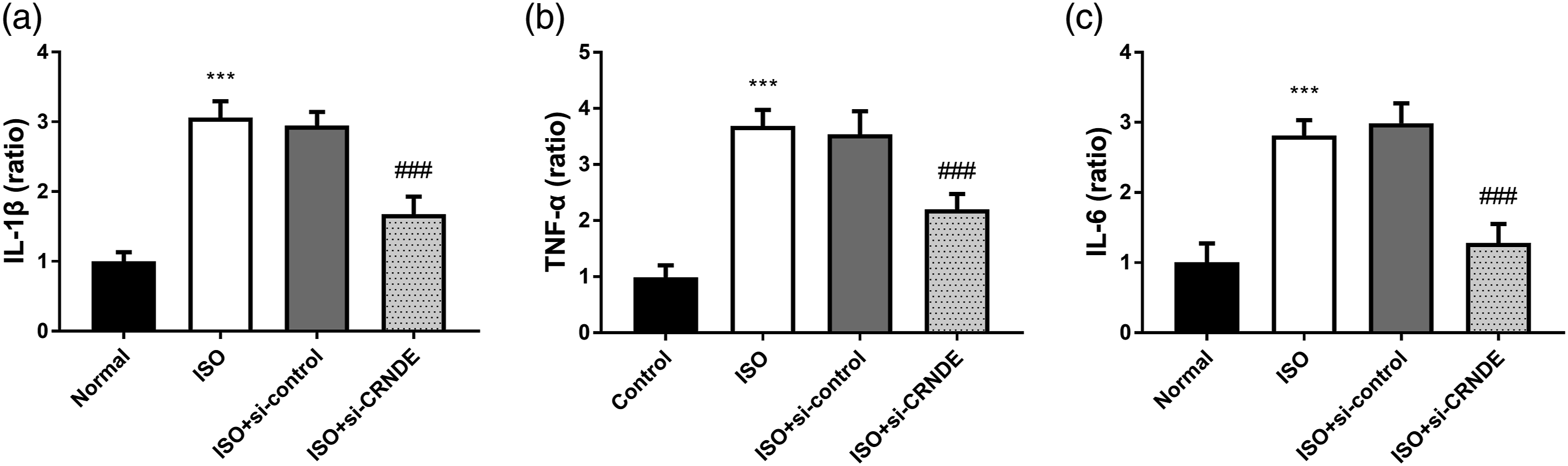
A ceRNA of CRNDE
There was a complementary binding site between miR-212-5p and CRNDE gene 3′ complementary UTR and miR-206 and CRNDE could target binding (Figure 4(a)). The luciferase activity was increased after transfection of wild-type CRNDE gene expression vector WT-3′UTR and miR-212-5p inhibitor, while the luciferase activity was not significantly promoted after transfection of mutant CRNDE gene expression vector (p < 0.001, Figure 4(b)). (a) Complementary binding sequence of miR-212-5p and CRNDE. (b) Luciferase activity in different groups. ***p < 0.001, relative to normal group.
CRNDE manipulated ISO damage via abrogating miR-212-5p expression
The expression level of CRNDE was detected after the knockdown of CRNDE in ISO models. The result was the same as the reporter gene experiment, silenced CRNDE could ameliorate the decreased miR-212-5p expression in the ISO rats (p < 0.001, Figure 5(a)). Then, the cotransfection of si-CRNDE and miR-2125-5p antagomir to ISO models suppressed the expression change of miR-212-5p induced by ISO and silenced CRNDE (p < 0.01, Figure 5(b)). The absence of miR-212-5p altered the NSS level in the ISO-si-CRNDE, pinpointing that CRNDE might regulate the ISO-damaged cognition via sponging miR-212-5p (p < 0.01, Figure 5(c)). (a) ISO inhibited the expression of miR-212-5p, but this trend was reversed by the elimination of CRNDE. (b) Injection of miR-212-5p antagomir and si-CRNDE reversed the expression of miR-212-5p in the ISO + si-CRNDE group. (c) MiR-212-5p destroyed the function of CRNDE on NSS. ***p < 0.001, relative to normal group; ###p < 0.001, relative to ISO group; &&p < 0.01, relative to ISO + si-CRNDE group. ISO: isoflurane.
The mediated roles of miR-212-5p were reflected by the following findings. Disruption of miR-212-5p impeded the beneficial function of CRNDE on learning and memory abilities, which boosted escape latency, attenuated times of rats across the target platform, and diminished the platform spend time (p < 0.01, Figure 6(a) to (c)). Elimination of miR-212-5p exaggerated the leakage of pro-inflammatory cytokines (p < 0.01, Figure 6(d) to (f)). (a–c) The finding of Morris water maze test certified that miR-212-5p was involved in the cognitive repair. (d–f) MiR-212-5p promoted the inflammatory response in the ISO + si-CRNDE group. &&&p < 0.001, &&p < 0.01, relative to ISO + si-CRNDE group. ISO: isoflurane.
Discussion
Inhalation anesthetics are widely used in clinical anesthesia, especially in pediatric anesthesia. 14 The neurotoxicity of inhaled anesthetics to surgical patients is one of the hot issues in clinical anesthesia at present, which is mainly manifested as POCD, neurodegenerative lesions of thalamus neurons, and decreased learning ability.15,16 The immature brain is the critical period of neural development. Animal experiments have shown that inhaled anesthetics can cause varying degrees of damage to the immature brain, resulting in cognitive learning dysfunction. 17 The hippocampus is differentiated by the mesocortex and is recognized as an important brain area in cognitive memory learning. 18 The gene changes in the hippocampus during the critical developmental period caused by inhaled anesthetics are the key factors leading to cognitive learning impairment. LncRNA is a non-coding molecule RNA found in recent years, which is involved in the regulation of life activities. The abnormal change of lncRNA in the hippocampus is the key factor of neonatal cognitive learning impairment caused by inhaled anesthetics.
LncRNA Neat1 Aggravated the neurotoxicity led by volatile anesthetic by accelerating the inflammatory generation. 19 LncRNA MEG3/miR-7-5p pathway is molecular regulation of cognitive disability triggered by ISO. 20 One of the important members of the lncRNA family recently discovered by CRNDE plays an extremely important role in cell growth, apoptosis, inflammation, immune regulation, and tumorigenesis. Recent publications have found that CRNDE is related to the regeneration of nerve injury. CRNDE can regulate the differentiation of neurons. 21 CRNDE overexpression accelerates histopathological injury and apoptosis in the hippocampus. 13 In this investigation, the ISO led to the overexpression of CRNDE and elevated NSS levels in rats and the inhibition of CRNDE suppressed the increased NSS exerted by ISO, indicating ISO might contribute to the alternation of CRNDE and CRNDE could mediate cognitive and learning ability. Morris water maze test is a classical route to test the spatial cognition and memory ability of animals. 22 The escape latency was elevated by ISO treatment and ISO management decreased the times across the target place and time spent on the target platform, suggesting that ISO anesthesia could cause cognitive dysfunction in rats. The insufficient CRNDE expression impeded the adverse cognitive effect of ISO on rat models, elucidating that CRNDE expedited the cognitive dysfunction.
Anesthetic drugs have certain effects on body metabolism, which can lead to inflammatory response. Publications have certified that inflammation is a potential mechanism of cognitive lesion irritated by ISO. 23 MEGA facilitates the neurotoxicity elicited by ISO through accelerating inflammatory imbalance. 20 H19 exacerbates the neuroinflammatory infiltrate under ISO circumstances, thus increasing the risk of cognitive disability. 12 In regards to this study, the rats subjected to ISO management exhibited a high inflammatory response, depicting the damage of ISO on neuroinflammation. The disruption of CRNDE exerted a repressive function on inflammatory disorders evoked by ISO, reflecting that CRNDE might improve the worsening of neurotoxicity of ISO through expediting inflammatory activators. The interconnections of CRNDE with inflammation are reflected by many researchers. CRNDE as an alternative factor promotes inflammation in alcoholic liver disease. 24 In the case of sepsis, upregulation of CRNDE distinctly aggrandizes the expression of pro-inflammatory indicators. 25 Together, CRNDE was an activator of inflammatory response.
Considering the ceRNA hypothesis, whether CRNDE could act as a molecular sponge for a miRNA to exert its biological effects had been verified. Database prediction discovered that miRNA binding existed in the vicinity of the predicted binding site of CRNDE. We further confirmed that miR-212-5p binds to CRNDE and CRNDE could inhibit miR-212-5p expression by using luciferase reporter assay and qRT-PCR assay. The same target correlations were verified in acute myeloid leukemia and delayed encephalopathy after poisoning.13,26 miR-212-5p exerts a preventive role in ISO-steered cognitive lesion by suppressing neuroinflammation, punctuating its significance on learning ability. 27 MiR-212 ameliorates neural damage in Parkinson’s disease, manifesting the neuroprotective roles of miR-212-5p. 28 The results of this investigation validated that intervention of miR-212-5p destroyed the protective roles of silenced CRNDE on learning ability and inflammatory recovery.
ISO inhalation anesthesia could decrease the cognitive function of rats, and its mechanism might be related to promoting the activation of inflammation and aggravating spatial learning disability. Downregulation of CRNDE could improve learning and memory ability and meliorate inflammatory stress which was damaged by ISO in rats. MiR-212-5p mediated the impacts of CRNDE on ISO-steered damage in rats.
Footnotes
Declaration of conflicting interests
The author(s) declared no potential conflicts of interest with respect to the research, authorship, and/or publication of this article.
Funding
The author(s) received no financial support for the research, authorship, and/or publication of this article.
Ethics approval
All animal protocols were performed under the approval of Ethics Committee of Minda Hospital of Hubei Minzu University (No. 2021-158).
