



Abstract
Aim of the work:
This prospective study was conducted to evaluate the clinical reliability of N-terminal fragment of proB-type natriuretic peptide (NT-proBNP) in identifying patients with cardiotoxicity in the early hours following scorpion sting.
Subjects and methods:
This study involved 483 children aging between 2–17 years who were admitted to Minia University Poisoning Control Center from 1st January 2010 to 31st December 2019 with a history of scorpion sting, and on clinical evaluation symptoms were manifested. All subjects were clinically examined, investigated for NT-proBNP and CPK-MB on admission, 6 h and 24 h post-envenomation; and subjected to 24 h cardiac monitoring with periodic ECG every 6 h.
Results:
Assessment of CPK-MB levels showed a significant increase in all moderate to severe cases 6 h post-envenomation. Assessment of NT-proBNP levels showed a significant increase in all moderate to severe cases on admission and 6 h post-envenomation. Moreover, there was a significant decrease in the NT-proBNP level after 24 h compared with that measured on admission. The sensitivity of NT-proBNP for the diagnosis of myocardial injury at hospital admission was significantly higher than that of CPK-MB.
Conclusion:
NT-proBNP may be a valuable and sensitive laboratory biomarker to predict cardiotoxicity of scorpion sting in the early hours.
Introduction
Scorpion envenomation and its consequences represents a serious healthcare problem in Upper Egypt and is considered to be an important cause of life-threatening emergency particularly in children. Due to their innocent and explorative nature, children are frequent victims. However, given their small size, infants are at risk for severe autonomic dysfunction, multisystem organ failure, and even death, but the majority of stings cause only a painful local reaction. 1
The overall mean mortality rate is 2%, but among children it is 20%. 2 In addition, it has been reported that, in Minia, animal envenomation represents 22.2% of all intoxicated children who were received at Minia Poisoning Control Center (PCC) during the period from the 1st of July 2004 to the 30th of June 2009. 3
Both adrenergic and cholinergic symptoms occur; hypertension, tachycardia, seizures and hyperglycemia, and salivation, lacrimation, urination, defecation, and emesis, also occur respectively. 4
Scorpion venom is a potent sodium channel activator 5 and results in sudden pouring of endogenous catecholamines into circulation due to the autonomic storm evoked by delayed inactivation of neuronal sodium channels. The cardiovascular and respiratory systems are the most affected ones and their degree of commitment will determine morbidity and mortality. Vomiting, profuse sweating, priapism in males and cold extremities precede the development of severe cardiovascular manifestations. 6
B-type natriuretic peptide is a vasoactive peptide which is primarily synthesized by the ventricular myocardium. It acts as a key regulator in the homeostasis of water and salt excretion and in the maintenance of blood pressure, mainly by inhibiting the renin-angiotensin-aldosterone-axis and blocking the cardiac sympathetic nervous activity. Its synthesis and secretion as pro-BNP are activated by myocyte stretch. In this process, it splits into physiologically active BNP and the N-terminal fragment (NT-proBNP). Both are considered to be valuable biomarkers in clinical practice for the prediction of disease state and prognosis in patients with suspected heart failure. 7 –10
The aim of this study is to evaluate the clinical reliability of using NT-proBNP in identifying patients with cardiotoxicity in the early hours following scorpion sting. The current study involves children aging between 2–17 years who were admitted to Minia University Poisoning Control Center, from 1st January 2010 to 31st December 2019, with a history of scorpion sting and on clinical evaluation symptoms were manifested.
Subjects and methods
This current study was conducted on 1829 children aging between 2–17 years old who were admitted to Minia University Poisoning Control Center during the period from January; the 1st, 2010 to December, the 31st, 2019 with a history of scorpion sting and on clinical evaluation they had been found to have manifestations.
Clinical evaluation
Inclusion and exclusion criteria: All subjects had: An alleged history of scorpion sting. Symptoms and signs of envenomation were either local or systemic. The clinical severity of each case was evaluated using Abroug’s classification
11
: Class I (Mild): local signs including local pain, erythema and paresthesia restricted to the sting area. Class II (Moderate): shivering, fever, excessive sweating, nausea, vomiting, diarrhea, hypertension and priapism. Class III (Severe): cardiovascular, respiratory or neurological symptoms (such as cardiogenic shock, pulmonary edema, altered consciousness and convulsive crisis).
Patients who were out of the age range or with a delay time more than 3 h were excluded. In addition, children with a history of renal, hepatic or cardiac diseases and patients on non-steroidal anti-inflammatory drugs were excluded. Using the inclusion and exclusion criteria, only 483 of children became eligible for the study.
It is to be mentioned that from the 344 excluded cases, 63 cases were out of age range (3.44%). Exclusion of the children under the age of 2 years old was based on the finding that the Egyptian children who are more likely to be anemic are those under the age of 2 years. 12 In addition, 137 children (9.46%) were with a delay time more than 3 h, 14 (0.77%) with a history of renal disease, 27 (1.48%) with hepatic disease, 42 (2.3%) with cardiac disease, and 61 (3.3%) on non-steroidal anti-inflammatory drugs.
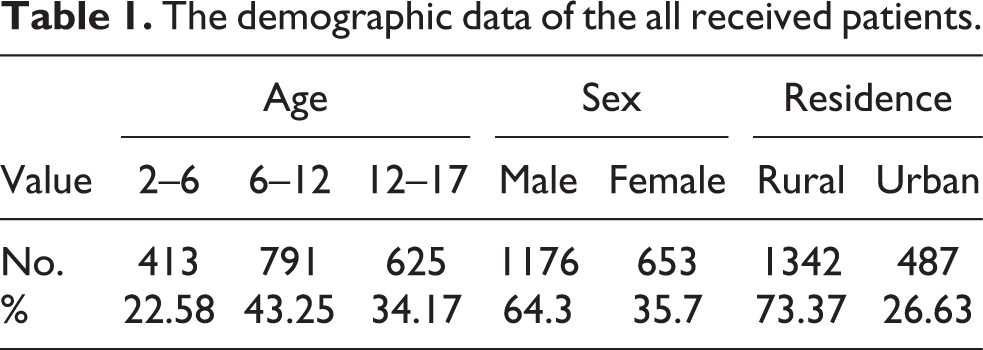
The demographic data of the all received patients are plotted in Table 1. From the studied 1829 cases, only 483 ones (26.41%) were involved in the current study while the rest were excluded. The excluded cases were divided into 2 types: Type I [cases who had a sting(s) but not envenomated and no manifestations were reported in a period of 6 h of close observation, i.e. “cold sting” (1012 cases: 55.33%)] and Type II [cases who have a sting(s) and clinically overt but did not met the inclusion criteria (334 cases: 18.81%)]. This means that only 44.67% of all cases were clinically ill (Table 2, Figure 1).
The demographic data of the all received patients.
Clinical evaluation of the studied cases.


Clinical evaluation of the studied cases.
All subjects were examined thoroughly for cardiotoxicity. It was assessed by heart rate, blood pressure and ECG monitoring for dysrhythmias. The diagnosis of myocardial injury (myocarditis) was confirmed with strain echocardiography (The delay between the admission and the realization of the echocardiography was 4–6 h). A strain echocardiography was performed by the same manipulator. It is to be mentioned that we used this method as it is cheap, available in our hospital, proved to be able to detect subtle functional changes that are not revealed by standard echocardiography, 13 and that cardiac MRI is not available in our hospital.
Biochemical analyses
Measurement of NT-proBNP:
Three blood samples were taken for each patient: on admission, 6 and 24 h post-envenomation. Prior to the third sampling, patients completed a 24 h fasting except for taking their regularly prescribed medications. Blood samples were drawn into chilled tubes containing EDTA; plasma was aliquoted and stored at –20°C. The Roche Diagnostics Elecsys NT-proBNP electrochemiluminescence immunoassay (Elecsys proBNP, Roche Diagnostics, Indianapolis, Indiana) was used. The assay range is 5 to 35000 pg/mL. Levels higher than 35000 were recoded as 35000 pg/mL. The intra-assay and inter-assay coefficients of variation ranged, respectively, from 1.8% and 2.3% at NT-proBNP concentrations of 4962 pg/mL to 2.7% and 3.2% at NT-proBNP concentrations of 175 pg/mL. The biochemist that ran the assays was blinded to the clinical presentation and electrocardiographic results. 14 Reference values of NT-proBNP serum levels in our laboratory were <100 pg/ml. The results of the analyses were obtained 3–5 days after sample withdrawal due to the economic policy of the hospital.
Serum CPK-MB isoenzyme:
All subjects were investigated for CPK-MB on admission, 6 h and 24 h post-envenomation. Immuno-inhibition method (Cat. No 81779. Diagnostics, Italy) was utilized.
Statistical analysis
Data were checked, coded, entered and analyzed by using SPSS (version 17.0 software). Data were expressed as Mean ± SD. Independent t-test; for quantitative data to test significance of differences between the mean values of the study variables for comparison between two groups of the study groups, was used. One-way ANOVA; for quantitative data to test significance of differences between the mean values of the study variables for comparison between study groups, was also used. P value of <0.05 was considered significant.
Results
The majority of the studied cases were moderately intoxicated, while the severe ones were the minority. In addition, it has been reported that there is a negative correlation between the severity of scorpion sting and the age of the victims i.e. the younger the victim the more severe is the clinical presentation (Table 3; Figure 2).
Assessment of scorpion sting severity among the studied cases according to Abroug’s classification and its correlation to age.


The severity of scorpion sting among the studied cases according to Abroug’s classification and its correlation to age.
Cardiotoxic signs (tachycardia, hypo- and/or hypertension, ECG findings, ST segment elevation in leads II, III, aVF, V5 and V6) were reported in the moderate to severe cases which represented 75.77% of all manifested cases. It is to be mentioned that the reported ECG changes were evident after 6 h post-envenomation.
The diagnosis of myocardial injury was confirmed with a strain echocardiography which reported a significant wall motion abnormalities and decreased ejection fraction. This procedure was performed in the moderate to severe cases (366 cases: 75.77%). From the 366 imaged cases, 211 cases (57.65%) showed abnormal findings.
Assessment of CPK-MB levels showed a significant increase in all moderate to severe cases 6 h post-envenomation when compared with the reference values of our laboratory (student-t test; p < 0.001). In addition, there was a significant decrease in the CPK-MB level after 24 h when compared with that measured on admission (student-t test: p < 0.001) (Table 4).
Values of CPK-MB and NT-proBNP (mean ± SD) and the correlation of these values to the reported ECG changes.

Assessment of NT-proBNP levels showed a significant increase in all moderate to severe cases on admission and 6 h post-envenomation when compared with the reference values of our laboratory (student-t test; p < 0.001). Furthermore, there was a significant decrease in the NT-proBNP level after 24 h when compared with that measured on admission (student-t test; p < 0.001) (Table 4).
The sensitivity and specificity of CPK-MB for the diagnosis of myocardial injury at hospital admission were 29.1% and 100%; respectively, while NT-proBNP showed sensitivity and specificity of 46.2% and 100%; respectively. The sensitivity of NT-proBNP was significantly higher than that of CPK-MB (P < 0.001), however there was no statistical difference as regarding the specificity of both.
After the initial 6 h following the onset of sting, another analysis showed that the sensitivity and specificity of CPK-MB for the diagnosis of myocardial injury were 59.61% and 97.83%; respectively, and the sensitivity and specificity of NT-proBNP were 77.37% and 97.2%; respectively, with significant statistical increase in NT-proBNP sensitivity than that of CPK-MB (P < 0.001).
NT-proBNP was found to have a higher negative predictive value when compared with that of CPK-MB. The negative predictive values of NT-proBNP and CPK-MB were 75.12% and 63.31% respectively
In addition, there was a negative predictive correlation between the measured NT-proBNP and the reported abnormal strain echocardiography for both 6 h and 24 h samples (P-value < 0.002). On the other hand, there was a negative predictive correlation between the measured CPK-MB and the reported abnormal strain echocardiography for only the 24 h samples (P-value < 0.001).
The results of the current study revealed that there was no significant correlation between the age of the patients and the values of CPK-MB and NT-proBNP (P-value < 0.051). Moreover, correlating these values to the clinical severity of the patients revealed a negative correlation, i.e. the more severe the clinical presentation the more increased biochemical changes (P-value < 0.001). Finally, there was a negative correlation between the biochemical changes and the length of hospital stay i.e. the increased the biochemical changes, the shorter the length of hospital stay (P-value < 0.001).
Discussion
Scorpion sting envenomation is a life-threatening emergency and a common public health problem in many regions of the world, particularly in children. Children are at greater risk of developing severe cardiac, respiratory, and neurological complications. 15
Given that, in Minia, animal envenomation represents 22.2% of all intoxicated children who were received at Minia PCC during the period from the 1st of July 2004 to the 30th of June 2009, 3 and that clinical assessment of the patients of this study revealed that the cardiovascular manifestations came in the third rank in the reported clinical presentations, the current study was conducted to evaluate the clinical reliability of NT-proBNP in identifying patients with the cardiotoxicity in the early hours following scorpion sting.
It is to be mentioned that the identification of the causative organism is nearly impossible. However, Androctonus crassicauda, Androctonus australis, Buthus mmox, Buthus occitanus, and Leiurus quinquestriatus are the most important lethal scorpion species in the Middle East. In Egypt, scorpion (Androctonus amoreuxi) is commonly found. 16
Results of the current study revealed that children were much more subjected to scorpion sting than adults, males (1176 cases: 64.3%) were more than females (653 cases: 35.7%), and rural areas (1342 cases: 73.37%) were more than urban ones (487 cases: 26.63%). These findings are compatible with many previous studies. 17 –20 These findings were logic and were expected as animal envenomation tends to occur in the rural communities rather than the urban ones.
In addition, it was reported that the cold stings constitute 55.33% of all received children with alleged history of scorpion sting which is contradicting with many other studies that reported that most; if not all, of their patient suffers intoxication. 21,22 This may be due to the fact that such studies covered different geographic areas with species different from the Egyptian ones.
Using Abroug’s classification, it was found that the majority of the studied cases were moderately intoxicated (272 cases: 56.31%), while the severely intoxicated ones were the minority (91 cases: 18.84%). The reported clinical presentation of the present study is in contradiction to a recent study conducted by Ahmed et al., 23 who reported that out of the 45 studied victims, 35 children (78%) showed signs of severe envenomation, while 10 victims (22%) showed signs of mild envenomation.
The reported cardiotoxic signs (tachycardia, hypo- or hypertension, ECG findings; ST segment elevation in leads II, III, aVF, V5 and V6) in the moderate to severe cases which represented 75.77% of all manifested cases are in agreement with Dudin et al., 24 who reported that from 54 children of Jerusalem area who were studied prospectively following scorpion envenoming, severe symptoms (convulsions, brain oedema, shock, respiratory distress and myocarditis) were encountered in 19 cases. Respiratory distress was the main feature in 17 of the children; in two cases owing to pulmonary oedema and in a third one because of adult respiratory distress syndrome and myocarditis. 24
Regarding the sensitivity and specificity of CPK-MB and NT-proBNP, the reported data revealed that those of NT-proBNP were significantly higher than those of CPK-MB for the diagnosis of myocardial injury in the initial 6 h after the onset of sting. This is supported by the findings of Sagarad et al., 25 who concluded that the NT-proBNP levels were significantly elevated in myocarditis which occurred after a scorpion sting envenomation. Further recent support came from Gökay et al., 26 who reported early elevation of NT-proBNP values in the scorpion sting related myocarditis.
The superiority of NT-proBNP over CPK-MB could be explained by the fact that in myocardial injury, CPK–MB increases in serum within 3 h to 6 h; the peak levels occur between 16–30 h and return to normal by 24 h to 36 h; a time-consuming process. 27 On the contrary, it was proved that NT-proBNP was affected early in the course of myocardial injury. 28 Unfortunately, CPK–MB is the routine and available investigation that is carried out to assess myocardial injury in Minia University Hospital.
On the other hand, the results of the current study revealed that there was no significant correlation between the age of the patients and the values of CPK-MB and NT-proBNP. This could be explained by the small size of the sample. In addition, the reported negative correlation between the biochemical changes and the length of hospital stay, i.e.; the more increased the biochemical changes, the shorter the length of hospital stay, could be explained by the earlier discovery of the diagnosis of the heart injury and the earlier aggressive medical intervention.
The exact mechanism(s) of the reported decrease of NT-proBNP levels 24 h post envenoming when compared with those on admission is unclear and is not the concern of this study. However, many factors could be claimed to be the cause of such as the improvement of LV strain, hemodynamic stability, improvement of the inflammatory syndrome, dysrhythmias control, and the drugs used as regular medical intervention cannot be excluded. In our opinion, it is a multifactorial issue that necessitates conducting other researches aiming at exploring the exact mechanism(s) of such improvement.
Conclusion
Basing on the results of the present study, it could be concluded that NT-proBNP may be a valuable and sensitive laboratory biomarker to predict cardiotoxicity of scorpion sting in the early hours. The earlier discovery of the diagnosis of the heart injury and the earlier aggressive medical intervention from the start may improve the prognosis and could decrease the length of the period of hospital stay. Larger multicenter studies are still needed to verify this possible conclusion.
Footnotes
Declaration of conflicting interests
The author(s) declared no potential conflicts of interest with respect to the research, authorship, and/or publication of this article.
Funding
The author(s) received no financial support for the research, authorship, and/or publication of this article.
