




Abstract
Background:
Toxicology in Malaysia has experienced rapid development and made great progress in education and research in conjunction with economic development in Malaysia over the past two decades.
Objectives:
The main objectives of this study were to analyse the research originating from Malaysia and published in toxicology journals and to examine the authorship pattern and the citations retrieved from the Scopus database.
Methods:
Data from 1 January 2003 till 31 December 2012 were searched for documents with specific words in the toxicology field as a ‘source title’ and Malaysia as an affiliation country. Research productivity was evaluated based on a methodology we developed and used in other bibliometric studies by analysing: (a) total and trends of contributions in toxicology fields between 2003 and 2012; (b) Malaysian authorship pattern and productivity; (c) collaboration patterns; (d) journals in which Malaysian researchers publish; (e) the classification of journals to Institute for Scientific Information (ISI) or non-ISI; (f) impact factors (IFs) of all publications; and (g) citations received by the publications.
Results:
In total, 290 documents were retrieved from 55 international peer-reviewed toxicology journals. The quantity of publication increased by around 10-fold from 2003 to 2012. The h-index of the retrieved documents was 20. Of the 55 journal titles, 42 (76.4%) have their IF listed in the journal citation reports 2012. Forty-two documents (14.5%) were published in journals that had no official IF. The total number of citations, at the time of manuscript writing (5 August 2013), was 1707, with a median (interquartile range) of 3 (0–7). Malaysia collaborated mostly with countries in the Asia-Pacific regions (18.3%), especially India and Japan, followed by the Middle East and Africa (10.0%), especially Palestine and Yemen.
Conclusion:
The present data show a promising rise and a good start for toxicology research activity in Malaysia. The sharing of relevant research questions by developed and developing countries can lead to research opportunities in the field of toxicology.
Introduction
Toxicology in Malaysia has experienced rapid development and made great progress in education and research in conjunction with economic development in Malaysia over the past two decades. 1 During the last decade, several specialties have computed and analysed the outcome of their scientific output from Malaysia. 2 –4 In contrast, the evolution of scientific productivity in the field of toxicology has been poorly explored to date, and there are few internationally published reports on research activity in toxicology. 5 –9 To the best of our knowledge, there is a lack of data concerning the evaluation of research productivity in toxicology originating from Malaysia.
Bibliometric studies are increasingly being used for research assessment. They involve the application of statistical methods to scientific publications to obtain bibliographics for each country. 10 These methods are mainly quantitative and are also used to make pronouncements about qualitative pictures of scientific activities. 10,11 Scientific progress is one of the most important indicators for the community and economic development of different countries. 12 There are some well-known databases, such as Scopus, Web of Science (i.e. Thomson Reuters Institute for Scientific Information (ISI)), PubMed, and Google Scholar for indexing international publications in biomedical sciences. 13
The objective of this study was to analyse research originating from Malaysia and published in toxicology journals and to examine the authorship pattern and the citations retrieved from the Scopus database. A 2010 report published by the Ministry of Science, Technology and Innovation, Malaysia, found that the total number of Malaysian-authored science and technology publications as indexed in Scopus from the earliest date of 1909–February 2009 was 54,124. From 2001 to 2009, there were 22,276 Malaysian publications listed in Scopus. 14 Scopus was used as the data source because it provided wide coverage of 41 million records and covers nearly 18,000 titles from 5000 publishers worldwide and provides 100% Medline coverage. 15
Bibliometric analysis is a useful tool to obtain information about the current state of research in particular areas and allows researchers to identify and undertake new lines of research. 16 Such a study will lead to a better understanding of the current and future status of toxicology in Malaysia. Furthermore, the results of the study will help health policymakers and people in academia to shape up toxicology research in the next decade. In addition, the momentum of research activity needs to be maintained through continuous analysis of publications from researchers in the region to provide feedback to academics, health institutions, and education planners.
Methods
This study obtained data from Scopus that were published from 1 January 2003 till 31 December 2012. It was assumed that the last decade would project a better picture on the pattern of publications and the citations received.
The Scopus database was developed by Elsevier, combining the characteristics of both PubMed and Web of Science. These characteristics allow for enhanced utility, for academic needs, medical literature research and citation analysis. Yet, access to the database is not free, although reviewers for numerous Elsevier medical journals are offered to 1 month of free use. 13 The Health Inter Network Access to Research Initiative (HINARI) also provides access to different database sources like Scopus. HINARI was developed by the World Health Organization, and its publisher partners to support the health sector in developing countries by enabling access to high quality, timely and relevant scientific information at affordable prices. 17,18 Scopus offers a basic search, a quick search, an author search, an advanced search and a source search. In the basic search, the results for the chosen keywords can be limited by the date of publication, by addition to Scopus, by subject area and by document type, whereas the author search is based only on author names. 13 The search results in Scopus can be displayed as a list of 20–200 items per page, and documents can be saved to a list and/or exported. The results can be refined by document type, source title, author name, year of publication and/or subject area, and a new search can be initiated within the results. The citation analysis that Scopus achieves is obtained as a table with numbers of cited articles for individual years, as well as the total number of cited references for all years. 13
The keywords entered in Scopus to accomplish the objective of this study were ‘Toxicology’, ‘Toxicological’ and ‘Toxic’, ‘toxicon’, ‘toxin’, ‘toxins’, ‘ecotoxicology’, ‘nanotoxicology’ and ‘neurotoxicology’ as ‘Source Title’. Then, Malaysia was entered as the affiliation country. Subject areas selected for this research were: health sciences, life sciences, social sciences and physical sciences. The resultant search was as follows: Your query:(SRCTITLE(toxicology) OR SRCTITLE(toxicological) OR SRCTITLE(toxic) OR SRCTITLE(toxicon) OR SRCTITLE(toxin) OR SRCTITLE(toxins) OR SRCTITLE(ecotoxicology) OR SRCTITLE(nanotoxicology) OR SRCTITLE(neurotoxicology) AND AFFILCOUNTRY(Malaysia)) AND PUBYEAR > 2002 AND PUBYEAR < 2013.
The collated data were used to generate the following information: (a) total and trends of contributions in toxicology fields between 2003 and 2012; (b) Malaysian authorship pattern and productivity; (c) collaboration patterns; (d) journals in which Malaysian researchers publish; (e) the classification of journals to ISI or non-ISI and (f) the citations received by the publications.
Statistical analysis
Data from Scopus were exported to Excel then to the Statistical Package for Social Sciences (SPSS; SPSS Inc., Chicago, Illinois, USA) program version 15 for analysis. Continuous data are presented as mean ± standard deviation, and categorical data are expressed as numbers with percentages. Variables that are not normally distributed are expressed as median (Q1–Q3: interquartile range). The h-index for the data collected from Scopus is presented. The h-index represents the number of citations received for each of the articles in descending order, and the h-graph measures the impact of a set of documents and displays the number of citations per article. The journal’s impact factor (IF) was evaluated using the Journal Citation Report (JCR; Web of Knowledge) 2012 science edition by Thomson Reuters (3 Times Square New York, NY, USA).
Results
Using the methodology stated, 290 documents were retrieved, which comprised 273 (94.1%) original journal articles; 13 (4.5%) review articles; 2 (0.7%) meeting/conference abstracts and 2 (0.7%) letters, with an average of 29 documents per year from Malaysia. Table 1 shows the annual number of documents published in the past decade, 2003–2012. The results indicated that publications in toxicology journals during the past decade were low in the first few years but showed an obvious doubling after 2008. The quantity of publications increased by around 10-fold from 2003 to 2012. The retrieved documents were published in 55 international peer-reviewed toxicology journals out of 102 peer-reviewed toxicology journals registered in Scopus (Table 2). In total, 33 articles (11.4%) were published in the Bulletin of Environmental Contamination and Toxicology, whereas 25 (8.6%) were published in Food and Chemical Toxicology and 25 (8.6%) were published in Toxicological and Environmental Chemistry. Of the 55 journal titles, 42 (76.4%) had their IF listed in the JCR 2012. Forty-two documents (14.5%) were published in journals that had no official IF (Table 2). Only one document was published in a journal with an IF > 5.
Annual number of toxicology-based publications in Malaysia.

List of journals in which the 290 documents were published based on ranked IFs.

NA: not available; IF: impact factor.
aThe impact factor was reported according to Institute for Scientific Information (ISI) journal citation reports (JCR) 2012.
The total number of citations, at the time of data analysis (5 August 2013), was 1707, with a median (interquartile range) of 3 (0–7). Table 3 presents a list of the 10 most cited articles originating from Malaysia. 19 –29 Furthermore, the total IF was 414.6, with a median (interquartile range) of 1.3 (0.0–2.6). Of the 290 documents considered for the h-index, 20 had been cited at least 20 times at the time of data analysis.
The top 10 cited toxicology articles from Malaysia in Scopus.

SCR: Standard Competition Ranking.
aEqual articles have the same ranking number and then a gap is left in the ranking numbers.
bTime cited at the time of data analysis (5 August 2013).
The study identified 115 (39.7%) documents with 33 countries as Malaysian-foreign collaborations. Malaysia actively collaborated with authors from India (n = 17, highest number recorded), followed by the United Kingdom (n = 13), United States (n = 13), and Japan (n = 13; Table 4). By region, Malaysia collaborated most with countries in the Asia-Pacific region (18.3%), especially India and Japan, followed by the Middle East and Africa (10.0%), especially Palestine and Yemen (Table 4).
Collaborations between MY and foreign countries in toxicological publications.

MY: Malaysia.
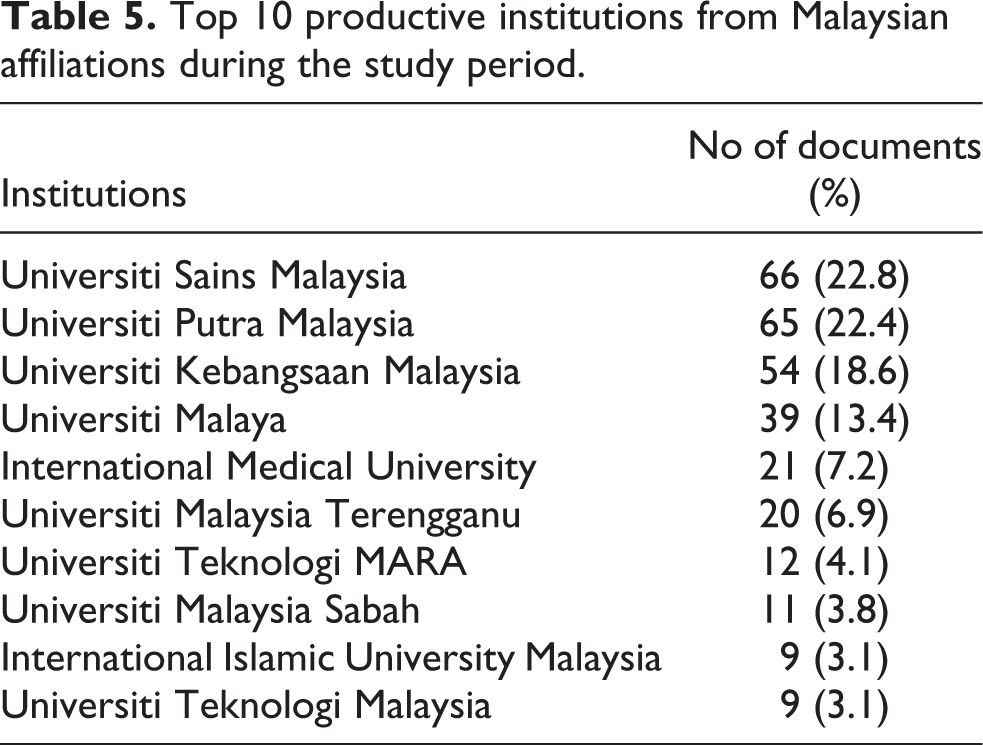
Table 5 shows the top 10 productive institutions in the field of toxicology from Malaysian affiliations. The productive institutions were Universiti Sains Malaysia (22.8% of total publications), Universiti Putra Malaysia (22.4%), Universiti Kebangsaan Malaysia (18.6%) and Universiti Malaya (13.4%). Table 6 shows the top 10 prolific toxicology authors in Malaysia with their affiliations and publications patterns using Standard Competition Ranking.
Top 10 productive institutions from Malaysian affiliations during the study period.
Top 10 prolific toxicology authors in Malaysia with their affiliations and publication patterns during the study period.

SCR: Standard Competition Ranking.
aEqual authors have the same ranking number and then a gap is left in the ranking numbers.
bTotal of all publications for each author during the period of study.
Discussion
Our analysis provides some estimates of research productivity of Malaysia in the field of toxicology during the last decade. This study was limited to 290 documents extracted from Scopus bearing Malaysia as an affiliation address and, therefore, cannot be generalised to toxicology literature covered by other databases such as Google Scholar. However, the study does give a clear picture of the characteristics of Malaysian documents published in foreign channels, especially those indexed by Scopus. Although the number of citations for certain publications might differ from one search engine to another, the Scopus search engine remains one of the best available tools for analysing and tracking citations and comparing citations among different research groups and different institutions. 30 A study that compared PubMed, Scopus, Web of Knowledge, and Google Scholar has found that PubMed remains an important resource for clinicians and researchers, while Scopus covers a wider journal range and offers the capability for citation analysis. 13,30 –32
Based on the authors’ knowledge, this is the first article to analyse the quantity and quality of toxicology-based research from the Asia-Pacific region. Research indicators showed that research activity in this field is promising in Malaysia. The total publications found in Scopus between 2003 and 2012 showed a yearly increase. Falagas et al. documented that this increase might be explained by the fact that economies of these regions are gradually improving; in addition, it may reflect increased research collaborations between countries in these areas and developed countries. 33 Toxicology productivity has followed the general explosion in scientific productivity observed in the last decades and, especially, in recent years. 5,7,34
Bibliometric descriptors for documents published by toxicologists and in toxicology journals are presented in this study. Therefore, it would have been more interesting to know the quality and quantity of the growth of toxicology in Malaysia, as shown in the median citations and IFs. It is noteworthy that Malaysian authors have succeeded in publishing in high-quality journals like the Archives of Toxicology, Toxicological Sciences, and Reviews of Environmental Contamination and Toxicology. Comparing toxicology journals to journals in areas such as molecular biology, where new discoveries are made almost every week, toxicology is a slowly advancing science. 35 Since the field of toxicology is considered a very narrow field with a very small and specialised readership, it is not surprising that toxicology journals have small IFs. 9,35,36
International collaboration may help Malaysian authors to publish in journals with high IFs. Investigators who are open to collaborations and those who seem to adequately manage those collaborations produce a superior product that results in a higher impact and higher citation rates. 37 The factors in favour of increasing international collaborations cannot be ignored; these are the results of easier access to public financing, opportunities to attain higher productivity and aspirations for greater prestige and visibility resulting from collaboration with renowned research groups. 38,39 In addition to these advantages of collaboration, follow-up research expertise of other countries, developed or developing, is another key factor for facilitating applicable and translatable research in countries that historically lack it. The preparation of quality research documents requires significant effort and time. Publishing in high-impact journals allows established researchers to be able to obtain further funding to support collaborative research and young researchers to be more competitive in career advancement. 40
Moreover, Malaysian authors mainly collaborated with authors from India, the United Kingdom, the United States and Japan. This may be because most Malaysian academics pursued their graduate or further training in those countries. Furthermore, regionally, Malaysia collaborated more with countries in the Asia-Pacific region, especially India and Japan. This may be due to Malaysians practising or teaching in universities in Asia-Pacific regions. Furthermore, recently, many PhD students from the Asia-Pacific region pursued their graduate toxicology education in Malaysia, where the concept of toxicology is being emphasised at the research and academic levels.
Institutions of higher learning, both public and private, dominated as the top 10 productive institutions for research publications in the field of toxicology, indicating that institutions of higher learning were actively researching in the toxicology field and were successful in making their contributions visible through Scopus- and ISI-indexed journals. This may be attributed to the emphasis by universities for academics to publish in journals indexed by the Scopus and ISI databases. Information about trends and productivity reveals the intellectual output of toxicology works published in Scopus and is useful to university administrators when evaluating yearly performance of university faculties in the light of university ranking among Malaysian universities. 4 This study shows the most prolific toxicology authors from Malaysia with their affiliations and publication patterns, indicating their active roles as writers. In Malaysian universities, promotional criteria require academics to show their active involvement in research, as reflected by the ranking as the most prolific toxicology authors. Often, the Division of Research and Innovation will be asked by university administrators to provide such evidence and the analysis of the names of productive authors becomes necessary.
To the best of our knowledge, this study is the first of its kind to obtain initial data regarding the publication and citation productivity of Malaysian toxicologist authors in the Scopus and ISI databases, databases that are being used to evaluate the performance of institutes and their members. This study is subject to a number of limitations, most of which are the same as those of studies performed in other biomedical fields. First of all, we used Scopus criteria for including toxicology journals in our study. Documents published in non-Scopus-cited journals were not included, although they might contribute to scientific production. In addition, we searched only journals included in the ‘Toxicology’-related term of Scopus, although many articles in the toxicology field are published in journals other than toxicology journals, with a wider field of interest, such as those in medicine and pharmacology.
Conclusions and recommendations
In conclusion, the results of this study show a promising rise and a good start for toxicology research activity from Malaysia in toxicology journals. Most aspects of toxicology are suitable for regional journals rather than international journals. Thus, Malaysia is recommended to establish peer-reviewed toxicology journals to promote science in the Asia-Pacific region, which could be submitted for indexing in Scopus. For future studies in this direction, it is recommended that similar quantitative and qualitative research analyses, based on the same methodology, should be compiled for the Asia-Pacific region. This would provide a comprehensive picture of this region’s overall research productivity at both the regional level and the international level. Furthermore, we recommend (i) that all toxicologists endeavour to publish their results in toxicology journals with high IFs since, on the whole, the IFs of toxicology journals are lower than other scientific journals; (ii) the Division of Research and Innovation is commencement to be requested to brief management on the yearly citation and publication performance of the university faculty or department in the field of toxicology, so that comparisons can be made with other regional universities and (iii) that the skills in applying bibliometrics to produce reports for management is becoming necessary for the Division of Research and Innovation and should be included in library and information science curricula, either as an elective or integrated in the research methodology courses.
Footnotes
Conflict of interest
The authors declared no conflicts of interest.
Funding
This research received no specific grant from any funding agency in the public, commercial, or not-for-profit sectors.