



Abstract
Purpose:
There is a lack of data concerning the evaluation of scientific research productivity in paracetamol poisoning from the world. The purposes of this study were to analyse the worldwide research output related to paracetamol poisoning and to examine the authorship pattern and the citations retrieved from the Scopus database for over a decade.
Methods:
Data were searched for documents with specific words regarding paracetamol poisoning as ‘keywords’ in the title or/and abstract. Scientific output was evaluated based on a methodology developed and used in other bibliometric studies. Research productivity was adjusted to the national population and nominal gross domestic product (GDP) per capita.
Results:
There were 1721 publications that met the criteria during study period from the world. All retrieved documents were published from 72 countries. The largest number of articles related to paracetamol poisoning was from the United States (US; 30.39%), followed by India (10.75%) and the United Kingdom (UK; 9.36%). The total number of citations at the time of data analysis was 21,109, with an average of 12.3 citations per each documents and median (interquartile range) of 4 (1–14). The h-index of the retrieved documents was 57. After adjusting for economy and population power, India (124.2), Nigeria (18.6) and the US (10.5) had the highest research productivity. Countries with large economies, such as the UK, Australia, Japan, China and France, tended to rank relatively low after adjustment for GDP over the entire study period.
Conclusion:
Our study demonstrates evidence that research productivity related to paracetamol poisoning has increased rapidly during the recent years. The US obviously dominated in research productivity. However, certain smaller country such as Nigeria has high scientific output relative to their population size and GDP. A highly noticeable increase in the contributions of Asia-Pacific and Middle East regions to scientific literature related to paracetamol poisoning was also observed.
Introduction
The terms acetaminophen (used in the United States (US), Canada, other Latin American countries, Hong Kong, Iran and Colombia) and paracetamol (used elsewhere)
1
both derived from chemical names for the compound: para-
Paracetamol (Tylenol®) was first marketed in the US in 1955 by McNeil Laboratories as an analgesic and antipyretic for children. In 1956, the United Kingdom (UK) Company Frederick Stearns & Co. marketed paracetamol as Panadol®, in a 500 mg tablet, and in 1958 they produced a paracetamol containing children’s elixir as a prescribed pain killer and antipyretic. 4 It is now the best-selling analgesic in the US. 7 Although the British medical establishment was initially cautious, in 1963, paracetamol was added to the British National Formulary 8 and as such became more commonly used as an analgesic, especially when phenacetin was banned from the market in the 1970s. 4
Paracetamol has since proven to be a remarkably safe drug at appropriate dosages, making it the antipyretic–analgesic of choice for various conditions. 2 In large doses, paracetamol is capable of causing both hepatic and renal failure. 9–14 The risk of toxicity is primarily assessed by determining the extent of paracetamol exposure from the stated amount ingested and comparing serum paracetamol concentrations to the Rumack–Matthew nomogram. 15 The extent of hepatic and renal injury is later determined by measuring serum liver enzyme activities, prothrombin time, and creatinine concentrations. 16,17
Paracetamol poisoning is on the rise 18–21 and as a multidisciplinary field of study, it has resulted in growing research that takes into account almost all those fields that have experienced the greatest increases in health care science production such as hepatology or clinical toxicology. In contrast, the evolution of scientific output in the field of toxicology has been poorly explored to date, and there are few internationally published reports on research activity in toxicology. 22–28 To the best of our knowledge, there is a lack of data concerning the evaluation of scientific research productivity in paracetamol poisoning from the world. Scientific progress is one of the most important indicators for the community and economic development of different countries. 29 There are some well-known databases, such as PubMed, Scopus, Web of Science (i.e. Thomson Reuters Institute for Scientific Information [ISI]) and Google Scholar for indexing international publications in biomedical sciences. 30 Bibliometric studies are increasingly being used for research assessment. 31 They involve the application of statistical methods to scientific publications to obtain the bibliographics for each country. These methods are mainly quantitative and are also used to make pronouncements about qualitative pictures of scientific activities. 31,32
The objectives of this study were to analyse the worldwide research output related to paracetamol poisoning and to examine the authorship pattern and the citations retrieved from the Scopus database for over a decade. This study will lead to a better understanding of the current and future status of research related to paracetamol poisoning in the world.
Methods
This study relied on data from Scopus database published from 1 January 2003 till 31 December 2012. It is supposed that the last recent 10 years would project the best picture of the pattern of publications and the citations received in research related to paracetamol poisoning. A comprehensive online search was performed using SciVerse, Scopus, which is one of the world’s largest a databases of peer-reviewed literature. Scopus covers nearly 18,000 titles from 5000 publishers worldwide and contains 41 million records and provides 100% MEDLINE coverage. 33
The Scopus database was developed by Elsevier, combining the characteristics of both Web of Science and PubMed. These characteristics allow for enhanced service for educational and academic needs and medical literature research and bibliometric analysis. Scopus offers a basic search, or an advanced search. In the basic search, the results for the chosen keywords can be limited by the date of publication, addition to Scopus, subject area and document type. 30 The search output from Scopus can be presented as a list of 20–200 items per page and extracted documents can be exported to Microsoft Office Excel®. The results can be refined by document type, author name, source title, publications per year and/or subject area, and a new search can be initiated within the results. 30
The MeSH keywords for ‘paracetamol’ from Pubmed have been used for retrieving data from Scopus. The keywords entered in Scopus engine to achieve the objectives of this study were ‘paracetamol’, ‘acetaminophen’, ‘n-acetyl-p-aminophenol’, ‘acetamidophenol’, ‘hydroxyacetanilide’, ‘tylenol’, ‘panadol’, ‘APAP’ and ‘acephen’ as ‘Article Title’. Then, the following keywords: ‘poison’, ‘poisoning’, ‘overdose’, ‘toxicity’, ‘toxic’, ‘toxicology’, ‘overdosing’, ‘toxicities’, ‘acetylcysteine’ were entered as ‘article title, abstract, keywords’. All subject areas were selected for this research: health sciences, social sciences, life sciences and physical sciences during all year to present (2 November 2013). The resultant search was as follows: Your query: (TITLE(paracetamol) OR TITLE(acetaminophen) OR TITLE(n-acetyl-p-aminophenol) OR TITLE(acetamidophenol) OR TITLE(hydroxyacetanilide) OR TITLE(acetamidophenol) OR TITLE(tylenol) OR TITLE(panadol)OR TITLE(APAP) OR TITLE(acephen) AND TITLE-ABS-KEY(poison) OR TITLE-ABS-KEY(poisoning) OR TITLE-ABS-KEY(overdose) OR TITLE-ABS-KEY(toxicity) OR TITLE-ABS-KEY(toxic) ORTITLE-ABS-KEY(toxicology) OR TITLE-ABS-KEY(overdosing) OR TITLE-ABS-KEY(toxicities) OR TITLE-ABS-KEY(acetylcysteine) AND PUBYEAR > 2002 AND PUBYEAR < 2013 AND(EXCLUDE(DOCTYPE, ‘er’) OR EXCLUDE(DOCTYPE, ‘ch’)). We excluded documents that published as erratum or as chapter book.
The collected data were used to generate the following information: (a) total and trends of contributions in worldwide research related to paracetamol poisoning between 2003 and 2012; (b) authorship patterns and research productivity; (c) collaboration patterns and (d) the citations received by the publications.
Ethical approval
Institutional review board (IRB) approval exemptions were obtained by authors from An-Najah National University. The IRB considered waiving the requirement to get approval exemptions for protocols that were clearly below minimal risk, and the current research did not involve any interactions with human participants and it used a secondary data set.
Statistical analysis
Data from Scopus were exported to Microsoft Office Excel® and then transferred to the Statistical Package for Social Sciences (SPSS; SPSS Inc., Chicago, Illinois, USA) program version 15 for analysis. Variables that are not normally distributed such as number of citations are expressed as median (Q1–Q3: interquartile range) and categorical data are expressed as numbers with percentages. The measurements of bibliometric analysis (e.g. countries, authors, cited articles and institutions) were converted to the rank order using the standard competition ranking. We took in our consideration only the 20 top ranked. If the measurements of bibliometric analysis have the same ranking number, then a gap is left in the following ranking numbers. The h-index for the data collected from Scopus is presented. The h-index represents the number of citations received for each of the documents in descending order, whilst the h-graph measures the impact of a set of documents and displays the number of citations per document. The journal’s impact factors (IFs) were evaluated using the Journal Citation Report (JCR; Web of Knowledge) 2012 science edition by Thomson Reuters (New York, NY, USA). Publication activity was adjusted for the top 20 countries categorized by population size and gross domestic product (GDP) retrieved from the online databases of the World Bank,
34
An adjustment index (AI) was calculated using the following formula:

where GDP per capita = GDP/population of the country. 35
Results
Using the methodology stated above, 1721 documents were retrieved comprising 1283 (74.5%) original journal articles, 179 (10.4%) review articles, 116 (6.7%) letter to editor and 143 (8.4%) other types of publications such as note or editorial, with an average of 172 documents per year from the world. The annual number of documents published in the past decade (2003–2012) indicates that research productivity related to paracetamol overdose during the past decade was low in the first few years but showed an obvious increase after 2009. The quantity of publications has increased by around twofold from 2003 to 2012 (Figure 1). The language in which the documents were published was dominated by English (n = 1580, 91.8%) followed distantly by French (n = 28), German (n = 22) and Spanish (n = 19).

Total articles included in a bibliometric analysis of worldwide publications related to paracetamol (acetaminophen) poisoning from 2003 to 2012.
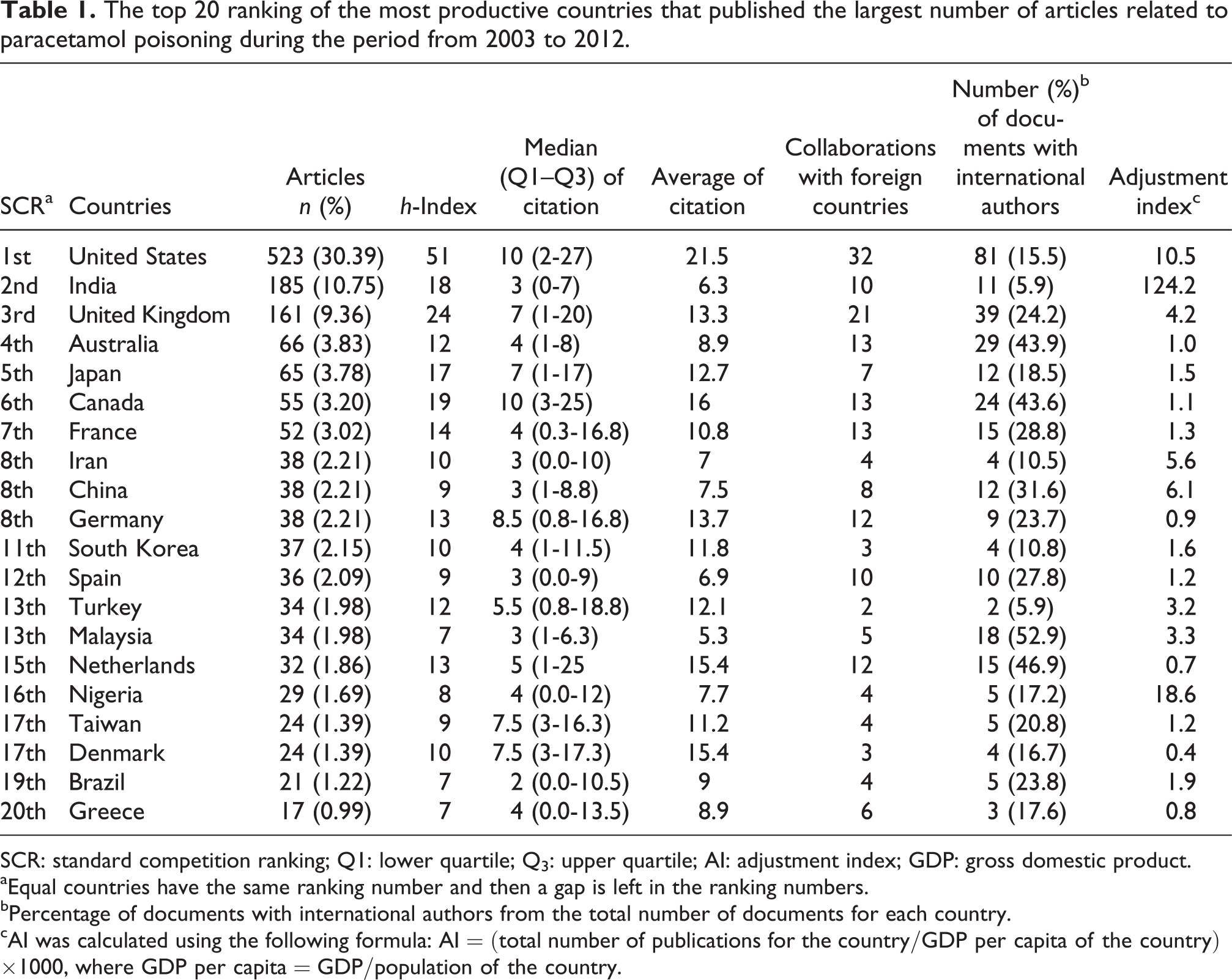
All retrieved documents were published from 72 countries. Table 1 shows ranking list of 20 countries whose researchers published the largest number of articles related to paracetamol poisoning during the period from 2003 to 2012. When the data were analysed by country, the largest number of articles related to paracetamol poisoning was from the US (30.39%), followed by India (10.75%) and the UK (9.36%) (Table 1). After adjusting for economy and population power, India (124.2), Nigeria (18.6) and the US (10.5) had the highest research productivity. Countries with large economies, such as the UK, Australia, Japan, China and France, tended to rank relatively low after adjustment for GDP over the entire study period (Table 1).
The top 20 ranking of the most productive countries that published the largest number of articles related to paracetamol poisoning during the period from 2003 to 2012.
SCR: standard competition ranking; Q1: lower quartile; Q3: upper quartile; AI: adjustment index; GDP: gross domestic product.
aEqual countries have the same ranking number and then a gap is left in the ranking numbers.
bPercentage of documents with international authors from the total number of documents for each country.
cAI was calculated using the following formula: AI = (total number of publications for the country/GDP per capita of the country) ×1000, where GDP per capita = GDP/population of the country.
The total number of citations at the time of data analysis (15 November 2013) was 21,109, with an average of 12.3 citations per each documents and median (interquartile range) of 4 (1–14). The highest median (interquartile range) number of citations was 10 (2–27) for the US and 10 (3–25) for Canada followed by 8.5 (0.8–16.8) for Germany. The h-index of the retrieved documents was 57 (i.e. 57 documents had been cited at least 57 times at the time of data analysis (15 November 2013)). The highest h-index was 51 for the US, followed by 24 for the UK and 19 for Canada. Furthermore, the highest number of collaborations with international authors for each country was held by the US, with 32 countries, followed by 21 countries for the UK. Furthermore, the highest percentage of documents in collaboration with international authors from the total number of documents for each country was 42.9% for Malaysia, followed by 46.9% for Netherlands, 43.9% for Australia, and 43.6% for Canada (Table 1).
Table 2 shows ranking the top 20 journals in which paracetamol poisoning-related articles from the world authors were published. A total of 51 documents (2.96%) were published in Hepatology, whereas 36 (2.09%) were published in Clinical Toxicology, 35 (2.03%) were published in Toxicological Sciences and 31 (1.80%) were published in Toxicology and Applied Pharmacology. Two journals from the top 20 ranking journal titles had no official IF and not listed in the JCR 2012.
Ranking of the top 20 journals in which articles related to paracetamol poisoning were published from the worldwide with their IFs.

SCR: standard competition ranking; NA: not available; IF: impact factor; ISI: Institute for Scientific Information; JCR: Journal Citation Reports.
aEqual journals have the same ranking number and then a gap is left in the ranking numbers.
bIF was reported according to ISI JCR 2012.
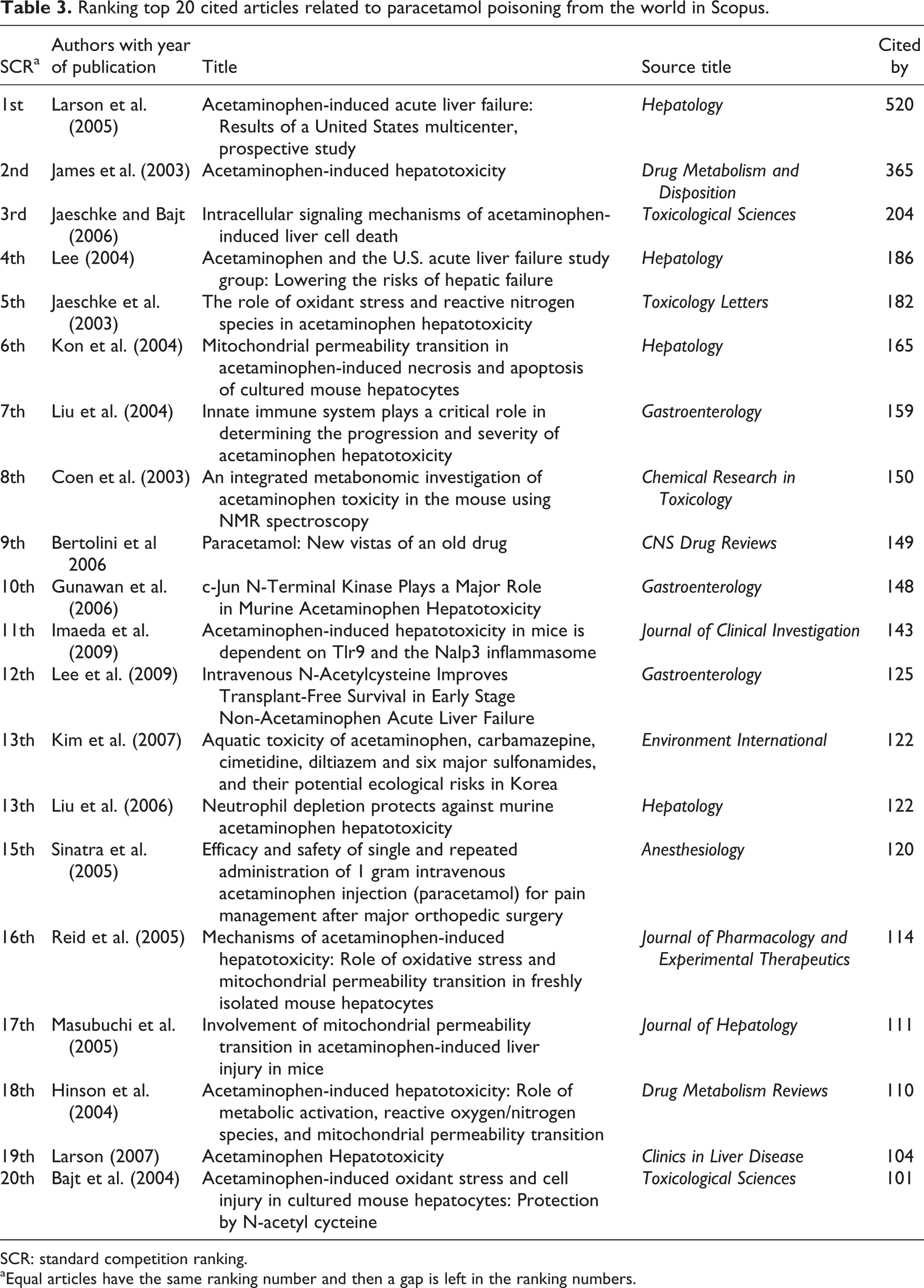
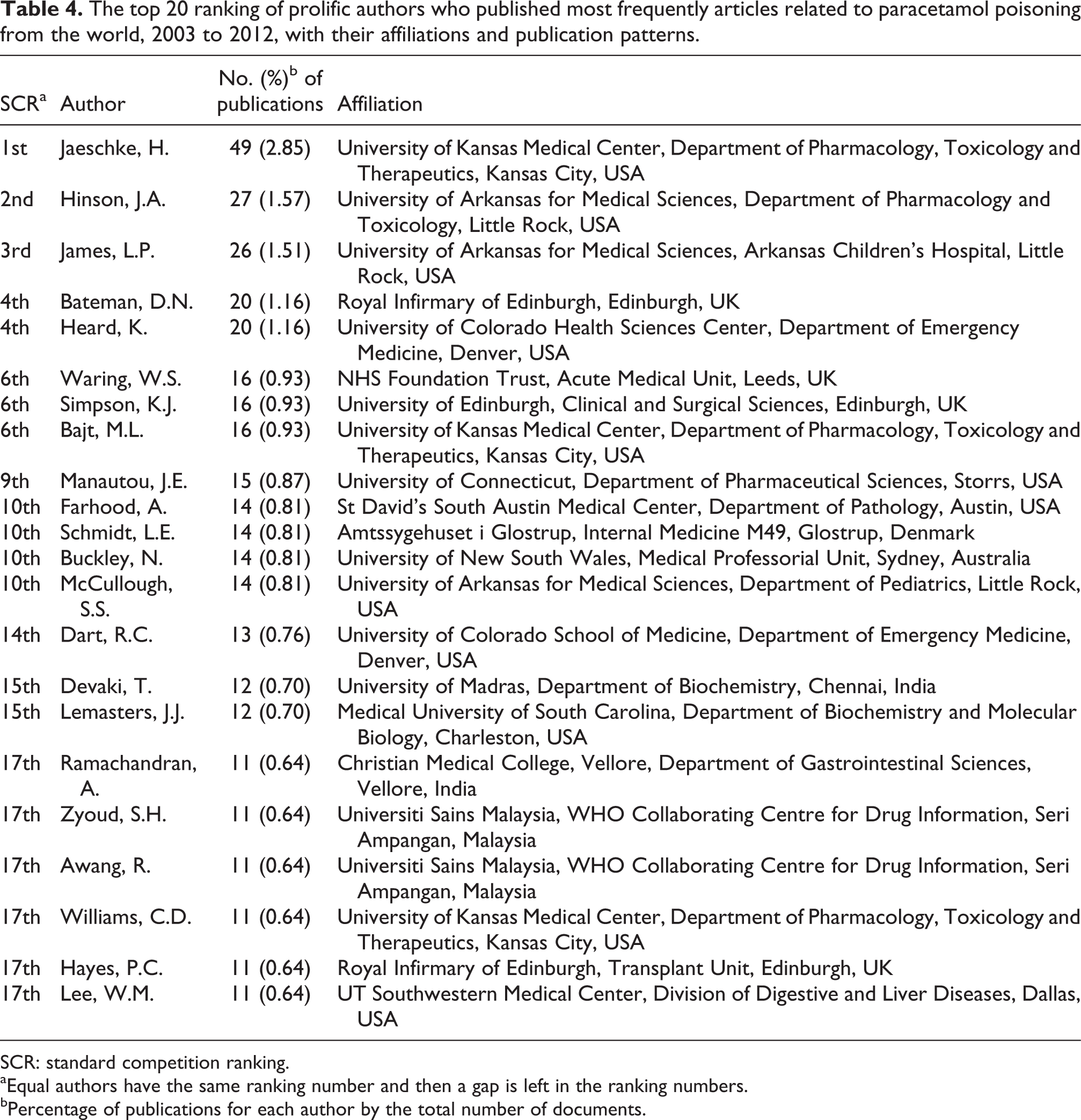
In Table 3, a list of the most cited articles from 2003 to 2012 is shown. Table 4 presents the top 20 ranking of prolific authors who published most frequently articles related to paracetamol poisoning from the world, with their affiliations and publication patterns, those authors have published at least 11 articles during the period of study. Table 5 shows ranking top 20 highly productive institutions that published most frequently related articles to paracetamol poisoning from the world. The most productive institution was University of Kansas Medical Center, USA (2.85% of total publications), followed by Royal Infirmary of Edinburgh, UK (2.50%), and University of Arkansas for Medical Sciences, USA (2.44%).
Ranking top 20 cited articles related to paracetamol poisoning from the world in Scopus.
SCR: standard competition ranking.
aEqual articles have the same ranking number and then a gap is left in the ranking numbers.
The top 20 ranking of prolific authors who published most frequently articles related to paracetamol poisoning from the world, 2003 to 2012, with their affiliations and publication patterns.
SCR: standard competition ranking.
aEqual authors have the same ranking number and then a gap is left in the ranking numbers.
bPercentage of publications for each author by the total number of documents.
Ranking top 20 highly productive institutions that published most frequently articles related to paracetamol poisoning from the world.

SCR: standard competition ranking.
aEqual institutions have the same ranking number and then a gap is left in the ranking numbers.
Discussion
Bibliometric analysis includes a series of visual and quantitative procedures of the communication and utilization of literature to evaluate scientific publications. Bibliometric studies have been applied primarily to reveal the global trends of research within a given topic, field, institute or country. 36,37 Bibliometric analysis remains to be essential in constituting a helpful complement for the opinions and judgements of experts in each field, in revealing a more realistic view of the global trends of research in certain specific discipline, in providing a valuable measure to assess and evaluate the results of the scientific activity, as well as in predicting how the research activity might progress for a given scientific speciality. 38 Our work focused primarily on assessing impact in the field (i.e. through number of publications), the productivity of particular institutions or academic departments, the relative contribution of authors and the utility of various journals to the field of paracetamol poisoning, which is considered as a sub-area of the multidisciplinary field of toxicology. This study was limited to 1721 documents extracted from Scopus, bearing article titles with terms related to paracetamol poisoning and, therefore, cannot be generalised to the paracetamol poisoning literature covered by other databases such as Google Scholar. Although the number of citations for each publication might differ from one search engine to another, the Scopus search engine remains one of the best available databases for analysing and tracking citations and comparing citations to different research groups and different institutions. 39 A study that compared Scopus, Google Scholar, PubMed, and Web of Knowledge found that PubMed is considered an important resource for clinicians and researchers, while Scopus offers the capability for citation analysis and covers a wider journal range. 30,39 –41
The design of the present analysis permitted a worldwide assessment on the growth of scientific publications related to paracetamol poisoning. Based on the authors’ knowledge, this is the first study to analyse the quantity and quality of paracetamol poisoning-based research worldwide. The total publications found in Scopus between 2003 and 2012 showed a yearly increase. The number of scientific papers had increased substantially in recent years (i.e. after 2008). Scientific publications related to paracetamol poisoning have followed the general evolution in scientific research productivity observed in the last decade and especially in the last years. 35,38,42 –46 Another aspect of interest for the current study in relation to the scientific publication related to paracetamol poisoning from the world was to investigate on its research paper quality. To note, 15 journals from the top 20 journals in which articles related to paracetamol poisoning were published from the worldwide carried IFs being greater than 2.00 and having significant impacts in the field of toxicology.
In our study, the average citation rate for paracetamol publications was 12.3 citations per article. This finding was more than the average citations of documents that were published in toxicological journals. 24,26,27,47 This finding means that paracetamol poisoning is still a hot issue in scientific research and may have a larger audience than that of other toxicological aspects. As expected, the US was the most productive country with its researchers being co-authors of 30.39% of all articles. These articles also amassed the largest number of citations (average of citations per document = 21.5). Furthermore, the US also collected the largest number of collaborations with foreign countries during the period of study. We reported that contributions from the ‘rest of the world’ (outside of the US) appeared to increase steadily during the period of study. Specifically, the current data indicated that Turkey and Iran have been the major research contributors from the Middle East, whereas India, China, Japan, South Korea, Malaysia and Taiwan produced the most research articles from the Asia-Pacific region, as well as Nigeria produced the most research articles from Africa region. The 20 most productive countries that were published in paracetamol poisoning includes new nations different from the familiar other scientific productivity ranking. 48
As can be seen in our study, the behaviour of every country in scientific research output is different. Our study showed that there were some countries, such as the US, the UK and India, where the total scientific publications related to paracetamol poisoning output during this 10-year period was obviously higher than the world’s remaining countries. This activity depends on population, socio-economic or overall scientific activity of the country. 22 In our study, the ranking of countries after adjusting for economy and population parameters differed conspicuously from those based on absolute production. After adjusting for economy and population power, India, Nigeria and the US had the highest research productivity. We did not find any study similar to ours, thus we are unable to discuss this point in light of other results. However, some studies using the same tool for analysis have reported similar findings. 43,49 Countries with rapidly growing economies, which results in more funding and investments for research, contribute to the tendency of increasing number of publications regarding paracetamol poisoning. Based on our findings, besides GDP, population size is one of the main factors related to research productivity such as in India. Otherwise, the tragedy story during the summer months of 1990 in Nigeria that resulted in 109 children deaths by paracetamol syrup ingestion 50 may explain why more research has focused on paracetamol poisoning since that time. So, it would have been more interesting to explore how the growth of scientific publications related to paracetamol poisoning in these countries differed in quality rather than in quantity, as shown by the h-index and average or median of citation. The h-index is a good indicator in predicting scientific achievement in future. 51,52 The preparation of quality research documents requires significant effort and time. Publishing high-quality research allows established researchers to be able to obtain further funding to support collaborative work. 27
The number of articles with international collaboration was high. Besides the US, research in paracetamol poisoning in most worldwide countries would benefit from more collaboration with the European region because international collaboration articles with high citations per documents have been co-authored with researchers from these countries. Moreover, most authors collaborated primarily with authors from the US, the UK, Sweden, Switzerland and Spain. The factors in favour of increasing collaborations internationally cannot be neglected; factors include, making the results more easily accessible to public financing, opportunities to achieve higher productivity and citations and aspirations for superior prestige and visibility resulting from collaboration with well-known research groups. 53 –55 In addition to these advantages of collaboration, follow-up research expertise of other countries, developed or developing, is another key factor for facilitating applicable and translatable research in countries that historically lack such research.
To the best of our knowledge, this study is the first of its kind to obtain initial data regarding the publication and citation productivity from the worldwide in paracetamol poisoning in the Scopus database, a database that is being used to evaluate the performance of institutes and their members in certain field. This study is not without limitations, most of which are the same as those of bibliometric studies performed in other biomedical fields. First of all, we used Scopus criteria for including paracetamol-related keywords in our study. Articles published in non-Scopus-cited journals were not included, although they might contribute to scientific productivity in paracetamol poisoning. Another limitation is that some articles did not point out paracetamol and related terms in article titles, however, these terms were mentioned throughout the text. Therefore, it is possible that the number of publications analyzed in this study did not exactly represent all paracetamol poisoning-based research activity.
Conclusion
Our study demonstrates evidence that research productivity related to paracetamol poisoning has increased rapidly during the recent years. The US obviously dominated in research productivity. However, certain smaller countries, such as Nigeria, have high scientific output relative to their population size and GDP. A highly noticeable increase in the contributions of Asia-Pacific and Middle East regions to scientific literature related to paracetamol poisoning was also observed. Research output can be improved by investing in more international collaborative research projects related to paracetamol poisoning. Furthermore, our findings demonstrate that paracetamol poisoning is still a hot issue in scientific research and may have a larger audience than that of other toxicological aspects. Editors and authors in the field of toxicology might usefully promote the submission or work in paracetamol poisoning in the future to improve their and journal’s impact.
Footnotes
Acknowledgements
The authors would like to thank An-Najah National University for giving the opportunities to access most recent information sources such as Scopus database.
Authors’ Note
All authors were involved in drafting the article, and all authors approved the final version to be submitted for publication. SZ conceived of the study conception and design, organised and supervised the data collection and provided analysis, interpretation and writing. SA and WS participated in the study design and provided critical revision of manuscript for important intellectual content.
Conflict of interest
The authors declared no conflicts of interest.
Funding
This research received no specific grant from any funding agency in the public, commercial, or not-for-profit sectors.