




Abstract
Purpose:
Calcium channel blockers (CCBs) were the most common agents associated with a significant morbidity and mortality rate. The main objective of this study was to examine the publication pattern related to CCBs poisoning at the global level using bibliometric analysis of articles published in SciVerse Scopus online database.
Methods:
Data were searched for documents that contained specific words regarding CCB poisoning as keywords in the title. No time period limitations were specified in the search regarding the starting year. The ending date of the search was 31 December 2012.
Results:
The criteria were met by 713 publications from 53 countries. The largest number of articles associated with CCBs was from the United States (30%), followed by the United Kingdom (7.4%), Japan (6%), and Germany (5.6%). No data related to CCBs were published from 159 (75%) of 212 countries registered in World Bank online database. There was no correlation between the number of published articles in the country and its population size (r = 0.03, p > 0.926). United Kingdom and Australia were the leading countries in terms of number of CCBs publications per million inhabitants (0.83 and 0.82 articles per million inhabitants, respectively), followed by the United States (0.68). Countries with a large population, such as India, tended to rank relatively low (0.01 articles per million inhabitants). The total number of citations at the time of data analysis (23 October 2014) was 6462, with an average of 9.1 citations per document. The highest median (interquartile range) number of citations was 8 (8–18) for the United States, followed by 6 (1–21) for Australia, 5 (1–15) for the United Kingdom, and 5 (1–24) for Canada. The h-index of the retrieved documents was 37.
Conclusions:
Scientific production on CCBs poisoning is increasing; nonetheless, the international collaboration is still rare. The amount of CCBs-based research activity was low or not available in most countries. More regional epidemiological studies are required to bridge the gap in CCBs-based research and to promote better evaluation of CCBs poisoning worldwide.
Introduction
Calcium channel blockers (CCBs) are some of the most commonly used medications in clinical practice to treat hypertension, migraine headaches, angina pectoris, Raynaud phenomenon, and cardiac arrhythmias. 1,2 Moreover, of cardiovascular medications, CCBs were the most common agents associated with a significant morbidity and mortality rate. 2,3 CCBs were responsible for at least 78 deaths in 2011 in the United States. 4
CCBs poisoning is on the rise, 4,5 and it has resulted in growing research in many research areas such as emergency medicine 6,7 or cardiovascular 8,9 or clinical toxicology. 5,10 In contrast, assessment of research productivity in the field of toxicology has been scantily explored to date and there are few published studies on research output in the field of toxicology. 11 –19 To our knowledge, there is a lack of research regarding the evaluation of scientific research output in CCBs poisoning from the world. Bibliometric studies are increasingly being used for research evaluation. 20 Bibliometric analysis is the application of statistical and mathematical methods to quantitatively analyze scholarly publications in a way to establish indicators of scientific activities and research performance. 21 There are some well-known databases used for bibliometrics analysis, such as PubMed, Scopus, Web of Science, and Google Scholar for indexing international publications in biomedical sciences. 22 As an academic database, Scopus is superior to PubMed and Web of Science in several aspects, particularly in the number of journal coverage and citation analysis. 23 –26
The main objective of this study was to examine the publication pattern related to CCBs poisoning at the global level using bibliometric analysis of articles published in SciVerse Scopus online database. This study will guide to a better understanding of the current performance and future status of research related to CCBs around the world.
Methods
Search strategy
Scientific output was evaluated based on a methodology developed and used in previous bibliometric studies. 18,27 –29 The data used in this study were sourced from SciVerse Scopus online database. SciVerse Scopus is one of the largest online academic databases. It provides 100% MEDLINE coverage and enables readers to do various types of analysis including citation analysis. 30
The keywords entered into the Scopus engine to achieve the objectives of this study were selected from the related review studies on CCBs. 1,5 All the following selected “keywords” were entered as “Article Title”: (calcium channel blockers or calcium channel antagonist or calcium channel blocking agent or amlodipine or bencyclane or bepridil or cinnarizine or felodipine or fendiline or flunarizine or gallopamil or isradipine or lidoflazine or barnidipine or benidipine or lercanidipine or manidipine or mibefradil or nicardipine or nifedipine or nimodipine or nisoldipine or nitrendipine or prenylamine or verapamil or diltiazem or dihydropyridine) and (overdose or medication errors or poisoning or intoxication or toxicity or adverse effect or side effect or toxic). All subject areas were selected for this search and no time period limitations were specified in the search regarding the starting year, the ending date of the search was 31 December 2012. We excluded documents that were published as an erratum. All searches were completed on 23 October 2014 to avoid bias due to the daily updating on Scopus database. No language restriction was placed on the literature search. The resulting search was as follows: ((TITLE(calcium channel blockers) OR TITLE(“calcium channel antagonist”) OR TITLE(“calcium channel blocking”) OR TITLE(amlodipine) OR TITLE(Azelnidipine) OR TITLE(Barnidipine) OR TITLE(Benidipine) OR TITLE(bencyclane) OR TITLE(bepridil) OR TITLE(cinnarizine) OR TITLE(felodipine) OR TITLE(fendiline) OR TITLE(flunarizine) OR TITLE(gallopamil) OR TITLE(isradipine) OR TITLE(Lercanidipine) OR TITLE(lidoflazine) OR TITLE(manidipine) OR TITLE(mibefradil) OR TITLE(nicardipine) OR TITLE(nifedipine) OR TITLE(nimodipine) OR TITLE(nisoldipine) OR TITLE(nitrendipine) OR TITLE(prenylamine) OR TITLE(verapamil) OR TITLE(diltiazem)OR TITLE(dihydropyridine)) AND TITLE(overdose) OR TITLE(“medication errors”) OR TITLE(poisoning) OR TITLE(intoxication) OR TITLE(toxicity) OR TITLE(“adverse effect”) OR TITLE(toxic) OR TITLE(“side effect”)) AND (EXCLUDE(PUBYEAR,2014) OR EXCLUDE(PUBYEAR,2013)) AND (EXCLUDE(DOCTYPE,”er”)).
Indices of research productivity
The collected data were used to create the following information 18,27 –29 : (a) total and trends of global contributions in CCBs research during all previous years up to 31 December 2012; (b) scientific research productivity and collaboration patterns by country; (c) research productivity of the most prolific institutions; (d) journals in which international researchers published; and (e) the citations received by the publications.
Bibliometric indicators were presented as rank order using the standard competition ranking. We took in our consideration only the 10 top ranked. When two ranking numbers were equal, then a gap is left in the following ranking numbers (e.g. 1, 2, 3, 3, and 5).
31
The quality of research productivity was measured using h-index, which is the number of articles (h) that have received at least h citations.
32
That is to say, a researcher has 100 published journal articles. This researcher has an h-index of 20 if 20 of the 100 papers have at least 20 citations each and the remaining 80 papers each have less than 20 citations. Two indicators were used to assess the relevance of the journals, the impact factor (IF), which is evaluated using the Journal Citation Report (JCR; Web of Knowledge) 2012 science edition by Thomson Reuters (New York, NY, USA) and the SCImago Journal Rank (SJR). A detailed clarification on how the SJR calculation is made can be found on the SCImago web site (Available at: http://www.scimagojr.com/SCImagoJournalRank.pdf; accessed 23 October 2014). In addition, top 10 ranked journals were classified into subject categories established by SJR or Thomson Scientific Institute. Research productivity was adjusted for top 10 countries based on population size retrieved from World Bank online database,
33
and therefore the total number of published documents per million inhabitants was presented.
27
Furthermore, publication activity was adjusted for the top 10 countries, categorized by population size and national gross domestic product (GDP; expressed in current billion US dollars), which was retrieved from the online databases of the World Bank.
33
An adjustment index (AI) was calculated using the following formula:
Ethical approval
No institutional review board approval was required because such a study imposes no risks for human subjects.
Statistical analysis
Data retrieved from Scopus database were analyzed using Statistical Package for Social Sciences (SPSS Inc., Chicago, Illinois, USA) program Version 15 for analysis. This analysis required processing the data to extract the relevant information about the object of the analysis, including journals, language, countries, cited articles, institutions, and collaborations. Data are shown in medians with interquartile ranges or numbers with percentages. Pearson’s correlation analysis was used to examine the association between research productivity and country variables.
Results
A total of 713 documents on CCBs indexed by Scopus between 1968 and 2012 are described in this study. The retrieved documents were comprised of 489 (68.6%) original journal articles, 80 (11.2%) letters to the editor, 39 (5.5%) review articles, and 105 (14.7%) documents that were classified as other types of publications, such as note or editorials. The annual number of publications related to CCBs that were published in the past years (1968–2012) are shown in Figure 1. The percentage share of global CCBs research output indicated that research output was 5.3% in 1968 to 1980, 26.4% in 1981 to 1990, 34.8% in 1991 to 2000, and 33.5% in 2001 to 2012 (Figure 1). The distribution of documents per year shows a nonlinear growth rate, with a publication peak in 1991. The first article related to CCBs in Scopus was published by De Thomatis and Murialdo in Pediatria (Napoli) in 1968. 35 Documents in English were the most prevalent (n = 540; 75.7%), followed distantly by German (n =38; 5.3%), Japanese (n = 30; 4.2%), and French (n = 27; 3.8%).

Total articles included in a bibliometric analysis of worldwide publications related to calcium channel blockers poisoning from 1968 to 2012.
All of the retrieved documents were published from 53 countries. Table 1 shows the top-ranking countries in terms of relative contribution of each country to the total number of articles. As shown in Table 1, the largest number of articles associated with CCBs was from the United States (30%), followed by the United Kingdom (7.4%), Japan (6%), and Germany (5.6%). In absolute terms, researchers from the top five countries combined, where researchers have published the largest number of articles associated with CCBs during the period of time from 1968 to 2012 produced almost half (54.2%) of the total indexed articles. No data related to CCBs were published from 159 (75%) of 212 countries registered in World Bank online database. 33 After adjusting the national GDP per capita and population, India (AI = 8.0), the United States (AI = 4.0), and the United Kingdom (AI = 1.3) had the highest research productivity (Table 1). Because worldwide countries are heterogeneous in terms of population size, productivity per million inhabitants was a good parameter for comparative purposes. There was no correlation between the number of published articles in the country and its population size (r = 0.03, p > 0.926). When the total number of articles was adjusted for population size, the United Kingdom and Australia were the leading countries in terms of number of CCBs publications per million inhabitants (0.83 and 0.82 articles per million inhabitants, respectively), followed by the United States (0.68). Countries with a large population, such as India, tended to rank relatively low after adjustment for population size over the entire study period (0.01 articles per million inhabitants).
Research productivity, collaboration, and citation analysis stratified by country and presented as top 10 ranking.
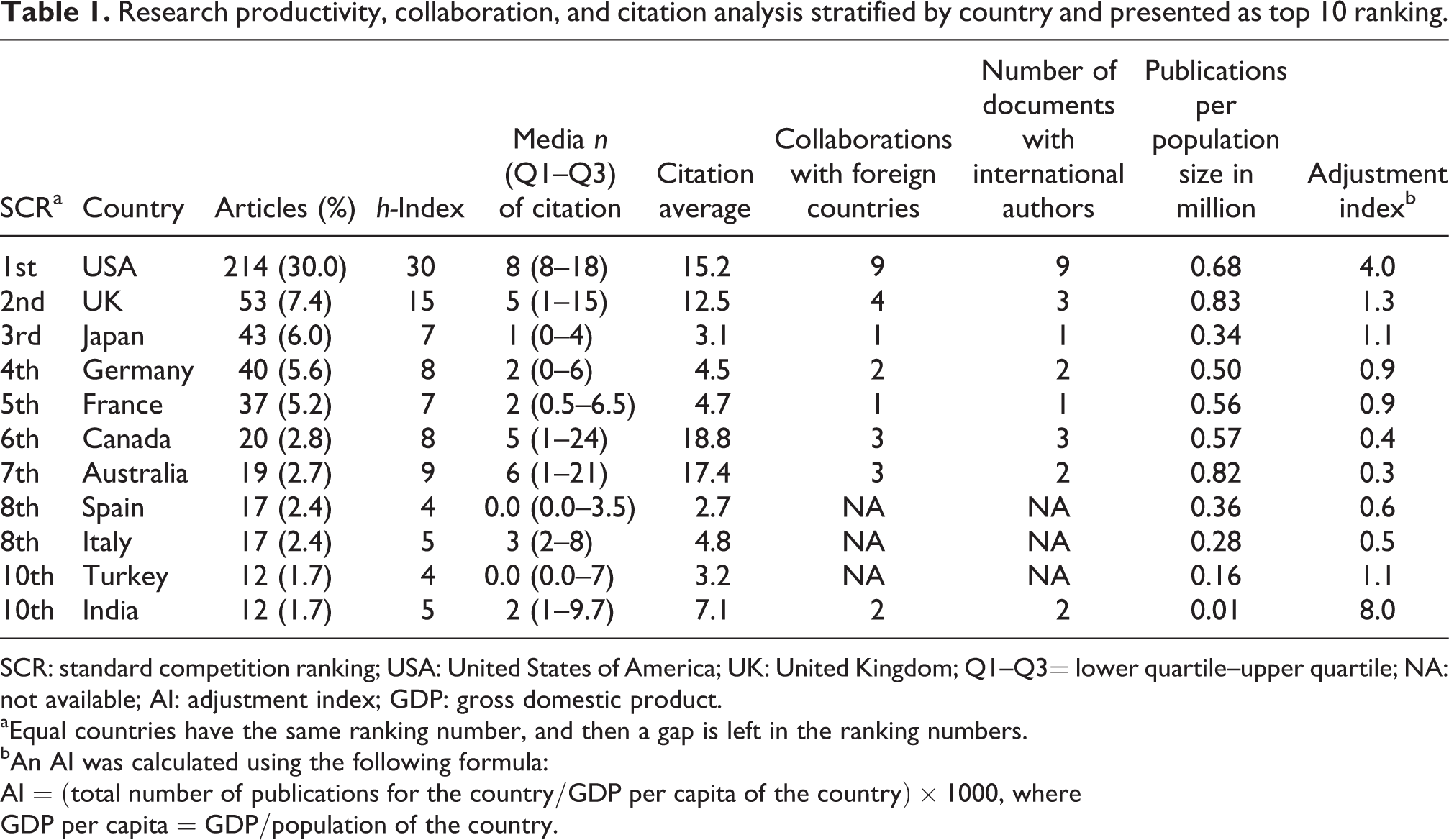
SCR: standard competition ranking; USA: United States of America; UK: United Kingdom; Q1–Q3= lower quartile–upper quartile; NA: not available; AI: adjustment index; GDP: gross domestic product.
aEqual countries have the same ranking number, and then a gap is left in the ranking numbers.
bAn AI was calculated using the following formula:
The total number of citations at the time of data analysis (23 October 2014) was 6462, with an average of 9.1 citations per document and a median (interquartile range) of 3(0.0–10.5). The highest median (interquartile range) number of citations was 8 (8–18) for the United States, followed by 6 (1–21) for Australia, 5 (1–15) for the United Kingdom, and 5 (1–24) for Canada. The h-index of the retrieved documents was 37 (i.e. 37 documents had been cited at least 37 times at the time of data analysis (23 October 2014)). The highest h-index was 30 for the United States, followed by 15 for the United Kingdom. Furthermore, the highest number of collaborations with international authors for each country was held by the United States, with nine countries, followed by four countries for the United Kingdom (Table 1).
Table 2 shows the top 10 journals in which CCBs-related articles were published. Twenty-seven documents (3.8%) were published in Clinical Toxicology, whereas 18 (2.5%) were published in Annals of Emergency Medicine, 16 (2.2%) were published in Japanese Pharmacology and Therapeutics, and 15 (2.1%) were published in Journal of Emergency Medicine. Two journals in the top 10 ranking journals had no official IF and were not listed in the JCR 2012. Only four journals from the top 10 ranking journals had SJR > 1.
Ranking of the top 10 journals in which articles related to CCBs poisoning were published with their corresponding impact factors.

CCB: calcium channel blocker; SCR: standard competition ranking; SJR: SCImago journal rank; NA: not available; IF: impact factor; ISI: Institute for Scientific Information; JCR: journal citation reports.
aEqual journals have the same ranking number, and then a gap is left in the ranking numbers.
bThe IF was reported according to the ISI JCR 2013.
cSJR was reported according to the SCImago web site.
dSubject categories were reported according to the ISI JCR 2012.
eSubject categories were reported according to the SCImago web site.
Table 3 lists the most frequently cited articles from 1968 to 2012. Table 4 shows the top 10 most institutions with higher quantities of articles related to CCBs. The most productive institution was Daiichi Sankyo Kabushiki-kaisha, Japan (1.1% of total publications), followed by VA Medical Center, USA (0.8%), and Carolinas Medical Center, USA (0.45%).
Top 10 cited documents related to CCBs poisoning in Scopus.

CCB: calcium channel blocker; SCR: standard competition ranking.
aEqual articles have the same ranking number, and then a gap is left in the ranking numbers.
Top 10 most highly productive institutions that published articles related to CCBs poisoning.

CCB: calcium channel blocker; SCR: standard competition ranking; USA: United States of America; UK: United Kingdom.
aEqual institutions have the same ranking number, and then a gap is left in the ranking numbers.
Discussion
This study used bibliometric analysis to quantitatively and qualitatively investigate research trends in studies of CCBs poisoning during the period 1968–2012. The design of the present analysis permitted a global assessment of the growth of scientific publications related to CCBs poisoning. To the best of our knowledge, this is the first study to evaluate the global research share in toxicology field. Our work focused primarily on assessing the relative contribution of the top 10 most productive countries to CCBs poisoning, which is considered as a subarea of the multidisciplinary field of toxicology. This study was limited to 713 documents extracted from Scopus, bearing article titles with terms related to CCBs poisoning and, therefore, cannot be generalized to the literature regarding CCBs covered by other databases such as Google Scholar. Scopus is superior to PubMed and Web of Science in numerous characteristics, mainly in the number of journal coverage and citation analysis, 23 –26 whereas Google Scholar offers results of inconsistent accuracy. 22 Furthermore, the citation information in Google Scholar has been found to be sometimes inadequate, less often updated, 22 and the fact that much information about its content coverage remains unknown. 22
The total publications related to CCBs found in Scopus between 1968 and 2012 indicated that research output was low in the first two decades but showed an obvious increase in the last decade, with peak publications in 1991. Scientific publications related to CCBs have followed the general evolution in scientific research productivity related to toxicology observed in the last decades. 11 –19,36 Another explanation for this increase is the development of new CCBs and approved by the US Food and Drug Administration for using in cardiovascular symptoms (e.g., verapamil, nifedipine, and diltiazem). A new toxicological concept related to CCBs poisoning indicated that formulation of new dosage forms and poisoning by it such as overdose with modified-release CCBs resulted in delayed and prolonged absorption and toxicity of CCBs. In addition, a new hypothesis that appeared at that time indicated that glucagon may be useful in the treatment of CCBs-induced myocardial toxicity. 37 –40 In part, this increase has also been motivated by recent interest in the role of lipid administration as a potentially effective antidote in CCB poisoning. 41,42
Some of the findings are similar to those reported in previous studies in other fields, particularly the fact that the United States dominates scientific production and the international collaboration networks. 19,43 The researchers from the United States, together with Canada, United Kingdom, and some other European countries, also have the highest citation rates. It is interesting to note that collaborations with foreign countries in this study are slightly lesser than that reported in other bibliometric fields. 36,44,45 In accordance with the present results, previous studies have demonstrated the importance of international collaboration, which has a positive effect on citation rates and enhances the quality of the research. 43,46,47 This result may be explained by the fact that the average citation rate for CCBs publications was similar to or lesser than the average citation of documents published in toxicology fields. 13,15,48,49 In this study, the average citation rate for CCBs publications was 9.1 citations per article. A more recent study using the same method found the average citation rate for paracetamol in publications was 12.3 citations per article. 44 Another more recent study using the same method found the average citation rate for scientific publications on waterpipe tobacco smoking was 13 citations per article. 45 A more recent analysis using the same method found that the average citation rate for N-acetylcysteine use for paracetamol overdose was 23.9 citations per article. 36 Citations for toxicology publications are usually low compared with those in other scientific disciplines because of the limited number of researchers in toxicology. 29,49 Furthermore, poisoning case studies are usually poorly cited. 50
The current study showed that the amount of CCBs-based research activity was low or not available in most countries. Furthermore, the research productivity in the field of CCBs poisoning was deviated to developed countries rather than developing countries. These results provide further support for findings from a previous study, which concluded that toxicology is underdeveloped in most developing countries, which is primarily due to improper educational policies. 18 These countries still lack well-defined and elaborate postgraduate toxicology programs at the university level, and there is a shortage of human resources in this field. Several factors encourage authors to launch international collaboration in research; such factors include easier access to public financing, opportunities to attain higher productivity, higher visibility, and prestige. 51 –54 In addition to these advantages of international collaboration, follow-up research expertise in developed or developing countries is another key factor for facilitating relevant and exchangeable research to countries that historically lack and require it. 18,19,29,55
This study is not without limitations, most of which are the same as those of studies performed in other bibliometric fields. 34,36,49,56 First of all, Scopus database was used, and, therefore, articles published in non-Scopus-cited journals were not included. Another limitation of this study is that some articles did not contain CCBs and related terms in the article titles; however, these terms were stated throughout the text, so it is possible that not all articles for all CCBs have been considered.
Conclusions
In conclusion, scientific production on CCBs poisoning is increasing; nonetheless, the international collaboration is still rare. The amount of CCBs-based research activity was low or not available in most countries. More regional epidemiological studies are required to bridge the gap in CCBs-based research and promote better evaluation of CCBs poisoning worldwide. The country with the greatest production is the United States, which concentrates the international collaboration network on CCBs poisoning. Furthermore, our data reveal that CCBs are still an important research issue and may have an audience similar to other toxicological aspects.
Footnotes
Acknowledgments
The authors would like to thank An-Najah National University for giving the opportunities to access most recent information sources such as Scopus database.
Conflict of interest
The authors declared no conflicts of interest.
Funding
This research received no specific grant from any funding agency in the public, commercial, or not-for-profit sectors.