




Abstract
Cisplatin (CP; cis-diamminedichloroplatinum II) is a drug widely used against different types of solid tumors. Patients receiving CP, however, experience very profound and long lasting gastrointestinal symptoms. Recently, ω-3 polyunsaturated fatty acid–enriched flaxseed/flaxseed oil (FXO) has shown numerous health benefits. The present study was undertaken to investigate whether FXO can prevent CP-induced adverse biochemical changes in the small intestine of rats. A single intraperitoneal dose of CP (6 mg/kg body weight) was administered to male Wistar rats fed with control diet (CP group) and FXO diet (CPFXO group). Administration of CP led to a significant decline in the specific activities of brush border membrane enzymes both in the mucosal homogenates and in the isolated membrane vesicles. Lipid peroxidation and total sulfhydryl groups were altered upon CP treatment, indicating the generation of oxidative stress. The activities of SOD, catalase and glutathione peroxidase also decreased in CP-treated rats. In contrast, dietary supplementation of FXO prior to and following CP treatment significantly attenuated the CP-induced changes in all these parameters. FXO feeding markedly enhanced resistance to CP-elicited adverse gastrointestinal effects. The results suggest that FXO owing to its intrinsic biochemical/antioxidant properties is an effective agent in reducing the adverse effects of CP on intestine.
Introduction
Cisplatin (CP; cis-diamminedichloroplatinum II) has been established as a potent chemotherapeutic agent administered to treat a variety of cancers. 1 However, the use of this agent in combating cancer is limited by the development of nephrotoxicity and gastrointestinal toxicity. The gastrointestinal toxicity of CP (which includes nausea, emesis and diarrhea) is a major problem for patients undergoing cancer chemotherapy with this drug. The prevention of side effects of CP is, therefore, one of the major issues in cancer treatment using this drug. Various methods to prevent or reduce the side effects of CP, such as the use of free radical scavengers and chemoprotective agents, have been tested but effective methods for clinical use have not yet been established. 2
Increased production of reactive oxygen species (ROS) and free radicals has been implicated in mediating CP-induced toxicity. These radicals can cause extensive tissue damage by reacting with macromolecules like membrane lipids, proteins and nucleic acids. Inhibitors of ROS accumulation can block CP-induced toxicity, indicating that pathways involved in and/or activated by oxidative stress are critical to CP bioactivity. 3,4 The brush border membrane (BBM) lining the epithelial cells of small intestines is one of the most important cellular membranes, owing to its role in the digestion and absorption of nutrients. 5 This process of digestion and absorption can be altered by drugs, chemicals, nutritional status and toxic pollutants. Recent study has shown that CP administration results in lowered activities of enzymes in the BBM lining the intestinal epithelial cells. It also led to increased production of ROS and alterations in the activities of several antioxidant enzymes. 6,7
Dietary supplementations are becoming a part of conventional or complementary and alternative medicine as they play an important role in maintaining health. Several approaches have been used to prevent the unwanted and harmful physiological effects of antineoplastic drugs like CP via supplementation of preventive agents simultaneously. These include antioxidants, modulators of nitric oxide, diuretics, cytoprotective agents and apoptotic agents. 2 However, none of these were found to be clinically suitable. Nutritional recommendations have recently promoted the increased need to consume ω-3 fatty acids due to their beneficial health effects. The most common way to consume ω-3 fatty acids has been in the form of marine oils like fish oil. Vegetable sources, including grains and oils, offer an alternative source for those who are unable to regularly consume fish for religious or other reasons. 8 Flaxseed (Linum usitatissimum) is the richest dietary source of ω-3 fatty acids among plant sources. It is also a good source of dietary fiber and phytoestrogenic lignans that are believed to have antioxidant properties. 9 Inclusion of flaxseed in the diet in animal studies has shown that it can inhibit arrhythmogenesis during ischemia–reperfusion, 10 inhibit atherogenesis 11,12 and protect against vascular dysfunction during hypercholesterolemic conditions. 13 Flaxseed oil (FXO) has also been shown to increase the life span of irradiated mice, suggesting its prophylactic potential against radiation-induced degenerative changes in liver. 14 However, the protective effect of FXO on drug-induced toxicity has not yet been investigated.
We hypothesized that FXO would prevent CP-induced adverse effects on intestine due to its antioxidant properties. To test our hypothesis, we studied the effect of CP alone and CP + FXO diet on the functional integrity of the mucosal membrane, as determined from the activity of BBM enzymes and antioxidant status in rats. The results suggest that FXO consumption can be an option for the long-term clinical use of CP as an anticancer drug without adverse effects on intestine.
Materials and methods
Chemicals and drugs
FXO is obtained from Omega Nutrition Canada Inc. (Vancouver, Canada) and Cisplatin from Sigma Chemical Co. (St Louis, Missouri, USA). All other chemicals used were of analytical grade and were purchased either from Sigma Chemical Co. or from SRL (Mumbai, India).
Diet
A nutritionally adequate laboratory pellet diet was obtained from Aashirwaad Industries (Chandigarh, India). Pellets were crushed finely and vitamin E as
Experimental design
The animal experiments were conducted according to the guidelines of Committee for Purpose of Control and Supervision of Experiments on Animals (CPCSEA), Ministry of Environment and Forests, Government of India. Adult male Wistar rats (8 rats per group) weighing between 150 and 200 g were used in the study. Animals were acclimatized to the animal facility for a week on standard rat chow and allowed water ad libitum, under controlled conditions of 25 ± 2°C temperature, 50 ± 15% relative humidity and normal photoperiod (12-hour dark and light cycle). Four groups of rats entered the study after acclimatization (Figure 1). They were fed on either normal diet (control and CP groups) or diet containing 15% FXO (CPFXO and FXO groups). After 10 days, rats in two groups (CP and CPFXO groups) were administered a single dose of CP intraperitoneally (6 mg/kg body weight (bwt)) in 0.9% saline. Animals in the control and FXO groups received an equivalent amount of normal saline. The respective dietary regime was followed, and after 4 days of CP administration, rats were killed under light ether anesthesia. The complete small intestine were removed and processed for the preparation of homogenates and BBM vesicles (BBMV), as described below. All the preparations and analyses of various parameters were performed simultaneously under similar experimental conditions to avoid any day-to-day variations. Body weight of rats was recorded at the start and completion of the experimental procedures.

Experimental design. ND: normal diet; C: control; FXO: flaxseed oil diet; CP: cisplatin; CPFXO: flaxseed oil + cisplatin; i.p.: intraperitoneal; ⇑: CP injection; ↑: normal saline injection.
Preparation of BBMV and homogenates
The intestines were washed with ice-cold saline, slit open and the mucosa was removed by gently scraping with a glass slide. Mucosal homogenates were prepared and aliquots were quickly frozen until further analysis. 15 BBMV were prepared by the CaCl2 precipitation method as described previously. 15 Homogenates used for the assay of free radical scavenging enzymes were clarified by centrifugation at 3000g (5000 r/min) for 15 min at 4°C, and the supernatants were used in the assays. Protein concentration in the homogenates and BBMV was determined by the Folin phenol reagent using bovine serum albumin as standard. 16
Assay of BBM marker enzymes
The activities of BBM enzymes were assayed in mucosal homogenates and isolated BBMV. The activity of alkaline phosphatase (ALP) was determined from the yellow color formed upon hydrolysis of p-nitrophenyl phosphate.
17
Leucine aminopeptidase (LAP) and γ-glutamyltransferase (GGTase) were assayed using
Assay of enzymes involved in free radical scavenging
Superoxide dismutase (SOD; E.C.1.15.1.1) was assayed from the auto-oxidation of pyragallol by the method of Marklund and Marklund. 21 Catalase (CAT; E.C.1.11.1. 6) from the decomposition of hydrogen peroxide 22 and glutathione peroxidase (GSH-Px) activity was determined by the method of Flohe and Gunzler. 23
Estimation of MDA and total SH groups
Total sulphydryl (SH) groups and malondialdehyde (MDA) levels were determined in the mucosal homogenates after reaction with 5,5′-dithiobisnitrobenzoic acid and thiobarbituric acid, respectively. 24,25
Statistical analyses
All data are expressed as mean ± SEM for at least 4–5 different preparations. Statistical evaluation was conducted by one-way analysis of variance using Origin 6.1 software. A probability level of p < 0.05 was selected as indicating statistical significance. Values of various groups were compared with control values for better understanding and clarity.
Results
The effect of dietary FXO supplementation on CP-induced changes in BBM enzymes and the antioxidant status of the rat intestine were studied. Intestinal mucosal homogenates and BBMV were prepared and used in the determination of various biochemical parameters. The daily food intake was similar in various experimental groups of rats. As shown in Table 1, there was a slight loss in body weight in CP and CPFXO rats.
Effect of dietary FXO on body weight (in g) of rats with/without CP treatment.a

CP: cisplatin; CPFXO: flaxseed oil + cisplatin; FXO: flaxseed oil diet.
a Results are expressed as mean ± SEM for 8–10 rats per group.
Effect of dietary FXO on CP-induced alterations in biomarker enzymes of BBM enzymes
The effect of CP alone and in combination with FXO diet was determined on biomarker enzymes of BBM in the homogenates and isolated BBM preparations from the intestine.
Effect of CP alone and with FXO diet on biomarkers of BBM in mucosal homogenates
The activities of ALP, GGTase, LAP and sucrase were determined in the mucosal homogenates prepared from animals in the control, CP, CPFXO and FXO groups (Table 2). Treatment of rats with CP alone resulted in a significant decline in the activities of ALP (−47%), GGTase (−43%), LAP (−30%) and sucrase (−40%) when compared with saline-treated control groups. The feeding of FXO diet prior and after the CP treatment prevented CP-elicited decrease in BBM enzyme activities.
Effect of FXO on biomarkers of BBM in intestinal homogenates with/without CP treatment.a

CP: cisplatin; CPFXO: flaxseed oil + cisplatin; FXO: flaxseed oil diet; ALP: alkaline phosphatase; GGTase: γ-glutamyltransferase; BBM: brush border membrane; LAP: leucine aminopeptidase.
a Results (specific activity expressed as µmoles/mg protein/h) are mean ± SEM for five different preparations. Values in parentheses represent percentage change from control.
b Significantly different from control.
c Significantly different from CP at p < 0.05 by one-way analysis of variance.
Effect of CP alone and FXO diet on BBM markers in isolated BBMV
The effect of CP alone and with FXO on BBM marker enzymes was further analyzed in BBMV preparations isolated from the intestinal mucosa (Table 3). The data show a similar activity pattern of BBM enzymes as observed in intestinal homogenates. However, the magnitude of the effect was much more pronounced in BBMV than in intestinal homogenates (Figure 2). Activities of ALP (−39%), GGTase (−66%), LAP (−60%) and sucrase (−30%) were profoundly declined by CP treatment when compared with control rats. FXO dietary supplementation similar to the effect in the homogenates appeared to lower the severity of the CP treatment. CP-induced decrease in BBM enzyme activities was significantly prevented in FXO-fed rats. Dietary supplementation with FXO without CP administration (FXO group) caused an increase in the BBM enzyme activities.

Effect of FXO consumption on (a) ALP, (b) GGTase, (c) LAP and (d) sucrase in intestinal homogenate and BBM with/without CP treatment. FXO: flaxseed oil; ALP: alkaline phosphatase; GGTase: γ-glutamyltransferase; LAP: leucine aminopeptidase; BBM: brush border membrane; CP: cisplatin.
Effect of FXO on activities of biomarker enzymes of BBM in intestinal BBMV with/without CP treatment.a
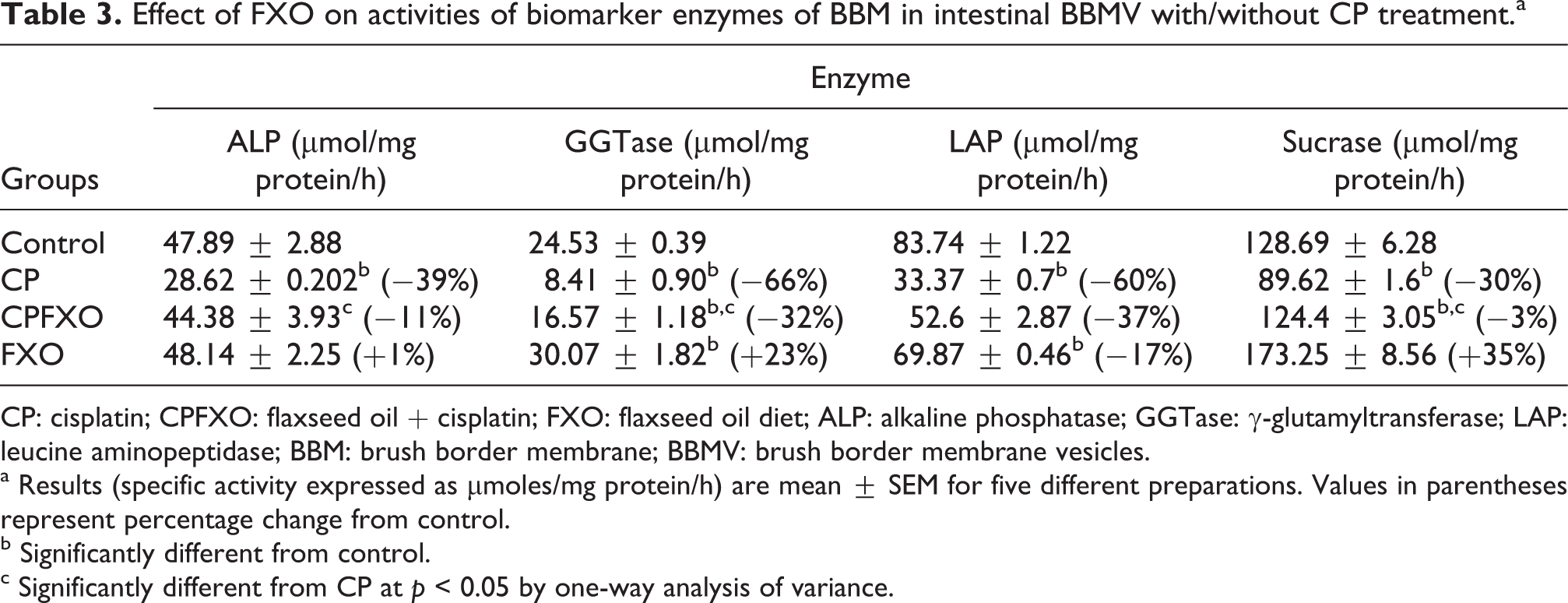
CP: cisplatin; CPFXO: flaxseed oil + cisplatin; FXO: flaxseed oil diet; ALP: alkaline phosphatase; GGTase: γ-glutamyltransferase; LAP: leucine aminopeptidase; BBM: brush border membrane; BBMV: brush border membrane vesicles.
a Results (specific activity expressed as µmoles/mg protein/h) are mean ± SEM for five different preparations. Values in parentheses represent percentage change from control.
b Significantly different from control.
c Significantly different from CP at p < 0.05 by one-way analysis of variance.
Effect of dietary FXO on CP-induced alterations in LPO and total SH groups
Both lipid peroxidation (LPO) and total SH groups were determined in mucosal homogenates. LPO was determined from MDA production as thiobarbituric acid reactive substances. MDA is an LPO product recognized as an indicator of oxidative tissue injury. Treatment with CP alone led to an increase in LPO (+145%) and decrease in SH content (−41%). However, these CP-induced changes were significantly attenuated by dietary FXO supplementation before and after the administration of CP. Dietary FXO supplementation alone increased total SH content (+10%), however did not cause any significant alterations in LPO (−2%) as compared to control (Table 4).
Effect of FXO on enzymatic and nonenzymatic antioxidant parameters with/without CP treatment in intestinal homogenates.a

CP: cisplatin; CPFXO: flaxseed oil + cisplatin; FXO: flaxseed oil diet; LPO: lipid peroxidation; Total SH: sulphydryl groups; SOD: superoxide dismutase; GSH-Px: glutathione peroxidase.
a Results are mean ± SEM for five different preparations. Values in parentheses represent percentage change from control.
b Significantly different from control.
c Significantly different from CP at p < 0.05 by one-way analysis of variance.
Effect of dietary FXO on CP-induced alterations in antioxidant defense parameters in the intestine
It is evident that ROS generated by various toxicants are important mediators of cellular injury and pathogenesis of various diseases. 26 Antioxidant status is a potential biomarker that determines the physiological state of the cell, tissue or organ. To ascertain the role of antioxidant system in CP-induced toxicity, the effect of CP was observed on the activities of various enzymes involved in antioxidant defense. CP treatment caused significant decrease in the activities of SOD (−53%), CAT (−27%) and GSH-Px (−72%) in the intestine (Table 4). These changes in the activities of SOD, CAT and GSH-Px were prevented when CP was administered to FXO fed rats. The results indicate marked protection by FXO diet against CP-induced oxidative damage to intestinal tissue. However, FXO when given alone significantly enhanced the activities of SOD, CAT and GSH-Px.
Discussion
CP is one of the most effective chemotherapeutic agents that play a major role in the treatment of a variety of human solid tumors including those of the head, neck, ovary and breast. 27 However, the use of high-dose CP is difficult in practice because of the associated adverse reactions such as renal damage, gastrointestinal dysfunction, auditory toxicity, myelosuppression and peripheral nerve toxicity. The symptoms (nausea, emesis and diarrhea) associated with the gastrointestinal toxicity of CP are important factors that reduce drug compliance in patients undergoing cancer chemotherapy with this drug. 28,29 The protection of intestinal mucosal toxicity could improve the tolerance of CP in patients.
Morphological studies have shown that the BBM lining the epithelial cells of the small intestine is an early and prominent site of morphological change in toxic injury. Histological analysis of small intestine of CP-treated rats has revealed that CP impairs the mucosal structure by causing acute epithelial necrosis and apoptosis. 30,31 CP chemotherapy causes a generalized mucositis of the gastrointestinal tract, and ROS contribute to the gastrointestinal tract toxicity of CP chemotherapy. 32 CP is a potent redox cycler that generates harmful ROS and hence causes oxidative injury of various cells and tissues. 33,34 It oxidatively impairs the mitochondrial function and mitochondrial DNA in kidney and small intestine, thereby inducing renal and intestinal dysfunction. 35 Previous studies have shown that the CP administration alters the activities of BBM marker enzymes and antioxidant status of intestinal mucosa. 7
During the past decade, interest in ω-3 polyunsaturated fatty acids (PUFAs) has increased considerably because of their beneficial health effects. The ω-3 fatty acids are essential for growth and development and have been associated with the prevention and treatment of heart disease, arthritis, inflammatory and autoimmune diseases and cancer. 36 The predominant dietary sources of PUFA are plants/seed namely flaxseed and fish/marine foods. The ω-3 fatty acid-enriched fish oil has received a great deal of attention as therapeutic options in a variety of clinical situations. 37 –39 Flaxseed (L. usitatissimum) meal and FXO have been used in food for centuries in Asia, Europe and Africa. Recently, flaxseed has been the focus of increased interest in the field of diet and disease research. 40 Flaxseed contains 32–45% of its mass as oil, of which 51–55% is α-linolenic acid (18:3; n-3 and ω-3 fatty acid), a precursor to eicosapentanoic and docosahexanoic acids that may have beneficial effects on health and control chronic diseases. 41 Flaxseed has three major components making it beneficial in human and animal nutrition: a very high content of α-linolenic acid (ω-3 PUFA), a high percentage of dietary fiber, both soluble and insoluble, and the highest content of phytoestrogenic lignans that are believed to have antioxidant properties in various pathological conditions. 42,43 Dietary supplementation of flaxseed was found to inhibit the progression of prostate cancer in the transgenic adenocarcinoma mouse prostate model. 44 Flaxseed has also been reported to inhibit human breast cancer growth and metastasis and downregulate expression of insulin-like growth factor and epidermal growth receptor. 45 Another study using rat suggested that the exposure to flaxseed during suckling inhibited chemically induced mammary tumorigenesis. 46 Recent studies have shown that FXO prevents lead-induced neurotoxicity and nephrotoxicity. 47,48 However, the role of FXO in ameliorating the side effects of CP chemotherapy have not yet been elucidated. The present studies were performed to test the hypothesis that FXO consumption would ameliorate CP-induced toxic effects on intestine, thus maximizing the clinical use of CP in the treatment of various malignancies without any major side effects.
The BBM lining the enterocytes contains a number of hydrolytic enzymes and is the major site of digestion and transport of nutrients. 49,50 The integrity of the membrane was assessed by the status of its biomarker enzymes ALP, GGTase, LAP and sucrase. A decrease in the activities of BBM enzymes was seen upon administration of CP. CP caused significant decrease in the activities of ALP, GGTase, LAP and sucrase in the intestinal homogenates as well as in isolated BBMV; however, the extent of decline was more in BBMV than in homogenates. The decrease in enzyme activities could be due to the direct modification and consequent inactivation of enzymes by CP-generated free radicals and ROS. There could also have been leakage or loss of these enzymes into the lumen of the intestine following ROS-induced damage to the epithelial cells, especially the membrane. Increase in LPO, which affects membrane structure and function, could also have resulted in the decreased activities of these enzymes. Dietary FXO supplementation prior to and after CP treatment (CPFXO group) reduced the CP-induced decline in the activities of BBM enzymes. Since CP is well known to induce oxidative stress, 51,52 the protective effect of FXO on CP-induced decline in BBM enzyme activities could have been due to the antioxidant properties associated with its biologically active components namely ω-3 PUFA, linolenic acid and lignans. 43,53 –55 The consequent reduction in LPO and in the oxidative modification of BBM enzymes might have contributed to the efficacy of FXO in attenuating the effects of CP on BBM. In contrast to CP (CP group), FXO consumption (FXO group), however, enhanced the activities of BBM enzymes in homogenate and BBM, indicating an overall improvement in intestinal BBM integrity.
A balance between the production and the catabolism of oxidants by cells and tissues is critical for the maintenance of biological integrity of the tissues. SOD, CAT and GPx are the major enzymes involved in quenching the ROS and reducing oxidative stress in the cell. Both SOD and CAT together convert the superoxide radicals first into hydrogen peroxide and then into molecular oxygen and water. Other enzymes, for example, GSH-Px, use thiol-reducing power of glutathione to reduce oxidized lipids and protein targets of ROS. Under ineffective antioxidant enzyme status, LPO in the cellular and subcellular membranes is the inevitable outcome of ROS injury. 56 –58 CP has been shown to enhance LPO, an indicator of tissue injury and deplete GSH and protein thiols. 59 The present results show that CP administration to control rats caused severe damage to intestine most likely by ROS generation as apparent by perturbation in the antioxidant enzymes (SOD, CAT and GPx-SH) and total SH content that lead to increased LPO. This increase in oxidative stress and ROS production may be responsible for the intestinal toxicity of CP as also suggested for other tissues. 60,61
The feeding of FXO diet to CP-treated rats prevented CP-induced augmentation of LPO and suppression of antioxidant enzyme activities. It can be suggested that dietary supplementation of ω-3 PUFAs-enriched FXO may have ameliorating effect on damage caused by CP by two possible ways: first, FXO supplementation increases the levels of SOD, CAT and GPx in the intestinal mucosal cells, resulting in enhanced defense against oxygen free radicals. Second, the constituent ω-3 PUFAs of dietary FXO may have replaced the polyunsaturated fatty acid components of the membranes that had been attacked by oxygen free radicals, 62,63 thereby increasing membrane integrity. Thus, the protection afforded by FXO may be attributed to its intrinsic biochemical/antioxidant properties associated with its biologically active components particularly ω-3 essential fatty acids 53 and phytoestrogenic lignans which have been shown to play an important role in free radical scavenging and singlet oxygen quenching. 43,54 A marked increase in the antioxidant enzyme activities was seen when rats were fed FXO diet alone without CP administration.
Taken together, the results suggest that ROS/oxygen free radicals could contribute to the development of gastrointestinal tract toxicity during CP chemotherapy and treatment with FXO considerably ameliorates the CP-induced biochemical changes in intestine. Our results demonstrate that FXO empowers the antioxidant defense system by reducing oxidative stress and increasing the activities of the major antioxidant enzymes SOD, CAT and GPx. In summary, a beneficial effect in intestinal function was found when rats were fed on FXO diet prior to and following CP administration. Further studies are needed to define the exact mechanism of protective effect of FXO on CP-induced gastrointestinal tract dysfunction.
Footnotes
Funding
Indian Council of Medical Research (ICMR, New Delhi, India) awarded JRF (Junior Research Fellowship)/SRF (Senior Research Fellowship) to W.K. University Grants Commission (UGC) awarded scholarship to A.N. and S.R. and financial support was provided to the department from University Grants Commission (UGC-DRF).