



Abstract
The present work aimed to study the toxic effect of cadmium (Cd) on rabbits’ blood indices, as well as the therapeutic effect of the antioxidant agents, vitamins C and B complex and bee honey on Cd intoxicated rabbits. Cadmium chloride (CdCl2) was injected subcutaneously at a dose of 3 mg/kg of body weight. The results showed a significant increase in serum glucose, triglycerides, cholesterol, total protein, albumin, globulin, urea and creatinine, compared to the control group. In addition, CdCl2 intoxication increased the levels of uric acid, aspartate aminotransferase, alanine aminotransferase, alkaline phosphatase and bilirubin. Concerning haematological parameters, the more obvious changes were an increase in mean corpuscular volume and a decrease in white blood cells count, platelets, lymphocytes, heamatocrit, haemoglobin and red blood cells count. Treatment of CdCl2-intoxicated animals with vitamins C and B complex and bee honey showed a decrease in the harmful effects of Cd by restoring haematological and biochemical changes. Bee honey treatment was the most effective in providing recoveries in the altered blood parameters.
Introduction
Cadmium (Cd), a widespread environmental toxicant, accumulates in various tissues after chronic exposure to polluted food and water resulting in toxicity. 1 Cd is widely used in paints, plastic manufacturing, electrolysis and industry. 2 Tobacco contains a significant amount of Cd, and smoking is one of the sources of Cd intoxication. 3 Intoxication with Cd was defined first in Japan in 1950 and known as Itai-Itai disease. 4 Cd persists in the kidneys of humans for many years (half-life of 30 years). This provides an opportunity for Cd toxicity to occur with no additional exposure, when the previously bound (nontoxic) Cd is displaced and released. 5 An increase in mortality risk by 40–100% has been noted among individuals with signs of Cd-linked nephropathy. 6
Toxic effects of Cd depend on the dose, the length of exposure and whether it is inhaled or ingested. 7 Research on Cd toxicity has most often focused on the subcutaneous administration of cadmium chloride (CdCl2) and cadmium oxide.8–10 These studies indicate that CdCl2 causes acute hepato- and nephrotoxicity.
Cd causes liver, kidney and testicular apoptosis, degeneration, hypertension, atherosclerosis, osteoporosis, anaemia and cancer. 11 –14 Cd also causes disruption in connections between the endothelial cells, an increase in vascular permeability, oedema, haemorrhage and necrosis. 2
After the intake and absorption, Cd enters the blood where it binds to the erythrocyte membranes and plasma albumin. 15 The immunotoxic action of Cd is also reported through its effect on T-cell phenotype and blood lymphocytes. 16,17 Also, evidence for the carcinogenic risk of chronic Cd exposure is accumulating and the effects of Cd on reproductive outcomes have begun to emerge. 18
In blood and tissues, Cd stimulates the formation of metallothioneins and reactive oxygen species, thus causing oxidative damage in erythrocytes and in various tissues. 19 The metal is currently believed to have caused most of its toxic effects by its ability to generate free radicals at a rate high enough to overwhelm the natural antioxidant defense system of the body. 20 Moreover, a variety of accompanying changes in antioxidant defense enzymes were reported. 10,21,22
Fariss 23 showed that free radical scavengers and antioxidants are useful in protecting against Cd toxicity. Vitamins C and B complex have an antioxidant role against the oxidizing agents as well as free radicals that are harmful to the human body. 24 –26 The results of Tandon et al. 27 suggest that Cd toxicity can be reduced by vitamin B complex supplementation.
Research indicates that honey has functional properties in human health promotion, which depend largely on the floral source. These properties could be associated with honey’s high osmolarity, antibacterial properties and antioxidant capacity. 28,29 Honey is a supersaturated solution of sugars, with phenolic compounds, minerals, proteins, free amino acids, enzymes and vitamins. Thus, in addition to polyphenols, honey contains a number of compounds known to act as antioxidants, as ascorbic acid and enzymes (glucose oxidase and catalase). 30
The aim of present work is to study the effect of CdCl2 on rabbit’s blood indices as well as the ameliorating action of vitamins C and B complex and bee honey on rabbits intoxicated with Cd.
Materials and methods
Experimental animal and dosing
A total of 30 rabbits were used in the present study, weighing 1000–1300 g. The rabbits were housed in the usual metal cages at the Biology Department, at room temperature. They were kept in plastic cages with wire mesh covers and maintained under the following conditions: temperature (25–27°C), relative humidity 40–60% and a light/dark cycle of 14 and 10 h). The rabbits were kept for 1 week before experimentation to adapt to laboratory conditions. The rabbits had free access to commercial balanced diet and water all over the experimental period. The local regulations of Guiding Principles in the Use of Animals in Toxicology were followed throughout the study. The animals were divided into five groups, each including six rabbits.
The first group was injected (subcutaneously [s.c.]) with a single dose of CdCl2 dissolved in distilled water (3 mg/kg of body weight [b.wt.]) according to Adaikpohl et al. 9 and Murugavel and Pari. 10 Selected Cd dose was one third of that used by Cameron and Foster 31 and Dobranić et al. 30 in rabbits.
The second group was given bee honey dissolved in drinking water (100 mg/L) as mentioned by Al-Ali and El-Alfy, 32 1 h before the Cd (s.c.) injection (3 mg/kg of b.wt.). Each rabbit ingested approximately 9 mg/kg of b.wt./day of honey.
The third group was injected (intraperitoneal [i.p.]) first with a single dose of vitamin C 33 (150 mg/kg b.wt.) and then injected (s.c.) with CdCl2 (3 mg/kg of b.wt.) 1 h later.
The fourth group was first injected (i.p.) with vitamin B group in a sequence of vitamin B1 (thiamin) at a dose level of 18 mg/kg b.wt.; vitamin B6 (pyridoxine) at 7.2 mg/kg b.wt. and vitamin B12 (cyanocobalamine) at a dose level of 180 mg/kg b.wt. 34 and then injected (s.c.) with a single dose of CdCl2 (3 mg/kg b.wt.) 1 h later.
The fifth group served as control and were s.c. injected with a single dose of equivalent amount of vehicle (distilled water).
CdCl2 was of an analytical grade and was purchased from Sigma Chemical Company (Germany). Bee honey was obtained from a known source in the local market. However, vitamins were obtained from Beit Jala Pharmaceutical Manufacturing Company (West bank, Palestine).
Blood sampling and processing
The animals were decapitated 72 h after CdCl2 injection. Approximately 5 ml of blood was collected into centrifuge tubes without any anticoagulant. The centrifuge tubes were left for about 15 min to allow blood coagulation. Clear sera samples were separated by centrifugation at 3000 rpm for 20 min. The sera samples were then stored in the refrigerator until analysis. However, determinations of enzyme activities were carried out on fresh sera samples.
Measurement of biochemical parameters
Serum glucose, triglycerides and total cholesterol were determined using the methods described by Trinder, 35 Fosstai and Prencipe 36 and Allain et al., 37 respectively. Serum urea measurement was based upon the cleavage of urea with urease (Berthelot’s reaction) according to the method of Fawcett and Scott. 38 Serum uric acid was determined following the method described by Fossatti et al. 39 Serum creatinine was measured without protein precipitation according to the method of Bartels et al. 40 Serum total protein was determined by Biuret reaction as designed by Armstrong and Carr. 41 The activities of serum transaminases aspartate aminotransferase (AST) and alanine aminotransferase (ALT) were determined according to the method of Reitman and Frankel. 42 The measurement of serum alkaline phosphatase (ALP) activity and bilirubin was based on the methods of Bessey et al. 43 and Perry et al., 44 respectively. Serum albumin was determined using RANDOX reagent kits and following their instruction manual according to the method of Doumas et al. 45 The concentration of globulin (g/dl) was calculated by subtracting the concentration of albumin from total protein.
Haematological parameters
The determination of haematological parameters was carried out using an 18 automated parameter haematology analyzer, ABX Micros 60 from Horiba ABX, France.
Data analysis
Data were computer analyzed using SPSS version 11.0 for windows (Statistical Package from the Social Sciences Inc., Chicago, IL, USA). Statistical analysis was performed by one-way analysis of variance. The differences between the means were tested by Duncan’s multiple range test; p < 0.05 was considered as significant. Percentage change was also calculated. However, the significances between the 1st, 2nd, 3rd and 4th groups compared to the 5th one (control group) were only depicted in the tables. On the other hand, comparing the counted percentages of changes in Cd-treated group with any group treated with the substances tested plus Cd could show the therapeutic action of the tested substances.
Results
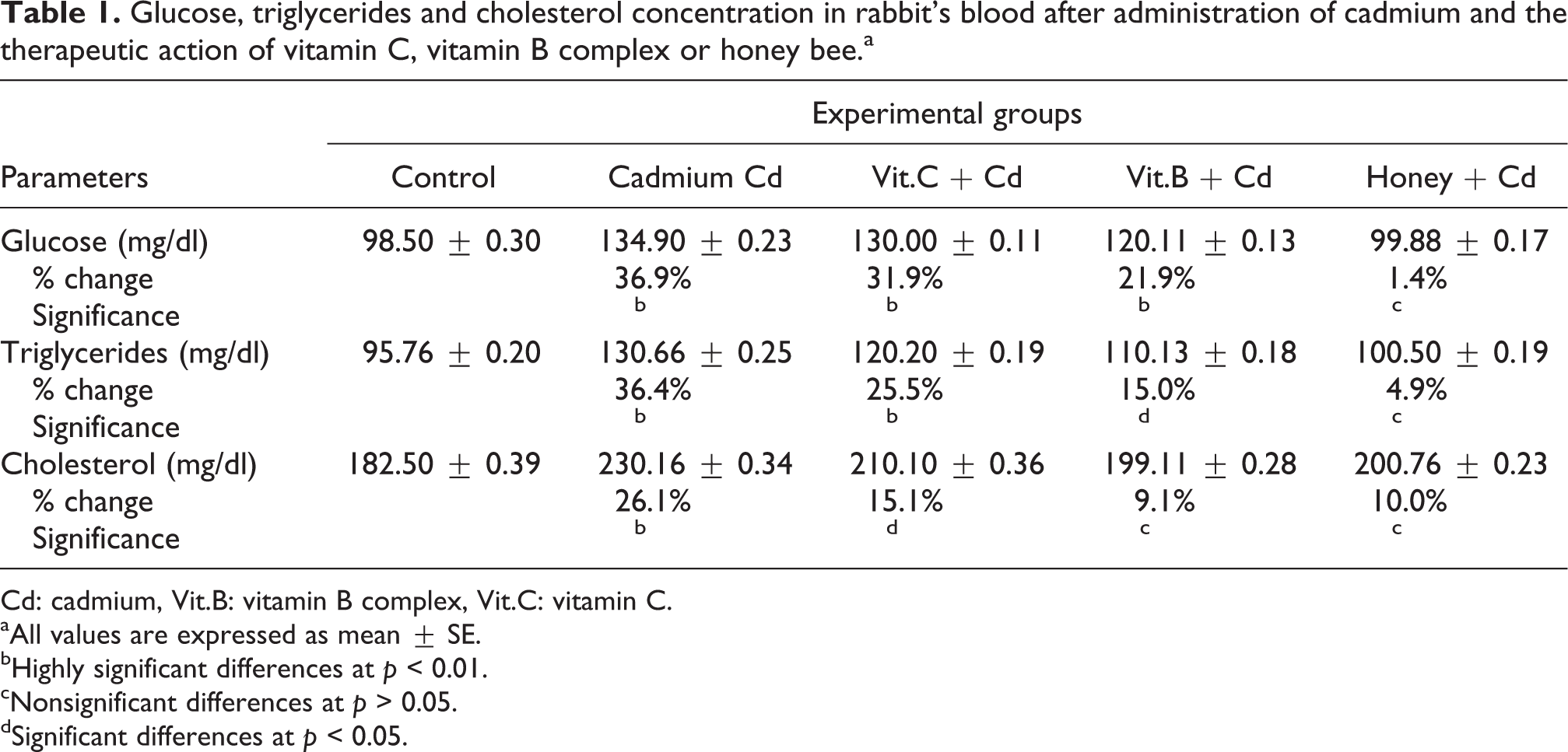
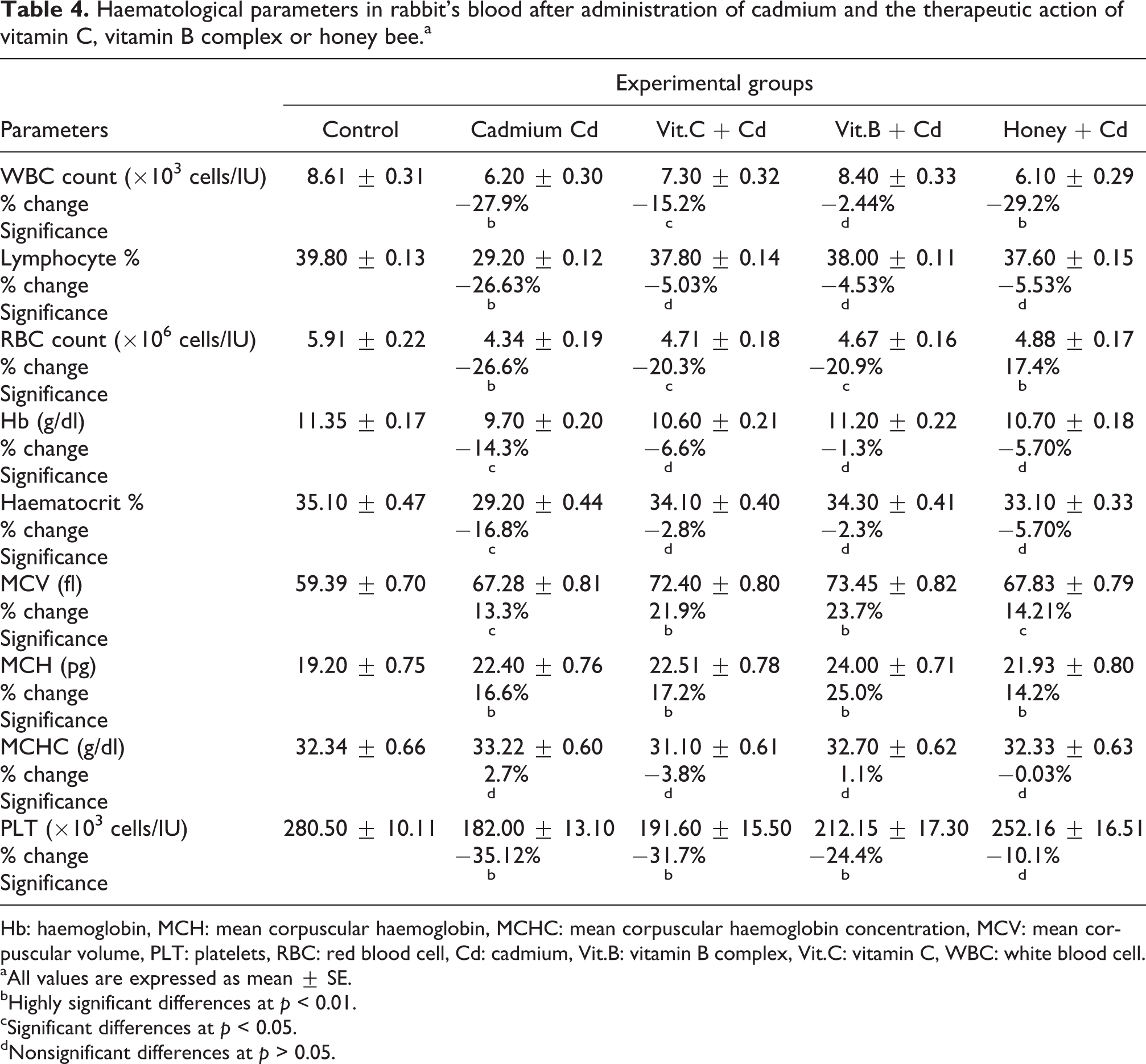
Mean values of the rabbits’ blood parameters as affected by CdCl2 toxicity and the ameliorating action of vitamin C, vitamin B complex and bee honey are presented in Tables 1–4.
Glucose, triglycerides and cholesterol concentration in rabbit’s blood after administration of cadmium and the therapeutic action of vitamin C, vitamin B complex or honey bee.a
Cd: cadmium, Vit.B: vitamin B complex, Vit.C: vitamin C.
aAll values are expressed as mean ± SE.
bHighly significant differences at p < 0.01.
cNonsignificant differences at p > 0.05.
dSignificant differences at p < 0.05.
Serum AST, ALT, ALP and bilirubin concentration in rabbit's blood after administration of cadmium and the therapeutic action of vitamin C, vitamin B complex or honey bee.a

ALP: alkaline phosphatase, ALT: alanine aminotransferase, AST: aspartate aminotransferase, Cd: cadmium, Vit.B: vitamin B complex, Vit.C: vitamin C.
aAll values are expressed as mean ± SE.
bHighly significant differences at p < 0.01.
cSignificant differences at p < 0.05.
Concentrations of protein and nonprotein nitrogenous constituents in rabbit’s blood after administration of cadmium and the therapeutic action of vitamin C, vitamin B complex or honey bee.a

Cd: cadmium, Vit.B: vitamin B complex, Vit.C: vitamin C.
aAll values are expressed as mean ± SE.
bHighly significant differences at p < 0.01.
cSignificant differences at p < 0.05.
dNonsignificant differences at p > 0.05.
Haematological parameters in rabbit’s blood after administration of cadmium and the therapeutic action of vitamin C, vitamin B complex or honey bee.a
Hb: haemoglobin, MCH: mean corpuscular haemoglobin, MCHC: mean corpuscular haemoglobin concentration, MCV: mean corpuscular volume, PLT: platelets, RBC: red blood cell, Cd: cadmium, Vit.B: vitamin B complex, Vit.C: vitamin C, WBC: white blood cell.
aAll values are expressed as mean ± SE.
bHighly significant differences at p < 0.01.
cSignificant differences at p < 0.05.
dNonsignificant differences at p > 0.05.
The data in Table 1 show that cadmium chloride administration caused a significant increase (p < 0.05) in the levels of glucose, total cholesterol and triglycerides at the end of the experiment. The percentage of increments in serum glucose, total cholesterol and triglycerides in Cd-intoxicated rabbits were 36.6, 36.4 and 26.1% compared to the control. In the groups that were treated with vitamins and honey, the levels of glucose, triglycerides and total cholesterol were reduced compared to the intoxicated animals but still higher than those of the control group. The levels of glucose in groups treated with vitamin C, vitamin B complex and bee honey in addition to Cd were 96.37, 89.03 and 74.04% of that treated with Cd alone, respectively.
The results cited in Table 2 show a significant elevation in rabbits’ serum transaminases (AST and ALT), bilirubin and ALP levels of CdCl2-treated group compared to the control. In the groups treated with a combination of CdCl2 with any one of the underinvestigated ameliorating agents, the levels of the previous parameters were reduced and were less than those in the Cd-treated rabbits but stayed higher than the control group. However, honey was more effective in reducing the effect of Cd intoxication.
The levels of urea, uric acid and creatinine significantly increased as a result of CdCl2 injection compared to the control. On the other hand, in the groups treated with CdCl2 plus vitamin C, vitamin B complex and bee honey, the levels of uric acid and urea were reduced compared to control level (Table 3). The data also show that the CdCl2 administration caused a significant increase in total protein, albumin and globulin levels. Their values were about 65, 66 and 64% more than the control level as a result of CdCl2 presence, respectively.
Table 4 reveals that CdCl2 administration caused approximately a significant decrease in white blood cell count, lymphocyte, red blood cell (RBC) count, haemoglobin, haematocrit and platelets at the end of the experiment. In the groups treated with a combination (CdCl2 and one of the studied agents); the levels of the haematological parameters increased but also remained less than the control. Notwithstanding, mean corpuscular volume and mean corpuscular haemoglobin increased significantly in response to the treatment with Cd.
Discussion
CdCl2 was administered to rabbits subcutaneously to drain the material quickly into the local lymphatic system. 46 Harmful changes in the studied blood parameters were noticed after 72 h of CdCl2 administration. On the other hand, since liver and kidney are the main organs involved in transformation and elimination of toxins, their functions may have been disturbed. However, most of these changes showed signs of improvement after the treatments with vitamin C, vitamin B complex and bee honey.
The increase in glucose level observed in this study, as a result of Cd administration is in good agreement with the observations of Bell et al., 47 that Cd induces hyperglycemia in fed and fasted animals. They suggested that Cd induced gluconeogenesis and altered carbohydrate content through its effects on the endocrine system, especially by modifying the secretion of glucocorticoids. Our results also agreed with that observed by Schwartz et al. 48
The observed changes in triacylglycerol and cholesterol contents in the serum of Cd-intoxicated rabbits took place due to the imbalance between the normal rates of lipid synthesis, utilization and secretion, as a result of the damage of liver tissues. 49
An increase in serum urea observed in this study agrees with the increased levels of blood urea which was concomitant with an increase in kidney weight found by Schraishuhn et al. 50 The elevated serum urea, uric acid and creatinine levels agree with those noticed in the study of Guilhermino et al. 51 In the study by Guilhermino et al., it was suggested that animals experienced haemoconcentration due to a mild dehydration caused by the presence of some toxic compounds. The decrease in uric acid toward the control level in response to the treatment by bee honey or vitamin C agrees with that reported by Pevicharova et al. 52 Elevated creatinine concentration is associated with abnormal renal function especially, as it relates to glomerular filtration rate. 53
The significant increase noticed in serum albumin, globulin and hence total protein in the serum of Cd-intoxicated rabbits is consistent with the results of Habbak et al. 54 These increments may have been caused by the destruction of blood cells or overproduction and activation of the immune system as a result of the presence of Cd in the blood of rabbits. The result of the present study is supported by the findings of other investigators. 55 –57 They found that Cd induces gene transcription resulting in the activation of protein synthesis. The specific elevation in globulin fraction in Cd-treated group may point toward the increased immunoglobulin synthesis. 53
Cd-treatment induced liver damage was evidenced from the significant increase (p < 0.01) in the activities of serum hepatic enzymes, AST and ALT, ALP and bilirubin levels consistent with the observations of Murugavel and Pari. 10 This elevation may have been due to the hepatocellular damage or blood cell damage. Honey caused an improvement in the activities of these enzymes comparing with Cd-intoxicated animal groups what is in agreement with that shown by Abd EL-Reheem. 58
The decrease in the levels of blood components in this study has resulted from the presence of Cd in the blood and tissues of rabbits which agrees with that reported by other investigators. Sarkar et al. 54 and Kostic et al. 59 report that Cd decreases the RBC count, haemoglobin concentration and haematocrit values. Cd may directly destroy the blood components or disturb the organs involved in its production. 61,62
Treatment of intoxicated animals with vitamin C, vitamin B complex and bee honey decreased the harmful effects of the toxic Cd and maintained the general metabolism. This appeared in the form of reduction in the levels of the different measured blood variables in the present study. The most effective treatment was obtained by honey. Supplementation of vitamin C in Cd-intoxicated animal groups may have compensated the significant decline in the concentration of ascorbic acid and increased the activity of antioxidant enzymes as mentioned by Acharya et al. 62 On the other hand, the protective effect of vitamin B complex in Cd toxicity may be attributed to the interference by the constituents of vitamin B complex in body absorption of Cd, possibly through forming readily excretable complexes. 29 Historically, the original oral chelation has been used safely and effectively for 20 years. It consists of royal jelly, unprocessed honey, natural vitamin C, B12 and honeybee pollen. 63 On the other hand, nutritional components (vitamins, essential metals, etc.) can also act as complementary chelating agents (adjuvants) increasing the efficacy of a known chelator. 64
But it is obvious that these substances are not able to completely overcome the toxic effect of CdCl2. The obtained results agree with those obtained by several investigators that some vitamins including vitamin C have a role in the diminishing the toxic effects of Cd. 22,28,60 On the other hand, the most noticeable ameliorating action of honey could be associated with honey antioxidant capacity and to its content of phenolic compounds, enzymes and vitamins. 30
In conclusion, CdCl2 caused a significant alteration in the measured haematological and serum biochemical parameters in the blood. Honey treatment was approximately the most effective in providing recoveries in affected blood parameters. The assumption of oxidative stress as a mechanism of action in CdCl2 toxicity suggests that antioxidants might play a role in the treatment of CdCl2 poisoning. The current findings suggest that bee honey, vitamins C and B complex appear to diminish CdCl2 toxicity. Postulated mechanisms for the protective effect may include antioxidant benefits or enhanced elimination of Cd. Nevertheless, a longitudinal study using other antioxidant agents such as other vitamins (e.g. vitamins E and A) and vitamin-like substances is recommended to be performed in order to investigate their ability to overcome the toxic effect of the CdCl2 and other toxic heavy metals.
Footnotes
Acknowledgements
The authors would like to express their deep thanks to Dr Mohammad Attia Abdelrahiem and Dr Mohamed El Haj Ahmed for their language assistance.
Funding
This research received no specific grant from any funding agency in the public, commercial, or not-for-profit sectors.