




Abstract
Alpine farming and pasturing at high altitudes in the Alps has created one of the most species-rich and diverse landscapes in Europe. In order to fully understand, appreciate and protect these habitats it is essential to learn about their history and origin. Until the present day, alpine farming provides essential additional food sources for livestock of farmers in the alpine valleys. Based on written sources, historians are able to track alpine farming back to the Middle Ages. Other approaches from different fields in science, however, can look back even further in search of evidence for alpine farming. This interdisciplinary literature review therefore aims to summarize the scientific work that has been done in different fields of science such as Archaeology, Palynology, Pedoanthracology and linguistic research in order to address the question of the beginning of alpine farming in the Alps. With the discovery of remains from alpine dairy huts, archaeological studies show that there is definite proof of alpine farming beginning in the Bronze Age (2200–800 BC) in different parts of the Alps. Archaeological and palynological data as well as linguistic findings from many different studies and study areas arrived at the same conclusions. Palynological studies found indicators for high-altitude pasture use even earlier, beginning from 4500 BC. The exact type or intensity of this pasture use though remains unclear. In order to confirm these findings, more archaeological research of these areas would be necessary.
Introduction
Alpine farming (Alpwirtschaft) is commonly described as the movement of humans with their livestock between permanent settlements in the mountain valleys in winter and temporary settlements in the alpine and subalpine belt for pasturing in summer.
This lifestyle has many advantages for the inhabitants of alpine regions. Open land for arable use is often scarce in the narrow valleys and land for pastures or hay meadows is even scarcer. Keeping the livestock on the naturally open alpine pastures or forest clearances in the subalpine belt, where the soil is not fertile enough for crop cultivation, solves this problem. The fertile land in the valleys can then be used for crop cultivation. Until the present day, using natural pastures above the tree line can provide a farm with approximately one-third of the fodder needed each year (Kirchengast, 2008).
Patzelt et al. (1997), Mandl (2009), Reitmaier (2010a) and others further specify the definition of alpine farming by differentiating between different forms of alpine farming. The traditional method includes processing of milk in summer settlements up in the mountains, whereas there are also forms of alpine farming where the livestock grazes on the high pastures, but the milk is transported to the valley for processing. A third method, using the alpine pastures only for livestock breeding and meat production, is also regarded as a form of alpine farming.
Nomadic or transhumant livestock keeping have to be distinguished from alpine farming. In many cases, these forms of livestock management are thought to precede the classical form of alpine farming in many regions of the Alps. The nomadic lifestyle differs from alpine farming in that herders travel from pasture to pasture with all their belongings and without permanent settlements (Reitmaier, 2010a). Transhumance, which is probably one of the oldest form of pasturing (Primas, 2008), involves permanent settlements of humans; however, in contrast to alpine farming the livestock is not kept in stables during the winter. Instead, the animals move from their summer pastures in the mountains to their winter pastures in the lowlands, where they find enough fodder until early summer (Reitmaier, 2010b). This, however, is only possible in the marginal regions of the Alps, especially in the southern part where snow-free winter pastures in the lowlands are available. In the Central and Northern Alps, winter pastures do not exist and farmers have to keep their animals in stables during the cold season (Frei-Stolba, 1988).
Therefore, when we look at the origins of alpine farming we have to differentiate between actual alpine farming as postulated by Mandl (2009) and others (Patzelt et al., 1997; Reitmaier, 2010a), and different forms of high-altitude pasturing like nomadism and transhumance. These differences though are difficult to detect in the different kind of archives such as sediments, peat deposits and mineral soil, which we have to study in order to understand prehistoric land use. Reitmaier (2010a, 2010b) critically assesses different methods and their suitability to answer questions about the origin of alpine farming. He claims that many studies using only one methodological approach fail to distinguish between actual alpine farming, transhumance, nomadism and simple forest clearing. He concludes that only the use of different methods combined in order to cross-validate the results can produce clear proof of alpine farming in prehistorical times. This review, therefore, aims to summarize the most important studies from different scientific fields, which try to answer questions about the beginning of alpine farming in the Alps and therefore gives an overview of the current state of research on this topic.
Methodology
The most common methods include traditional archaeological excavations and different palaeobotanical methods such as palynology and pedoanthracology. Archaeological findings, however, are comparatively scarce in the Alps for several reasons. It is very difficult to find well-preserved settlements due to strong relocation of sediments in the Alps. On slopes, soil erosion is strong and relevant information is often lost. In the valleys and depressions, the accumulation of sediments is a problem. In the Reichenhall basin in southeast Germany, for example, 15 m of sediment have accumulated since the Bronze Age (Brunnacker et al., 1976). Therefore, many studies use palaeobotanical methods to reconstruct the past vegetation using, for example, pollen or pedoanthracological archives. Starting with the beginning of the past century, palynological studies have been conducted mainly in order to reconstruct the forest history of the Alps, to study the recolonization of plant species after the last Ice Age and to identify past climate changes (e.g. Bortenschlager, 1970; Bortenschlager, 1972; Bortenschlager and Patzelt, 1969; Welten, 1950). This method can also be used to detect human impact in the vegetation. Studies in the Alps often use the ratio between arboreal and non-arboreal pollen as a proxy for human impact as the first humans cleared the naturally closed mountain forests to gain more pastures. However, there are also specific pollen types, which are correlated to human activities like agriculture or pastoral activities. Behre (1981) defined different groups of pollen types that indicate human land use. Pollen types such as Poaceae, Asteraceae, Plantago lanceolata or Rumex acetosa among others may indicate pastoral activities (for more information about the different indicator pollen groups see Behre, 1981 and Faegri and Iversen, 1989). As different studies use different sets of indicator pollen for human activity, a spreadsheet containing all indicator pollen types, which were used by the authors cited in this review, is given in the Appendix. The value of many of the older palynological studies for determination of the beginning of alpine farming, however, is often limited, as only few of them already used radiocarbon dating to determine the age of the pollen deposits. Only after the discovery of radiocarbon dating by Arnold and Libby (1949) and the following perfection and calibration of the method, could pollen deposits be effectively dated and interpreted accordingly. Further information is often obtained from pedoanthracological analysis. Former forest clearings by burning are often well preserved as charcoal horizons in the soil (Kutschera et al., 2014; Reitmaier and Walser, 2007). The micro- and macro-charcoal content in pollen deposits often serves as an important indicator for human-induced fire in order to create open pastures below the tree line (e.g. Wick et al., 2003). According to Reitmaier (2010a, 2010b), however, a clear confirmation of alpine farming is only possible when there are archaeological remains of former huts and, ideally, remains of tools for milk processing or livestock remains. Palynological data and charcoal analysis can serve as evidence of ancient pasture use in general without allowing a closer definition of the exact form of pasture use.
In the following section, we want to summarize the most important scientific studies that try to answer the question about the beginning of alpine farming and pasturing in high regions of the Alps in history. To find the respective literature, we searched in Google Scholar and Scopus for literature applying the search terms (both, English and German) ‘origin’, ‘prehistory’, ‘history’, ‘archaeology’, ‘palynology’, ‘pedoanthracology’, ‘Alps’, ‘alpine land use’, ‘alpine farming’ and ‘alpine pastures’, which gave comparatively few results. Most literature was found by searching in the references of the papers we found via the database.
Results
The oldest signs of human presence in the Alps were found in caves in the Western Alps dating back between 40,000 and 100,000 years ago (Pauli, 1980). Palaeolithic and later Mesolithic hunters populated the Alps in search of hunting game. Fireplaces at 2000 m a.s.l. from Mesolithic hunters dating between 7900 and 7000 BC in the Ötztal Alps prove regular human presence at these altitudes during that period (Kutschera et al., 2014; Schäfer, 2011). Around 4500–4000 BC, humans began to settle in the big valleys and started with livestock breeding and cultivation of grains (Pauli, 1980). From that time onwards, it is imaginable that farmers began to use natural pastures above the treeline to graze their livestock, as open land in the often narrow valleys was scarce and valuable and, therefore if available, was used as arable land. Clear proof for alpine farming in the form of written sources exists only from the Middle Ages, but historians from the 18th century already believed that the use of alpine pastures goes back even beyond the time of the Roman Empire (4th century BC to 4th century AD). Already in 1758 the Swiss Politician and Historian, Aegidius Tschudi, claims pre-Roman use of alpine pastures: Es seyd ohne Zweifel von Königs Prisci Tarquinii Zeitn beyderseits in Italien und Gallia Völcker bis nächst an die Alp-Gebirg wohnhaft gewesen, die werden wohl bis in die obersten Firsten der Alpen, von Wegen der Vieh-Weidungen zu Sommers-Zeiten, Steg und Weeg gemacht haben, mit dem Vieh auf- und abzufahren, dieweilen doch grosser Genuss an Fleisch und Molchen allda zu gewünnen, dardurch viel Strassen über alle Alpen mithin gemacht- und aufgethan worden, ohne Zweiffel vor viel hundert Jahren, ehe Rom je gebauen […] (Pauli, 1980: p. 223) (During king Prisci Tarquiniis times without doubt people lived on both sides of the Alps in Italy and Gallia. They went to the highest places to graze their livestock in summer and built tracks and bridges to walk up and down the mountains to enjoy from milk and meat. Many roads have been constructed all over the Alps without doubt many hundred years before Rome was even built. (Translated by the authors)
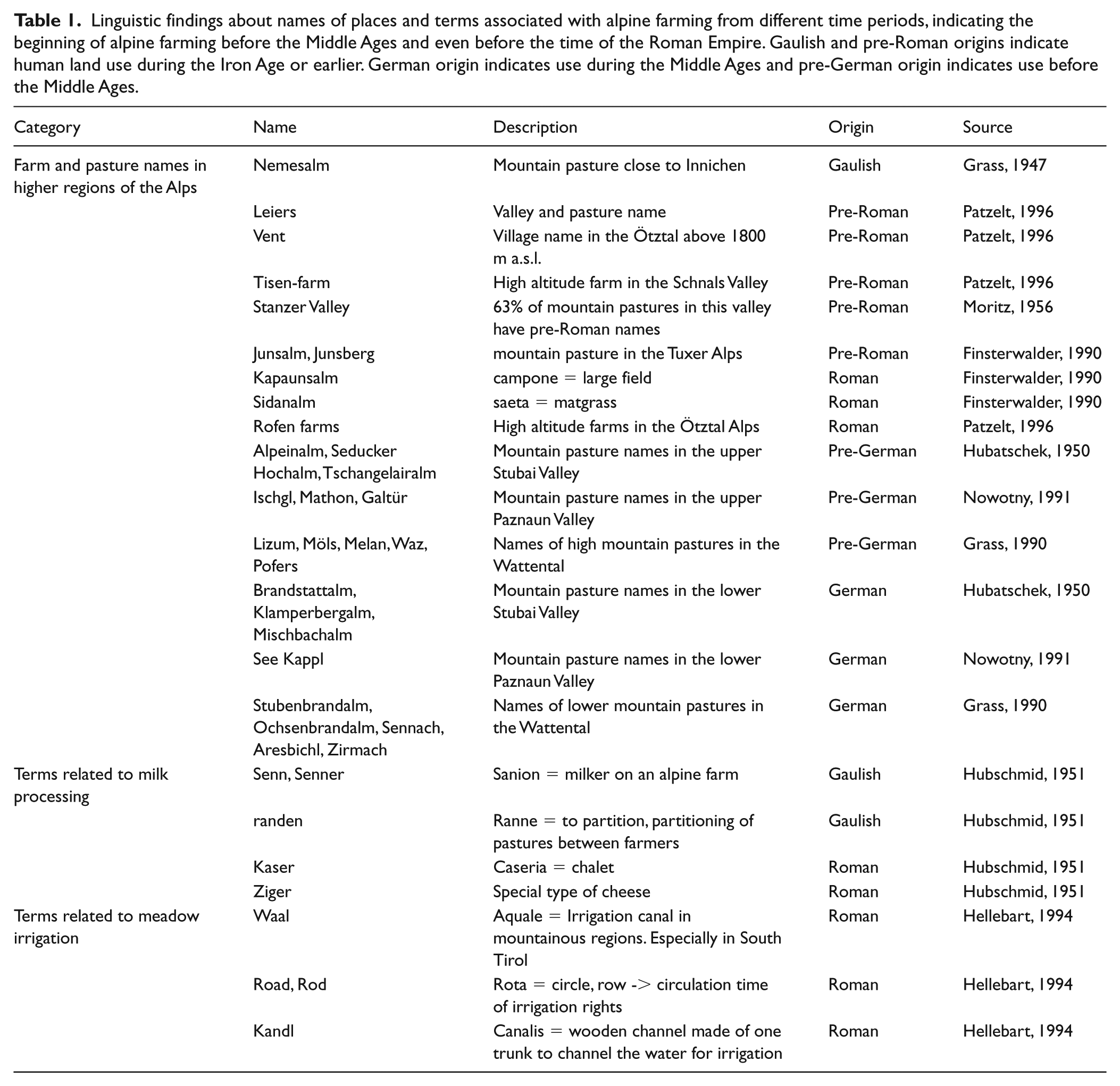
Later on, other scientists supported this thesis with further proof from different scientific disciplines. Pittioni (1931) suggested that alpine farming most likely took place already during the Bronze and Iron Ages. He mentioned many archaeological findings on present-day alpine farms that led him to this conclusion. Most of these artefacts included features like fireplaces, bronze or other metal tools, which suggest human presence at this time. Pittioni (1931), however, thought it was very reasonable to assume that people used these places as pastures, as many of these findings were made on present-day alpine pastures. Even more convincing, he cited linguistic studies according to which many places and meadows at high altitudes in the Alps have pre-German or Rhaetian (pre-Roman) names, which points to their pre-Roman origin (Pittioni, 1931; Wopfner, 1920, 1995). In Grass (1990) and Hubschmid (1951), an overview of the Roman and pre-Roman (often Gallic) terminology associated with milk processing and alpine farming was provided and serves as a further indicator for the beginning of alpine farming before the Roman Empire (see Table 1). Nowotny (1991), Finsterwalder (1990) and others conducted similar linguistic studies and found many pre-German names for places at high altitudes in the Alps (see Table 1). Interesting in this context is also the fact that places at the head of valleys often possess older, pre-German or even pre-Roman, names and places lower in the valleys have German names originating mostly from the Middle Ages (Grass, 1990; Hubatschek, 1950; Nowotny, 1991) (see also Table 1). This may indicate that colonization of these valleys started in the alpine belt where naturally open pastures above the treeline were used before the people turned to the lower forested and often steep slopes in search of more pasture grounds. Gleirscher (1985) also summarized many archaeological findings from high altitudes that indicate pasture usage at high altitudes in the Alps during the Bronze Age, but he is more careful with their interpretation. According to Gleirschner, alpine farming can be assumed, at least for the Roman period and the late Iron Age. During the Bronze Age, archaeological findings are not sufficient to prove the existence of alpine farming, but Gleirscher (1985) assesses a high likelihood for its presence at that time. In the following sections, different regions of the Alps will be addressed where more recent archaeological and palaeobotanical studies have been conducted in order to detect early human influence on alpine ecosystems.
Linguistic findings about names of places and terms associated with alpine farming from different time periods, indicating the beginning of alpine farming before the Middle Ages and even before the time of the Roman Empire. Gaulish and pre-Roman origins indicate human land use during the Iron Age or earlier. German origin indicates use during the Middle Ages and pre-German origin indicates use before the Middle Ages.
Ötztal Alps
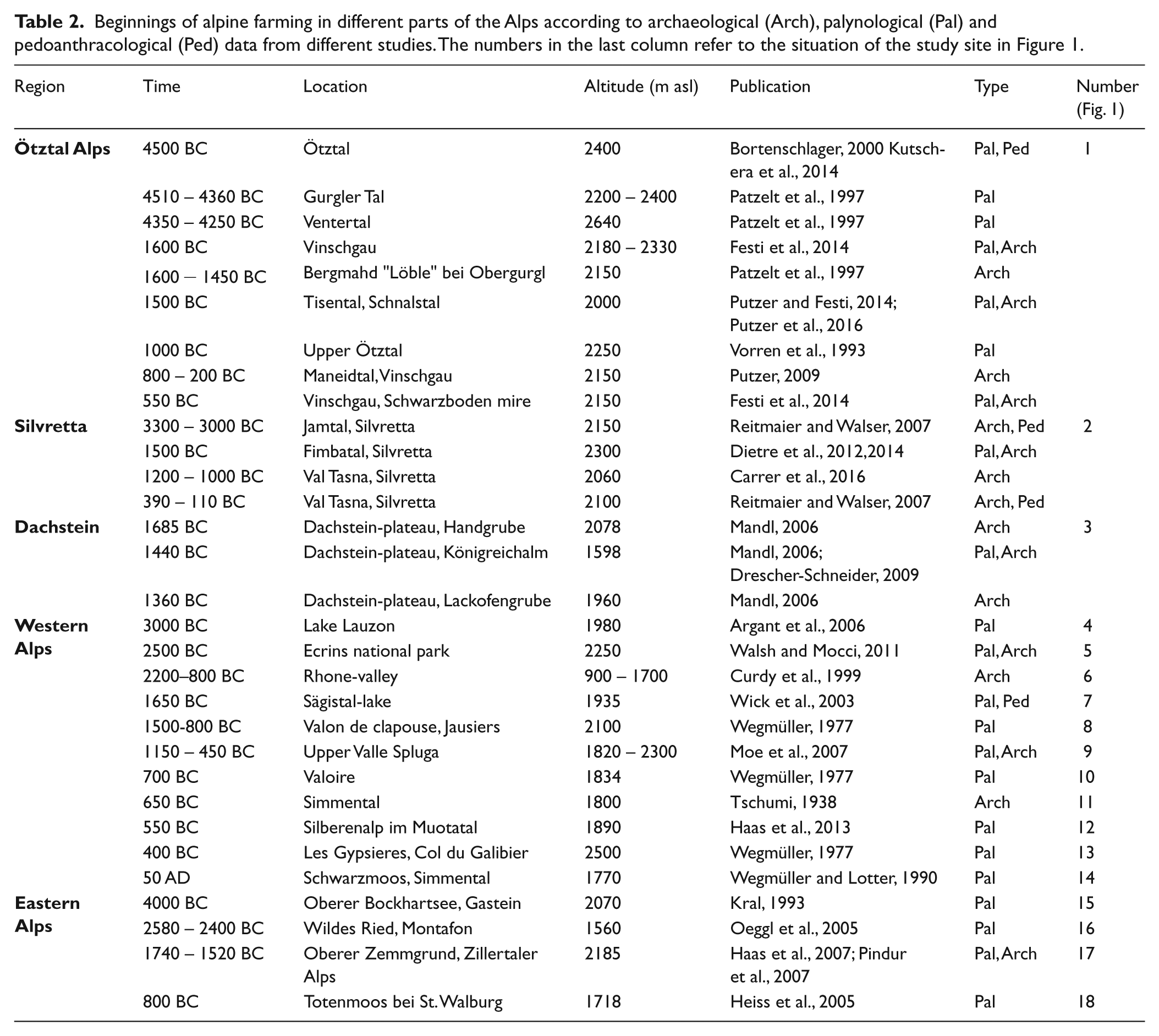
During the past few decades, three main areas with a focus on the research of the history of alpine farming in higher regions of the Alps emerged. The first and probably most intensively researched region evolved around the place of discovery of the 5000-year-old Iceman in the ‘Ötztal’, in the Central Alps. Researchers aimed to study the environment in which the Iceman lived and his way of life over 5000 years ago (Bortenschlager and Oeggl, 2012; Kutschera et al., 2014). In the valleys adjacent to the Tisenjoch where the iceman was found, archaeological and palaeobotanical studies were conducted to answer the question of whether the iceman was a hunter or a herder (Bortenschlager, 2000; Festi et al., 2014; Kutschera et al., 2014; Patzelt et al., 1997; Putzer, 2009; Putzer et al., 2016; Vorren at al., 1993). In most of the palaeobotanical studies, an increase in pasture indicator pollen types (for particular species see Supplemental Appendix) indicated the very early beginnings of pasturing above 2000 m a.s.l. around 4000–4500 BC in the Neolithic Age (Bortenschlager, 2000; Kutschera et al., 2014; Patzelt et al., 1997; Vorren et al., 1993). These results, however, can only indicate pasture use but fail to distinguish between nomadism, transhumance and alpine farming. Accompanying archaeological research revealed the remains from alpine huts above 2000 m a.s.l. that were dated to 1600 BC and therefore present definite proof of alpine farming in the Bronze Age (Festi et al., 2014; Patzelt et al., 1997; Putzer and Festi, 2014) (see also Table 2). In the ‘Maneidtal’ and around the ‘Schwarzboden’ mire in the ‘Vinschgau’ region, archaeological and palynological results yielded proof for first alpine farming during the Iron Age between 800 and 200 BC (Festi et al., 2014; Putzer, 2009). Here again, pasture indicator pollen from the palynological examination of the Schwarzboden mire and the accompanying discovery of Iron Age building remains provide strong evidence for alpine farming (Festi et al., 2014; Putzer, 2009). Thus, the matching of the results from both the palaeobotanical and archaeological research provides clear evidence for the existence of high-altitude pasturing and alpine farming in the Ötztal Alps, beginning at least in the Bronze Age and probably even earlier. Linguistic examination of farm names in the upper Ötztal also supports this hypothesis as many of the names have a pre-Roman origin (Finsterwalder, 1990; Patzelt, 1996) (see Table 1). Another noteworthy finding in this region is the discovery of irrigation sediments in the soil profiles from alpine pastures that date between 1600 and 1110 BC after a phase of intensive use as pastures (Kutschera et al., 2014; Patzelt et al., 1997). Irrigation of hay meadows in order to increase their productivity in the dry inner alpine valleys exists verifiably only since the Middle Ages (Poschlod, 2017; Poschlod et al., 2009). Linguistic findings, however, indicate irrigation already for the Roman Age as some terms for tools in the ancient irrigation systems are of Roman (Latin) origin (Hellebart, 1994) (see Table 1). The findings of dated sediments in soil profiles, which indicate artificial irrigation, suggest that irrigated hay meadows at considerable altitude might have existed even before that (Kutschera et al., 2014; Patzelt et al., 1997).
Beginnings of alpine farming in different parts of the Alps according to archaeological (Arch), palynological (Pal) and pedoanthracological (Ped) data from different studies. The numbers in the last column refer to the situation of the study site in Figure 1.
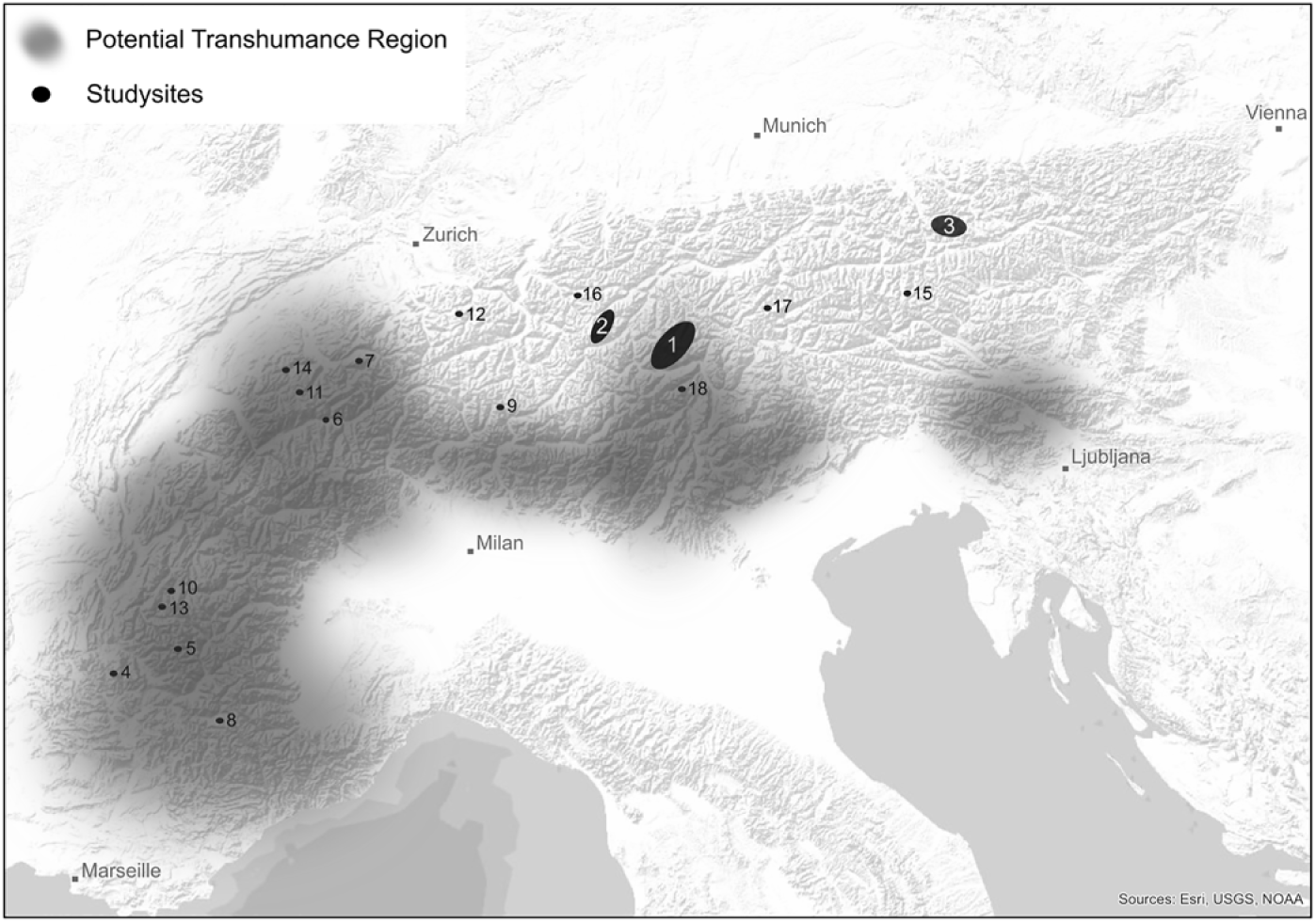
Overview map of the study sites mentioned in this review. Numbers of the study sites correspond to the numbers in Table 2. Potential transhumance regions are marked according to Braudel (1985). The remaining uncoloured regions of the Alps are regions where mainly alpine farming takes place because the winters in the lowands are too cold and too rich with snow, so that the animals cannot graze outside.
Dachstein
Beginning from 1980 the Association for Alpine Research, Rock Art and Settlement in the Alps ‘ANISA’ established another hotspot for the research of alpine farming in the history of the Alps in the ‘Dachstein’ region in Austria. The group around Franz Mandl discovered many archaeological artefacts providing evidence of alpine farming in pre-Roman times. Most important among these finds are the foundations and remains of alpine huts together with bones from livestock that date back to the Bronze Age and doubtlessly prove the existence of alpine farming during that time (Mandl, 2006). An additional palynological study of a mire close to the archaeological sites confirmed these findings with increasing pasture indicator pollen types and an increase in non-arboreal pollen during the Bronze Age (Drescher-Schneider, 2009). This makes the ‘Dachstein’ plateau one of the best-researched areas in the Alps to date. Radiocarbon dating of material from the archaeological sites and from the pollen profile dated the beginning of alpine farming between 1685 and 1360 BC (Cerwinka and Mandl, 1996; Hebert et al., 2007; Hebert and Mandl, 2009; Mandl, 2006, 2009; Mandl and Mandl-Neumann, 1990; Mandl and Stadler, 2010; Pucher, 2010) (see also Table 2). This first occurrence and high intensity of alpine farming in the Dachstein region correlates strongly with the salt mining activities in Hallstatt, in the close vicinity (Barth, 1998) and the climate optima that occurred during that time (Poschlod, 2015). This indicates that alpine farming could have developed as a way to supply food to the mining communities in the valley where sufficient land for crop cultivation and pastures was not yet in existence.
Silvretta
A third hotspot for the research on alpine farming in history formed in the Silvretta mountains where fireplaces and archaeological artefacts at high altitudes (>2000 m a.s.l.), dating as far back as 9000 BC, proved early human presence in this area (Reitmaier and Walser, 2007; Reitmaier, 2012). Palaeobotanical data confirmed very early human land-use activities at high altitudes, where pollen of the first pasture indicator species appeared around 4200 BC and charcoal findings indicate the first forest clearings at the same time (Dietre et al., 2012, 2014, 2017; Kothieringer et al., 2015). The oldest archaeological remnants of seasonal settlements, found above 2000 m a.s.l., were dated to the late Neolithic period (around 2800 BC). Big ceramic vessels that could have been used to transport and store food and evidence of fire in peat deposits and soil profiles suggest the presence of seasonal settlements during that time (Kothieringer et al., 2015). Clear proof for alpine farming emerges after 2200 BC in the Bronze Age. Dietre et al. (2012) found evidence of Bronze Age alpine huts at 2300 m a.s.l. in the Fimba Valley and conducted a pollen analysis that confirmed these results. Findings of the remains from a shelter and a corral at 2100 m a.s.l. in the neighbouring Tasna Valley, dating back to the late Iron Age (390–110 BC) confirmed (pre-)Roman farming at these altitudes (Reitmaier and Walser, 2007). The discovery of dairy fats on clay pots from three different sites between 2000 and 2400 m a.s.l. in the Silvretta mountains, dating back to the Iron and Bronze Ages undoubtedly proved alpine farming and dairying for this time (Carrer et al., 2016). These findings also demonstrate that despite the aforementioned difficulties of archaeological research in the Alps, research in this field and new advancements in archaeological scientific methods can yield promising results.
Western Alps
Apart from these three centres of alpine farming research, many more studies have been conducted all over the Western Alps (see table 2). Most of them rely only on palynological data (Argant et al., 2006; Haas et al., 2013; Moe et al., 2007; Wegmüller, 1977; Wegmüller and Lotter, 1990; Wick et al., 2003). They also confirm the use of alpine pastures with an increase in non-arboreal pollen and pasture indicators during the Bronze and Iron Ages but the exact form of pasture use remains unclear due to the lack of other research methods that could provide clear proof or provide alternative lines of evidence to the results from the pollen analysis. In the Ecrins National Park, however, the combination of archaeological and palynological research provided solid evidence for the beginning of alpine pasture use around 2500 BC at altitudes around 2000 m a.s.l. and above (Walsh, 2013; Walsh and Mocci, 2011). In these studies, archaeological findings from remains of livestock corrals and the increase of indicative pollen types from peat cores in the close vicinity of the sites clearly point to human presence and pasturing beginning around 2500 BC. Curdy et al. (1999) and Curdy (2007) summarized archaeological findings (settlements, tombs, isolated artefacts, deposits, cultural areas) from the Rhone Valley at altitudes between 900 and 1700 m a.s.l. and concluded that intensified land use at higher altitudes and the locally typical alpine farming system called ‘remuage’ (a form of seasonal nomadism) slowly began to form in the Bronze Age and clearly manifested itself during the Iron Age after 800 BC. This mainly confirms the results from palynological data throughout the West Alps and complements the findings in other parts of the Alps.
Eastern Alps
In the Eastern Alps, apart from the two mentioned hotspots for alpine farming research in the Ötztal and Dachstein area, scientists conducted more palaeobotanical studies at high altitudes. One emphasis was made on the vegetation and settlement history in the Montafon region. Pollen analysis indicated that the first human impact at higher altitudes started at the transition from the Neolithic Age to the Bronze Age (~2500 BC). First pasture use with increasing numbers of pasture indicator pollen and micro-charcoal influx presumably occurred at the end of the early Bronze Age (Kostenzer, 1996; Oeggl et al., 2005; Schwarz et al., 2013). However, it remains unclear which form of land use was present and the study lacks clear evidence of alpine farming in pre-Roman times. Another palynological study in the adjacent area confirms Bronze Age forest clearings and possible alpine farming on a present-day alpine farm at 1960 m a.s.l. (Wahlmüller, 2002). The palynological study of Kral (1993) with sediments of the ‘Oberer Bockhartsee’ in the Gastein region dated the beginning of forest clearings (micro-charcoal influx) and following pasture use (increase in pasture indicator pollen types) very early to 4000 BC. That is a confirmation of the palynological studies from the Ötztal Alps where the first human influence on the alpine and subalpine vegetation was dated to roughly the same period (see above and Table 2). In spite of that, these results have to be interpreted with caution. Reitmaier (2010a, 2010b) stated that changes in the vegetation according to pollen profiles can serve only as an indicator of human impact in general and that it is very difficult to deduce any specific land use type from this kind of data. Similar palynological studies in the ‘Zemmgrund’ Valley in the Zillertal Alps also indicated Neolithic pasturing beginning around 4100 BC and intensifying with fire clearings of the forest and increasing pasture indicators in the pollen profiles during the Bronze Age (Haas et al., 2007). Additional findings of a fireplace from around 1600 BC confirmed human presence in this area at that time (Pindur et al., 2007). In a short summary of palynological records in the Eastern Alps, Oeggl (1994) observed that pasturing has an older history at higher altitudes, and subalpine or montane pastures are generally younger. This would also complement the results of the aforementioned linguistic studies of farm names (see Table 1). These publications confirm the idea that first pastures in the Alps were situated above the natural treeline and from there early farmers moved to lower altitudes by clearing the forest and establishing new pastures below the forest line.
Conclusion
In conclusion, we can state that there is good evidence for alpine farming with findings of archaeological remains from seasonal huts beginning in the Bronze Age at subalpine to alpine altitudes. Archaeological and palynological data as well as linguistic findings from many different studies and different study areas come to the same conclusion. The data also indicates pasturing activity at high altitudes much earlier during the Neolithic age. Palynological studies found indicators for pasture use beginning from 4500 BC (Figure 2). The exact type or intensity of pasture use though remains unclear. Up to now no archaeological evidence of seasonal shelters, huts or livestock corrals dating to that time is available. Therefore, we can state with certainty that alpine farming was present in the Alps during the Bronze Age whereas for the Neolithic Age we can only assume unspecified pasture use at high altitudes in the Central Alps. More research in this field is necessary, especially archaeological investigation of areas where palynological and pedoanthracological results showed forest clearings and occurrences of pasture indicator pollen during the Neolithic period would be promising study areas. Nevertheless, the results of this review demonstrate, that alpine farms are not only worth protecting because of their positive effect on biodiversity but also because of their long history, which makes them cultural monuments of great value for our society (see Poschlod, 2017).
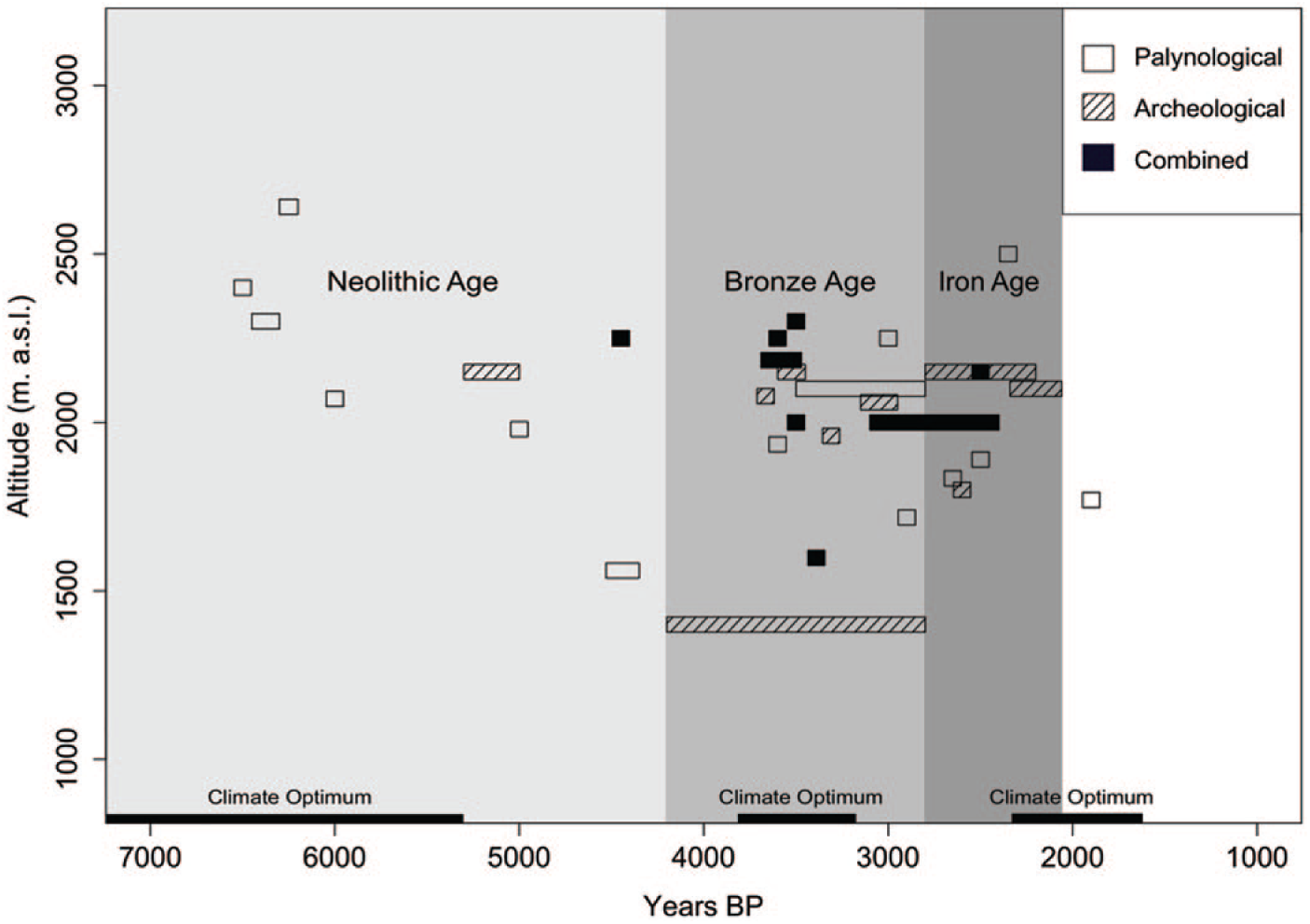
Beginning of alpine farming at different altitudes presented by the different types of approaches. Data from the studies in Table 2 were used to generate this graph.
Supplemental Material
Pasture_Indicator_Pollen – Supplemental material for The origin of alpine farming: A review of archaeological, linguistic and archaeobotanical studies in the Alps
Supplemental material, Pasture_Indicator_Pollen for The origin of alpine farming: A review of archaeological, linguistic and archaeobotanical studies in the Alps by Fridtjof Gilck and Peter Poschlod in The Holocene
Footnotes
Acknowledgements
The authors thank Christoph Rust for his help with illustrating the results of the most important studies in this review. They are also thankful to Claudia van der Stock for language editing.
Funding
The author(s) received no financial support for the research, authorship and/or publication of this article.
Supplemental material
Supplemental material for this article is available online.

References
Supplementary Material
Please find the following supplemental material available below.
For Open Access articles published under a Creative Commons License, all supplemental material carries the same license as the article it is associated with.
For non-Open Access articles published, all supplemental material carries a non-exclusive license, and permission requests for re-use of supplemental material or any part of supplemental material shall be sent directly to the copyright owner as specified in the copyright notice associated with the article.
