




Abstract
The empirical literature is divided on whether job tenure has declined or remained stable in Europe in recent decades. We argue that three analytical decisions explain the lack of consensus: whether researchers focus on men or women, whether they control for changes in labour market composition and whether the period under study is marked by a recession or a boom. We show the influence of these three decisions by analysing change in job tenure for France, Germany, Italy, Poland, Spain and the UK using two leading surveys: the European Labour Force Survey 1993–2021 and the European Working Conditions Survey 1995–2021. The results show that the share of workers remaining with the same employer for 10 years or more was stable at around 50%. Similarly, the average job tenure remained constant over time – at about 11 years – between 1993 and 2021. Trends in job tenure differ by gender. While the tenure of men remained stable or declined, the tenure of women increased. The stability in job tenure was due to the ageing of the workforce. For a given age, job tenure was shorter in the early 2020s than in the early 1990s.
Introduction
In the public debate, there is a consensus that long-term employment has declined, workers being no longer able to expect to stay with the same organization for several decades. This position is exemplified by the career counselling literature and the influential life design theory, whose leading proponent, Mark Savickas, argues that ‘the 21st century has brought a new social arrangement of work in which temporary assignments and time-limited projects replace permanent jobs … [This] calls for viewing career not as a lifetime commitment to one employer but as a recurrent selling of services and skills to a series of employers who need projects completed’ (Savickas, 2012: 13).
However, the empirical evidence on job tenure is far from unanimous. To begin with, historical analyses show that even in the post-war decades, long-term employment was the exception rather than the norm (Booth et al., 1999; Copeland, 2019; St-Denis, 2021). Moreover, findings on the recent evolution of job tenure, measured as the duration a worker has been continuously employed by the same employer, are also ambiguous. For Europe in the 21st century, empirical studies vary between trendless fluctuation (Bachmann and Felder, 2018; Cazes and Tonin, 2010; Doogan, 2005; Eurofound, 2015) and declining job tenure (Bussolo et al., 2022; Gregg and Wadsworth, 2002; OECD, 2019; St Denis and Hollister, 2023a). The results for the US do not paint a clear picture either. Recent analyses of the Current Population Survey show either increases (Copeland, 2019; Hyatt and Spletzer, 2016), decreases (Farber, 2010; Hollister and Smith, 2014) or stability in job tenure over time (Molloy et al., 2021).
Our study revisits this debate on the evolution of job tenure and focuses on three analytical decisions made by researchers. First, researchers often decide to present their findings on job tenure for men and women together. However, across the Western world, stable measures of job tenure over the last decades tend to mask declining tenure for men and increasing tenure for women (Bussolo et al., 2022; Gregg and Wadsworth, 2002; Hollister and Smith, 2014; St Denis and Hollister, 2023a). Second, researchers may choose to control – or not control – for changes in labour market composition. If the question is descriptive and focuses on what has happened to the tenure of existing jobs, the answer is an unconditional model. If the question is about what would have happened to job tenure if labour market composition and, notably, age had remained constant over time, the answer is a conditional model. Third, researchers focus on different periods that are marked by different business cycles, which may crucially affect the trend in job tenure. Voluntary separations and new hires increase during economic booms, but drop during crises (Farber, 2010). As a result, job tenure falls when the economy is strong and rises during recessions (Gregg and Wadsworth, 2002; Hyatt and Spletzer, 2016). Because of these cyclical fluctuations, the analysis of job tenure may show different trends depending on the range of years considered.
Our paper aims to unravel these threads in the job tenure debate by providing evidence for Europe. We do so by analysing the change in job tenure over the last three decades in the six most populous countries of Western Europe, namely, France, Germany, Italy, Poland, Spain and the UK. Our paper makes three contributions. First, we discuss the reasons why the research literature on job tenure has produced divergent results on the evolution of tenure in recent decades in Europe. Second, we replicate earlier analyses that used the European Labour Force Survey to trace change in job tenure, such as Cazes and Tonin (2010), Bachmann and Felder (2018) or Bussolo et al. (2022), but we cover a longer period and, above all, we use a second high-quality data source, the European Working Conditions Survey, to increase the robustness of our findings. Third, we show that our result of stable job tenure is due to opposing trends between men and women, as well as the ageing of the workforce. Without demographic ageing, job tenure in Europe would not have remained constant, but fallen. For a given age, job tenure was shorter in the 2020s than in the 1990s. However, because workers were older in the 2020s than in the 1990s, the average duration of jobs remained stable.
Literature review
Drivers of trends in job tenure
In the discussion of job tenure, three developments are used to argue why labour market turbulence should have increased and work careers become more fragmented. First, technological progress has shifted employment from longer-term manufacturing jobs to shorter-term service jobs in recent decades (Molloy et al., 2021). In parallel, advances in information technology may have increased both voluntary labour mobility by facilitating job search and involuntary labour mobility by displacing workers through automation (OECD, 2019). Second, globalization may have amplified this effect by creating larger markets and improving job opportunities for some workers, while exposing others to international competition and the risk of job loss. Third, the political consensus favouring long-term employment relationships became weaker after the 1970s when the Keynesian class compromise, based on full employment and collective bargaining, fell apart (Temin and Levy, 2007). As the balance of power shifted from labour to capital, employers regained greater discretion in hiring and firing, and the social norm of retaining long-term employees eroded (Kalleberg, 2009).
As a result of these shifts in technology, trade and politics, long-term jobs were seen as having gone from the norm to the exception: ‘The most tangible sign of change [in the global marketplace] might be the motto “no long term”’ (Sennett, 1998: 22). However, long-term jobs were never the norm. Findings for the UK show that among early baby boomers (born 1947–1952) aged 55 who were in employment, only a third of men and less than a fifth of women had held their jobs for more than 20 years (St-Denis, 2021). While long-term employment was more common among higher-educated native-born men, this model never applied to the labour market experiences of migrants, women and workers without tertiary education, notably low-skilled workers (St-Denis, 2021: 261). While work history data for Britain, collected in 1993 and covering the second half of the 20th century, suggests that job tenure may have been longer for earlier birth cohorts (Booth et al., 1999), German life history data shows stability of work biographies over time for cohorts born between 1929 and 1971 (Mayer et al., 2010).
Evidence for a generalized decline of job tenure is also ambiguous for the United States. A careful descriptive analysis of both the Current Population Survey (CPS) 1951–2014 and the Longitudinal Employer–Household Dynamics data 1998–2014 shows stability in the US job tenure between the 1950s and 2000s and a shift toward longer-term jobs thereafter (Hyatt and Spletzer, 2016). This finding contrasts with the conclusion of a multivariate model using the CPS 1983–2012 that job tenure declined if the workforce composition is held constant over time (Hollister and Smith, 2014). The same disparity exists for Europe, where some studies based on the European Labour Force Survey report stability in job tenure over the early 2000s (Bachmann and Felder, 2018; Cazes and Tonin, 2010; Doogan, 2005; Eurofound, 2015), while others using the same data report a decline (Bussolo et al., 2022; OECD, 2019). For France, register data for the period 1985–1999 show a slight decrease in mean tenure in the late 1980s and stability in the 1990s (Duhautois, 2006: 6). A similar pattern has been observed for Spain based on the Labour Force Survey, with declining tenure between 1987 and 1990 and stability between 1990 and 2003 (Arranz and Garcia-Serrano, 2007).
Diverging trends in job tenure by gender
It is unlikely that changes in job tenure have been massive when authors using the same surveys disagree about the trend line. It is nonetheless insightful to look at the reasons for their disagreement, which are linked to three analytical decisions.
The first decision is to aggregate the results by gender. The relative stability of overall job tenure hides contrasting trends for men and women. Over the last few decades, the decline in job tenure for men has been offset by an increase for women – in the US (Copeland, 2019; Farber, 2010; Hollister and Smith, 2014; Molloy et al., 2021), Canada (St-Denis and Hollister, 2023b), Ireland (Murphy and Turner, 2023), Spain (Arranz and Garcia-Serrano, 2007), the UK (Gregg and Wadsworth, 2002) and Europe, more generally (Eurofound, 2015). An analysis of the European Labour Force Survey finds that between 1995 and 2020, average job tenure decreased from 11.1 to 10.7 years for men but increased from 9.2 to 9.9 years for women (Bussolo et al., 2022: 38). To a large extent, the increase in job tenure was driven by women with dependent children whose employment careers became less affected by maternity breaks.
The slow convergence of men’s and women’s job tenure reflects the sustained increase in women’s labour market participation over recent decades, while men’s participation has stagnated. The same trend can be observed for usual weekly working hours, which increased by 1.3 h for women and decreased by 0.5 h for men in the OECD between 1993 and 2022 (OECD statistics). Although most countries are still far from full labour market equality, women’s life courses have become more similar to men’s over time (Goldin and Mitchell, 2017).
Disagreement about control variables
A second decision involves the inclusion of control variables in the analysis of job tenure, which results in differing time trends. If the question is whether long-term jobs have become rarer, the unit of analysis are jobs (rather than workers) in a given labour market. For this descriptive question, the answer is the unconditional mean duration of existing jobs. If, instead, the question is how workers' career stability has evolved, the focus may shift to the comparison of workers from different birth cohorts at the same age. For this question, the answer is the average duration that a given worker spends in a given job at a given age.
We would argue that the primary goal of the job tenure literature is descriptive, trying to document what happened to existing jobs rather than to shed light on the counterfactual scenario of what would have happened if everything else had remained equal. This warrants an unconditional model, analogous to research on time trends in household income (e.g. Nolan, 2018; Saez and Zucman, 2020). Instead, conditional models show what would have happened if the composition of the workforce had remained stable over time, typically controlling for changes in labour demand (e.g., sectoral and occupational shifts) and labour supply (e.g., trends in age and education). However, if the change in tenure is jointly driven by technology, globalization and politics (e.g., educational expansion and pension reforms), it makes no sense to hold constant the influence of educational and demographic shifts. It seems somewhat academic to show what job tenure would have looked like if deindustrialization and occupational upgrading, educational expansion and population ageing had not occurred and if the labour force were dominated by mid-aged manufacturing workers with secondary education.
We are, therefore, not fully convinced by models of job tenure that control for workers’ education, migrant origin or job characteristics, such as sector and occupation. However, the status of two covariates is more ambiguous, namely, sex and age. Over recent decades, European workforces have become more female and older. Population ageing in general, and the postponement of the statutory retirement age in particular, have increased the share of older workers, who accumulate longer tenure than young workers. Several studies show that in the absence of workforce ageing – if age had remained constant over time – average job tenure would not have been constant but dropped over recent decades (Bachmann and Felder, 2018; Bussolo et al., 2022; Molloy et al., 2021). It is therefore insightful, even in a descriptive analysis, to examine what happened to the job tenure of population subgroups, notably men and women, and various age groups.
The business cycle and job tenure
A third and final decision that may explain some of the literature’s disagreement over trends in tenure concerns the influence of the business cycle. When an economy runs at full capacity and unemployment is low, more workers switch jobs, and job-to-job transitions increase. Conversely, during labour market downturns, workers stay put in their jobs and the quit rate declines. Since voluntary quits in good times dominate involuntary layoffs in bad times, job tenure falls in boom periods and rises in recessions (Farber, 2010; Gregg and Wadsworth, 2002). The countercyclical nature of job tenure is illustrated by the increasing tenure in the US after the Great Recession 2008 (Hyatt and Spletzer, 2016). For this reason, time trends in job tenure may vary depending on the start and end years of a given analysis.
More fundamentally, the counter-cyclical component of tenure also implies that an increase in job tenure is not necessarily good news if it is driven by the disproportionate destruction of low-tenure jobs and fewer hires during recessions. Nor is a decrease in job tenure necessarily bad news if it is due to increased job-to-job mobility and many new hires during economic boom periods. In this sense, downward fluctuations in job tenure may not always be the signs of declining job security that they are perceived to be (Hollister, 2011; St Denis and Hollister, 2023a). If researchers are interested in the phenomenon of job insecurity, there are better measures than job tenure. However, note that subjective measures of job insecurity also seem to be constant over time. A comprehensive analysis of perceived job security in large surveys shows no clear trend over the last three decades in Britain, Germany or the US (Manning and Mazeine, 2024).
Countries, data and analytical strategy
Our analysis aims, first, to accurately describe the evolution of job tenure in Western Europe and, second, to show how the empirical findings change depending on the three analytical decisions outlined above. We cover a period of almost three decades (1993–2021) and focus on Western Europe’s six most populous countries: Germany (DE), France (FR), Italy (IT), Spain (ES), Poland (PL) and the United Kingdom (UK) (Eurostat, 2021) 1 . Our primary interest is not comparative and in explaining country differences, but in seeing whether the same trend in job tenure can be found across large labour markets in Europe.
Given the disagreement in the literature on the trend in tenure, we increase the robustness of our results by following the practice of ‘identical analysis of parallel data’ (Firebaugh, 2008) and use two different surveys, the European Labour Force Survey (EU-LFS) and the European Working Conditions Survey (EWCS). The EU-LFS is the largest European survey on labour participation of people aged 15 and over, whereas the EWCS focusses on working conditions in Europe. While the EU-LFS is a yearly (and quarterly) survey, the EWCS is carried out every 5 years. Our analysis for EU-LFS covers every year over the period 1993–2021, and the EWCS provides information on 6 years: 1995, 2000, 2005, 2010, 2015 and 2021.
The debate on the decline of stable long-term jobs focuses mainly on the standard employment relationship. We therefore restrict our analytical samples in both surveys to employees aged 25 to 64 who work for at least half-time and thus 20 h per week. Besides the self-employed, very young and older individuals, this restriction excludes workers with a marginal attachment to the labour market, such as students or early retirees with small part-time jobs. As most part-time employment is in jobs of 20 h or more, 2 our restriction of 20 h reduces our sample by only 7% and leaves us with large annual analytical samples: for Germany, 91,243 (EU-LFS) and 1481 (EWCS) observations. For France, 85,231 (EU-LFS) and 1292 (EWCS). For Italy, 95,232 (EU-LFS) and 904 (EWCS). For Poland, 59,193 (EU-LFS) and 902 (EWCS). For Spain, 36,231 (EU-LFS) and 1140 (EWCS). For the UK, 31,716 (EU-LFS) and 907 (EWCS).
Both samples contain more men than women: 55% of workers are male in the EU-LFS and 53% in the EWCS. The mean age in the two samples is almost identical, with 42.5 years in the EU-LFS and 42.2 years in EWCS. Descriptive statistics can be found in Tables A1 and A2 in the Appendix. Our analysis with the EU-LFS uses cross-sectional sample weights where available. As weights were calculated differently in the EWCS for the last wave 2021, we chose not to include them. When presenting and discussing results, we give stronger emphasis to the EU-LFS because it is based on larger samples (note that the EWCS uses the EU-LFS to calibrate its weights).
Our main variable of interest is job tenure, which is measured as the number of years a worker has continuously been employed by the same organization or company, in the same or different positions. Given that these employment relationships were still in progress at the moment of the survey, this variable does not reflect completed job tenure but elapsed job tenure with a worker’s current employer. 3 To get a better handle on long-term employment, we also present results for a categorical measure of job tenure where we distinguish long tenure (10 years and more), medium tenure (2 to less than 10 years) and short tenure (less than 2 years).
In order to show how different analytical decisions affect the findings for job tenure, we first present the unconditional evolution of job tenure over time for the entire workforce in a given country. We then show how findings for job tenure change if we separate men and women, and if we control for the ageing of the workforce. Finally, we show how business cycle fluctuations affect the time trend in job tenure by controlling for national yearly unemployment rates, following the strategy used by Gregg and Wadsworth (2002). To do so, we first estimate a linear regression on job tenure with year dummies as independent variable for each country. We then extract the predicted yearly values for job tenure from this model and regress these predictions on a linear time trend and the yearly national unemployment rate (taken from OECD, 2023). This provides us with a time trend in tenure, net of business cycle fluctuations.
Results
The trend in job tenure across countries
Figure 1 provides descriptive evidence for the trend in job tenure over the last three decades, and Table 1 shows the numerical values for the start and end years. The two surveys lead to very similar results in terms of overall job tenure: mean tenure in the six countries under study was 10.9 years in 1993 based on the EU-LFS and 11.2 years in 1995 based on the EWCS. In 2021, values of mean tenure remained basically unchanged: 11.1 years according to the EU-LFS and 11.2 years according to the EWCS. Mean job tenure in European countries in years, EU-LFS and EWCS. Mean job tenure (in Years) by country, start and end years. Note: Totals for the EU-LFS and the EWCS are means of country means, where each country is counted equally. Italic values show the difference (delta). aPoland’s first year in our study was 2001 in the EU-LFS and 2000 in the EWCS. bUK’s last year was 2019 in the EU-LFS.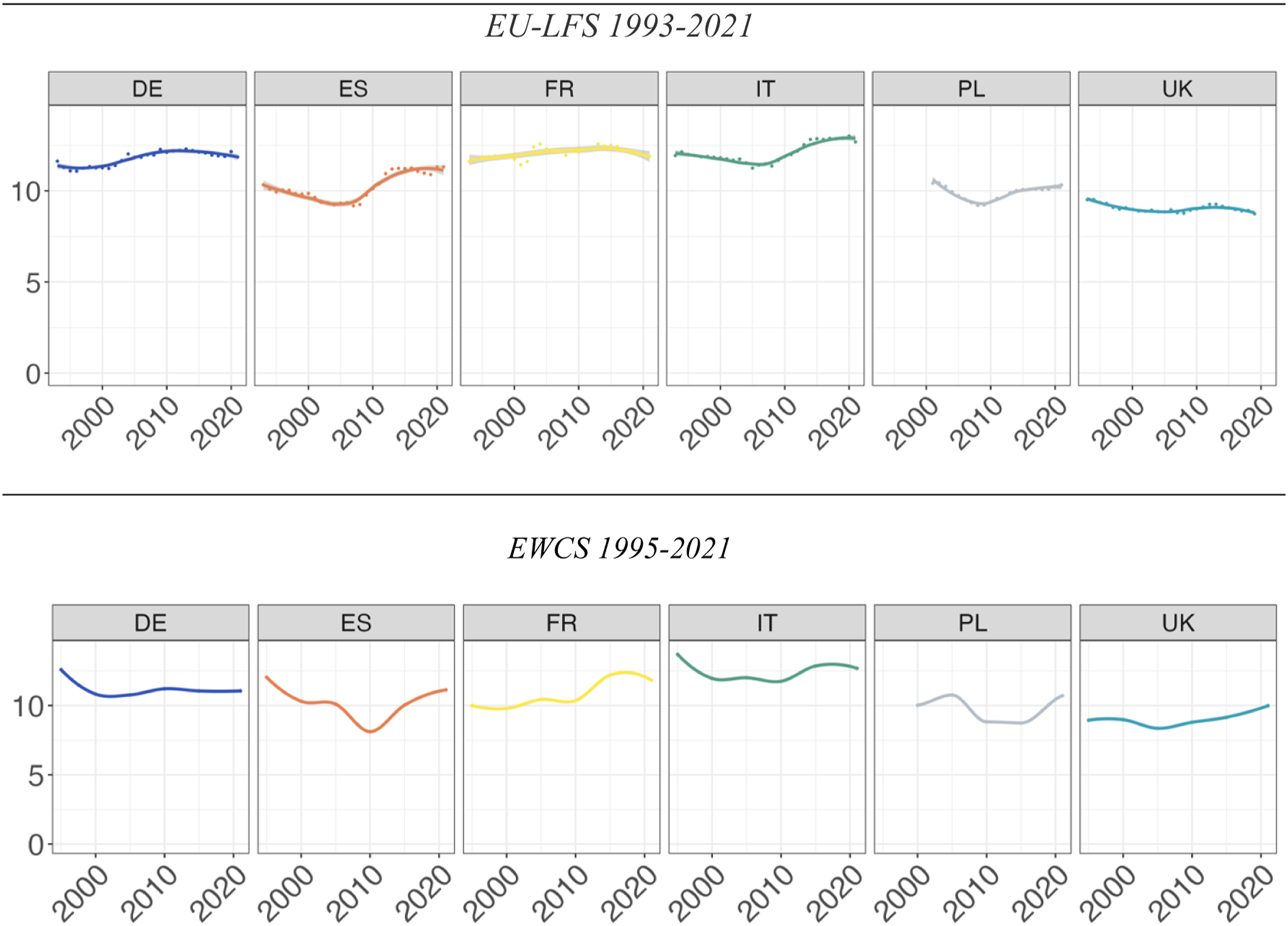
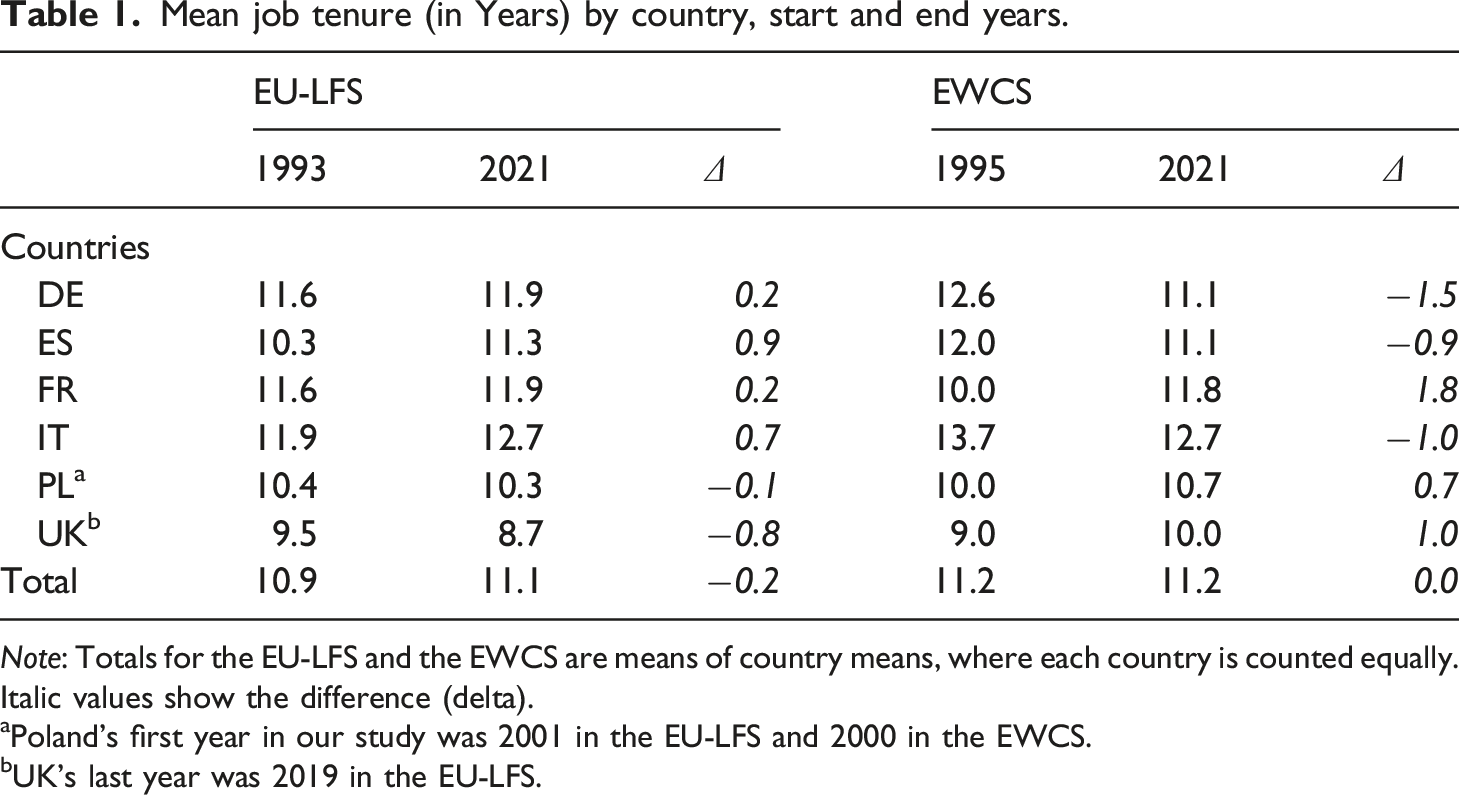
Based on the EU-LFS, we observe an increase in job tenure from 11.9 to 12.6 years in Italy and from 10.3 to 11.2 years in Spain, whereas job tenure decreased in the UK from 9.5 to 8.7 years. For France, Germany and Poland, there was basically no change in job tenure over time. The trends are somewhat different according to the smaller samples of the EWCS, which show increasing job tenure in France, Poland and the UK, but decreasing tenure in Germany, Italy and Spain. While the evolution of job tenure over time is thus uncertain, the two surveys agree that job tenure is longest in Italy and shortest in the UK. While workers in Southern Europe have, on average, longer tenure than their counterparts in Northern Europe (Bussolo et al., 2022), the outlier is the UK where workers’ mean tenure is about 2 years (or 20%) shorter than in the other major European countries. Our analysis suggests that this difference cannot be explained by differences in age structure, the business cycle or the larger service sector in the UK. Instead, the shorter average tenure may be related to the British model of capitalism and its weaker legal regulation of the labour market (Hyman, 2008). A similar argument may help to explain the shorter average tenure in Poland.
Figure 1 provides more information on the year-to-year evolution of job tenure for each country. In some countries, such as Italy, Poland, Spain and the UK, the evolution shows a U-shaped pattern, with tenure decreasing before the Great Recession and increasing afterwards. This confirms previous findings that the short-term evolution of job tenure is influenced by the business cycle. The counter-cyclical evolution of job tenure is particularly evident in Italy and Spain, where tenure declined during the boom of the early 2000s, followed by a significant increase after 2008. However, a key message from Figure 1 is the lack of a linear trend in job tenure over the last three decades. There is nothing to suggest that there has been a fundamental shift in the average tenure of existing jobs in the large Western European countries over the last few decades.
The literature on boundaryless careers stresses the disappearance of long-term jobs. We therefore shift the focus from changes in mean job tenure to changes in the distribution of job tenure. For this reason, Figure 2 shows how the share of jobs with short (less than 2 years), medium (2 to less than 10 years) and long tenure (10 years and more) has changed over time. Evolution of job tenure in three categories, EU-LFS and EWCS. Note: Long tenure: 10 years or more; Medium tenure: 2 – less than 10 years; Short tenure: less than 2 years.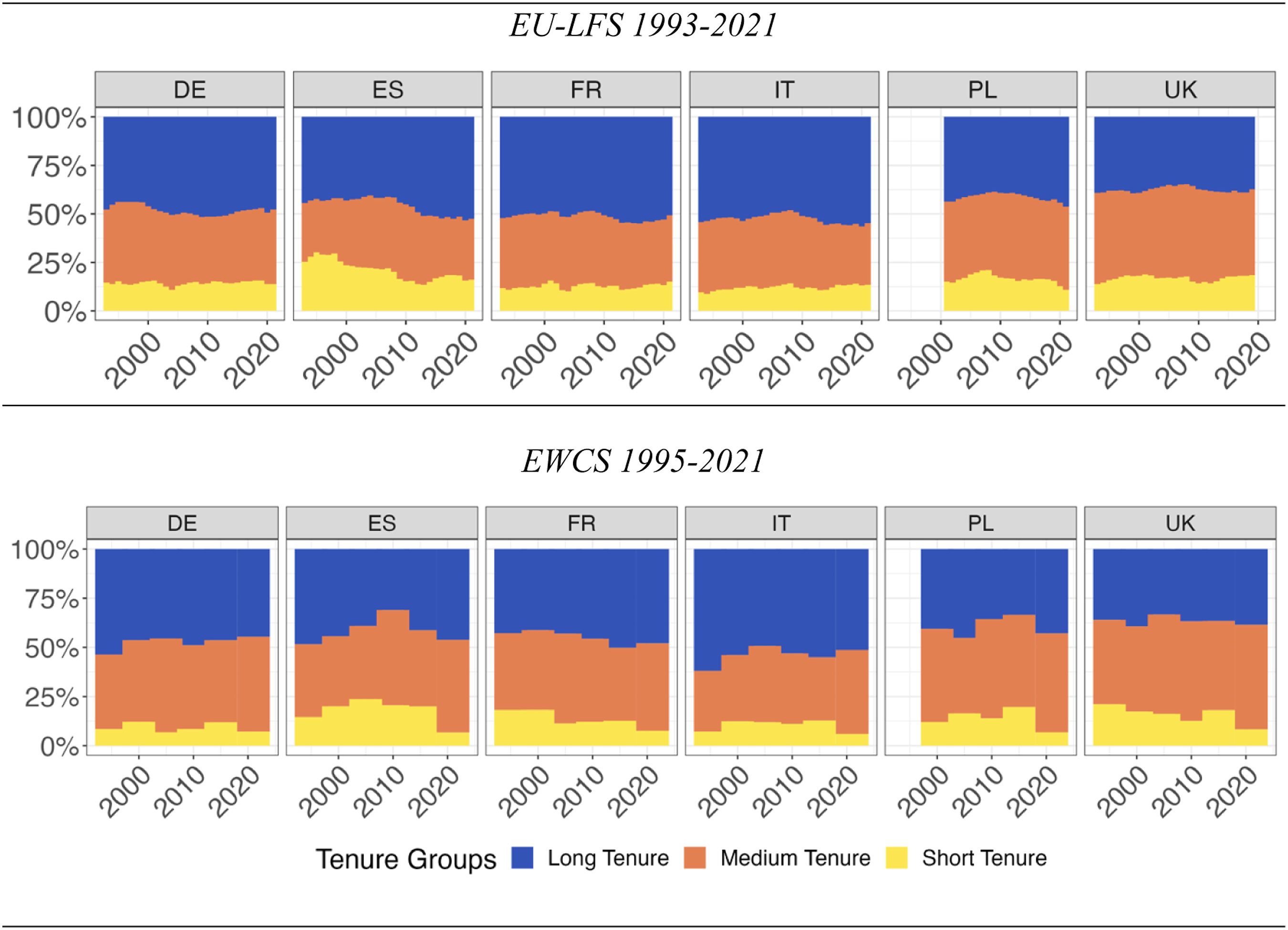
These results do not show a decrease in long-term jobs. According to the EU-LFS, between 1993 and 2021 the share of jobs lasting at least 10 years remained unchanged in Germany (48% of all jobs), France (51%–52%) and Italy (54%–55%). There was a small increase in Poland (from 44 to 46%) and a small decrease in the UK (from 39 to 37%), but the only notable shift took place in Spain where the share of long-term jobs increased from 44 to 52% after the Great Recession hit Spain particularly hard. Overall, about half of all jobs lasted for at least 10 years in 2021 – essentially the same proportion as in 1993. The findings based on the EWCS are similar: The share of long-term employment relationships fell slightly in Germany and Italy, rose slightly in France and the UK, and fluctuated without trend in Poland and Spain.
Job tenure by gender and age
We do not observe any time trend in overall job tenure, but the situation may be different for particular subgroups. We first distinguish the evolution of job tenure for men and women. Figure 3 shows that at the beginning of our study, women’s mean job tenure lagged behind men’s job tenure in all countries, with the notable exception of Poland. In 1993, Germany and Spain had the largest tenure gap between men and women, while Italy and, especially, France the smallest. However, by 2021, the gap in job tenure between men and women had disappeared everywhere, except in Germany where women continued to have, on average, 1 year less of job tenure. The convergence of mean tenure between men and women over time confirms earlier findings for the US (Hollister and Smith, 2014) and Europe (Bachmann and Felder, 2018) that pooling together the sexes masks different tenure trajectories. Mean job tenure by sex in European countries in years, EU-LFS and EWCS.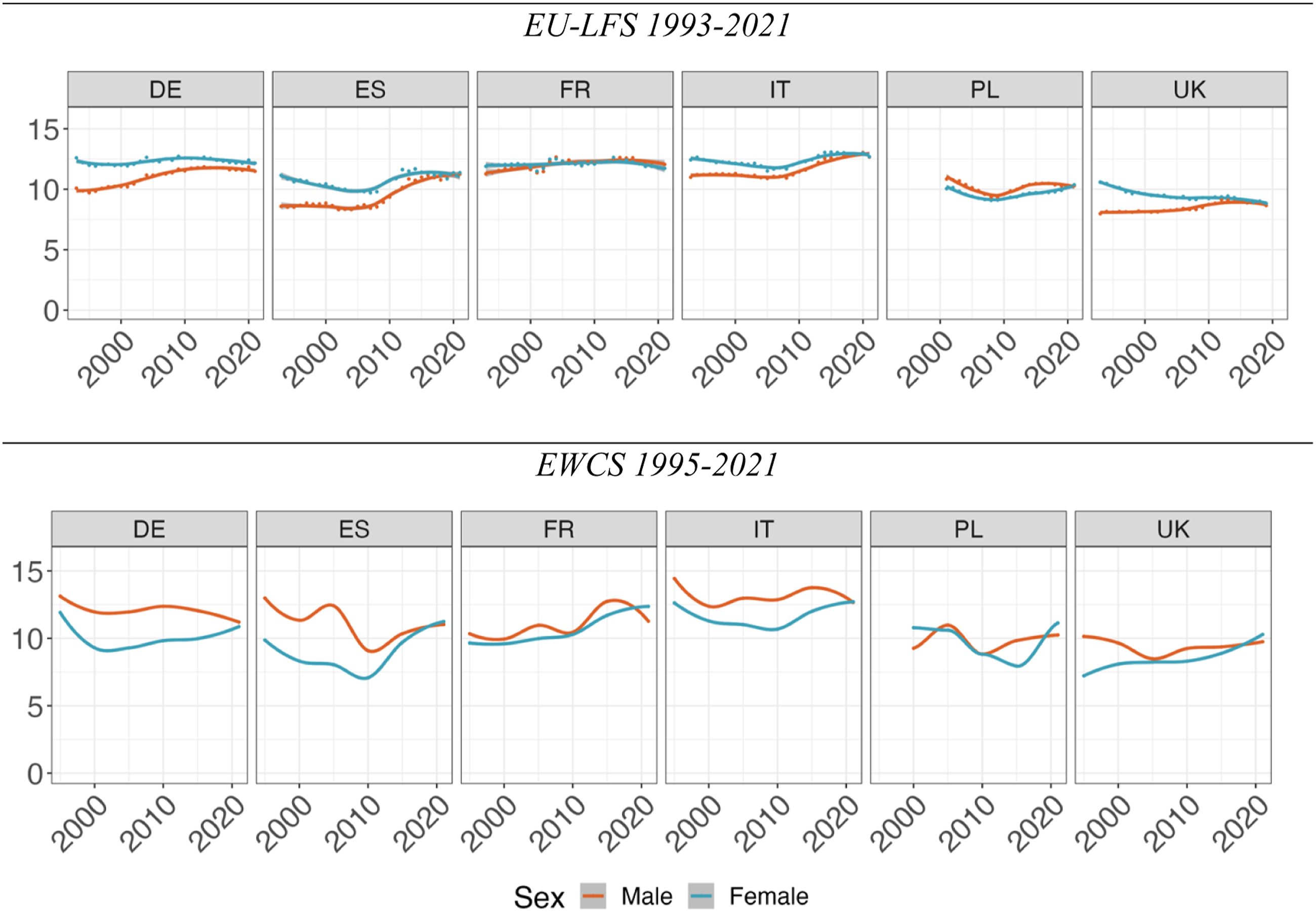
Mean Job Tenure (in Years) by sex and age.
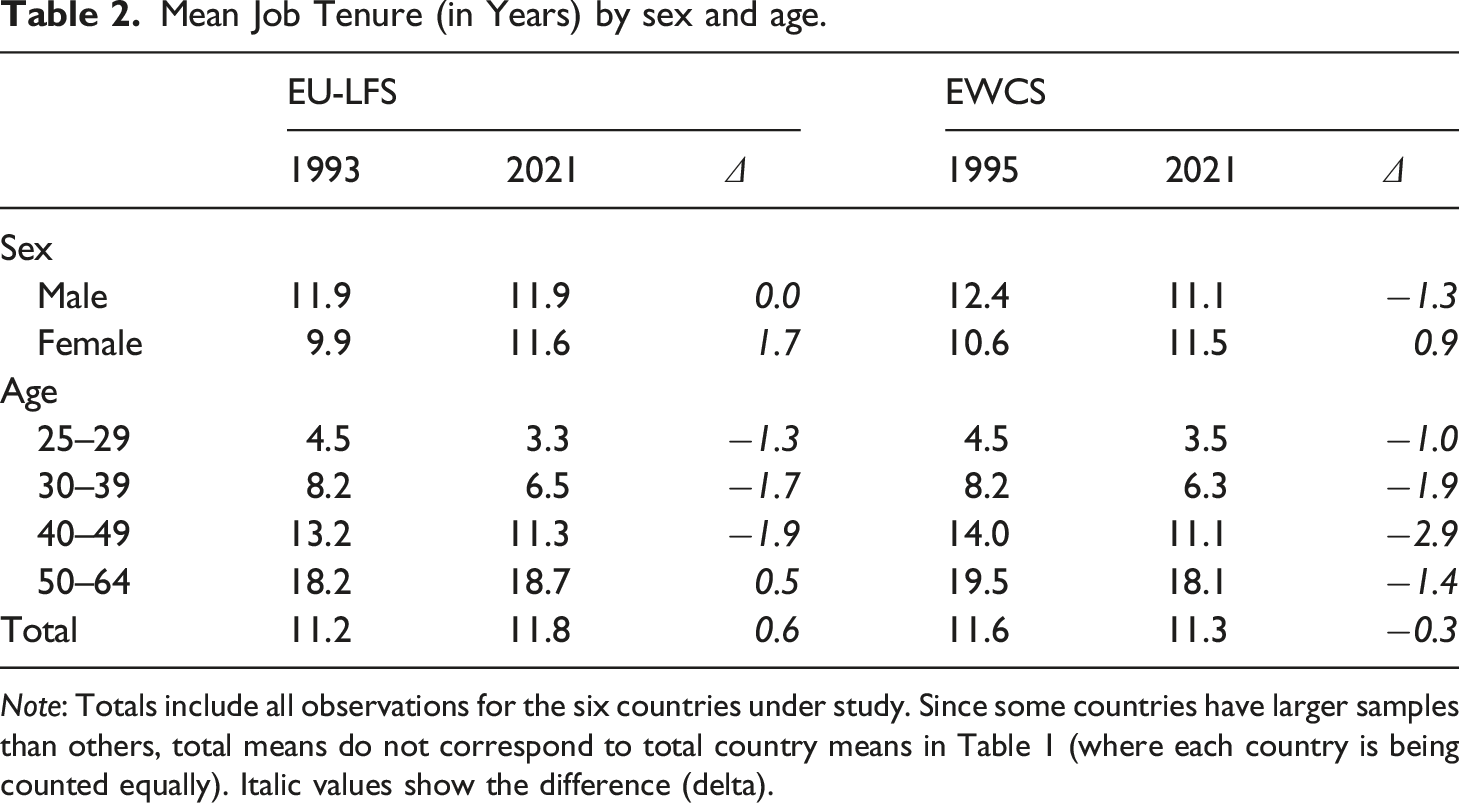
Note: Totals include all observations for the six countries under study. Since some countries have larger samples than others, total means do not correspond to total country means in Table 1 (where each country is being counted equally). Italic values show the difference (delta).
The differences between the two surveys become much smaller once we disaggregate job tenure for age subgroups (see Table 2). Without surprise, tenure increases with age. In 2021, workers in their twenties reported a mean tenure of 3.3 years in the EU-LFS and 3.5 years in EWCS, whereas workers aged 50 and above had on average 18.7 and 18.1 years of tenure, respectively. Both surveys concur that in each single age group, mean tenure declined over the last three decades. In relative terms, the decline has been greatest for young workers (aged 25–29), where longer periods of study (and, possibly, a more difficult transition from school to work) leaves workers in their twenties with shorter tenure in the early 2020s than the early 1990s. In absolute terms, the drop was largest for workers in their forties and smallest for workers in their fifties for whom the EU-LFS shows no downwards trend.
Figure 4 shows what the evolution in job tenure would have looked like if the age distribution had remained unchanged between the early 1990s and 2021. The results of both surveys suggest that in the absence of demographic ageing, job tenure would have fallen in all six European countries. According to the EU-LFS, job tenure of both men and women at a given age declined in France, Italy and Poland. In Germany, Spain and the UK, this was only the case for men, whereas women’s job tenure, net of age, remained stable. The EWCS suggests that women’s job tenure, net of age, evolved in a u-shaped pattern in most countries, decreasing up to the Great Recession and increasing thereafter. Conditional model - mean job tenure by sex in European countries, controlling for age, 1993–2021 (in years).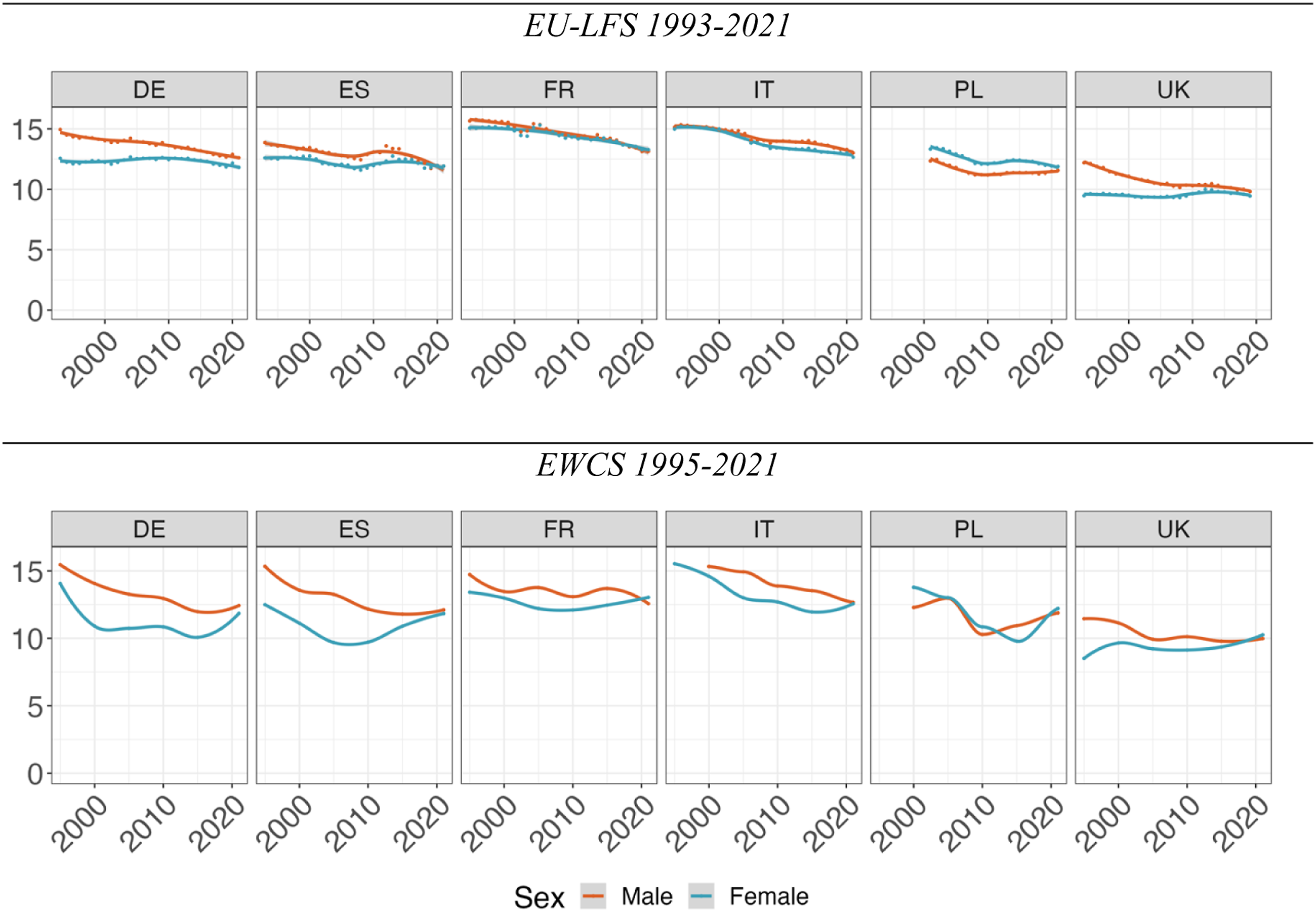
In a last step, we show what the evolution of job tenure looks like if we account for fluctuations in the business cycle by controlling for the unemployment rate.
4
The results are shown in Figure 5 and lead to similar conclusions as Figure 3 (above). Based on the EU-LFS, they suggest that the evolution in job tenure, adjusted for cyclical effects, was flat for men in Germany, France and Poland, slightly increasing in Italy and Spain, and slightly decreasing in the UK. By contrast, the long-term trend for women shows an increase in job tenure in Germany, Italy and above all Spain where the starting point was particularly low. In comparison, the upwards trend in job tenure among women was much weaker in France and the UK, with no change in Poland between 2001 and 2021. Adjusted for the business cycle, the EWCS confirms the long-term trend towards longer job tenure among women for France, Italy, Spain and the UK, but shows no change for Germany and possibly a slight decrease in Poland. Linear time trend in mean job tenure, controlling for national unemployment rates.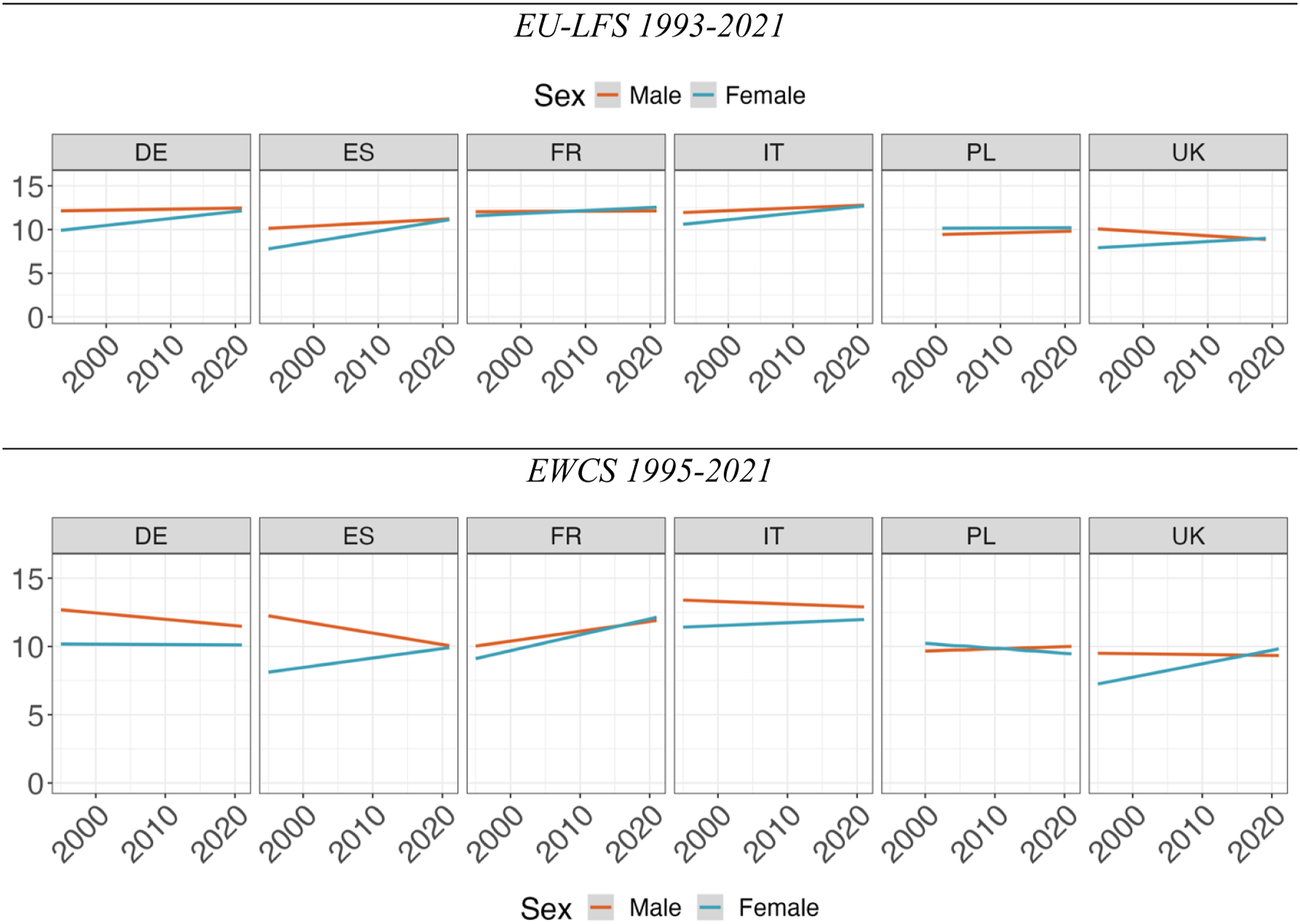
Conclusion
This paper examined how job tenure evolved in the six most populous countries of Western Europe after the early 1990s. Contrary to a widely held view that ‘the 21st century has brought a new social arrangement of work in which temporary assignments … replace permanent jobs’ (Savickas, 2012: 13), we find that the mean duration of jobs has remained constant between the early 1990s and early 2020s. The two leading surveys of the European workforce, EU-LFS and EWCS, show that the mean tenure of ongoing jobs was 11 years both in the early 1990s and the early 2020s in the six large countries under study. In the same vein, the proportion of workers holding a job for 10 years or more has remained stable at around half of the workforce in the same European countries. This means that one in two workers had been with the same employer for at least 10 years in the early 1990s – and the same was true in 2021. Clearly, the duration of ongoing jobs has changed little over the last decades. If the question is descriptive and focuses on how the tenure of jobs evolved in large European countries since the early 1990s, this is the key finding: Job tenure remained unchanged. This result resounds with the finding that subjective measures of perceived job security have been very stable in Germany (1985–2018), the UK (1991–2018) and the US (1978–2018) over the last three to four decades (Manning and Mazeine, 2024).
However, the overall stability in job tenure masks opposing trends for subgroups – and this is the reason why the research literature reports conflicting results. One crucial difference concerns the evolution of men’s and women’s job tenure in recent decades. While men’s job tenure has remained stable according to the EU-LFS and possibly decreased according to the EWCS, women’s job tenure was on an upward trend everywhere except in Poland. Women’s job tenure increased because fewer women in their thirties and forties stopped working after becoming mothers. In addition, larger shares of women in their fifties and sixties were working in the 2020s than the 1990s, either because they were healthier and enjoyed their work more – or because they did not have sufficient financial resources to retire early and the statutory retirement age was raised (Goldin and Mitchell, 2017). As a result, women’s attachment to the labour market has become more continuous and spread over longer periods of their life course. While there was still a large gender gap in tenure at the beginning of the 1990s – particularly in Germany, Spain and the United Kingdom–, it had almost disappeared by 2021.
However, the decisive trend that contributed to the stability of job tenure is ageing: Europe’s labour force has become older over the past three decades. Without this ageing of the workforce, we would have seen a decline in men’s job tenure and stagnation in women’s job tenure. This implies that at any given age, workers had less job tenure in the early 2020s than did workers in the early 1990s. This is not surprising as longer education and later retirement shift labour market participation later in the life course. Educational expansion means that younger cohorts enter the workforce later – and these younger cohorts continue to work longer as early retirement schemes phased out and official retirement ages were raised across Europe.
Our analysis therefore explains why studies reach ambiguous conclusions about the evolution of job tenure on Europe, despite using the same EU-LFS data. When Bachmann and Felder (2018: 481) report ‘a slight increase in average job tenure at the EU level’ for 2002–2012, they focus on descriptive evidence. In contrast, Bussolo and colleagues’ (2022) conclusion that ‘job tenure in Europe has shortened’ 1995–2020 is based on a conditional model that holds constant the age and gender composition of the workforce. Both conclusions are valid, but they address different questions. If the question is what has happened to the tenure of existing jobs, the answer requires an unconditional model and shows stable job tenure. If, on the other hand, the question is what would have happened to job tenure if the workforce composition had remained unchanged, then the answer requires a conditional model and points to declining job tenure. In our view, the unconditional model is more useful for answering the question of whether or not long-term jobs have become rare in Western Europe (they have not). At the same time, if researchers are interested in knowing what has happened to the job tenure of a given worker profile – a man or a woman aged 40 – the conditional model will provide the right answer (it has become shorter). In both cases, however, it is safe to conclude that reports of the end of long-term employment have been greatly exaggerated.
Footnotes
Acknowledgements
This article benefited greatly from the advice of Katy Morris (University of Lausanne).
Declaration of conflicting interests
The author(s) declared no potential conflicts of interest with respect to the research, authorship, and/or publication of this article.
Funding
The author(s) received no financial support for the research, authorship, and/or publication of this article.
Notes
Appendix
Descriptive statistics of the two analytical samples. Note: EU-LFS 1993–2021, EWCS 1995, 2000, 2005, 2010, 2015, 2021. Countries included in both surveys: DE, ES, FR, IT, PL, UK.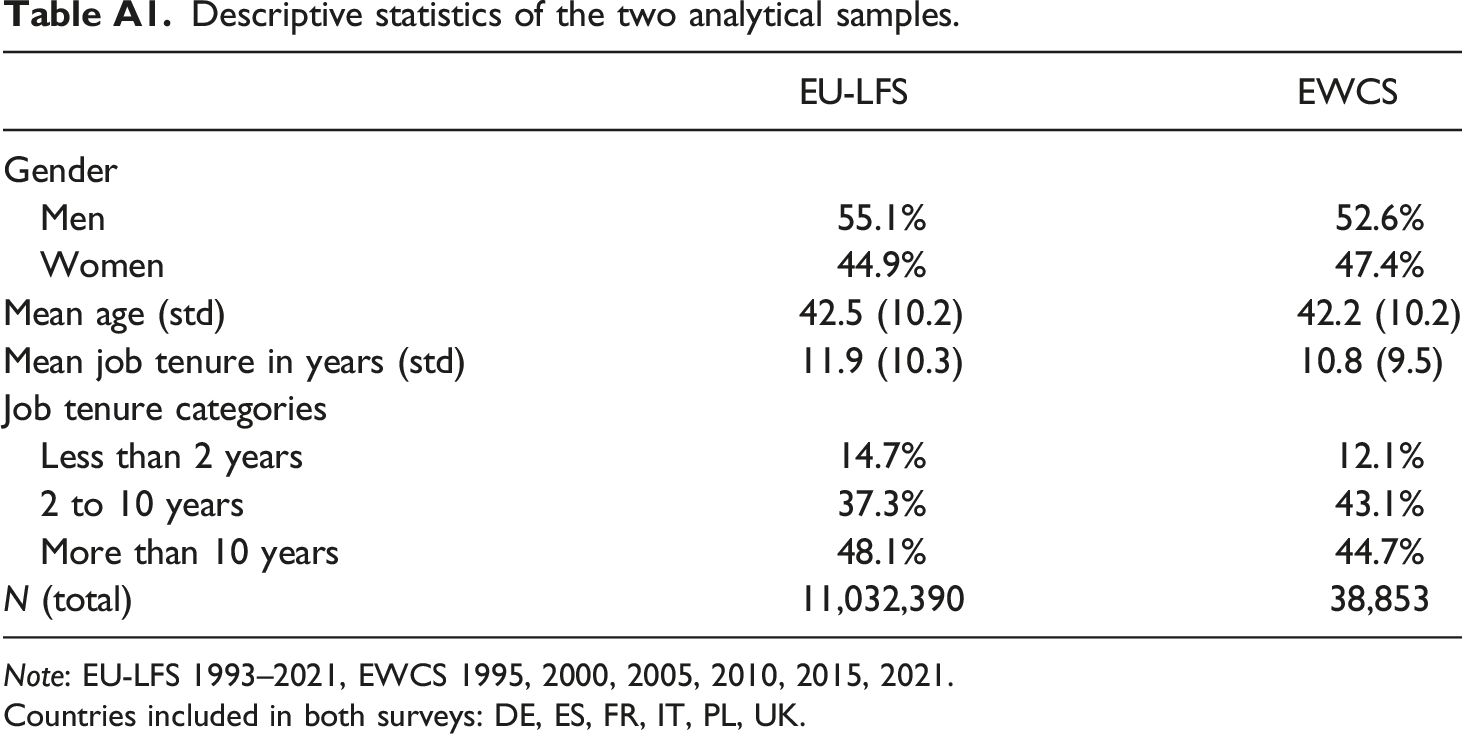
EU-LFS
EWCS
Gender
Men
55.1%
52.6%
Women
44.9%
47.4%
Mean age (std)
42.5 (10.2)
42.2 (10.2)
Mean job tenure in years (std)
11.9 (10.3)
10.8 (9.5)
Job tenure categories
Less than 2 years
14.7%
12.1%
2 to 10 years
37.3%
43.1%
More than 10 years
48.1%
44.7%
N (total)
11,032,390
38,853
Change in sample composition by sex and age groups.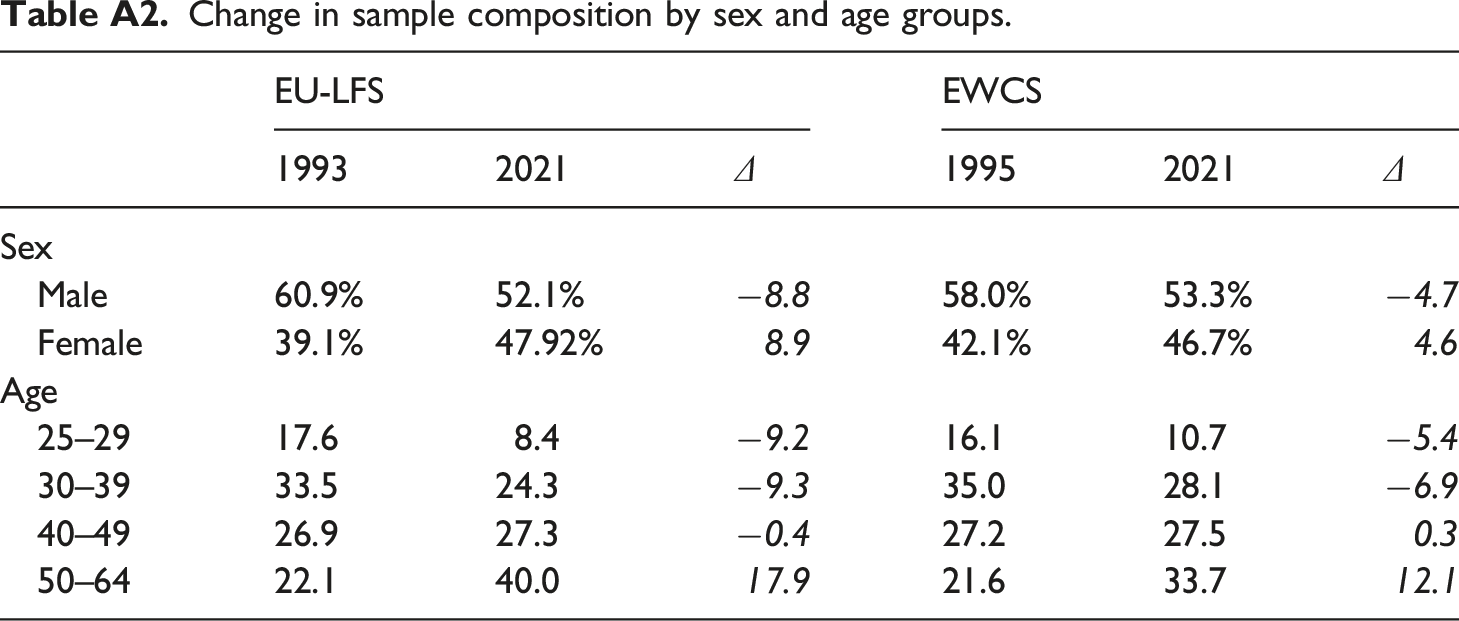
EU-LFS
EWCS
1993
2021
Δ
1995
2021
Δ
Sex
Male
60.9%
52.1%
−8.8
58.0%
53.3%
−4.7
Female
39.1%
47.92%
8.9
42.1%
46.7%
4.6
Age
25–29
17.6
8.4
−9.2
16.1
10.7
−5.4
30–39
33.5
24.3
−9.3
35.0
28.1
−6.9
40–49
26.9
27.3
−0.4
27.2
27.5
0.3
50–64
22.1
40.0
17.9
21.6
33.7
12.1
Author biographies
 ).
).