




Abstract
Welfare chauvinism, that is, the exclusion of non-citizens who live permanently within a state from social benefits and services, has become a mainstream form of welfare policy opposition advocated by some political parties and members of the public. While existing studies have successfully cast a light on the roots and scope of these policies, welfare chauvinism effectively encompasses a wide range of ideas that all have different meanings. Drawing on the stances taken by populist radical right parties, this article introduces five categories (or frames) of welfare chauvinism: temporary, selective, functional, cultural and, in its most extreme form, unconditional chauvinism. The article then illustrates how such categorization is applied empirically by focusing on the stances taken by three populist radical right parties and open-ended discussions held during mini-publics in examples of three different institutional forms of welfare state: Denmark, Germany and the United Kingdom. This article offers a more precise depiction of how this form of opposition to welfare state policies plays out in the public sphere, taking full account of how different forms and frames of welfare chauvinism yield different policy outcomes and implications in different institutional and political contexts.
Keywords
Introduction
Across Europe, populist radical right parties have managed to take advantage of the emergence of new social cleavages and solidarities to increase their influence over the past couple of decades. These parties tend to favour an anti-immigration, Eurosceptic and welfare chauvinist agenda, which may look attractive to some who perceive themselves as the ‘victims’ of globalization (Hobolt, 2016). However, some aspects of that agenda may also appeal to those who do not support or vote for these parties. Even though their influence in the domestic (and European) political spheres can be overstated by some academics and observers, populist radical right parties often establish ‘ownership’ of the issue of immigration. As a result, they are able to shape the positions of other parties on the issue (see, e.g., Akkerman, 2015; Minkenberg, 2013) or shift public opinion towards a more anti-immigration stance (see e.g., Abou-Chadi and Kause, 2020; Leruth and Taylor-Gooby, 2019). Their political significance reaches beyond that implied by the proportion of the electorate voting for them.
Welfare chauvinism is a form of opposition to welfare policy that has received a lot of attention over the past decade. The term, which was first coined by Andersen and Bjørklund (1990), is best understood as the exclusion of non-citizens who live permanently within a state from social benefits and services (Eick and Larsen, 2022). As mentioned in the introduction to this special issue, welfare chauvinism can be framed in different ways and yield significantly different policy outcomes (Eick and Leruth, 2024). In their analysis of the changing welfare state agenda of populist radical right parties across Europe, Afonso and Rennwald (2018: 171) point out that ‘the economic policies of radical right parties have ranged from libertarian to socialist, with different shades of welfare chauvinism in-between’. More recently studies have highlighted that analyses of welfare chauvinism require a cross-disciplinary engagement in order to explain how an overall policy stance plays out differently in the contexts of different welfare states (Careja and Harris, 2022: 219). This must include the political economy of welfare states which leads to the kind of institutional typology developed by Esping-Andersen (1990) and also the domestic party politics that shape how populism is understood (Esping-Andersen, 1990; Rathgeb and Busemeyer, 2021). Welfare chauvinism has been analysed in some detail, as explained in the introduction to this special issue (Eick and Leruth, 2024). Yet, the ‘shades’ of welfare chauvinism as they emerge in political discourse and their implications for different welfare states have not been analysed to a similar extent in terms of everyday political discourse. For example, public and political actors can draw on different understandings of welfare chauvinism to deploy a range of arguments to justify their opposition or target specific policies that are being deemed ineffective, too expensive or too generous.
This article aims at filling this gap in the existing literature by offering a categorization of welfare chauvinism based on how the term is used in political discourse and applying it to material gathered from qualitative work in different types of welfare state. Our core argument is that the way opposition to welfare policy is framed by political and public actors matters more than the existing literature acknowledges, especially with regards to electoral outcomes. Indeed, some categories of welfare chauvinism advocated by political parties can be deemed too ‘soft’ or ‘harsh’ by voters, and this may ultimately have an impact on their voting preferences (see e.g., Marx and Naumann, 2018).
We first develop a categorization of welfare chauvinism in relation to four variables: time, space (in terms of legal status in a determined territory), function, and culture. To illustrate the validity and utility of our categorization, we then explore how political parties and citizens frame welfare chauvinism in practice by analysing the programmes of populist radical right parties as well as mini-public data from three countries drawn to illustrate social democratic, conservative/corporatist and liberal varieties of European welfare state: Denmark, Germany, and the United Kingdom. We conclude by reflecting on the strengths and potential weaknesses of using such categorization and review the different policy implications of different kinds of welfare chauvinism in context.
Why categorizing welfare chauvinist discourse matters
Welfare chauvinism implies support for a welfare system that is primarily offered to natives, and thus excludes immigrants and denizens who do not belong to the ethnically defined community (Kitschelt, 1997; Mewes and Mau, 2012). It is not a new phenomenon, as the Danish and Norwegian Progress Parties had already been advocating this policy paradigm in the late 1980s (Andersen and Bjørklund, 1990). Such chauvinism has become increasingly popular since the Great Recession and is now advocated by both radical and mainstream political parties across Europe (Abou-Chadi and Kause, 2020; Dancygier and Margalit, 2020), as illustrated by the 2019 Danish general election (DW, 2019).
Scholars have recently started analysing party positions on the matter (see Careja and Harris, 2022; Ketola and Nordenswold, 2018b; Keskinen et al., 2016). Populist radical right parties, which tend to campaign on an anti-immigration platform, constitute the obvious starting point for analysing party-based welfare chauvinism, although welfare chauvinism is not an exclusive feature of these parties’ social policy agenda (Schumacher and van Kersbergen, 2016). Mudde (2007, 2017) identified three core ideological features of populist radical right parties: nativism, that is, a combination of nationalism and xenophobia; authoritarianism, that is, a strictly ordered society with limited individual freedoms; and populism, which he defines as ‘an ideology that considers society to be ultimately separated into two homogeneous and antagonistic groups, ‘the pure people’ and ‘the corrupt elite,’ and which argues that politics should be an expression of the volonté générale (general will) of the people. Other common, though non-exclusive features of populist radical right parties include an acceptance of the rules of parliamentary democracy with a stronger executive, opposition to pluralism, and advocacy of welfare chauvinism. However, these features emerge differently in different contexts.
Empirical studies have subsequently analysed the welfare policy stances advocated by populist radical right parties. Focusing on the Austrian Freedom Party’s stance between 1983 and 2013, Ennser-Jedenastik (2016) offered a very useful distinction between groups that are deemed ‘deserving’ and ‘undeserving’ of support by populist radical right parties, emphasizing that welfare chauvinism appeals to their nativist ideology. Schumacher and van Kersbergen (2016) demonstrated that mainstream political parties in Denmark and the Netherlands directly adapted their stances to the welfare chauvinism advocated by the main populist parties in both countries, contradicting earlier studies, which suggested that mainstream parties first need to lose an election before changing their position (e.g., Budge et al., 2010). As far as populist radical right voters are concerned, Afonso (2015: 275) argued that most populist radical-right voters favour traditional welfare provisions, as they ‘may be afraid to extend these rights to outsider groups, such as immigrants and women.’
There is little work systematically distinguishing the varieties of chauvinist policy. Marx and Naumann’s (2018) distinction between ‘soft’ and ‘harsh’ welfare chauvinism refers to attitudes rather than policies. Careja et al. (2016) consider effects and distinguish direct (where policies negatively and directly affect immigrants) and indirect (where policies are directed to larger groups but negatively affect immigrants to a larger extent) chauvinism. It is only recently that some scholars started focusing on specific variables of welfare chauvinism. Ennser-Jedenastik (2018) analysed the manifestos of populist radical right parties in the Netherlands, Sweden, Switzerland and the UK and found that welfare chauvinism tends to focus on healthcare and means-tested social assistance programmes. Having a look at European populist radical right parties’ welfare agenda, Abts et al. (2021: 35) found these parties generally advocate for ‘a temporal ban until some residence, contributory or cultural integration requirements are fulfilled,’ as well as an implied tendency to exclude non-EU migrants while sometimes remaining vague for electoral purposes. Chueri (2022) for instance focused on how different migrant groups are being affected by welfare chauvinist policies adopted by governments that include populist radical right parties. Empirically, Chueri demonstrates that asylum seekers have historically been the most targeted migrant group but that different strategies have been adopted to target intra-EU migrants, thereby hinting at specific, EU-focused welfare chauvinist strategies (which further hints at a linkage between welfare chauvinism and welfare Euroscepticism, as discussed in the introduction to this special issue (Eick and Leruth, 2024; see also Keskinen et al., 2016; Ketola and Nordenswold, 2018a). While the literature started to acknowledge distinctions between different forms of welfare chauvinism in terms of their policy implications advocated by populist radical right parties, none of the above-mentioned studies called for a systematic categorization of these policy stances. Yet, given the diverging implications of these policy preferences (should they be implemented), a categorization of welfare chauvinist discourses may help indicate the degree and nature of welfare policy restructuring advocated by these parties. As some populist radical right parties tend to stay deliberately vague in their stances (as touched on in Abts et al., 2021; Ketola and Nordenswold, 2018b), categorizing welfare chauvinist stances as frames used by parties and the public can also enable researchers to determine whether welfare chauvinism is mostly used as a vague electoral strategy (for instance when parties want to unconditionally ban access to welfare benefits and services for migrants) or as a clear-cut policy agenda with specific proposals that target specific migrant groups or policy areas.
As far as public attitudes towards welfare chauvinism are concerned, existing studies mostly relate to the European Social Survey which includes some questions that enable researchers to make some distinctions between different policy preferences (e.g., Mau and Burkhardt, 2009; Mewes and Mau, 2012; van der Waal et al., 2013). The eighth wave of the European Social Survey (2016) included a question that only encompasses specific dimensions of welfare chauvinism by asking respondents whether and when immigrants should obtain rights to benefits and services. It is formulated as such: ‘Thinking of people coming to live in [country] from other countries, when do you think they should obtain the same rights to social benefits and services as citizens already living here?’ This question, however, excludes a distinction between different groups of migrants and a distinction between the types of benefits, such as in-kind or cash, which may yield different responses. Furthermore, the range of potential responses in the ESS survey provides a combination of time-specific as well as contribution- and integration-related accomplishments as conditions of accessing social benefits and services and does not allow respondents to share more complex, potentially overlapping preferences. Introducing a categorization of welfare chauvinism based on public discourse and showing how the different approaches relate to policy stances may also help researchers to design new surveys that focus on different core dimensions of this form of welfare policy opposition.
The categorization
Drawing on the stances taken by populist radical right parties and critically assessing the only internationally comparable public opinion survey question measuring welfare chauvinism, we identify four dimensions, each based on a different category of welfare chauvinism: time, space, function, and culture. The four categories apply primarily to the form of welfare chauvinism in terms of policy implications and are not mutually exclusive: a policy proposal may combine some of or all four dimensions.
Temporary welfare chauvinism refers to the limitation in the access of non-natives to benefits and services in time, for instance after they have worked and paid taxes for 1 year (as defined in ESS since 2008). This dimension constitutes the core of the above-mentioned question included in the European Social Survey. Here, the argument is that the restriction of access to benefits and services is justified by a period of integration into the domestic system. It assumes that non-natives enter the country without deserving access to welfare, but will do so if they meet a series of mostly economic criteria (i.e., integration in the labour market). Other forms of temporary welfare chauvinism could be introducing access to benefits and services but only for a specific period of time, after which migrants lose such access. Examples of such policy (irrespective of migration status) include the introduction of 6-months out-of-work benefits to avoid long-term unemployment.
Selective welfare chauvinism relates to the ‘space’ dimension as reflected in the legal status of people in a specific country. It limits the access of some but not all non-natives to benefits and service, therefore operating like a selection among migrants. In other words, it creates different categories of non-native citizens. Such categories are mostly driven by nationality criteria, but also by residence status which can be directly related to the citizenship of the subject. A common distinction is made in Europe between migrants who hold the European Union citizenship and those who do not. This distinction is generally made to comply with fundamental principles of European Union law, although in practice, distinctions between natives of an EU member state and other EU citizens can be common. Another such distinction is discussed in Chueri (2022) between asylum seekers (who tend to be more targeted by welfare chauvinist policies) and so-called ‘economic’ migrants, who move to another country for work purposes.
Functional welfare chauvinism restricts access to specific benefits and services, such as healthcare or unemployment benefits. In this context, ‘the’ welfare state is untangled between policies, for instance by restricting access to housing benefits but not childcare. The benefits and services that are targeted by welfare chauvinist policies can be driven by the levels of domestic politicization: for example, if the public healthcare system is under strain and ‘healthcare tourism’ is an issue that is politically salient (see e.g., Forkert, 2020). Researching welfare chauvinist attitudes, Eick and Larsen (2022) find greater opposition to grant immigrants access to cash benefits than in-kind services. The distinction between cash and in-kind benefits can become especially salient under an austerity-driven policy agenda (Taylor-Gooby et al., 2017).
Cultural welfare chauvinism restricts access to benefits and services to non-natives until their social integration can be demonstrated, either through language skills or cultural knowledge. While cultural chauvinism generally has a temporal dimension, such integration differs from economic integration which is generally demonstrated by tax contributions. Language skills and cultural knowledge tests are widely used in the context of citizenship applications, for example in the context of British and Australian Citizenship tests. Cultural chauvinism can be traced back to the roots of welfare chauvinism in the 1970s, when debates took place in the Danish Parliament regarding the introduction of language requirements to gain access to employment benefits (Borevi, 2014). Citizenship as a potential preferred condition of accessing social benefits and services – that is, as a means to welfare inclusion is also raised in the ESS welfare chauvinism question.
A fifth, holistic form of welfare chauvinism can also be distinguished: unconditional welfare chauvinism. In short, it is the most extreme form of welfare chauvinism, that is, the total exclusion of non-natives from any benefits and services, no matter their work, family or health status, for an indefinite period. In practice, unconditional chauvinism is unlikely to become policy within the European Union, as it would effectively exclude all immigrants from the system and would break EU legislation. However, unconditional chauvinism can be used by political parties in the context of general elections as part of an anti-immigration strategy to catch as many votes as possible. As mentioned above, some studies focusing on welfare chauvinism have demonstrated that some populist radical right parties tend to make broad welfare chauvinist statements that effectively target all migrants and all policies for an indefinite period, even though such policy would be unlikely to become law. As such, unconditional chauvinism as a category of welfare chauvinism is perhaps best understood as an electoral strategy rather than as an inherent part of a party’s ideology.
The initial four varieties of welfare chauvinist policies (temporary, selective, functional and cultural) are not mutually exclusive. The case of the so-called ‘emergency brake’ (officially named ‘alert and safeguard’ mechanism), negotiated by (then) British Prime Minister David Cameron and President of the European Council Donald Tusk, is a good illustration. This emergency brake proposed that if a EU member state faces a high migration flow which ‘affects essential aspects of its social security system, including the primary purpose of its in-work benefits system, or which leads to difficulties which are serious and liable to persist in its employment market or are putting an excessive pressure on the proper functioning of its public services’ (European Council, 2016), then the Council might authorize a 7-year restriction of access to in-work benefits for newly arriving EU migrants for a period of 4 years (Barnard, 2016). As such, the emergency brake can be categorized as a temporary, selective and functional form of welfare chauvinist policy.
Empirical illustration
In order to illustrate the utility of the categorization above, the article focuses on populist radical right parties’ positions and public attitudes towards welfare chauvinism in Germany, Denmark and the United Kingdom. These countries are selected for analysis for two reasons: German, Danish and British populist radical right parties have fared well in recent years (keeping in mind that welfare chauvinism is organically compatible with these parties’ broadly anti-immigrant agenda); in addition, their welfare systems illustrate the main types in Esping-Andersen’s (1990) categorization: Germany is typically seen as inclining towards a more social insurance-based corporatist system, Denmark towards a more universal citizenship system; and the UK towards a more targeted liberal leaning system (Esping-Andersen, 1990; Taylor-Gooby et al., 2017). Thus we are able to make a contribution to a point highlighted by Careja and Harris (2022) regarding cross-country variation in terms of the different welfare chauvinist frames taken by populist radical right parties in these three countries.
Three populist radical right parties are analysed in this study, which covers a timeframe of 3 years between 2014 and 2016 (at the height of the so-called ‘refugee’ crisis and ahead of the Brexit referendum held on 23 June 2016): the UK Independence Party (UKIP), the Alternative for Germany (AfD), and the Danish People’s Party (DF). The categories of welfare chauvinism favoured by these parties are assessed based on a content analysis of their party manifestos (retrieved from the Comparative Manifesto Project) and official party documentation made available on the populist radical right parties’ websites published between 2014 and 2017, during and after the so-called refugee crisis that was heavily politicized across all three countries.
We link the party discourse of statements and manifestos to that of ordinary citizens through analysis of data from a series of mini-publics held between October and November 2015, ahead of the Brexit referendum campaign and while the AfD was in the process of becoming a genuine populist radical right party, as part of the NORFACE-funded ‘Welfare State Futures: Our Children’s Europe’ (WelfSOC) project (Taylor-Gooby and Leruth, 2018). Besides being a useful tool to engage a wider audience in deliberation (see e.g., Curato and Niemeyer, 2013), mini-publics have features which the more commonly used large sample surveys do not share and can shed fresh light on how people think about issues, particularly when the issues are complex and not well understood by researchers. They allow for greater control of the discussion by participants who frame the debate by selecting some of the key issues that need to be addressed. Mini-publics also differ from the most widely used qualitative research methods for investigating attitudes, namely focus groups, as they take place over a much longer period of time (in our case two full days), they include more participants (in our case between 34 and 37 participants), moderation is much less directive, there is no schedule of topics, and the main theme of discussion is more loosely defined (Taylor-Gooby et al., 2019).
The mini-publics analysed within the framework of this article were held over two Saturdays in 2015 in Berlin, Copenhagen and Birmingham, respectively. The following deliberately loose question was asked to start the discussion: ‘Which benefits and services should the [country] government provide in 2040?’ This question allowed the maximum of freedom in approaching the discussion and did not explicitly refer to welfare chauvinism. As a result, the discussions regarding the different categories of welfare chauvinism mentioned in the section above occurred organically and without prompts from the research team.
With the aim to go beyond the pre-defined survey responses from the ESS and to better understand the potential reasons behind these responses as well as exploring the potential ambivalences and contradictions in attitudes, the mini-public discussions were systematically coded in three stages in NVivo – from the first most comprehensive thematic coding, to the third coding focusing on the specific categories of welfare chauvinism.
Temporary welfare chauvinism
Restricting the access of non-natives to benefits and services for a specific duration proves to be a relatively common position among Danish, German and British populist radical right parties. In Denmark, both the Danish People’s Party and mini-public participants favour a form of temporary welfare chauvinism by referring to the extension of a ‘wait period’ to access some benefits and services, quantified to 6 years. For immigrants who contribute to the system, Danish mini-public participants discussed setting up a limited period during which immigrants could have access to cash benefits (between 6 months and 1 year). Afterwards, if they are not self-sufficient, they should be asked to leave the country. ‘No entitlement to social benefits until you’ve contributed for say six years. I should say I’m not talking about medical assistance here. If they get sick they should be allowed to go to hospital but they shouldn’t get social security, income support, housing or child benefit. Until you’ve contributed to society for six years you won’t be able to get any social benefits. The only reason why you would get those benefits would be if you were about to die on the street. We need to draw a line.’ (DK-57, Danish People’s Party voter) ‘Immigrants come here voluntarily. They shouldn’t get benefits because they have a reason for being here, presumably in order to work. On the other hand, I think that if you’ve obtained Danish citizenship and you’ve contributed for a certain a period of time then you shouldn’t get kicked out if you suddenly become unemployed after five years. Then you’ve been a part of society and should have the same rights as the rest.’ (DK-65, Red–Green Alliance voter)
In Germany, the Alternative for Germany (2017: 61) advocated a form of temporary welfare chauvinism by supporting access to social benefits to individuals ‘who have contributed to social security systems for a minimum of 4 years of employment without receiving state subsidies.’ However, temporary forms of welfare chauvinism were not discussed or advocated by mini-public participants, who mostly put an emphasis on selective and cultural welfare chauvinism (see below).
In the United Kingdom, the UK Independence Party’s ‘golden era’ took place in 2015, at the same time as the mini-public was held. Even though the party never secured more than two seats in Westminster, it managed to politicize the issues of health tourism and paved the way for a future Brexit by putting pressure on Prime Minister David Cameron, notably by focusing on the issue of immigration and the strain it puts on the British welfare state (see also Donoghue and Kuisma, 2021 for a discussion on Brexit and welfare chauvinism). It is therefore not surprising that the party’s programmes have consistently included welfare chauvinist frames. Two of those policies have a temporal dimension: first, ‘preventing foreign nationals from obtaining access to social housing until they have lived here and paid UK Tax and National Insurance for a minimum of 5 years’ (UK Independence Party, 2015: 34); second, ‘all new migrants to Britain will have to make tax and national insurance contributions for five consecutive years before they will become eligible to claim UK benefits, or access to more than non-urgent NHS services’ (except when urgent treatment is needed: UK Independence Party, 2015: 13). In the mini-publics, participants expressed similar levels of temporary welfare chauvinism, albeit less harsh than UKIP’s. The main policy recommendation put forward by participants was to require at least 2 years of contribution to the system before welfare benefits could be accessed. Some participants even preferred a 5-year wait period, but ultimately compromised to two.
Selective welfare chauvinism
A distinction between different ‘types’ of non-natives (based on their legal status in the country or territory in question) was also expected to be made by populist radical right parties and mini-public participants across all three countries for two reasons. First, European law may not allow for discrimination against non-native EU citizens (although in practice, such discrimination already existed in all three countries due to legal uncertainties, see e.g., Blauberger and Schmidt, 2014; Gago and Hruschka, 2022). Second, our analysis (2014–17) covers the period of the so-called refugee crisis, at times when the status of asylum seekers and the perceived strain they put on the system were intensively discussed by populist radical right actors.
In Denmark, the Danish People’s Party specifically targeted refugees and asylum seekers, arguing they should not gain special access to early retirement schemes, and the waiting period to gain access to child allowances should be extended from 2 to 6 years, thereby illustrating that temporary, functional and selective frames of welfare chauvinism can indeed be combined. Many participants to the Danish mini-public followed the party’s lines, arguing that the welfare system used to be too generous towards refugees, which created an incentive for them to come to Denmark. However, participants emphasized that regulations have recently been tightened, in line with the Danish People’s Party’s position. Several participants argued that the EU should establish an equivalent level of benefits across all EU member states, thus preventing refugees from seeking the most generous welfare system (a system the Danish People’s Party could not support, given their Eurosceptic stance). While participants were more willing to grant access to benefits for refugees as opposed to economic migrants, they also combined selective welfare chauvinism with a selective form to target specific welfare policies: ‘If you come here as a refugee then we need to get you out onto the labour market quickly so that you can make money. You don’t have the right to come here and receive social security benefits. (DK-67, Danish People’s Party) ‘But no-one wants to. (DK-77, Alternative (Green) Party) ‘Nonsense. A lot of people want to. That’s why I think that we need to have a system that says that if you want to stay in Denmark then we won’t support you for more than six months or a year, then you should be able to fend for yourself.’ (DK-67, Danish People’s Party).
The 96-pages long manifesto released by the Alternative for Germany in the context of the 2017 federal elections (the first domestic, nationwide manifesto released by the party) distinguished different groups of migrants: refugees, defined by the party as those who ‘enter Germany irregularly with the aim to stay here forever’ (Alternative for Germany, 2017: 58); immigrants from poorer European countries coming to Germany ‘for the sole purpose of obtaining social aid’ (Alternative for Germany, 2017: 60), and non-EU migrants who (in the party’s views) should only be allowed into Germany if they possess a high level of skills. The party’s welfare chauvinist policy proposals further target asylum seekers and their families: [e]ach single asylum seeker immigrates into the social system, as he [sic] is entitled to benefits as soon as he crosses the border. […] The AfD demands an end to unlimited family reunions for approved asylum seekers, as this opens the door to a direct and permanent influx of new migrants into the social security systems. (Alternative for Germany, 2017: 62)
Similarly, the party sought to reform repatriation for foreign nationals who are not entitled to stay in Germany, as it saw a reduction of the access to benefits and services as an incentive to promote voluntary departure. German mini-public participants made a distinction between refugees who were fleeing war in their home countries and those coming to Germany for economic reasons (those were deemed ‘less deserving’). The discussion did not focus centrally on limitation of access to welfare benefits (with the exception of some participants criticizing the system that does not allow refugees to work for the first 3 months in Germany), but rather on how to integrate refugees within the German society – with few references to access to welfare compared to Denmark and the United Kingdom. Interestingly, very little attention was paid to non-refugee or skilled migrants, and their access to benefits and services did not seem to be controversial. This is most likely because the democratic forum was held just when the refugee crisis was at its height (October 2015).
In the United Kingdom, UKIP did not advocate for selective welfare chauvinism in line with the party’s core policy: for the United Kingdom to leave the European Union and to implement lawful welfare chauvinist policies that apply to all non-natives. In this context, the party avoided making a distinction between refugees and economic migrants. Yet, ahead of the Brexit referendum, the party’s discourse strongly targeted EU citizens: ‘[o]ur current immigration rules ignore the wishes of the British people. They discriminate in favour of EU citizens and against the rest of the world. The system is failing so badly that we cannot even properly identify how many people enter and leave our country’ (UK Independence Party, 2015: 11). Under a similar context, British mini-public participants targeted non-EU citizens, as illustrated by the quote below: ‘The NHS is one area that we are saying that we spend a lot of money on, so I mean in this case with non-EU nationals, you know, it’s fair enough that they don’t have access to the NHS. If that’s something that we are having an issue of doing cuts and jobs and all sorts are in place and education is something that we really want to, you know, develop and examine, but it’s a bit unfair for non-EU nationals to come in and, sort of, take advantage of that.’ (UK-40, no voting preference)
Functional welfare chauvinism
Welfare chauvinist frames that target specific benefits and services are expected to be found among populist radical right parties that have a well-defined welfare policy agenda. In Denmark, the Danish People’s Party essentially focused on cash rather than in-kind benefits, by targeting child allowances, access to early retirement (especially for refugees) and a reduction of economic benefits for asylum seekers. Restricting access to healthcare or education, however, is not the focus of the party. Such frame was broadly reflected in mini-public discussions among Danish participants. One collective policy proposal put forward was not to grant refugees any cash benefits, but to offer them opportunities to work on farms to ensure that they contribute to the society: ‘Asylum seekers should be allowed to contribute from the outset but they mustn’t get welfare benefits such as child benefit from day one. They need to earn their right to those. If you’re a direct refugee and you’re fleeing a war then you need help at first but if years go by then they shouldn’t just be allowed to sit around. That’s my opinion.’ (DK-71, Socialist People’s Party voter)
In contrast, the Alternative for Germany does not make a distinction between specific benefits and services. As such, it does not advocate functional frames of welfare chauvinism. This was largely reflected in German mini-public debates. Only one reference to functional welfare chauvinism occurred when participants discussed their opposition to the policy that enabled refugees entering without a valid passport to access welfare provisions, although most of them agreed that access to specific benefits, especially healthcare, was necessary: ‘But if [refugees without passports] are let in, then the social welfare state must give them support, they can’t just let them die if they’re sick.’ (DE-23, SPD voter)
Functional welfare chauvinism is much more prominent in the United Kingdom, especially given the political salience of ‘health tourism’ and the role played by the National Health Service at the heart of the British public discourse. UKIP combined temporary and functional welfare chauvinism by proposing to restrict migrants’ access to non-urgent healthcare services to those who have not paid taxes for at least five consecutive years. This stance was also reflected in mini-public discussions: one proposal put forward and approved by participants was to exclude migrants from accessing all free healthcare services in the first 2 years following their arrival as they believed these services should be paid by the individual or the employer. The party also targeted childcare (cash) benefits, calling to stop ‘child benefit being paid to children who don’t live in the UK’ (UK Independence Party, 2015: 23), although this stance was not discussed between mini-public participants.
Cultural welfare chauvinism
Conditioning access to welfare based on the socio-cultural integration of migrants can be an effective tool for populist radical right actors to consolidate their agenda around the issue of national identity. Yet, there are significant differences between our three case studies. The Alternative for Germany does not formally advocate such stance, even though its 2017 programme emphasizes that immigrants have an obligation to integrate and that the person ‘who refuses to integrate has to be sanctioned and will finally lose his right of residence’ (Alternative for Germany, 2017: 62). Germany mini-public participants, however, proposed cultural welfare chauvinism by advocating for language requirements in order to gain access to (unspecified) benefits, giving migrants (in particular refugees) better access to training opportunities and getting their foreign qualifications recognized by the German state: ‘Why is it that people who have nothing come here and receive everything? Spending 120 euros a day and so much per month or per week.’ (DE-26, CDU voter) ‘Those who don’t take part in a language course [should not] get any benefits. Clearly.’ (DE-31, SPD)
In Denmark, cultural welfare chauvinism was neither part of the Danish People’s Party electoral platform, not advocated by mini-public participants. The same conclusions can be drawn from our analysis in the United Kingdom: even though UKIP and British mini-public participants advocated for the introduction of a so-called ‘Australia-style’ points-based system for migration (which includes a language test), access to benefits and services is not conditioned on cultural or linguistic integration.
Unconditional welfare chauvinism
As mentioned in the previous section, unconditional welfare chauvinism is expected to be found among parties that have a broadly anti-immigration strategy and do not wish to detail their welfare policy plans on the matter. In practice, however, implementing unconditional welfare chauvinism would be close to impossible, especially within the European Union. It is therefore unsurprising to see in our analysis that unconditional welfare chauvinism was not advocated by any of the three populist radical right parties. Mini-public discussions, which took place over 2 days among a diverse group, did not yield an unconditional welfare chauvinist frame either: where welfare chauvinism proposals were put together by participants, these were consistently targeted along one or several of the dimensions mentioned above (time, space, function or culture).
Discussion and conclusion: different shades, different policy implications
Categorisation of discursive welfare chauvinism and policy examples.
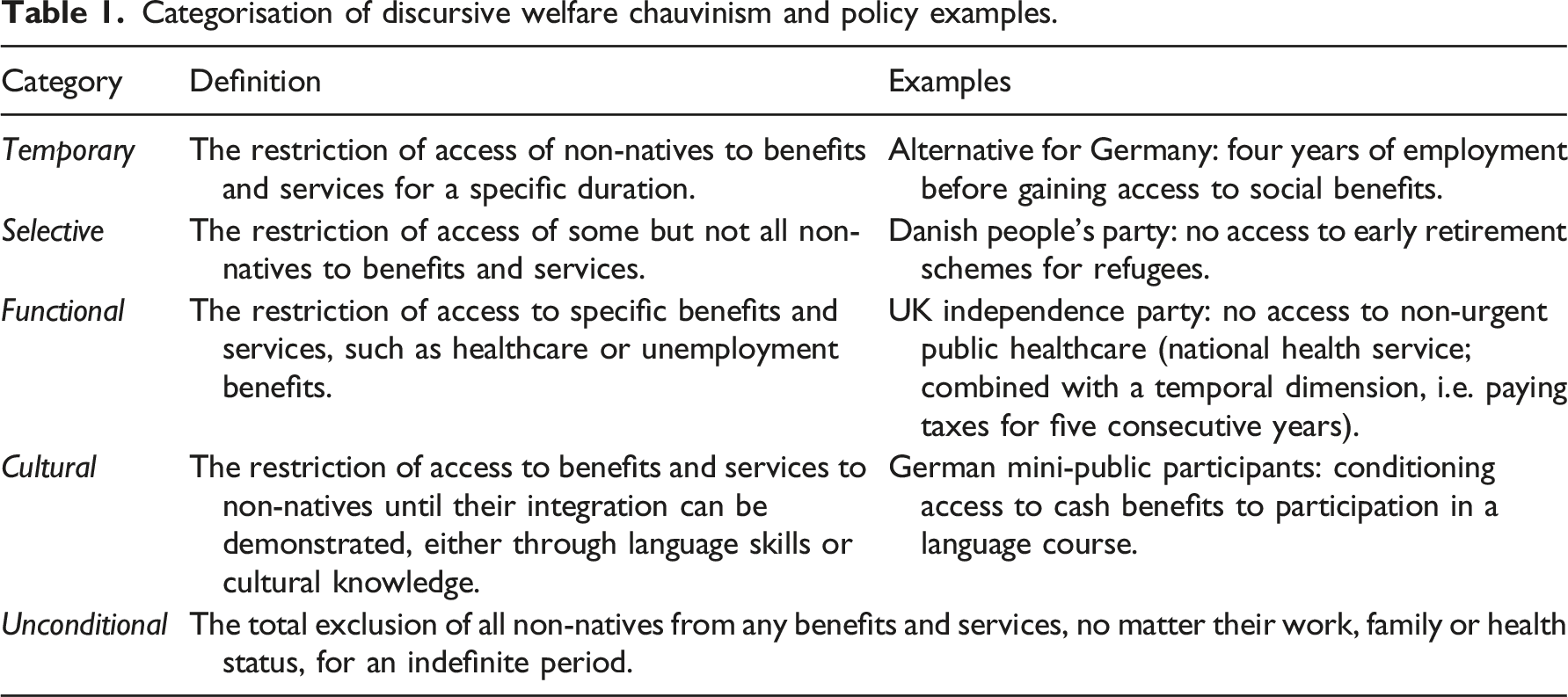
In our empirical illustration, the various populist radical right parties differ significantly in their policies on welfare and often combine different categories of chauvinism. Temporary welfare chauvinism is a key feature of the policy platform of populist radical right in all three countries. Germany and Denmark share a selective welfare chauvinist agenda, while Denmark and the UK are both inclined to functional policies. Cultural welfare chauvinism, however, is not advocated by these parties. Mini-public discussions also yielded significant differences between the three countries. In Germany, the main driver of concern was pressure on the welfare system, mitigated by concern that the neediest should be looked after and that non-natives’ access to some welfare provisions should be conditioned to their knowledge of German (cultural welfare chauvinism). In Denmark, economic concerns dominated discussions, and citizens’ positions on chauvinism matched most of the Danish People’s Party agenda by using temporary, selective and functional frames of welfare chauvinism. In the UK both economic interests and normative considerations apply; and while mini-public participants favour temporary and functional welfare chauvinism like UKIP, they went further by advocating a selective dimension by distinguishing access between EU and non-EU nationals (in a pre-Brexit setting). While Denmark and mostly Germany were affected by the refugee crisis (especially compared to the United Kingdom), one should keep in mind that the domestic socio-economic context is also likely to produce differences in attitudes (in line with Careja and Harris, 2022).
Welfare chauvinism is a form of welfare policy opposition that operates across national politics and is not limited to particular parties and their supporters. At the same time, national differences in welfare state traditions remain important in influencing how it operates. This has two implications for welfare politics: first, chauvinism will find it hard to become a transnational force or to figure prominently in direct cross-party links. In this sense, in terms of policy implications, the political directions which emerge from public discourses in the different countries are best understood as national although they emerge across a number of countries at the same time, in contrast to the internationalism implied by, for example, a thorough-going liberalism, which might involve freedom of trade or movement, engaging several countries and forcing citizens to look outwards. Second, chauvinism has much stronger implications for the modification of national welfare states in more universalist citizenship and in liberal selective systems than in corporatist social insurance ones, because it implies a categorization of recipients on a basis other than need or contribution.
Our work further demonstrates the need to unravel the concept of welfare chauvinism to understand what types of restrictions are advocated (or tolerated) by parties and the citizenry and to take into account the specific policy stances that different approaches involve. As such, we extend the empirical work started by Ennser-Jedenastik (2018) on welfare chauvinist discourse by identifying different categories of restrictions. We also contribute to the evolving debates surrounding welfare chauvinism (and, more broadly, welfare state opposition) by identifying which welfare chauvinist frames also appeal to the electorate beyond populist radical right voters. This is particularly relevant as welfare chauvinism has become increasingly mainstream (Abou-Chadi and Kause, 2020). While the dimensions identified in our categorization (time, space, function, culture) are not mutually exclusive, it could be argued that these are part of a more complex discursive puzzle that yield different policy outcomes. For instance, one could argue that cultural, functional and selective welfare chauvinism also have a temporal dimension by conditioning access to benefits to a multi-layered economic and cultural integration which often targets individuals originating from non-EU countries and of Muslim faith, although this is not always explicitly mentioned in public discourse. Future research could investigate the reasons why populist radical right parties do not offer similar chauvinist frames, especially in light of recent studies on transnational (Moffitt, 2017) and international (McDonnell and Werner, 2019) populism. Because chauvinism is not an international movement but one which stresses national differences it is more fruitful to focus on specific forms of welfare restrictions rather than seeking to examine welfare chauvinism holistically. In this article, we demonstrate that different discourses exist and show how these discourses emerge in the understanding of how welfare systems should be designed to differentiate between ‘natives’ and others in our mini-public dataset.
Footnotes
Declaration of conflicting interests
The author(s) declared no potential conflicts of interest with respect to the research, authorship, and/or publication of this article.
Funding
The author(s) disclosed receipt of the following financial support for the research, authorship, and/or publication of this article: NORFACE; 462-14-050.
