



Abstract
The article theorises how covering social risks through cash transfers and in-kind services shapes public attitudes towards including/excluding immigrants from these programmes in Western European destination countries. The argument is that public attitudes are more restrictive of granting immigrants access to benefits than to services. This hypothesis is tested across ten social protection programmes using original survey data collected in Denmark, Germany and the UK in 2019. Across the three countries, representing respectively a social democratic, conservative and liberal welfare regime context, the article finds that the public does indeed have a preference for easier access for in-kind services than for cash benefits. The article also finds these results to be stable across programmes covering the same social risks; the examples are child benefits and childcare. The results are even stable across left-wing, mainstream and radical right-wing voters; with the partial exception of radical right-wing voters in the UK. Finally, the article finds only a moderate association between individual characteristics and attitudinal variation across cash benefits and in-kind services.
Introduction
The issue of how to combine welfare states and increasing levels of immigration has become a salient political, public and also academic question (Alesina and Glaeser, 2004; Freeman, 1986; Sainsbury, 2006). In particular, the redistribution of welfare resources to immigrants is widely debated, and welfare chauvinism increasingly polarises Europe (Eger et al., 2020). Following Larsen (2020), this article defines welfare chauvinism (or nationalism) as the exclusion of non-citizens who live permanently within a state from social benefits and services and welfare chauvinist (or nationalist) attitudes as the support for such policies. Most previous studies have treated welfare chauvinist attitudes as something that is applied uniformly across social benefits and social services. This holds true for both the previous theoretical debates (Johnston et al., 2010; Kymlicka and Banting, 2006; Miller, 1993) and empirical studies (Gerhards and Lengfeld, 2013; Kros and Coenders, 2019; Mewes and Mau, 2012, 2013; Reeskens and Van Oorschot, 2012; Van der Waal et al., 2010, 2013). The political rhetoric of radical right-wing parties is also geared to pose the question in this one-dimensional way (Andersen and Bjørklund, 1990; Eger and Valdez, 2018). This is important as such parties capitalise on welfare chauvinism as a winning formula: it is about ‘them’ having access to ‘our’ (whole) welfare state. One could label it ‘general welfare chauvinism’. The dominant perspective has been to theorise welfare chauvinist attitudes as a matter of self-interest (Scheve and Slaughter, 2001), lack of shared identity (Miller, 1993) and concern for the broader social consequences of immigration (Hainmueller and Hopkins, 2014). Thus, welfare chauvinist attitudes are often treated as individual-level phenomena influenced by factors that are somewhat exogenous to the institutional structures of the welfare states already in place.
In line with other recent studies (Larsen, 2020), our study shows, however, that welfare chauvinist attitudes vary significantly across different programmes. Therefore, there is a need to theorise cross-programme differences in levels of welfare chauvinist attitudes. Following a long line of research on general welfare attitudes (Larsen, 2008; Rothstein, 1998; Svallfors, 1995; Titmuss, 1974), our point of departure is that existing historical institutions influence public attitudes. More specifically, the article proposes that welfare chauvinist attitudes are affected by whether social risks are covered by cash benefits or in-kind services in the existing programmatic structure of the welfare state. A few previous studies have explored the importance of selectivsm/universalism (Bay and Pedersen, 2006; Crepaz and Damron, 2009), reciprocity (Ruhs and Palme, 2018), welfare regimes (Van Der Waal et al., 2013) and cognitive status-quo biases (Larsen, 2020). However, the importance of in-kind services versus cash transfers have yet to be explored, and this article aims to fill this gap.
The article is divided into six sections. In the next section, we develop the theoretical argument about the importance of in-kind service versus cash benefit. We test this overall proposition using original survey data collected in the UK, Germany and Denmark in the following sections. In the third section, we develop several hypotheses related to specific programmes in the three countries. In the fourth section, we present the data material and measurements. In the fifth section, we report the levels of welfare chauvinist attitudes across programmes. We also describe levels across political orientation as the attitudes of radical right-wing voters are believed to be a critical case for our theoretical argument. In the sixth section, we analyse to what extent individual-level variables, used in previous research on welfare chauvinism, can account for the respondents’ tendency to distinguish between cash benefits and services. In the last section, we summarise our findings and discuss limitations.
Theory
The history of the welfare state is usually told as a matter of introducing cash benefits that cover the risk of old age, sickness, disability and later unemployment. As modern societies commodified the residents of states, those who could not sell their labour were given an alternative income. The service side of the welfare state is often less salient. However, modern societies also came with educational and healthcare systems provided by the state, or at least partly organised by the state, and they inherited a large number of poverty relief programmes, which have a much longer history. Education and healthcare are by ‘nature’ services, while poverty relief can have both a service and a benefit element. Thus, in the latter case, the state involvement was typically followed by a discussion about whether cash or in-kind service should be provided for poverty relief (Castles et al., 2012). The progressive liberal solution was to give poor people cash, and the conservative paternalistic solution was to give poor people food and other kinds of services. Later the classic in-kind services of healthcare, education and poverty relief were supplemented, among others, with public employment offices, childcare and care for the elderly. The Nordic countries extended in-kind services first, but continental welfare states such as Germany, France and the Netherlands followed soon after. Thus, in contemporary welfare states, the social services make up as large a share of the public budget as do cash benefits, or even a larger share (Castles et al., 2012). Therefore, it is puzzling that previous public and academic discussions in the North-Western European welfare states primarily focus on natives’ attitudes to immigrants’ access to cash benefits.
From our point of view, the limited interest in attitudes to immigrants’ access to services points to the importance of theorising the cash–service divide. We propose four characteristics, which make the public more willing to give immigrants access to in-kind service than to cash benefits. The first of these characteristics is a matter of the real operation of programmes, whereas the latter three are primarily matters of public perception.
Lower level of transferability
The establishment of social benefits and services was part of a larger nation-building project, which created both structural and symbolic boundaries between the native insiders and the non-native outsiders. This is a standard historical account (Christiansen et al., 2005; Petersen, 2011). Thus, social commitments and risk-sharing expanded to the boundaries of the newly formed nation-states but not beyond. In other words, the welfare state was built for the citizens of the state. In times of increasing immigration, this basic premise is in particular challenged by cash benefits as they are more transferable than are services in kind. In the paternalistic poverty relief tradition, the classic concern was that cash was wasted for indulgences, such as alcohol or gambling. This made in-kind services such as the provision of food and shelter preferable. In terms of welfare chauvinist attitudes, a critical feature of benefits is that they can be transferred across borders. In contrast, the consumption of services can only take place in the country of destination. Hence, we argue that welfare chauvinism across services is lower as services do not violate the basic principle of welfare being for residents living permanently within the state borders. There is already some empirical evidence for the importance of this characteristic for public opinion; through a survey experiment, Bay et al. (2016) demonstrated that welfare chauvinist attitudes were fuelled more by the statement that child benefits could be consumed in the country of origin than by the statement that immigrants in Norway would have immediate access to domestic child benefits.
Lower imagined potential for cheating
A fundamental premise for supporting a welfare state is that free-riding is perceived to be a marginal problem. This is a standard account within the current welfare state literature (Levi, 1997). Furthermore, we know from numerous studies on perceptions towards immigrants, among others from basic social psychological theory, that immigrants can easily be constructed as a deviant out-group with negative characteristics, in particular as free-riders trying to cheat the insiders (Allport, 1954; Tajfel, 1981). However, we argue that welfare chauvinism across services is lower because the (perceived) potential of cheating is larger for benefits than services. It is easier for the public to imagine that immigrants would have a possibility to claim benefits to which they are not entitled than they have for services; for example, receiving social assistance or unemployment benefits while working in the shadow economy. Consuming a social service such as education, healthcare or childcare requires the presence of the recipients and the right to entitlement is typically monitored by public-employed frontline personnel who function as gatekeepers.
Weaker imagined giver–receiver link
The public often imagines the welfare state as a reciprocal giver–taker relationship. Thus, the standard account within sociology is that welfare benefits and services give rise to what has been labelled the moral economy of the welfare state. The basic premise is that the public applies gifts-relationship heuristics when thinking of who deserves to be helped. Here reciprocity is the pivotal yardstick for deservingness (Mau, 2004; Svallfors, 2006). However, we argue that the imagined link between tax-payment and recipients is stronger for benefits than for services. This is because there is a straightforward link between giving and receiving as cash transfers are given in the same unit as tax or insurance payment (in this case, a currency). Hence, it is easier for the public to imagine that the ‘receivers’ directly take out what the ‘givers’ have paid in, in the same unit. The imagined link between tax or insurance payment and service consumption is more indirect, as the putting in and taking out is in different units. The money paid in is transferred to a service, the value of which most people have a hard time calculating. This has been labelled the fiscal illusion of the public (Logan, 1986). We argue that the looser ‘giver–receiver’ link of services is particularly crucial for welfare chauvinism as natives in North-Western European destination countries often hold the misguided perception that immigrants take more out than they pay in (Larsen et al., 2018; Nielsen et al., 2020).
Higher imagined positive externalities
The public might also judge the welfare state by whether it is good or bad for the broader society, in functional terms. This importance of sociotropic thinking has often been theorised within election research and has also been found to be one of the main reasons for negative attitudes towards immigrants (Kinder and Kiewiet, 1981). In general, the public tends to see the welfare state as functional for modern societies. However, we argue that the imagined positive externalities are more significant for social services than for social benefits. This is because cash benefits are often perceived as a means to uphold living standards, that is, the focus is the utility of the receiving individuals or families. Upholding living standards through cash benefits might have positive consequences for the broader society, for example, less poverty-connected problems such as crime, more political stability and better democracy. However, the imagined causal chain is not straightforward and imagined adverse incentive effects on employment often counterweigh the positive effects. By contrast, the imagined positive externalities of social services are more straightforward. Education, healthcare, public-employment agency, childcare and care for the elderly enables recipients and their families to participate in the labour market, that is, becoming contributors in the moral economy. It is telling that, in recent decades, social services have been promoted as social investment, that is, a positive externality (Morel and Palier, 2011). We argue that these positive effects could be particularly important for welfare chauvinist attitudes, as immigrants in North-Western Europe are often imagined as being non-integrated in society. Notably, low female workforce participation rates are often symbolic indicators of non-integration (Zimmerman et al., 2018). In order to strengthen integration, Denmark, for example, passed a law in 2018, which made 25 hours of public childcare attendance compulsory for children of immigrant parents with limited language skills living in so-called ghetto areas. Thus, social services can be imagined to enable labour market participation and a more comprehensive integration of immigrants.
These four characteristics of services led to the overall hypothesis that welfare chauvinist attitudes will be lower for in-kind services than for cash benefits. The overall null-hypothesis is that welfare chauvinist attitudes are at the same level for cash benefits and in-kind services. In the next section, we will develop several hypotheses, which are more directly connected to the programmatic structure of the three countries we have studied.
Programme-specific hypotheses and data
The three welfare states, Denmark, Germany and the UK, have more or less the same way of using cash benefits and in-kind services, despite different regime contexts. However, there are some variations between them, which we will exploit in the analysis. Public attitudes towards immigrants’ access to cash benefits were measured for social assistance, unemployment benefit and child benefit for children living in the destination country as well benefits for children living in the country of origin (here referred to as child benefits domestic and child benefit origin) as well as childcare in the UK and working tax credit in the UK. In all three countries, social assistance is a classic means-tested benefit, unemployment benefits are classic insurance benefits (compulsory in Germany and the UK, 1 voluntary in Denmark but heavily state-subsidised), and child benefits are classic universal cash benefits given to everybody with children. Despite the name, the working tax credit in the UK is not a tax-reduction for low-income individuals but rather a unique type of means-tested benefit to top-up lower wages 2 (hence, we did not ask about it in Denmark and Germany). Finally, the UK government runs a number of programmes that reduce the cost of childcare, with most of them sharing the characteristics that they are cash benefits, which are partly universal, partly means-tested (House of Commons Treasury Committee, 2017). For this reason, we categorise childcare in the UK mainly as a benefit.
Public attitudes towards granting immigrants access to in-kind services were measured for school education, healthcare and childcare as well as university education in Denmark and Germany. In all three countries, school education is a classic universal in-kind service. The same goes for healthcare in Denmark and the UK. In Germany, compulsory insurance has to be paid, but the insurance will be covered by the state if not provided by the employer/employee. Thus, it is close to a universal programme covering all residents of the state. Childcare is a classic tax-financed universal in-kind service in Denmark and Germany; in the former typically provided by the state, in the latter provided by a mix of state and civil society institutions. Finally, university education in Denmark and Germany is also a tax-financed public service. This leads to the following hypothesis concerning levels of welfare chauvinist attitudes across the programmes:
H1: Welfare chauvinist attitudes are higher for all the cash benefits (social assistance, unemployment, child benefit domestic and child benefit origin as well as childcare and working tax credit in the UK) than they are for all in-kind services (school education, healthcare as well as childcare and university education in Denmark and Germany).
In the UK and Germany, we also asked about equal social rights to social housing. We did not ask in Denmark as social housing is not connected to clear social rights, and provisions are blurred between public and private sectors. Social housing is believed to fall in between being an in-kind service and a cash benefit. Housing shares the low level of transferability and the low level of imagined potential for cheating of services. However, it does not have a weaker giver–receiver link as the value of housing is often known; as most people pay it in cash. Neither does housing come with the high (imagined) externalities of services, that can be framed as an investment (or maintenance) of human capital. This leads to the hypothesis:
H2: Social housing is attached to more welfare chauvinist attitudes than other in-kind services in the UK and Germany and attached to less welfare chauvinist attitudes than cash benefits in the UK and Germany.
One of the limitations of this reasoning is that the cash benefits and in-kind services cover different social risks. Thus, it could be argued that the level of welfare chauvinism might reflect ‘the nature’ of the risk rather than the programme structure of how the risk is covered. The dominant way of theorising the importance of the nature of the social risk has been through deservingness criteria. In this tradition, it is, in particular, the degree of controllability of a risk that matters (Larsen, 2008; Petersen, 2009; Van Oorschot, 2005; Van Oorschot et al., 2017). Falling ill is a classic example of a risk that cannot be controlled, which, in the eyes of the public increases the deservingness of recipients (Jensen and Petersen, 2017). In contrast, the risk of unemployment is the classic example of a more (imagined) controllable risk covered by social assistance and unemployment benefits, which make these recipients less deserving. As the same deservingness logic seems to apply to immigrants (Nielsen et al., 2020), one should not be so surprised to find more welfare chauvinist attitudes towards social assistance and unemployment benefits than towards healthcare. In order to address this argument, we test programmes that cover the same risk across different programme structures, namely, having children. In particular, we investigate the impact of services versus benefits by looking at differences between childcare service and childcare benefit as well as child benefit domestic and child benefit origin. This leads to the following hypothesis:
H3: Welfare chauvinist attitudes are higher for cash benefits for children (child benefit domestic and child benefit origin in all three countries as well as childcare in the UK) than they are for in-kind service for children (childcare in Denmark and Germany).
For the case of child benefit, we follow Bay et al. (2016) by specifying the condition of the child respectively being located in the destination country and in the country of origin (child benefit domestic versus child benefit origin). This gives a direct measure of the importance of the recipients being inside or outside the state borders, which is deemed an essential criterion for welfare reciprocity (Christiansen et al., 2005). The hypothesis is:
H4: Welfare chauvinist attitudes are higher for child benefit when it is specified that entitlement is based on children located in the origin country versus in the destination country.
Finally, we use the attitudes of radical right-wing voters as a critical case for our theoretical argument. As these parties tend to promote the general welfare chauvinism assumed in previous studies, one could expect their voters to be the least likely to differentiate between immigrants’ access to in-kind services or cash benefits. This leads us to test the following hypothesis:
H5: Our hypotheses H1 to H4 hold true among left, mainstream as well as radical right-wing voters.
Data collection and measurement
For testing our hypothesis, we collected the Welfare State Attitude Survey data in Denmark, Germany and the UK as existing datasets have not measured welfare chauvinist attitudes towards services and benefits. The country choice allows us to test our theoretical argument across three different welfare regimes contexts: social democratic (Denmark), conservative (Germany) and liberal (UK) (Esping-Andersen, 1990).
The Welfare State Attitude Survey data was collected by YouGov in 2019 among adult respondents (18–79 years) based on standing panels (N = 1849 in Denmark, N = 1870 in Germany, N = 1825 in the UK). For the analysis, we deleted participants with an immigration background from the sample (N = 362). YouGov used cluster sampling within the panels to produce a representative sample, and post-weighting procedures are used to correct for remaining biases (connected to basic socio-economic differences between the sample and the population; weights delivered by YouGov). While there is a risk of panel effect, previous studies have found standing panels to be close to representative and replicate the correlation structure of random probability surveys (Weinberg et al., 2014).
As most of the research on welfare chauvinism in Europe analyses a standard question used in the European Social Survey (ESS), we used an adjusted version of it for our research. Instead of the abstract category ‘social benefits and services’ used in the ESS, we specified the programmes discussed in the previous section. The order of the programmes was randomised in order to reduce bias. Instead of the abstract category ‘people coming to live in [country] from other countries’ used in the ESS, we used ‘workers from Eastern Europe’ for two main reasons: first, Eastern European workers is a sizeable group in all three countries. In Germany, in 2019, the immigrants from Poland and Romania make up respectively the second- and fourth-largest group (the other two being immigrants from Turkey and Syria). In Denmark, the two groups were respectively the largest and fifth-largest (the other being migrants from Germany, Syria and Turkey). In the UK, immigrants from Romania made up the third-largest group of foreign-born people (the other being India and Pakistan). Second, this is the group with the most questioned social rights, as the mobile EU-workers in principle are entitled to the same social rights and charges as natives. They are, in principle, also allowed to transfer social rights across borders, for example, sending child allowance to children residing in origin countries (Pennings and Seeleib-Kaiser, 2018). We used the following exact wording: ‘In relation to the migration of East European workforce it has been discussed, when and to what extent they should have the same rights as [Danish, German, British] citizens. When do you think workers from Eastern Europe should have the same rights to [specific social protection programme] as citizens that already live here?’ For all items, we used the same response categories as in the ESS: (0) immediately on arrival, (1) after living in [Denmark, Germany, the UK] for a year, whether or not they have worked, (2) only after they have worked and paid taxes for at least a year, (3) once they have become a [Danish, German, British] citizen and (4) they should never get the same rights. For reasons of practicability, we measure only the means of the dependent variable in the main analysis of this article (see supplementary material for descriptives of the dependent variables). However, we conducted sensitivity tests with the categorical underlying answers and found similar results. Political orientation is based on the vote in the last general election. 3 In the multivariate analysis, we measure the degree of difference to in-kind and cash benefits at the individual level by subtracting an additive index of attitudes to access to school education and healthcare ranking from 0 to 4 from an additive index of attitudes to social assistance, unemployment benefits and child-benefits (domestic) also ranking from 0–4. 4 This leaves us a dependent variable on a 9-point scale going from −4 to +4. We control for gender, age, educational level, occupation, last votes plus two attitudinal variables measuring perception of threat (see Results II section and supplementary material for details on the independent variables). The analyses of the data are performed in Stata 16.
Results I: Levels of welfare chauvinist attitudes
Figure 1 shows welfare chauvinist attitudes across specific services and benefits (ranged from lowest to highest within each country).
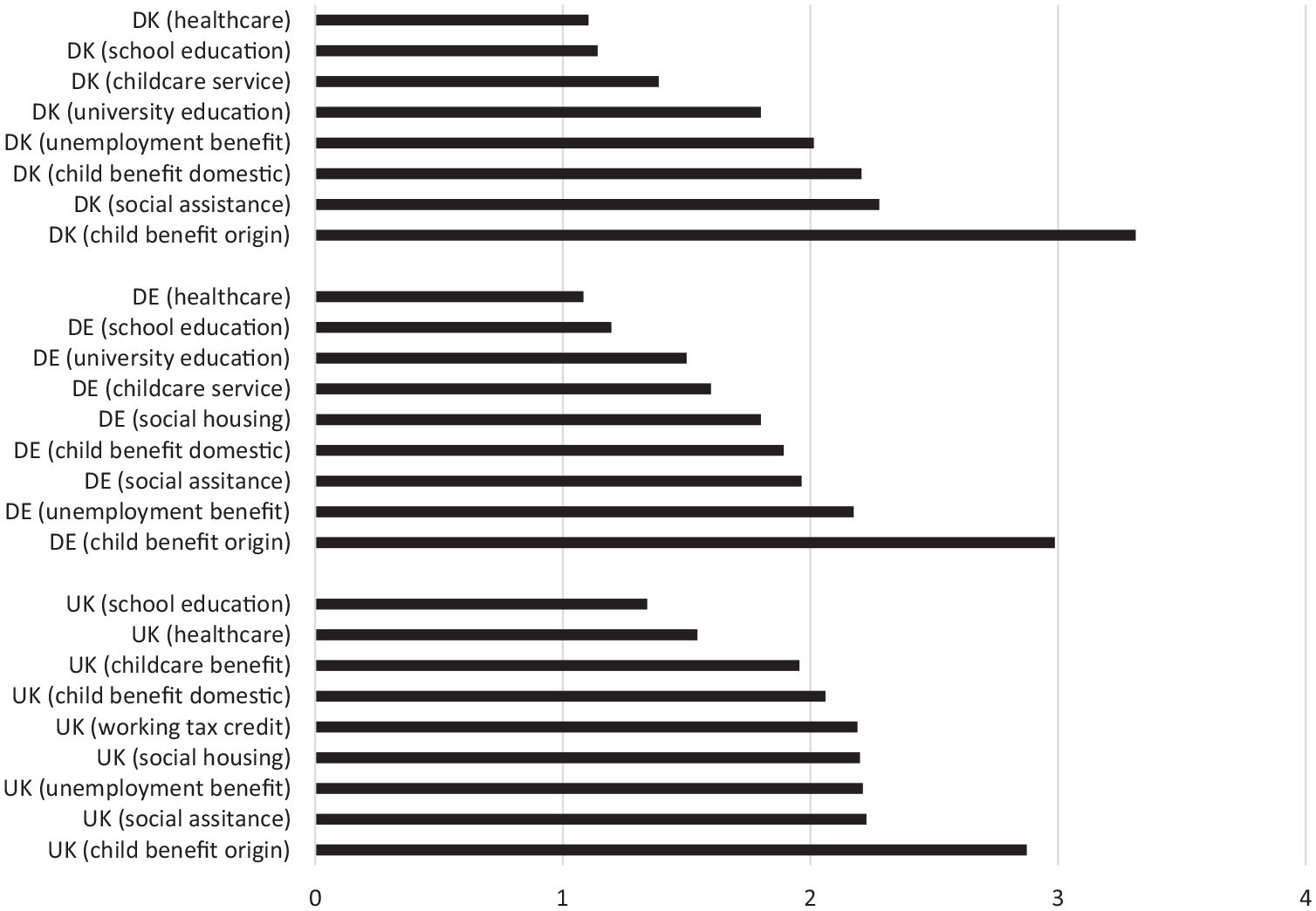
Welfare chauvinist attitudes across ten benefits and services.
The overall result is that the expected difference between cash benefits and in-kind services is present in the data. Judged by the ranking of the programmes, H1 holds true in all three countries. The Danish and German public was more willing to give access to the services (healthcare, school education, childcare service and university education) than to the benefits (unemployment benefit, child benefit domestic, child benefit origin, childcare benefit and social assistance). All differences were statistically different at 0.01-level. The British public was also more willing to give access to services (school education and healthcare) than to benefits (childcare, child benefit domestic, child benefit origin, working tax credit, unemployment benefit and social assistance). Again, all differences are statistically significant at 0.01-level.
The hypothesis of the public being more willing to give access to housing than to benefits and less willing than for services (H2) holds true in Germany. The German public was less willing to give access to housing than to all services and more willing to give access than to all benefits. Differences were sizeable and statistically significant. The hypothesis only holds partly true in the UK. The British public was less willing to give access to housing than to the two services. However, the British public was not more willing to give access to housing than to benefits. In fact, the British were more willing to give access to childcare and child benefit (domestic) than to housing. Thus, for this hypothesis, we have mixed evidence in the two countries.
We can confirm the two hypotheses related to the same risk across benefits and services, the risk of having children (see Figure 2). In all three countries, welfare chauvinist attitudes were higher for child benefit received by immigrants with children located in the origin country than in the destination country (H4). Specifying the child being in the country of origin increases welfare chauvinism with 1.1 in Denmark, 1.2 in German and 0.9 in the UK on the 0–4 scale. They are the most considerable differences found in the data material. The cross-national differences expected by H3 were also found. The public was more willing to give access to the in-kind childcare service in Denmark (1.39) and Germany (1.60) than to the childcare benefit in the UK (1.96). The difference is sizeable and significant. The public in Denmark and Germany were also more willing to give access to the in-kind childcare service than to child benefit domestic and child benefit origin (the means are respectively 2.21 and 1.89, and differences to childcare are sizeable and statistically significant). Thus, for the same social risk, it matters whether services or benefits cover it.
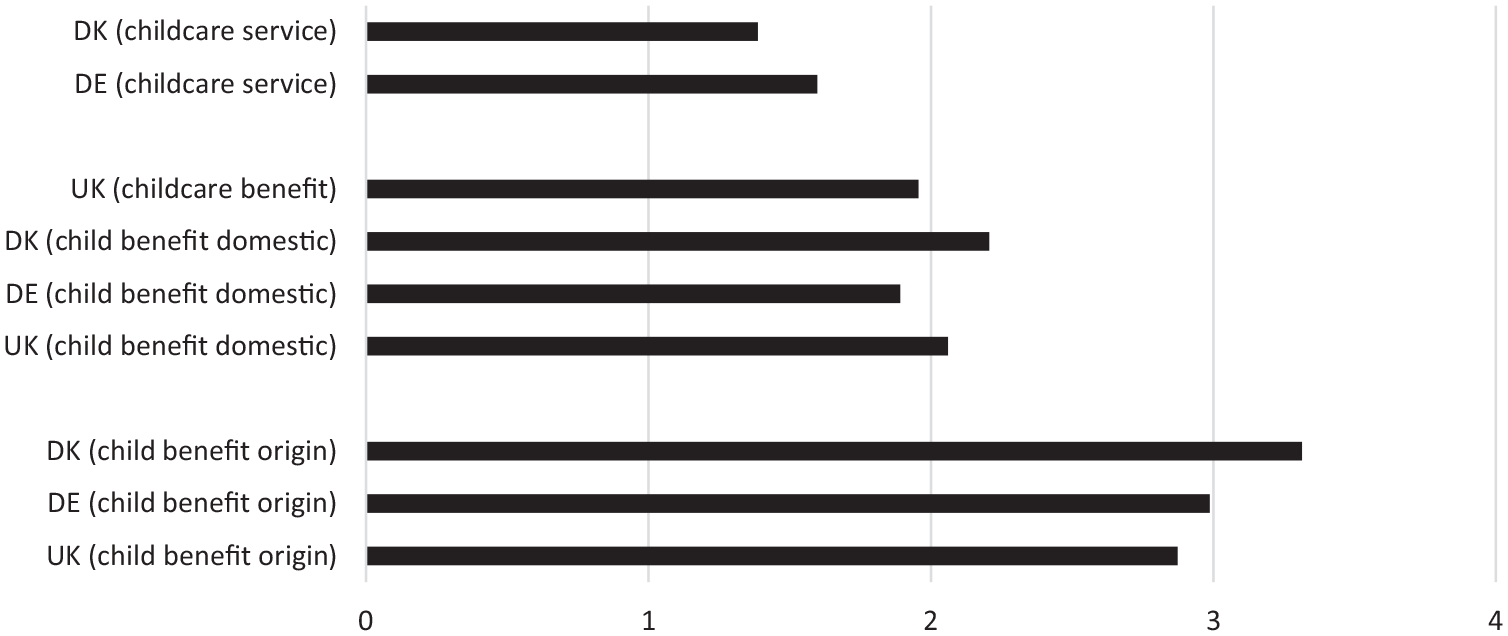
Welfare chauvinist attitudes covering the same social risk across benefits and services.
Finally, Figure 3 demonstrates that the level of welfare chauvinism increases, going from left-wing voters to radical right-wing voters, which is in line with previous research. However, we still find differences across in-kind services and cash benefits. H1 (less restrictive attitudes to all in-kind services than to benefits) holds true for Danish left-wing and mainstream right-wing voters. This also holds true for Danish radical right-wing voters; with the exception of restrictiveness not being significantly lower for access to university than for unemployment benefits. H3 (higher welfare chauvinism for childcare benefit than in-kind childcare service) and H4 (right to child benefit abroad) also hold true in all three Danish ideological segments. In Germany, H1 holds true in all three ideological segments; without exceptions. For H2 (housing) it holds true in all three segments that it is attached to more welfare chauvinism than in-kind service, but it does not hold true in any of the three segments that it is attached to less welfare chauvinism than are benefits. Finally, as in Denmark, H3 and H4 hold true in all three segments in Germany. Thus, in general, we find H5 to hold true in Denmark and Germany.
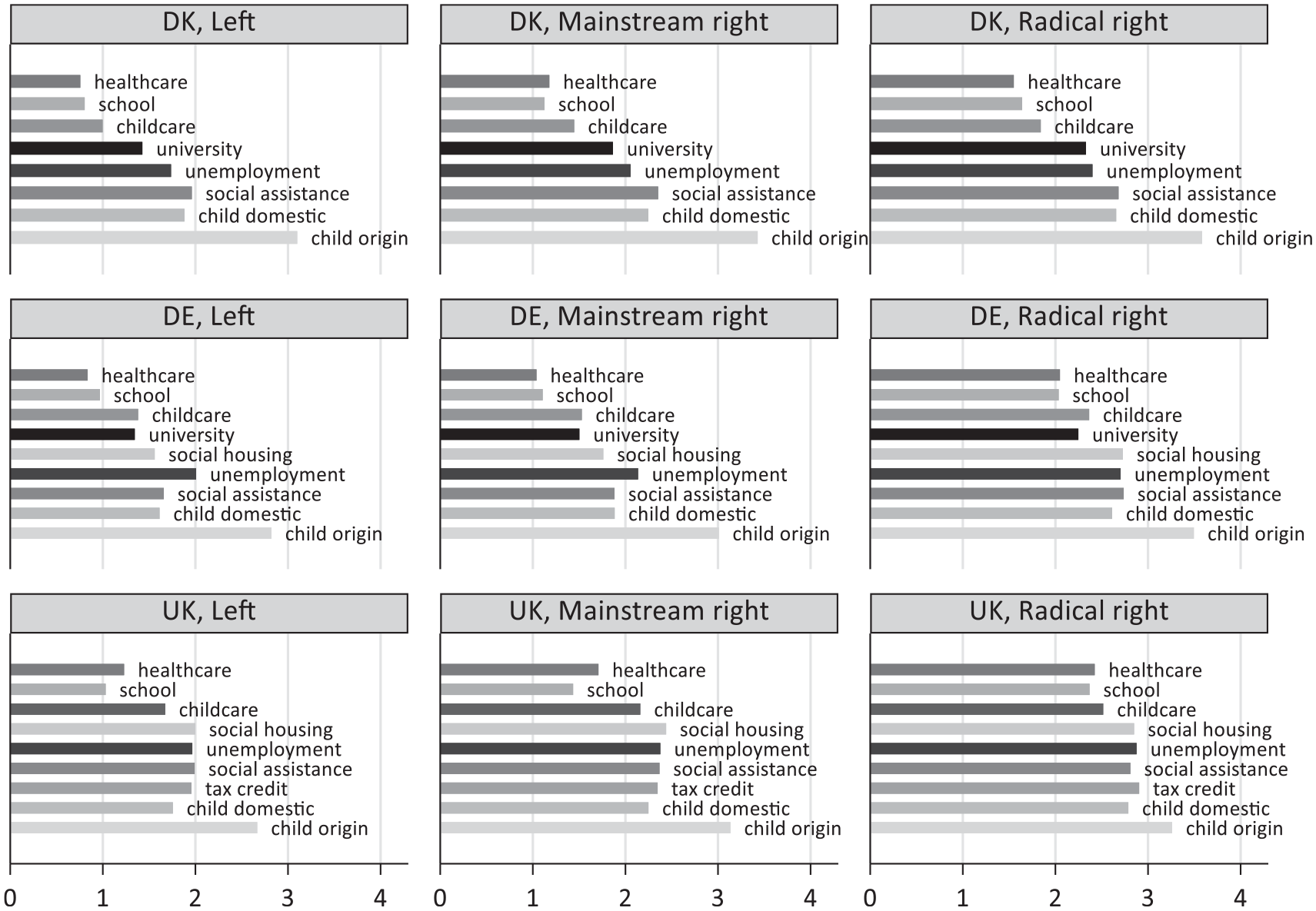
Welfare chauvinist attitudes across services and benefits and last vote in general election.
In the UK, H1 holds true among left- and mainstream right-wing voters. In-kind service in the form of healthcare and school education is associated with less welfare chauvinism than any of the benefits. H1 does not hold entirely true for the radical right-wing voters. In this ideological segment, the two services are not associated with less welfare chauvinism than childcare benefits. However, they are associated with less welfare chauvinism than the other benefits. As in Germany, housing (H2) is in all three British segments associated with more welfare chauvinism than are services, while the expected difference to benefits could not be found. In all of the three segments, housing is actually associated with more welfare chauvinism than are childcare benefit and child benefit domestic, in line with the overall results (see above). H3 cannot be tested in the UK, as in-kind childcare services are not present. However, in all three British segments, the childcare benefit is associated with less welfare chauvinism than are child benefit domestic and child benefit abroad. Finally, H4 also holds true in all three British segments. However, as the British radical right-wing voters are the most restrictive in our sample, the difference between child benefit to children of Eastern European workers living in the UK and those living in the country of origin is smaller than what is found in the other ideological segments in our sample. Thus, for H5, we have mixed results for the British radical right-wing voters.
Results II: Multivariate patterns
In this section, we explore variations in citizens’ tendency to distinguish between in-kind and cash benefits using multivariate analysis. The mean differences in the additive indexes were 1.04 in Denmark, 0.90 in Germany and 0.75 in the UK. Thus, the largest distinction between in-kind service and cash benefits on the 9-point scale was found in Denmark, and the lowest was found in the UK. With a point of departure in previous research, we analyse whether variables known to increase welfare chauvinist attitudes at the same time reduce the tendency to distinguish between in-kind service and cash benefits. This mostly turns out to be the case, but the effects are modest. Model I in Table 1 shows no effect from gender, a significant but small positive effect from age (meaning that older respondents differentiate more between in-kind and cash benefits than younger respondents). Previous studies have found more welfare chauvinist attitudes among lower educated respondents, and indeed, we find a tendency towards less differentiation between in-kind and cash benefits as education level decreases. Those with primary education are estimated to score −0.26 lower than those with tertiary education on the 9-point-scale. Previous studies also have welfare chauvinist attitudes to be particularly high among blue-collar workers, but we do not find this group to differentiate less between cash and in-kind services; taking education into account. Finally, after controlling for the composition of gender, age, education and blue-collar work, Model I shows that the UK respondents also differentiate less between in-kind service and cash benefits than do respondents from Denmark. The UK respondents are estimated to score 0.26 lower on the 9-point scale. Respondents from Germany differentiate marginally less than respondents from Denmark (0.08), but the effect is significant.
Models (OLS) estimating the difference in welfare chauvinist attitudes towards cash benefits (social assistance, unemployment benefit and child benefits (domestic)) and in-kind services (healthcare and school education).
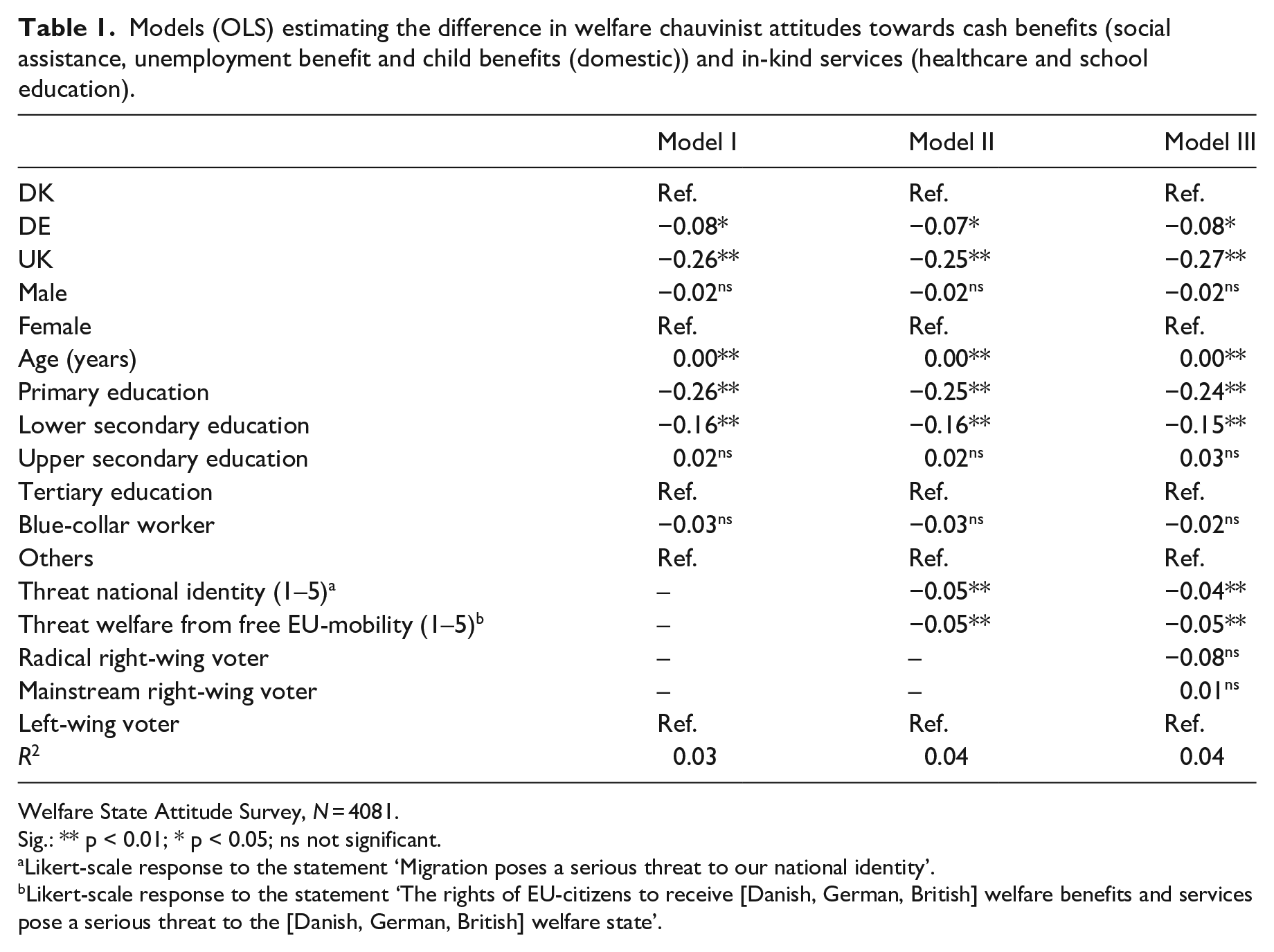
Welfare State Attitude Survey, N = 4081.
Sig.: ** p < 0.01; * p < 0.05; ns not significant.
Likert-scale response to the statement ‘Migration poses a serious threat to our national identity’.
Likert-scale response to the statement ‘The rights of EU-citizens to receive [Danish, German, British] welfare benefits and services pose a serious threat to the [Danish, German, British] welfare state’.
In Model II we include an indicator for the perceived threat to national identity from immigration and the perceived threat to the welfare state from EU-immigrants’ free access to benefits and services (see Table 1 note). Both of these attitudes have been found to go together with higher welfare chauvinist attitudes. We find that these go together with less differentiation between in-kind service and cash benefits. However, again it is a small effect; for example, ‘completely agreeing’ that immigration is a threat to national identity, as opposed to completely ‘disagreeing’, is only estimated to lower the level of distinction between cash and in-kind services by 0.20 (four times 0.05). Finally, we enter vote at the last election in Model III. We do find that voters of the radical right-wing parties differentiate less between in-kind service and cash benefits than do left-wing voters. However, the effect is only −0.08 on the 9-point scale, and it is not significant in models where threat-indictors are included (without these, it does turn significant). Furthermore, there is no difference between left- and right-wing when it comes differentiating between service and in-kind benefits. Thus, all in all, we find that the variables linked to the level of welfare chauvinism are not particularly useful in explaining the tendency to differentiate between cash benefits and in-kind service.
Conclusion and discussion
This article demonstrates that public attitudes in North-Western Europe are not simply divided into being for or against equal social rights for immigrants. In contrast, the article provides further evidence for the overall theoretical argument that the programmatic structure of the existing welfare state influences the level of welfare chauvinist attitudes found in the public. Due to the lower level of transferability, lower imagined potential for cheating, weaker imagined giver–receiver link and higher imagined positive externalities, we expected in-kind services to be associated with less welfare chauvinism than is the case for cash benefits. We tested this argument through four specific hypotheses adapted to the programmatic structure of the Danish, German and UK welfare states.
The hypothesis (H1) that various in-kind services were attached to less welfare chauvinism than were various cash benefits holds true in all three countries. The hypothesis (H2) that social housing was positioned in between services and benefits, as it had some but not all the characteristics of in-kind services, was partly confirmed. It holds true in Germany but only partly in the UK. The article found support for the two hypotheses related to the same risk: the risk of having a child. The public is more willing to give immigrants access to childcare than to child benefits (H3). Finally, in line with previous research, we found that specifying that the child is located in the country of origin reduces the willingness to give immigrants equal social rights (H4). Thus, at least for child benefits, it holds true that transferring tax-financed benefits across nation-state borders is perceived as highly problematic. For the critical case of radical right-wing voters (H5), we found these hypotheses (H1 to H4) largely to hold true in Denmark and Germany. In contrast, the British radical right-wing voters distinguished less between in-kind services and cash benefits. Finally, we found that variables found to explain higher levels of welfare chauvinist attitudes seem to lower the tendency to differentiate between immigrants’ access to in-kind service or cash benefits, but the effects are modest. In other words, the differences in willingness to grant immigrants access to benefits and services are not caused by factors such as education, income or perceptions of cultural threats. The results support the argument – in an indirect way – that an effect is caused by mechanisms at an aggregated level (in this case, differences in how social risks are covered by the programmatic structure of the welfare state).
The study provides support for the argument that it matters for welfare chauvinist attitudes, whether social risks are covered by in-kind services and cash benefits, but the study naturally comes with limitations. The study is limited by the classic problem of distinguishing between the effect of the way a particular programme is organised and the social risk covered. We addressed this problem by analysing childcare versus child benefits, confirming expectations, but still, the nature of the social risks might matter for our other results. We also fully acknowledge that we have only tested the expected outcome of our theoretical argument and not the suggested causal mechanisms. We leave it to future research to measure how the public perceives transferability, the potential for cheating, the level of reciprocity and the positive externalities connected to giving immigrants access to specific programmes. We also leave it to future research to explore whether the theses hold true across other countries and other immigrant groups than Eastern European workers. We do, however, think that Eastern European workers in the UK provide somewhat of a critical case. After the EU-enlargement in 2004 and 2008, the UK experienced an unprecedented inflow of EU-workers, and this happened in a context of a liberal labour market and general welfare retrenchment, which pushed the UK closer to the ideal-typical liberal welfare regime. The UK experienced a strong political mobilisation against the social rights of immigrants, as the issue became part of a larger campaign for leaving the European Union. Our data do show more general welfare chauvinist attitudes in the UK than in Denmark and Germany. The radical right-wing discourse about services such as the NHS (the universal national healthcare system) being a magnet for attracting sick immigrants and welfare tourism is telling (Larsen et al., 2018). However, even in this context, we do, in general, find the expected differences between welfare chauvinist attitudes connected to in-kind services on the one hand, and benefits on the other. This might point to in-kind services as a fertile way to combine immigration and public acceptance of immigrants’ social rights within the European Union and beyond.
Supplemental Material
sj-pdf-1-esp-10.1177_09589287211023047 – Supplemental material for Welfare chauvinism across benefits and services
Supplemental material, sj-pdf-1-esp-10.1177_09589287211023047 for Welfare chauvinism across benefits and services by Gianna Maria Eick and Christian Albrekt Larsen in Journal of European Social Policy
Footnotes
Acknowledgements
We would like to thank Wim Van Oorschot, Bart Meuleman, Heejung Chung, Trude Sundberg, all scholars at the Centre for Comparative Welfare Studies (ccws.dk), and the reviewers for helpful comments. Furthermore, this article and the research behind it would not have been possible without the Jos Berghman Welfare Studies Stipend.
Funding
The author(s) received no financial support for the research, authorship, and/or publication of this article.
Supplemental material
Supplemental material for this article is available online.
Notes
References
Supplementary Material
Please find the following supplemental material available below.
For Open Access articles published under a Creative Commons License, all supplemental material carries the same license as the article it is associated with.
For non-Open Access articles published, all supplemental material carries a non-exclusive license, and permission requests for re-use of supplemental material or any part of supplemental material shall be sent directly to the copyright owner as specified in the copyright notice associated with the article.
