




Abstract
This article examines the impact of the radical right political discourse on welfare chauvinistic attitudes over time. Using data from two rounds of the European Social Survey (2008/09 and 2016/17), the Comparative Political Data Set and the Manifesto Project for 17 European countries, our analyses show that radical right mobilization and the salience of political rhetoric framed on cultural diversity and immigration issues have a significant positive effect on welfare chauvinist attitudes. Although in the years after the Great Recession and the refugee crisis, welfare chauvinism remained fairly stable among the general European public, the influence of radical right mobilization and negative political discourse on welfare chauvinism has significantly increased. Furthermore, we find that when radical right parties become stronger and the political rhetoric regarding cultural diversity and immigration becomes more salient, differences in welfare chauvinist attitudes between people with different political affiliations become more polarized. These results contribute to a broader understanding of the mechanisms underlying welfare chauvinistic attitudes and mark the importance of the inclusion of political factors in studies on welfare chauvinism.
Keywords
Introduction
Since the beginning of the twenty-first century immigration has been a prominent issue on the political agenda of Western societies. The so-called European refugee crisis, the EU–Turkey deal and the increasing popularity of radical right and anti-immigrant parties are only a few prominent examples that have caused great controversy along the political spectrum (Eger and Breznau, 2017; Eger and Valdez, 2015). Central to this political debate are questions about the relationship between immigration and the welfare state (Eger and Breznau, 2017; Eger et al., 2020; Marx and Naumann, 2018). In the aftermath of the financial crisis and the European refugee crisis, people have become increasingly concerned that immigrants move to countries with more generous welfare systems, where they receive social benefits without sufficiently contributing to the system (Ennser-Jedenastik, 2018). Therefore, it is not surprising that the policy principle of welfare chauvinism, that is, generous welfare benefits for natives but restricted access for immigrants, has become more popular in European countries. Social policy research shows that welfare chauvinism can nowadays not only be found on the political agenda of the radical right, but is also embraced by mainstream politicians and political parties (Ennser-Jedenastik, 2018; Schumacher and Van Kersbergen, 2016). Surprisingly however, the impact a welfare chauvinist political discourse on popular support for welfare chauvinism is still understudied (Marx and Naumann, 2018).
Exclusionary attitudes do not form in a vacuum and as negative reactions towards migration have become politically salient in Europe, it is important to take notice of the political and ideological context in which individual level welfare chauvinism emerges and rises (Semyonov et al., 2006). The presence of a well mobilized radical right party for example, will likely increase the salience of concerns among the broader public. As European countries differ in the extent to which radical right parties are mobilized, it might help to understand country variation in support for welfare chauvinism (Koning, 2011). A better understanding of how and to what extent the political climate matters for welfare chauvinistic attitudes among the population is therefore crucial to gain insight in the process of the institutionalization of selective solidarity (Koning, 2011). Moreover, these political and ideological country contexts might have changed after the Great Recession of 2008 and the refugee crisis in 2015. Since then, the political debate around immigration has thrived with rising success for radical right parties. Did this contextual change in political discourse also have an impact on popular support for welfare chauvinism?
Although previous studies examined change in welfare chauvinism (Eger et al., 2020; Marx and Naumann, 2018), so far, the role the political discourse plays in shaping welfare chauvinism in the previous decade has been understudied. In this article our main contribution lies in studying the impact of the mobilization of radical right parties and the influence of the politicization of immigration issues on welfare chauvinism, specifically among individuals with different political affiliations. We use data from the fourth (2008/09) and eighth round (2016/17) of the European Social Survey (ESS), from the Comparative Political Data Set (CPDS) (Armingeon et al., 2021) and the Manifesto Project (Lehmann et al., 2022). The results of our analyses will increase our understanding of the mechanisms that underlie the dynamic relationship between radical right political discourse and welfare chauvinism and to what extent this leads to political polarization at the individual level. We address the following research questions: 1) What is the effect of the radical right political discourse on welfare chauvinist attitudes in European countries? 2) Was there a change in effect of the radical right political discourse on welfare chauvinism between 2008/2009 and 2016/2017? 3) How does the radical right political discourse influence the role of individual political affiliation in the formation of welfare chauvinistic attitudes?
The following section outlines the study’s theoretical building blocks and its corresponding hypotheses in more detail. After the data and methods section, the analytical section presents both the descriptive statistics and the results from multilevel modelling. Finally, these results are discussed, leading to a final conclusion.
Theoretical framework
Welfare chauvinism in previous studies
Welfare chauvinism – in line with the introduction of this special issue – is understood as ‘the exclusion of non-citizens who live permanently within a state from social benefits and services and welfare chauvinist (or nationalist) attitudes as the support for such policies’ (Eick and Larsen, 2022: 19–20). The term was first coined by Andersen and Bjorklund (1990) who referred to it as ‘the idea that welfare services should be restricted to our own’ (Andersen and Bjorklund, 1990: 212). Although welfare chauvinism has gained in popularity, only a small minority of European citizens think immigrants should be excluded from redistribution entirely (Mewes and Mau, 2012; Reeskens and Van Oorschot, 2012; Van der Waal et al., 2010, 2013). Most people are willing to grant social welfare rights to immigrants, provided they have acquired state citizenship or have made significant tax contributions (Reeskens and Van Oorschot, 2012). Welfare chauvinism is thus considered to be a dynamic concept (Ennser-Jedenastik, 2018); in its weakest form it refers to lower deservingness of immigrants compared to natives (Reeskens and Van Oorschot, 2012) while in the strongest sense, it refers to the unwillingness to grant immigrants any social rights as a manifestation of xenophobia and nativist resentments (Reeskens and Van Oorschot, 2012).
So far, research on welfare chauvinism as a public attitude has been mainly focusing on three major predictors of welfare chauvinism. First, an extensively debated question is whether migration induced diversity erodes support for an inclusive redistributive welfare state. Large scale immigration is thought to impair feelings of shared belonging and solidarity that are needed to uphold support for a viable welfare state (Kymlicka and Banting, 2006; see also, Alesina and Glaeser, 2004). Because the empirical evidence for an effect of immigration and diversity on overall solidarity remains rather scarce (Eger et al., 2020; Mau and Buckhardt, 2009), some authors have shifted towards a focus on welfare chauvinism and immigrant exclusionary welfare reforms (for example, Eger and Breznau, 2017; Koning, 2011; Mau and Burckhardt, 2009; Reeskens and Van Oorschot, 2012). Second, some scholars have focused on institutional explanations for differences in the levels of welfare chauvinism and refer to the integrative capacity of welfare states and their ability to shape national identities, communities, and political attitudes (Eick and Larsen, 2022; Van der Waal et al., 2013). Lastly, there are studies that focus on socio-economic and class differences in support for welfare chauvinism. Support for welfare chauvinism increases with lower levels of (perceived) material wellbeing and education and stronger perceptions of economic risks and threat (Heizmann et al., 2018; Kros and Coenders, 2019; Mewes and Mau, 2012; Van der Waal et al., 2010).
Although the concept of welfare chauvinism is already well-known in research on party competition and spatial models of politics (Careja and Harris, 2022; Ennser-Jedenastik, 2018) and is denoted as the winning formula for radical right parties (Careja and Harris, 2022;) the influence of such an ethnonationalist and racializing political agenda on individual level welfare chauvinist attitudes has however not yet been extensively investigated. Few scholars have sought to assess the impact of particularly the radical right and its political discourse on attitudes of welfare chauvinism among the public (Eger et al., 2020; Marx and Naumann, 2018). Marx and Naumann (2018) show that in Germany welfare chauvinist attitudes increased strongly after the crisis, but that this is the case among supporters of all political parties. They conclude that the ‘refugee crisis activated dispositions to make in-group/out-group distinctions that are to some extent independent of party rhetoric’ (Marx and Naumann, 2018: 111). However, they are not able to assess direct effects of political discourses, nor if the widely shared welfare chauvinist attitudes sprouted from general discontent, or if the general discourse shifted under influence of the German radical right party AfD (Marx and Naumann, 2018). Eger et al. (2020), in their assessment of change in welfare chauvinism, used the variable ‘salience of nationalism and multiculturalism in previous elections’ to examine the influence of the political salience of immigration on change in welfare chauvinism within countries. They find that only the most exclusionary attitudes (excluding immigrants from the welfare state) become less strong when salience of this issue – within a country context – goes up. However, the findings in this study were not related to broader theoretical arguments on the influence of radical right discourses. Moreover, there have been studies investigating the impact of the politicization of immigration issues on anti-immigrant attitudes (Bohman, 2011; Bohman and Hjerm, 2016; Hopkins, 2011; Rydgren, 2003; Semyonov et al., 2006). Bohman and Hjerm (2016) find no effects of radical right party parliamentary presence or nationalistic frames on anti-immigrant sentiment (between 2002 and 2012), while Semyonov et al. (2006) find that negative attitudes towards foreigners increase in places where radical right parties are better mobilized. The empirical evidence regarding the impact of radical right discourse on anti-immigrant sentiment is therefore not conclusive.
Below we formulate our theoretical expectations linking the political discourse of the radical right to welfare chauvinism.
Welfare chauvinism and the political discourse of the radical right
In the aftermath of the Great Recession and the following refugee crisis, radical right parties quickly gained electoral territory across Northern and Western Europe (Keskinen et al., 2016; Schumacher and Van Kersbergen, 2016). Although these radical right parties did not start out as vocal advocates for welfare chauvinism, in recent years the combination of anti-immigrant views and pro-welfare stances has emerged as their typical winning formula (Careja and Harris, 2022). The radical right uses the welfare state to draw a distinction between ‘us’ and ‘them’, by claiming that immigrants make excessive use of the welfare state, making the system unaffordable (Careja and Harris, 2022; Ennser-Jedenastik, 2018; Keskinen et al., 2016). For that reason, welfare should be restricted to ‘us’, the ‘deserving’ natives (Keskinen et al., 2016; Schumacher and Van Kersbergen, 2016). The question is, however, which mechanism connects the discourse of the radical right to welfare chauvinist attitudes at the individual level?
Slothuus and Vreese (2010) address the question how public opinion is influenced by issue frames specifically communicated by political parties. Political parties engage in the process of framing, by defining and producing a political issue and pointing the receiver to the essence of this issue (Slothuus and Vreese, 2010: 631). A framing effect occurs when the frames in communicating the issue affects the recipients’ cognitive understanding of the issue and/or his/her opinion on this issue (Chong and Druckman, 2007; Slothuus and Vreese, 2010: 631). Based on the idea of motivated reasoning (Taber and Lodge, 2006), Slothuus and Vreese (2010) argue that citizens respond more strongly to issues framed by political parties. They theorize (and empirically confirm) that if parties conflict over an issue, people care more about that issue and aim to defend or oppose it, in line with their previous expressed values, identities and attitudes (Slothuus and Vreese, 2010). This would lead to the expectation that radical right parties voicing a frame about welfare chauvinism that is contested in the political arena, leads to stronger effects on individual opinion formation on this issue. In contexts with stronger right-wing political mobilization, the effects on welfare chauvinism can therefore be expected to be stronger. We expect higher levels of welfare chauvinism among citizens in contexts where radical right-wing political parties occupy a larger part of the political electorate (H1).
Radical right parties also have an influence on other political parties (Bohman, 2011; Rydgren, 2003). Bohman (2011) identifies three ways in which the political articulation of immigration issues at the national level can influence anti-immigrant attitudes. First, by highlighting what unites or what separates, political actors are able to set preconditions for differences and distance between social groups in society. When radical right parties reinforce the symbolic boundaries in terms of ethnicity and nationality between immigrants and natives, it forces other politicians to talk about politics in terms of categories and division lines (Rydgren, 2003). Second, political articulation influences the visibility of immigrants in society (Bohman, 2011; Hopkins, 2011; Helbling et al., 2015). Politicization serves an important priming role; salient political rhetoric determines what issues are considered important (Hopkins, 2011). The more the issue of immigration becomes visible, the more the majority will perceive the minority as a threat (Bohman, 2011; Hopkins, 2011). The presence of a radical right party of significant size can increase the salience of the immigration issue and keeps it high on the political agenda (Rydgren, 2003). This in turn will increase the visibility of the immigration issue, also because it is more likely to catch the media’s attention. Boomgaarden and Vliegenthart (2007) showed that the prominence of immigration issues in national newspapers has a significant positive impact on the share of vote intentions for anti-immigrant parties. Finally, political articulation can bring anti-immigrant attitudes into the sphere of acceptance (Bohman, 2011; Hopkins, 2011). When important political actors use harsh and exclusionary rhetoric and express negative attitudes towards immigrants, it increases the legitimacy of such feelings. As a result, the line between what is considered extremist and mainstream fades, making people who hold negative attitudes more comfortable in expressing their views and to advocate and act on their beliefs (Bohman, 2011; Hopkins, 2011). The more political articulation by (larger) traditional parties, the more sceptical natives become towards immigrants (Bohman, 2011). Based on the reasoning above, the expectation is to find higher levels of welfare chauvinism in contexts where the issue of cultural diversity and immigration is both more salient and more negatively addressed in political discourse (H2). In the decade following the Great Recession, the radical right gained strength in European countries (Keskinen et al., 2016). Fuelled by a large influx of migrants in the year 2015, debates about immigration and the refugee crisis were high on the political agenda and were accompanied by the increasing popularity of radical right parties (Eger and Breznau, 2017; Eger et al., 2020; Eger and Valdez, 2015). Although Eger et al. (2020) find remarkable stability in welfare chauvinist attitudes before and after the refugee crisis, these contextual developments seem to suggest that the impact of both the mobilization of the radical right as well as the radical right discourse on welfare chauvinistic attitudes have become stronger since 2008, independent of the trend in support for welfare chauvinism itself. We therefore expect both the effect of the mobilization of the radical right (H3), as well as the effect of a more salient and more negative discourse towards cultural diversity and immigration (H4), on welfare chauvinism to be stronger in 2016/2017 compared to 2008/2009. Finally, to enhance our understanding of how the contextual effects of radical right mobilization and political discourse influence welfare chauvinist attitudes at the individual level, we examine the moderating effect of this discourse on the relation between political affiliation on the one hand, and welfare chauvinism on the other. People who affiliate with the political right, are more likely to express welfare chauvinist attitudes, not only because (radical) right parties express welfare chauvinist positions (Bohman, 2011; Rydgren, 2003) but also because right-wing ideological positions are less egalitarian and more prone to exclude outsiders from the redistribution system (Kros and Coenders, 2019). As the influence of the radical right discourse becomes more prominent in a context, we argue that this affects the role individual political affiliation plays in opinion formation regarding welfare chauvinism. Slothuus and Vreese (2010) argue that citizens will respond to issue frames, expressed by political parties, as ‘motivated reasoners’, that is, following their predispositions. They argue that partisanship or political affiliation is a strong and enduring political predisposition and likely to influence the perception of the specific issue frame. If people are supportive of the party expressing the issue, ‘motivated reasoning should lead them to pay closer attention to frame content and assess it more favourably’ while ‘in contrast, if people have negative feelings towards the party sponsor, they would discount, simply ignore, or even engage in counterarguing the interpretations in the frame’ (Slothuus and Vreese, 2010: 632). This would lead us to the expectation that in contexts with stronger radical right mobilization, differences between citizens with different political affiliations become stronger. We expect that the same mechanism plays a role when cultural diversity and immigration issues become more salient and negatively addressed. Hence, we expect that in contexts with stronger radical right mobilization (H5) as well as more salient and more negative discourse towards cultural diversity and immigration (H6), the effect of political affiliation on welfare chauvinism becomes stronger.
Data and methods
Data
We use both the fourth (2008/09) and the eighth (2016/17) round of the ESS to test our hypotheses, in which 19 countries appear in both waves. Due to data availability issues for our contextual factors, Israel and Russia were excluded from data analyses. The final dataset used consisted of a total of 17 countries: Belgium, Switzerland, Czechia, Germany, Estonia, Spain, Finland, France, Great Britain, Hungary, Ireland, the Netherlands, Norway, Poland, Portugal, Sweden and Slovenia. The total number of respondents was 55,578 (27,891 respondents from the 2008/9 wave and 27,687 respondents from the 2016/17 wave of the survey.
To measure welfare chauvinism on an individual level respondents were asked: ‘Thinking of people coming to live in [country] from other countries, when do you think they should obtain the same rights to social benefits and services as citizens already living here?’ allowing for the following responses: 1) ‘immediately on arrival’, 2) ‘after living in [country] for a year, whether or not they have worked’, 3) ‘only after they have worked and paid taxes for at least a year’, 4) ‘once they have become a [country] citizen’ and 5) ‘they should never get the same rights’. Although we are aware of the critique concerning the extent to which the fourth answer category validly indicates a stronger reluctance towards entitling immigrants to welfare services (see Van der Waal et al., 2013) and the limited international comparability of this category (compare Mewes and Mau, 2012; Van der Waal et al., 2013), however, according to Heizmann et al. (2018) the process of naturalization is considered to be a more difficult hurdle than working and paying taxes for a year. Therefore, we interpret a higher score on the variable as an indication of stronger resistance towards entitling immigrants to welfare.
Our contextual independent variables of interest are indicators for radical right mobilization and immigration issues in political discourse. For radical right mobilization we use the number of parliamentary seats of the radical right in each country the year before each survey wave, that is, from 2007 to 2015. Data were retrieved from the Comparative Political Data Set (CPDS) (Armingeon et al., 2021), which contains annual data on the share of votes and seats in parliament for 36 democratic countries for the period of 1960 to 2017.
In order to measure the politicization of immigration issues, we use indicators from the Manifesto Project Dataset, version 2022a (Lehmann et al., 2022), which contains data on the parties’ policy positions derived from a content analysis of parties’ electoral manifestos across 50 countries. It contains the total number of sentences that a manifesto dedicates to a wide variety of subject matters. We follow Helbling et al. (2015) who created an indicator to measure the salience of cultural diversity and immigration issues in the political discourse as well as a position indicator to analyse the overall position of a party or the political climate in a country. Both indicators are based on manifesto information for individual national parties regarding two issues related to cultural diversity and immigration, namely ‘national way of life’ and ‘multiculturalism’. For both categories there is a positive and negative formulation. 1 In measuring the salience of cultural diversity and immigration issues we follow Helbling et al. (2015) by adding up the scores on these four issues. This leads to an indicator ranging (in theory) from 0 (no mention of such issues in manifestos in a country) to 100% (no other issues are mentioned in the manifestos). 2 In addition we calculate a position indicator, again following Helbling et al. (2015). Here we create a ratio indicator that ranges from 1 for anti-diversity manifestos to a value of 1 for pro diversity manifestos, by first subtracting the percentage of positive sentences (positive references to multiculturalism and negative references to the national way of life) from the percentage of negative ones (negative references to multiculturalism and positive references to the national way of life) and divide this by the sum of all negative and positive sentences. A salience and position indicator for cultural diversity and immigration issues was created for each country for 2 years by calculating the average of the values of all national parties on these variables. Moreover, the data was weighted by the electoral strength of these parties. We took values for the election campaign that was closest to 2008 and 2016. In some countries however, elections took place in the same year as the fieldwork of the ESS. Therefore, we decided to take a half year scope and in some instances we used the manifestos of the survey year itself (for an overview see Appendix Table A1).
On the individual level our main independent variable political affiliation was measured on an 11-point left–right self-placement scale, running from left wing (0) to right wing (10).
To properly investigate influence of the political climate on welfare chauvinism, a number of control variables were added to our statistical models. First, on the individual-level, socioeconomic status was measured by the respondent’s income and education. Objective income was measured by the household’s total net income with answer categories based on deciles of the actual household income range in the given country. Mean substitution was applied in order to deal with the high percentage of missing values and in addition, a dummy for the missing income values was created and included in the analyses. Subjective income was measured by the item ‘how do you feel about your household’s income nowadays?’ with four answer categories. The item was recoded so that a higher score on this variable indicates the experience of less financial strain. Finally, education was measured with five categories ranging from 1 ‘less than lower secondary education (ISCED 0–1)’ to 5 ‘tertiary education completed (ISCED 5–6)’. As the fourth category proved to be rather small this category was merged with the third category. Tertiary education is used as a reference category. In addition, age measured in years, gender (reference category is male) and whether the respondent is not born in the country (reference category is born in the country) were added to the analysis.
Due to the limited number of countries, we use only social expenditure as a percentage of GDP, retrieved from OECD data, for the year before each survey wave as a main control variable to capture broad socio-economic differences between countries. However, all models were also run with GDP, level of unemployment and migrant influx (number of asylum applicants per 100,000 citizens), number of refugees (per 100,000 citizens) and Eastern European countries using a dummy variable to check the robustness of the effects. A summary of the descriptive statistics of all the variables included in the analyses can be found in Table A2 of the Appendix.
Methods
After presenting the descriptive statistics for the average levels of welfare chauvinism in 2008/09 and 2016/17 in all 17 countries, we use three-level linear regression analysis, in which individuals (level 1, 55,578 units of analysis) are nested in (country-)years (level 2, 34 units of analysis) and (country-)years are nested in countries (level 3, 17 unites of analysis) to take into account the specific clustered structure of the data (Schmidt-Catran and Fairbrother, 2016; Meuleman et al., 2018). To assess differences between the two survey waves we use a dummy variable for the year of the survey (see also Meuleman and Delespaul, 2020). The models present three variance components; country level variance that captures cross-national differences (averaged over two time points), (country-)year level variance that captures aggregated change within countries over time, and individual level variance that captures the variation between individuals within a given spatial and temporal context (Meuleman and Delespaul, 2020). Individual and contextual effects are added to explain variation at these three levels. We include a random slope for the individual level indicator in the models that estimate the interaction effects.
First, an empty model will be estimated in order to gain insight in the variance components of countries and country-years (model 0). Thereafter, the dummy for survey year (model 1), individual (model 2) and contextual factors are added (models 3–5). Due to the limited number of level 3 units (countries), contextual level effects are added one by one. Finally, interactions with a dummy for the survey year and with political affiliation are included in models 6–11.
Results
Descriptive results
We first inspect differences between the survey years. Appendix Figure A1 shows the change in the country-level average scores on welfare chauvinism between 2008/09 and 2016/17. In all but six countries the average level of welfare chauvinism is lower in 2016/17 compared to 2008/09. Only in Switzerland, Czech Republic, Hungary, France, the Netherlands and Poland, welfare chauvinism scores are slightly higher in 2016/17. However, the differences are relatively small (see also Eger et al., 2020). When looking at the overall trend (see Appendix Table A2), the level of welfare chauvinism has slightly decreased from M = 3.16 in 2008/09 to M = 3.13 in 2016/17 indicating that, on average, in both years people are generally more in favour of more strict forms of welfare chauvinism.
Multi-level regression analyses
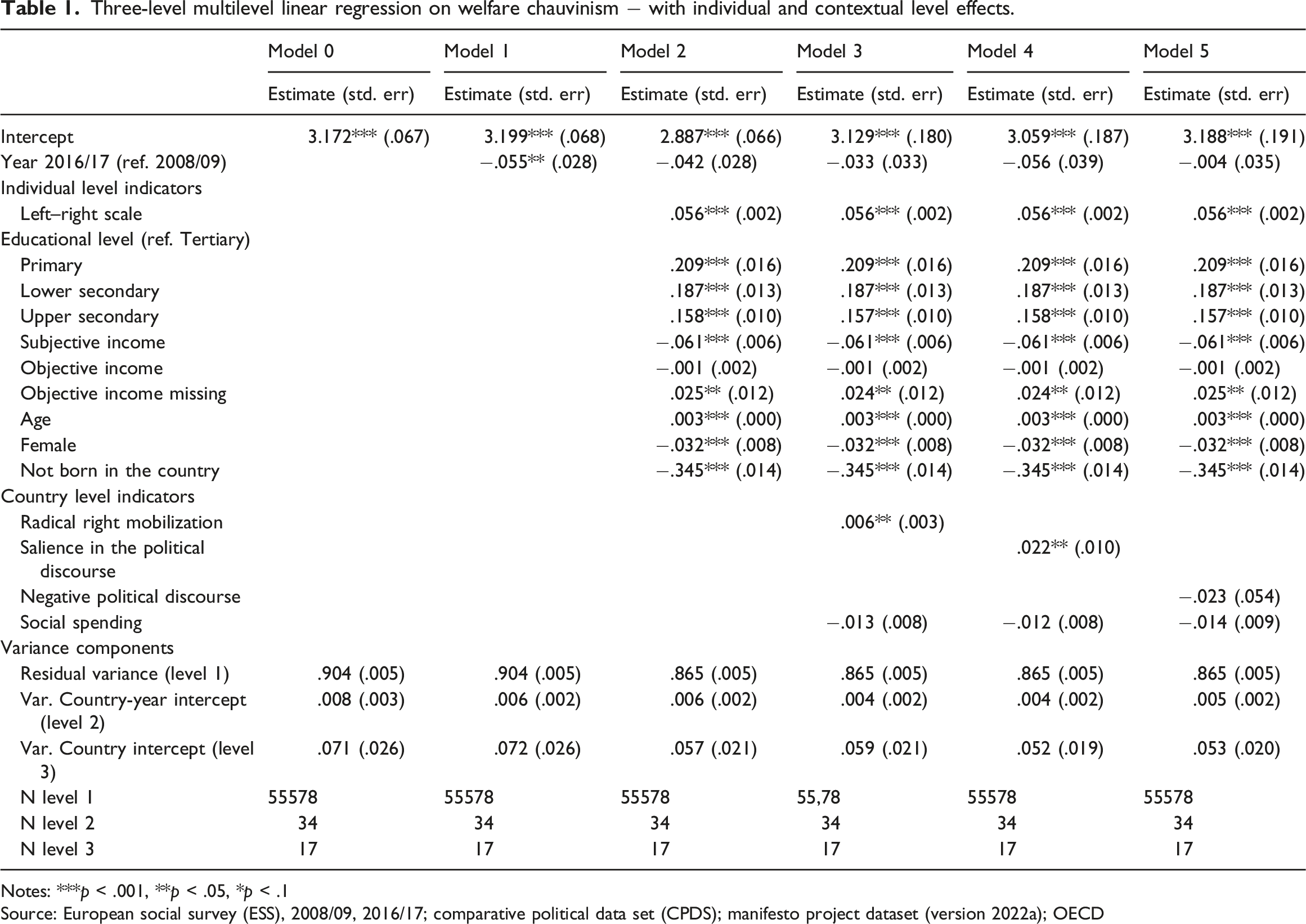
Three-level multilevel linear regression on welfare chauvinism − with individual and contextual level effects.
Notes: ***p < .001, **p < .05, *p < .1
Source: European social survey (ESS), 2008/09, 2016/17; comparative political data set (CPDS); manifesto project dataset (version 2022a); OECD
In model 1, the dummy for the year of the survey is included. The small but significant negative effect indicates that despite the economic crisis and the refugee crisis, on average, people have become slightly more tolerant towards immigrants, but attitudes are remarkably stable considering the contextual changes (see also, Eger et al., 2020). The individual level effects are included in model 2. Results show that as expected people who are more right-wing orientated have a stronger welfare chauvinistic attitude. Control effects also show no deviating patterns considering the results from previous studies; people with lower socio-economic status (lower objective and subjective income, lower education) being more welfare chauvinistic, as well as men, elderly people and people of native descent (for example, Heizmann et al., 2018; Kros and Coenders, 2019; Mewes and Mau, 2012). Remarkably, the effect for survey year turns insignificant in this model, which suggests that controlled for composition effects the welfare chauvinism remains stable over time.
In order to take account of the limited number of countries, the contextual level factors are included one by one together with social spending as our main control variable, which is insignificant in all our models. Our first contextual variable of interest, radical right parliamentary seats, is included in model 3. 3 In line with our expectations, the effect of radical right-wing parliamentary seats is positive and significant. This suggests that in contexts where the radical right occupies a higher percentage of seats in the national parliament, people are more welfare chauvinistic than in contexts where the radical right has fewer parliamentary seats. This supports our first hypothesis.
In model 4, the salience indicator of cultural diversity issues in political discourse is included. The significant positive effect suggests that the more cultural diversity and immigration issues become politicized, the higher the level of welfare chauvinism among the public. In model 5 the position indicator is included. Here we find an insignificant effect, which suggest that a specific negative discourse on cultural diversity and immigration at the contextual level does not change individual level welfare chauvinism. As a robustness check we also estimated the separate effects of the salience and negative discourse for the two issues underlying the salience and position indicator: multiculturalism and national way of life. Results are available in Appendix Table A4 and show that with regard to the position indicator both discourses are insignificant. With regard to the salience indicator, we find that only the discourse on ‘national way of life’ is significant, while the discourse on multiculturalism is insignificant. We therefore conclude with regard to our second hypothesis, that it is only the salience of the discourse on nationalism (both in positive and negative terms) that is associated with welfare chauvinism.
In Appendix Table A3(a)–(c) we present the results for our additional control variables. The main conclusion is that the results for our three main contextual indicators remain robust. We find stable significant positive effects for radical right mobilization and salience of the political discourse, while the position indicator remained insignificant, despite the control variable added. This confirms previous conclusions. Regarding the control variables, we find that unemployment level has a negative effect on welfare chauvinism, while a dummy for Eastern European countries has a strong and significant effect. The control variables for GDP migrant influx and refugee influx were insignificant in all models. 4
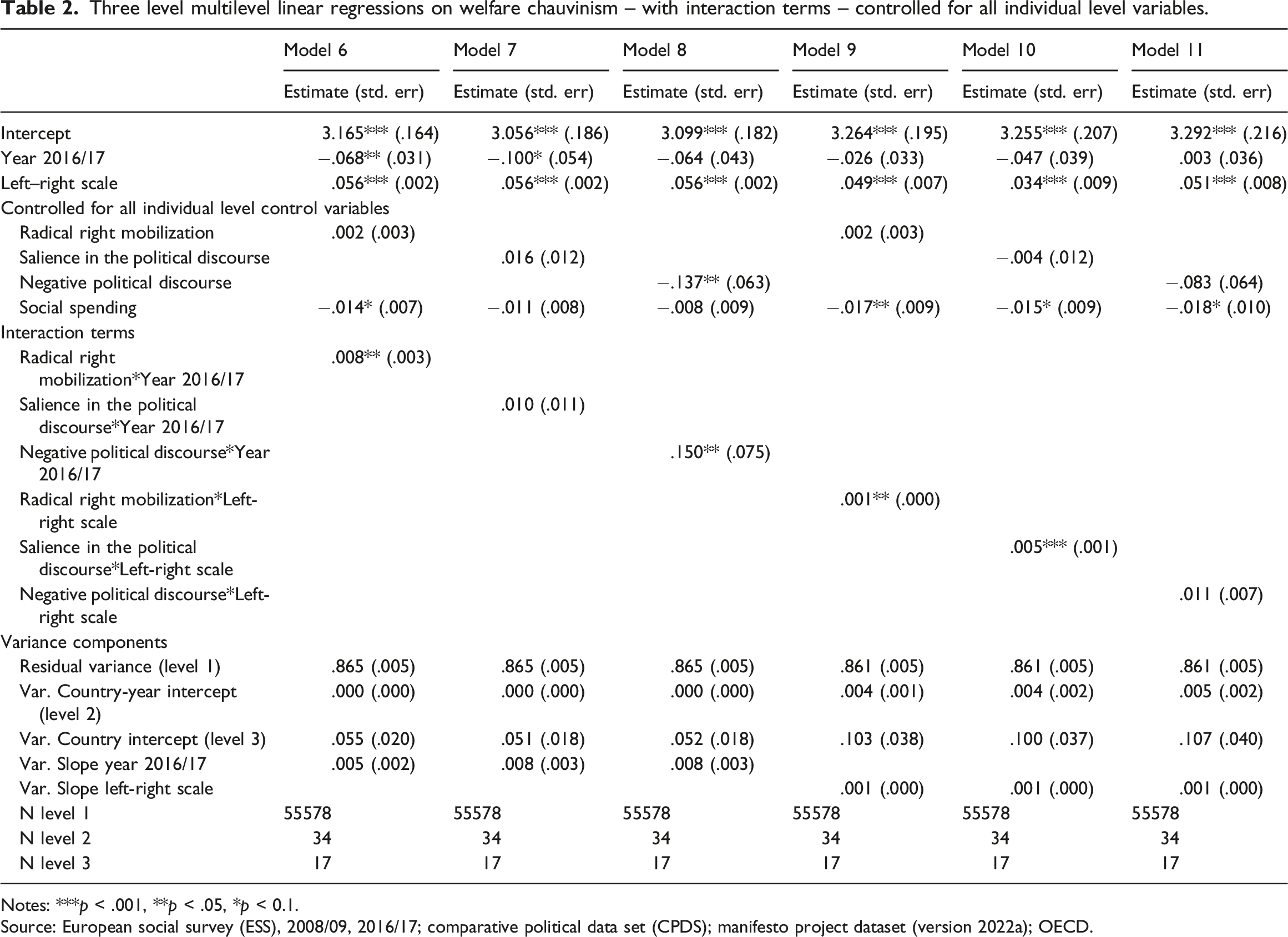
Three level multilevel linear regressions on welfare chauvinism – with interaction terms – controlled for all individual level variables.
Notes: ***p < .001, **p < .05, *p < 0.1.
Source: European social survey (ESS), 2008/09, 2016/17; comparative political data set (CPDS); manifesto project dataset (version 2022a); OECD.
The interaction effects of the survey year and the salience indicator of cultural diversity and immigration discourse is insignificant, indicating no substantial change in effect over time. This somewhat contradicts the findings of Eger et al. (2020), who find a decrease in (extreme) welfare chauvinism within country contexts, between 2008 and 2016. However, in their models, country differences are fixed and the effect is only found for the most exclusionary attitudes of welfare chauvinism which are shared by a small proportion in the population. We conclude that the salience of the discourse on cultural diversity and immigration has not substantially changed in its effect on welfare chauvinism.
For the position indicator, however, we do find a positive interaction effect with the survey year. The interaction effect indicates that the direction of the effect of the position indicator changes between 2008/09 and 2016/17. The effect on welfare chauvinism is substantially negative in 2008/09, but becomes slightly positive in 2016/17 (Appendix Figure A2(b)). When we run separate models for 2008/09 and 2016/17 including the position indicator and our individual and contextual level control variables, we find that indeed the effect for the position indicator is negative, but insignificant, in 2008/09, while it is positive and significant in 2016/17. 5 This suggests that negative political discourse on cultural diversity and immigration had no significant effect on welfare chauvinism in 2008/09, but in 2016/17 increased in impact on welfare chauvinism.
Finally, we turn to the moderating effects of radical right mobilization and political discourse on the relation between political affiliation and welfare chauvinism in models 9 to 11, also presented in Table 2. For radical right mobilization (model 9) we find a positive and significant interaction effect on the relation between left–right self-placement and welfare chauvinism. This means that the effect of political affiliation on welfare chauvinism in contexts with more radical right mobilization is stronger. Figure 1(a) illustrates that differences in welfare chauvinism between left- and right-wing political affiliation become stronger in contexts with more radical right mobilization. It suggests that the prominence of the radical right leads to polarization in welfare attitudes among people with different ideological affiliations, which aligns with the theoretical expectations based on Slothuus and Vreese (2010) that people are motivated reasoners and interpret party frames based on previously held political dispositions. Predicted scores for welfare chauvinism for respondents with different political affiliations in contexts with various levels of (a) radical right mobilization and (b) salience in the political discourse on cultural diversity and immigration.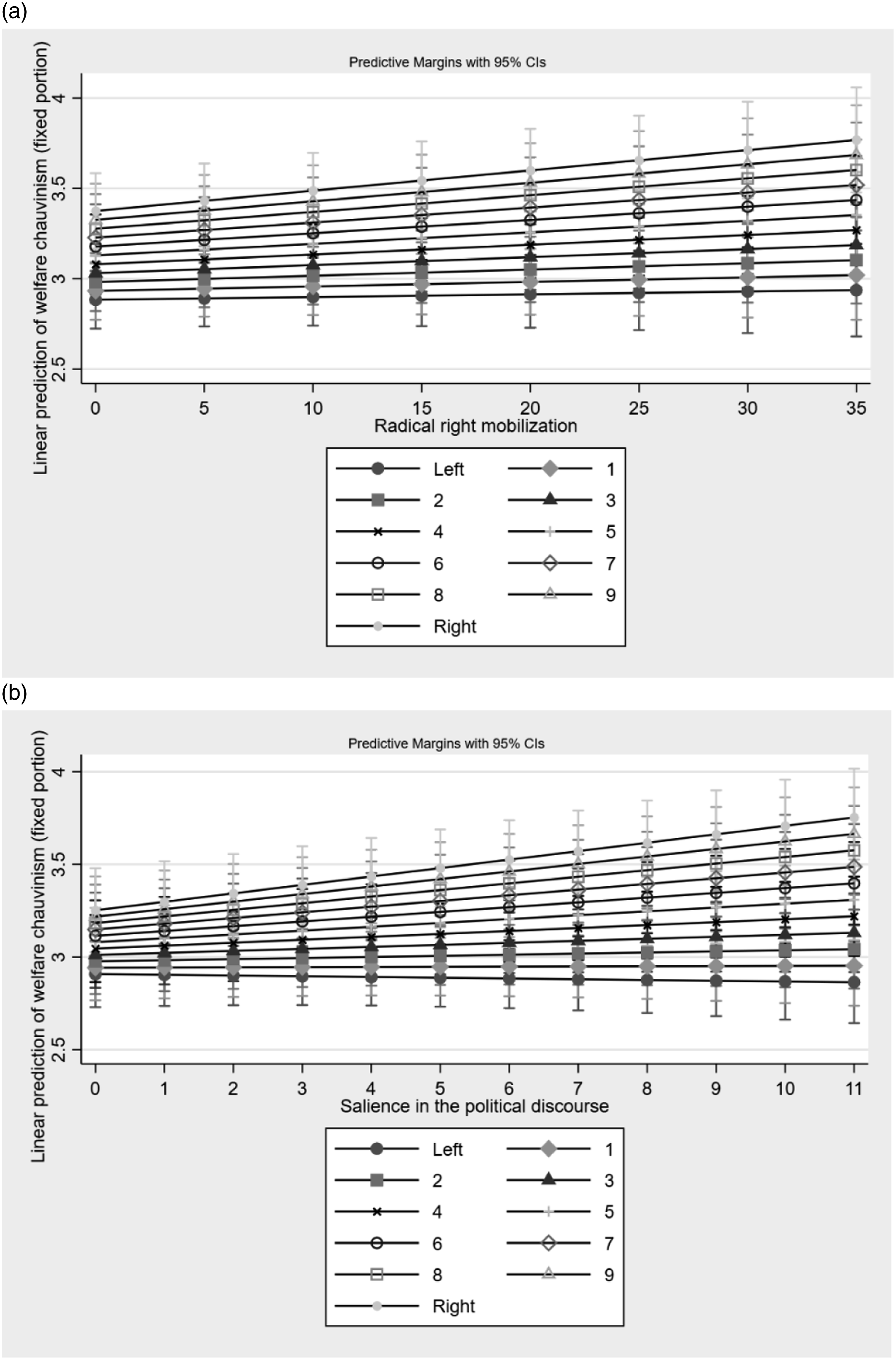
Also, the interaction effect of the salience indicator on the relation between political affiliation and welfare chauvinism is positive and significant, indicating more polarization at the individual level in contexts with a more salient cultural diversity and immigration discourse. Figure 1(b) illustrates this. In contexts where a nationalist discourse is more prominent, people with left-wing affiliations seem to become less welfare chauvinist while people on the radical right become more welfare chauvinist. Again, this aligns with the theoretical expectations that suggest that people follow previously held attitudes and values when political frames are voiced and intensified (Slothuus and Vreese, 2010). For the position indicator we do not find a significant moderation effect. Differences between people with different political affiliations do not become significantly stronger (or weaker) in contexts with more negative discourses. Also, when models are estimated for 2008/09 and 2016/17 separately interaction effects are insignificant. These results thus only partly confirm our sixth hypothesis.
Discussion and conclusion
The aim of this study was to examine the impact of the political discourse on welfare chauvinistic attitudes over time. Results of our three-level linear regression analyses show that despite the increasing political unrest over immigration and the increasing importance of the radical right and anti-immigrant discourse (Eger and Breznau, 2017; Eger et al., 2020; Eger and Valdez, 2015), welfare chauvinistic attitudes are remarkably stable (see also Eger et al., 2020). At first glance, it therefore appears as if the (increasing) political articulation of immigration issues in recent years did not influence public ideas about ‘the fundamental tension between immigration and the welfare state’ (Heizmann et al., 2018: 13). However, under the surface we do find that political dynamics influence welfare chauvinistic attitudes among European citizens.
Our findings show that the better the radical right is mobilized in terms of political influence through parliamentary seats and the more issues of cultural diversity and immigration become politically articulated (salience of issues), the more welfare chauvinist people become, while in a previous study focusing on anti-immigrant sentiment (until 2012) rather than welfare chauvinism no effect of radical right discourse was found (Bohman and Hjerm, 2016). Furthermore, and this may partly explain the diverging results, the effect of radical right mobilization and of negative discourses on cultural diversity and immigration on the attitudes of citizens has significantly increased after 2008/09. The radical right political discourse thus plays an important part in the formation of exclusionary welfare perceptions and this effect has become stronger over time.
Moreover, we find that when radical right parties and salience of cultural diversity and immigration in the political discourse become stronger in a context, differences in welfare chauvinist attitudes between people with different political affiliations become more pronounced. Welfare chauvinism does not become more accepted by people on the centre and left-side of the political spectrum in context with stronger radical right discourse, as was suggested by Marx and Naumann (2018), but our results indicate more polarization among people with different political backgrounds. In line with political framing theory, these results suggest that if issues are framed more strongly by political parties, people tend to follow previously held dispositions and differences in opinions become more pronounced (Slothuus and Vreese, 2010).
Our findings also add to insights in welfare opposition more generally. On the one hand, welfare chauvinism – as an important form of welfare opposition – seems to remain a stable phenomenon in public opinion formation, seemingly unaffected by major and relevant contextual changes. This is the case for many other welfare critiques (Laenen et al., 2020; Roosma, 2021). On the other hand, looking under the surface, we show that welfare critiques within certain contexts, within specific segments of the population can be influenced and fuelled by exogenous factors. Analysing polarization within welfare opposition seems a relevant road for future research (see also Eger et al., 2020).
There are some limitations to this study. Political parties’ election manifestos were analysed on two issues (‘multiculturalism’ and ‘national way of life’) that were covered in the Manifesto Project dataset to create a salience and position indicator as proxies for (anti-)immigrant articulation by political parties around the time of the survey. Our analysis shows that, despite the fact that these issues align and the indicator was used previously, discourses have different effects on the outcome variable, which should be taken into account in future studies. Moreover, we have not covered the discourses on the economic dimension of welfare chauvinist ideas, namely the increase in welfare redistribution, in combination with the exclusion of immigrants from the welfare state. Future research could take this dimension in particular into account when studying the effects of discourses on welfare chauvinism. Furthermore, while in some countries national elections were just over when the survey was conducted, for others, there was only election data available from up to 3 years before the survey. Therefore, this implies an imperfect correlation with the actual political articulation that takes place within a country, especially during the time of the surveys. In addition, as radical right political actors are known for their often provoking and bold statements, they receive more attention from the media. It might therefore be that the effects found in the current study are an underestimation of the actual influence of the radical right on individual level welfare chauvinism. Also, although party size is weighed into the salience and position indicators, it could be that the impact from the incumbent party is much larger than that of other parties of comparable size (Bohman, 2011). Unfortunately, this is not captured by our analyses. Nonetheless, the fact that political articulation and radical right mobilization have an impact despite these data restrictions clearly indicates that the political climate should no longer be overlooked in future welfare chauvinism research.
Establishing more valid and fine-grained measures are necessary to further explore the impact of anti-immigrant sentiment in the political discourse. In addition, Helbling et al. (2015) argue that some people might be more exposed to political mobilization due to individual differences in media consumption or political interest. On the other hand, people with more inter-ethnic relationships might be less susceptible to the effects of political rhetoric. Closer studies are needed to examine to what extent media consumption, immigrant visibility and perceptions of difference and boundaries intermediate the relationship between political context and welfare chauvinism.
Finally, an important limitation to this study involves the issue of causality. In formulating our theories and expectations we have focused on studying the effect of political party mobilization and discourses on opinion formation, but there could very well be a feedback effect in which political parties try to articulate (perceived) voters’ opinions. We can assume that welfare chauvinist attitudes within the population find their way to political rhetoric as well. More longitudinal data is necessary to capture these feedback effects and disentangle precise causal patterns.
To conclude, from a broader societal perspective, the results may also be of relevance. By portraying immigrants as a threat and keeping the problem of immigration high on the political agenda, radical right parties have made concerns about immigration a much more prominent part of the political discourse. This discourse leads to increased polarization in society among the political left and right, making it harder to find solutions for the prominent question of how to include immigrants in the welfare state.
Supplemental Material
Supplemental Material - Welfare chauvinism in times of crises: The impact of the radical right political discourse
Supplemental Material for Welfare chauvinism in times of crises: The impact of the radical right political discourse by Rosan Haenraets and Femke Roosma in Journal of European Social Policy
Footnotes
Declaration of conflicting interests
The author(s) declared no potential conflicts of interest with respect to the research, authorship, and/or publication of this article.
Funding
The author(s) received no financial support for the research, authorship, and/or publication of this article.

Supplemental Material
Supplemental material for this article is available online.
Notes
References
Supplementary Material
Please find the following supplemental material available below.
For Open Access articles published under a Creative Commons License, all supplemental material carries the same license as the article it is associated with.
For non-Open Access articles published, all supplemental material carries a non-exclusive license, and permission requests for re-use of supplemental material or any part of supplemental material shall be sent directly to the copyright owner as specified in the copyright notice associated with the article.
