




Abstract
This paper explores the construction of different understandings of poverty in The Times newspaper (1900–2009). Using corpus-based discourse analysis, it examines the premodification of poverty with different nouns. Rising to prominence from the 1950s onwards, the resulting compound nouns, including world poverty and child poverty, facilitate the discursive construction of different types of poverty as distinct entities. Through close reading of concordance lines and collocate analysis, the paper investigates how these categories are presented as qualitatively similar/different and discusses how such representations reflect broader ideological contexts in the UK.
Keywords
Introduction
The language used to talk about poverty matters; it can have real-world consequences for those experiencing financial hardship, homelessness or a lack of access to resources including education, clothes and food. How poverty is framed (relative or absolute, historical or contemporary, in moral terms, etc.) and who/what is positioned as its cause can have an impact on how it is understood, the types of interventions put in place to relieve it, and the criteria by which individuals are (in)eligible for help. Drawing on 11 multimillion-word corpora of The Times newspaper from 1900 to 2009, this paper considers whether different categories of poverty are created through noun premodification. It interrogates when different constructions – pensioner poverty, fuel poverty, etc. – came to the fore and analyses the relationships between them. The use of these compound nouns facilitates the discursive construction of discrete categories of poverty. This contrasts with the use of adjectival modification where different categories of poverty – relative poverty, severe poverty – may be perceived to differ only in degree.
Drawing on a form of corpus-based discourse analysis, comprising collocate analysis combined with the close reading of concordance lines, the paper interrogates whether (and how) different categories of poverty are presented as qualitatively different. Details about the newspaper corpora are provided in the Section ‘Category construction as a linguistic phenomenon’, before the results (Section ‘Premodification of poverty over time’) are contextualised within a discussion of how representations of poverty can index broader ideologies about the poor. But first, the Section ‘The consequences of defining poverty’ situates this paper within existing research on the relationship between language, poverty and moral evaluation.
The consequences of defining poverty
Poverty is an abstract concept that is difficult to define. Nevertheless, ‘[d]efinitions of poverty matter’ because they act as a determinant of ‘whether the incomes and living conditions of the poorest in society are acceptable or not’ (Lansley and Mack, 2015: 3). Many definitions include the notion that poverty differs in degree – some individuals will be in worse poverty than others – and work on the understanding that poverty is measurable by proxy, particularly at a macro level, as expressed in unemployment rates, number of benefits claimants, foodbank use, etc. Such proxies facilitate the comparison of different populations and reinforce the idea that poverty sits somewhere on a scale from absolute wealth to absolute poverty. Thus, poverty is discursively constructed as a phenomenon that differs primarily in degree.
This understanding of poverty makes possible the creation of a threshold by which someone can be deemed to be poor and thus eligible for state and/or local interventions. In the UK, for example, there are rules about annual income which determine access (or not) to state benefits as well as criteria which must be met for referrals to foodbanks (Citizens Advice, n.d.). Ultimately, this means that there are individuals (benefits assessors, social workers) and institutions (government, the Civil Service, charities) in positions of power who have the ability to determine who is poor enough to warrant help. The problems with such threshold-based systems, which are used in a large number of countries, are well summarised by Carr (2021). But, ultimately, they provide little-to-no room for the self-determination of poverty nor is there much consideration of the heterogeneity of how poverty is realised in any given context.
Taken to the extreme, the understanding of poverty as a sliding scale allows for the dismissal and/or underplaying of the consequences of relative poverty. In example (1) a member of the public commenting on a newspapers’ website expresses the position that ‘real poverty’ only occurs outside of the UK (1) There is no such thing as poverty in this country. The welfare state picks everybody up that wants to be picked up. Go to África [sic] or part of South America or the streets of Mumbai to see real poverty (Paterson, 2020: 79)
Of course, evidence from homelessness statistics (taken here as an extreme realisation of poverty) easily debunk claims that there is ‘no such thing’ as UK poverty. In the first quarter of 2024, 94,560 households were assessed for homelessness in the UK, only 270 were deemed ‘not homeless’ (Ministry of Housing and Local Government, 2024). Nevertheless, the expression ‘real poverty’, or related terms like ‘real hardship’, creates (yet leaves unexpressed) the category of ‘fake poverty’ and allows opponents of state interventions, for example, to index a moral stance that negatively evaluates those who do not meet their threshold for ‘real poverty’.
What this moral lens brings to debates about poverty are the concepts of blame and agency. At a macro level, those in ‘real poverty’ tend to be positioned as not responsible for their lot, or at least not explicitly blamed for it. By contrast, example (1) implies that anyone claiming to be poor in the UK is not really poor or is unwilling to engage with the safety net provided by the welfare state. Thus, those who do not sit at the absolute end of the poverty scale are positioned (at least partially) as agents of their own economic circumstances. Previous research has shown this moral evaluation to be couched particularly in terms of flawed consumerism (Bauman, 2004), where the poor simply spend their money wrong (see 2), and as a way of distinguishing between the deserving and undeserving poor (Katz, 2013). (2) They moan they have no money on benefits and live in a dump but yet they can afford to buy drugs! Get a job! (3) The liberals miss the point. Its [sic] not the fact they claim benefits but their useless, lazy, drug taking lifestyles we despise (both taken from van der Bom et al., 2018: 40)
Examples (2) and (3) are Tweets sent by viewers of the UK television programme Benefits Street which followed the lives of several individuals in receipt of government benefits. The benefits recipients were positioned here as responsible for their own poverty and the moral evaluation evident in the Tweets facilitates the minimisation/backgrounding of wider structural issues, such as access to suitable housing, jobs paying a living wage, etc. Furthermore, these individual examples are taken to represent a broader negative stereotype (see 3), which is perpetuated by the mass media, and which can be drawn upon to influence policy and public understanding of what UK poverty is (Bennett, 2012; Paterson, 2020; Tyler, 2008). Toolan (2020: 71) refers to this as a script by which ‘the continued existence of a significant percentage of the population living in poverty is explained as stemming from some dysfunctionality on their part, some failure in those affected to act reasonably by the standards of the wider community’.
Yet applying a moral lens to debates about poverty sits in tension with the fact that not all individuals/social groups can, logically, be held accountable for their own circumstances. This includes children born into poverty or whose parents/caregivers experience acute poverty, and people with disabilities that restrict their engagement with broadly-understood neoliberal mechanisms for poverty relief, such as employment. Significantly, the way different groups are differentiated in discourse (e.g. as deserving or undeserving) involves how poverty is labelled. Moving away from poverty conceptualised as a single cline on which all individuals can be located, terms such as child poverty and material poverty can be used to discursively construct different categories of poverty that are held, at least partially, distinct from each other. This creates a discursive space where the negative moral evaluation associated with stereotypes about poverty can be removed. It thus becomes possible, for example, for an individual who may be hostile to the unemployed poor to express sympathy for those experiencing pensioner poverty without contradiction. Ultimately, different categories of poverty – not different in merely degree but representing different types – can be debated, if not in complete isolation from, but at least partially removed, from broader ideologies about poverty.
Drawing on the concept of category construction (Bowker and Star, 2000), coining labels for different types of poverty facilitates the creation of new conceptual realities of what poverty is, who it impacts, and what (if any) macro/micro intervention is needed. Furthermore, the legitimisation of one interpretation of a category label, such as fuel poverty, ‘valorizes some point of view and silences another’ (Bowker and Star, 2000: 156). This paper is concerned with how different categories of poverty are established over time and whether, once established, they are evaluated differently in The Times newspaper. To interrogate this, the paper draws on the adage that ‘you shall know a word by the company that it keeps’ (Firth, 1957: 11). It uses corpus-based methods of discourse analysis to interrogate how categories of poverty are discursively constructed and asks the following:
Does The Times newspaper present poverty in terms of differences in degree or type?
Are there discrete categories of poverty and how do they develop over time?
Are different categories of poverty evaluated differently and what might this tell us about the ideologies underpinning broader understandings of (UK) poverty?
Category construction as a linguistic phenomenon
One way to distinguish something from something else is by premodification. The combination of adjective and noun allows us to know that there is a qualitative difference between a ‘large jewel’ and a ‘small jewel’ and that ‘severe poverty’ is different from ‘localised poverty’. But in each case the underlying concept expressed by the noun is the same; the premodification does not change our basic understanding of ‘jewel’ or ‘poverty’. By contrast, the apposition of nouns, which may look the same as adjectival premodification but which is better classified in syntactic terms as a compound noun, represents not merely a modification of a baseline concept, but the creation of a different concept that stands in its own right. For example, ‘post office’ and ‘cabinet office’ do not depend on the same basic meaning of ‘office’. In a UK context, at least, the former refers to a shop where one sends letters, while the second is both a suite of individual offices and a metonym for government actors.
Individual uses of noun premodification are unlikely to illustrate significant shifts in wider discourses around poverty. As such, this paper uses 11 decade-long corpora of The Times newspaper (spanning from 1900 to 2009) to investigate how the premodification of poverty shifts over the course of a century. Each corpus is held in CQPWeb (Hardie, 2012) and contains material from The Times Digital Archive. The earlier corpora have been scanned and digitised to facilitate their analysis using corpus tools and, while this has not significantly impacted the following analysis, it is possible that there were some small errors in the digitisation process. There is, however, existing research showing the validity of using these corpora for historical analysis (Toolan, 2020; van der Bom and Paterson, 2020), which sits within a large body of research showing the benefits of using corpus-based discourse analysis to establish patterns in language use. The combination of methods associated with corpus linguistics and discourse analysis is well-established (Baker, 2006; Taylor and Marchi, 2018) and ensures that any examples are representative of a larger dataset.
Using corpora to investigate category construction
To investigate premodification, each decade of The Times corpora (1900–2009) was searched for all occurrences where poverty was immediately preceded by an adjective or a noun (corpus query: *_JJ poverty|*_NN1 poverty). Comparative and superlative adjectives, which only provide information about how things differ in degree, were excluded from the analysis. While there are other forms of premodification, they did not represent major trends in the corpora. Similarly, while alternatives like ‘poverty of fuel’ or ‘poverty of food’ were possible, these constructions were rare. The query ‘poverty of’ returned 445 hits in the 2000s corpus, which tended to relate to particular contexts (‘poverty of a refugee camp’, ‘poverty of Cambodia’), or used ‘poverty’ as a synonym for ‘lack’ as in ‘poverty of imagination’ or ‘aspiration’. While these phrases are interesting, they sit outside the boundaries of the present research.
The analysis begins with an overview of general trends in how poverty was premodified. It shows how adjectival and noun premodification shift over time and identifies eight combinations of noun + poverty which increased in relative frequency. A focus on these eight terms, which was conducted in two phases, comprises the bulk of the analysis. First, lists of collocates – words that show a statistically-observable relationship to the search terms under investigation – were generated for each of the noun + poverty combinations that occurred 10+ times in a corpus. Collocates were generated using LogRatio (Hardie, 2014) within a span of five words either side and a minimum frequency/number of collocations of 5. The collocate analysis was used to find any repeating patterns within/across corpora and to highlight potential areas of interest for the qualitative portion of the analysis.
Next, to avoid being led solely by the patterns identified using corpus tools, the analysis proceeded using the close reading associated with discourse analysis as a form of triangulation. Adapting the method set out by Baker (2006: 92) the concordance lines were read chronologically while looking for (shifts in) semantic and discourse-level patterns. Thus, the second part of the analysis involved looking at all tokens of the search terms in their broader co-text (starting with a span of ±20 words and expanding where necessary) to establish any semantic patterning, to interrogate whether any noun + poverty forms were formally defined, and to highlight any similarities/differences with the discourses associated with poverty in previous research.
Premodification of poverty over time
Figure 1 shows how often, per million words (pmw), poverty was premodified by either a noun or an adjective in each corpus. Although the focus here is on compound nouns, data for adjectives is provided to establish temporal changes in the type of premodifier used to describe poverty. During the earlier portion of the time period covered, adjectival premodification was more common than noun premodification. However, from the 1960s, there is a relative increase in the use of nouns to premodify poverty, with a peak in the 1970s, a drop towards the 1990s, then a large spike in the 2000s where noun premodification occurred more frequently than adjectival premodification. However, as noted above, comparative and superlative adjectives were excluded from the analysis and, as such, these results should be interpreted with caution. Nevertheless, there is evidence that using nouns to premodify poverty became more prevalent in The Times in the latter half of the 20th century.
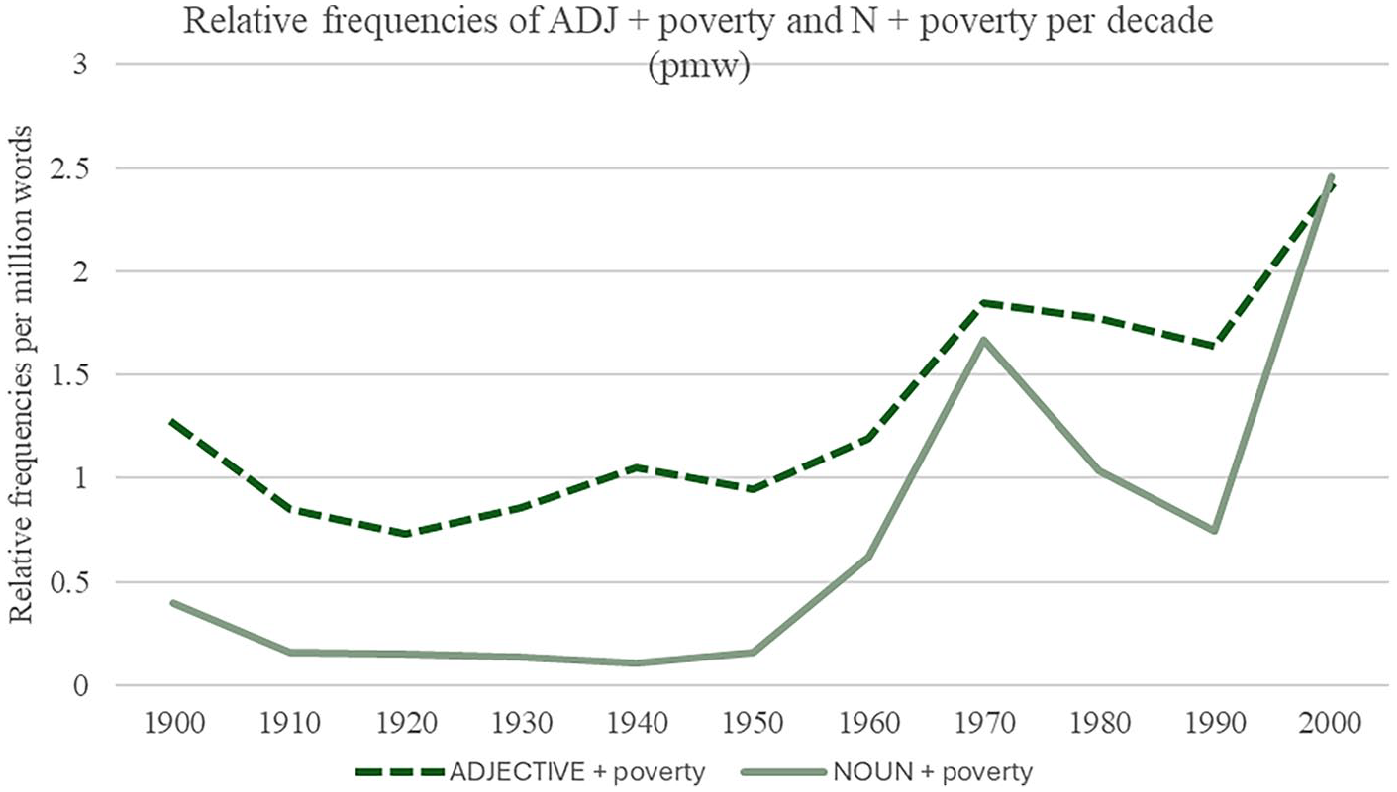
Relative frequencies of adjective + poverty and noun + poverty (per million words).
To focus on those terms that suggest repeated patterns in discourse, as opposed to idiosyncratic or low-frequency terms, such as ‘campus poverty’ and ‘village poverty’, which occurred once each in the 1990s corpus, the results were thinned to just those noun + poverty combinations that occurred 10+ times in a corpus. Table 1 gives the raw frequencies of these combinations, while Figure 2 shows their relative frequency from the 1950s onwards. No combination was used 10+ times in the corpora for the 1900s to the 1940s.
Raw frequency of noun + poverty (10+ tokens).

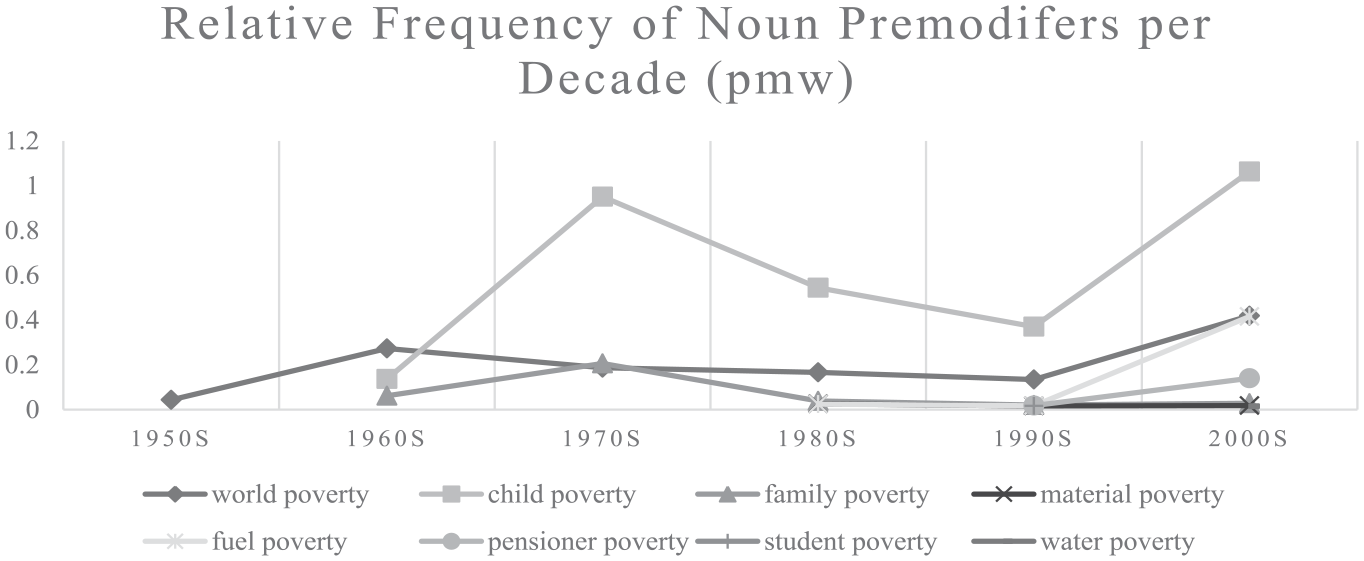
Relative frequencies noun + poverty per decade (10+ hits per million words).
Figure 2 shows that while world poverty remains relatively steady, child poverty shows more peaks and troughs, but is the most commonly used noun + poverty pairing. Although present from the 1960s onwards, family poverty peaks in the 1970s but never rises to prominence, while fuel poverty spikes in the 2000s corpus. Newer terms, like water poverty, student poverty and pensioner poverty potentially represent emerging types of poverty that are increasing in salience in discourse, but as the analysis will show, there is not enough data to make firm conclusions about the trajectory of their use. The relatively low frequency of these terms meant that statistical analysis was limited and, as such, the analysis of the later terms depends on close reading to establish patterns in usage or the presence of a formal definition.
The analysis thus proceeds by focusing on the eight terms in Table 1, in the order they appeared chronologically, to determine how/if they are discursively constructed as different categories of poverty. It considers whether they involve different social actors, are positioned as requiring different solutions/interventions, and whether they depend on particular ideologies about ‘the poor’.
World poverty
The only collocates for world poverty in the 1950s were on and an. Close reading of the concordance lines including these collocates showed that this combination of words occurred in phrases such as ‘an attack on’ and ‘an all-out war on world poverty’. This is an early indication that world poverty is something that needs to be fought against, potentially by a range of geographically dispersed social actors. Indeed, the notion of a ‘war on poverty’, realised primarily through the use of verbs associated with the semantic field of war (‘attack’, ‘eliminate’, etc.) was common to several of the category labels and evidences the positioning of poverty as a threat that needs to be defeated.
The concordance lines from the 1950s associate a ‘war on world poverty’ with Harold Wilson, who wrote a book with this title, and US President Eisenhower, as well as broader discussions that are pro-Christianity and/or anti-communism. In the 1960s, addressing world poverty was seen as a better use of resources than the nuclear arms race, but the absence of a clear strategy on how to solve poverty on a global scale is noted (4). (4) What is so striking about the rich world’s reaction to the problem of world poverty is the almost total lack of any conscious strategy to deal with it; there seems to be a belief that if we continue business as usual, with a modicum of charity, the living standards of some 2,01 million people will automatically rise (TMZ_1962_07_02)
There are also multiple references to the ‘War on Want’, ‘the Campaign Against World Poverty’ and donations being given to ‘fight world poverty’. The religious/moral component remains present, with five references to a report by the British Council of Churches entitled ‘World Poverty and British Responsibility’. However, references to religion/charity decrease in the later corpora. World poverty is also linked to food infrastructure and family planning (in non-Western countries) and there are mentions of several campaigns to ‘fight’ world poverty. Indeed, in every decade analysed, a new campaign (or the re-launch of an old one) makes the claim that it will be the one that will tackle world poverty.
Towards the end of the 1960s, there is some mention of monetary values committed by the British government to international funds, such as the UN’s Children’s Fund, and some controversy in 1969 when MP Enoch Powell suggested a separation of church and state on issues of world poverty (deeming the former well-meaning but ‘amateur’). Also notable in the 1960s and 1970s is that many tokens of ‘world poverty’ occur in letters to the editor and job adverts, showing that this term was used by the broader Times-readership and was thus a meaningful unit of discourse understood by the general public.
Situating world poverty in (socio)geographical space, occurrences of ‘third world poverty’ become a major trend from the 1980s onwards, accounting for 20 of the 89 hits (22.5%). In the 1990s, there were 38 tokens (36.9%) of ‘third world poverty’ and 62 (18.0%) in the 2000s. While ‘third world poverty’ and ‘world poverty’ may appear initially to be distinct, the term ‘third-world’ was not coined until the 1950s and concordance analysis indicates that most early tokens of ‘world poverty’ referred to the same overarching concept as ‘third world poverty’. Close reading also supports the conclusion that ‘world poverty’ was understood as not existing within the UK. Indeed, in the 1980s, there is evidence of tension between the ‘third world’ and ‘rich’ countries: (5) The World Bank, in its 1981 World Development Report, identified four crucial ways in which the industrial countries could help reduce third world poverty: faster economic growth, avoidance of trade protection, reduced dependence on imported oil, and expanded aid and investment programmes in developing countries. But the leaders of the eight rich nations meeting in Mexico will confront third-world aspirations at a time when they are facing immense internal pressure to pursue policies, such as trade protection, which would run directly counter to developing countries’ interests, and when their own economic difficulties are uppermost in their minds (TMZ_1981_10_02)
In the 1980s, the phrase ‘a Bombay conference on world poverty’ occurs 14 times (15.7% of hits), all referring to the play A Map of the World. This skews the results somewhat, but again suggests that world poverty was not an alien concept to the theatre-going public. Thus, despite no formal definition appearing in the corpora, world poverty is understood as something negative that should be actively tackled. In this vein, the 2000s corpus included a range of examples drawing on the semantic field of war: ‘fight/crusade/campaign against world poverty’ (17 tokens), and ‘abolish’, ‘beating’, ‘combat’ (2), ‘conquer’, ‘fight/ing’ (11), ‘tackl/ing’ (9) and ‘vanquish world poverty’. There was a similar grouping of verbs that concerned poverty reduction: ‘alleviat/ing’, ‘cut/ting’ (4 tokens), ‘eliminat/ing’ (4), ‘end/ing’ (29), ‘eradicate/ing’ (9), ‘halv/ing’ (10), ‘reduc/ing’ (25), ‘reliev/ing world poverty’ (5). These patterns serve two main discursive purposes. By positioning world poverty itself (an abstract concept) as the enemy, the causes of world poverty are backgrounded and any human action which has led to poverty is minimised, leaving governments to fight a ghost. This then facilitates a transition to a focus on poverty reduction, with ‘rich nations’ (see 6) treating the symptoms (i.e. real-world consequences) of poverty, without fundamentally upsetting the status quo of global politics.
Child poverty
In contrast to the global focus of world poverty, The Times’ coverage of child poverty tends to be geographically situated within the UK. Of the 1978 tokens of child poverty, 1025 (51.8%) are direct references to the Child Poverty Action (Group) also known as CPAG, a charity which focuses on UK-based poverty relief. Not only are letters from representatives from this group responsible for a significant number of these tokens, members of this organisation are also quoted directly in the newspaper articles. Thus, this group is positioned by The Times as somewhat of an authority on child poverty. For context, CPAG’s (2024) current definition of poverty is that it ‘means not having enough resources to meet household needs and participate in society’ with the additional framing that ‘Poverty is about money’. Hence (child) poverty is understood in terms of economic circumstances and purchasing power.
The collocate analysis was heavily skewed by references to CPAG. In the 1960s collocates include surnames and job titles of the charity’s representatives. This pattern continued in the 1970s and 1980s, with other institutions, such as the homelessness charity Shelter, also being named. The actions of CPAG as an institutional body are also evident in references to ‘guidelines’, ‘reports’ and ‘memorandums’ ‘published’ by the charity. In the 1990s, the same is true, but the occurrence of ‘eradicating’ and ‘tackle’ indicate a shift in the contents of newspaper articles about child poverty. In the 2000s, references to CPAG decreased significantly, indicating that it became less important to The Times’ presentation of child poverty: in the 1960s, 45.1% of concordance lines included ‘child poverty action’, rising to 90.1% in the 1970s, 85.6% in the 1980s, with the 1990s heralding the start of a decline (63.0%) that dropped to 15.2% of hits in the 2000s corpus. Relatedly, there was only one token of ‘CPAG’ in the 1960s, 36 in the 1970s, 62 in the 1980s, dropping to 49 in the 1990s.
This shift in how The Times reported on child poverty appears to be motivated by the 1999 Labour government’s stance on child poverty (see 6). The top collocates of child poverty in the 2000s corpus include ‘eradicat/ing’, ‘halv/ing’, ‘abolish/ing/ion’, ‘eliminating/ion’, ‘alleviate’, ‘tackling’, ‘reducing’ and ‘ending’ as well as the years ‘2010’, ‘2020’. References to Labour’s ‘pledge’ to ‘eradicate child poverty’ (7 tokens) include a lot of these top collocates. There are also multiple claims that then-Chancellor Gordon Brown had ‘miss[ed] his target of halving child poverty’. (6) In 1999 it [the Labour government] set a target of eradicating child poverty by 2020, having halved it by 2010 and reduced it by a quarter by 2005. Since 1996–97, child poverty has fallen by 600,000 before housing costs, which is now the preferred measure. However, the Government still missed the 2004–05 target and the latest child poverty figures, published in March, show that child poverty actually rose between 2004–05 and 2005–06 (TMZ_2007_10_29)
Further down the list of collocates is ‘unemployment’, which only occurs in a list-like structure, linking child poverty to other social issues such as ‘welfare reform’, ‘overcrowding’ and ‘homelessness’. The causal links between these are not explicitly established, but they are all presented as ‘challenges’.
Given the results of the collocate analysis, which show the dominance of references to CPAG, close reading of all concordance lines was expected to return similar results. As such, to interrogate how child poverty was represented more generally, concordance lines including references to CPAG were removed from further analysis. This meant that the first example of child poverty in the 1960s (example 7) explicitly notes who and what are to blame. Here we see allusions to the undeserving poor (Katz, 2013) and the ‘feckless’ stereotype that can still be found in contemporary debates about UK poverty (Baker and McEnery, 2015). (7) The primary cause of their hardships is to be found in low earnings. A secondary cause of child poverty is due to the absence of a father (TMZ_1965_10_05)
The focus in the 1960s corpus is on the government ‘reexamining’ the issue of child poverty and deciding how to tackle it, as child poverty is ‘hurting the public conscience’. However, this framing sits in contrast with a letter to the editor (8) which apportions blame and calls for birth control in certain social demographics: (8) Measures to reduce child poverty by increasing the incomes of families where low wages are combined with a large number of children are most welcome, but should be combined with a nation-wide domiciliary birth-control service for bringing contraceptive knowledge and opportunity into the homes of such families. Limited local experience already shows that many such families take no initiative in seeking family-planning help but welcome such help when it is brought to them (TMZ_967_08_04)
The use of ‘such families’ here combined with the absolute ‘take no initiative’ positions poor children as victims of their parents’ fecklessness.
In the 1970s, however, there was a shift in focus, as The Times increasingly reports on ‘failing’ policies and calls for the government to take another look at the financial help available to families. In the 1980s, there were calls to establish a minimum wage (which would not happen in the UK until 1999) as a way of alleviating child poverty. But these calls sit alongside arguments that ‘family breakdown’ is a key driver of poverty (9) which has facilitated a ‘welfare culture’. Notably, these arguments are not restricted to the UK, as (10) comes from US President Ronald Reagan. (9) Another potential cause: Miss Rathbone argued that the break-up of the clan or extended family system caused by the Industrial Revolution had led to wide-spread child poverty (TMZ_1984_09_14) (10) In the welfare culture, the breakdown of the family, the most basic support system, has reached crisis proportions in female and child poverty, child abandonment, horrible crimes and deteriorating schools (TMZ_1986_02_06)
The references to different, but still Western, nations also coincide with references to the ‘spread of child poverty increasing’, a trend that continues into the 1990s where child poverty is positioned as a site of ‘moral outrage’. There is also an increasing use of statistics: an example from 1994 claims that ‘one in three children’ in Britain were in poverty, while another claims that ‘three million children were being brought up in workless households’. While blaming parents is still prevalent – there are calls to ‘reduce child poverty by cutting the number of unwanted teenage pregnancies’ – there is some acknowledgement that poverty is more than just economic circumstance, with links made between child poverty and poor educational performance.
The government promise ‘to eradicate child poverty within 20 years’ (see 6) is often repeated and mostly rejected as ‘unattainable’, not least because the government are deemed not to have defined child poverty. The negative evaluation of social groups continues into the 2000s corpus, where blame for child poverty is placed on the ‘workshy’, ‘abuse’ and ‘neglect’. Example (11) is a letter to the editor from 2002 which morally evaluates the behaviours of (un)married women, and which places the blame for child poverty on ‘parental irresponsibility’. (11) On the day that Tony Blair announced his determination to end child poverty (report, September 19), my local paper carried the story of an unmarried woman of 25 who, over the past six years, has had five children. Now Tony Blair intends [letter, September 25] to tax those of us who had, in wedlock, only the number of children we could afford, to provide for such women and their families. Much child poverty is the result of parental irresponsibility and the widely held belief that any woman capable of bearing children has a right to have any number she wants regardless of whether she has a husband, a home or an earned income (TMZ_2002_09_28)
While (11) may be an extreme case, similar sentiments were drawn upon in the UK Budget of 2000. While an excerpt (example 12) notes that fighting child poverty will involve institutions and individuals beyond the government and acknowledges that child poverty goes beyond the economic, this budget also included references to a benefits snitching hotline (where the public could report benefit fraud), unemployment, lone mothers and mothers not working. (12) The war against child poverty needs more than finance and more than the efforts of Government acting alone. The war against child poverty can only be won by the combined efforts of private, voluntary, charitable and public sectors working together (TMZ_2000_03_22)
Placing the blame for poverty on the ‘workshy’ or an ‘underclass’ has been well documented in analysis of the UK media in recent years (Harkins and Lugo-Ocando, 2016; van der Bom et al., 2018), but this framing of child poverty places the blame particularly at parents’ feet. Thus, where child poverty differs from world poverty then is not just in its geographical location in the UK, but in its supposed causes. Poverty itself is not the enemy that needs to be tackled here, rather the blame is placed on the shoulders of parents.
Family poverty
While world poverty and child poverty were the most frequent noun + poverty combinations, their framing, points of difference and potential areas of overlap could be further illuminated through the analysis of less frequent category labels. Collocate analysis for the 1960s indicates that family poverty is a ‘problem’ associated with ‘debate’, while in the 2000s its only collocate was ‘meals’ as in ‘free school meals’. Taking a closer look at the concordance lines, family poverty came to the fore because it was the title of a government survey in 1967 which associated poverty with low-income, but working, families. Perhaps in contrast to the ideas about large families (see 6), in the 1970s there were repeated claims that family poverty was not restricted to those with a large number of children, alongside references to low pay and calls for a minimum wage.
In the 1980s, gender norms about child rearing and the amount of money women could earn were drawn into debates. Notably, the child benefit scheme was paid directly to women and is repeatedly presented as ‘the most effective direct means of fighting family poverty’. A focus on lone parents emerged in the 1990s, with references to Labour’s ‘new deal’ – a government initiative that aimed to encourage single parents to engage in paid employment. In the 2000s, however, family poverty was associated with causing ‘offending behaviour’, ‘crime’, truancy and ‘gambling’, with the latter positioned as a root cause for some instances of family poverty. Links are made to education, hence the focus on free school meals – positioned as ‘the yard stick of family poverty’ – with claims that children who were eligible for this benefit tended to perform worse academically than their peers.
Until the 2000s, there was no significant moral evaluation of those in receipt of the benefits associated with family poverty. As with the other category labels analysed so far, verbs associated with the semantic field of war – ‘attack’, ‘tackling’ and ‘fight’ – were relatively frequent, as was ‘reducing’. Thus, for most of its use in The Times, family poverty is a relatively neutral term, albeit one that becomes associated with different social actors over time (working families, mothers, lone parents) and one which has now, for the most part, fallen out of usage. Reasons for this decline include the fact that family poverty was initially associated with working families (representing the deserving poor). The idea that such families can experience poverty challenges dominant neoliberal arguments that position poverty as resulting from individual agency. Thus, there is a tension whereby ‘family breakdown’ is presented as the cause of (child) poverty, but the existence of family poverty shows that a strong family unit is not a guaranteed safeguard against poverty.
Material poverty
Only the 2000s corpus generated any collocates for material poverty meeting the statistical parameters noted above and even then, the only collocate was is. As such, the analysis of material poverty relies solely on the 41 concordance lines. While there is no explicit definition of material poverty, 14 concordance lines refer to both ‘material poverty’ and ‘spiritual poverty’ (see 13), with a further subset making links to ‘moral poverty’ and ‘intellectual poverty’. There are also references to the Bible, the Pope, speeches given by Catholic officials, and commentary on the intentions of mission-based interventions (13). As such, there is a religious undertone to the use of this term not present elsewhere. (13) There is a continuing controversy about the action of North American Protestants and their activities in Latin America. Those who enter a country to alleviate its material poverty should separate that mission from what they take to be its spiritual poverty (TMZ_2008_10_21)
Where there are similarities, however, is towards the latter period covered by the corpus, where there is a denial or downplaying of the existence of material poverty in the UK: ‘There is much less material poverty than a decade ago’.
The analysis of material poverty shows how different categories of poverty are understood in relation to each other. The co-occurrence of ‘moral poverty’, ‘spiritual poverty’ and ‘material poverty’ is further evidence that the use of noun premodification demarcates conceptually different, discrete forms of poverty which, although they may share a relationship or sit in a broader matrix, do not (necessarily) overlap. Thus, while category labels have been analysed separately here, future research on which terms co-occur would be fruitful.
Fuel poverty
The collocate analysis for fuel poverty was also limited, with only on meeting the statistical threshold in the 1980s corpus. In the 2000s, the term collocated with ‘alleviate’, ‘eradicate’ and ‘tack(ling)’, suggesting that these are common to poverty discourse in general, rather than being associated with a particular category of poverty. However, the top collocate for fuel poverty in the 2000s was ‘households’, with similar terms like ‘house’ and ‘homes’ also occurring alongside references to ‘bills’, ‘gas’ and ‘energy’. The focus is on (government) interventions to decrease fuel poverty, with a notable use of statistics showing the scale of the problem. Also ‘defined’ occurs in the list of collocates and is repeated 18 times in the 2000s corpus. (14) The Government has pledged to eradicate fuel poverty – defined as a household spending more than 10 per cent of its income on heating – by 2010 (TMZ_2008_10_08)
Thus, unlike the terms analysed so far, there is a repeated definition of what this form of poverty comprises, likely because the term was new and there could be no assumption of readers’ understanding. Indeed, fuel poverty only occurred 13 times in the 1980s and 1990s corpora before jumping to 342 occurrences in the 2000s, 10 of which include ‘scare quotes’ identifying ‘fuel poverty’ as new and potentially indicating scepticism. The frequent use of ‘households’ (56 tokens) is also partially explained by this definition. It is also often repeated in (changing) estimates about the prevalence of fuel poverty: ‘About 1.5 million households’, rising to ‘4.5 million’, then ‘5.4 million households’.
Towards the end of the 2000s there is a run of examples that criticise how the government is approaching fuel poverty (15) questioning whether fuel poverty can be directly linked to benefits receipt. (15) provision of free insulation is falling short of expectations the National Audit Office also found that 57 per cent of households in fuel poverty do not claim the relevant benefits to qualify for Warm Front, while nearly 75 per cent of those that do qualify are not necessarily in fuel poverty (TMZ_2009_04_04)
This example also illustrates another trend in the data: the repeated occurrence of ‘in fuel poverty’ (69 tokens) as well as ‘into fuel poverty’ (25). Unlike the other labels analysed so far, fuel poverty appears to be dynamic, rather than chronic, a reading that is supported by repeated occurrences of households ‘sliding’ and being ‘plunged’, ‘forced’ and ‘pushed’ into fuel poverty. This also suggests, as was the case for child poverty, and as will be shown for pensioner poverty, that the conditions that create fuel poverty are beyond an individual’s control; they have no agency over their experience of fuel poverty. As such, there is an absence of blame or moral evaluation of individuals in the concordance lines. While the causes of fuel poverty are not mentioned explicitly (there is limited acknowledgement that energy suppliers control energy costs), the government, not individuals, is positioned as the agent that should be responsible for addressing the issue, although as (15) shows, The Times positions their actions as inadequate.
Pensioner poverty
Occurring above the 10+ threshold in two of the corpora, the collocates for pensioner poverty in the 1990s were only ‘poverty’ and ‘and’. In the 2000s, the collocates included ‘child’, which stemmed from repeated links between ‘child and pensioner poverty’ (20 tokens). This phrase was commonly paired with the verbs ‘reduc(ing)’ or ‘tackl(ing)’ and was associated with Gordon Brown’s Labour Government (‘government’ is also a collocate), who are the agents of change (see 16), although their actions are not always evaluated positively. (16) By concentrating on how much overall the Government had done to reduce child and pensioner poverty, he [Brown] underestimated, and failed to acknowledge, the number of losers from the 10p tax change (TMZ_2008_04_29)
The repeated co-occurrence with child poverty suggests that age may play a role in different people’s susceptibility to/responsibility for their poverty. As shown below, there is also an implicature that, like children, pensioners’ agency to control their economic circumstances is diminished when compared to the wider adult population.
While the collocate analysis suggests that pensioner poverty is mentioned only in passing, the concordance lines show otherwise. In the 1990s, pensioner poverty was used repeatedly to report on proposed (and eventually realised) changes to the state pension in the UK, but there are multiple calls to ensure that state money goes ‘only to those who need it’. Indeed, example (17) shows the denial of pensioner poverty, restricting this type of poverty to a previous generational time point. (17) Professor Walker said that the public misunderstanding of pensioner poverty was an obstacle for the Government in attempting to reform the pensions and benefit system. Times have changed. A generation ago, the stereotype of the poverty-stricken pensioner was grounded in truth. Not so today. Some pensioners are very poor, but most are not. The Government’s political problem is that public opinion has not caught up with the massive changes that have occurred (TMZ_1999_09_14)
Here, an expert – then director of the Centre for Research in Social Policy, Robert Walker – draws on the notion of the stereotypical poor, suggesting that this held at some point in the past, but did not represent the ‘truth’ in the late 1990s. A similar denial of pensioner poverty occurred in Paterson’s (2020: 72) analysis of reader responses to newspaper articles about UK poverty. Thus, there is evidence that Walker’s position still has support 25 years later.
No definition is given for pensioner poverty, although the broader understanding of pensioner – a person of pensionable age, currently 66 in the UK – suggests that it can only be experienced by a subset of the population. However, there is at least some expression of the underlying causes for pensioner poverty. These include state-funded incomes being linked to the consumer price index and changes being made to work-based pension schemes, neither of which are within the influence of the pensioners themselves.
There are no calls for pensioners to have simply made different choices earlier in life and no shame associated with pensioner poverty. Furthermore, in the 2000s, pensioner poverty is somewhat gendered, with references to there being more women than men affected due to government policy, a lack of legal protection around divorce and the (historical) expectation that women would ‘remain at home’. Again, there is a lack of agency, with these women having the conditions of pensioner poverty imposed upon them. The discursive construction of pensioner poverty implicitly relies, then, on the assumption that pensioners used to work or raise children (thus following gendered social expectations) and thus represent the deserving poor.
This sits in contrast, however, to how working-age adults are positioned, with claims that people are ‘failing to save’ (example 18), making them agents of their own downfall should they find themselves experiencing pensioner poverty in the future. (18) The number of people failing to save for retirement has risen dramatically over the past year despite warnings on pensioner poverty, according to a study (TMZ_2006_06_27)
There is no consideration, however, of why working-age adults are not putting money aside, whether they have enough income for this to be a possibility, or the wider future of the state pension.
Student poverty and water poverty
The concordance lines for student poverty focused on whether changes to university fees/grants were dissuading students from applying. However, there are only 12 tokens and student poverty is not a major topic of interest in The Times. This may be because the newspaper’s expected readership may be less impacted by student debt than the general UK public – an estimated 86% of readers are from the economic middle class (Hurst, 2020). However, this hypothesis is tentative.
Finally, there were 12 tokens of water poverty in one corpus. Despite occurring infrequently, water poverty has two definitions. It is associated with access to clean water on a global scale – the ‘international water poverty line [is] 1000cubic metres’ per person per year – but also has a UK-centric definition of ‘more than 3 per cent of net household income’ used for water bills. Thus, one potential reason why it is relatively low frequency is because it cannot be understood without an accompanying definition.
Conclusions
Although not claiming to be exhaustive, the analysis of the premodification of poverty has shown that there are nuanced differences in how different categories of poverty are presented in The Times newspaper. Adjectival premodification – which presents poverty in terms of degree – has decreased, while noun premodification – framing poverty as comprising different types – has increased. However, while there is evidence that different categories of poverty are presented as discrete entities, their differences should not be overstated. The results were heavily skewed by two categories of poverty – child poverty and world poverty – the latter of which was strongly associated with the semantic field of war, a feature that was common to several other category labels. Indeed, no category of poverty is held wholly distinct from the others.
Nevertheless, there is evidence that different types of poverty were evaluated differently, particularly in terms of where the blame for poverty lies. Children, pensioners (particularly women) and those experiencing fuel poverty were, in the main, not deemed responsible for their circumstances. Rather, parents, government policy and national/global economics were positioned as playing some form of causative role. Notably, the (negative) moral evaluation of the (UK) poor, which has been well documented elsewhere (Bennett 2012; Tyler 2008; van der Bom et al., 2018) is not challenged by the creation of these categories of poverty. In fact, blaming parents for child poverty is an extreme realisation of the negative stereotypes found in other research: not only are these adults responsible for their own poverty, they are now the agents imposing poverty on their children. This is, of course, simplistic, and is another example whereby structural inequalities are backgrounded in favour of applying a neoliberal lens to the evaluation of an individual (who may then be taken to be representative of a larger group – i.e. lone parents).
Unfortunately, it has not been possible to determine the mechanisms by which these different categories develop over time. With the potential exception of fuel poverty, which was initially used in ‘scare quotes’ and for which a repeated definition was given, there is little evidence in the corpora of the processes by which new categories of poverty come to be. It is highly unlikely that one would find the individual who coined these terms, but there is scope to investigate where and when these terms became prominent components of the discourse around (UK) poverty and analyse which social actors brought the terms to the level of public consciousness. Such endeavours are beyond the present paper, not least because the data is drawn from a single source. There may be categories of poverty that did not meet the 10+ threshold for analysis in The Times which are more frequent elsewhere. Similarly, as indicated by the co-occurrence of ‘spiritual poverty’ and ‘moral poverty’, lower frequency terms may exist in a matrix. For example, ‘city poverty’ and ‘village poverty’, along with adjective-based forms such as ‘urban poverty’ and ‘rural poverty’ work together to frame poverty as having a geographical element. As such, there is scope for further research on how different category labels work together.
Looking across the categories analysed here, there is agreement that poverty is undesirable and should be alleviated/eliminated, yet there is a lack of concrete solutions reported by The Times. Government and even international policies appear to focus on the high-level economics of how to decrease poverty. Much less is said about access to resources, education and/or the psychological and health implications of experiencing poverty. Partially this is due to poverty being an abstract concept, but it also represents a choice in The Times (and across other media) to perpetuate the idea that (UK) poverty equates to a lack of money resulting from poor choices made by individuals in the general adult population.
However, towards the end of the time period analysed, there is a shift in the categories of poverty being drawn upon. Fuel poverty and water poverty foreground the absence of specific resources as a condition of poverty. This contrasts with student, pensioner and child poverty which focus on who experiences poverty. This may indicate a trend whereby categories of poverty are labelled in terms of concrete resources, the absence of which can be tackled directly (and potentially without a negative moral evaluation). These categories of poverty thus have the potential to shift the discourses surrounding what (UK) poverty is and what causes it. While evidence for this move towards a focus on resources rather than individuals/groups is tentative, it will be important to investigate how/if these newer categories of poverty continue to be used and where they come to sit within contemporary discourses of poverty.
Footnotes
Declaration of conflicting interests
The author declared no potential conflicts of interest with respect to the research, authorship, and/or publication of this article.
Funding
The author received no financial support for the research, authorship, and/or publication of this article.
