



Abstract
This paper explores design as a situated, socially responsive and transformative practice. It positions design within Southern theory, questions spatial injustice and the gaps in practice, and discusses how to enable an iterative, engaged, relational process in upgrading projects. Through practice-oriented reflections, the author, a spatial practitioner, educator and researcher, describes a participatory, action-based research approach in the case of iThemba Walkway in Cape Town, and the challenges of transforming public space. Findings uncover ‘scales of practice’ to support the creation of Southern terms towards a just city. A discussion argues for a shift beyond the recognition of participation, to the intentional co-design of safe and courageous spaces to enable strategies of action, including (1) empowering conversations (process); (2) facilitating disruptions (power); (3) enabling (re)construction (space); and (4) shaping collaborations (agency). Concluding remarks focus on integrating scales, practical steps and actions towards principles of care, acknowledging the limitations of knowledge co-production.
I. Introduction
“Amaphupha am, my dreams. I have a dream that this is a space (walkway) for peace and safety . . . [but] we cannot change this space alone; a strategic partnership will be needed. Igalelo lethu, our commitments. These are powerful words”, stated Xolile Ndzoyi, a local change-maker and leader, at the first co-design workshop for iThemba Walkway in Section 3, Gugulethu township. Drawing on the iThemba Walkway as a case study, this paper explores the experiences and relationships of peripheral urban space, participatory design and spatial justice to understand strategies towards a socially responsive and emerging transformative practice in post-apartheid Cape Town. The walkway upgrading process uncovers scales of practice, while supporting the creation and use of Southern terms towards a ‘just’ city. It involves diverse stakeholders engaging in joint actions and decisions to (re)construct public space as social infrastructure.
As an initial strategy towards sustainable development, the project co-designed a safe and ‘courageous’ space for learning and collaboration to enable small-scale public space transformation and everyday collective resilience. By a courageous space I mean a caring environment (both physical and virtual) where all interested participants can comfortably listen, be heard, make suggestions and deliberate on sensitive issues without feeling threatened. The walkway project demonstrates the challenges, possibilities and urgency of a Southern urban practice, where agency, dialogue and cooperation assist in the upgrading of public space. The project reveals gaps between practice, policy and theory, pointing to analytical and theoretical blind spots in urban upgrading in South Africa.
The paper aims to review and expand Southern ‘vocabularies’(1) on transformative practice in localized upgrading projects. Bhan’s terms ‘squat’, ‘repair’ and ‘consolidate’ act as an incentive to further develop a vocabulary appropriate to Southern practice. Alternative public space development requires a richer integration of Southern theory if it is to be considered transformative. In defining transformative (design) practice and Southern theory, I draw on scholars Hamdi,(2) De Carli and Apsan Frediani(3) who deliberate on and promote the connection between theory and the practice of participation and design methodologies. Apsan Frediani argues that the role of participatory design as a practice is seen to open spaces “for new imaginaries about the city, citizenship, and transformation”.(4) Participatory design (PD) and radical planning (RP) are not new concepts,(5) yet the way we discuss social design and its impact,(6) decolonize the production of knowledge(7) and redesign research for justice(8) has progressed and transitioned.
However, a consideration of participatory design raises challenges about how we enable practice to include an iterative, engaged and relational process in the (re)making of public spaces. The assumption is that a transformative practice aims to address complex problems and societal challenges by rethinking design processes in order to create meaningful, long-term systemic changes. It goes beyond traditional design by focusing on justice, equity and inclusion, often involving hands-on methods, practical tools, technical support and ethical considerations. I reason that transformative design combines what I refer to here as interdisciplinary ways of making and scales of practice, moving outside of what Bhan calls “hierarchical segmented worlds of sectors, disciplines and domains”(9) to actively co-design visions for the future.(10)
Designing during uncertain times(11) requires the co-production of authentic knowledge that is valuable, relevant and visible to all stakeholders. A reframing of practice in Southern theory attempts to address the everyday realities of urban upgrading, including what Sandercock describes as resistance and resilience in the (re)construction(12) of public space. Opportunities for change in fragile and shifting environments encourage empathetic design discoveries at the intersection of participatory methods(13) and the theoretical framing of ‘peripheral urbanization’(14) and ‘insurgent citizenship practices’.(15) The work unites with the notion of ‘sustainability citizenship’,(16) demonstrating the need to recognize development processes beyond participation in environmental place-making. I argue that transformative practice has the potential to connect and facilitate the top-down requirements, resources and capabilities with ‘informal production’(17) in ‘insurgent public spaces’.(18) This approach includes rethinking equitable partnerships, negotiated ethics, responsible methods and, to some degree, fair funding.
Further, I reason that a transformative practice is emancipatory, driven by a sensitivity to what Badat terms “active democratic participation”(19) and Longo calls “deliberative pedagogy in the community”.(20) It motivates a process of critical engagement and exchange of power, with guided expertise through co-designing, co-producing and co-managing the public realm. Diverse voices and visions are triggered from the onset, incorporating communities-in-practice to enact change. I view participatory, action-based design methods as flexible, energetic and multi-directional across time, communities and locations. Engaged activities allow transitions forwards and backwards between what Moreno-Tabarez calls “emancipatory spacetimes”,(21) including pasts, presents and futures, deliberately seeking spatial justice.(22) The paper has four sections. It starts by acknowledging the divergence of Southern theory from policy and practice in South Africa,(23) highlighting the disconnect of participatory design possibilities and the reality of urban upgrading in Cape Town. The next section discusses my positionality, situating my personal reflections from a practice-oriented, action-based approach as a professional urban designer, architect, planner, educator and researcher in South Africa. Within this section, the project methodology is explained. Informed through the case study findings, the subsequent section uncovers multi-dimensional scales of practice as Southern terms. These terms seek to be measurable, accountable and familiar with the relational dimensions of life to understand multiplicity, coexistence and interdependence.(24) A discussion section advances the argument towards what Sandercock termed “strategies of action”,(25) including in our case: (1) conversations (process); (2) disruptions (power); (3) (re)construction (space); and (4) collaborations (agency). Concluding remarks illustrate an emerging transformative practice, integrating diverse processes, scales and actions towards spatial justice and positive social impact, inserted in a call for decolonial urban knowledge production.(26)
II. Recognition of a Southern Practice
iThemba translates from isiXhosa as ‘hope’ or ‘last hope’. “There is no other powerful translation other than hope”, claims Xolile Ndzoyi in reference to the iThemba Walkway. Inspired by local translations and expressions surfacing from the case study in Gugulethu and Bhan’s call to action for new vocabularies(27) of a Southern urban practice, this paper seeks to amplify a reframing of the urban practice of (re)making public space. Importantly, this theoretical framing offers what Bhan calls “new meanings of older words”(28) to expand and humanize design practice and operations. Bhan discusses the South not just as a geography but as moving and relational peripheries. At this point, the boundaries of design disciplines are blurred, and contexts are hybrid or transitional between formal and informal spaces. Such work then encourages “critical perspectives around the urge to deocolonise urban knowledge”,(29) which is necessary to explore multivalent forms of transformative practice in the South.
a. Encountering disconnects in a Southern context
The relationship between practice-oriented approaches(30) and theoretical application is not straightforward, particularly where Southern urban practice has multiple meanings involving the multifaceted realities of participatory design, implementation and management of neighbourhood upgrading.(31) Building on Bhan’s observation of the “multiple disconnects between theory and practice”,(32) I include the additional policy gap, which is often viewed in isolation from the challenges and implementation progress in South African cities.(33) The article revisits an “unrootedness”,(34) where policy struggles to address complexities on the ground, and theories appear complicated relative to the urgency and vulnerability of daily life.
After 30 years of democracy, Cape Town remains burdened by the political influence of apartheid’s social, political and economic structural inequalities. Alongside increasing threats of climate change, migration, violence and crime, the city is rapidly changing through cultural practice, informal arrangements and socioeconomic routines. These changes disrupt formal municipal delivery systems and planning norms, for better or worse. Meanwhile, inherited colonial and apartheid spatial and ecological injustices perpetuate persistent patterns of informality, sprawl, fragmentation and separation.(35) At the same time, well-meaning, comprehensive national, provincial and local policies in South Africa are strained in their application and often fail to adapt to the realities or to provide systematic, practical, participatory and scalable upgrading interventions.
The recent 2024 White Paper for Human Settlements(36) reveals some critical gaps in the understanding of the urgency of the human settlement crisis in the South African landscape. The absence of detailed assessment of the institutional and community needs leaves a vacuum in practical application for urban upgrading. Reference is made in the White Paper to “meaningful community engagement”, but participatory design is mentioned only once in the publication, where it notes that “Participatory design of incremental service options will consider safety, accessibility, and dignity, particularly of marginalised social groups”.(37) Although informal settlement upgrading is described throughout the White Paper, public space is listed just twice in relation to infrastructure grant funding, rather than being viewed as a social impact of the quality of urban space. The lack of clear substantive guidance on deliberate ways of engaging between communities, municipalities, intermediary organizations and relevant stakeholders in the upgrading of neighbourhoods renders the policy weak in terms of understanding the local needs and use in context. As a result, upgrading projects can become trapped between and within what Watson calls “conflicting rationalities”(38) in the state and community positions. The two positions engage in parallel conversations between the state’s perspective on policy and the community’s experience on the ground, necessitating discussions towards participatory approaches. These approaches should integrate diverse perspectives, foster inclusion and enhance resilience by highlighting the contributions of marginalized communities in systemic and long-term transformations.
b. Reimagining participation in peripheral spaces
The reading of ‘state’ and ‘community’ as separate entities in the upgrading process may result in what Bhan terms a narrow reading of ‘practice’. Many scholars refer to insurgent planning, but I seek to understand the inclusion of insurgent citizenship, positioned in a transformative design practice. Using the scaffolding provided by Miraftab’s work, I see insurgency as an internal instrument for designers involved in urban upgrading in the South. Spatial professionals should be intricately involved in informal processes and practices with people, where, as Miraftab notes, “citizens and authorities (re)negotiate their relationships”.(39) In seeking a further description, Comelli introduces the idea of a ‘hybrid insurgent citizenship’(40) to understand a contemporary shift as a pathway towards urban equality. ‘Hybrid’ in this sense refers to Watson’s description of ‘conflicting rationalities’ combined with the influence of informal and formal practices, actors and situations in everyday life.
These concepts align with Caldeira’s notion of ‘peripheral urbanization’, highlighting the inherent set of interrelated processes and modes of production of urban spaces. Critical to the discussion are the complex processes that connect citizens and the state, referenced by Caldeira as “transversal logics” that “are inherently unstable and contingent”.(41) Caldeira’s view of ‘autoconstruction’ refers to a step-by-step approach to upgrading houses and cities that follows an incremental process (studied over time) and continuous reproduction (studied across space). ‘Periphery’ from this perspective is specifically argued as marginal geographic places, where public space is predominantly informal, as in Simone’s description of a “space in-between . . . never really brought under the auspices of the logic and development trajectories that characterize a centre”.(42)
Although my paper does not discuss in depth the multifaceted meaning of public space or place-making in a Southern context, it does explore a process of making space for resistance and resilience. When working with insurgent public spaces,(43) it is important to understand how and why individuals reclaim and create (new) urban sites, temporary spaces and peripheral places. These actions challenge traditional views of ‘practice’ and ‘public space’ and can resist, conflict with or transform city environments.
III. Positioning a Southern Methodology
With regard to my own extensive “reflection in-and-on action”,(44) I acknowledge the multiple modes of the production of Southern space. My (re)search into participatory design as a holistic, multi-dimensional, socially situated and transformative practice uses reflection as a key method to unpack what Cousin terms “troublesome knowledge”.(45) This may require an uncomfortable and emotional repositioning in tricky journeys of Southern practice. By referring to troublesome knowledge, I acknowledge the abstract understandings of participatory design and upgrading public space in South Africa. My reflections reveal my part as a professional, spatial practitioner in the non-profit sector and as an educator in academia, cutting across disciplines, where I act as facilitator, mediator, technical adviser and participant.
My professional expertise in urban upgrading is guided by my experience of working on the Violence Prevention through Urban Upgrading (VPUU)(46) programme, and the practical application of the VPUU methodology and strategy in peripheral neighbourhoods of the Western Cape since 2010. Of significance is my experience implementing the VPUU public space upgrading project, known by the local understanding of a water point as emthonjeni.(47) Socially responsive teaching, learning and research in the urban design programme at the University of Cape Town (UCT) from 2018 have encouraged a constant reframing of my theoretical approach to urban upgrading, related to a critical pedagogy and engaged scholarship.
While there is a growing literature on engaged learning,(48) and while Badat(49) argues that community engagement is increasingly an accepted social responsibility and activity of the universities, meaningful participatory design within the teaching sphere remains complicated. Supporting participatory design tasks require a set of unique social skills, including disaster risk management, conflict resolution, facilitation and communication competencies. Design students and community members are generally not trained in these skill sets, which have to be learned by working on social projects or through urban studies programmes, which are accessible to only a few. My experiences in the field have encouraged a pedagogic shift to develop an authentic, transformative urban design curriculum. Still, my experience in moving ‘outside’ a transdisciplinary, non-profit company and transitioning to new approaches ‘inside’ academia, has opened up questions about which parts of social design and spatial practice require attention, why, and what is worth sharing.
Although the emphasis here is on ‘doing’,(50) the research project I document in this paper emerged from a design studio and is genuinely integrated into my teaching and past experience. There are four parts to the participatory design methods used to understand the iThemba Walkway project. First, we conducted urban walks as detailed fieldwork investigations with local agents, partners and citizens in Gugulethu. Here, we discussed the contextual risks and potentials through walking, measuring, photographing, sketching, mapping and observing. The data collected were illustrated by way of creating social maps, accurate detailed site drawings and creative stories of site impressions. These urban walks have become a regular feature of discovering new walkways across Gugulethu. Second, we co-piloted urban talks through co-design workshops which took place after the fieldwork. Participants engaged in facilitated, creative model building, visioning exercises and safety mapping activities highlighting key risks and potential in the area. We encouraged participants to write their own reflections during the workshops on postcards and posters. Through the assistance of students, we documented the discussions during the workshop activities through filming, photography and audio recordings that supported collective loop-back reflections and further debriefing reviews by interpreting the information back into the contextual maps. The first urban talk opened up a new way of connecting and collecting data that has encouraged multiple subsequent co-design workshops over the past five years. Third, through design-build workshops, local stakeholders, students, researchers and local agents participated in the physical making of public space. These three methods are iterative, relational and continuous. Reflecting on the process is considered the fourth method through interpretation of the process into research papers within academia and creative exhibitions for dissemination beyond the university.
IV. Situating iThemba Walkway
a. Locating Gugulethu
Gugulethu in isiXhosa is a contraction of igugu lethu, meaning ‘our pride’. Although Gugulethu is centrally located 20 kilometres from Cape Town’s central business district, access to resources, infrastructure and services remains economically and socially peripheral. It experiences extreme and violent crime. Gugulethu was established in 1958 as a Black residential area or African township on the Cape Flats under apartheid spatial planning through the Group Areas Act of 1950.(51) The original suburban settlement remains racially divided from the surrounding neighbourhoods by large infrastructure and spatial barriers. However, within Gugulethu, formal and informal systems are interconnected with a sense of identity and passion in a township undergoing daily spatial and socioeconomic transformation. The research project is in the southern, peripheral section of Gugulethu.
b. (Re)discovering Gugulethu through teaching and research
In 2019, I was approached by two community members from Gugulethu township, namely Nontsika Mnotoza and Xolile Ndzoyi(52) to form a project partnership. Ndzoyi had a keen interest in facilitating and upgrading a space for the youth in Gugulethu, to be known as the Gugulethu Wall of Hope.(53) This project was envisaged as a 20-metre-long wall, creating a platform for the youth to express their challenges and messages of hope. We recognized that the project had potential for being integrated into an experimental public space and alignment with a design research studio course in UCT’s postgraduate urban design programme.
As the convenor of the studio course, intended for urban design and landscape architecture students, I introduced Studio Hope as a youth-to-youth exchange platform in early 2020. The intention was to connect Ndzoyi’s original concept of a physical platform for the youth with a deliberate space for engaged learning in the studio. Youth from Gugulethu acted as key facilitators, working with students from UCT. The studio emerged as an invented space of social design – with design as the core discipline that integrated the findings. The relationship with youth, students and community representatives, subsequently known as local agents, enabled a deliberate and critical pedagogy. This was a key starting point for all the following work in Gugulethu. With the advent of COVID-19, we had to shift to a virtual teaching space in March 2020, and in 2021 carried out virtual training with youth members.
The students, tutors and local agents were viewed as active participants and partners(54) in the co-creation of knowledge and the exchange of learning ideas. The subsequent development of a collaborative learning framework encouraged participants to bring the everyday into their design process through five iterative design progressions. Exploring was grounded in the lived experience and fieldwork observations of everyday life, providing an evidence-based understanding. Disrupting encouraged engaged dialogue through storytelling (real and virtual), co-design workshops, model building activities and scenario-planning exercises. The resultant emotional maps and models were embedded in partnerships,(55) and inspired key themes to emerge. Transforming stimulated design interventions that are practical, scalable and replicable, guided by context, themes and communities. Representing provided a platform for formal and summative student assessment but also enabled a deeper learning and open questioning with all participants. An overarching method was to move between progressions, forwards and backwards over the academic semester, between data from different student years, and across the different scales of Gugulethu.
c. Describing the iThemba Walkway
iThemba Walkway is a small, urban space in the formally zoned residential area of Section 3 in Ward 39 of Gugulethu. The passage connects Dora Tamana Road (old NY89 – Native Yard) to Lolo Mkonto Road (old NY57) and provides access to Nobantu Primary School. It was previously referred to as NY57/89 paveway or, in isiXhosa, iRhanga, a term that implies a left-over, non-identified access passage between streets where people gather or pass by.
During the COVID-19 lockdown in March 2021, on a virtual urban walk for Studio Hope, Ndzoyi visited the neglected and dangerous urban space, which was covered with solid waste and old building rubble (Figure 1). The iThemba Walkway emerged as an insurgent public space through a community-led clean-up initiative in April. I was invited to visit the walkway in September. My intended role was to provide technical support and research advice. The residents from the surrounding streets and from two non-profit organizations (Africa Unite and Movement for Change and Social Justice, MCSJ) were seeking guidance and strategies for their next steps – upgrading the paveway, questioning spatial and environmental injustices, accessing funding, building partnerships and developing an inclusive participatory process.
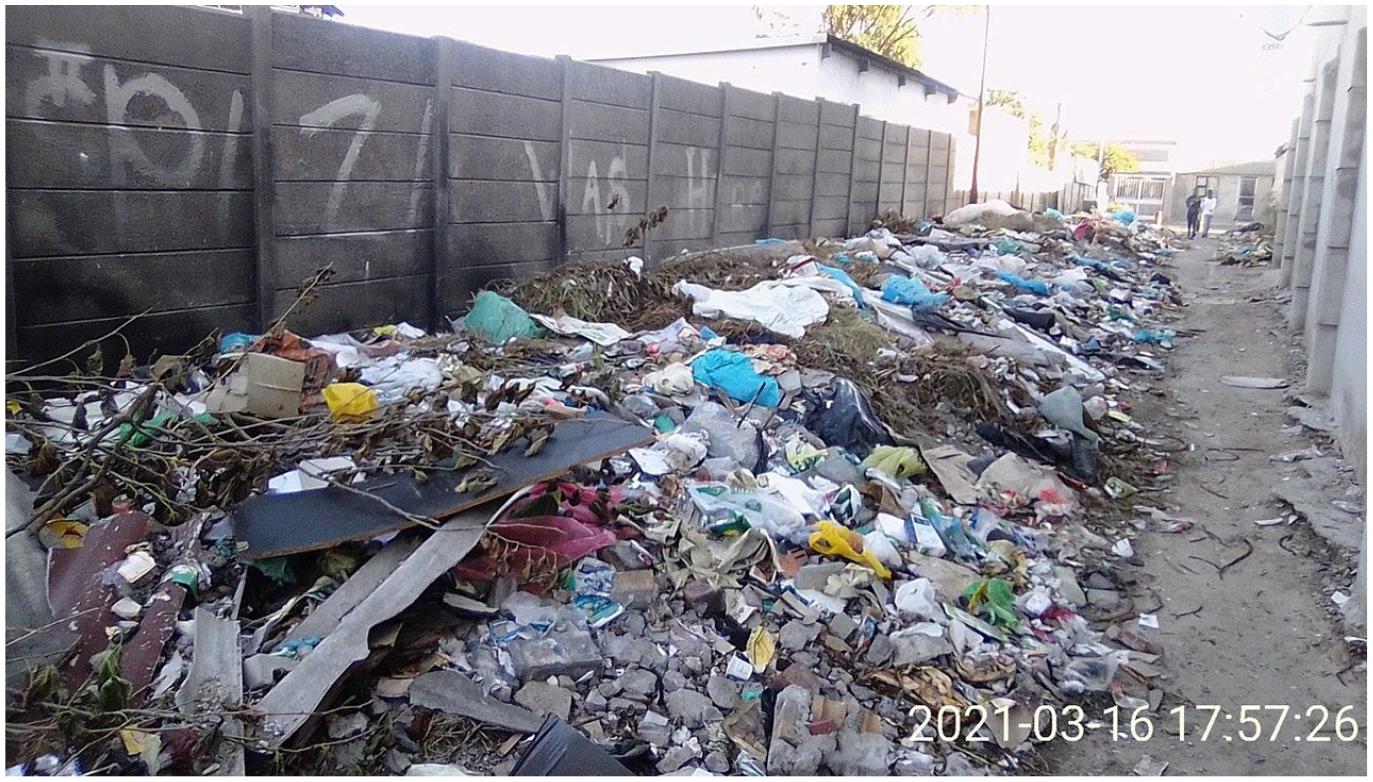
NY57/89 passage or iRhanga, before, March 2021
Through recording narratives and using storytelling methods, residents described how the paveway attracted serious challenges, including illegal activities, crime and violence, waste dumping and unsocial behaviour. Since the initial engagement, multiple co-design and collaborative workshops and public space clean-up campaigns have been activated with partners, local agents, change-makers, street committees, citizens, spatial researchers and urban design students. This collective now views the paveway as a catalytic project for renewed peace, safety and resilience through regular activations(56) and small-scale, resourceful interventions, including public art and strategic place-making as a means of what Beza and Hernández-Garcia describe as “sustainability citizenship rather than placemaking”.(57) (Figure 2).
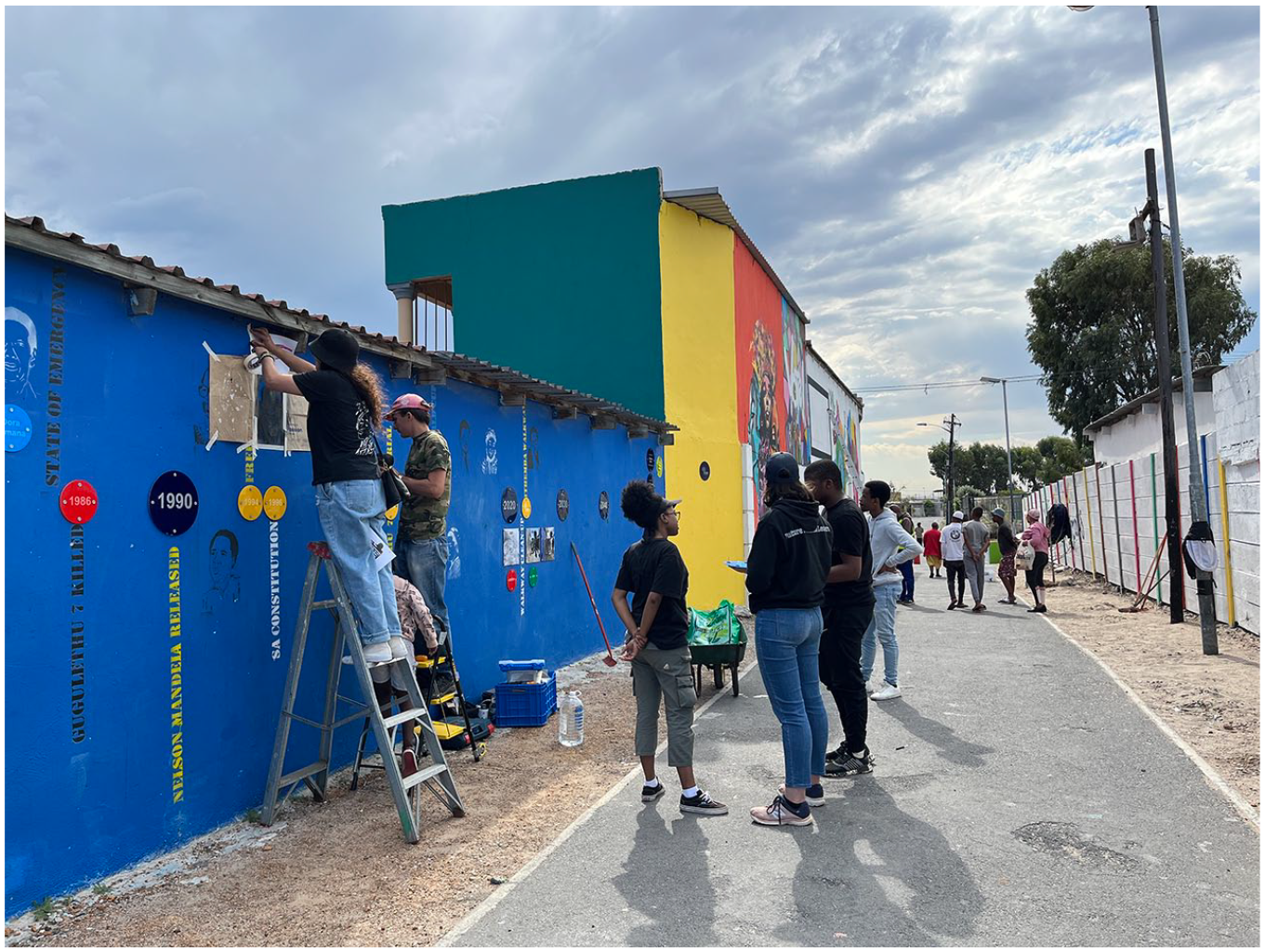
iThemba Walkway, after, April 2024
iThemba Walkway is neither part of an informal settlement, nor a designated public space, leaving it outside of official upgrading policy, budgets and registers. It struggles to be legally acknowledged, remaining an incomplete, partially implemented paveway in a state of unmaking, making and remaking. The walkway draws critical attention to the processes of transformation, characterized by distinctive forms of agency and temporality, where, as Caldeira puts it, “Their spaces are always in the making . . . always being altered, expanded, and elaborated upon.”(58) At the same time, the walkway has managed to ignite interest within the local municipal government, introducing a different kind of public space through participation and recognition.
The iThemba Walkway (with the Wall of Hope in mind as a public space for the youth) has materialized as a co-design space and a small-scale, design-build intervention project. This outcome resulted in the development of a fifth method of (research by) making, as an important addition to the four design progressions. Through an in-depth review of the design process, this progression included acts of unmaking (looking backwards – collaborating to find challenges through story gathering); making (being present – co-designing in the space); and remaking (looking forward – envisioning strategies of action and (re)constructing public space). The intention was to facilitate troublesome questions (and maybe answers) where actions were tangible from the onset.(59)
V. Localizing Transformative Practice
By presenting findings from the case study, I depict iThemba Walkway as a “grounded place-specific struggle for equitable development”.(60) I argue the walkway is an invented and invited space of democratic action, being a peripheral place of constant experimentation. This case study releases the possibility for what Bhan calls “open secrets”, or things that are known about public space but not included in state legislation or documents regarding participatory upgrading projects. Lessons in participatory design in the making of the ‘off-grid’ social infrastructure and ‘make-do’ low-cost upgrading approaches used in iThemba Walkway are worthy of reframing and investing with the logics of a Southern urban practice. This includes a nuanced understanding of ‘who’ is involved in informal relationships and the ‘how to’ of the practical strategies, citizenship planning and unofficial reconstruction methods used in upgrading neighbourhoods that are seldom apparent in policy or project briefs. Through an iterative process of exploring (walks), disrupting (talks), transforming (scenario designing) and making (design-build), the walkway describes key challenges and opportunities as what I term scales of practice.(61) This highlights the spectrum of urban practice and opens alternative Southern terms to describe the ways of making.
a. Engagement
“iThemba Walkway speaks volumes, but our approach needs to be simplified when engaging with partners and government institutions . . . But technical ‘things’ are needed for reference, research and a support case”, notes Xolile Ndzoyi.(62)
A common term used in conventional, contracted urban upgrading projects is ‘public participation’. The implied dichotomy between state and community restricts the dynamic complexity of participatory design. In defining an alternative term to describe a process of participatory design, I describe multiple scales of engagement. Miraftab, with her concept of invited and invented spaces of action with porous borders between them,(63) argues for the density of interactions and entanglement of citizenship beyond participation and formal politics.
The term ‘engagement’ is an attempt to understand what Miraftab describes as “the multiplicity of spaces of action that exist in mediating the relationship between authority and citizenship, including how citizens and authorities understand these varied spaces”.(64) All types, forms and dimensions of stakeholder, partner and participant encounters are important so as to encourage a transformative practice to surface and to expand a meaningful design process. Based on experience in upgrading projects, I highlight two upfront challenges: (1) points of entry; and (2) multiple points of access, in the effort to listen to community voices, collect authentic data and engage with contextual conditions. Initial meetings and later discussions can be complicated in vulnerable settings or undefined spaces with changing local leadership, varied citizenship input, political interference and uncertain municipal interests.
During the first entry point, the urban walk (Figure 3) to NY57/89, the participants and I agreed to co-facilitate a co-design workshop, involving representatives from street committees, local change-makers, the ward councillor, members of non-profit organizations and students and scholars from Nobantu Primary School. We set up a WhatsApp group chat on the same day, which has been instrumental in documenting stories. Through the group chat and a workshop, the group of partners carefully decided on three themes for our first workshop: iingxaki zethu (our challenges/problems – unmaking) discussed through mapping; amaphupha am (‘I have a dream. . .’ – making) reviewed through creative storytelling; igalelo lethu (our commitments/contributions – remaking) captured through visioning exercises and games.
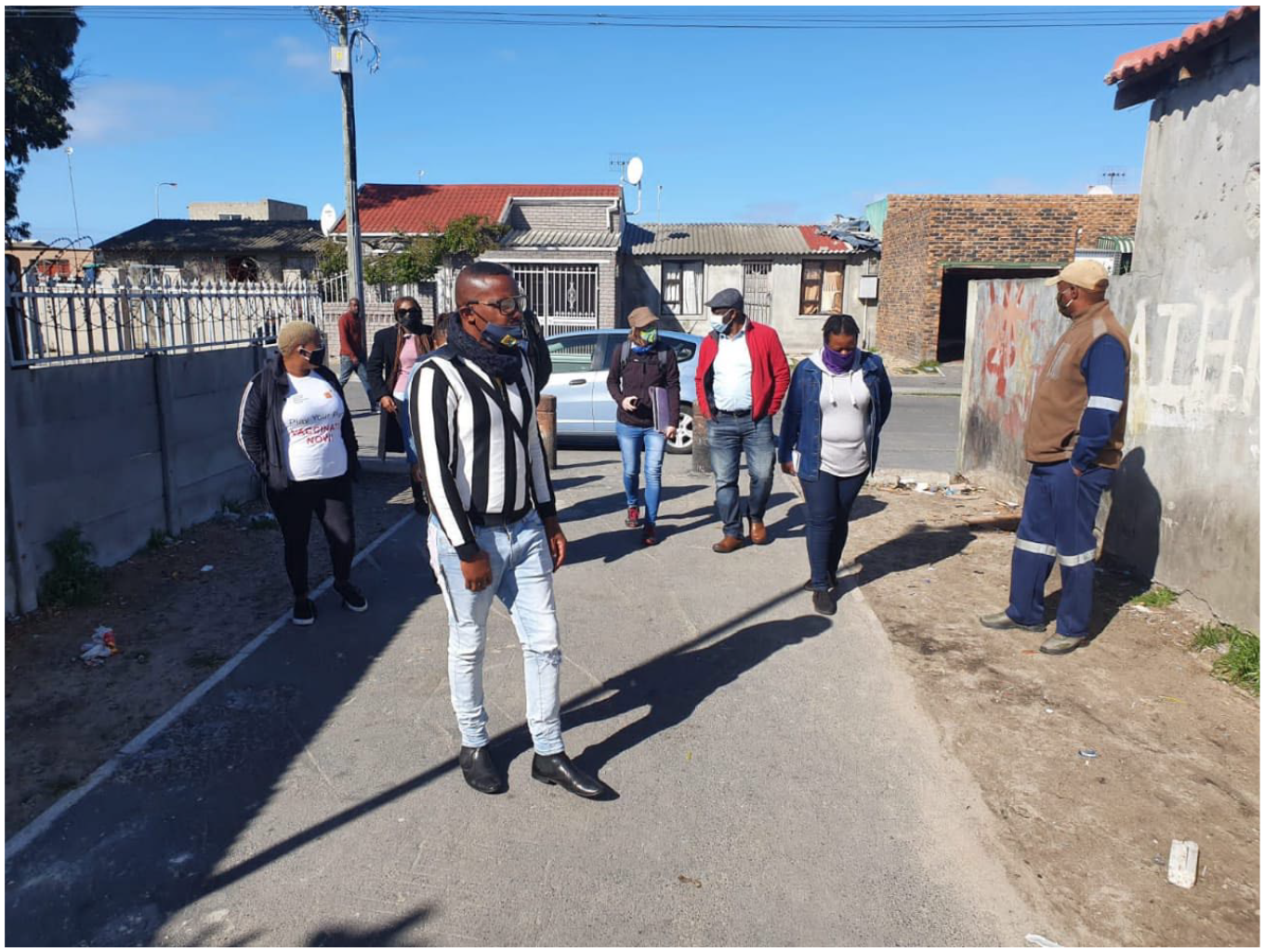
Urban walk, 13 September 2021
The first co-design workshop was held on a Saturday morning in the walkway, inviting participation from passers-by and citizens as a broader entry point. The activation on the day was a magnet for children, offering a temporary, safe, public space (Figure 4). The first workshop intentionally set out, in Beza and Hernández-Garcia’s words, to “work outside formal planning and manoeuvre around established path dependencies, which offer an evolutionary step in the creation and understanding of community realized places in the global South”.(65) Further dialogue with participants after the workshop on our WhatsApp group chat guided input on the design of a logo, the formal naming of the walkway, and a collective objective identification or slogan: to re-imagine a forgotten space by transforming the existing walkway into an accessible, colourful and safe place for all. The combination of various engagements enabled reflexive individual and collective input with the underlying goal of creating a safe and courageous space to exchange ideas, perceptions and feelings.
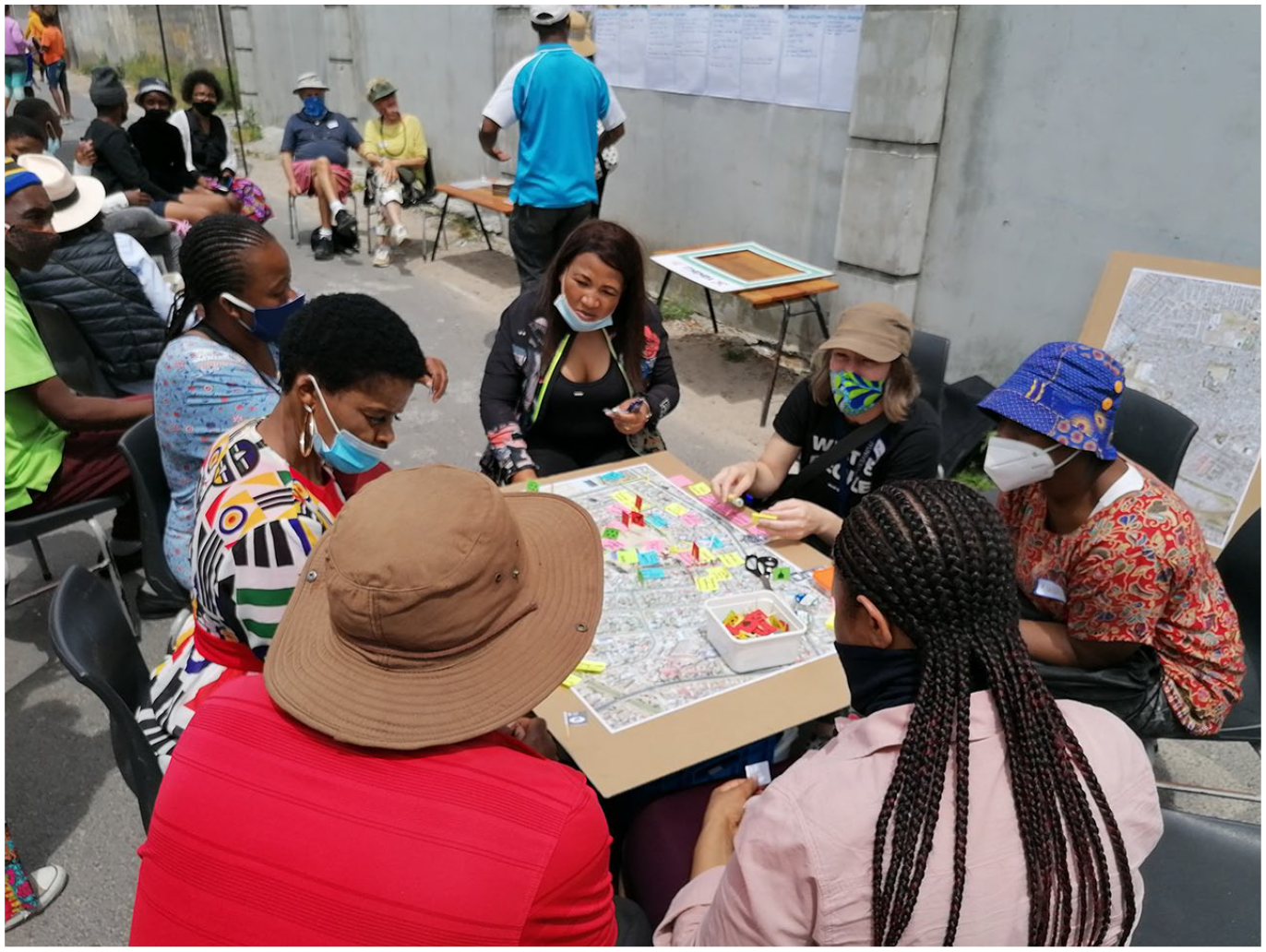
Urban talk at the first co-design workshop, 13 November 2021
Trust-building is an important part of participatory upgrading processes. The primary phases of engagement in the iThemba Walkway built the foundation for an engaged and relational process. Constant ongoing co-design workshops, collaborative mapping, moments of activation and design-build interventions in the walkway are small but provide opportunities for valuable data collection (stories, maps and sketches) and have measurable, visible outcomes (logo, name, chat group, exhibitions).
b. Responsibility
“Some people around the area are so much triggered by the looks of iThemba Walkway wishing to challenge the municipality to deliver services to all walkways in Gugulethu. iThemba is a living example, meaning communities must initiate responsibility to look after their spaces and surroundings for better living”, remarked Phumzile Yongamela after a co-design workshop.
Based on collective reflections after the co-design workshops and clean-up days, I note that there are numerous levels of commitment – from superficial communication (occasional dialogue, ad hoc participation) to informed cooperation (regular sharing of information and joint planning) – all contributing towards a profound integration with formal recognition (single strategy, joint budget, common funding, contract, action plan) of project partnerships. However, partnerships require sustainable long-term relationships to foster accountability and meet project objectives. The size of the problems and barriers between and within sectors, projects and partnerships, and the scale at which they occur can cause distress or a lack of progress, requiring the need to discuss scales of responsibility.
The iThemba Walkway project partnership constantly raises questions: what are our challenges, what are our opportunities, and what should we change? This is an ongoing exploration with the collective to question the partners’ roles, responsibilities and actions, making all accountable for change (or not). To work through the problems and opportunities, a series of sub-questions were raised in a walkway workshop(66) around the meaning of place-making and partnerships. These are messy, unresolved dialogues and remain a sticking point for the iThemba Walkway.
The pace of the walkway upgrading process can be varied and unpredictable. It shifts from slow, reflective engagements to fast, reactive actions, making strategic planning a tricky task. As Caldeira explains it, “Actors in this way of creating cities . . . engage with each other not necessarily outside of mainstream logics, but rather by taking them transversally as matter of negotiation and transformation.”(67) The walkway as a public space project continues with no end date or exit strategy, remaining in a state of precarity, but also a condition of reclamation and occupation of urban space. This entails a heavy and continual burden in terms of sourcing the means to implement this public space. Voluntary input generally occurs outside of residents’ working hours and on weekends, and for this reason public holidays become activation days for the walkway. Incentives, such as training or skills development, are crucial for encouraging involvement but require inclusion in grant applications and mentorship programmes, which we have only managed in limited doses over the past four years. This may be considered as what Caldeira calls a “matter of struggle, negotiation, and especially of transformation; in short, of politics”.(68)
Every year, new community challenges add fresh and sometimes resisted dimensions to the upgrading process. Maintenance is an underestimated demand in terms of human resources and funding. A local community resident, Khayalethu Nqolobe, volunteers to care for the walkway: “I just cleaned her [the walkway] up. Now she’s looking beautiful on school opening.” Unfortunately, Nqolobe constantly struggles to get support with this ad hoc maintenance, stating, “There have been a lot of promises to help and none have pitched . . . With teamwork, we can achieve more, I believe”. Another local resident stated “[a] plan B is needed”.
A committed stakeholder initiated a peace initiative in the walkway with the bold idea of donating and planting trees (long-term change). The trees were planted in late November 2023, at the beginning of a dry summer, when there was limited access to water once the local school had closed for the holidays. Nqolobe stepped up to support the trees, using water from his property. However, the quantities of water needed to sustain six young saplings exceeded his monthly subsidized supply within a few days. The maintenance needs of the trees created uncertainty and confusion over who was responsible for them and who would be paid for this caretaking. Xolile Ndzoyi organized a contribution from the National Government Department of Agriculture of two 260-litre water tanks in 2024, located via an access gate at Nobantu Primary School, to support the growth of the trees going forward.
To assist with similar disruptions, two co-design workshops in 2022, and another in 2024, attempted to come up with a Walkway Action Plan.(69) As an outcome of the first workshop and through on-going discussions(70) between partners, Ndzoyi and me, a flexible, interim and informal Responsibility Framework was initiated, aligned with an evolving memorandum of understanding (MoU). These mechanisms are supposed to keep the iThemba partners accountable for collaboration, providing financial input through a micro crowdfunding source, agreeing to workshop activities and events, and deciding on responsibilities for partners and participants. The MoU remains a weak mechanism, however, as it takes the form of an overly complex and abstract contract. In times of uncertainty, the iThemba partners prefer to refer to their one-page Responsibility Framework to channel actions and make decisions. Importantly, this approach requires ongoing administration, management and evaluation, which has been limited to date.
The Responsibility Framework, however, needs to be expanded, altered and adapted (and to become accessible digitally). The idea is to identify and redistribute resources, knowledge and power across more actors to improve the resilience of the walkway and to acknowledge systems of accountability and transparency. An enhanced framework will require a mindset shift from conventional linear development and service delivery model, allowing a reframing of the standard and linear step-by-step package of plans approach used by municipality, which depends on each step reaching completion. A reframed design-and-act tactic to making, including designing, building, costing, reporting and recording, should be integrated and co-developed.
c. Incrementality
“Our space could be an educational tool”, noted an iThemba Walkway participant in the first co-design workshop. Another participant continued, “I would like this space to be people friendly, a space of learning and a space for fun, a memorial wall, educational drawings on the floor . . . market day, Wi-Fi, lights, 1st Friday events . . . My idea about the space is to be a green space, with vertical gardens that will encourage health.”
Sparked by the ‘I have a dream. . .’ activity, the ideas that emerged from the co-design workshop were not the conventional ideas on public space (playground, gardens, sports fields). Hou argues that “insurgent public spaces challenge the conventional, codified notion of public and the making of space”.(71) Within the iThemba Walkway, bold actions, temporary reconstruction and flexible activations run counter to conventional standards, by-laws and stringent requirements of upgrading, thus calling into question the notion of ‘public space’ in their materiality, use and occupation. It is important to design various scales of incrementality for the making of public space as social infrastructure in peripheral neighbourhoods.
Funders, politicians and municipal officials in urban upgrading projects generally emphasize the final products – housing and the delivery of bulk infrastructure (water, sanitation, electricity).(72) As demonstrated in iThemba, a solution for public space is what Caldeira refers to as the “constant processes of transformation”(73) through parallel systems of incremental design inputs, low-tech, labour-intensive construction techniques with maintenance-friendly, affordable, local solutions. Outcomes can usually be measured and monitored against development indicators. However, in this case, the indicators for the walkway remain unclear and undecided, and evaluation is sporadic.
Of course, it is imperative not to over-design public space but to leave room for democratic interaction, adaptation and ingenuity, applying and stretching the idea of incomplete space. Highly designed and crisp public environments are sometimes sterile civic places. The key is to provide just enough of a design framework as a series of strategic physical interventions to understand the important elements and conflicting possibilities that will initiate and shape sustainable, just development.
Aligned with the original Wall of Hope, the idea of a memory wall in the iThemba Walkway stems from the first co-design workshop, when it was suggested by a participant. The iThemba partnership, community elders, local agents and Gugulethu representatives decided to identify a space for a memory wall, with its content telling the story of Gugulethu, iinkumbulo zethu (our memories). The project enhanced debate and has encouraged people to connect. In 2022, the partners officially opened the wall through the creation of memorial nameplates that celebrate the lives of two young people from the community, both violently murdered in the walkway – one in 2001, the other in 2018. Since the opening of the memory wall, UCT researchers and students have constructed a timeline over three design-build implementation days (Figure 5). This usually takes place annually on Freedom Day,(74) the date of the original clean-up, and the annual commemoration of South African democracy.
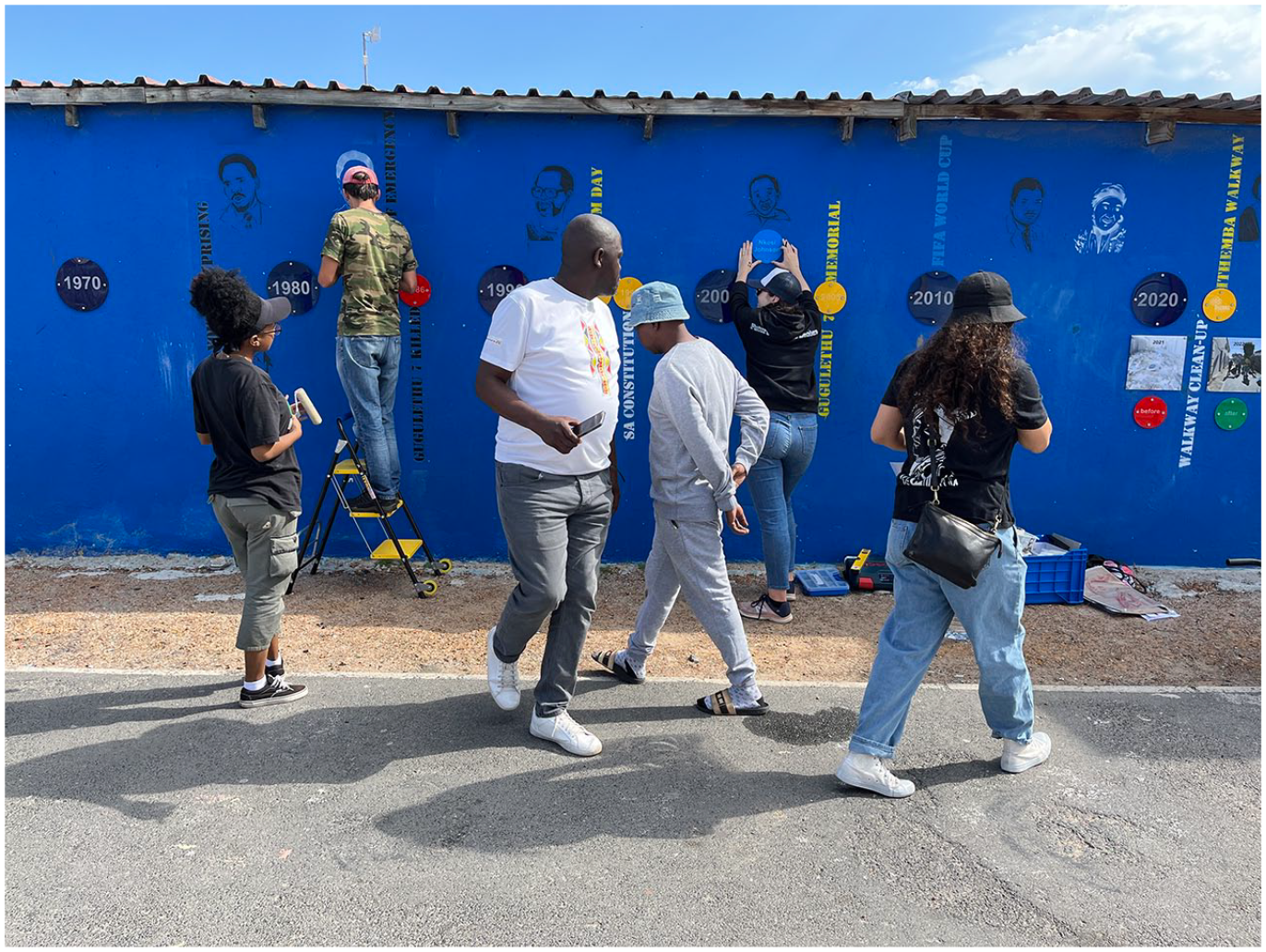
Design-build workshop and implemetation of the memory wall, 27 April 2024
The timeline consists of circular plates, installed by the design-build workshops, and shows 10-year intervals with dates spanning a 100-year period from 1950 to 2050. Painted portraits (by urban design researcher Leigh Maurtin) and text illustrate events, individuals and moments in South African history. The memory wall recognizes the first occupation in Gugulethu and the Group Areas Act and includes other devastating events and relocations that took place in Cape Town during apartheid. It provides space for the inclusion of the upgrading process in the present and anticipates an imagined future. The transparent material and application of the circular plates, decided as an alternative material to reflective glass but being lightweight and shatterproof, and which was offered as a donation, are not sufficiently robust for a public space. After some youths vandalized some of the plates, a series of engagements with residents and other partners ignited a series of care and repair days. The fixing, cracks and remaking of the memory wall are signs of resistance, resilience and reconstruction. Public space that falls under the purview of no specific line department and with no plan for operations and maintenance unfortunately requires a high level of self-sustainability and community ownership.
Another idea raised in the first co-design workshop was the installation of lights. Over the past three years, Christmas lights have been temporarily installed in December, proving to be a delight and a highlight for iThemba users. The lights released a sense of optimism around the space being public. Ndozyi stated on the WhatsApp group, “Christmas lights bring joy and social cohesion”. Mongezi Tamana also noted, “Indeed, iThemba Walkway is evidence that there is hope in our community. I never imagined these lights in this walkway, particularly at this time of the year. Great vision and great work team iThemba.” The recent addition of solar lights, amid load-shedding in Cape Town, have been a positive and somewhat more permanent intervention.
The partnership’s commitment to micro investment and maintenance in the walkway as an element of critical, social infrastructure has resulted in the delivery of public dustbins and the upgrading of municipal pedestrian streetlights in late 2024 by the City of Cape Town. This has changed the night-time use and perception of safety in the space.
d. (Ex)change
“This important mission is to change our public spaces from crime hot spots to a narrative that has been updated through community involvement. This is driven by passion and commitment. iThemba Walkway in Gugulethu is not just a space but a global inspirational brand . . . Let’s think globally and be locally relevant . . . We will make this township better if all of us are united and sharing one common vision”, notes Ndzoyi.(75)
Time is an underestimated asset and a scarce resource(76) in long-term relationship building and urban upgrading. The time frames and arrangements required to meet the demands of donor funding may be hard to manage in precarious environments. I have found that funding to pay fieldworkers and community stipends is limited and difficult to source. These funds are required to secure access to local venues for meetings, and to cover the costs of more detailed fieldwork. Where funding is provided, there are high transactional costs associated with paying small sums of money, because conditions of funding and institutional mechanisms require this to be done through formal, conventional payment channels. Technology can also be difficult to access – one example is the provision of decent smartphones for community members to connect, map and record the local context. Issues of access, safety and logistics remain unnecessarily convoluted, demanding a need to review scales of (ex)change.
iThemba participants collectively developed a ‘manifesto’ during a debriefing session after the first co-design workshop that reads “Walk the path where hope is alive with possibilities, where the past paints future projections. A space to thrive, flourish and bridge the divide.” However, as a collective, we questioned how to establish a strategic iThemba Walkway partnership given our lack of funding and municipal support and our limited capacity, even to upgrade the small passage. So, as part of an iThemba upgrade partner workshop, we collectively built the discussion around four Sustainable Development Goals (SDGs), decided through consensus by the partners: SDG 5 (gender equity), SDG 11 (sustainable cities and communities), SDG 13 (climate action) and SDG 16 (peace, justice and strong institutions). The idea was to tap into some SDG funding as small (ex)change opportunities in order to finance community events and activation days in the walkway. This has been very successful, both through non-profits’ contributions and small-scale municipal operations funding.
In 2022, on Heritage Day (24 September), a South African public holiday that celebrates diversity and the cultural wealth of the nation, our event focused on creating a new mural painting (by artist Marnette Swartz) on climate change and sustainability on the wall adjoining the walkway, complemented by the planting of fruit trees (by Gugulethu Urban Food Forest Initiative – GUFFI) at Nobantu Primary School. The project continues to use the SDGs as ideas for exchange with other partners, and both external and internal organizations. Further dialogue and workshops on election voting resulted in a mural “for a better Gugulethu”. Another mural painting on gender-based violence for another public holiday in South Africa on Women’s Day (9 August) in 2024, with the support of a new partner iLitha Labantu, opened up a discussion with a feminist lens. As a celebration of hope and unity, and a connection to 16 days of activism on gender-based violence, our core partner, Africa Unite NPO, hosted a workshop in the walkway, adding SDG 3 (good health and well-being), SDG 10 (reduced inequalities) and SDG 17 (partnerships for the Goals) as additional topics of conversation and funding opportunities.
Supported by small international climate resilience and local project-based research grants, I commenced a study as the principal investigator for The Walkway Project. This research integrates Southern theory and the practical application of upgrading walkways and waterways in Cape Town. Through multiple urban walks, 24 walkways have been (re)discovered for upgrading across the neighbourhood, including the Lotus River Canal, which stretches over 4 kilometres through Gugulethu. Outside residents from other iRhanga visit iThemba Walkway as a collaborative space for knowledge exchange and to understand the implications, urgency and agency of a transformative practice in public space upgrading. In April 2025, UCT, supported by Africa Unite, hosted an exchange workshop, during which the working concept of communities-in-practice was created, an alternative to the more conventional communities-of-practice.
Additionally, iThemba Walkway has been a strategic partner in the municipal Liveable Urban Waterways and Green Infrastructure Project since 2023, enabling it to reach a wider audience, scaling outside of Gugulethu to the larger Lotus River Catchment Area and giving significant recognition to the walkway as a transformative practice. Further, the iThemba partners opened up a conversation, site visit and exchange with the Mayor of the City of Cape Town on the closure of walkways in other township neighbourhoods of Cape Town.(77) This has sparked a recognition of the need to co-produce an overarching vision for safe walkways and resilient waterways beyond Gugulethu. The intention is to actively engage with the broader political, cultural and economic context, emphasizing the impact, scale, agency and communities of small-scale and social design projects.(78) In 2025, the Walkway Project has generated a co-curated exhibition of creative works, representing Studio Hope, iThemba Walkway and the more general research in Gugulethu over five years. The exhibition aimed to foster ongoing dialogue and (ex)change knowledge beyond the academy.
VI. Strategies of Action
Strategies of action, adapted from Sandercock,(79) and tested through the different scales of practice, involve multifaceted mechanisms towards urban upgrading. The strategies are not expected to be enacted in a linear fashion, but as they are deemed appropriate. Understood and applied in relationship to one another, they have the potential to expedite a shift towards systemic change. The complexity lies in creating an open set of actions that hold participants accountable in places where stakeholder dynamics and needs are marginalized and troublesome. Transformative design in this context aims to facilitate sustainable transitions through collaborative decision-making, comprehensive policy reframings and the prototyping of an enhanced systemic upgrading of public space.
The strategy empowering conversations promotes participative processes and transversal viewpoints as central to urban upgrading, where uncertainty can be exciting and unsettling. The strategy, in the words of Beza and Hernández-Garcia, “situates citizens as social change agents”(80) by embracing interrelated, participatory processes that empower safe and courageous spaces for meaningful conversations as entry points and points of access over time. The reappropriation of space through participatory design is essential to a post-apartheid revolution.
Facilitating disruptions, and what to do when ‘things’ (projects, agents, decisions) are contested or delay project implementation, is a strategy that seeks to recognize and confront power imbalances. The intention is to actively create spaces and tools for marginalized voices to be heard and to provide a structured action plan or framework to guide decisions regarding reasonable time frames, fair and genuine financing mechanisms and the alignment of resources and responsibilities and to avoid unnecessary disruptions. The development of action plans or responsibility frameworks requires alternative approaches to participatory design and training that may challenge existing conventional practices, studies, acts of kindness and donations, all of which can potentially stifle decision-making and enable inappropriate development. Contractual conditions and legal applications must be carefully considered as these may repress authentic decision-making, becoming barriers to upgrading. This requires adequate income to conduct and make meaningful action plans.
Enabling (re)constructions is a strategy to actively encourage an incremental design and construction approach to the public realm. Efforts by communities to appropriate and expand public space (although much contested) are integral to self-empowerment, social networking and contribute to the ways of making cities. Stakeholders are central to decision-making in an integrated and incremental approach. Incomplete spaces should positively memorialize and integrate the past through debates, enjoy the present through celebrations, and design visions for the future. This kind of decision-making moves away from dependency-driven, formal practices and offers a step towards contemporary thinking around social design and critical infrastructures.
Shaping collaborations includes the co-development of equitable partnerships as a strategy towards productive agency and exchange to uncover Bhan’s ‘open secrets’ regarding co-design, co-production and co-management of peripheral urban spaces. The research about iThemba Walkway has been conducted on a shoestring research budget, making the project necessarily incremental in terms of physical upgrading and knowledge production. Nevertheless, the project exposes limitations and possibilities to horizontal scaling out, vertical scaling up and scaling deep(81) of small-scale upgrading projects located within informal arrangements. Importantly, the limitations of collaborative urban knowledge co-production in urban upgrading are acknowledged, particularly where public space is incomplete, and design occurs in occupied space through a ‘design-and-act’ approach.
My concluding reflection emphasizes a call for locally relevant, hybrid solutions to upgrade the urban environment as a collaborative, empathetic and transformative practice within and between partners, funders, organizations, disciplines, research projects and teaching spaces. This research acknowledges Southern urban practice as a principle-based ethics of care and repair. Democratic access to information, critical deep analysis and interpretation of urban experiences enable design that draws on co-produced strategies of action. This allows participants to have a say in both the determination of Southern terms and the decision-making processes and trauma healing in South African neighbourhood transformation. The scales of engagement, responsibility, temporality and exchange acknowledge the role of the urban designer as a participant offering more than just technical support to a social process.
Footnotes
Acknowledgements
This paper covers my practice, teaching and research in Cape Town. I acknowledge and would like to thank local agents, particularly Xolile Ndzoyi, community members, core partners, participants and stakeholders of iThemba Walkway within the urban upgrading participatory process. Recognition is also given to all the University of Cape Town Master of Urban Design and Master of Landscape Architecture students and staff who have been part of our journey. My gratitude extends to the full editorial team for their guidance, and to the anonymous reviewers who both offered valuable comments on the paper.
Funding
This work was supported by the Association of Commonwealth Universities Climate Resilience Challenge Grant 2022 and UCT URC Block Grant Award: Research Project Funding, 2022/23 and 2025. The author received no financial support for the publication of this paper.
Ethics Approval Statement
The study was approved by the University of Cape Town EBE Research Ethics Committee over consecutive years from 2020 to 2024 (ethics approval no. EBE/00578/2024), and an updated renewal for 3-year research in 2025–2027. Participants provided verbal, digital and written informed consent prior to participating and consent to publication, giving amplification to their voices.
