




Abstract
Writing alongside Southern urban theorists, this essay argues that the emerging body of “theory from the South” must be simultaneously tied to the production of forms and theories of practice. It must ask: How can a new body of thought give us ways of moving and modes of practice? Drawing from the experience of Indian cities, three such modes of Southern practice are offered: squat as a practice not just of subaltern urbanization but of the state; repair in contradistinction to construct, build and even upgrade; and consolidate rather than focus on the building of a singular, universal network within services and infrastructure. The essay then offers a first set of shared characteristics that may enable us to think of a practice as “Southern”, and urges the expansion of a vocabulary of Southern urban practice.
I. Introduction
Philip Harrison, in a wonderfully reflective piece, thinks back to his transition from being a university-based academic to working with the city of Johannesburg.(1) He argues that while “planning theory may have honed [his] conscience and improved [his] capacity to deliberate in a complex environment … it did not provide [him] with guidance, or even an orientation, on substantive matters”.(2) Harrison’s lament is neither new(3) nor specific to planning. The implicit questions – how one knows what is to be done, and what one needs to know to actually do that – are fundamental to any understanding of the role of knowledge in shaping human societies.
These questions are intimately familiar to anyone who has sought to respond to the cities they reside in. Activists in social movements, researchers in think tanks, engineers in utilities and other companies, citizens trying to survive everyday life, residents building their own housing, or anyone trying to figure out where to get water, a job, an escape, or an opportunity: All claim the difficulty of finding articulations of knowledge that help address their particular forms of practice.
Some of this difficulty lies in the multiple disconnects between “theory” and “practice”. In this essay, I look at three particular kinds of disconnection. The first is when theory remains arguably “unrooted” in context and thus seems impossible to translate, apply or use to influence practice in particular places. I will argue that recent work on Southern urban theory reveals partially this challenge of “unrootedness”. The second is a narrow reading of “practice” that restricts it to professional, formal or institutional modes rather than a more expansive sense of different ways of moving by differently situated and motivated actors and institutions. Such narrowing shapes the kinds of theories we generate and value, and creates a “common sense” that particular modes of practice can be neatly mapped onto particular kinds of practitioners: A “planner” makes spatial plans, and does not need to know about modes of political activism; an “activist” organizes public protests and is exempt from being technically sound on zoning and land-use regulations.
Across theory and practice, this common sense sits nicely within our hierarchically segmented worlds of sectors, disciplines and domains, which then bring the third form of disconnect: where things that are known (“open secrets”) are not present in authoritative disciplinary canons or dominant forms of practice.
To engage with these three forms of the theory-practice “disconnect”, I borrow from both sides of the hyphen. From “practice”, I claim a form that is propositive and polemical – it “calls for things even if all of the evidence is not yet in and often hard to come by”.(4) From “theory,” I align myself with a view of theory-building that is, as Graham once phrased it, “as much a discursive intervention as a task of accurate representation”.(5) I do so through an attempt to offer terms that could be part of the vocabulary of Southern urban practice.
Section II of this essay reflects on the construction of vocabulary as a mode of theorizing and practice, and explains the choices behind the particular terms that this essay offers. Section III briefly marks my understanding of “Southern” as a context within, as well as a position from which, I write. The most substantive part of the essay, Section IV, then introduces three terms for our vocabulary: squat, repair and consolidate. In conclusion, I reflect on what is shared across these terms to offer possible ways that others may propose terms of their own so that we may collectively build a theoretical framework of something called Southern urban practice.
II. On Vocabularies
A vocabulary is a specific kind of knowledge assemblage and intervention. Its etymological roots lie in the act of giving a name to things, just as its contemporary meaning underscores the need to expand the “range of words” available to us. Both are means to make a range of realities intelligible, visible and relevant. Vocabularies, in one sense, are maps of different life-worlds of knowledge, including their hierarchies. As a mode of theory-building, choosing to expand a vocabulary then can be an argument for the need for new words, or new meanings of older words, precisely to enable an expansion of the life-worlds under consideration. Equally, however, vocabulary-building can be more straightforwardly political than epistemological. Words – known and new, ordinary and conceptual – can be wielded and presented to amplify particular issues, places, and forms of knowledge at a particular time. Indeed, the histories of practice are not just about the consistent generation of new ideas but also about the sudden rise and fall of different ideas at different political and historical conjunctures. Seen like this, a vocabulary is dynamic and located, its construction a strategic call to mobilize around its terms so they become salient in particular places and times. Vocabularies of something called urban practice must take this role even more seriously than those addressing, say, the reconsideration of a theoretical or disciplinary canon.
The terms this essay offers have been chosen for both of these ends. Theoretically, they come from a relationship with work that can loosely be called “Southern urban theory”. Over the past decade, many authors have argued that place matters in shaping geographies of urban theory as well as those of authoritative knowledge. Their work, described below in more detail, rethinks urban theory “from the South”, using the experiences of a different set of locations – Johannesburg, Lagos, Cairo, Mumbai, Jakarta – to think about all cities. I write within this emergent tradition(6) but also challenge it, arguing that the project to think from place must be simultaneously tied to the production of first the forms and subsequently the theories of practice. This too must be part of the ethos of Southern inquiry. We must ask: How can a new body of thought give us ways of moving and modes of practice as well as theoretical formulations? I contend that building a vocabulary is a way to begin such work.
My choice of these specific terms – and not the many others that could have been offered – is thus not just a challenge to what some scholars have called “mainstream global urbanisms” within urban theory.(7) It is invested in my own reading of what a vocabulary rooted in a specific empirical context – the contemporary Indian city – should be speaking about and allowing us to speak about. Each term asserts the political importance of viewing a set of key urban issues facing Indian cities in a particular way. They are not just reflections of a grand theoretical coherence or apparatus of either “Southern” or “Northern” urban theory. My own practice within policymaking, teaching and activism in India convinces me that they are the ideas that require amplification in this context to challenge conventional thinking.(8) In particular, I believe they are the terms that institutions of authority – the state, universities, city utilities, public officials – need to consider. In some way, my choice of terms is a response to Philip Harrison’s provocation.
The choice to speak specifically from and about Indian cities is deliberate. I believe that speaking of practice requires rooting oneself in an empirical specificity. It is open to debate whether a set of cities within a nation-state is the correct scale or form of this specificity. For example, I could look collectively at megacities across the South. For now, I choose to rely – as we often do in polemical and exploratory writing – on contexts where my knowledge is more intimate and reliable. I do not believe that vocabularies of practice can be created other than incrementally from multiple locations, so that they may then begin to speak to each other to see if shared theoretical frames can emerge across these locations. Such work then holds the possibilities to generate and imagine both localized forms of practice and more generalized forms of theory.
III. On “Southernness”
Over the past decade, a set of scholars – let us loosely call their distinct but shared work “Southern urban theory” – have persistently argued that place matters in shaping urban thought. Thus far, they argue, urban “T”heory has been considered placeless – a set of principles, to use Timothy Mitchell’s phrase, that are true in every country.(9) In contrast, writing on “other” cities has been historically treated as testimony rather than theory. The urbanism of these cities has been read, described and understood largely in terms of theory built elsewhere. Analyses are measures of deviation against an unspoken norm, a placeless universal unmarked by historical difference.(10)
This had two critical consequences. First, we simply do not know enough about the everyday realities of many parts of the world. Second, even with what we know, we do not generate the inquiries, concepts, ethico-political locations, or theoretical and technical languages that shape urban thought and practice from “here”.
Work that has sought to write from these places rather than just about them has grown.(11) My task here is not to assess these theoretical formulations directly, but to return to two founding impulses of Southern inquiry. The first is to look from a set of places, paying particular attention about the contexts from which they speak, acknowledging that this is a challenge to the current geographies of authoritative knowledge. The second is to think of the South not just as a set of places but as a set of moving peripheries, a loci of “ex-centric locations” as the Comaroffs have termed it.(12) In this sense, the South is as much a project as a place, a relational geography that insists on calling out hegemonies of knowledge and dominant forms of practice no matter where they emerge.
I write alongside both of these understandings of Southernness. In one sense, I follow Maringanti, Leitner and Shepherd, who once described “Southern” residents as “those, everywhere, whose livelihoods have been made precarious by geohistorical processes of colonialism and globalizing capitalism”.(13) This certainly allows the concept of Southernness to tackle relational and moving peripheries, reminding us that Southern questions can well be asked from the peripheries of all cities, no matter where they are. Yet in this historical conjuncture, there are also empirical similarities that mark a “Southern” location. These are not limited to a geohistorical “global South” and not all cities in the global South hold them in the same way, but they are very much contexts that thinking from the South forces us to confront. The “South” then is a relational project, yet also a currently discernible and defensible empirical geography.
Let us take the production of space as an illustration of this empirical geography. Writing about “peripheral urbanization”, Teresa Caldeira describes modes of the production of space that “(a) operate with a specific temporality and agency, (b) engage transversally with official logics [of law, property, and labour], (c) generate new modes of politics, and (d) create highly unequal and heterogeneous cities”.(14) Drawing on examples from São Paulo, Istanbul, Santiago, Mexico City and New Delhi, she argues that writing from all these locations reminds us that “that peripheral urbanization is remarkably pervasive, occurring in many cities of the south, regardless of their different histories of urbanization and political specificities”.(15) This does not mean that it plays out the same way in these cities, or that the forms of “unequal and heterogenous cities” look the same, or that all cities in a geographical “South” exhibit it. What it tells us is that looking from a certain set of cities provokes particular lines of inquiry because of the particular nature of their urbanism.
Other writers – sometimes boldly, sometimes hesitantly – also refer to such shared empirical contexts. If for Caldeira it is the mode of production of space, for Susan Parnell and Edgar Pieterse it is the shared fates of “large, fairly well-resourced places that nevertheless have very large concentrations of chronically poor people who are institutionally excluded from the government support structures that are necessary for their well-being”.(16) This amorphous set of cities become more specific in their shared historical geographies. They are “embryonic post-colonial local state structures”(17) or “post-colonial contexts where local and provincial governments are rather belated constructions, with limited fiscal and human capacity and with incomplete administrative systems at their disposal”.(18) It is thus that AbdouMaliq Simone and Edgar Pieterse offer what I consider the most convincing definition of an empirical configuration of the “South”: cities where the majority holds political, economic, spatial and ecological vulnerability.(19)
One way to conceptualize a vocabulary of Southern urban practice, then, is to start from particular empirical configurations of core urban systems – land, infrastructure, economy, governance and cultural systems(20) – in a particular set of cities. Each of the terms offered in the next section of this essay thus draws upon and locates itself in a particular empirical configuration of urbanism that Southern urban theorists have described. They do so in the contemporary Indian city, recognizing that practice requires specificity, especially if particular empirical configurations are its starting point. I now turn to the three terms.
IV. The Terms
a. Squat
It is now well established that squatting – the process of occupying and incrementally building urban inhabitation on land or in structures to which residents do not hold legal title – is the mainstay of how auto-constructed cities are inhabited. The literature speaks of squatting mostly as, in Alexander Vasudevan’s words, a “response to and an expression of housing precarity”.(21) The housing that results from squatting – often mistakenly reduced to a catch-all category of “slum”– is perhaps the single most recognizable marker of the landscapes of Southern cities and of writing on them. This remains empirically true of all contemporary Indian cities – and, indeed, for many of these cities, Simone and Pieterse’s description of the vulnerable urban majority is both apt and accurate.
Recent scholarship has usefully shifted the focus from the materiality of the dwellings that squatting creates to the mode of producing and inhabiting urban space. Vasudevan reframes squatting as a set of practices, arguing that we need to better understand the dynamics of a “makeshift urbanism” that results from the juxtaposition of both structural exclusion but also the possibilities of “endurance and social transformation”.(22) Scholarship from practice – particularly the work of organizers, residents and activist federations – has shown and rallied behind in-situ upgrading, for example, as opposed to either eviction or redevelopment as modes of practice that begin from and affirm squatting as a core form of producing urban space.(23)
Yet even here, squatting remains a mode of practice associated with the marginalized, another weapon of the weak.(24) Just as, for so long, informality remained discursively the domain of otherness, vulnerability and exclusion until several scholars pointed out the empirical reality of elite informality, and argued that informality had to be understood as a regime of rule.(25) What would a reframing of squatting as a practice more widely deployed look like?
Photo 1 shows a mohalla (neighbourhood) clinic. These clinics, a state intervention in the delivery of public health, are the brainchild of the Aam Aadmi Party (AAP)-led government of the National Capital Territory of New Delhi. Over a hundred have been established all over the city, providing consultations, diagnostic tests, and medicines at minimal cost. The clinics are built simply, cheaply and quickly, usually with prefabricated materials. In both process and form, they hold more than a passing resemblance to the auto-constructed, incrementally built homes that dominate the low-income neighbourhoods they serve.
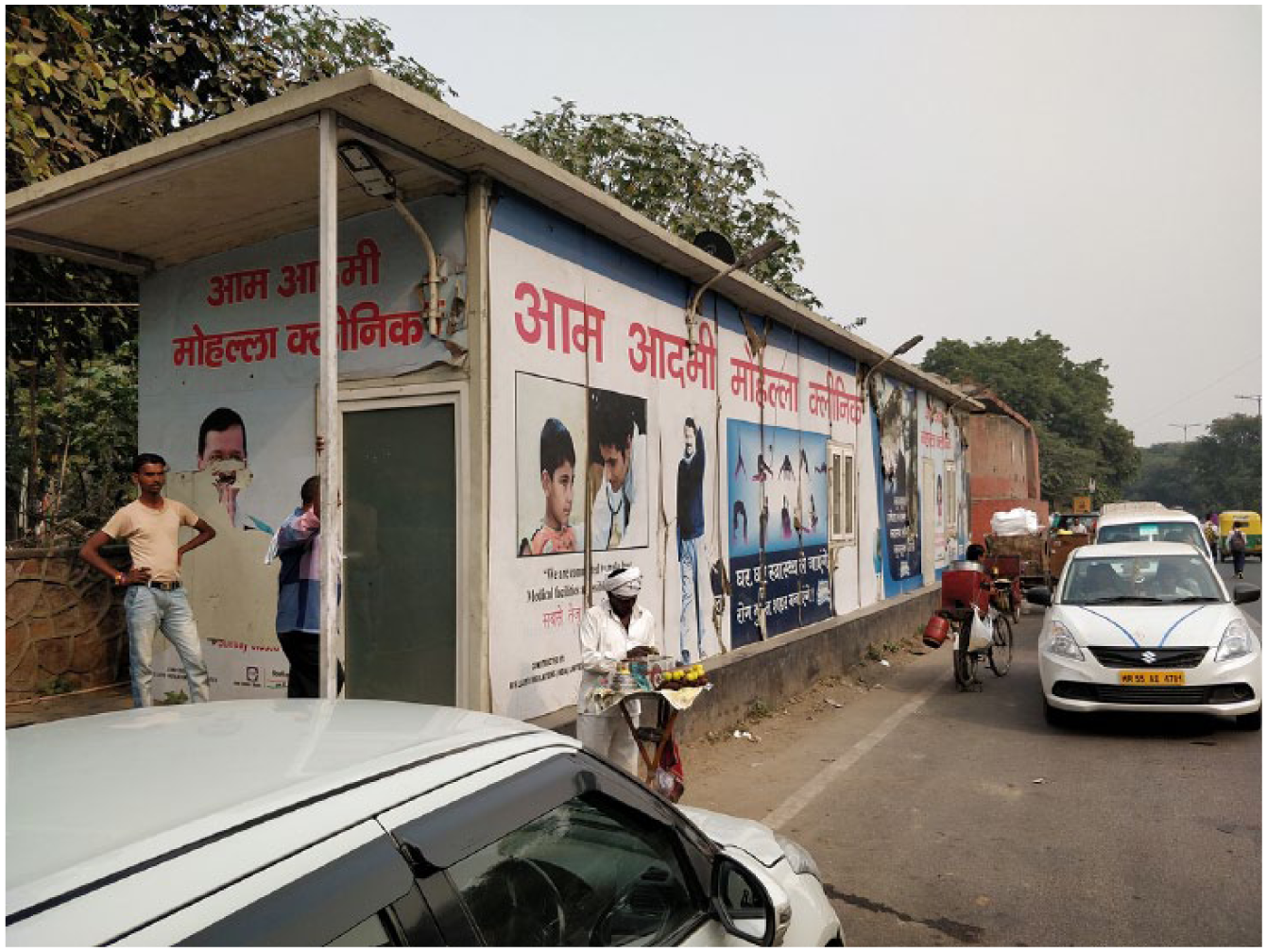
A mohalla clinic in Delhi
The mohalla clinic scheme’s ambitions are grand – over a thousand were planned by March 2017,(26) although only about 110 are in operation. The delay isn’t due to a lack of resources or will, but the inability to find adequate land in dense neighbourhoods. Here is the dilemma of a Southern megacity: geographies of auto-construction overlap with those of formal ownership to make land scarce. How then does one move forward? A decision to use public resources to expand access to healthcare for the poor is precisely within Vasudevan’s twin hopes for squatting: the enabling of endurance and social transformation. Yet how should the government of a city-region proceed against the challenges?
Many clinics moved forward any way they could. The one in Photo 1 occupies the sidewalk, sharing space with a street vendor. Two uses of sidewalk space are thus juxtaposed: one that we recognize immediately as “informal,” while the other is, in fact, a formal and public health dispensary. Inevitably, this has landed the clinics in the middle of a tenure security battle. The North Delhi Municipal Corporation – ruled by the AAP’s rival Bharatiya Janta Party (BJP), also the ruling party at the centre – has argued that mohalla clinics are unauthorized structures and continually threatens to demolish them. In response, the AAP health minister’s response is that the structures are, in fact, not “structures” at all. Being “temporary”, he argued, they needed no permission.(27)
Consider this set of practices: building a “temporary” structure; using a particular set of materials and construction techniques that reflect an uncertain temporality; building knowingly in tension with regimes of law, property and planning (the health minister did not deny that one could not build on a sidewalk); proceeding without resolving these tensions or knowing if a resolution is possible; and simultaneously defending one’s occupation on moral and ethical grounds (this is, after all, a public clinic) as well as technicalities (this is a “temporary” structure). This is a familiar set of claims and processes. The government of Delhi is, to put it bluntly, squatting on the land of the North Delhi Municipal Corporation. It is entirely possible, reading the health minister’s response, to argue that they know precisely that they are squatting. In responding as they did, one can argue that the AAP government is challenging the central government to demolish – in public space and public view – what is, after all, not a form of private appropriation, but a public health centre. Legally, the municipal corporation is right. Yet the clinic draws its staying power more through a claim to legitimacy than to legality.(28)
Why has this situation come about? To build the number of clinics that the AAP government wants, and within its timeframe, squatting is their only option. As with income-poor urban residents who cannot afford to buy or rent legal housing, squatting is the only mode though which the government can move forward at scale. In doing so, it is using a mode of practice that fits with squatting and its uncertainties: build quickly in a material form that can come down as quickly as it goes up, and in the interim, survive as long as possible, knowing that the longer you survive, the more legitimacy you gain.
My intention here is not to debate which government is “right”, nor to draw a simplistic equivalence between a mohalla clinic and a pavement dwelling. It is to show that squatting as a practice has a set of logics that make it both effective and necessary for reaching certain outcomes in the specific historical and spatial contexts of Southern urbanization. Taking Southern practice seriously means seeing squatting not just in its tensions with formal logics of law and planning, nor merely in the material forms of housing, but as mode of practice that embraces uncertainty, measures itself against limited temporalities, and operates to move forward incrementally in any way it can. This mode of practice is claimed here as an equal possibility for state action – for policies, programmes and plans – and not just for subaltern urban residents. To use Solomon Benjamin’s conceptualization, squatting is a practice that can allow even planners within state structures to become occupancy urbanists.(29) This results in new forms of planning practice from within the state apparatus.
b. Repair
It is established that, for a large number of urban residents in Indian cities, a house is something one builds while living in it. You inhabit and build both incrementally and simultaneously: brick by brick, one layer at a time, moving forward but sometimes also falling behind. This is Caldeira’s “specific temporality” of auto-construction described earlier in this essay, echoing older arguments that told us to think about housing as time, as a verb, as a process.(30) What, then, is an appropriate vocabulary to describe this practice of house-making?
Formally, in the labour market and in our education systems, we continue to speak of house-making through the vocabulary and imaginations of construction, building and/or design. In Indian architectural education, certainly, these remain the way professionals are taught. Yet what if we used repair? If one lives in one’s house while incrementally building it, the distinction between these terms is difficult to maintain. Repair is clearly foundational to incremental and auto-constructed materialities, yet is arguably still seen as distinct from – and chronologically subsequent to – something called “construction”.
I argue that there is also a distinction between repair and its closest referent: upgrading. Within Indian cities, those who practice upgrading have, as the work of many scholars and practitioners has shown, battled to define it as incremental improvement rather than transformative redevelopment.(31) Yet its own success within policy discourse presents a challenge. Upgrading is now often seen as something linked to settlement-level environmental services and infrastructure, an action taken by the state through policy rather than through everyday incremental auto-construction, and moving between the scales of households and communities with greater ease. Choosing repair instead of upgrading as a vocabulary term thus reflects a slight conceptual shift but also a claim that repair is better suited, in this moment, to reframe the current common sense of housing policy, as well as to challenge, as I will argue later, the current modes of architectural training, education and practice.
What does looking at repair allow us to see? Repair suggests a particular assemblage of practices. First, repair emphasizes the need to restore immediate function over the need for substantive material improvement. Second, it is located in an immediate material life-world where what can be quickly accessed and easily used is more likely to be chosen as the “right” material for the job. Third, it does not presuppose any actors. Everyone can, should, and generally does, repair in some form – there are no particular professionals whose “sector”, “domain” or “practice” is repair. Those practitioners with reputation or experience have knowledge that can be accessed – it is not seen as distant, formal or external expertise. Fourth, repair can hence be seen as a mode of practice that draws upon forms of public and proximate knowledge. This does not mean that this knowledge is not complex, but that it is available in a variety of contexts and can be accessed from a variety of people. Put simply: One can quickly find out what needs to be done, and someone who knows how to do it. Fifth, repair suggests not just actions but a sensibility, one that sees materials in a constant cycle of use and reuse by the same actors and in the same setting over a long time period. The distinction between “repaired” and “new” then itself is diffused, allowing repair to hold a sense of endurance but also one of aspiration and renewal.
Many possibilities open up when we shift from construction, building and design to repair. Let me briefly allude to two. The first is the way that starting with repair challenges India’s housing policy frameworks. The second is that repair insists on a reimagining of the pedagogy of formal and technical practice in architecture.
When we speak of housing policy in India, the vocabulary is that of “shortage”. There are not enough homes, the story goes, and hence policies have empirical estimations of how many homes are needed and what is to be built. The target for just 2018-19 to meet the current government’s “Housing for All by 2022”(32) scheme, for example, is 1.2 million homes.(33) An ideal flat for income-poor families has been devised: 25 square metres, including a bedroom, hall and kitchen. The “slum” is to be replaced by vertical buildings of such units.
My intention is not to detail or debate this policy.(34) It is instead to think about the idea of “shortage” in itself. Housing data make it clear that these 1.2 million Indian households that need new homes do not all lack homes. Homelessness as a proportion of shortage is miniscule. The question in India is of existing but inadequate homes – homes auto-constructed by residents that remain legally, materially or spatially insecure. The government’s own technical committee suggests that “affordable homes are not adequate, and adequate homes are not affordable”.(35) If empirically we must begin with housing that already exists but is inadequate, then it is not construction we need but repair, enhancement, improvement and even expansion: homes that can become materially more adequate, or grow to reduce congestion. Shortage suggests construction; improvement and upgrading suggest repair.
A housing policy built on repair has an entirely different imagination of practice: its financial models, questions of capacity, institutional design, standards and norms, as well as delivery models, all profoundly change. I do not mean by this necessarily that one replaces the current practices of repair with more “professional” or “formal” practices. Taking repair seriously within policy means examining different modes of enhancing, securing and scaling repair as an already existing mode of housing practice – asking also, for example, how it fits into current understandings of settlement-scaled upgrading.
We are far from being able to grapple with repair as a key term of urban practice in Indian cities. How far is evident when we acknowledge a peculiarly Southern phenomenon: what we teach in our universities echoes curricula written elsewhere that rarely reflect – let alone engage with – the conditions in which we live. In a country where a majority live in auto-constructed housing, standard syllabi for architectural education have no courses on repair, which is taken seriously only in heritage and conservation. While core training on materials and construction is part of the mandated syllabi prescribed by the Council of Architecture, formally trained architects in India claim they are not trained to work on existing buildings or structures. This is linked in large part to the imaginations of the professional practice of architecture, which Southern urban practice must challenge. Working with materials from first principles is core to architectural practice. Why then limit the range of materials one is trained on to exclude, say, tarpaulin, which so many urban residents rely on?
There are two challenges, then. The first is to expand, support and remunerate the work of the actors who undertake repair – informal contractors, local workers – without necessarily seeking to formalize it. The second is to expand the notion of architectural practice so that state-sponsored “slum” upgrading programmes, for example, can draw upon a wider range of practitioners who engage with self-built environments. The absence of these practices is precisely the kind of disconnect that Southern theory points out, and thinking about repair as both practice and pedagogy gives us a way to start responding to the theoretical disjunctures as we unearth them.
c. Consolidate
For historical reasons, Sylvy Jaglin argues, the network – a “set of interconnected structures, centrally planned and managed by a single monopoly-based public utility offering a uniform service in a given area according to an egalitarian access standard” – has been perceived as the “most efficient way to provide urban services to concentrations of population and activities in northern cities”.(36) Much of our practice, according to her, is geared to bringing urban service delivery as close as possible to this ideal. This has often meant foreclosing other ways to reach the same outcomes – ways that look or seem neither desirable nor technically correct.
As a further example of Southern urban thought, Jaglin argues for a “radical shift in perspective”.(37) Southern cities, she points out, have never been characterized by a network, and perhaps, they need not be at all. Following Olivier de Sardan, she proposes a focus instead on delivery configurations, the “totality of actors and institutions, and of equipment and resources, which contribute to the delivery of its various components, under some form or other of co-production: collaboration (direct or indirect, episodic or permanent), substitution, competition, complementarity, etc.”(38) Each form of such access, she argues, is a sociotechnical system that should challenge the way we reach just service delivery outcomes.
Indian cities fit Jaglin’s descriptions perfectly. To take one example, Figure 1 shows the cycle of sanitation for urban Indian households, understood here as the safe and effective management and disposal of human waste. The “network” here (effective and safe disposal through a piped sewer system) processes 12 per cent of human waste. The reality of sanitation in India is a range of sociotechnical systems, a complex delivery configuration rather than a network. Different modes – soak pits, septic tanks, pit latrines, and open defecation – spatially and structurally match different kinds of households, often because of their socioeconomic status. These then are applied to different housing forms marked not just by different material conditions, but tenure security that further shapes the infrastructure they have or lack.
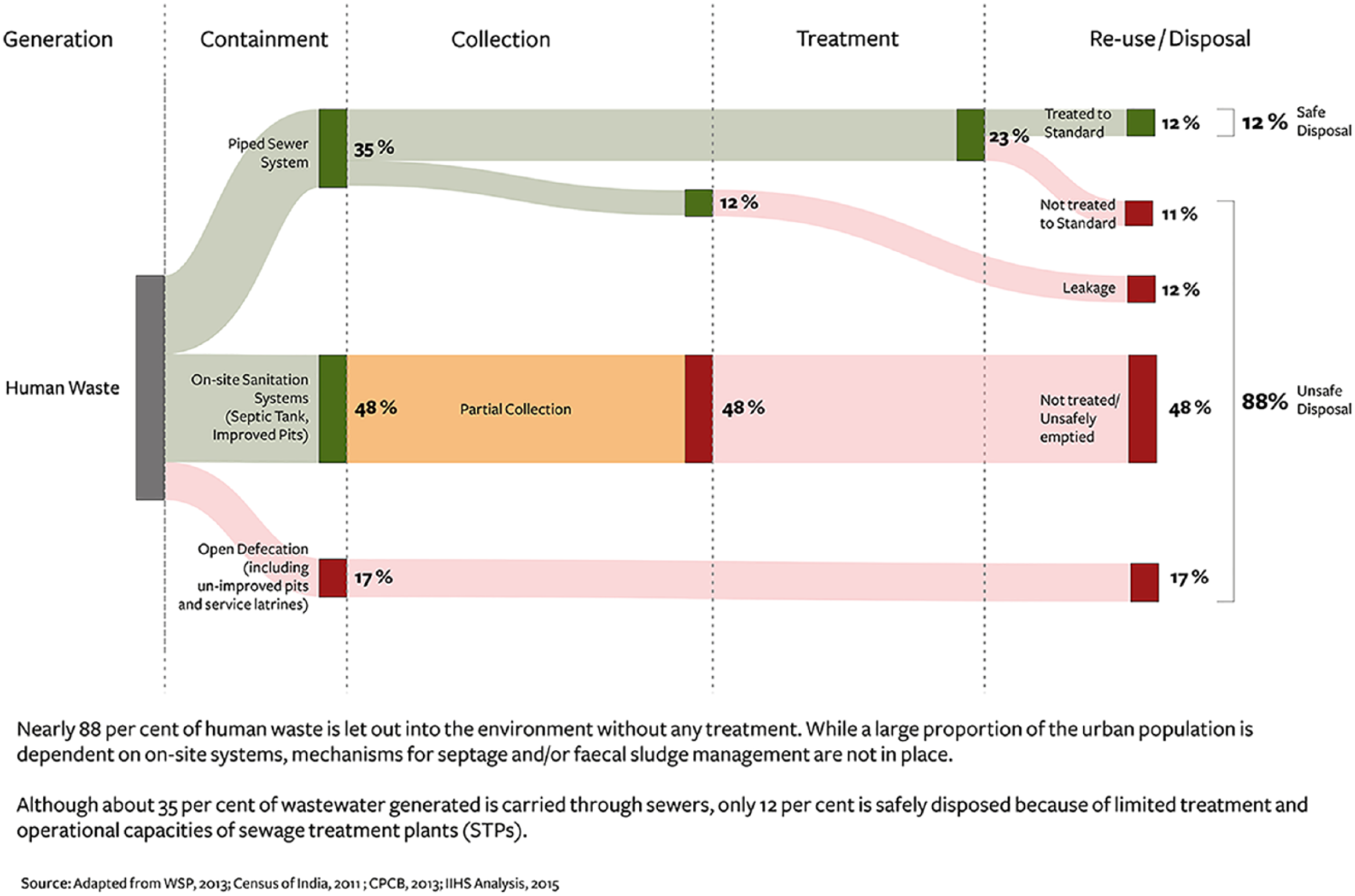
Full Cycle of Urban Sanitation in India | A Schematic
The presence or absence of a piped sewer system is thus Southern and sociotechnical in multiple ways: in urban form that was built without being preceded by planning or the laying of trunk infrastructure; in the perceived as well as real financial and technical limitations of public utilities; in the reality of an urban majority with an uncertain ability to pay either sufficiently or regularly or both; and in the presence of auto-constructed neighbourhoods able to pay for infrastructure but unable to get it due to their spatial illegality.
There are two challenges to practice here. The first is to reframe our question. If 88 per cent of disposal occurs through modes outside the network ideal, must we not begin from “here”, from the dominant modes of access, regardless of their distance from an ideal? Can outcomes not be reached in newer, different modes than the exemplars from elsewhere? I am not setting aside the notion of the network as incorrect. Indeed, there are good technical, financial and social reasons to want universal networks. I contend, rather, that we must begin from existing practices of service delivery on their own terms, recognize the contexts that they come from, understand why they have emerged, and then reassess whether the network is the most feasible (and not just the most theoretically desirable) mode through which to reach the outcomes we want.
For our vocabulary, therefore, the key word I offer is not build or engineer, but consolidate. One of the key challenges of multiple sociotechnical systems is how one leverages the fact that they are empirically dominant while also engaging with their inadequacies and vulnerabilities. Thinking about consolidation makes us focus our practice away from, say, such purely technical responses as building better soak pits, or changing the technology of the toilet, or designing an appropriately lined septic tank. I am arguing for a different emphasis in practice: focusing on the governance of multiple sociotechnical systems rather than simply improving their engineering. What are the governance arrangements – institutions, processes and regulatory instruments – that can bring together these diverse existing systems to deliver the desired outcomes of universal access that the network was intended for?
Thinking about appropriate institutional forms and regulatory frames that can consolidate across a diversity of sociotechnical, spatial and legal contexts is precisely the challenge of Southern urban practice. Doing so at the scale that urban service delivery requires implies that such consolidation must be both vertical and horizontal, both bringing together and scaling up. What institutions can hold these systems: community organizations? Public utilities? Private companies? Worker cooperatives? What forms of public regulation can enable these institutions to succeed given their particular strengths and weaknesses? What instruments – licences, contracts, incentives – are best suited to bind a diverse range of actors that wield such power and represent such different institutional forms?
Existing practice in India has been experimenting with such forms when it comes to solid waste management. Dry waste collection and sorting centres in Bengaluru (Bangalore), for example, are now regulated to be managed and run by workers identified as waste pickers in the informal sector.(39) Slowly, the scale of this practice has grown – 180 of the city’s 198 wards have sorting centres, and the capacity of these centres is rising. The establishment of the centres is a new form of consolidation. The land and physical structure are provided by the municipal corporation, Bruhat Bengaluru Mahanagara Palike (BBMP). The BBMP pays for the door-to-door collection of waste, but not for the running and management of the waste collection centre. Instead, the centre has the right to retain profits from the sale of all waste that is brought to it. This is an assemblage of regulatory forms that consolidates municipal function with private enterprise; retains an employment link among waste gatherers, sorters and traders; structures and yet relies on an existing market for waste; and, importantly, differentiates which actors – the corporation, the waste collectors, the entrepreneurs running the collection sectors – can take what risk.
The BBMP has had to come up with these new forms of regulation. As with the mohalla clinic, this was the only way the objective could be achieved at scale. Recognition of the delivery configuration prompted a different modality of practice and a different set of governance arrangements. This is precisely the opportunity that the government of India did not take in sanitation. The new central scheme, one of the flagship urban missions called the Swachh Bharat Abhiyan (Clean India Mission), chose to fund solely the construction of toilets, rather than investing in the much more difficult task of recognizing, working with and consolidating the sanitation arrangements shown above.
Consolidation raises one of the most trenchant difficulties facing Southern practices. If a certain distance from regulation, visibility and formality enables new solutions to emerge – dry waste collection in Bangalore grew from informal waste worker collectives, and new regulations on street vending from organized vendor networks – then how does consolidation not risk losing that flexibility while addressing scale and lowering vulnerability? How does one “formalize” what has succeeded but also remained vulnerable precisely due to its “informal” nature? This question is as true of the “slum” as of the street vendor, and of infrastructure and services as well as organic forms of governance like street committees and associations. The recurrence of this question is not incidental. It is exactly the question that Southern contexts raise repeatedly: How does one consolidate across this diversity of institutional forms, situated in structures of entrenched and deeply unequal power relations?(40)
V. Notes on a Theory of Southern Practice
The intent of this essay has been to offer the beginnings of a vocabulary of urban practice rooted in the traditions of Southern inquiry. In conclusion, I attempt to outline broader theoretical formulations of, and from, Southern urban practice. How should we build such theory? The three modes of practice on offer – squat, repair and consolidate – share certain characteristics. We begin there, with four observations.
One: Each mode of practice is rooted in the specific spatial, historical and socio-political context of a particular urbanism. It exists already as a mode of practice that has emerged within and because of this particular urbanism. Had auto-construction not been the most common mode of urbanization in the Indian city, for example, then neither squatting nor repair would have emerged as widespread modes of practice. This also implies that, over time, they may recede: as one generation of auto-construction consolidates, squatting and repair may give way to other praxes or change their own forms. Modes of practice, in other words, are rooted in space and time, and we must begin by looking, listening and paying attention to the current instantiations of practice and their relationship to place.
The terms I have chosen, however, also perform one additional function. They highlight certain modes of existing practice within Indian cities that are under-recognized and under-valued precisely because of their distance from formal sectors and domains of professional practice, and the formal registers of law and planning. I used the examples of repair (not part of formal architectural training) and squatting (not imagined as a best practice of a state government) in order to highlight that different modes of practice are associated not just with certain practitioners, but with registers of value, power and importance. Such highlighting – perhaps it is better to think of it as amplification – is an important part of the ethos of Southern inquiry that must seek to constantly make explicit and challenge registers of value and power.(41)
Two: Each of these modes can hold uncertainty. These are modes of practice that challenge the notion of “evidence-based policymaking”, whose implicit assumption is that specific actions will lead to specific impacts in a time-defined horizon, when those actions are chosen on the basis of evidence. The modes highlighted here do not reject the idea of evidence – indeed, they offer data, rigour and logics of their own. What they challenge are the certainties that evidence-based policymaking takes for granted: that systems will work as they should, that people will act predictably, that the rules of the game are fair, known or stable. Whether such uncertainty makes the practice “weak” or “fragile” often depends on the actor and the context. When one arm of the state squats, as it does in building the mohalla clinic, it can manage the uncertainty in very different ways than an auto-constructing squatter on public land. Yet, despite these differences in power, both actors are, in their own way, acting despite, within, and because of the sustained presence of uncertainty. Thinking about squatting practised by these very differently located actors also reminds us that squatting as a mode of practice then must be freed from being seen only as a necessity.(42) Doing so will open up its possibilities, not just within the state but within the “informal settlement”.
Three: These are modes of practice that measure themselves – and thus evaluate “success,” “outcome” and “impact” – often (though not always) on limited and non-linear temporalities. They are incremental by design, and expect to adapt frequently rather than rarely. This is not the practice that seeks the “long term”, unless that can be reached through a series of incremental “what nexts”. A focus on not “going backwards”, whether in time, space or status, is a key Southern practice. This does not mean that these modes of practice cannot seek structural change – the making of new laws and fundamental rights, for example – but the way they do so will reflect the incremental nature of shorter-term praxis. The recently won Rights to Information and Education in India, for example, were not acts of legislative fiat or enlightened leadership and constitutionalism. They were the result of long-term mobilizations where a series of incremental and spatially specific struggles culminated in structural and legal change.
Four: These are modes that emphasize the need to act, to move, because the contexts they emerge from demand, require and already exhibit an almost constant movement. Iterative and incremental, yet also scalar, these are modes that see “best practice” as pragmatic, possible and feasible, just as much as ideal, technical and appropriate. This urgency is familiar to anyone who has practised in a Southern context. Its roots lie in the fact that these practices must locate themselves in contexts of entrenched inequality, destitution and vulnerability that are held – to return again to our definition of Southernness – by the urban majority.(43) Acknowledging the imperative to “do something” is not just to imply action that seeks to fix or make better; it can equally suggest a constant moving to stay in place, to maintain status, to consolidate the ground beneath one’s feet for a little while longer. It also indicates that the ethos of such practice is more forgiving of imperfect, uncertain moves – they are often indistinguishable, in fact, from ones that appear otherwise.
Putting these four characteristics together is one way to begin to think about certain characteristics of urban practice as “Southern”: incremental, uncertain, temporally fluid, speculative, transversal and rooted. Choosing a different set of entry points, a different set of terms for our vocabulary, would offer further shared characteristics, or challenge these. Consolidate, for example, could refer to different modes of land aggregation that allow a bringing together of large holdings. Squatting could be applied to describe certain modes of rural and peri-urban land conversion, but could also well speak of prevalent modes of elite land-grabbing. Repair could be read as a refusal to accumulate and grow, for a variety of reasons, rather than a choice based on efficiency or constraint. What is important for us at this stage is precisely to do this work: to add terms, to experiment further, to pay attention in particular ways, and to generate vocabularies from different positionalities – normative and analytical priorities – as well as multiple geographies.
It is particularly important to remind ourselves of the choices we have made in our approach to Southern inquiry. I acknowledge, for example, that the geohistorical “South” that I have stood behind empirically, as a relational location, is as much a space of emergence and growth as it is of vulnerability. Empirically, it is undeniable that across Asia, Africa and Latin America, the most significant shifts in poverty have occurred in the last century alongside the most dynamic forms of growth. These have changed the geographies of power both within the “South” and globally – think of the economic and resource footprint of China in Africa, for example, or the rise of the BRICS as a new geopolitical formation. While the set of terms offered in this essay continues to grapple with Southern questions focusing on inequality and vulnerability, this reflects the normative preference of its author, not the conceptual bounds of the argument. It is my hope that, as this vocabulary expands, others will speak “from the South” equally to understand new configurations of power and, indeed, new forms of urbanization, globalization, capitalism and even economic imperialism.
My concluding note then is a call for more work that builds upon the theoretical work of Southern urban theory and it extends to grappling with forms and theories of Southern urban practice. I urge that this work hold on to both forms of Southernness that I have tried to describe: a project of speaking from moving and relational peripheries to challenge dominant forms of knowledge and practice, and a commitment to remaining rooted in the specific geographies of these peripheries at different historical conjunctures. Such work must continue to be careful to keep dislodging the link between a particular kind of practitioner and a particular kind of practice. In this essay, I have deliberately sought to maintain this “disconnect”, precisely to allow experimentation with unlikely practices from unlikely locations, where we can see, for example, the government of Delhi be a squatter in its own city. Our emphasis, in other words, must be on modes of practice and not kinds of practitioners. This reminds us that we must imagine different ways in which these modes of practice can be mobilized, by whom this can and will be done, and with what consequences for different desired urban outcomes.
The provocation to articulate Southern urban practice comes, in the words of Simone and Pieterse, from the need “to explore grounded and speculative alternatives that can animate and stitch together a plethora of diverse and molecular experiments”.(44) A vocabulary of Southern practice must make apparent forms of doing, moving and acting. It must do so continuously and dynamically, churning along with transforming urban landscapes. This will allow new formulations and frameworks to both emerge from it and sustain it. As Southern urban theory has pushed us to reimagine geographies of authoritative knowledge, we must equally listen to what the theory is telling us about our modes of practice, and hopefully create new vocabularies to be able to do so.
Footnotes
Acknowledgements
A version of this article was delivered as a keynote lecture at the African Centre for Cities’ International Urban Conference in Cape Town in January 2018. My participation was partly made possible by support from the IJURR Foundation and is gratefully acknowledged. I would also like to acknowledge the insightful and deeply helpful comments of Diana Mitlin, AbdouMaliq Simone, Prasad Shetty, Hussain Indorewala and Ricardo Cardoso.
1.
Harrison, P (2014), “Making planning theory real”, Planning Theory Vol 13, No 1, pages 65–81.
2.
See reference 1, page 68.
3.
Notable is one set of responses in the North that emerged after Bish Sanyal responded to a survey showing that planning practitioners found planning theory of little to no use in their practice. See Sanyal, B (2002), “Globalization, ethical compromise and planning theory”, Planning Theory Vol 1, No 2, pages 116–123.
4.
Simone, A and E Pieterse (2017), New Urban Worlds: Inhabiting Dissonant Times, John Wiley & Sons, page x.
5.
Graham, J (1990), “Theory and essentialism in Marxist geography”, Antipode Vol 21, No 1, pages 53–66.
6.
Bhan, G (2016), In the Public’s Interest: Evictions, Citizenship and Inequality in Millennial Delhi, Orient Blackswan/University of Georgia Press, Delhi/Athens; also Bhan, G, S Srinivas and V Watson (editors), (2018), Companion to Planning in the Global South, Routledge/Orient Blackswan, London/Delhi.
7.
Sheppard, E, H Leitner and A Maringanti (2013), “Provincializing global urbanism: a manifesto”, Urban Geography Vol 34, No 7, pages 893–900.
8.
In doing so, I am following a generation of scholarship on feminist epistemologies. Very useful is Kate Derickson’s review of this argument within urban theory, which is a telling reminder that producing knowledge and assigning it legitimacy is a deeply political act that is a lens through which to see current configurations of power. Derickson, K (2015), “Urban geography 1: locating urban theory in the ‘urban age’”, Progress in Human Geography Vol 39, No 5, pages 647–657.
9.
Mitchell, T (2002), Rule of Experts: Egypt, Techno-Politics, Modernity, University of California Press.
10.
The recent debate between Scott & Storper and Ananya Roy encapsulates much of this discussion. See Roy, A (2016), “Who’s afraid of postcolonial theory?”, International Journal of Urban and Regional Research Vol 40, No 1, pages 200–209; and Scott, A J and M Storper (2015), “The nature of cities: the scope and limits of urban theory”, International Journal of Urban and Regional Research Vol 39, No 1, pages 1–15.
11.
See, for example: Teresa Caldeira’s idea of peripheral urbanization and Ananya Roy’s reframing of informality as modes of urbanization in their own right and not as end-states of urban development; AbdouMaliq Simone’s framing of “people as infrastructure” as both network and system along with Sylvy Jaglin’s challenge to the network itself; Vanessa Watson and Oren Yiftachel’s assertions of “deep difference” and “urban ethnocracies” that challenge self-evident notions of a shared public or the ubiquity of liberal democracy as a mode of organizing urban life; James Ferguson’s investigation of “declarations of dependence” rather than freedom, empowerment or emancipation; and Vinay Gidwani’s insistence on reading capital through waste rather than rent. Caldeira, T P (2017), “Peripheral urbanization: autoconstruction, transversal logics, and politics in cities of the global south”, Environment and Planning D: Society and Space Vol 35, No 1, pages 3–20; also Roy, A (2005), “Urban informality: towards an epistemology of planning”, Journal of the American Planning Association Vol 71, No 2, pages 147–158; Simone, A (2004), “People as infrastructure: intersecting fragments in Johannesburg”, Public Culture Vol 16, No 3, pages 407–429; Jaglin, S (2014), “Regulating service delivery in Southern cities: rethinking urban heterogeneity”, in S Parnell and S Oldfield (editors), Routledge Handbook of Cities in the Global South, Routledge, London; Watson, V (2006), “Deep difference: diversity, planning and ethics”, Planning Theory Vol 5, No 1, pages 31–50; Yiftachel, Oren (2006), “‘Re-engaging planning theory?: Towards “South-Eastern” perspectives”, Planning Theory Vol 5, No 3, pages 211–212; Ferguson, J (2013), “Declarations of dependence: labour, personhood, and welfare in Southern Africa”, Journal of the Royal Anthropological Institute Vol 19, No 2, pages 223–242; and Gidwani, V and R N Reddy (2011), “The afterlives of ‘waste’: notes from India for a minor history of capitalist surplus”, Antipode Vol 43, No 5, pages 1625–1658.
12.
Comaroff, J and J L Comaroff (2015), Theory from the South: Or, How Euro-America Is Evolving toward Africa, Routledge.
13.
Sheppard, E, H Leitner and A Maringanti (2013), “Provincializing global urbanism: a manifesto”, Urban Geography Vol 34, No 7, pages 893–900.
16.
Parnell, S and E Pieterse (2010), “The ‘right to the city’: institutional imperatives of a developmental state”, International Journal of Urban and Regional Research Vol 34, No 1, pages 146–162, page 147.
17.
See reference 16, page 148.
18.
See reference 16, page 150.
19.
See reference 4.
20.
I take these as a useful frame from Simone and Pieterse; see reference 4.
21.
Vasudevan, A (2015), “The makeshift city: towards a global geography of squatting”, Progress in Human Geography Vol 39, No 3, pages 338–359, page 352.
22.
See reference 21, page 355.
23.
See particularly the extensive body of work in this journal from SDI (formerly Slum/Shack Dwellers International) that has crafted arguments for housing policy and practice based precisely on this foundation of in-situ upgrading. For example: Patel, S (2013), “Upgrade, rehouse or resettle? An assessment of the Indian government’s Basic Services for the Urban Poor (BSUP) programme”, Environment and Urbanization Vol 25, No 1, pages 177–188. For recent work on housing policy in India specifically, see Burra, S, D Mitlin and G Menon with I Agarwal, P Banarse, S Gimonkar, M Lobo, S Patel, V Rao and M Waghmare (2018), “Understanding the contribution of the BSUP (JNNURM) to inclusive cities in India”, Effective States and Inclusive Development (ESID) Working Paper No 97, University of Manchester, Manchester, available at http://www.effective-states.org/working-paper-97/. See also Bhan, G (2018), “Housing, common sense and urban policy in India”, in H Bhurte and A Bhide (editors), Urban Parallax Policy and the City in Contemporary India, Yoda Press, New Delhi.
24.
Scott, J C (2008), Weapons of the Weak: Everyday Forms of Peasant Resistance, Yale University Press.
26.
Press Trust of India (2016a), “AAP government will set up 1,000 mohalla clinics by March 2017”, Indian Express, 2 December, available at  .
.
27.
Press Trust of India (2016b), “Makeshift mohalla clinics In North Delhi face ‘demolition’”, NDTV, 8 March, available at .
29.
Benjamin, S (2008), “Occupancy urbanism: radicalizing politics and economy beyond policy and programs”, International Journal of Urban and Regional Research Vol 32, No 3, pages 719–729.
30.
In the North and the South, there is a long tradition of speaking of incrementality in house-making though it rarely has impacted, as the rest of this essay argues, the formal practice or education of house-making itself. See Turner, J F and R Fichter (editors) (1972), Freedom to Build: Dweller Control of the Housing Process, Macmillan.
31.
See reference 24.
32.
33.
Press Trust of India (2017), “Govt sets ambitious target of 1.2 million houses under PMAY scheme in FY18”, Business Standard, 22 May, available at .
34.
For that debate, see reference 24; also Bhan, G (2017), “From the basti to the ‘house’: socio-spatial readings of housing policy in India”, Current Sociology Vol 65, No 4, pages 587–602.
35.
Ministry of Housing and Urban Poverty Alleviation (2012), Report of the Technical Group on Urban Housing Shortage (TG-12), Government of India, New Delhi, available at .
38.
de Sardan, J-P O, A Abdoulkader, A Diarra, Y Issa, H Moussa, A Oumarou and M T Alou (2010), Local Governance and Public Goods in Niger, Africa Power and Politics Programme (APPP) Working Paper No 10, Overseas Development Institute, London.
39.
For details, see Chandran, P, N Shekar, M Abubaker and A Yadav (2014), “Waste management & resource utilisation”, Waste Management & Resource Utilisation.
40.
41.
See reference 8.
42.
I owe this argument to AbdouMaliq Simone’s insightful reading of drafts of this piece.
43.
See reference 6, Bhan (2016) and .
44.
See reference 4, page 56.